Sugar roll vs alcohol wash accuracy: which one is right?
TL;DR
- Alcohol wash counts varroa mites more accurately than sugar roll.
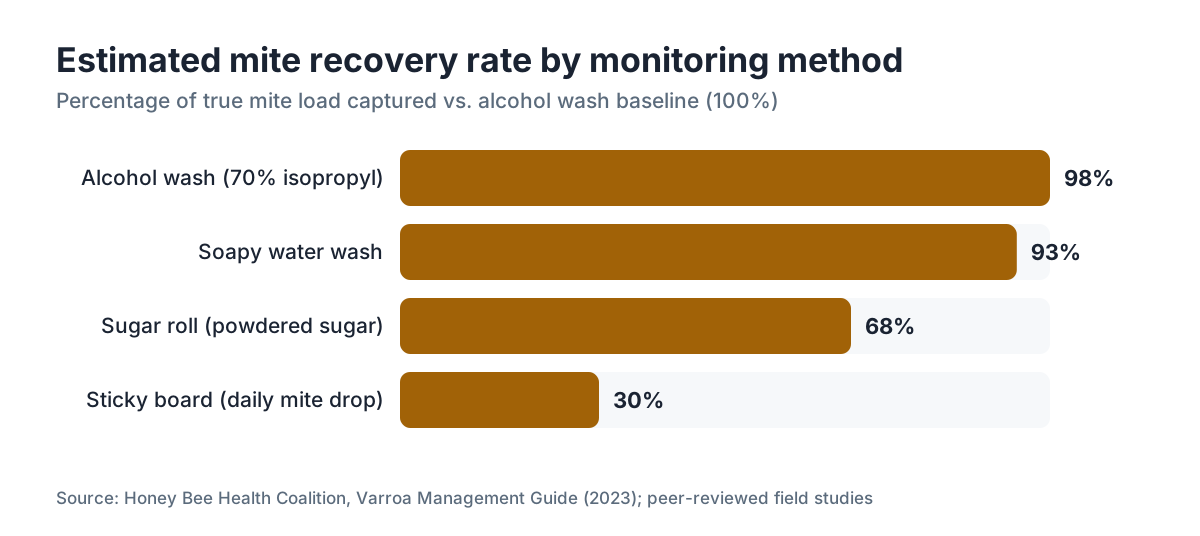
- Side-by-side studies show sugar roll finds only about 60 to 75 percent of the mites an alcohol wash catches on the same sample, so it undercounts by 25 to 40 percent.
- Use alcohol wash for any count that drives a treatment decision.
- Sugar roll has one real advantage: the bees live, which matters for a nucleus, a queen frame, or a teaching demo.
What is the core difference between sugar roll and alcohol wash?
Both methods sample about 300 adult bees (roughly half a cup) off a brood frame and knock the phoretic mites loose. The difference is what happens next, and whether the bees walk away.
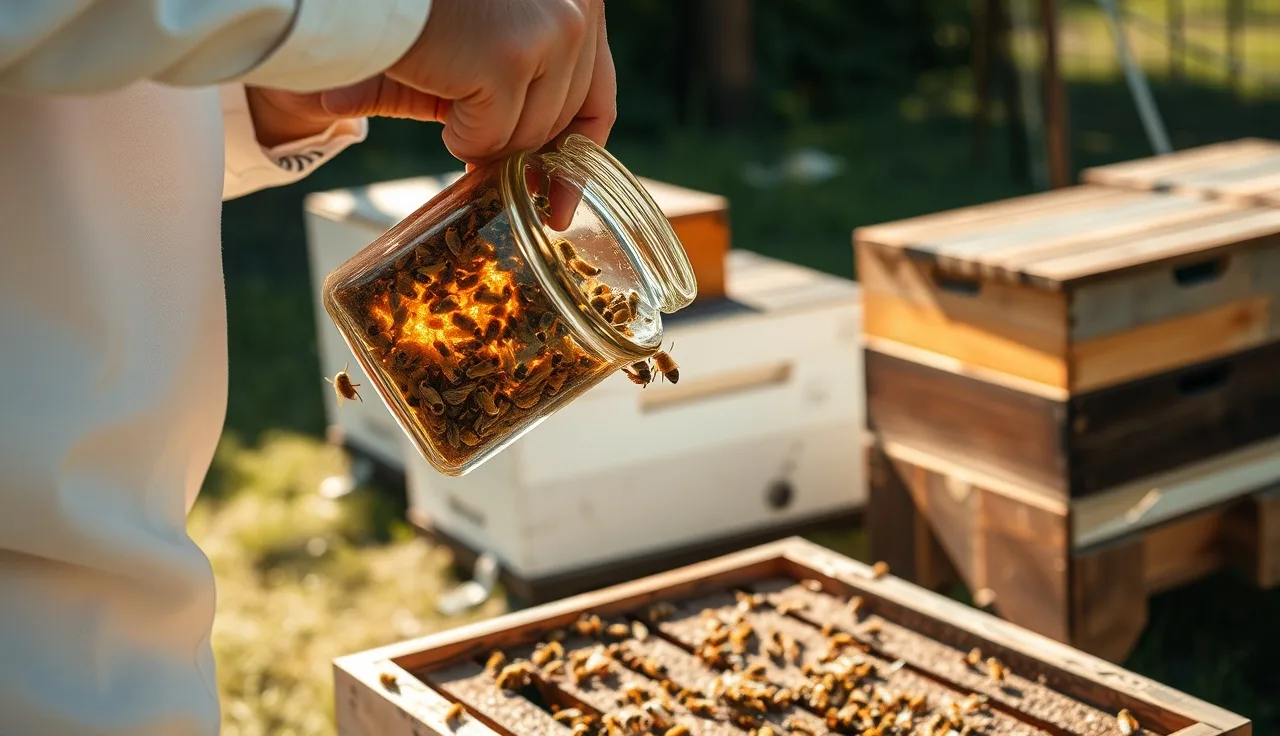
In a sugar roll, you coat the bees in powdered sugar, shake them in a jar, and count the mites that drop through a mesh lid onto a white surface. The bees survive and go back in the hive. In an alcohol wash, you drown the same size sample in isopropyl alcohol (or soapy water), agitate until the mites let go, then strain and count. The bees die.
That bee mortality is the tradeoff people agonize over. The bigger difference is accuracy, and the data on that is not close. [1]
How much more accurate is alcohol wash than sugar roll?
Alcohol wash wins every head-to-head test. Sugar roll captures roughly 60 to 75 percent of the mites an alcohol wash finds on the same sample, which means it undercounts your infestation by 25 to 40 percent in the worst cases. [1][2]
A 2014 study led by Keith Delaplane in the Journal of Economic Entomology ran both methods on the same colonies and found sugar roll consistently came up short. The Honey Bee Health Coalition's Varroa Management Guide, the reference most North American beekeepers reach for, calls alcohol wash the method that "provides the most accurate results" and recommends it for threshold decisions. [1][2]
Here is why sugar roll misses mites. Powdered sugar clumps around the mites and cakes on the mesh screen, and some mites just hold on through the shaking. Alcohol breaks the bond between mite and bee chemically and mechanically at once. Soapy water works the same way and performs about as well. [3]
For a hobbyist with four hives deciding on oxalic acid or Apivar, a 25 to 30 percent undercount is not a rounding error. Say your threshold is 3 mites per 100 bees and your sugar roll reads 2.2. You skip a treatment that an alcohol wash would have told you to run.
| Method | Typical recovery rate vs. true count | Bees survive? | Equipment cost |
|---|---|---|---|
| Alcohol wash | ~95-100% | No | $5-15 (rubbing alcohol + jar) |
| Sugar roll | ~60-75% | Yes | $3-10 (powdered sugar + jar) |
| Soapy water wash | ~90-95% | No | < $5 |
Those recovery ranges come from several university and USDA comparisons. No single study pins an exact number, and operator variance moves it around too. [1][2][3]
Does operator technique affect accuracy more than method choice?
It can, and that is worth being honest about. A sloppy alcohol wash can undercount as badly as a sugar roll. The variables that matter most are sample size, agitation time, and how thoroughly you rinse mites off the mesh.
For alcohol wash: use 70 percent isopropyl (rubbing alcohol), fill the jar about a third full, close the lid, and shake hard for at least 30 seconds. Pour through a fine mesh strainer (200 to 300 micron, or a standard paint strainer) into a white tray, then rinse the jar and strain again. Mites are small, flat, and reddish-brown. Count everything you see.
For sugar roll: two tablespoons of powdered sugar per 300-bee sample is standard. Roll the jar for 60 seconds, wait two minutes, then roll again. Shake the sugar out through the mesh lid. Rinsing the sugar off with water into a white tray makes counting easier, and it genuinely helps.
Sample size matters enormously for both. Half a cup (about 300 bees by volume) is the standard. Go smaller and your variability balloons. Go larger and it gets awkward to run cleanly. The Honey Bee Health Coalition says to sample from a brood frame, never the entrance, because phoretic loads run highest there and best predict what is hiding in the capped cells. [2]
A careful sugar roll by an experienced hand will beat a rushed alcohol wash. But learn to do both cleanly and alcohol wash gives you the higher, truer number every time.
When does sugar roll still make sense?
Sometimes killing 300 bees is a real problem, and that is when sugar roll earns its keep.
Sample a nucleus colony with three or four frames of bees and 300 dead workers hurt a lot more than they would in a 40,000-bee production hive. Same logic if you want to sample the frame your queen is on, or monitor a package that has not built up yet.
Sugar roll also works as a teaching tool. It is easier to run at a bee club or in a class because you can show new folks the mites without the smell and mess of alcohol.
For a sideliner running 50 to 150 hives, the argument tips back to alcohol wash. At that scale, better accuracy means better treatment timing, and treatment timing is the single biggest lever you have on winter survival. A few thousand bees lost across 50 samples costs you nothing that matters.
One more option: soapy water wash (a few drops of dish soap in water) kills the bees but lands close to alcohol wash on accuracy, costs less, and does not catch fire. The Honey Bee Health Coalition lists it as an acceptable alternative. [2] If the fire risk or cost of isopropyl bugs you, soapy water is a fine substitute.
What is the treatment threshold and does the method affect whether you cross it?
The common threshold is 3 mites per 100 bees (3 percent) during the active season, dropping to 2 percent before the winter cluster forms. Those figures come from the Honey Bee Health Coalition's Varroa Management Guide and mark the point where treatment prevents colony decline. [2]
Your sampling method decides whether you appear to cross that line. If your true load is 3.5 percent and your sugar roll reads 2.4 percent, you do not treat. The colony rolls into fall with a mite population already past easy control. By the time you spot deformed wings or a population crash, it is too late.
Here is the practical case for alcohol wash in one sentence. A false negative (missing a threshold you should have crossed) costs far more than a false positive (treating when you maybe did not need to). Beekeepers who lose colonies almost always err by failing to treat, not by treating too much. Oxalic acid and Apivar are EPA-registered and labeled for a reason; used correctly, they do not seriously harm colonies. [4][5]
The math is plain. A sugar roll reading of 2.2 mites per 100 bees has a real chance of being 3.0 or higher on an alcohol wash. Trust the more sensitive method when a treatment hangs on the number.
How do you correctly perform an alcohol wash step by step?
Here is exactly what I do, in order.
Grab a wide-mouth quart Mason jar with a two-part lid. Cut the center out of the flat lid insert and replace it with 200 to 300 micron nylon mesh (a paint strainer bag works). That is your counting lid.
Go to a frame with open and capped brood, not a honey frame. The bees clustered on brood carry the most phoretic mites. Shake or brush about 300 bees (half a cup by volume) into a separate container, and keep the queen out.
Pour the bees into the jar. Add enough 70 percent isopropyl to cover them, roughly one to two cups. Screw on the mesh lid and shake hard for 30 to 60 seconds.
Invert the jar over a white enamel tray or any light-colored bowl and let the liquid and mites drain through the mesh. The bees stay in the jar. Let the alcohol in the tray evaporate a little so the mites stand out, then count the dark reddish specks.
Rinse the jar once more with a splash of fresh alcohol and pour that into the tray too. You will usually catch one or two extra mites.
Divide mites by bees (about 300 if you measured half a cup) and multiply by 100 for your percentage. Write it down with the date and hive number. You want a trend, not a snapshot. [2][6]
How do you correctly perform a sugar roll step by step?
Same jar, same mesh lid, same brood-frame sampling. Only the material and the return step change.
Shake 300 bees into the jar. Add two tablespoons of powdered sugar, close the mesh lid, and roll the jar gently for 60 seconds so sugar coats every bee. Let it sit in the shade for one to two minutes. Then shake and roll hard over a white tray for another 60 seconds.
Invert the jar and shake the sugar and mites through the mesh onto the tray. Add a little water to the tray at this point to dissolve the sugar and make the reddish-brown mites pop against the white. That works well.
Open the jar and return the sugar-dusted bees to the entrance or the top bars. Most clean up and recover.
Count the mites in the tray. Same math: (mites / 300) x 100 = infestation rate as a percentage.
Read 1.8 percent on a sugar roll and I would still confirm with an alcohol wash before deciding to skip treatment, especially in August or September when mite populations climb fastest. The gap between 1.8 and 3 percent is close enough to matter, and the undercount risk is real. [1][2]
What do university extension services recommend?
Extension apiculture programs at several land-grant universities have weighed in, and the consensus leans toward alcohol wash for accuracy.
NC State's apiculture extension recommends alcohol wash as the most reliable way to tell whether you have crossed a treatment threshold, and notes sugar roll is less consistent between operators. [6] The University of Minnesota Bee Lab likewise calls alcohol wash the preferred method for phoretic mite counts. [7]
The Honey Bee Health Coalition Varroa Management Guide (the 2023 edition is current) describes both methods but recommends alcohol or soapy water wash for "the most accurate results." [2] That guide is built by more than 30 organizations, including USDA-ARS, university researchers, and major beekeeping groups, so it is about as close to a consensus document as this industry gets.
None of these sources call sugar roll useless. They say if you want a number you can bet a treatment on, wash.
For the full picture on what you are fighting, the varroa mite article covers the biology of Varroa destructor. That matters here, because the reproductive cycle explains why phoretic counts track colony risk so tightly.
Does sample location in the hive change accuracy for either method?
Yes, and it changes it a lot. Where you pull your 300 bees decides what load you detect, no matter which counting method you run.
Bees on a capped-brood frame carry higher phoretic mite loads, because mites cycle between reproducing inside capped cells and riding on adult bees. Sample bees from the entrance or a honey super and you get a systematically lower count, since those bees are less likely to be carrying mites fresh out of a cell.
The Honey Bee Health Coalition is blunt about it: sample from a frame with open and capped brood in the brood nest. [2] Penn State Extension gives the same guidance, calling brood-frame sampling the way to get a representative count. [8] If you cannot find your queen and worry about killing her, look before you shake, then let her walk free from a separate container before pouring the rest into your jar.
Wrong location is an error that stacks on top of your method. A beekeeper who always samples the entrance with a sugar roll undercounts twice: bad location plus low-sensitivity method. That combo can hide half your mites or more.
How often should you monitor, and does method choice affect monitoring frequency?
The standard advice from the Honey Bee Health Coalition and most extensions is monthly monitoring through the active season (roughly April through September in temperate North America), plus at least one check in late summer before your winter bees are raised. [2][9]
Monitor only twice a year and each reading carries more weight, which argues for alcohol wash. Monitor every four weeks and you build a trend line, so one slightly low sugar-roll reading is less dangerous because you recheck soon.
Still, I would not use frequent monitoring as an excuse to accept the weaker method. The cost gap between the two is maybe $10 over a full season in materials. The time gap per hive is maybe 90 seconds. Use the method that gives you real information.
Tools that track counts over time earn their place. VarroaVault's free monitoring protocol tools are built around alcohol wash counts, because the thresholds in those protocols are calibrated to alcohol wash accuracy. Feed sugar roll numbers into a system designed for wash counts and you can read below threshold when you are actually above it.
For jars, mesh, and other supplies, beekeeping supply companies give you a place to compare, though either setup costs almost nothing at a hardware store.
Are there any situations where alcohol wash gives a false high count?
Rarely, and only in narrow cases. Alcohol below 70 percent may not fully release the mites, which pushes you toward undercounting, not over. Mesh that is too coarse (above 1000 microns) lets debris through, and a new beekeeper might misread a pollen grain or fleck of propolis as a mite. Varroa are oval, about 1.1mm wide by 1.6mm long, flat, and reddish-brown. With a little practice the difference is obvious.
There is no documented mechanism by which alcohol wash systematically overcounts. Its errors run almost entirely toward undercount, from weak agitation or a small sample. [1][3]
Sugar roll errors are structurally biased toward undercount, because the sugar traps mites and the shaking is gentler than chemical immersion. There is no realistic scenario where sugar roll returns a higher count than alcohol wash on the same sample.
What about the ether roll and CO2 methods, and how do they compare?
The ether roll (starter fluid sprayed on bees in a jar) was an early method and is now mostly obsolete. It is toxic to handle, flammable, and no more accurate than alcohol wash. Extension services dropped it years ago.
CO2 immobilization, used in research, sedates bees so you can count mites directly on their bodies. It beats both shake methods in a lab because you see every mite on every bee. It also needs equipment and training, so it is not a field tool.
Sticky boards (coreboard inserts) had their moment a decade ago and show mite drop, but they are not a reliable stand-in for a wash count. Mites falling per day track poorly with real infestation rate, because natural drop swings with colony size, season, and bee behavior. Virginia Cooperative Extension and the Honey Bee Health Coalition both steer beekeepers away from sticky boards for treatment decisions. [2][10]
For most beekeepers the real choice is alcohol wash or sugar roll. Everything else is research-grade or retired.
What should you actually do, given all of this?
Use alcohol wash for any count that drives a treatment decision. Full stop.
Got a genuine reason to keep the bees alive (small nuc, queen frame, teaching demo)? Run a sugar roll and mentally add 25 to 30 percent before comparing to the threshold. A sugar roll reading of 2.3 percent should be treated like it might be 3 percent or higher.
Buy a pack of 200-micron paint strainer bags (about ten for a few dollars), cut a circle to fit your Mason jar lid, and you have a permanent alcohol wash rig for under $10. The rubbing alcohol runs maybe $3 at a pharmacy. This is a cheap fix.
Check monthly April through August, and take your most careful reading in late July or August, when mite populations are building fast and your winter bees are being raised. A colony that crosses 3 percent in August and goes untreated faces a brutal road to spring. [2][9]
Keep records. Date, hive ID, method, count, and what you did about it. One number tells you nothing. A trend tells you everything.
None of this is hard. The hard part is doing it every month, even when the hives look fine from the outside. They usually look fine right up until they don't.
Frequently asked questions
Can I use water instead of alcohol for a varroa wash?
Yes. A few drops of dish soap in water (soapy water wash) breaks the surface tension that helps mites cling and lands close to alcohol wash on accuracy. The Honey Bee Health Coalition lists it as an acceptable alternative. It costs less and does not catch fire. Shake the sample hard for 60 seconds, let it sit a minute, then shake again before straining and counting.
How many bees should I use for a varroa sample?
300 adult bees is the standard, roughly half a cup (about 120ml) by volume. Smaller samples widen your statistical variability. Capture only 150 bees and your count carries much wider confidence intervals. Always sample from a brood frame with capped brood, not the hive entrance or honey supers, where mite loads run artificially low and misrepresent the colony's true infestation.
Will a sugar roll hurt or kill my bees?
No, not if you do it right. Bees dusted in powdered sugar go back to the entrance, clean themselves off, and recover. A few may die from stress or rough handling, but the method is not meant to kill them. If you accidentally sample the queen and she survives the roll, she can go back too, though most beekeepers deliberately keep the queen out of the sample.
What mite level means I need to treat?
The most widely used threshold is 3 mites per 100 bees (3 percent) during the active season, dropping to 2 percent in late summer when winter bees are being raised. Those thresholds come from the Honey Bee Health Coalition's Varroa Management Guide and are calibrated for alcohol wash counts. Using sugar roll, your true infestation rate is likely 25 to 30 percent higher than your reading.
How do I count mites after an alcohol wash?
Pour the washed liquid through a fine mesh strainer into a white tray or bowl. Varroa are oval, about 1.1mm wide, flat, and reddish-brown, and they do not float. Let the alcohol evaporate a little if visibility is poor, or add water to dilute. Count every reddish speck. Rinse the jar with a second small pour of alcohol and strain again to catch stragglers.
Can sugar roll give a false negative that leads to colony death?
Yes, and it is the main practical risk. If your colony's true rate is 3.5 percent and the sugar roll reads 2.4 percent, you skip a treatment you needed. Mite populations grow exponentially in late summer, so a missed August treatment can leave a colony collapsing by October. This is not hypothetical. It is the most common way careful beekeepers still lose hives.
Is there a varroa monitoring method that does not kill bees and is as accurate as alcohol wash?
Not for practical field use. CO2 immobilization in research settings approaches 100 percent accuracy without killing bees, but it needs equipment that does not fit routine apiary work. Soapy water wash matches alcohol wash on accuracy but kills the bees. Sugar roll is the only widely used live-bee field method, and it consistently undercounts. For now, accuracy and bee survival stay in tension.
How do I avoid accidentally killing my queen during an alcohol wash?
Look hard at the frame before you shake. Queens are larger, longer, and move differently from workers. Spot her and set that frame aside, then sample an adjacent brood frame. If you cannot find her and must sample, shake the bees into a container, wait 30 seconds, and let any queen walk to the side before scooping your 300 workers. A marked queen is far easier to spot.
Does the alcohol concentration matter for wash accuracy?
Yes. Use 70 percent isopropyl, standard rubbing alcohol. Higher concentrations (91 percent, 99 percent) also work. Very low concentrations (under 50 percent) may not fully break the mite-bee bond and could undercount. Water-based washes work through soap chemistry rather than alcohol, so concentration matters differently there. Skip ethanol (drinking alcohol) in high volumes; it works chemically but wastes money.
How do sugar roll and alcohol wash results compare if I test the same colony twice?
Run both on the same colony the same day, with fresh 300-bee samples from the same frame, and alcohol wash almost always returns the higher number. Studies put the difference around 25 to 40 percent, though it swings with operator technique and infestation level. The gap tends to widen at higher infestation rates, which is exactly when accuracy matters most for a treatment call.
When should I monitor for varroa mites specifically?
Monthly during the active season (April through September in temperate North America) is the standard. The most critical sample is late July or August, before winter bees are raised. A second important check is late September, to confirm your summer treatment worked. The Honey Bee Health Coalition advises at least three samples per season at minimum, with monthly being better.
Does hive size or breed affect which monitoring method to use?
No. Method choice rides on accuracy needs and whether bee survival matters for that sample. Hive size affects how much losing 300 bees costs you: irrelevant in a 40,000-bee colony, meaningful in a five-frame nuc. Some breeders claim hygienic or mite-resistant stock runs lower background mite loads, which might loosen thresholds a bit, but the counting method recommendation does not change.
Sources
- Delaplane et al., Journal of Economic Entomology, 2014, comparison of sampling methods for Varroa destructor: Sugar roll consistently undercounts mites compared to alcohol wash in side-by-side colony trials
- Honey Bee Health Coalition, Varroa Management Guide (2023 edition): Alcohol wash and soapy water wash provide more accurate mite counts than sugar roll; treatment threshold is 3 mites per 100 bees during active season and 2% before winter cluster
- USDA-ARS Bee Research Laboratory, varroa monitoring methods overview: Soapy water wash accuracy is comparable to alcohol wash; both outperform sugar roll in controlled comparisons
- U.S. EPA, oxalic acid pesticide registration and label: Oxalic acid is EPA-registered for use in honey bee colonies for Varroa destructor control
- U.S. EPA, Apivar (amitraz) pesticide registration for honey bee colonies: Amitraz (Apivar) is EPA-registered for Varroa management in honey bee hives
- NC State University Extension Apiculture, varroa monitoring methods: NC State recommends alcohol wash as the most reliable method for phoretic mite counts used in treatment decisions
- University of Minnesota Bee Lab, varroa sampling guidance: University of Minnesota describes alcohol wash as the preferred sampling method for phoretic varroa counts
- Pennsylvania State University Extension, varroa mite management: Sample from brood frames rather than hive entrance for representative phoretic mite counts
- Honey Bee Health Coalition, Varroa Management Guide, monitoring frequency guidance: Monthly monitoring during active season recommended; most critical sample is late July or August before winter bees are raised
- Virginia Cooperative Extension, Varroa mite sampling methods for beekeepers: Sticky boards do not provide reliable data for treatment threshold decisions; wash methods are preferred
Last updated 2026-07-09