Powdered sugar roll vs alcohol wash: which actually counts mites?
TL;DR
- Alcohol wash is significantly more accurate than the powdered sugar roll for counting varroa mites.
- Multiple university studies found the sugar roll undercounts mites by 30 to 60 percent compared to alcohol wash.
- For any real treatment decision, alcohol wash is the standard recommended by the Honey Bee Health Coalition and most extension apiarists.
- Sugar rolls are not reliable enough to stake a colony's life on.
Why does your mite-counting method matter so much?
A varroa count is only as good as the test behind it. If your method undercounts mites by half, you might read a number that looks safe and skip treatment, while the real mite load in that hive is already past the point where collapse becomes likely. That's the problem with the powdered sugar roll. It feels scientific, it's cheap, it needs no alcohol, and it still gets the answer wrong at rates that should scare any serious beekeeper.
The Honey Bee Health Coalition sets an action threshold of 2 percent infestation (2 mites per 100 bees) for most of the active season, and 1 percent heading into winter [1]. Those are tight numbers. A method that undercounts by even 30 percent can push you past that threshold without you knowing it.
For context on the whole mite biology picture, the varroa mite overview on this site covers the reproductive cycle, phoretic versus reproductive phases, and why phoretic load on adult bees is the number you're actually measuring with either wash method.
What is a powdered sugar roll and how does it work?
The powdered sugar roll (sometimes called a sugar shake) means collecting roughly 300 adult bees, ideally nurse bees from brood frames, into a jar with about two tablespoons of powdered sugar. You roll the jar for about a minute so the sugar coats the bees, then shake the sugar out through a mesh lid onto a white surface or into water. Count the mites that fall off, divide by the number of bees (estimated or counted), and you get a percentage.
The theory is simple. Varroa grip bee bodies using specialized adhesive pads, and the sugar disrupts that grip. Mites fall off. In practice, the sugar removes some mites, but not all of them, and the variation between samples is wide enough to make the results unreliable.
The method got popular partly because it doesn't kill bees. That's its one genuine advantage. You can return the bees to the hive after the test. For some beekeepers that emotional factor matters. But if the test gives you wrong information, the whole colony pays for it.
What is an alcohol wash and how does it differ?
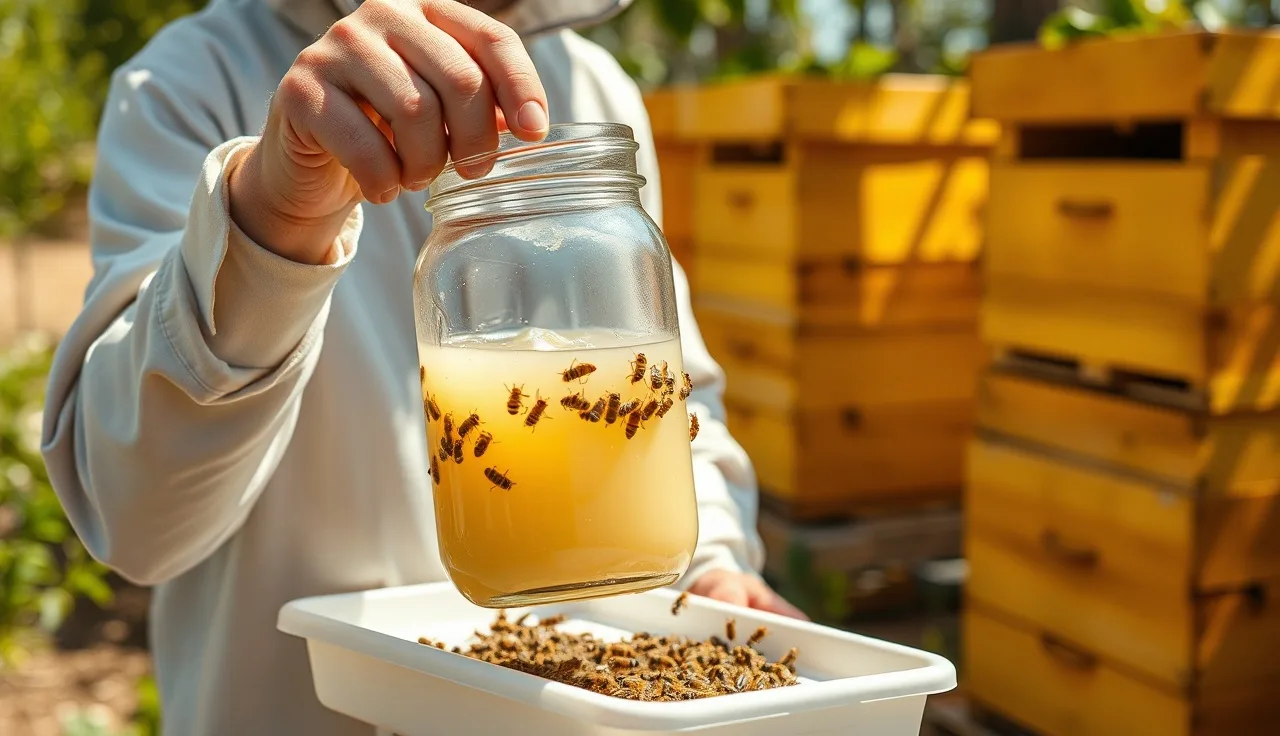
An alcohol wash uses the same sampling process: about 300 adult bees (roughly half a cup) collected into a jar. Instead of sugar, you add isopropyl alcohol (70 percent works fine, and so does windshield washer fluid, which is cheaper) or soapy water, swirl the jar for 30 to 60 seconds, then pour the liquid through a mesh strainer into a white tray. Every mite that was on those bees ends up in the tray. You count them, divide by bee count, get a percentage.
The difference is completeness. Alcohol kills and dislodges every phoretic mite on the sample bees. No adhesive pad holds mites in place, no sugar clump lets a mite hide. The wash is destructive, meaning those bees die. That's the tradeoff.
Soapy water (a few drops of dish soap in water) is an alternative to alcohol that's somewhat gentler to handle. Studies suggest it performs close to alcohol for mite knockdown, though the data are not as extensive [2]. It's a reasonable substitute if you're working somewhere you'd rather not handle alcohol.
For sourcing jars, mesh lids, and the other gear for either method, a look at beekeeping supply companies can help you find what you need without overpaying.
How accurate is the powdered sugar roll compared to alcohol wash?
This is where the data get uncomfortable for sugar roll advocates.
A study from North Carolina State University tested both methods side by side on the same colonies and found the sugar roll detected significantly fewer mites than alcohol wash across all trials [3]. The researchers concluded that sugar rolls are not a reliable substitute for alcohol wash when the goal is accurate infestation assessment.
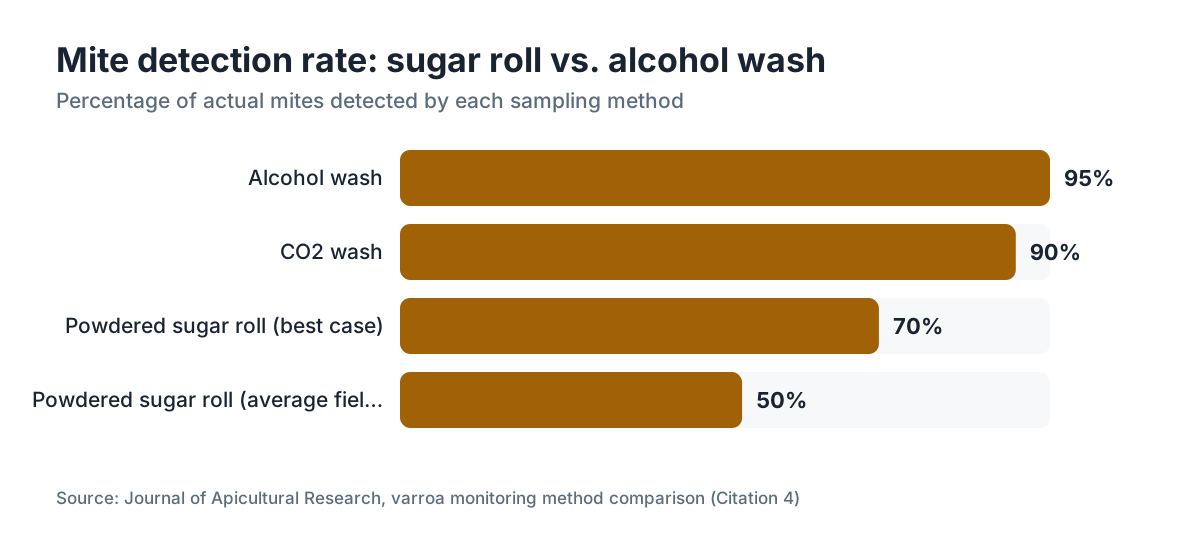
A separate analysis published in the Journal of Apicultural Research compared sugar roll, alcohol wash, and CO2-based methods, finding that powdered sugar rolls underestimated true infestation rates by anywhere from 30 to 60 percent depending on hive conditions and operator technique [4]. That range matters. Your specific results depend on how fresh the powdered sugar is (moisture kills its effectiveness), how vigorously you roll the jar, ambient temperature, and the experience of the person doing the test.
The Honey Bee Health Coalition's Varroa Management Guide states directly: "Research has shown that the alcohol wash method is more accurate than the powdered sugar roll" [1]. That's a direct quote from the guide, and it's about as close to a consensus statement as you get in applied apiculture.
Below is a comparison of both methods across the dimensions beekeepers actually care about.
| Factor | Powdered sugar roll | Alcohol wash |
|---|---|---|
| Mite detection accuracy | Low to moderate (undercounts 30-60%) | High (near complete removal) |
| Kills sample bees? | No | Yes (approx. 300 bees) |
| Cost of supplies | Very low (~$1) | Low (~$2-5 per session) |
| Time to complete | 5-10 minutes | 5-10 minutes |
| Operator skill needed | Low to moderate | Low |
| Recommended for treatment decisions? | No | Yes |
| Suitable for winter monitoring? | Marginal | Yes (with alcohol) |
Why does the sugar roll undercount mites?
Several mechanisms explain why the sugar roll misses mites that alcohol wash catches.
First, mites hide. Varroa sit in the spaces between bee abdominal segments, tucked under sclerites where sugar doesn't penetrate well. Alcohol wicks into those spaces. Sugar doesn't.
Second, sugar effectiveness drops fast with humidity. If your powdered sugar has absorbed any moisture (common in warm, humid climates or if the bag has been open for a few days), it clumps instead of coating bees, and mite removal plummets. There's no reliable way to know by looking whether the sugar is still dry enough to work.
Third, the rolling technique varies between operators. A gentle roll is much less effective than a vigorous one. Studies that trained operators got more consistent results than field surveys where beekeepers used their own technique [3]. That's a reproducibility problem for any monitoring program.
Fourth, mite behavior matters. Mites that are actively groomed and weakened grip less well, while recently molted or otherwise healthy mites hold tighter. Alcohol doesn't care about mite behavior.
Is the alcohol wash worth it if it kills bees?
Yes. Losing roughly 300 bees hurts less than losing a colony.
A healthy colony in mid-summer has 40,000 to 60,000 bees. Three hundred is less than one percent of the workforce, and those bees die in 30 seconds giving you information that could prevent a total collapse. The math isn't close.
The objection to killing bees comes from the right place, an instinct to protect the colony, but it turns counterproductive when it pushes beekeepers toward an inaccurate test. If a sugar roll shows 1.5 percent and the true count is 2.5 percent, you might delay oxalic acid or Apivar treatment by three weeks. In late summer, three weeks of varroa population growth can triple the mite load [5]. That's when colonies die.
For queenright colonies in spring and summer, the alcohol wash is the standard. The USDA AMS National Honey Bee Survey uses alcohol wash as its sampling protocol for the same reason [6].
How do you do an alcohol wash correctly?
Good technique is straightforward. You need a wide-mouth jar with a mesh or hardware cloth lid, alcohol or soapy water, and a white collecting tray.
Step one: find a frame of open brood or young nurse bees. Those bees carry the highest phoretic mite loads. Do not sample from the honey supers, foragers don't carry representative mite levels.
Step two: shake or brush the bees from one or two frames into a collection bin. Then scoop roughly half a cup of bees (about 300) into your wash jar. If you want a precise count you can weigh the sample: 100 grams of bees is approximately 300 bees, though most experienced beekeepers estimate by volume.
Step three: add enough alcohol or soapy water to cover the bees, about one to two cups. Cap with the mesh lid and swirl or shake for 30 to 60 seconds.
Step four: pour the liquid through the mesh into a white tray or pan. The mites are tiny, reddish-brown, and settle to the bottom. Count them. Divide by your estimated bee count (use 300 if you sampled by volume). Multiply by 100 for a percentage.
A 2 percent result with 300 bees means you counted 6 mites. At 3 percent you'd see 9. Those small numbers are why technique matters, and why missing even a few mites with a sugar roll can push you across a threshold.
VarroaVault has a free mite wash calculator and threshold tracker in its protocol tools that handles the math and logs your results over time, useful if you're managing more than a few hives.
When should you use a sugar roll instead of alcohol wash?
Honestly? There are very few situations where I'd choose the sugar roll over an alcohol wash.
The most legitimate use case is a quick, rough screen in early spring when colonies are small and you really don't want to sacrifice 300 bees from a four-frame nuc. Even then, treat a low sugar roll result with skepticism. If the sugar roll shows anything above 1.5 percent, go straight to an alcohol wash to confirm before you decide.
Another situation: demonstrations and teaching. For introducing new beekeepers to the concept of mite monitoring, a sugar roll is lower-stakes and easier to explain. The bees survive, the crowd isn't alarmed, and the goal is teaching the habit of sampling, not getting a treatment-grade count. Just be clear with students that this isn't the test you'd use for an actual treatment decision.
Some beekeepers use sugar rolls as a "no mites visible" screen: if you see zero mites on a sugar roll, you might still have mites, but the hive is probably not in crisis. That's a loose heuristic, not a reliable protocol, and I wouldn't lean on it heading into fall buildup.
What do the major beekeeping organizations recommend?
The Honey Bee Health Coalition, which includes USDA, land-grant universities, and commercial beekeeping associations, recommends alcohol wash (or CO2 wash) as the primary monitoring method for treatment decisions [1]. Their Varroa Management Guide, updated in recent years with input from extension apiarists across North America, does not endorse the sugar roll as a standalone monitoring tool.
The Bee Informed Partnership, which runs the annual colony loss surveys and has been sampling colonies since 2006, uses alcohol wash in its monitoring programs [7].
Cornell University's Small Farms program and extension resources from NC State, Penn State, and the University of Florida all either recommend alcohol wash as the preferred method or explicitly note that sugar rolls are less accurate [3][8][9]. Penn State Extension notes that alcohol wash is "the most accurate method for determining varroa infestation levels in a colony" [8].
There is no major apiculture research institution or extension service that recommends the powdered sugar roll over alcohol wash for treatment-level monitoring.
Does sample size affect alcohol wash accuracy?
Yes, and this is an underappreciated source of error even with alcohol wash.
The standard recommendation of 300 bees gives you a reasonably stable estimate, but with small mite loads (1 to 2 percent), the confidence interval on a single 300-bee sample is wide. A 2018 analysis published in PLOS ONE examined the statistical precision of bee sample monitoring and found that sample-to-sample variation in mite counts from the same colony can be significant enough to occasionally misclassify a hive above or below threshold [10]. The researchers suggested that sampling two frames or taking duplicate washes from the same colony improves classification accuracy.
The practical implication: if you're right on the threshold (say 2.1 percent when your threshold is 2 percent) and you're uncertain whether to treat, sample again from a different frame. A second wash costs you another 300 bees and five minutes. That's cheap insurance.
Always sample from brood frames, not honey supers. Forager bees carry lower mite loads than nurse bees because foragers are away from the hive longer, and mites preferentially ride on bees that spend time near brood.
What treatment thresholds apply to your mite count?
The Honey Bee Health Coalition's current guidance sets these thresholds for alcohol wash results [1]:
- 2 percent or higher (2+ mites per 100 bees): treat any time from spring through fall
- 1 percent or higher: treat colonies heading into winter preparation (roughly August onward in most of the northern US)
- Below 1 percent in late summer: still monitor closely, don't assume you're safe through winter
Some researchers and extension apiarists advocate for a lower threshold of 1 percent year-round based on evidence that lower mite loads are associated with better winter survival, though this isn't the current consensus recommendation. The Honey Bee Health Coalition's published guide is the most widely cited standard.
These thresholds assume you're using alcohol wash data. If you're using sugar roll data, the undercount means your real infestation is almost certainly higher than what you measured. Applying a 2 percent treatment threshold to sugar roll data is, in effect, applying a threshold closer to 3 to 4 percent in actual mite load. That's too high.
For treatment options once you hit threshold, the EPA registers several active ingredients for varroa control including oxalic acid, amitraz (Apivar), fluvalinate (Apistan), coumaphos (CheckMite+), and formic acid products (Mite Away Quick Strips, MAQS, and Formic Pro). Each has specific temperature and colony condition requirements on the label. Always follow the EPA-registered label [11].
Is the CO2 wash or ether roll more accurate than alcohol wash?
CO2 wash performs comparably to alcohol wash in most studies and has the advantage of not killing bees. You expose the sample to CO2 gas, which anesthetizes the bees and causes mites to release, then count the mites on the container floor and return the live bees to the hive [4].
The CO2 method has practical drawbacks. You need a CO2 source (often a small medical-grade canister), and the equipment costs more upfront. Accuracy depends on adequate CO2 concentration and exposure time. In field conditions with variable pressure and temperature, results can vary. Alcohol wash is simpler, cheaper, and equally accurate, which is why it stays the standard recommendation.
The ether roll is an older method using starter fluid. Extension services have largely abandoned it because ether is flammable, the vapor is unpleasant to work with, and accuracy is lower than alcohol wash [9]. Don't use it.
Some beekeepers ask about drone brood uncapping as a monitoring method. It can detect reproductive mites in capped cells and gives you a sense of the overall colony mite situation, but it doesn't produce a standardized infestation percentage comparable to a wash. It's useful as a supplemental observation, not as your primary monitoring tool.
What equipment do you actually need, and what does it cost?
For alcohol wash, you need a wide-mouth mason jar (quart size works well), a piece of hardware cloth or a mesh jar lid insert with approximately 8 mesh openings per inch (coarse enough for mites to fall through but fine enough to retain bees), a white paint tray or white tupperware lid, and either 70 percent isopropyl alcohol or windshield washer fluid. Total cost for first-time setup: roughly $5 to $15 depending on what you already have.
If you want to skip sourcing individual parts, several beekeeping supply companies sell purpose-made varroa wash kits with the right mesh size already built in. These run $15 to $35 and are convenient, though no more accurate than the DIY version.
For sugar roll, you need the same jar and mesh setup, plus powdered sugar. The sugar itself is cheap, but the variability in results means you're spending the same five minutes of work for a less reliable answer.
The gear for either method is basic. The choice between them isn't about cost or complexity. It's about what you're willing to accept as the foundation for a treatment decision.
Frequently asked questions
Can I make a treatment decision based on a powdered sugar roll result?
No, not confidently. The powdered sugar roll undercounts varroa by 30 to 60 percent in most studies, which means a result below the 2 percent action threshold could reflect a real infestation closer to 3 or 4 percent. For any decision about whether to apply oxalic acid, Apivar, or another registered treatment, use alcohol wash. If you only have a sugar roll result, treat it as a signal to do an alcohol wash immediately, not as clearance to skip treatment.
Does a powdered sugar roll harm the bees at all?
A properly done sugar roll leaves bees alive and able to return to the hive. The bees groom the sugar off each other within a few minutes. There is minor stress from the handling and confinement. In cold weather below about 50 degrees F, chilling during sampling is a real concern for any monitoring method. The survivability of the bees is the sugar roll's main selling point, but it doesn't compensate for the method's poor accuracy.
How many bees should I sample for an alcohol wash?
The standard is approximately 300 adult bees, which is roughly half a cup by volume. Sampling fewer bees makes your percentage estimate less statistically stable, especially at low mite loads near the treatment threshold. If you're right on the edge of the 2 percent threshold, consider sampling 300 bees twice from different frames in the same hive and averaging the results for a more reliable answer.
Can I use soapy water instead of alcohol for a mite wash?
Yes. A few drops of dish soap in water is an effective alternative to isopropyl alcohol for mite knockdown. Soapy water performs close to alcohol in the studies that have compared them, though there's less published data than for alcohol. It's cheaper, less flammable, and easier to dispose of. The bees are equally dead at the end, but the mite count should be comparably complete. Windshield washer fluid (blue, methanol-based) also works and is widely available.
What is the action threshold for varroa, and does it change by season?
The Honey Bee Health Coalition recommends treating when mite infestation reaches 2 percent (2 mites per 100 bees) during the active season, and 1 percent going into winter buildup, which in most northern US locations means starting in August. These thresholds are based on alcohol wash data. Colonies entering winter with even 1 to 2 percent mite loads face elevated mortality risk because winter bees live longer and accumulate virus loads more severely.
Which frame should I sample from for the most accurate varroa count?
Sample from frames with open brood, specifically the nurse bees clustered on or near capped brood. These bees carry the highest phoretic mite loads because mites prefer bees that spend time near cells where they can reproduce. Forager bees, which you'd find at hive entrances or on outer frames, carry lower and less representative mite loads. Do not sample from honey supers above a queen excluder.
How often should I monitor varroa with an alcohol wash?
The Honey Bee Health Coalition recommends monitoring at least monthly during the active season, and more frequently in late summer (every two to three weeks) when mite populations grow fastest relative to declining bee populations. After any treatment, monitor again two to four weeks post-treatment to confirm efficacy. Monitoring once in spring and once in fall is the absolute minimum; most experienced beekeepers consider monthly the real standard.
Is the powdered sugar roll ever accurate enough to use?
Only as a rough screen or for demonstration purposes. If a sugar roll shows a very high mite count, say 4 to 5 percent or more, you can be reasonably confident treatment is needed because the true count is almost certainly higher. But for counts near the treatment threshold (1.5 to 3 percent), the sugar roll's undercount makes it unreliable. At those decision points, switch to alcohol wash.
Does humidity or temperature affect sugar roll accuracy?
Yes, significantly. High humidity causes powdered sugar to absorb moisture and clump, which reduces its ability to coat bees and dislodge mites. Accuracy drops the most in warm, humid conditions, which is also when summer mite populations are building fastest. Cold temperatures slow bee movement inside the jar, potentially reducing mite release. Alcohol wash accuracy is largely unaffected by ambient humidity, one of several practical advantages it holds over the sugar roll.
Why do some beekeeping books still recommend the sugar roll?
Many beekeeping guides were written or last updated before the comparative accuracy studies accumulated enough weight to shift the consensus. The sugar roll was also actively promoted for years as a humane alternative to destructive sampling. The research comparing the two methods has become clearer and more consistent since roughly 2010, but older instructional materials haven't all caught up. The Honey Bee Health Coalition's current Varroa Management Guide reflects the current evidence.
What do I do with the dead bees and alcohol after an alcohol wash?
Pour the alcohol-bee slurry into the trash or bury it away from the hive. Do not pour alcohol directly into the hive or near the hive entrance. Do not pour large quantities of isopropyl alcohol down a household drain in some jurisdictions, though small volumes from a single wash (one to two cups) are generally acceptable in most municipal systems. Reusing alcohol between samples is possible but reduces effectiveness as it becomes diluted with bee fluids.
Can I monitor varroa without killing bees at all?
CO2 wash is the most validated non-lethal alternative that comes close to alcohol wash accuracy. The bees are anesthetized, mites fall off, and the bees recover. Sticky boards (counting mite fall on a board below the hive) give a rough sense of mite levels but are harder to interpret and much less precise than a direct wash. Brood uncapping gives information about reproductive mites but no standardized percentage. For a non-lethal option with decent accuracy, CO2 wash is your best bet, though it requires more equipment.
Does the type of alcohol matter for a mite wash?
70 percent isopropyl alcohol is the standard and works well. Higher concentrations (91 or 99 percent) also work. Ethanol at similar concentrations works. Windshield washer fluid, which is typically 30 to 40 percent methanol, works in practice and is cheap. What matters is enough alcohol concentration to kill and dislodge mites quickly. Avoid using very dilute alcohol (beer, wine) since the concentration is too low for reliable knockdown.
Sources
- Honey Bee Health Coalition, Varroa Management Guide: Alcohol wash is more accurate than sugar roll; action thresholds are 2% during active season and 1% pre-winter
- Penn State Extension, Varroa Mite Monitoring Methods: Soapy water performs close to alcohol wash for varroa monitoring; alcohol wash is the most accurate method for determining varroa infestation levels
- NC State Extension, Varroa Mite Monitoring, comparison of alcohol wash vs. sugar roll: Sugar roll detected significantly fewer mites than alcohol wash; operator technique variation reduces sugar roll reproducibility
- Journal of Apicultural Research, comparison of varroa monitoring methods (sugar roll, alcohol wash, CO2): Powdered sugar rolls underestimated true infestation rates by 30 to 60 percent compared to alcohol wash
- University of Minnesota Extension, Varroa Mite Management: Mite populations can triple in late summer during periods of declining bee population relative to mite reproductive rate
- USDA AMS National Honey Bee Disease Survey, sampling protocols: USDA AMS uses alcohol wash as the standard sampling protocol for the National Honey Bee Disease Survey
- Bee Informed Partnership, Varroa Monitoring Methods: Bee Informed Partnership uses alcohol wash in its colony monitoring programs
- Penn State Extension, Varroa Monitoring: Penn State Extension describes alcohol wash as the most accurate method for determining varroa infestation levels in a colony
- University of Florida IFAS Extension, Varroa Mite Control: Ether roll method has been largely abandoned due to flammability, vapor hazard, and lower accuracy than alcohol wash
- PLOS ONE, Statistical precision of bee sample varroa monitoring (2018): Sample-to-sample variation in 300-bee washes from the same colony can misclassify hives near threshold; duplicate samples improve accuracy
- US EPA, Pesticide Registrations for Varroa Mite Control Products: EPA registers oxalic acid, amitraz, fluvalinate, coumaphos, and formic acid products for varroa control; label requirements apply
Last updated 2026-07-09