Why beekeepers are moving away from powdered sugar rolls
TL;DR
- Powdered sugar rolls undercount varroa mites next to alcohol wash or CO2 methods, missing 30 to 50 percent of the mites actually present.
- Treatment decisions rest on that count, so an undercount means undertreating, which speeds up resistance and colony loss.
- Most extension programs and the Honey Bee Health Coalition now name alcohol wash the standard monitoring method.
What is a powdered sugar roll, and how did it become popular?
A powdered sugar roll works like this: you scoop roughly 300 bees (about half a cup) into a jar with a mesh lid, add two tablespoons of powdered sugar, roll the jar for a minute or two to coat the bees, then shake the sugar out through the mesh onto a white surface or into water. You count any mites that fell, return the bees to the hive (ideally), and calculate mites per hundred bees.
The method took off in the early 2000s for one straightforward reason. It looked bee-friendly. You weren't killing your sample, which felt like a win, especially for new beekeepers already nervous about harming their colonies. It also needed nothing more than powdered sugar, a mason jar, and a scrap of hardware cloth. Total cost: maybe a dollar.
Extension educators taught it widely for years because it was cheap and it got people monitoring at all, which beat not monitoring. That original logic was sound. The problem is that later research made the accuracy case hard to defend.
How accurate is powdered sugar roll compared to alcohol wash?
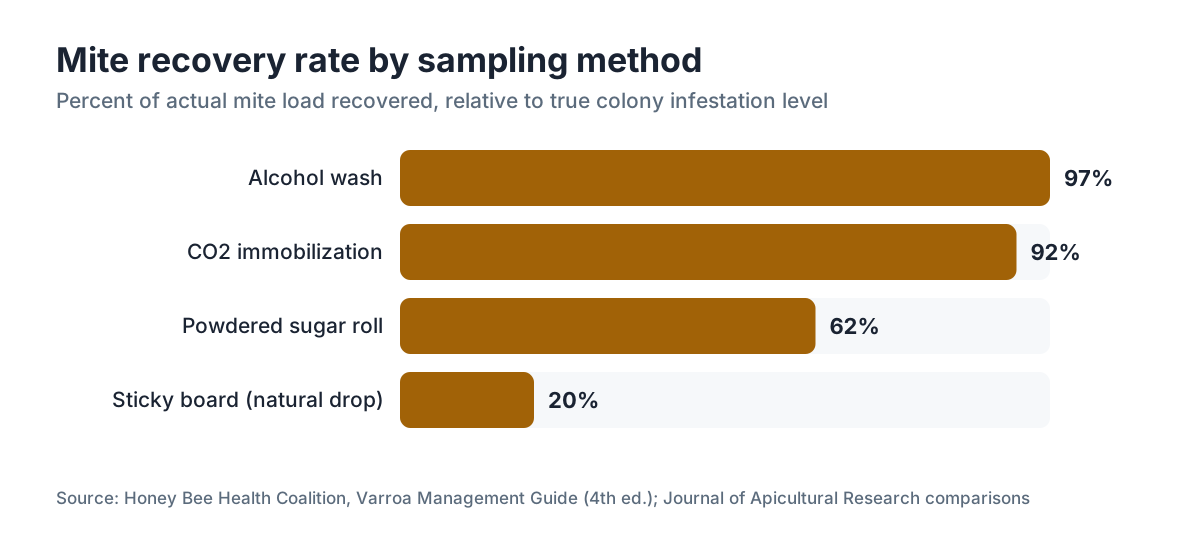
Not accurate enough to trust a treatment decision on. Study after study comparing the two methods on the same bees found that sugar rolls return lower mite counts than alcohol wash, every time. The gap isn't small.
A 2014 study published in the Journal of Apicultural Research by Macedo et al. found sugar rolls recovered significantly fewer mites than alcohol wash, with efficiency estimates ranging from about 50 to 75 percent of actual mite loads depending on conditions [1]. A widely cited University of Florida/IFAS comparison found similar results, with alcohol wash detecting roughly 1.6 times more mites than sugar roll on matched samples [2].
Here's what that means at the hive. Say your true load is 3 mites per 100 bees, the treatment threshold most programs use. A sugar roll might hand you 1.5 to 2.0, which reads as safely below threshold. So you hold off. Your colony keeps declining while you think it's fine.
The Honey Bee Health Coalition's Varroa management guide puts it plainly, calling alcohol wash the "most accurate method for monitoring varroa mite levels" and recommending it as the preferred sampling approach [3]. That's about as blunt as a consensus document gets.
| Method | Relative mite recovery | Bee mortality | Cost | Skill level |
|---|---|---|---|---|
| Alcohol wash | ~95-100% (reference standard) | 300 bees killed | Under $5 | Low |
| CO2 immobilization | ~90-95% | None | $20-100 for CO2 source | Moderate |
| Powdered sugar roll | ~50-75% | Minimal | Under $1 | Low |
| Sticky board (passive) | Qualitative only | None | Under $5 | Very low |
The table above reflects ranges from the HBHC guide and university extension comparisons [3][2]. Sticky boards tell you mites are present. They don't give you a count you can treat on.
Why does a small counting error matter so much for treatment decisions?
Varroa management runs on thresholds. The common guidance, used by extension programs across the U.S., sets a treatment threshold at 2 to 3 mites per 100 bees during the brood season, dropping to 1 to 2 per 100 bees going into winter [3]. Those numbers exist because colony damage climbs a steep curve as mite load rises. A colony at 4 mites per 100 bees isn't twice as stressed as one at 2. It's in a different category of danger.
If your method carries a 30 to 50 percent downward bias, you're not slightly off. You're making every decision from a distorted picture. Beekeepers who lean on sugar rolls and never cross-check with alcohol wash often treat far less than they actually needed to, then wonder why the colony crashed in October.
There's a resistance angle too. Undertreating with oxalic acid doesn't breed resistance the way antibiotic misuse does (varroa resistance to oxalic acid isn't well documented yet), but undertreating with Apivar or Apistan absolutely does. When mite populations survive treatments because colonies were never really below threshold, you're building selection pressure into your own apiary. Accurate counts are the foundation of good resistance stewardship.
If you track hive health across several colonies, a tool like VarroaVault lets you log wash counts, flag colonies nearing threshold, and time treatments by season. That removes a lot of the guesswork inaccurate methods tend to paper over.
Does powdered sugar actually dislodge mites effectively?
The mechanism behind why sugar rolls fall short is worth knowing. The theory was that sugar particles gum up the mite's sticky pads (the pretarsus), forcing it to let go of the bee. Early proponents believed the rolling created enough mechanical disruption to knock a high share of mites free.
Researchers found the sugar coating just doesn't dislodge mites as well as agitation in alcohol. A phoretic mite, riding on an adult bee, grips the abdomen with real force. Alcohol dissolves the waxy cuticle interface and kills the mite, so its grip relaxes completely and it falls. Sugar doesn't reliably do that, especially with mites wedged between the abdominal sclerites [1].
Humidity makes it worse. In damp conditions, powdered sugar clumps and cakes, which cuts even the mechanical disruption it does provide. Beekeepers in the Southeast and Pacific Northwest report especially unreliable summer results. So the method's already poor accuracy gets poorer in exactly the conditions when mite populations are exploding fastest.
Are there any situations where a sugar roll is still acceptable?
A few, though narrower than most people think.
If you want a quick yes/no on whether mites are present at all, say in a new package or a colony you just treated, a sugar roll gives you a rough signal. Zero mites probably means a very low load. A high count definitely means a high load. The bias only runs one direction: toward undercounting, never over. So a high sugar roll number you can trust.
For teaching, sugar rolls earn their keep because they're non-lethal and let students see live mites without any chemical. As a classroom or youth-program demo, fine. As a decision tool for a real colony, not fine.
If you genuinely can't bring yourself to sacrifice 300 bees, CO2 immobilization beats the sugar roll. CO2 temporarily stuns bees and mites, the mites drop free, and recovery rates approach alcohol wash, around 90 to 95 percent in most comparisons [4]. The bees wake up. The catch is you need a CO2 source, either a small tank or a device like the Varroa EasyCheck CO2 version, and CO2 methods are harder to standardize in the field.
What does the Honey Bee Health Coalition actually recommend?
The Honey Bee Health Coalition (HBHC) is the closest thing the U.S. bee industry has to a consensus body on varroa. Their Varroa management guide, now in its fourth edition, is the document I'd hand any beekeeper who wants to know current best practice.
On sampling method, the guide leaves no room to argue: "Alcohol wash is the most accurate method for monitoring varroa mite levels" [3]. It walks through the alcohol wash procedure step by step and sets the threshold guidance that most state extension programs have adopted.
The guide does describe the sugar roll and lists it as an alternative, but it flags the accuracy limits directly. The coalition's position isn't that sugar rolls are useless. It's that alcohol wash is the standard and the sugar roll should be understood as an inferior substitute.
The HBHC guide is free to download from their website [3]. If your monitoring protocol comes from anything older than their latest edition, you're probably working with outdated guidance. Extension programs at Penn State, University of Florida, and University of Minnesota have all updated their recommendations to the alcohol wash standard in recent years [2][5][6].
How do you do an alcohol wash correctly?
The procedure is simple and takes under five minutes once you've done it twice.
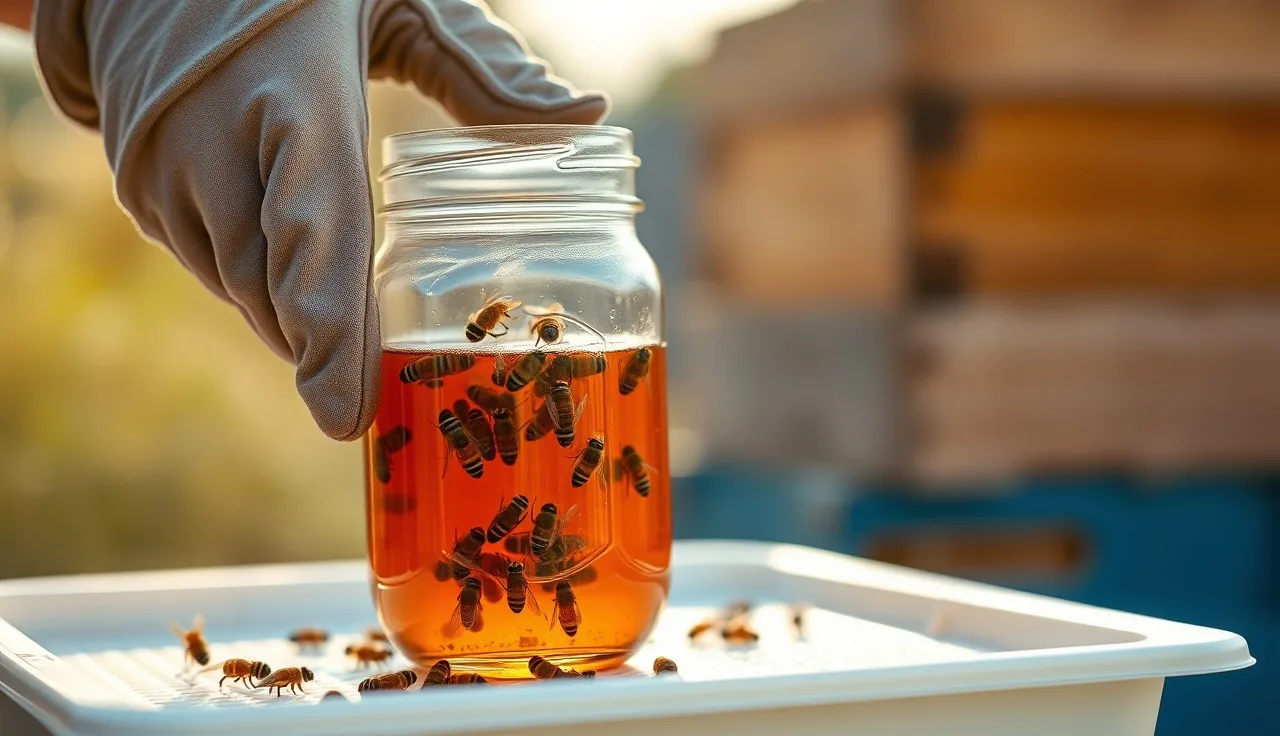
You need a two-part jar (a mason jar with a hardware cloth lid works, or a commercial product like the Varroa EasyCheck). Fill the bottom to the fill line with 70 percent isopropyl alcohol, windshield washer fluid, or soapy water. All three work. Alcohol gives the cleanest separation.
Find a frame of brood with bees on it. Nurse bees on brood frames carry the highest mite load, so that's where your sample gives you the most signal. Shake or scrape about 300 bees into the jar. You don't need to count them one by one. Half a cup by volume is roughly 300 bees [3].
Cap the jar, shake it for 30 to 60 seconds, then pour the liquid through the mesh into a second container or a white tray. The mites (tiny reddish-brown oval specks) show up in the liquid. Count them. Divide by 3 (since 300 bees is 3 groups of 100) for your mites-per-100-bees figure.
If your count is 2 or higher during the brood season, you're at or above the threshold most programs use. At 3 or above, treat now [3][5].
One note on windshield washer fluid: it works well in cold weather when alcohol can gel, and it's cheaper in bulk. The bees are dead either way, so the choice is yours.
For more on the gear you'll need for accurate monitoring, the beekeeping supplies overview covers what's worth buying and what isn't.
What about the argument that killing 300 bees is harmful to the colony?
This objection comes up constantly, and I understand the instinct. Let's do the math anyway.
A healthy colony in peak summer holds 40,000 to 60,000 adult bees. Sampling 300 removes 0.5 to 0.75 percent of the workforce. The colony doesn't notice. Queen rearing programs graft hundreds of larvae and shuffle frames in ways far more disruptive than losing 300 workers.
Now weigh that against undertreating because your sugar roll said the load was fine. A colony that crashes in October and takes 40,000 bees with it because you missed a treatment window is a far bigger loss than 300 bees in a jar.
The "killing bees to save bees" framing is real, and the math strongly favors the wash. The University of Minnesota Bee Lab makes the point directly in its monitoring guidance: the small sample loss is far outweighed by the accuracy you gain [6].
Then there's the queen worry: some beekeepers fear washing her by accident. Sample from a brood frame after confirming she isn't on it. You can see her. If you're still nervous, pull your sample from two or three frames that clearly don't have her.
When should you monitor, and how often?
The sugar roll debate distracts from this question, but timing matters as much as method. Monitor every 30 days through the active season, and always before and after a treatment.
The Honey Bee Health Coalition recommends monitoring every 30 days during the active season (roughly March through October across most of the continental U.S.) and at least once before and after any treatment [3]. Penn State's extension guidance matches this and adds that the make-or-break window for preventing winter loss is August and September, when mite populations peak against a declining bee population [5].
Sample once a year or once a treatment cycle and you're flying half blind, whatever method you use. Colonies can go from manageable to a collapsing mite load in six to eight weeks during peak brood season.
Run more than five or six colonies and a season of results reveals patterns a single data point never will. Which colonies run high year after year? Which hives need earlier treatment in your microclimate? Those questions are answerable once you have a season of regular wash counts recorded somewhere.
VarroaVault offers free monitoring log tools built around these seasonal thresholds, which help you catch a colony trending toward threshold before it crosses.
For the biology behind why the threshold numbers make sense, the varroa mite overview covers what the mite is and how it damages colonies.
What do experienced beekeepers use now instead of sugar roll?
Alcohol wash, almost without exception. Talk to beekeepers who've fought varroa for ten years or more, especially sideliners running 50 to 200 hives, and you'll find near-universal adoption. The economics are simple: at that scale, a treatment mistake costs real money, so accurate counts aren't optional.
Among hobbyists the shift is slower, but it's moving. Bee clubs that taught sugar rolls as recently as 2018 have largely rebuilt their courses around alcohol wash. The North American education programs behind varroa management, including those from Penn State, University of Florida, and the Honey Bee Health Coalition, all use alcohol wash in their instructional materials now [2][5][3].
CO2 methods are gaining ground with beekeepers who want non-lethal accuracy, though the equipment barrier slows things down. The Varroa EasyCheck works with both alcohol and CO2 and runs about $15 to $20, which makes it the most common entry point for people upgrading from sugar roll.
Sticky boards still have fans, mostly for qualitative confirmation rather than threshold counts. Natural mite drop swings too much with season, temperature, and colony size to give a reliable mites-per-100-bees number without calibration tables that most hobbyists don't use consistently [3].
Here's the field verdict. If sugar roll is still your primary monitoring method, you're using a tool the research, the extension programs, and the experienced practitioners have moved past. The switch to alcohol wash costs you almost nothing but the willingness to accept 300 bees as a fair price for accurate information.
Are there any newer monitoring technologies on the horizon?
A few, though none has displaced wash-based sampling in practical beekeeping yet.
Acoustic monitors and hive sensors that claim to read mite-related stress signals are being researched, but no peer-reviewed standard exists that would let you set a treatment threshold from sensor data alone. The tech is interesting and probably has a future. "Probably useful someday" isn't much help to a beekeeper deciding whether to treat this August.
Image recognition tools that count mites on photos of bees or sticky boards are under development at several universities. Accuracy on sticky board images is improving, but sticky boards still don't give you the phoretic mite load that treatment decisions require.
For now, alcohol wash is the standard, and it's likely to stay that way for years simply because it's cheap, validated, and accurate enough to drive good decisions. No technology is replacing a $5 mason jar and a bottle of rubbing alcohol anytime soon.
Frequently asked questions
Is powdered sugar roll good enough for a casual backyard beekeeper with one or two hives?
No, and this is where the case for sugar roll is weakest. With one or two hives, each colony matters enormously. Losing one because a sugar roll said your load was fine when it wasn't hurts far more than it would for someone with twenty hives. The stakes for accuracy are actually higher when you have fewer colonies, not lower. Alcohol wash takes five minutes and costs almost nothing.
Can I use rubbing alcohol from the drugstore for an alcohol wash?
Yes. Standard 70 percent isopropyl alcohol from any pharmacy works fine. Some beekeepers use 91 percent, which also works. Windshield washer fluid (which contains methanol) works and is cheaper per gallon if you're sampling many hives. Soapy water (a few drops of dish soap in water) acts slower but still produces accurate counts in most comparisons.
What is the treatment threshold for varroa, and how does sampling accuracy affect it?
The most widely used threshold is 2 to 3 mites per 100 bees during brood season, dropping to 1 to 2 per 100 bees in late summer heading into winter, per the Honey Bee Health Coalition guide. If your method has a 30 to 50 percent downward bias, as sugar roll does, a true count of 3 might read as 1.5 to 2.1, making a colony that needs treatment look like it's under threshold.
Does powdered sugar roll hurt the bees or the queen?
Sugar roll rarely kills bees outright if you work carefully and return them promptly, though returning coated bees in cold weather can cause chilling deaths. The queen risk is low but not zero if she ends up in your sample. The bigger issue is that the non-lethal character is the method's main selling point, and that advantage disappears once you weigh it against the cost of undertreating on inaccurate counts.
How many bees do I need for a reliable varroa sample?
About 300 bees, roughly half a cup by volume. This sample size is validated in the Honey Bee Health Coalition guide and gives you statistically useful data. Smaller samples increase the swing in your count. You don't need to count bees individually. Calibrate your container once by counting a half-cup sample to confirm you're near 300, then use volume for everything after that.
What frame should I sample from for the most accurate mite count?
A frame of open brood with nurse bees clustered on it. Nurse bees, which tend larvae, carry the highest mite loads because phoretic mites prefer riding nurses to reach brood cells. Sampling honey frames or the outer edges of the cluster gives you an unrepresentative picture. Confirm the queen isn't on the frame before you shake it into your jar.
How does CO2 mite monitoring work, and is it actually better than alcohol wash?
CO2 temporarily immobilizes both bees and mites. When the mites release their grip and you shake the jar, they fall free and can be counted. Bees recover within minutes. CO2 recovers roughly 90 to 95 percent of mites present, better than sugar roll but slightly below alcohol wash in most comparisons. The main barrier is accessing a CO2 source. For beekeepers who truly cannot accept killing a sample, CO2 is the right answer.
Why did extension programs teach powdered sugar roll for so long if it was inaccurate?
Because the comparison data wasn't widely available when extension curricula were built in the 2000s, and because getting beekeepers to monitor at all was the first problem to solve. A method people would actually use beat a theoretically better one they wouldn't. As the accuracy studies piled up through the 2010s, extension programs updated. That's how science-based practice is supposed to work, even when it's slower than we'd like.
Does a high powdered sugar roll count still mean I should treat?
Yes, absolutely. The bias in sugar roll runs one direction: it undercounts. So if your sugar roll shows 3 or more mites per 100 bees, your actual load is almost certainly higher. A high sugar roll count is a clear treatment signal. The trap is false negatives, where the roll looks fine but the real count would show a treatment-level infestation. High sugar roll counts are reliable. Low ones are not.
How do I calculate mites per 100 bees from a wash count?
Count the mites in your wash liquid, then divide by the number of bees sampled and multiply by 100. With a standard 300-bee sample, just divide your mite count by 3. So 9 mites divided by 3 equals 3 mites per 100 bees, which is at or above the treatment threshold most extension programs use during the brood season.
Is there any evidence that varroa mites are becoming resistant to treatments because of inaccurate monitoring?
Resistance to synthetic miticides (Apivar, Apistan, CheckMite+) is well documented in varroa populations worldwide, and repeated sub-lethal exposure from undertreating is a recognized driver. Whether poor monitoring methods like sugar roll have contributed measurably to resistance spread hasn't been studied directly, but the mechanism is plausible: if beekeepers keep underestimating mite loads, they treat less, which leaves more mites exposed to subtherapeutic conditions after treatment.
What's the cheapest way to switch from sugar roll to alcohol wash?
A quart mason jar, a piece of hardware cloth cut to fit the lid ring, and a bottle of 70 percent isopropyl alcohol. Total cost is under $5 if you buy hardware cloth by the small roll. Commercial options like the Varroa EasyCheck run about $15 to $20 and are handier for repeated use, but the mason jar setup produces equally accurate results. There's genuinely no equipment barrier to making the switch.
Can I use powdered sugar roll in combination with alcohol wash to get a better picture?
Some beekeepers do a sugar roll first for a quick field check, then confirm with an alcohol wash if the sugar roll count looks borderline. That's a reasonable workflow if you're already comfortable with both. Practically, though, if you're pulling a bee sample anyway, the extra minute to switch to alcohol wash instead of sugar gets you reliable data the first time and saves you a second sampling.
Sources
- Journal of Apicultural Research, Macedo et al. 2014, sugar roll vs. alcohol wash mite recovery comparison: Sugar rolls recovered significantly fewer mites than alcohol wash, with efficiency estimates ranging from approximately 50 to 75 percent of actual mite loads
- University of Florida IFAS Extension, Varroa mite monitoring and management: Alcohol wash detects roughly 1.6 times more mites than sugar roll on matched samples
- Honey Bee Health Coalition, Varroa Management Guide (4th edition): Alcohol wash is the most accurate method for monitoring varroa mite levels; treatment threshold is 2 to 3 mites per 100 bees during brood season
- Journal of Apicultural Research, CO2 immobilization mite recovery studies: CO2 immobilization recovers approximately 90 to 95 percent of mites present, compared to lower recovery with sugar roll
- Penn State Extension, Varroa mite management for Pennsylvania beekeepers: Treatment threshold of 2 to 3 mites per 100 bees during brood season; critical window is August and September before winter
- University of Minnesota Bee Lab, Varroa mite sampling and monitoring guidance: Sampling 300 bees for alcohol wash removes 0.5 to 0.75 percent of colony workforce; the accuracy benefit far outweighs the loss of the sample
- EPA, Apivar (amitraz) pesticide registration and label: Apivar is a registered miticide for varroa control in honey bee colonies; label compliance required for use
- USDA Agricultural Research Service, Honey bee health and varroa mite research: Varroa mite resistance to synthetic miticides is documented; accurate monitoring supports resistance management
- Honey Bee Health Coalition, Tools for Varroa Management guide, sticky board vs wash comparison: Sticky boards provide qualitative mite presence data only and cannot reliably deliver a mites-per-100-bees count for treatment decisions
- University of California Agriculture and Natural Resources, Honey bee varroa mite pest management guidelines: Alcohol wash is recommended as the standard monitoring method; sugar roll identified as less accurate alternative
Last updated 2026-07-09