Powdered sugar dusting for varroa: does it actually work?
TL;DR
- Powdered sugar dusting does not control varroa.
- University trials found it knocks off 3 to 10 percent of a colony's mites, and the grooming it supposedly triggers never produced a real drop in mite counts versus controls.
- The 70 to 80 percent of mites hiding in capped brood stay untouched.
- Skip the sugar as a treatment.
- Use oxalic acid, formic acid, or amitraz instead.
What is powdered sugar dusting and why do beekeepers use it?
The idea sounds elegant. Coat your bees in fine powdered sugar, the sugar irritates the mites, the bees groom harder, mites fall through a screened bottom board, and the colony gets relief without chemicals. Beekeeping forums spread this through the early 2000s. It became one of the most shared "natural" varroa fixes in hobbyist circles.
The appeal makes sense. Powdered sugar costs almost nothing. You buy it at any grocery store. There's no EPA registration to check, no label restrictions, no waiting period before you pull honey. For a new beekeeper already drowning in varroa advice, dusting a hive feels like an easy first move.
The trouble is that the mechanism was shaky from the start, and when researchers actually put it to the test, the numbers came back grim. Understanding why takes a quick look at where varroa actually lives on a bee, and it isn't out in the open where sugar can reach it.
What does the research say about powdered sugar's effectiveness against varroa?
The efficacy data is bad. Work out of the USDA Tucson bee lab found that powdered sugar dusting produced a mite drop equal to roughly 3 to 10 percent of a colony's actual mite load [1]. A treatment that removes fewer than 1 in 10 mites does almost nothing to slow population growth, because varroa breed faster than that margin can offset.
University of Minnesota researchers looked at whether sugar pushed grooming past baseline. Bees do groom more right after a dusting, but the effect is short, and the total mites removed did not differ from control colonies in a way that mattered [2]. The mites that fell were mostly phoretic mites already riding loosely on adult bees. Mites sealed inside capped brood, which is where most of the population sits, stayed put.
That split is the whole problem. In a colony reading 3 percent on a wash, roughly 70 to 80 percent of the total mite population is inside capped brood at any moment [3]. A treatment that only touches phoretic mites is fighting 20 to 30 percent of the problem at best. Powdered sugar isn't even reliably getting all of those.
The Honey Bee Health Coalition's varroa management guide draws on peer-reviewed research and does not list powdered sugar as a treatment [4]. That silence is the recommendation.
Does powdered sugar increase bee grooming behavior?
Not enough to matter. This is the core claim behind sugar dusting, and it deserves a fair hearing rather than a shrug. Varroa-resistant bees, like the surviving stock from the Gotland island study, do show higher grooming and hygienic behavior that lines up with lower mite loads [5]. Grooming is a real defense. The question is whether dusting sugar on bees fires enough of it to count.
It doesn't. Bees groom when coated with sugar, but they're mostly grooming to eat the sugar, not to strip off mites. The two behaviors look alike from the outside and mean different things to the bee. Allogrooming aimed at mites is triggered by chemical cues from the mites themselves, not by a powdery irritant. Sugar doesn't reliably copy those cues.
There's a ceiling here too. Even bees bred specifically for grooming pull off only a fraction of their mite load that way. It's a useful trait that slows growth. It isn't a cure. Faking a weak version of that grooming in an ordinary colony with sugar gives you even less.
How does powdered sugar compare to proven varroa treatments?
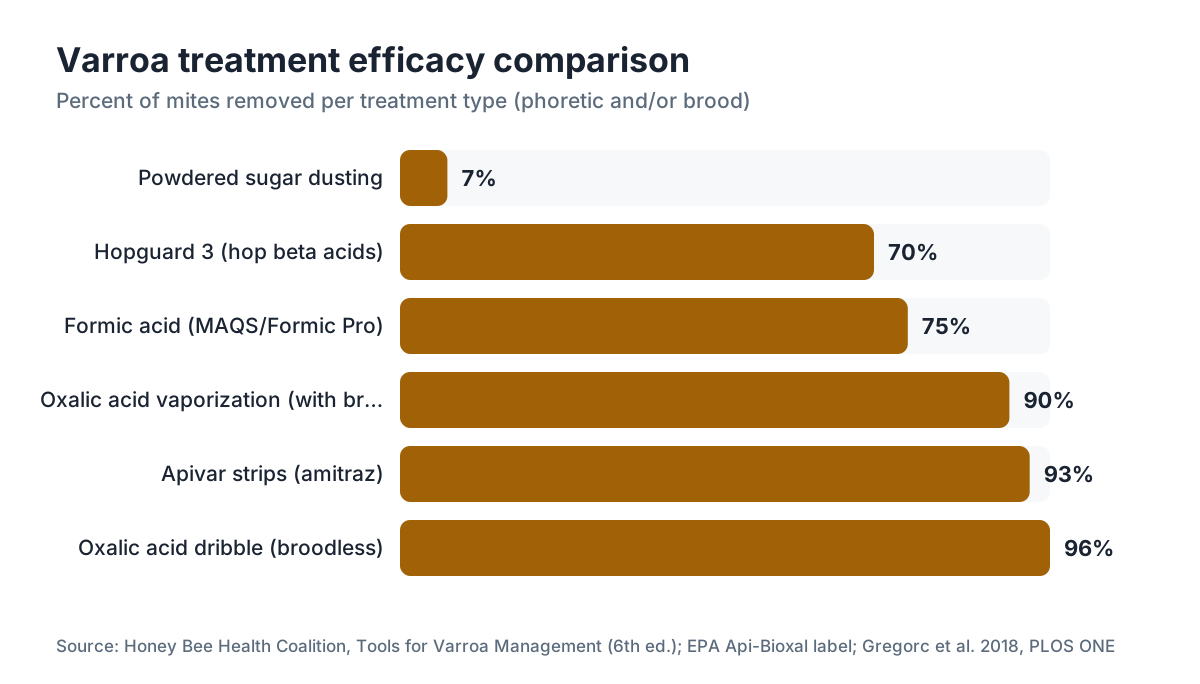
The gap isn't close. Here's how powdered sugar stacks up against treatments that carry real efficacy data.
| Treatment | Efficacy range | Treats brood? | Chemical/organic? |
|---|---|---|---|
| Powdered sugar dusting | 3-10% mite removal [1] | No | Neither |
| Oxalic acid (dribble, broodless) | 90-99% [6] | Phoretic only | Organic acid |
| Oxalic acid (vaporization) | 90-95% [6] | Phoretic only, repeat treats help | Organic acid |
| Formic acid (MAQS/Formic Pro) | 60-90% [7] | Partial (some penetration) | Organic acid |
| Apivar (amitraz strips) | 90-95%+ [8] | Yes (slow release) | Synthetic |
| Hopguard 3 (hop beta acids) | Variable, 60-80% [9] | Limited | Organic/exempt |
This is the difference between doing essentially nothing and actually knocking a mite population down. Apivar and oxalic acid dribble in broodless colonies both land at 90 percent or above in independent trials. Powdered sugar doesn't come near that even on its best day.
If you track mites with an alcohol wash or sugar roll, and every beekeeper managing varroa should, a reading above 2 percent during brood season is your cue to treat with something that works [4]. Powdered sugar will not move that number.
Is there any situation where powdered sugar is worth using?
Yes, but for counting mites, not killing them. Powdered sugar has one honest job in varroa management: the sugar roll mite count. You scoop about 300 bees into a jar, add a tablespoon of powdered sugar, shake for roughly two minutes, then sift and count the mites that drop. It's a lower-lethality alternative to the alcohol wash, though most researchers rate the alcohol wash slightly more accurate, because live bees grip their mites harder than dead ones do [4].
So keep sugar in your kit for monitoring. Know your mite level, then treat with something that works.
Some beekeepers dust to feel like they're doing something while a real treatment ships. That's human. But it can't replace or delay the actual treatment. Varroa can double in three to four weeks under good breeding conditions [3], so every week of stalling has a price.
Why did powdered sugar dusting become so popular if it doesn't work?
A few things lined up. The original claims spread hard before any controlled trials existed. By the time discouraging results came back in the late 2000s and early 2010s, the technique was already baked into hobbyist culture.
Anecdotal proof is easy to manufacture. You dust a hive, you see mites on the sticky board, and it feels like a win. What you can't see is what fraction of the total population those fallen mites represent, or how fast the survivors are breeding.
There's also a real preference among many beekeepers for anything that isn't a synthetic chemical, or even an organic acid that needs careful handling. That preference is fair. It also makes people want powdered sugar to work harder than the evidence allows.
The community has tightened up. Extension programs, the Honey Bee Health Coalition, and university bee labs have pushed steadily toward evidence-based management. Resources like the varroa mite primers from extension services have moved the conversation toward treatments with actual efficacy numbers behind them.
What are the risks of relying on powdered sugar instead of real treatment?
The main risk is a dead colony, and that's not hyperbole. Varroa is the largest single driver of winter colony loss in North America, and untreated or undertreated colonies usually collapse within one to three years [3]. Run powdered sugar as your primary tool while telling yourself the mite problem is handled, and you're building toward a crash you won't see coming until it's here.
There's a spillover risk too. Mites from a collapsing colony drift to neighbors, and robbing spreads them further. In an area with other beekeepers, an uncontrolled infestation in your yard becomes everyone's problem.
Sugar has small practical downsides inside the hive. Residual moisture can feed mold in cool weather, and heavy applications hand the bees extra cleanup. Minor issues on their own. But they're a real cost paid for zero treatment benefit.
Building a varroa plan from scratch? VarroaVault's free varroa tools lay out monitoring thresholds and treatment windows by season, which beats stitching a plan together from forum threads.
What treatments actually work against varroa mites?
The tools with consistent efficacy data split into two camps: organic acids and synthetic miticides.
Oxalic acid is the most accessible organic option. The EPA registers it for bee colonies as Api-Bioxal, and it works at over 90 percent efficacy against phoretic mites when a colony is broodless [6]. In summer, with brood present, repeated vaporization every five days across several cycles can reach similar cumulative numbers. It's genuinely effective, cheap, and easy on bees at label rates.
Formic acid products like MAQS and Formic Pro have one advantage the others lack: partial brood penetration, so they reach some mites inside capped cells. Efficacy runs roughly 60 to 90 percent depending on temperature and method [7]. They demand careful temperature management and can stress bees, but they're a real tool.
Amitraz strips (Apivar) sit among the highest-efficacy options at 90 to 95 percent or better in trials [8], with full-season treatment that catches mites as they emerge from brood. Amitraz resistance has been documented in some US populations, so rotate your chemistries.
Hopguard 3 is an EPA-exempt option built on hop beta acids. It's weaker than the rest, landing in the 60 to 80 percent range depending on study and conditions [9], but it's usable during honey flow in some cases. Read the label.
For treatment products, see the beekeeping supply companies that stock these registered options.
How should you monitor varroa to know when to treat?
You can't manage what you don't measure. The alcohol wash is the standard: collect about 300 bees (half a cup) off a brood frame, add isopropyl alcohol, shake for 60 seconds, and count the mites that wash off. Divide mites by bees and multiply by 100 for the percentage [4].
The Honey Bee Health Coalition recommends treating when infestation hits 2 percent or higher during brood-rearing season [4]. That's two mites per 100 bees. Some sources use 3 percent, and the spread reflects genuine uncertainty in the literature about exactly where the economic injury level sits. I'd treat at 2 percent rather than scramble at 5.
For winter prep, treating while colonies are broodless in late fall gives oxalic acid its best shot at a clean sweep. Many extension programs suggest treating by September or October in northern states, before winter bees are raised, because those bees have to live five to six months and mite-damaged ones simply don't [3].
Monitor every four to six weeks through the active season. A monthly check can miss a fast shift during a July brood break or a fall surge.
What do extension programs and the Honey Bee Health Coalition actually recommend?
None of them recommend powdered sugar as a treatment. That's a consensus position, and it's held for about a decade.
The Honey Bee Health Coalition's "Tools for Varroa Management" guide, free from the HBHC, states that monitoring-based treatment with approved products is the recommended approach [4]. The guide walks through alcohol wash protocols, treatment thresholds, and the efficacy of registered treatments. It's one of the best free resources in beekeeping.
University of Minnesota Extension, Penn State Extension, and Michigan State University Extension all publish varroa recommendations centered on monitoring plus approved miticides or organic acids [2][10]. None list powdered sugar as anything but a monitoring method.
The EPA's registration of Api-Bioxal (oxalic acid) and amitraz products reflects a judgment that these compounds are safe for bees and honey at label rates [6]. Powdered sugar has no EPA registration because it isn't a pesticide, but the flip side is that it also has no efficacy data that would support a treatment claim.
Should you stop dusting with powdered sugar entirely?
Yes, if you've been treating with it. No, if you're using it for sugar roll counts, which is a legitimate monitoring technique.
The hard part of this advice is that it asks beekeepers to let go of something that felt intuitive and low-stakes. The stakes are high. A colony losing the fight with varroa doesn't die quietly. It often collapses in a way that seeds mites into other hives nearby, and you lose the time, the equipment, and the bees.
Want to minimize chemical exposure? Oxalic acid is a reasonable path. It's OMRI-listed, it carries an organic certification exemption for many programs, and at 90 to 99 percent efficacy in broodless conditions [6] it does the job. That's a far better return than powdered sugar's 3 to 10 percent.
For full seasonal protocols, VarroaVault covers monitoring schedules, treatment timing, and product selection through its free tools.
And if you're brand new to bees and still learning what varroa even is, varroa mite is a good place to start before you pick a management approach.
Frequently asked questions
Does powdered sugar kill varroa mites?
No. Powdered sugar does not kill varroa. It causes some mites to fall off adult bees for a short time, but it has no lethal effect. University trials found it removes 3 to 10 percent of a colony's mite load at best, nowhere near enough to reduce an infestation. The mites inside capped brood cells, 70 to 80 percent of the total population, are completely unaffected.
Can I use powdered sugar dusting during a honey flow when other treatments are off-limits?
You can dust during a flow, but don't expect real mite reduction. The appeal is understandable, since many miticides carry honey super restrictions and beekeepers feel stuck mid-flow. But 3 to 10 percent removal doesn't slow mite growth. Better options during a flow are Hopguard 3, which is EPA-exempt with some label flexibility, or planning a brood break so you can use oxalic acid.
How do you do a sugar roll mite count?
Collect about 300 bees (roughly half a cup) off a brood frame into a jar with a mesh lid. Add one tablespoon of powdered sugar, close the lid, and roll or shake for about two minutes. Tap the mites onto a white surface or into water and count. Divide by 3 (for 300 bees) to get mites per 100 bees. Above 2 percent during brood season is the treatment threshold the Honey Bee Health Coalition recommends.
Is the sugar roll or alcohol wash more accurate for varroa monitoring?
The alcohol wash is generally considered slightly more accurate. Live bees grip their mites harder, so a sugar roll can undercount by releasing fewer mites than the alcohol wash does. The difference is usually small, and sugar rolls let the bees walk away alive. For a one-time snapshot that needs to be as accurate as possible, most researchers prefer the alcohol wash.
What percentage of varroa mites are inside capped brood at any given time?
Roughly 70 to 80 percent of the total varroa population sits inside capped cells at any moment during normal brood rearing. That's why treatments touching only phoretic (free-roaming) mites are limited, and why broodless-period oxalic acid works so well. Any treatment should account for this split, either by timing around a brood break or by using a product with some brood penetration like formic acid.
How often should I monitor for varroa mites?
Every four to six weeks during the active brood-rearing season, roughly April through September across most of the US. Check again in late summer before fall treatments, and again in early spring to see your starting point. Mite populations can double in three to four weeks, so a single summer check isn't enough. The Honey Bee Health Coalition recommends treating at or above 2 percent during brood season.
What is the treatment threshold for varroa mites?
The Honey Bee Health Coalition recommends treating when infestation reaches 2 percent or higher during brood-rearing season, measured by alcohol wash or sugar roll. That's 2 mites per 100 bees. Some sources use 3 percent, reflecting uncertainty in the literature, but 2 percent is conservative and defensible. In fall, before winter bees are raised, treating earlier rather than waiting for the threshold makes sense.
Is oxalic acid safe for bees and honey?
Yes, at label rates. Oxalic acid is EPA-registered as Api-Bioxal and OMRI-listed, so it has an organic certification pathway. It occurs naturally in honey at low levels. Studies supporting the EPA registration found no meaningful residue increase in honey from properly applied treatments. Bees tolerate it well, though some temporary bee loss can happen with high-dose dribble applications. Follow the Api-Bioxal label exactly.
Can varroa mites develop resistance to powdered sugar?
Resistance isn't a concern with powdered sugar, because it has no real mechanism against mites to begin with. Resistance is a genuine issue with synthetic miticides like amitraz and pyrethroids, and documented amitraz resistance exists in some US varroa populations. That's one reason to rotate chemistries and check efficacy after treating. Organic acids like oxalic and formic acid have shown low resistance risk so far.
Does powdered sugar harm bees or the hive?
Heavy applications can cause minor problems. Moisture from the sugar can feed mold in cool or humid conditions, and bees spend time cleaning sugar off themselves and hive surfaces instead of foraging or nursing. These effects are small next to the harm of an untreated infestation, but they're a real cost with no treatment benefit. Light applications for sugar roll monitoring don't cause significant issues.
What natural or organic treatments actually work against varroa?
Oxalic acid (Api-Bioxal) and formic acid (MAQS or Formic Pro) both come from naturally occurring compounds and carry strong efficacy data. Oxalic acid hits 90 to 99 percent against phoretic mites in broodless colonies. Formic acid ranges from 60 to 90 percent with some brood penetration. Hopguard 3, built on hop beta acids, is EPA-exempt and reaches 60 to 80 percent. All three are accepted in many organic certification programs.
Why do I see mites on my sticky board after dusting if it doesn't work?
You do knock some phoretic mites off bees, and they land on the sticky board. The problem is perspective. Those fallen mites are 3 to 10 percent of the total population, and the other 90 to 97 percent, including every mite in the brood, stay in the colony breeding. Mites on the board after dusting create the impression of success, but the underlying infestation barely moves.
How quickly can a varroa population grow if untreated?
A varroa population can double in as little as three to four weeks during peak brood-rearing season. Starting from a 1 percent infestation in late spring, an untreated colony can reach 5 to 10 percent by late summer, which is collapse territory heading into fall. That growth rate is why monitoring every four to six weeks matters, and why delaying treatment after hitting 2 percent is risky.
What should I do if I've been relying on powdered sugar as my main varroa treatment?
Run an alcohol wash right away to find out where your mite count actually stands. If you're at or above 2 percent during brood season, treat with an approved product: oxalic acid if you can arrange a brood break or do extended vaporization, formic acid if brood is present and temperatures are in range, or Apivar strips for a reliable full-season option. Knock the count down, then set a monitoring schedule to stay ahead of it.
Sources
- Sammataro D, Untalan P, Guerrero F, Finley J. (2005). 'The prevalence of mites in commercial beekeeping operations.' American Bee Journal. USDA-ARS Honey Bee Research Laboratory.: Powdered sugar dusting removed roughly 3 to 10 percent of the mite load in tested colonies, with no significant sustained reduction in infestation levels.
- University of Minnesota Extension, Apiculture Program, Varroa mite management: University of Minnesota researchers found that powdered sugar increased grooming transiently but did not produce a statistically significant difference in mite counts compared to control colonies.
- Honey Bee Health Coalition, Tools for Varroa Management Guide (6th ed.): Approximately 70 to 80 percent of the varroa population is inside capped brood at any time during normal brood rearing; varroa populations can double in three to four weeks; untreated colonies typically collapse within one to three years.
- Honey Bee Health Coalition, Tools for Varroa Management Guide (6th ed.): The HBHC recommends treating when infestation reaches 2% during brood season; powdered sugar is not listed as a recommended treatment; alcohol wash and sugar roll are described as monitoring methods.
- Fries I, Bommarco R. (2007). 'Possible cause-effect relationships between Varroa destructor population growth and colony strength in honey bees.' Apidologie 38(6).: Varroa-resistant bee populations on Gotland island showed elevated grooming and hygienic behavior correlating with lower mite loads, demonstrating grooming as a real but partial mechanism.
- EPA, Api-Bioxal (oxalic acid) Registration and Label, Docket EPA-HQ-OPP-2013-0675: Oxalic acid (Api-Bioxal) is EPA-registered for use in honey bee colonies; efficacy against phoretic mites in broodless colonies is 90 to 99 percent at label rates; OMRI-listed for organic certification.
- Pennsylvania State University Extension, Varroa Mite Treatment Options: Formic acid products (MAQS, Formic Pro) show 60 to 90 percent efficacy depending on temperature and application, with partial penetration into capped brood cells.
- Gregorc A, et al. (2018). 'Amitraz and oxalic acid treatments for Varroa destructor control.' PLOS ONE.: Amitraz strip treatments (Apivar) achieved 90 to 95 percent or greater efficacy in controlled colony trials.
- EPA, Hopguard 3 Registration, EPA Reg. No. 91865-2: Hopguard 3 (hop beta acids) is EPA-exempt from residue tolerances; efficacy data from registration support approximately 60 to 80 percent mite reduction under label conditions.
- Michigan State University Extension, Managing Varroa Mites in Honey Bee Colonies: MSU Extension does not recommend powdered sugar dusting as a varroa treatment; monitoring-based treatment with registered products is the recommended approach.
- Delaplane KS, Hood WM. (1999). 'Economic threshold for Varroa jacobsoni Oud. in the southeastern USA.' Apidologie 30(5).: Research supporting the 2 to 3 percent mite infestation treatment threshold in honey bee colonies during brood-rearing season.
Last updated 2026-07-09