Summer varroa management tasks month by month

TL;DR
- Summer is the highest-risk season for varroa.
- Mite counts can double every 3-4 weeks while bee numbers start falling in late summer.
- Monitor every 3-4 weeks with an alcohol wash, keep mites under 2% in June and July, drop the trigger to 1% by mid-August, and treat before your winter bees are raised.
Why does summer matter so much for varroa control?
Summer feels like the safe season. Colonies are big, honey is coming in, everything looks fine. That's exactly when varroa bites hardest.
Varroa mites reproduce only in capped brood cells. A colony in full summer swing has 60,000 to 80,000 bees and a brood nest to match, so mite reproduction runs flat out the whole time [1]. One mite entering a cell in June can leave dozens of descendants by August. The Honey Bee Health Coalition estimates mite populations can double roughly every 3-4 weeks during peak brood season [1].
The trap is timing. Bee numbers peak in June or early July, then decline toward the winter cluster. Mite numbers keep climbing. By late August you can have a shrinking bee population carrying a surging mite load, and every bee raised in July and August is a candidate winter bee. Those are the bees that have to be healthy. Varroa-damaged winter bees have shortened lifespans and depleted fat body stores, so colonies that look fine in September can be dead by January [2].
Summer management is really about saving your winter bees before they hatch. Miss the August window and you're gambling with more than this year's colony. You're spending next spring's package money.
What mite level threshold should I target each summer month?
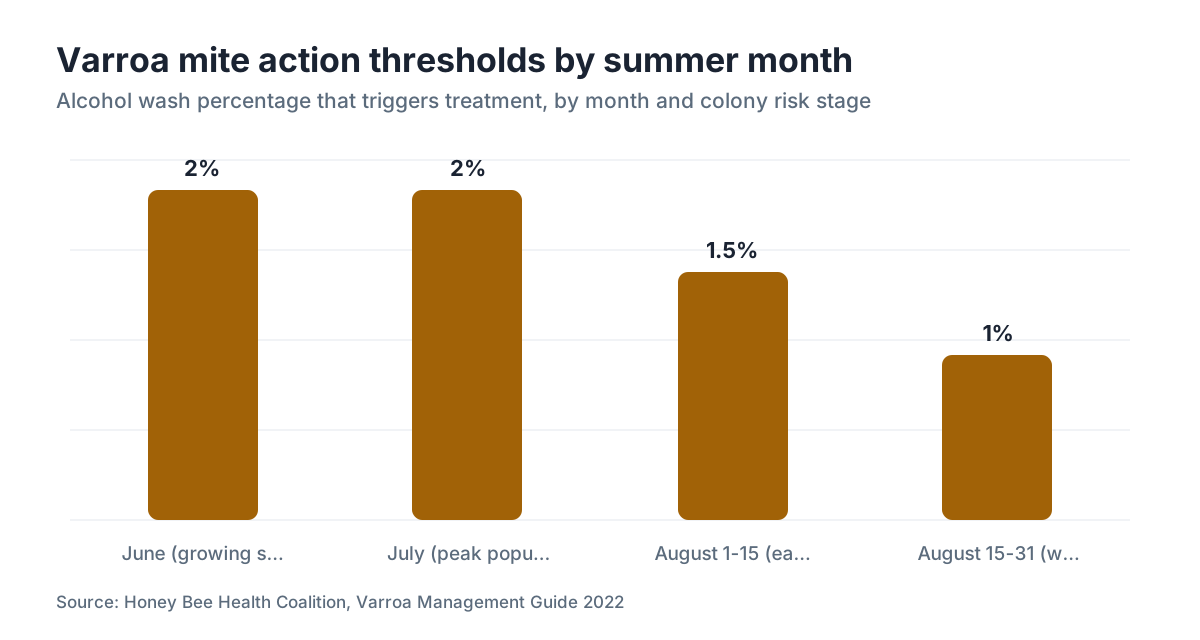
Thresholds shift across the summer because the stakes change as the season runs. Aim for under 2% in June and July, then tighten to 1% by mid-August when winter bees start getting raised.
The Honey Bee Health Coalition's Varroa Management Guide gives the clearest published thresholds for managed colonies in the United States [1]. The 2022 edition sets the action threshold at 2% (2 mites per 100 bees on an alcohol wash) for most of the active season. Penn State Extension recommends treating at 2% or above during brood-rearing months and warns that even 1-2% in August is a red flag given the approaching winter population [3].
Here's a practical way to read summer thresholds by month:
| Month | Action threshold | Why it matters at this stage |
|---|---|---|
| June | 2% or above | Colony is growing fast; treat now to prevent a July explosion |
| July | 2% or above | Peak population; early July treatment keeps August loads low |
| August (before day 15) | 1-2% | Winter bees start being raised; treat even at lower counts |
| August (after day 15) | 1% | Winter bee window is open; any real load is a threat |
August 15 is a benchmark, not a law. In northern states above roughly the 45th parallel (Minnesota, Wisconsin, Maine), winter bee production may start closer to August 1 [13]. In the deep South you may have a longer window. Match the date to your local drone population. When you see drones getting evicted, winter prep is already underway inside the colony.
One honest caveat: nobody has perfectly clean data on when winter bees begin to be raised in every climate. The closest well-cited estimate comes from Doke, Frazier, and Grozinger (2015) in PLOS ONE, which found the physiological shift in nurse bees tied to winter preparation happens about 6 weeks before brood rearing stops [4]. Count back 6 weeks from your first expected frost. That's your hard treatment deadline.
How should I monitor for varroa in June?
June is setup month. The moves you make in the first two weeks set your trajectory for the rest of the summer. Start with an alcohol wash on every colony before the first week is out.
An alcohol wash (also called an alcohol roll) works like this. Take a half-cup sample of nurse bees (roughly 300 bees) off a brood frame, submerge them in 70% isopropyl alcohol, shake for 60 seconds, then pour through a mesh strainer and count the mites [1]. Divide mites by bees, multiply by 100, and you have your percentage. This is the most accurate field test a hobbyist can run. Sugar rolls are easier on the conscience but consistently undercount mites by 20-30% compared to an alcohol wash [5].
Sticky boards have their place too. A 24-hour count gives you a rough read on infestation trajectory, but converting board numbers to a percentage is unreliable because drop rates swing with colony size, temperature, and whether brood is present. Use sticky boards for trending. Use the alcohol wash for decisions.
If your June wash comes back under 1%, wash again in three weeks. Between 1-2%, mark your calendar for a wash in two weeks and start thinking about which treatment fits your current nectar flow. At 2% or above, treat now.
If you run several varroa mites across multiple hives, a written monitoring log with dates and percentages is one of the highest-return habits you can build. A single season of data tells you which colonies are your mite bombs, which ones show genuine hygienic behavior, and whether your treatment actually worked.
What varroa treatments can I use in summer, and which ones are actually worth it?
Summer treatment has one big constraint: temperature. Most products have a working window, and summer heat can make some options dangerous to the colony or useless.
Here's an honest comparison of what's registered for use in the US and what hobbyists actually get from it in summer:
Oxalic acid (dribble or vaporization): Oxalic acid vaporization (OAV) hammers phoretic mites but does nothing to mites sealed in capped brood. Api-Bioxal is the main EPA-registered product, and it moved under the FDA's oxalic acid classification, so check your state's current requirements before buying [6]. For summer treatment with brood present, you need a brood-break strategy or an extended course to catch emerging mites. Extended OAV protocols (usually 3 treatments 5-7 days apart) can work in summer, though data on optimal timing is still maturing. The temperature range is wide, so heat rarely limits OAV.
Formic acid (Mite Away Quick Strips, Formic Pro): Formic acid is the one treatment that penetrates cappings and kills mites inside brood cells. That makes it genuinely useful in summer when brood is everywhere. The catch is temperature. MAQS needs 50°F to 85°F (10-29°C) [7], and Formic Pro needs 50°F to 79°F (10-26°C) [8]. Apply in early morning or wait for a cooler week. Above the ceiling you risk killing brood and the queen. Keep a backup plan ready if a heat wave lands mid-treatment.
Amitraz (Apivar strips): Apivar works well at most summer temperatures and gets used a lot. The label requires 6-8 weeks of continuous exposure, and the strips must not be in the hive during a honey flow when that honey is meant for people [9]. Pull supers first. Amitraz resistance has been documented in some US populations, so running Apivar every single cycle may select for resistance faster than you think.
Thymol (ApiLife Var, Apiguard): Apiguard's range is 60-105°F (15-40°C) [10]; ApiLife Var runs cooler. Thymol can work but it's temperature-sensitive and tends to perform best in fall conditions across much of the US.
My honest take for most summer beekeepers: under 85°F, Formic Pro or MAQS is the most complete option because it reaches mites in cells. Running hot, do OAV with an extended 3-treatment course and plan a follow-up wash to confirm. Apivar is reliable and simple if you can pull supers and live with the 6-8 week window.
What are the main varroa management tasks in June specifically?
June tasks are mostly monitoring and early intervention. Don't get so buried in swarm-season cleanup and honey supers that you skip the mite check.
Week 1-2 of June: Alcohol wash every colony. Record results. Any colony at 2% or above gets a treatment decision made on the spot.
Week 3-4 of June: If you treated, re-wash 10-14 days after the treatment ends to confirm it worked. If you skipped treatment because counts were low, wash again to check trajectory. A colony that climbs from 0.5% in week one to 1.8% in week three is trending badly and probably needs treatment before July.
June is also the month to think about splits and artificial swarms as a brood-break tool. Make a split, move the queen to a new box, and the original colony sits with a gap in capped brood while the new queen gets established. That brood break lets OAV work at near 100% efficacy, because far fewer capped cells are hiding mites from the treatment [1]. Not everyone wants to split in June, but if your counts are high and you've been meaning to grow the apiary, it's a two-for-one move.
Nectar flow drives treatment choice. In a major June flow (clover, tulip poplar, black locust, depending on your region), set Apivar aside and lean toward formic acid, or schedule OAV for after the flow. Honey contamination is real, and you have to follow label directions exactly [9].
What are the main varroa management tasks in July?
July is the hinge month. Get it right and your colonies head into fall healthy. Ignore it and August turns into triage.
Early July: Alcohol wash if you haven't in the last 2-3 weeks. Colonies that came in clean in June can spike in July after picking up mites from collapsing neighbors or riding their own population explosion. Seeley and Smith (2015) in PLOS ONE found that crowding colonies in apiaries increases their vulnerability to varroa, since robbing and drifting move mites between hives [11]. Your clean hive isn't safe just because it started the season clean.
July is also your last comfortable window for Formic Pro or MAQS in many US climate zones before temperatures get unpredictable. Check the 10-day forecast before you apply strips. Aim for a week forecast to stay under 85°F.
Mid-to-late July: If you used Apivar, confirm the strips are still positioned right (not buried in propolis or dropped to the bottom board) and that you're on track for the 6-8 week removal timeline. Propolis-coated strips lose contact with the bees and stop working. Re-seat if needed.
One thing most hobbyists skip in July: queen assessment. A failing queen shrinks the brood area, which compresses the mite-to-bee ratio and can mask a worsening infestation on the wash. Spotty brood or a patchy laying pattern should color how you read the result. A colony with 8 frames of brood and 2% mites is in very different shape than one with 3 frames and 2% mites.
A monitoring log earns its keep here. Precise July records make August decisions fast.
What are the main varroa management tasks in August?
August is where beekeeping gets serious. By mid-month across most of the continental US, the bees hatching now are the bees that will form your winter cluster.
Those winter bees need fat bodies loaded with vitellogenin, working immune systems, and full lifespans. Varroa-damaged winter bees have truncated fat bodies and shortened lives, which is the direct mechanism behind many winter losses [2].
August 1-15: Alcohol wash right away if you haven't in the last 2 weeks. At 1% or above, treat. Don't wait for the usual 2% trigger. The Honey Bee Health Coalition recommends a lower late-summer threshold because the cost of treating is far below the cost of heading into fall with a compromised population [1].
Pick your treatment based on temperature and honey super status. If supers are still on and a fall flow is coming (goldenrod, aster), you may need to pull them before treating with amitraz. Done with honey production, and you have more room to maneuver.
August 15-31: Treated in early August? Do a confirmation wash. Haven't treated and your wash comes back above 1%? Treat now with whatever registered product fits your temperatures. This is late but not hopeless. OAV, three treatments at 5-day intervals, drops phoretic mite loads fast, and a partial correction beats none.
August is also the month to hunt for mite bomb colonies. A colony collapsing from varroa actively spreads mites into your healthy hives through robbing. If one is beyond saving, a quick OAV pass to knock down its mite load before it collapses can protect the neighbors. Or shut the entrance down to cut robbing pressure.
Buying treatment and monitoring gear? Check beekeeping supply companies in early summer, not August. Api-Bioxal, Formic Pro, and Apivar all go out of stock during peak season, and an August shipping delay can cost you the whole window.
How do I know if my summer varroa treatment actually worked?
A treatment you can't verify is a guess. The proof is a post-treatment alcohol wash, done 10-14 days after the treatment finishes (not 10-14 days after you started it).
For Apivar, that means waiting until you pull the strips at week 6-8, then washing. For formic acid or oxalic acid, wash 2 weeks after the last application.
What does success look like? Your mite percentage should drop by at least 90-95% from the pre-treatment level. Start at 4% and finish at 0.4%, and that's a good result. Start at 4% and finish at 2%, and the treatment fell short. That could mean resistance, mites you missed in capped cells (a real issue for OAV), poor product contact, or too short a window.
A note on amitraz resistance: Rinkevich et al. (2015) in PLOS ONE confirmed amitraz resistance in Varroa destructor from US honey bee operations, though it isn't yet widespread [12]. If your Apivar isn't dropping mites toward zero, don't just add another round of Apivar. Switch to a different mode of action. Rotate chemical classes across seasons to slow resistance.
Sticky board counts after treatment give you a feel for whether mites are falling, but they don't replace the post-treatment wash. Watch for a spike in mite drop in the first few days, which tells you the treatment is working, then run the formal wash at the right interval.
What makes late summer (August-September) the critical window for winter bee protection?
Winter bees are a specific physiological type, more than cold-weather survivors. They're nurse bees with enlarged fat bodies, high vitellogenin (the main protein storage molecule), and stretched lifespans that can reach 6 months instead of the usual 6 weeks [4]. They cluster, generate heat, and feed the colony until spring brood rearing starts.
They come from eggs laid roughly 6-8 weeks before brood rearing winds down for winter. In zone 6 (Kentucky, Virginia, Kansas), brood rearing might taper in October, putting winter bee production squarely in August and early September. In zone 4 (Minnesota, northern Wisconsin), that window is July through mid-August.
Varroa damages these bees in the capped cell. Mites feeding on developing pupae don't just remove hemolymph. They vector deformed wing virus (DWV) and other viruses that wreck fat body development [2]. Dainat et al. (2012) in PLOS Pathogens found DWV infection levels correlated strongly with poor overwintering outcomes, and the mechanism runs through impaired nurse bee physiology during late-summer brood rearing [2].
This is why the treatment window shuts earlier than most new beekeepers expect. You can't raise healthy winter bees in a colony sitting at 3% mites in August, even if you treat hard in September. The damage is already sealed in the capped cells. Treat ahead of the problem, not behind it.
What are the biggest mistakes beekeepers make with summer varroa management?
The same handful of mistakes show up over and over in the research and in the stories of beekeepers who lost colonies.
Skipping the July wash. June treatment goes well, counts drop, the beekeeper coasts through the summer flow. By the time they check again in September the mites have exploded. Wash every 3-4 weeks no matter how good the colony looks.
Trusting your eyes over the data. A big, booming colony in July can be carrying 4% mites. Population size hides the problem until it's too late. The alcohol wash doesn't lie. Your eyes do.
Using sugar rolls and trusting the number. Sugar rolls aren't good enough for treatment decisions. They undercount against the alcohol wash, sometimes by half [5]. Squeamish about sacrificing 300 bees? That's about 0.3% of a healthy summer colony, a rounding error next to losing the whole hive to varroa.
Treating with OAV once and calling it done while brood is present. A single OAV pass with brood in the hive might knock down 40-60% of the load, useful but nowhere near enough. You need the extended protocol or a brood break for OAV to matter when capped brood is around [1].
Waiting for symptoms. By the time you see deformed wings crawling at the entrance, your load is probably 5-10% or higher and you're past the point where treatment can save the winter bees. Treat on threshold numbers, not on symptoms.
What should a full summer varroa calendar look like?
Here's a practical calendar you can bend to your climate zone. Shift dates earlier by 2-3 weeks in zones 3-4, and later by 1-2 weeks in zones 8-9.
| Date | Task |
|---|---|
| June 1-7 | Alcohol wash all colonies, record results |
| June 7-14 | Treat any colony at 2% or above |
| June 21-28 | Confirm-wash treated colonies, re-wash untreated low colonies |
| July 1-7 | Alcohol wash all colonies; treat at 2% or above |
| July 14-21 | Check Apivar strip placement if in use; reassess formic acid temps |
| July 28-Aug 4 | Alcohol wash all colonies; treat at 1-2% given the approaching winter bee window |
| August 10-15 | Final pre-winter treatment decision; treat at 1% or above |
| August 20-31 | Confirm-wash post-treatment colonies |
| September 1 | Assess results; plan fall OAV treatment after brood rearing winds down |
This assumes a temperate US zone with brood rearing running through September. The core logic holds everywhere. Monitor every 3-4 weeks. Treat on threshold, not on gut feel. Confirm the treatment worked.
Tracking wash results and treatment timing across multiple hives is far easier with written records than with memory. Whatever system you use, keep it between inspections so August decisions don't rest on a guess.
Do I need a veterinarian to treat for varroa in summer?
For most registered varroa treatments in the US, the answer is no. Formic acid, thymol, and amitraz products are available over the counter. Oxalic acid is the one to check on for your state.
The FDA's Veterinary Feed Directive, effective 2017, requires a prescription or VFD from a licensed veterinarian for medically important antibiotics in food-producing animals, honey bees included [6]. That covers oxytetracycline (Terramycin), which some beekeepers use against American foulbrood. Terramycin does nothing to varroa.
For varroa-specific products the picture is easier. Formic acid (MAQS, Formic Pro) and thymol products (Apiguard, ApiLife Var) are sold over the counter in most US states. Apivar (amitraz) is generally over the counter too. Oxalic acid products, Api-Bioxal in particular, sit under tighter classification, so confirm your state's current rule before you buy [6]. Many state agriculture departments have veterinarians who work with beekeepers, and extension services like Penn State keep lists of bee-friendly vets by state [3].
Bottom line: check your state's specific regulations, because implementation varies. Most hobbyists can buy formic acid or amitraz directly. For Api-Bioxal, budget a little time to get compliant. Using any registered product strictly by the label is both the law and honest practice.
Frequently asked questions
How often should I do a varroa mite wash during summer?
Every 3-4 weeks during active brood-rearing months. At minimum, wash once in early June, once in early July, and again in early August. If you've just finished a treatment, add a confirmation wash 10-14 days after it ends. Four washes across the summer is reasonable. Six is better for apiaries under high mite pressure.
Can I use oxalic acid vaporization in summer when brood is present?
Yes, but a single OAV treatment is much less effective with capped brood because it only kills phoretic mites. An extended course of three vaporizations 5-7 days apart improves efficacy by catching mites as they emerge. The Honey Bee Health Coalition recommends a post-treatment wash to confirm the protocol worked. A brood break paired with OAV gives the best result.
What temperature is too hot for formic acid varroa treatment?
Mite Away Quick Strips (MAQS) should not be used above 85°F (29°C). Formic Pro's upper limit is 79°F (26°C). Both can cause queen loss and brood damage above those temperatures. Apply strips in early morning, check your 10-day forecast before starting, and have a removal plan ready if an unexpected heat wave lands during the treatment window.
What is the 2% action threshold for varroa and where does it come from?
The 2% threshold means 2 or more mites per 100 bees on an alcohol wash. It comes from the Honey Bee Health Coalition's Varroa Management Guide, which pulled together university research and field studies. At 2%, mite populations are high enough to cause measurable colony harm and will compound fast without treatment. The threshold drops to 1% in late summer when winter bees are being raised.
How do I know if a colony has varroa resistance or just escaped detection?
Low mite counts on repeated washes over two or more seasons, combined with normal brood and healthy population, can suggest varroa-tolerant behavior. True hygienic and VSH (Varroa Sensitive Hygiene) traits are heritable and testable. Most low-mite colonies in standard stock just have favorable timing or recent treatment carryover. Sustained low counts across seasons without treatment are the real signal, not a single clean wash.
Will splitting a colony in summer help control varroa?
Yes. A split that forces a brood break in the parent colony cuts the number of capped cells available to shelter mites. During that gap, oxalic acid vaporization reaches close to 95% efficacy because most mites are phoretic. The split also spreads the total mite load across two colonies. The tradeoff is reduced honey production and a queenless stretch that needs careful management.
When should I pull honey supers before treating for varroa?
The label is the law. Apivar (amitraz) requires supers removed before treatment and off until the strips come out. Formic acid products (MAQS, Formic Pro) allow supers on during treatment in some cases, but read the specific label version. OAV with Api-Bioxal requires supers off. Never guess on label directions where food safety is involved.
Can varroa mites spread between my hives during summer?
Yes, and it's a serious problem in late summer. Mites move through robbing (bees from a collapsing mite-bombed colony raid healthy hives and carry mites home) and through drifting (foragers wandering into the wrong hive). A colony collapsing with a high load is a source for every neighbor. Managing or collapsing weak colonies, and treating all hives at once, cuts the spread.
Is there any varroa treatment that works during a honey flow?
Formic acid (MAQS, Formic Pro) is labeled for use with honey supers on in some protocols, which makes it the best option during a flow if you have to treat. Thymol products and Apivar require supers off. Oxalic acid vaporization requires supers off per the Api-Bioxal label. Always read the current label since registrations change, and confirm with your local extension office if you're unsure.
What is deformed wing virus and how does it connect to varroa in summer?
Deformed wing virus (DWV) is a pathogen that varroa mites transmit to bee pupae while feeding inside capped brood cells. It causes bees to emerge with shrunken, deformed wings and shortened lives. In summer, high mite loads mean high DWV transmission, and that damages the exact bees being raised for winter. Controlling mites in summer is the most direct way to lower DWV in your colonies.
How long does it take for a varroa treatment to drop mite levels?
It depends on the product. Formic acid shows mite drop within days and peaks by week one or two. Apivar works gradually, with real reduction by week 4 and full efficacy assessed at week 6-8. OAV drops phoretic mites within a day or two per treatment but needs repeat passes to catch emerging brood. Run a post-treatment wash regardless of the product.
Should I treat all my hives at the same time in summer?
Generally yes, for multiple hives in the same apiary. Treating all colonies at once stops mite spread from untreated hives back into treated ones during the window. If some colonies genuinely test below threshold, you can hold off, but monitor them weekly while neighbors are being treated. For apiaries over 4-5 hives, synchronized treatment is the more reliable approach.
What is the difference between an alcohol wash and a sticky board for varroa monitoring?
An alcohol wash gives you a direct mite percentage of your bee population and is accurate enough for treatment decisions. A 24-hour sticky board count gives a daily mite fall rate, which is harder to convert to a percentage because it depends on colony size, temperature, and other variables. Use the alcohol wash for all threshold-based decisions. Use sticky boards for trending and post-treatment confirmation only.
How do I find varroa mite treatment supplies and monitoring tools?
Most beekeeping supply companies carry alcohol wash jars, Api-Bioxal, Formic Pro, MAQS, Apivar, and Apiguard. Ordering in May or early June avoids late-summer stock shortages. University extension apiculture programs often publish free monitoring protocols and local supplier lists. Checking beekeeping supply companies early in the season is the simplest way to stay stocked.
Sources
- Honey Bee Health Coalition, Varroa Management Guide (2022 edition): Mite populations can double every 3-4 weeks during peak brood season; action threshold is 2% on alcohol wash; OAV near 95% efficacy during brood break
- Dainat et al., PLOS Pathogens 2012, Predictive markers of honey bee colony collapse: Deformed wing virus infection levels correlated strongly with poor overwintering outcomes through impaired nurse bee fat body physiology
- Penn State Extension, Varroa Mite Management: Action threshold of 2% during brood-rearing months; 1-2% in August is a red flag; veterinarian resources for beekeepers
- Doke, Frazier, and Grozinger, PLOS ONE 2015, Overwintering honey bees: biology and survival: Physiological shift in nurse bees associated with winter preparation occurs about 6 weeks before brood rearing stops
- Macedo et al., Journal of Apicultural Research 2002, Comparison of sampling methods for Varroa: Sugar rolls consistently undercount mite levels by 20-30% compared to alcohol wash
- FDA, Veterinary Feed Directive Final Rule (21 CFR Parts 514 and 558, effective 2017): Medically important antibiotics for food-producing animals including honey bees require a VFD from a licensed veterinarian as of 2017
- EPA, Mite Away Quick Strips (MAQS) Product Label: MAQS temperature operating window is 50°F to 85°F (10-29°C)
- EPA, Formic Pro Product Label: Formic Pro temperature operating window is 50°F to 79°F (10-26°C)
- EPA, Apivar (amitraz) Product Label: Apivar strips require 6-8 weeks continuous exposure; supers must be removed during treatment if honey is for human consumption
- EPA, Apiguard (thymol) Product Label: Apiguard temperature operating range is 60-105°F (15-40°C)
- Seeley and Smith, PLOS ONE 2015, Crowding honeybee colonies in apiaries can increase their vulnerability to the deadly ectoparasite Varroa destructor: Horizontal mite transmission between colonies through robbing and drifting increases when apiaries are crowded and weaker colonies fail
- Rinkevich et al., PLOS ONE 2015, Amitraz resistance in Varroa destructor from USA honey bee operations: Documented resistance to amitraz in Varroa destructor has been confirmed in US apiaries
- University of Minnesota Extension, Varroa Mite Management: Northern states above the 45th parallel may begin winter bee production closer to August 1; monitoring and treatment timing should be adjusted for local climate zone
Last updated 2026-07-09