Sunken cappings and varroa: what the wax is telling you
TL;DR
- Sunken, greasy-looking, or perforated brood cappings are one of the clearest visual signs of a varroa problem.
- Mites reproduce inside capped brood cells, and the bees' hygienic response to that disruption distorts the wax cap from outside.
- Seeing more than a handful of affected cells is a reason to run a mite wash immediately, not next week.
What are sunken cappings and why do beekeepers care about them?
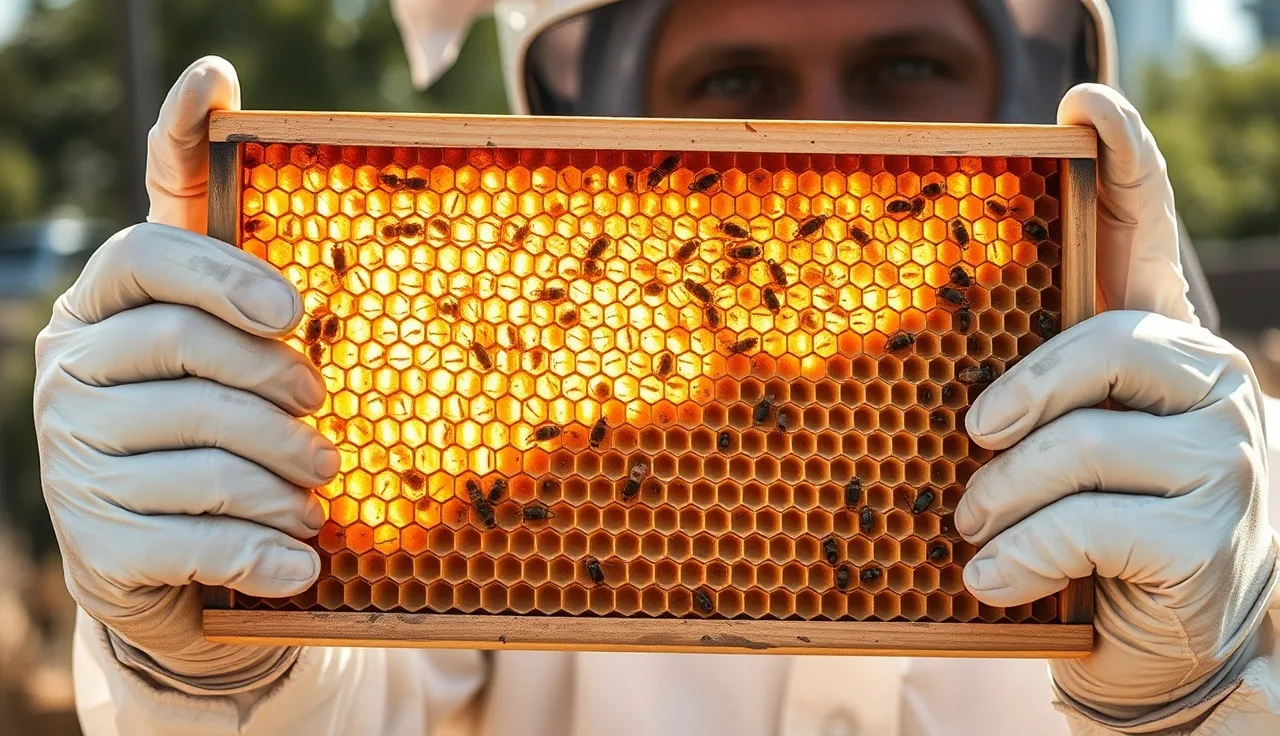
A healthy brood frame looks almost uniform: slightly domed, dry, tan-to-brown cappings stretched tight across cells in a solid pattern. Sunken cappings look the opposite. The wax is depressed inward, sometimes greasy or dark, occasionally punctured with a small hole. The cell beneath stays sealed, but something has gone wrong inside it.
Beekeepers pay attention because a frame with scattered sunken cappings is often the first thing you see before a hive gets into real trouble. That trouble is usually one of two things: varroa mites reproducing in the brood, or a disease called sacbrood. Sometimes both. A spotty, sunken capping pattern on otherwise healthy-looking brood is not cosmetic. It is a distress signal.
The descriptions vary. Some beekeepers see individual cappings that look like someone pressed a thumb into the wax. Others see pinhole perforations. Others just notice that a patch of brood looks greasy or wet compared to the rest of the frame. Every one of these points back to the same question: what is happening inside that cell, and is it varroa?
How does varroa actually cause sunken or perforated cappings?
Varroa destructor mites reproduce almost entirely inside capped brood cells [1]. A mated female (the foundress) slips into a larval cell just before it is capped, hides in the brood food, and starts laying eggs once the cell is sealed. She and her offspring feed on the developing pupa's fat body and spread multiple viruses while they do it.
The cap distorts through two related mechanisms. Bees with hygienic behavior can detect the chemical signature of an infested or diseased cell and will partially uncap it to investigate or pull the pupa [2]. That partial uncapping leaves the cap sunken and sometimes perforated. Separately, the pupa itself sometimes dies or develops abnormally, and the cell contents shrink, pulling the wax cap inward.
So the sunken cap you are looking at from outside is often the hive's own immune response to what is inside. That is useful information. It means your bees are at least trying to detect and remove infested brood. Colonies with strong hygienic behavior do this more aggressively, which is one reason breeders select for the trait [2].
Not every sunken cap has a mite inside. Sacbrood virus, chalkbrood, and temperature swings in a weak colony can all produce similar-looking caps. But varroa is the most common cause across the United States today, and the mite's link to viruses like Deformed Wing Virus (DWV) means the damage compounds fast [3].
Is seeing sunken cappings enough to confirm a varroa problem?
No. Sunken cappings are a reason to test, not a diagnosis on their own.
Looking at cappings is good for triggering your attention. It is no substitute for a mite count. The only way to know your load is to run an alcohol wash or a sugar roll on a sample of roughly 300 bees from the brood nest. The Honey Bee Health Coalition recommends the alcohol wash as the most accurate method for hobbyist beekeepers, saying it estimates infestation with enough precision to drive management decisions [4].
Here is why the eyeball approach misleads you. A colony with strong hygienic behavior might show many sunken caps but carry a moderate mite load, because the bees are pulling infested brood before mites finish reproducing. A colony with weak hygienic behavior might show almost no sunken caps while sitting on a catastrophic mite level, because the bees are capping everything and leaving it alone.
Sunken cappings without a mite count is a warning light with no scan behind it. Take it seriously. Get the number before you act.
For a fuller look at the mite itself, the varroa mite article on this site walks through the full life cycle and feeding behavior in more detail.
What mite level should trigger treatment after you see sunken cappings?
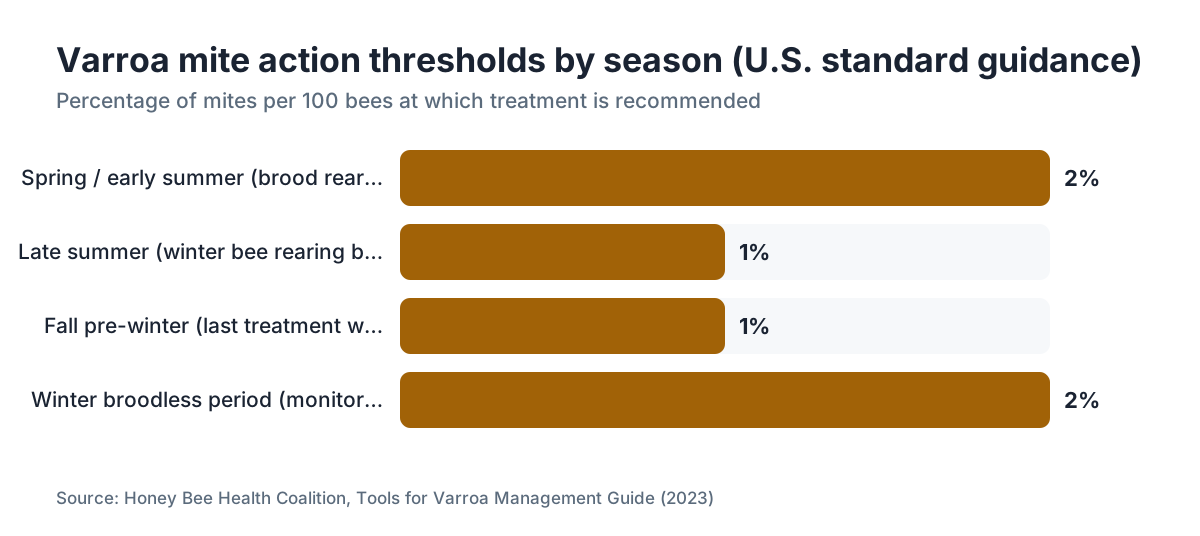
Treat at 2 mites per 100 bees or higher during the brood season. That is the action threshold in the Honey Bee Health Coalition's Varroa management guide [4]. Some university extension programs use 3%, mostly outside the summer peak. The exact line is not settled and shifts with region, season, and colony strength, but 2% is the most widely cited number in current U.S. guidance.
If you are seeing a real sunken capping pattern AND your mite wash comes back at or above 2%, treat. Do not wait for next month's inspection.
If your wash comes back below 2% but you are still seeing plenty of sunken caps, look harder at sacbrood or chalkbrood as a contributing factor, and retest in two weeks. Mite loads climb fast during a strong brood cycle.
The table below maps mite thresholds to recommended responses under standard U.S. guidance [4].
| Mite wash result | Season | Recommended action |
|---|---|---|
| Below 1% | Any | Monitor monthly, no treatment |
| 1-2% | Spring/summer | Increase monitoring frequency |
| 2% or above | Spring/summer | Treat immediately |
| 1% or above | Late summer/fall (winter bee rearing) | Treat immediately |
| Any level | After treatment | Retest 3-4 weeks post-treatment |
Can you tell varroa damage apart from sacbrood just by looking at cappings?
Sometimes, but not reliably. Both produce sunken, discolored, or punctured caps. The best visual distinction is what you find when you uncap the suspect cells yourself.
With sacbrood, the dead larva inside looks like a sac of fluid, yellow to dark brown, with a gondola or banana shape. The fluid does not smell strongly foul, which separates it from European or American foulbrood. Sacbrood is a virus and usually clears on its own in strong colonies, though it can hang on in weak ones [5].
With varroa, uncap an infested cell and you may see the mites themselves. Adult foundress mites are reddish-brown, about 1.1 mm wide, and visible to the naked eye against the white surface of the pupa. You might see one or several, depending on how far reproduction has gone. The pupa may show deformities: shortened or crumpled wings, a shrunken abdomen.
In practice, a colony carrying a heavy varroa load often has sacbrood at the same time, because varroa spreads sacbrood virus along with DWV and several other pathogens [3]. So the caps can show a mix of both problems at once. That is one more reason to get a mite count instead of diagnosing by eye.
What does a "shotgun brood pattern" mean and how does it relate to varroa?
A shotgun brood pattern is what beekeepers call it when healthy brood cells are scattered irregularly across a frame with many empty cells in between. It looks like someone fired a shotgun at the comb.
Capping problems and shotgun brood often show up together during a varroa infestation because the bees keep removing infested or diseased brood, leaving gaps. Each removed larva or pupa makes an empty cell. Over time the frame looks patchy instead of holding the solid arc of healthy brood.
A shotgun pattern can also come from a failing or spotty queen. The distinction matters because the fix is completely different. If you see shotgun brood, look for eggs. A frame with many empty cells but fresh eggs in the occupied ones usually points to a queen problem, not a pest. A frame where cells have been recently emptied and the wax around their mouths looks chewed or rough usually points to hygienic removal, which sends you back to varroa or disease.
None of this is clean diagnostics. The cappings tell you something is wrong. The mite wash tells you whether varroa is driving it. If your read points to the queen instead, our queen management coverage walks through requeening timing and how to judge a failing queen.
Which varroa treatments are approved and which ones actually work?
Every varroa treatment used in managed hives in the United States has to be EPA-registered [6]. The main approved active ingredients are oxalic acid, amitraz, and thymol (the active in Apiguard and Api-Life VAR). Formic acid (Formic Pro, MAQS) is registered too. Coumaphos (CheckMite+) stays registered but is rarely a first choice today, thanks to residue concerns and documented resistance in some mite populations [7].
Oxalic acid is the most recommended treatment for broodless periods, like midwinter or a deliberate brood break. Vaporized oxalic acid (using an EPA-registered vaporizer) or a dribble application reaches mites riding on adult bees, but it does not penetrate capped cells. That is why timing it to a broodless window matters so much [6]. When brood is present, three trickle or vapor treatments spaced 5-7 days apart can help, but efficacy drops sharply compared with a single broodless application.
Amitraz strips (Apivar) work with brood present and reach mites inside cells, which makes them a strong choice when you are treating a colony with heavy capped brood and an elevated mite load. The label requires a 42-56 day exposure period and sets specific temperature limits for use [7].
Thymol-based treatments (Apiguard, Api-Life VAR) are temperature-sensitive and work best in the 60-105 degree F range. They work with brood present, but less completely than amitraz strips.
To plan treatment timing and pick the right product for your situation, the free protocol builder at VarroaVault helps you map out a season-long plan instead of treating reactively.
The Honey Bee Health Coalition's "Tools for Varroa Management" guide, free online, is the most widely trusted resource for U.S. hobbyists comparing treatment options [4].
Does seeing sunken cappings mean the colony is about to collapse?
Not necessarily, but the risk is real and it builds faster than most new beekeepers expect.
Varroa populations grow exponentially through the brood season. A colony at 2% mites in July can hit 6-8% by September if nothing is done. At high infestation levels, the share of bees emerging with Deformed Wing Virus climbs sharply, winter bee populations get compromised, and colonies frequently collapse by late fall or early winter [3].
Scattered sunken caps in May are a different situation than heavy sunken caps everywhere in August. The May colony has time to treat and recover before winter. The August colony sits in a much tighter window, especially if winter bees are already being reared.
The research is clear on timing. A study by Kulhanek and colleagues in PLOS ONE found that colonies treated in August had significantly better overwintering survival than those treated in October, even when October mite loads were similar [8]. The mechanism is the damage done during winter bee rearing. Mites feeding on pupae during that period shorten the fat body of emerging bees and cut their odds of surviving the winter cluster.
Sunken cappings are not a death sentence. They are a fire alarm. The only real question is how fast you respond.
How do you inspect brood frames correctly to spot varroa-related capping problems?
Go through brood frames in good light, with the sun behind you so it lights up the cell surfaces. Hold the frame at an angle so light catches any change in capping height. Healthy caps look relatively uniform and slightly convex. Anything depressed, wet, greasy, or holding a small hole deserves a second look.
Mark suspicious frames with a paint marker or tape and come back to them. Uncap a sample of suspect cells with a capping fork or toothpick and look at what is inside. You are looking for the reddish-brown mite bodies (flat, oval, about 1-1.5 mm wide) [1], dead or deformed pupae, or the sacbrood sac appearance.
Do not judge off one frame. Check at least three brood frames from the center of the nest. A few sunken caps on one frame is less alarming than the same pattern spread across several.
After your visual inspection, run an alcohol wash before you make any treatment decision. The procedure: collect roughly 300 bees from a brood frame, submerge them in isopropyl alcohol or windshield washer fluid, shake for 30-60 seconds, and count the mites that fall out against the number of bees [4]. That gives you a percentage you can act on.
To pull your inspection and treatment supplies together, beekeeping supply companies that stock mite-testing kits make this easier to set up. Some free-shipping honey bee supply companies also carry the alcohol wash jars and capping forks you want on the shelf before the season starts.
Can good bee genetics reduce sunken cappings and varroa damage?
Yes, meaningfully. Hygienic behavior is a heritable trait in honey bees, and colonies that score high for hygiene detect and remove varroa-infested brood more efficiently [2]. That directly cuts the reproductive success of mites in the colony, which slows mite population growth even without chemical treatment.
Two behavioral traits have been researched heavily. Varroa Sensitive Hygiene (VSH) is a trait where bees preferentially remove mite-infested cells. Colonies with high VSH scores can suppress mite reproduction significantly. Recapping behavior, where bees detect and respond to compromised caps, is related but distinct.
The visible effect of good hygienic behavior is exactly what we have been talking about: more sunken, opened, or partially chewed caps where the bees found a problem and acted on it. A hive with great hygiene may look messier in its cappings than a low-hygiene hive, but it is doing better at varroa control.
The practical limit is that buying VSH-selected queens or grafting from hygienic lines takes access to reputable breeders and a willingness to requeen regularly. It does not remove the need for monitoring and treatment, but it does cut how often treatment becomes urgent [2].
The USDA Agricultural Research Service Honey Bee Breeding, Genetics and Physiology Research unit in Baton Rouge has published extensively on VSH trait selection, and its work is the basis for most commercial breeding claims about hygienic behavior [9].
What should your full response plan look like after spotting sunken cappings?
Step one: run an alcohol wash the same day or the next. Do not wait.
Step two: record your mite count and the date. Write it down. Memory is unreliable across a season of multiple hives.
Step three: if you are at or above 2%, pick a treatment that fits your current brood situation and the season. Read the EPA label for the product you choose and follow it exactly. Off-label application is illegal and often ineffective [6].
Step four: treat, then retest 3-4 weeks after treatment ends. A retest is not optional. It confirms whether the treatment worked and whether reinfestation from neighboring colonies has started. Mites from nearby collapsing colonies (the mite bomb effect) can reinfest a treated hive within weeks.
Step five: document everything. Date of inspection, what you saw, mite count, treatment used, start and end date, post-treatment count. Over a few seasons this record becomes genuinely useful for spotting patterns in your own apiary.
This is the kind of seasonal protocol workflow VarroaVault's free tools are built around: tracking counts, timing treatments to brood cycles, and flagging when a retest is due. If you want to work backward from your goal, our treatment calendar guide lines up these steps against the brood cycle month by month.
For the materials themselves, a reliable beekeeping supply companies source matters. Treatment products, alcohol wash kits, and capping forks should be on hand before you need them, not ordered in a panic after a bad inspection.
Frequently asked questions
Are sunken cappings always caused by varroa mites?
No. Sacbrood virus, chalkbrood fungus, and temperature stress in a weak colony can all produce sunken or discolored cappings. Varroa is the most common cause in U.S. colonies today, but you should uncap a few suspicious cells and run an alcohol wash before assuming varroa is the driver. What you find inside the cell (mite bodies, deformed pupae, or a fluid-filled larval sac) helps tell the causes apart.
How many sunken cappings are "too many" before I should be worried?
There is no officially defined number. Even a handful of sunken caps scattered across a frame warrants a closer look and a mite wash. If you see the pattern on multiple frames, or the caps look consistently greasy or perforated rather than isolated, treat it as an urgent signal to test. The capping appearance triggers the test; the mite count triggers the treatment decision.
Can I treat for varroa just based on looking at the cappings without doing a mite wash?
You can, but it is not recommended practice. Visual inspection alone cannot tell you whether your mite load is 1% or 8%. Treating when mites are low wastes money and exposes your bees to treatment chemicals for no reason. Missing a high load because you assumed the caps looked okay is much worse. The alcohol wash takes about 10 minutes and gives you an actual number to act on.
What does a varroa mite look like inside a capped brood cell?
Adult female varroa mites are reddish-brown, flat, oval, and roughly 1.1 mm wide by 1.6 mm long. They are visible to the naked eye against the white surface of a pupa. If you uncap a suspicious cell and see one or more small reddish-brown discs clinging to the pupa, those are mites. Immature mites (protonymphs and deutonymphs) are smaller and whitish but still visible with a hand lens.
Do bees with good hygienic behavior cause more sunken cappings on purpose?
Yes, that is essentially what happens. Hygienic bees detect the chemical signals from varroa-infested or diseased cells, partially uncap them to investigate, and then either recap or remove the contents. This creates the sunken, perforated, or recapped appearance. Counterintuitively, a hive showing this behavior may have better mite suppression than one with clean-looking, undisturbed caps over equally infested brood.
What is the difference between sunken cappings and sunken comb wax issues like cross-comb?
Sunken cappings means the brood cap surface is depressed or perforated, which happens at the individual cell level. Cross-comb or collapsed comb are structural issues affecting whole combs. They are unrelated problems. Sunken cappings are always judged cell by cell on a brood frame, not at the level of comb structure or hive architecture.
If I see deformed wing virus symptoms (crumpled wings) on adult bees, does that confirm varroa caused my sunken cappings?
It is strong supporting evidence. Deformed Wing Virus is spread mainly by varroa feeding on pupae during capping [3]. Seeing both crumpled-wing bees and sunken caps together makes varroa the most likely explanation. But you still need a mite wash to know your actual infestation level, because the treatment you choose and how urgently you apply it depend on that number more than on the symptoms.
Can I reuse comb from a heavily infested hive after treating the bees?
Generally yes, if the bees have recovered and mite counts are back below threshold after treatment. Old, dark comb does accumulate chemical residues over time, and heavily infested comb may have dead pupae or mite feces in cells, but bees will typically clean and reuse it. Some beekeepers rotate out the oldest combs on a 3-5 year cycle as general hygiene practice, not specifically because of varroa.
Does sunken capping pattern get worse at certain times of year with varroa?
Yes. The pattern usually becomes most visible in late summer, when mite populations have built all season and brood is at peak density. That is also when winter bees are being reared, making late summer the most damaging time for mite-related brood disruption. Spring infestations start lower but climb fast. Most beekeepers find the worst capping problems showing up August through September in temperate U.S. climates.
How do I do an alcohol wash to confirm a varroa problem after seeing sunken cappings?
Shake or brush about 300 adult bees from a brood frame into a jar with a tight mesh lid. Add roughly 1 cup of isopropyl alcohol (70% or higher) or windshield washer fluid. Cap the jar and shake vigorously for 60 seconds, then pour the liquid through the mesh and count the mites in the wash. Divide mite count by bee count and multiply by 100 to get your percentage. The Honey Bee Health Coalition's guide has step-by-step photos [4].
Are there any oxalic acid treatments that work when brood is present?
Oxalic acid vapor applied repeatedly (typically three treatments 5-7 days apart) during a brood-rearing period can reduce mite loads, but efficacy is significantly lower than a single treatment during a broodless period. The EPA-registered label for oxalic acid vapor allows up to three applications per brood cycle. For heavy infestations with a lot of capped brood, amitraz strips (Apivar) are more effective because the active ingredient reaches mites inside cells [6][7].
What does "mite bomb" mean and can it explain sunken cappings appearing after a clean inspection?
A mite bomb is when a collapsing, heavily infested neighboring colony sends out drifting bees or gets robbed out by your bees, moving large numbers of varroa into your hive fast. Your colony can go from a clean mite wash to a problematic one in a matter of weeks. If you suddenly see sunken caps and elevated mites after previously clean inspections, a mite bomb from a nearby hive is a real possibility, more likely than treatment failure.
Is there a way to reduce varroa without chemicals if I am seeing early-stage sunken cappings?
A brood break (caging the queen for about 24 days to stop brood production) combined with oxalic acid treatment during the broodless window is an evidence-based, low-chemical approach. Drone brood removal also cuts mite reproductive success, since varroa strongly prefers drone brood. These strategies work best as prevention or when mite loads are still low. They are much less effective as rescue treatments when capping problems are already widespread and mite counts are high.
Sources
- USDA Agricultural Research Service, Bee Research Laboratory (Varroa destructor biology overview): Varroa destructor mites reproduce in capped brood cells; adult female mites are approximately 1.1 mm wide and reddish-brown
- University of Minnesota Extension, Honey Bees program (hygienic behavior): Hygienic behavior is heritable and bees expressing it detect and remove varroa-infested or diseased brood, reducing mite reproductive success
- Honey Bee Health Coalition, Tools for Varroa Management Guide (Viruses section): Varroa mites vector Deformed Wing Virus and sacbrood virus, and high mite loads correlate with increased prevalence of deformed-wing bees
- Honey Bee Health Coalition, Tools for Varroa Management Guide (Thresholds and Monitoring): Alcohol wash is recommended as the most accurate monitoring method; action threshold is 2 mites per 100 bees during brood-rearing season
- Penn State Extension, Honey Bee diseases (sacbrood): Sacbrood is caused by a virus and produces a fluid-filled, gondola-shaped dead larva; it is usually self-limiting in strong colonies
- U.S. EPA, Pollinator Protection (oxalic acid registration for honey bee hives): Oxalic acid is EPA-registered for varroa control; label allows up to three vapor applications per brood cycle and is most effective during broodless periods
- U.S. EPA, Pollinator Protection (Apivar amitraz label and registration): Amitraz strips (Apivar) require 42-56 day exposure and are effective against mites in capped brood cells; coumaphos resistance has been documented in some mite populations
- Kulhanek et al. 2021, PLOS ONE, Timing of varroa treatment and overwintering survival: Colonies treated for varroa in August showed significantly better overwintering survival than colonies treated in October, even at similar late-season mite loads
- USDA Agricultural Research Service, Honey Bee Breeding, Genetics and Physiology Research (Baton Rouge), VSH trait research: Varroa Sensitive Hygiene (VSH) is a heritable trait; colonies with high VSH scores suppress mite reproduction significantly without chemical treatment
- University of California Agriculture and Natural Resources, Integrated Pest Management for honey bee varroa: Monitoring mite levels monthly during brood season and treating at threshold prevents colony collapse more effectively than calendar-based treatment schedules
Last updated 2026-07-09