Apivar strips for varroa: how they work, when to use them, and what to watch out for
TL;DR
- Apivar strips contain 3.3% amitraz and hang between brood frames for 6 to 10 weeks.
- Field studies show 90 to 95% efficacy when applied correctly and no resistance is present.
- They work at any temperature, need no hive math, and rank among the most reliable varroa treatments a hobbyist or sideliner can buy today.
What are Apivar strips and how do they work?
Apivar is a varroa miticide made by Veto-pharma. Each plastic strip is impregnated with amitraz, a formamidine-class acaricide, at 3.3% active ingredient [1]. You hang the strips in the brood area. Bees walk across them, brush against them, and pick up amitraz on their cuticle. They then carry it through the colony, knocking off phoretic mites and, over the weeks, killing mites that emerge from capped cells.
Amitraz works on octopamine receptors. Those receptors are everywhere in arthropods and absent in vertebrates, which is why the safety profile for bees and people is decent compared to older broad-spectrum insecticides. A mite that contacts amitraz loses coordination, loses its grip, and falls off the bee.
The slow release is the whole design. One placement covers the full treatment window with no reapplication, which keeps labor low and residue more predictable than some other treatment types. The EPA has granted Apivar a Section 3 registration, so it is a federally legal treatment with a formal label [1].
Here is the part to understand up front. Apivar does not reach inside capped cells. Mites sealed in with developing brood stay protected until they emerge. That single fact drives everything about the timing. The label sets a minimum 6-week window because the strips need to stay in through at least two full brood cycles to catch mites as cells uncap.
What is the correct Apivar dosage and how do you place the strips?
The EPA-registered label is specific: 2 strips per colony for up to 5 frames of bees, plus 1 more strip per additional 5 frames [1]. A strong double-deep with 8 to 10 frames of bees still gets 2 strips. A booming colony with 11 to 15 frames gets 3. Most hobbyist single-brood-box hives need exactly 2. Sideliners running big production colonies should count bees rather than guess.
Placement decides whether it works. Hang each strip between two frames in the center of the brood nest, where traffic is heaviest. Each strip has a small wire loop at the top. Hook that loop over the top bar so the strip hangs vertically and bees can brush both faces. Do not lay strips flat on the bottom board. Do not pin them against the side of the hive body. Both mistakes cut contact hard, and beekeepers who make them report meaningfully lower knockdown, though the exact loss depends on the colony and the study.
Leave them in for the full window. The label says a minimum of 6 weeks and a maximum of 10 [1]. Pulling strips at 4 weeks because the colony looks fine is a classic error that leaves mites alive to rebound. The 10-week ceiling is about residue, not because the strips quit killing.
After removal, dispose of used strips as the label directs. Do not compost them. Do not leave them in the hive. Amitraz builds up in wax over time, and residue in heavily treated combs is a real concern researchers have tracked for years [2].
How effective is Apivar at killing varroa mites?
The honest answer: very effective when resistance is absent, and close to useless when it is present.
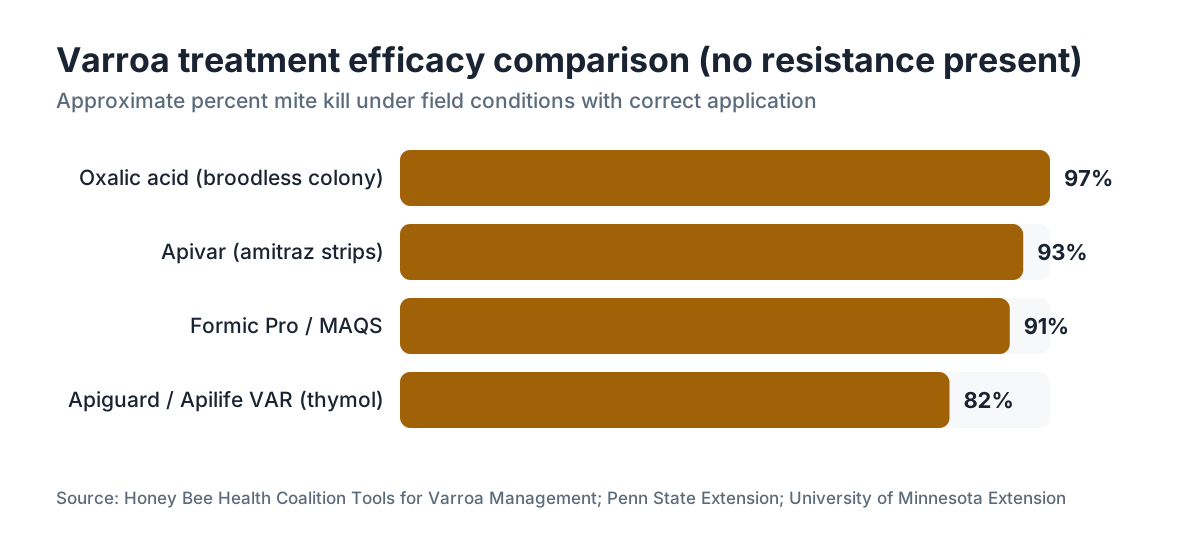
Multiple field trials put efficacy in the 90 to 95% range where amitraz resistance is not a factor [3]. A Penn State Extension review of treatment trials placed Apivar around 93% in the absence of resistance [3]. The Honey Bee Health Coalition's Tools for Varroa Management guide, which pulls together university trial data from across North America, rates Apivar as a highly effective, first-line option for colonies that still have capped brood and therefore cannot lean on oxalic acid alone [4].
Those numbers assume three things: correct placement, a full window, and no resistance already in your mites. A colony that still reads 3 to 5% infestation after a properly run Apivar treatment is waving a resistance flag. It is not telling you to add more strips.
The caveat is the whole story. If you skipped the post-treatment mite wash, you do not know whether the treatment worked. You are guessing.
Run the math and it gets concrete. A colony starting at 3% (3 mites per 100 bees) with a 93% knockdown ends near 0.2%, well under the 2% action threshold. Start at 6% and you end around 0.4%. But drop efficacy to 60% because of resistance, and that same 6% colony ends at 2.4%, still over threshold and still headed for trouble.
When should you apply Apivar strips, and are there temperature restrictions?
This is where Apivar beats oxalic acid vapor and thymol products like Apilife VAR and Apiguard on convenience. Amitraz stays active across a wide temperature range. The Apivar label sets no minimum ambient temperature for efficacy [1], so you can treat in late summer, early fall, or early spring, whenever the colony has brood that keeps oxalic acid from finishing the job.
University extension programs cluster their timing advice around two windows:
- Late summer to early fall (roughly August through October across most of the US), after supers come off, to crush mite loads before the winter bees are raised [3]
- Early spring (March through April) if a colony wakes up carrying a heavy mite load
With no temperature floor, Apivar earns its keep for northern beekeepers who need to treat in shoulder seasons, when thymol turns unreliable below about 15°C (59°F). You still cannot treat during a flow with supers on. Amitraz can taint honey, and the label bans treatment when honey supers are present [1].
The Virginia Cooperative Extension frames the timing cleanly: treat after the last honey harvest, monitor with an alcohol wash or sugar roll before and after, and aim to carry mite loads under 2% into winter brood rearing [5].
If you track hive health on a set schedule, VarroaVault's free protocol tools map Apivar windows to your local season. The timing logic is all here too.
Can you use Apivar with honey supers on?
No. This one is a hard label rule with no wiggle room.
Amitraz in honey is a food safety problem. The EPA registration for Apivar states plainly that strips must come out before supers go on, and supers should never sit on a colony during treatment [1]. The European Union sets a maximum residue limit for amitraz in honey at 200 micrograms per kilogram [6]. US retail honey is not routinely tested for amitraz, but a colony treated with supers in place risks pushing residue past that line.
Plan the treatment around your harvest. Pull supers, extract, then install strips. Run the full window, remove the strips, and give hive residue time to fall before you put supers back for a fall or spring flow. Beekeepers who treat in late summer usually run strips from August through mid-October, which clears before goldenrod or any fall flow in most regions.
Sometimes a late flow overlaps with a mite crisis. That is a genuine trade-off. The standard advice is to protect the bees over the honey, because a dead winter cluster makes no honey next year. The call is yours. The no-supers rule is not.
What is amitraz resistance in varroa mites and how do you detect it?
Amitraz resistance in varroa is real, confirmed, and spreading. It turned up in US commercial apiaries around 2010 and has been documented in multiple states since [7]. Mutations in the varroa octopamine receptor gene reduce amitraz binding, so resistant mites shrug off a normal dose.
Resistance is patchy, not uniform. An apiary or region can carry a mix of susceptible and resistant mites, which produces the confusing middle ground: mite counts drop but not to near-zero, and the colony rebounds faster than it should after treatment.
Post-treatment monitoring is the only reliable way to catch it. Run an alcohol wash 2 to 4 weeks after finishing a full Apivar treatment and compare it to your pre-treatment wash. If a colony still reads over 2 mites per 100 bees after a correct 6- to 8-week run with properly hung strips, that fits resistance. Check placement and confirm the strips stayed in for the full window before you blame the mites.
There is no home resistance test for varroa on the market as of 2025. Some university labs assay samples for the resistance mutation, but that is not routine for hobbyists. The working strategy is rotation. If Apivar is not clearing mites, move to oxalic acid (for broodless colonies) or another mode of action, and keep amitraz products out of that apiary for at least a full season.
The Honey Bee Health Coalition calls rotating miticide modes of action the main resistance management tool beekeepers have right now [4].
For the mite biology behind why resistance develops, see our varroa mite article, which walks through the lifecycle and what it means for treatment timing.
How does Apivar compare to other varroa treatments?
Here is a side-by-side of the main registered varroa treatments in the US, built from label requirements and university extension summaries [3][4][5]:
| Treatment | Active ingredient | Temp. restriction | Works with brood | Honey super rule | Typical efficacy (no resistance) |
|---|---|---|---|---|---|
| Apivar strips | Amitraz 3.3% | None | Yes | No supers | 90-95% |
| Oxalic acid vapor | Oxalic acid | Above 0°C (32°F) | No (phoretic only) | No supers | 90-99% broodless |
| Oxalic acid dribble | Oxalic acid | Above 10°C (50°F) | No (phoretic only) | No supers | 90-99% broodless |
| Apiguard | Thymol | 15-40°C (59-104°F) | Partial | No supers | 74-90% |
| Apilife VAR | Thymol | 15-30°C (59-86°F) | Partial | No supers | 74-90% |
| MAQS (Formic Pro) | Formic acid | 10-29°C (50-84°F) | Yes (penetrates caps) | No supers | 88-95% |
Apivar's edge is real: no temperature window, simple and reliable dosing, and it keeps working through the brood cycle. Its weak spots are the spreading resistance problem and the flat ban on use during a flow.
Formic acid (Formic Pro or MAQS) is the other option that works with brood, and it does something Apivar cannot: it penetrates capped cells [11]. Formic acid also sidesteps honey residue limit worries in many markets, but it demands a narrow temperature window and can kill queens or bees if you apply it in a heat wave.
Oxalic acid is the standard for broodless colonies, with efficacy near 99% in some trials when every mite is phoretic [10]. Add any brood and efficacy falls off a cliff, because capped mites are fully protected.
For a hobbyist in a region with no documented amitraz resistance, Apivar is a sound first choice for late-summer treatment while brood is still present. If resistance is suspected near you, induce a broodless period and hit them with oxalic acid vapor, or reach for Formic Pro.
What are the safety precautions for handling Apivar strips?
Amitraz is not something to handle carelessly, though at the concentration in Apivar strips the acute risk to a healthy adult stays low with basic precautions.
The label calls for chemical-resistant gloves (nitrile or latex both work) when you handle strips [1]. Amitraz absorbs through skin, and some people are more sensitive than others. Do not eat, drink, or smoke while handling them. Wash your hands well after you peel off the gloves.
Amitraz acts as a monoamine oxidase inhibitor in mammals. Anyone taking MAO inhibitor medication for depression or another condition should take extra care and may want to talk to a physician before handling strips regularly. It is not a common situation for beekeepers, but it is worth knowing.
For bees, amitraz at label rates goes down easy. A short burst of agitation right after you place the strips is normal. Overdose it (more strips than the colony size calls for) and you risk queen problems, including temporary brood suppression. Follow the dosage table and you avoid that.
Store unused strips in the original packaging, away from heat, sunlight, and any food or feed. Dispose of used strips and packaging as the label specifies. Do not burn them.
How do you know if the Apivar treatment worked?
You run a mite wash after treatment ends. Nothing else tells you the truth.
The standard protocol is an alcohol wash (or a sugar roll if you want lower bee mortality) of about 300 bees, counting mites and figuring infestation as mites per 100 bees. Do one before treatment for a baseline, then again 2 to 4 weeks after the strips come out to judge efficacy.
A good Apivar treatment drops infestation below 2 mites per 100 bees. Colonies starting at 3 to 5% usually land at 0.1 to 0.5% when everything goes right. A post-treatment reading over 2% after a full, correctly placed treatment means you switch products and start asking whether resistance has reached your area.
The Honey Bee Health Coalition recommends monitoring at set points: mid-summer to decide whether treatment is needed, right before treatment, and about 3 weeks after treatment ends [4]. That cadence captures both how bad it got and how well the treatment cleaned it up.
Logging wash results across several seasons is how you actually learn whether your management holds up and whether resistance is creeping in. VarroaVault's free monitoring tools give you a structured place to keep those numbers.
For mite wash supplies and other beekeeping supplies, compare a few vendors. Apivar prices and stock swing by region and season.
How much do Apivar strips cost and where can you buy them?
As of mid-2025, a 10-strip pack of Apivar (enough for 5 standard two-strip treatments) runs about $25 to $35 at major US beekeeping suppliers [8]. A 50-strip pack lands around $90 to $110, the better value once you have more than a handful of hives. Prices drift up in late summer when demand spikes.
Apivar sells through most beekeeping supply companies, including Dadant, Mann Lake, Brushy Mountain, and Amazon's beekeeping category. Plenty of local agricultural suppliers carry it too.
You need no prescription or veterinary sign-off to buy Apivar in the US. It is an over-the-counter product registered by the EPA. That sets it apart from some beekeeping antibiotics, which now require a Veterinary Feed Directive.
Running the per-colony math: an Apivar treatment (2 strips) costs roughly $5 to $7 at bulk pricing. Oxalic acid runs well under $2 per treatment at scale but needs a vaporizer, typically $50 to $150 for a basic unit. With 5 to 10 hives, Apivar's convenience can beat the higher per-treatment cost. Past 30 hives, a vaporizer usually pays for itself, assuming your mites stay susceptible.
If you shop the free shipping honey bee supply companies, Apivar often clears the free-shipping threshold at several major vendors.
Are there any situations where you should not use Apivar?
Yes. Several.
Do not use Apivar with honey supers on the hive. The label is explicit, and honey contamination is a real risk [1].
Do not use it when you suspect amitraz resistance in your mites. A treatment that does not work burns time and money, and time is the one resource mites exploit best. If post-treatment counts stay high, switch modes of action.
Do not use Apivar on package bees or nucs that are still building up with almost no brood. There, a broodless oxalic acid treatment is faster and cheaper. Apivar earns its place on a mature colony with brood that would otherwise shield mites from oxalic acid.
Some beekeepers steer clear of Apivar over wax contamination. Amitraz does build up in beeswax across repeated treatments. A Belgian study found amitraz residues in wax from heavily treated colonies, and researchers are still debating whether chronic low-level exposure hurts queen fertility or brood development [2]. Most extension programs land on the same advice: rotate treatments rather than running Apivar every season in the same hive.
And again, do not use Apivar during a flow or with supers on, no matter how badly the mites need hitting. The label ban protects your bees, your honey, and everyone who eats it.
What do you do if Apivar is not working on your hive?
Start by ruling out application errors. Were the strips hung in the brood area with both faces open to bee traffic? Did they stay in the full 6 to 10 weeks? Did you use the right number for the colony size? A surprising share of treatment failures trace back to strips flat on the bottom board or pulled too early.
If placement and timing checked out and counts still sit above 2% after treatment, the likely culprits are amitraz resistance or heavy reinfestation from neighboring colonies during the window. Reinfestation runs high in areas thick with beekeepers or feral colonies. If counts bounce back within a month of removal without any obvious reinfestation source, resistance climbs to the top of the list.
Either way, the next move is a different mode of action. Oxalic acid and formic acid work through mechanisms unrelated to amitraz, so no cross-resistance. Caging the queen for 24 to 25 days to force a broodless period, then hitting the colony with oxalic acid vapor, is an aggressive but effective reset for a high-mite colony with suspected resistance.
Report persistent failures to your state apiarist. Several states run extension programs watching for amitraz resistance, and your data point helps the wider map. The USDA's Bee Research Laboratory at Beltsville has done resistance assay work and backs state apiarists handling confirmed cases [9].
Frequently asked questions
How long do you leave Apivar strips in the hive?
The label sets a minimum of 6 weeks and a maximum of 10. Six weeks covers about two full brood cycles, the minimum needed to catch mites emerging from capped cells. Pulling strips early is one of the most common reasons treatments underperform. Most beekeepers aim for 8 weeks, a practical middle ground that clears the brood cycle reliably without piling up residue.
Can you use Apivar when there is still brood in the hive?
Yes, and that is one of Apivar's main selling points. Unlike oxalic acid, which only kills phoretic mites and cannot reach capped cells, Apivar's slow-release amitraz works over a long enough window to catch mites as they emerge with new bees. The full 6-to-10-week period is built specifically to cover multiple brood cycles.
Does Apivar require a minimum temperature to work?
No. The Apivar label sets no minimum ambient temperature for efficacy, unlike thymol products, which need temperatures above roughly 15°C (59°F). That makes Apivar a practical fall and early spring option in colder climates, as long as the colony still has bees moving through the brood area to contact and spread the amitraz.
How many Apivar strips do I need per hive?
The EPA-registered label says 2 strips for up to 5 frames of bees, plus 1 more per additional 5 frames. Most single-brood-box hobbyist hives need 2. A large double-deep with 10 to 15 frames of bees needs 3. Count frames of bees, not frames of comb. When in doubt, underestimating colony size costs you more than overestimating.
Is Apivar safe for the queen?
At label rates, Apivar is generally well tolerated and does not directly harm queens in normal use. Overdosing, meaning more strips than the label calls for, has been linked to temporary brood suppression and occasional queen problems. Stick to the label dosage. Some beekeepers report brief dips in egg-laying just after placement, but it usually clears within a week or two.
Can varroa mites become resistant to Apivar?
Yes. Amitraz resistance in varroa was documented in US apiaries starting around 2010 and confirmed in multiple states since. It involves mutations in the mite's octopamine receptor gene. The main way to manage it is rotating miticide modes of action, so you do not run amitraz every cycle. If post-treatment counts stay above 2% after a correctly applied Apivar treatment, resistance is a likely cause and you should switch to oxalic acid or formic acid.
Can Apivar contaminate my honey?
Amitraz can transfer to honey if supers are present during treatment. The Apivar label bans use when honey supers are on. The EU sets a maximum residue limit for amitraz in honey at 200 micrograms per kilogram. The practical rule: remove and extract supers before installing strips, run the full window, pull the strips, and only then add supers back for a later flow.
What do I do after Apivar treatment is done?
Remove the strips and dispose of them as the label directs. Wait 2 to 4 weeks, then run an alcohol wash to confirm mite levels dropped below 2 mites per 100 bees. If they did not, check placement, timing, and possible resistance. Record pre- and post-treatment counts so you can track trends across seasons. If counts are below threshold, go back to monthly monitoring.
How do Apivar strips compare to oxalic acid vaporization?
Oxalic acid vapor is more effective (near 99%) when the colony is fully broodless, but it barely touches mites when capped brood is present. Apivar works through brood cycles and needs no temperature window, but it cannot reach capped cells and carries resistance risk. Many beekeepers use both: Apivar in late summer when brood is present, then oxalic acid vapor on a broodless winter cluster if counts warrant.
Can you use Apivar in a nucleus colony (nuc)?
Yes, but a small nuc (3 to 5 frames) still gets 2 strips per the label's minimum. In a very small nuc with little brood, an oxalic acid dribble or vapor during a broodless window can be a more proportionate choice. If you use Apivar in a nuc, make sure the strips hang in the actual brood cluster, not in empty comb where bees rarely travel.
How does amitraz in Apivar affect bees?
At label rates, amitraz has low toxicity to adult honey bees. Bees carry it through the colony by contact transfer, which is exactly what makes it work. Short-term agitation right after placement is normal. At overdose levels, amitraz can stress bees and suppress brood. The residue builds up in beeswax over repeated treatments, one reason extension programs push rotating treatments each season.
Is Apivar approved for use in all US states?
Apivar holds federal EPA registration, which covers all 50 states. Some states add their own registration requirements, and a handful update their pesticide registries periodically. The safest move is to confirm registration status with your state department of agriculture before buying, especially in states with strict pesticide rules. In practice, it sells widely across the US.
Where should the strips be placed inside the hive?
Hang each strip vertically between two frames in the center of the brood nest, hooking the wire loop over a top bar. Both flat faces should sit open to bee traffic. Do not lay strips flat on the bottom board, do not press them against hive walls, and do not stick them in the honey storage area away from the cluster. Contact surface area is everything for amitraz transfer.
Can I use Apivar and oxalic acid at the same time?
No label rule bans concurrent use, and some beekeepers run a broodless oxalic acid treatment at the start or end of an Apivar window to hit phoretic and reproductive mites at once. The evidence for this combination is thin, though, and most extension guidance treats them as sequential options rather than a standard concurrent protocol. Ask your state apiarist about any regional recommendations.
Sources
- EPA - Apivar (Amitraz) Pesticide Registration: Apivar contains 3.3% amitraz, requires 2 strips per 5 frames of bees, prohibits use with honey supers, and specifies a 6-to-10-week treatment window
- Journal of Apicultural Research - Amitraz residues in beeswax: Amitraz accumulates in beeswax over repeated treatments and has been detected in wax samples from treated colonies
- Penn State Extension - Varroa Management in Honey Bee Colonies: Apivar efficacy is approximately 93% in trials where amitraz resistance is absent; late summer is the recommended primary treatment window
- Honey Bee Health Coalition - Tools for Varroa Management Guide: Apivar is rated highly effective as a first-line option for colonies with capped brood; rotating miticide modes of action is the primary resistance management strategy
- Virginia Cooperative Extension - Varroa Mite Management: Recommended treatment timing is after last honey harvest; target mite loads below 2% before winter brood rearing
- European Food Safety Authority - Maximum Residue Levels for Amitraz in Honey: The EU maximum residue limit for amitraz in honey is 200 micrograms per kilogram
- USDA Agricultural Research Service - Varroa Amitraz Resistance: Amitraz resistance in varroa mites was documented in US commercial apiaries starting around 2010
- Mann Lake Bee Supply - Apivar Strip Pricing: A 10-strip pack of Apivar retails for approximately $25 to $35; a 50-strip pack runs approximately $90 to $110 as of 2025
- USDA ARS Bee Research Laboratory - Beltsville: The Beltsville Bee Research Laboratory conducts resistance assay work and supports state apiarists investigating treatment failures
- University of Minnesota Extension - Varroa Mite Treatments: Oxalic acid vaporization achieves near 99% efficacy in fully broodless colonies; thymol products require temperatures above 15 degrees C
- North Carolina State University Apiculture - Varroa Treatment Comparison: Formic acid products achieve 88 to 95% efficacy and can penetrate capped cells unlike amitraz-based treatments
Last updated 2026-07-10