Varroa collapse vs pesticide kill: how to tell them apart
TL;DR
- Varroa collapse and pesticide kill both leave you a dead colony, but the clues split cleanly.
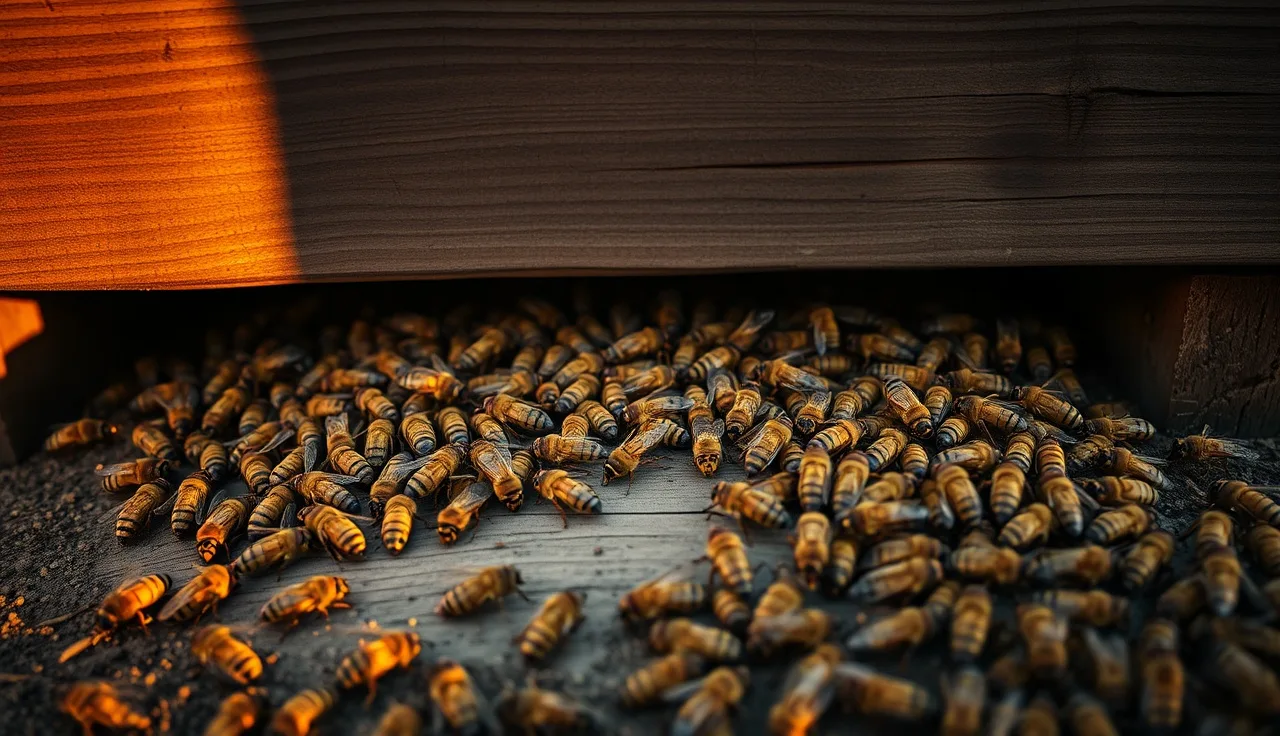
- A pesticide kill hits in hours to days, piles dead bees outside, and leaves the brood normal.
- A varroa collapse takes weeks to months, shrinks the colony gradually, gives you a spotty brood pattern, and leaves crawling bees with crumpled wings.
- The right read changes your very next move.
Why does it matter whether it's varroa or pesticides?
The wrong diagnosis points you the wrong direction, and bees pay for it. Assume pesticides and skip your mite management, and the next colony you install in that box follows the same slide down. Assume varroa and start dosing a hive that actually died from an acute spray, and you waste money, stress the neighboring hives, and push chemical residue into comb that was never the problem.
The money is real. A package of bees runs $160 to $220 across most of the US, and a nucleus colony runs $175 to $280 depending on region [1]. Losing one hive stings. Losing three in a row because you misread the cause is the kind of thing that makes people quit.
Getting it right also matters past your own fence line. Document a pesticide kill properly and you can file with your state department of agriculture, sometimes recover damages, and at minimum push for better applicator communication. EPA label language on many insecticides restricts application timing around flowering crops [2]. That evidence rots fast once you clean up the hive.
What does a varroa collapse actually look like?
A varroa collapse almost never happens overnight. You see a colony that was big in spring or summer and then quietly shrank. By the time you open the hive and think something is badly wrong, the slide has been running for one to three months.
The late-stage picture inside is consistent. A small cluster of adult bees, often too few to cover the brood nest they are trying to warm. A spotty, shotgun brood pattern with sunken or discolored cappings. A run of drone-sized or otherwise irregular cells. And bees at the front with crumpled, stubby wings, crawling instead of flying. Those wings come from deformed wing virus (DWV), and high mite loads amplify DWV transmission dramatically [3]. Find bees with shortened abdomens and stubby wings crawling in the grass, and varroa is almost certainly in the picture.
The Honey Bee Health Coalition's "Tools for Varroa Management" guide describes the late-stage colony as having "a small, spotty brood nest" with "many cells open or recapped" and an adult population too small to hold brood temperature [4]. By the time the hive fully collapses, it can look like the bees absconded. You find honey, pollen, some capped brood that never hatched, and almost no adults. Extension agents call this the "ghost hive" pattern.
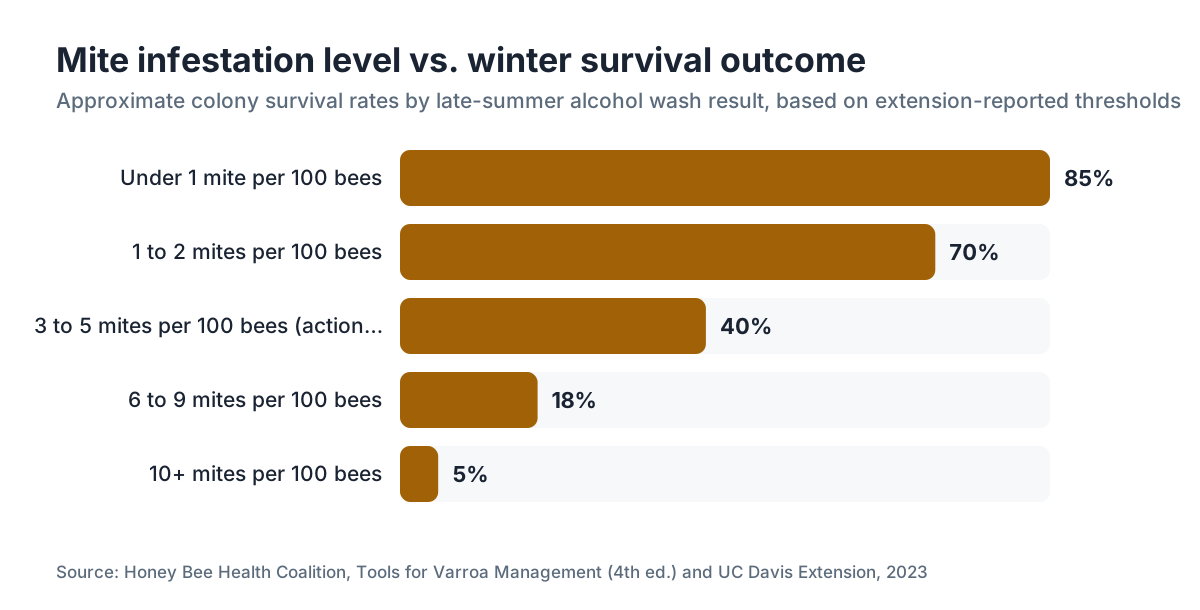
Your mite wash records tell the most important part of the story. Tracked counts above 3 mites per 100 bees in late summer, no treatment, dead colony: varroa is the likely cause. No records? Look for mites on the bees still in the cluster. Even at collapse, a hand lens will often show mites riding on adult abdomens.
For the biology behind all this, our article on varroa mite covers the reproductive cycle and why late-summer mite explosions turn deadly.
What does a pesticide kill look like?
Speed gives it away. An acute contact insecticide (organophosphates, pyrethroids, neonicotinoids applied as sprays) usually produces visible die-off within 4 to 24 hours of exposure [5]. You walk out and find a carpet of dead bees in front of one or more hives, sometimes a pile deep enough to cover the landing board and spill into the grass. Many are in the K-wing or trembling posture, or flat on their backs.
Inside, the brood is usually alive and normal. That is one of the strongest signals you get. Foragers gathered food and hauled the poison home, or they died out in the field, but the nurse bees and brood stayed protected. The shotgun pattern of a varroa hive is missing. The comb looks healthy.
Other things a pesticide kill shows you:
- The die-off hits several hives in the same yard at roughly the same time, or the hives closest to one field or orchard go first.
- The dead are mostly field-age foragers: older, darker, worn wings. A varroa collapse leaves more young bees and a run of deformed-wing individuals.
- You may find dead bees at the field source too. If you can safely check nearby flowering crops, check.
- A colony that survives a spray often rebounds if the queen lived and it was otherwise healthy. A varroa-collapsed colony does not rebound without treatment.
- Systemic poisoning (treated seed dust, contaminated pollen or nectar) runs slower and mimics disease more closely. Bees tremble, wander, or fail to fly, but the clock reads days, not weeks.
The EPA notes that contact with certain pesticides, including many pyrethroid formulations, can be lethal to bees at very low doses, and that forager losses in severe acute events can be heavy [2].
What are the 7 diagnostic signs to check at the hive?
Work the checklist in order. The more boxes you check in one column, the stronger your read.
| Sign | Points to varroa collapse | Points to pesticide kill |
|---|---|---|
| Speed of die-off | Gradual over weeks to months | Sudden, within hours to 2 days |
| Dead bee location | Few bodies outside; bees "disappeared" | Large pile outside entrance, carpet on ground |
| Brood condition | Spotty, sunken caps, irregular pattern | Normal and healthy |
| Adult bee appearance | Many with deformed/stubby wings, short abdomens | Normal wings on dead bees; possible trembling |
| Colony size trend | Shrinking for weeks before death | Was full-size shortly before event |
| Mite count history | High counts (above 3%) documented | Low counts or no recent history of mite issues |
| Neighboring hives | Other hives in apiary also declining slowly | Other hives hit at once or by proximity to field |
No single sign closes the case. A colony can carry varroa pressure and eat a pesticide dose in the same season. But when five of seven signs point one way, that is where your investigation goes.
One thing trips people up: robbing. A collapsing varroa hive gets robbed hard by its neighbors, and the fighting leaves dead bees outside. If you see fighting at the entrance plus the slow-shrinkage story plus deformed-wing bees, that is still varroa collapse with secondary robbing, not a spray event.
Can you do a mite wash on a dying colony to confirm varroa?
Yes, and you should. An alcohol wash (or a sugar roll, though alcohol reads more accurately) takes about five minutes and costs almost nothing. The widely used action threshold is 3 mites per 100 bees. Many extension programs now set it at 2 per 100 in late summer, because mite populations can double in as little as three weeks [6].
Already collapsed with only a handful of live bees? Wash whatever you can scrape from the cluster remnant. Even 50 bees give you a real number: find 10 mites and that is a 20% infestation rate, which is catastrophic and confirms varroa as at least a major factor.
Zero mites on a wash from a dead colony does not clear varroa completely. Mites leave dead colonies fast, often riding robbers into neighboring hives. But a clean wash does move pesticide up your list.
For a standardized method, the USDA AMS National Honey Bee Survey protocol lays out the alcohol wash step by step, and a hobbyist can follow it at the kitchen counter [7]. The Honey Bee Health Coalition's guide has a clear photo-illustrated version too [4].
How do you get a pesticide kill confirmed through lab testing?
Timing rules everything here. Residues degrade fast, faster in heat. Suspect a spray, and you need samples collected within 24 to 48 hours and frozen right away.
What to collect:
- At least 100 to 200 fresh dead bees in a zip-lock bag, frozen as soon as you can. No preservative. Labs need untreated tissue.
- If you have it, a comb sample of pollen (about 2 square inches of capped pollen cells) and a comb sample of honey. Systemic contamination shows up in pollen more reliably than in bee tissue.
- Photos of the scene before you touch anything: the pile, the landing board, the surrounding land, any visible crops or orchards.
Where it goes: USDA's National Science Laboratory in Gastonia, NC runs chemical residue panels on bees and pollen [8]. Several state departments of agriculture run these tests too, sometimes free when you file a report. University extension programs in big ag states (UC Davis, Penn State, Cornell, NC State) can point you to the nearest lab.
The National Pesticide Information Center (NPIC), run by Oregon State University under a cooperative agreement with the EPA, has staff who walk you through sample collection and help find labs in your state [9]. Call 1-800-858-7378.
The cost bites. Commercial residue analysis on bee tissue runs roughly $150 to $500 per panel depending on scope (a screen versus a quantitative panel). That is a lot for a hobbyist. The practical answer: call your state agriculture department first, file the incident report, and ask whether they cover the testing.
What field symptoms look similar between varroa and pesticides?
This is where diagnosis gets genuinely hard, and honesty means naming the overlap.
Trembling bees walking in circles show up with both DWV infection (from varroa) and neurological pesticide toxicity (organophosphates, neonicotinoids at sublethal doses). You cannot look at a trembling bee and tell which one it is.
Reduced foraging follows both a collapsing varroa population (too few healthy adults to work) and a sublethal pesticide dose (busted navigation, failed homing). A 2012 study in Science found that sublethal neonicotinoid exposure cut bumblebee colony weight gain and queen production, and later honey bee work showed impaired homing at field-realistic doses [10].
Missing adults is another split sign. A varroa-collapsed hive looks empty because the bees died away from home or grew too few to spot. An acute spray also strips the foragers. The tell is the speed (already covered) and the brood condition.
Acute sacbrood or European foulbrood add confusion because they also throw a spotty brood pattern. But neither produces deformed-wing adults, and neither crashes a population at pesticide speed.
The honest position: some deaths stay inconclusive. A colony with moderate mite pressure that also caught a spray is fighting both, and pulling apart their shares is not realistic without lab work.
How do robbing and absconding fit into this picture?
Both get misread as pesticide kills or mysterious disappearances, and both often trace back to varroa.
Absconding looks like this: the hive is simply empty. No dead bees outside, minimal brood, queen gone, maybe some honey. A colony that absconded under heavy mite pressure differs from a ghost hive mainly in whether any brood or mites stayed behind. True absconders leave less evidence than varroa collapses do. Africanized colonies abscond more readily than European honey bees, worth noting if you keep bees where africanized honey bees have established.
Robbing looks like this: bees fighting at the entrance, a pile of dead that includes bees from neighboring hives, torn-apart comb, honey stores stripped fast. A weak, varroa-hammered colony that gets robbed out can pass for a pesticide kill because you end up with dead bees outside and an empty box. The clues: find bees from more than one colony in the pile (watch for size and color variation) and check the honey. A pesticide kill leaves the honey; robbing takes it.
What should you do with the equipment after either type of loss?
The two paths split here, and the split matters for your next colony.
After a varroa collapse: do not drop a new package or nuc onto that comb without dealing with mites first. Varroa can survive on capped brood in empty equipment for up to 8 days after the colony dies [6]. Any capped brood remaining? Freeze all the frames for at least 48 hours (24 hours at 0 degrees Fahrenheit kills mites and small hive beetle eggs), then store them sealed. The wax from a varroa-collapsed hive is otherwise fully reusable. Do not treat the comb with oxalic acid. Oxalic works on bees, not on comb.
After a pesticide kill: the honey, pollen, and wax can carry residue. This one is harder. If a systemic pesticide came in through contaminated pollen, that pollen comb can keep exposing any new colony you install. Freeze the comb anyway (belt and suspenders), call your state department of agriculture, and if you filed a damage claim, destroy no evidence until they say you can.
Either way: clean the bottom board and document everything with photos and written notes: the date, the weather, any nearby ag activity you know about. Good notes are the difference between a usable record and a fading memory.
How do you report a pesticide bee kill?
Every US state runs a department of agriculture with a pesticide regulatory program. That is your first call. Many keep a dedicated incident hotline. Filing does three real things: it creates a legal record, it can trigger an investigation, and it qualifies you for any reimbursement program your state offers.
At the federal level, the EPA maintains a pesticide incident reporting system, and some incidents are reportable under FIFRA (Federal Insecticide, Fungicide, and Rodenticide Act) Section 6(a)(2) by the registrant. As a beekeeper, though, you work at the state level in practice [2].
The Apiary Inspectors of America keeps state-by-state contact information for apiary inspectors, and your state apiarist can advise on the reporting process for your area [11]. Do this before you clean up the hive.
One blunt reality: the burden of proof falls on you. Without frozen samples and documentation, a pesticide claim is very hard to support. Labs cost money. Investigations take months. Most hobbyists do not recover damages. That is the honest picture. But filing still feeds the aggregate data regulators use, and it may help another beekeeper down the road from you.
What varroa monitoring tools help you prevent getting to this point?
The best diagnostic tool is the one you use before the colony dies. A mite wash every four weeks from July through September is the most reliable early warning a hobbyist has. Hit 3 mites per 100 bees and treat. Treat, recheck four weeks later, and still see 3 per 100? Either the product failed, the application was off, or the mites are resistant and you need a different treatment class.
The Honey Bee Health Coalition's "Tools for Varroa Management" guide, now in its fourth edition, has decision trees for exactly this: what to do when counts run high, when a treatment fails, and how to rotate active ingredients to slow resistance [4]. It is free to download and is the closest thing the industry has to a consensus protocol.
Tracking several hives across a season is easier with a simple paper log or spreadsheet: wash date, mite count, hive ID, treatment history. That record makes the post-loss diagnosis far cleaner. If you want a template, VarroaVault's free tools include a mite tracking log and a seasonal treatment calendar you can print or run digitally.
Two things that waste money in the monitoring context: sticky boards as a primary tool (they measure mite fall, which tracks actual infestation poorly next to a wash [4]), and mite counters that were never validated against the alcohol wash standard. The wash costs about $2 in rubbing alcohol and five minutes. Do the wash.
What does good prevention look like going forward?
Preventing both problems comes down to timing and communication.
For varroa: the highest-leverage move is a late-summer treatment timed to protect your winter bees. The bees that carry a colony through winter are raised in August and September. High mite levels in July and August mean those bees develop in cells with reproducing mites, catch DWV, and emerge compromised. A treatment window of late July to early August across most of the northern US gives oxalic or formic acid time to knock the mite population down before those winter bees get capped. UC Davis and Penn State extension both back this timing [6].
For pesticide exposure: the practical fix is talking to nearby farmers and applicators. If an orchard down the road sprays during bloom, talk to the grower. Ask for a heads-up before application. Plenty of applicators will give a 48-hour warning that lets you close the hives at dusk and reopen after. That conversation costs nothing and can save a colony.
You can also register your apiary in states that run voluntary notification programs. BeeCheck and similar platforms link growers and beekeepers, though coverage varies by region [12].
For sourcing beekeeping supplies that hold up a monitoring routine, buy from suppliers that make good gear. Cheap wash kits and flimsy mite trays hand you bad data. The equipment is simple, but it has to work.
One last thing, said plainly: lose colonies two seasons running with no documented pesticide event, and you assume varroa until proven otherwise. Colony loss data consistently names varroa and the viruses it carries as the leading biological stressor in managed US honey bee colonies [3]. Pesticide kills are real and serious. Varroa is more common and more preventable with the tools you already have.
Frequently asked questions
How fast do bees die in a pesticide kill versus a varroa collapse?
A contact pesticide kill from pyrethroids or organophosphates usually shows visible die-off within 4 to 24 hours of exposure. A varroa collapse unfolds over weeks to months as the population slowly shrinks. If you walked past the hive three weeks ago and it seemed fine, and now it is empty or nearly dead, that timeline points away from an acute spray and toward a gradual varroa-driven decline.
Can a colony die from both varroa and pesticides at the same time?
Yes. A colony under heavy mite pressure has a compromised immune response, fewer nurse bees, and weaker adults. That same colony is more vulnerable to any added stressor, pesticide exposure included. Co-occurring causes are genuinely common and make a clean diagnosis harder. Lab testing on bee tissue and comb is the only way to separate the contributions, and even then results show presence of a pesticide, not necessarily cause of death.
What does deformed wing virus look like and is it only caused by varroa?
Deformed wing virus (DWV) produces bees with crumpled, stubby wings, shortened abdomens, and bloated bodies. They cannot fly and crawl at the entrance before dying. Varroa mites transmit DWV when they feed in capped brood cells, and high mite loads amplify virus levels dramatically. DWV can spread through other routes at low levels, but large numbers of deformed-wing bees point almost certainly to varroa.
Is an empty hive always varroa or could it be something else?
An empty hive has several possible causes: varroa collapse (most common), absconding, robbing to completion, or, rarely, a fast pesticide kill that stripped the foragers and was followed by robbing. Small hive beetle can crash a weak colony in warm climates. American foulbrood eventually leaves a dead, foul-smelling hive with scale on the cell bottoms. Check brood condition, smell the frames, and look for mite evidence before you decide.
How do I collect bee samples for pesticide testing and how long do I have?
Collect 100 to 200 fresh dead bees in a sealed plastic bag and freeze them immediately. No preservative. Also bag a small comb sample of pollen if you have it. You have roughly 24 to 48 hours before residue levels degrade significantly in warm weather. Contact your state department of agriculture and the National Pesticide Information Center (1-800-858-7378) before shipping. USDA's National Science Laboratory in Gastonia, NC runs residue panels on bee tissue.
What mite count level indicates a colony is heading toward collapse?
A count of 3 mites per 100 bees is the widely used action threshold in the US, backed by the Honey Bee Health Coalition and multiple university extension programs. Some programs now recommend treating at 2 per 100 in late summer because mite populations can double in three weeks. Any count above 6 per 100 going into fall means very poor winter survival odds without immediate treatment.
Why are the dead bees sometimes missing from a varroa-collapsed hive?
Bees dying from varroa-related disease often die away from the hive while foraging or shortly after leaving. Others die inside and get carried out by house bees. By the time the colony is too small to sustain itself, most of the death has already happened away from the entrance. That creates the ghost hive pattern: honey, some capped brood, very few adults, and no obvious pile outside.
Will the comb from a pesticide-killed hive hurt my next colony?
Possibly, if the kill involved a systemic pesticide that contaminated pollen stores. Pyrethroid and organophosphate residues bind to wax and can persist for years. Neonicotinoid residues in pollen comb are a documented exposure route for new colonies. Suspect systemic contamination, and the conservative move is to keep pollen-heavy frames out of a new colony until lab testing clears them. Structural wax with no pollen is lower risk.
Are there bee diseases that mimic pesticide poisoning?
Yes. Acute sacbrood virus and nosema can produce dead and dying bees at the entrance with behavioral symptoms similar to sublethal pesticide poisoning, including trembling and difficulty flying. Isle of Wight disease (acarine mite infestation of the trachea) produces crawling, K-winged bees. Brood condition and speed of onset are the clearest differentiators. Brood diseases do not produce the rapid, massive forager die-off that acute pesticide poisoning does.
Do I need to report a varroa collapse to any authority?
In most US states there is no mandatory reporting for a varroa-related loss. But if you believe American foulbrood is involved, most states do require reporting because of quarantine rules. Your state apiarist can advise. Registering your apiary location is voluntary but useful in many states. Reporting is not required, though documenting losses with mite counts and treatment records helps you and your state's colony loss tracking.
Can sticky boards reliably detect a high varroa infestation before collapse?
Not reliably as a primary tool. Sticky board counts measure the mites falling naturally over 24 or 48 hours. Mite fall tracks total mite load, but the relationship shifts with colony size, time of year, and treatment history. The alcohol wash gives a direct percentage of bees infested and is more actionable. The Honey Bee Health Coalition recommends the alcohol wash or CO2 roll over sticky boards for monitoring.
How do I tell if nearby agriculture caused a pesticide kill versus exposure from my own equipment?
Timing and pattern are the main clues. An agricultural pesticide event usually hits foragers returning from one direction or field, and multiple apiaries in that flight radius may go down at the same time. Exposure from in-hive treatments gone wrong (wrong dose, wrong temperature, wrong timing) typically affects only your own hives, shows up as queen loss or slow brood die-off rather than a forager pileup, and lines up with a recent treatment date.
Sources
- USDA National Agricultural Statistics Service, Honey Bee Colonies report: Honey bee package and nucleus colony pricing context; NASS tracks colony inventories and associated industry pricing data.
- EPA, Protecting Bees and Other Pollinators from Pesticides: EPA label requirements restrict pesticide applications around flowering crops; contact with certain insecticides can be lethal to bees at very low doses and forager losses can be severe.
- USDA Agricultural Research Service, Bee Research and Colony Health: Varroa mites and the viruses they vector, including deformed wing virus, are identified as the leading biological stressor in managed US honey bee colonies.
- Honey Bee Health Coalition, Tools for Varroa Management Guide (4th edition): Late-stage varroa collapse described as a small, spotty brood nest with many cells open or recapped; sticky boards recommended against as primary monitoring; alcohol wash endorsed as primary monitoring method.
- Penn State Extension, Honey Bee Pesticide Poisoning: Acute contact insecticide kills typically produce visible die-off within 4 to 24 hours; large piles of dead foragers at the entrance are characteristic.
- UC Davis Department of Entomology and Nematology, Bee Colony Losses and Varroa: Action threshold of 2 to 3 mites per 100 bees; mite populations can double in approximately three weeks in summer; varroa mites can survive on capped brood in empty equipment for up to 8 days; late-July to early-August treatment window endorsed for protecting winter bees.
- USDA AMS, National Honey Bee Disease Survey Protocol: Standardized alcohol wash protocol for mite monitoring used in the National Honey Bee Survey, applicable by hobbyist beekeepers.
- USDA AMS, Science and Technology Laboratory Testing (Gastonia, NC): USDA's National Science Laboratory in Gastonia, NC runs chemical residue panels on bee tissue and pollen samples.
- National Pesticide Information Center (NPIC), Oregon State University / EPA cooperative agreement: NPIC provides bee pesticide kill guidance, sample collection advice, and state lab referrals at 1-800-858-7378.
- Whitehorn et al., Science 2012, Neonicotinoid Pesticide Reduces Bumble Bee Colony Growth and Queen Production: Sublethal neonicotinoid exposure reduced bumblebee colony weight gain and queen production; follow-on research demonstrated impaired homing in honey bees at field-realistic doses.
- Apiary Inspectors of America, State Apiarist Directory: State-by-state contact information for apiary inspectors who can advise on pesticide incident reporting procedures.
- BeeCheck / FieldWatch, Pollinator Protection Platform: BeeCheck platform connects growers and beekeepers for voluntary notification of pesticide applications; coverage varies by state.
Last updated 2026-07-09