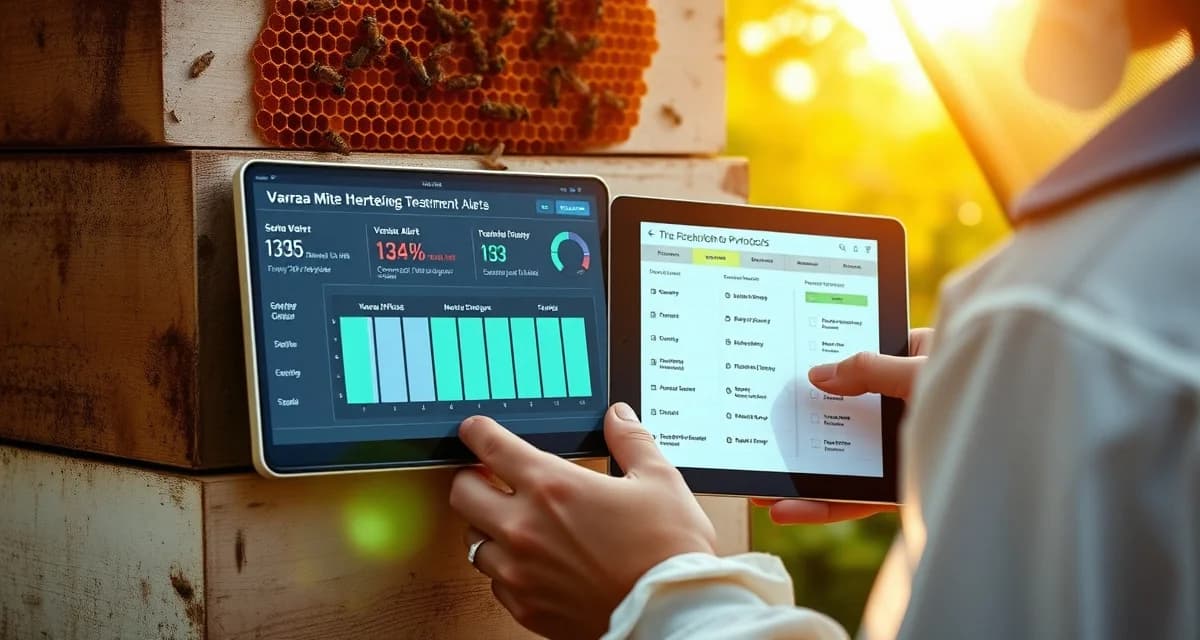
Building an Early Warning System for Varroa: Monitor, Alert, Act
Beekeepers with a pre-decided treatment protocol act 10 days faster after a threshold alert than those deciding in the moment. That 10-day difference is the gap between catching a problem before it compounds and letting a developing infestation get ahead of you. An early warning system isn't just about detecting the problem sooner; it's about removing the decision friction so you act immediately when you need to.
Here's what an effective varroa early warning system requires and how to build one.
TL;DR
- This guide covers key aspects of building an early warning system for varroa: monitor, alert,
- Mite monitoring should happen at minimum every 3-4 weeks during active season
- The 2% threshold in spring/summer and 1% in fall are standard action points based on HBHC guidelines
- Always run a pre-treatment and post-treatment mite count to calculate efficacy
- Treatment records including product name, EPA number, dates, and counts are required for state inspection compliance
- VarroaVault stores all monitoring and treatment data with automatic threshold comparison and state export formatting
The Three Components of an Early Warning System
Component 1: Regular monitoring.
You can't get an early warning from data you don't have. Monitoring that happens monthly (minimum) during the active season gives you the count trend that makes early detection possible. Monitoring that happens only when you remember or only when you're worried is reactive, not early warning.
The monitoring piece requires a schedule with reminders. Not "I'll count this month sometime" but "I count the first weekend of each month April through October, and my phone reminds me." Regular cadence converts counting from an occasional task into a system.
Component 2: Automated threshold alerts.
A count of 1.8% with a rising trend toward 2% means something different from a count of 1.8% that's been stable for two months. Without automated trend analysis, you're interpreting each count in isolation. With threshold alerts set at 2% (pre-winter) or 3% (active season), you get notified the moment a count crosses the line.
The automated alert removes the requirement to always remember your threshold and compare manually. You log a count; the system does the comparison; you get notified. Automation makes the early warning reliable.
Component 3: A pre-decided treatment protocol.
When an alert fires, you need to be ready to act. The 10-day delay for beekeepers who haven't pre-decided their response comes from decision time: What should I use? Do I have it? When's the right temperature? What's my PHI situation?
Pre-deciding your treatment protocol means: if count exceeds 2% in September, I use Apivar. If count exceeds 3% in June with supers on, I use Formic Pro. These decisions can be made in advance based on your certification status, resistance history, and seasonal constraints. When the alert fires, you've already made the decision. You're just executing.
What to Set Up Before You Need It
Monitoring schedule: Set count reminders for the first week of each month from April through October. In July and August, add a mid-month count. In September, count every 3 weeks.
Threshold settings: Use 3% as your active season threshold and 2% as your pre-winter threshold (tightening from August onward). Adjust based on your operation's specific risk profile. High-reinfestation-risk apiaries may warrant a lower active season threshold.
Pre-decided treatment protocols:
- Spring (April-June): If above threshold, use OA vaporization extended protocol (3-5 applications, 5-7 days apart). Supers likely not on yet, full options available.
- Summer (June-August), supers on: Formic Pro or MAQS (both can be used with supers on per label). Or remove supers and use Apivar.
- Late summer (August), supers off: Apivar for maximum efficacy. OA vaporization extended protocol if rotating away from amitraz.
- Fall (September-October): Formic Pro or OA vaporization if temperature cooperates. Apivar if amitraz-naive colony and threshold is significantly exceeded.
- Winter broodless: OA dribble.
Product inventory: Have your go-to product on hand before you need it. An early warning system fails if the alert fires and you're waiting 5 days for a product to arrive. Keep one treatment cycle worth of your primary products in stock.
Setting Up VarroaVault as Your Early Warning System
VarroaVault's early warning score rates your system readiness based on three factors:
- Testing frequency: When did you last count? How often are you counting? A count within the last 30 days = full score. Longer gaps reduce the score.
- Alert configuration: Which alerts are active? Threshold approach, count overdue, PHI expiry, treatment step reminders, and resistance flags each contribute to the early warning readiness score. All five active = full score.
- Pre-decided protocol: Have you set your treatment preferences for each season? VarroaVault's treatment preference settings allow you to pre-select your default treatment by season, certification status, and temperature range. When an alert fires, your pre-decided protocol appears as the primary recommendation.
The readiness score appears on your dashboard. A low score tells you which component is incomplete.
What to Do When a Threshold Alert Fires
- Confirm the count is accurate. A single count above threshold that seems out of pattern warrants a verification count from a different part of the brood nest. If the second count confirms, proceed.
- Check your treatment inventory. Do you have your pre-decided product on hand?
- Check the weather forecast for temperature-dependent treatments. Formic acid requires 50-85°F. OA vaporization is affected by temperatures below 50°F.
- Act within 48 hours of confirming. The 10-day delay statistic comes from beekeepers who don't pre-decide and spend time researching, ordering, and waiting. With a pre-decided protocol and product in stock, 48 hours is achievable.
- Log the treatment in VarroaVault immediately. The system creates your efficacy baseline and schedules the post-treatment count reminder.
Frequently Asked Questions
What makes a good varroa early warning system?
Three components: regular monitoring on a scheduled cadence (monthly minimum during active season), automated threshold alerts that fire when counts cross your action threshold, and pre-decided treatment protocols that remove decision friction. The monitoring provides the data; the alerts provide the trigger; the pre-decided protocol enables immediate action. All three are necessary. A monitoring-only system without alerts misses the automation piece. Alerts without pre-decided protocols create delay.
How do I set up VarroaVault as an early warning system?
Configure your monitoring schedule (monthly count reminders in Apiary Settings), set your threshold levels (2% pre-winter, 3% active season in Hive Settings), enable all five alert types in Settings > Notifications, and set your treatment preferences for each season in Treatment Preferences. The early warning readiness score on your dashboard shows which components are fully configured. All three components active = full early warning capability.
What should I do when I receive a threshold alert?
Confirm the count with a verification sample if the result seems unusual. Check your product inventory and confirm your pre-decided treatment is available. Check the temperature forecast if using a temperature-dependent treatment. Act within 48 hours of confirmation. Log the treatment immediately so VarroaVault creates your efficacy baseline and schedules your post-treatment count reminder. Pre-decided protocols and stocked inventory make this 48-hour window achievable.
How do I know if my varroa treatment is working?
Run a mite count 2-4 weeks after the treatment ends and compare it to your pre-treatment count. The efficacy formula is: ((pre-count - post-count) / pre-count) x 100. A result above 90% indicates effective treatment. Results below 80% should trigger investigation for possible resistance, application error, or reinfestation. Log both counts in VarroaVault to track efficacy trends across treatment cycles.
How often should I check mite levels in my hives?
At minimum, once per month (every 3-4 weeks) during the active season. Increase to every 2 weeks when counts are near threshold or after a treatment to verify it worked. In fall, monitoring frequency matters most because the window to treat before winter bees are raised is narrow. VarroaVault's monitoring reminders can be set to your preferred interval for each apiary.
What records should I keep for varroa management?
Each record should include: date of count or treatment, hive identifier, monitoring method used, number of bees sampled, mites counted, infestation percentage, treatment product name and EPA registration number, dose applied, treatment start and end dates, and PHI end date. State apiarists typically expect this level of detail during inspections. VarroaVault captures all of these fields in a single log entry.
What is Building an Early Warning System for Varroa: Monitor, Alert, Act?
A varroa early warning system is a structured approach to mite monitoring that combines regular alcohol wash or sugar roll counts, predefined action thresholds, and a pre-decided treatment protocol. Rather than reacting to visible colony decline, it catches infestations before they compound. The system has three core components: consistent monitoring on a set schedule, threshold-based alerts that trigger action, and a ready treatment plan that eliminates decision delay when counts exceed safe levels.
How much does Building an Early Warning System for Varroa: Monitor, Alert, Act cost?
Building a varroa early warning system costs nothing beyond your existing beekeeping equipment. Alcohol washes require isopropyl alcohol, a jar, and a mesh lid—materials most beekeepers already own. The real investment is time: roughly 15–20 minutes per hive every 3–4 weeks. Digital tools like VarroaVault can automate threshold comparisons and record-keeping at low or no cost, but the core monitoring practice itself requires no special purchase.
How does Building an Early Warning System for Varroa: Monitor, Alert, Act work?
The system works by combining scheduled mite counts with preset action thresholds. Beekeepers perform alcohol washes every 3–4 weeks during active season and compare results against standard thresholds: 2% in spring and summer, 1% in fall. When a count crosses the threshold, a pre-chosen treatment is applied immediately—no deliberation needed. Pre- and post-treatment counts measure efficacy. Research shows beekeepers with pre-decided protocols act 10 days faster than those deciding in the moment.
What are the benefits of Building an Early Warning System for Varroa: Monitor, Alert, Act?
The primary benefit is catching mite infestations before they reach levels that cause colony collapse or virus transmission. Acting on data rather than visible symptoms gives you a 10-day head start on a developing problem. Secondary benefits include state inspection compliance through proper treatment records, measurable treatment efficacy via pre- and post-count comparisons, and reduced decision fatigue. A documented system also makes it easier to spot patterns across seasons and improve your management over time.
Who needs Building an Early Warning System for Varroa: Monitor, Alert, Act?
Any beekeeper managing colonies during active season needs a varroa early warning system, but it is especially critical for hobbyists with limited time who may go weeks between inspections, commercial operators managing multiple yards where infestations can spread between hives, and new beekeepers who lack the experience to recognize early infestation symptoms visually. Beekeepers in regions with high varroa pressure or those who have lost colonies to mite-related collapse in previous seasons benefit most from a structured, threshold-driven approach.
Related Articles
Sources
- American Beekeeping Federation (ABF)
- USDA ARS Bee Research Laboratory
- Honey Bee Health Coalition
- Penn State Extension Apiculture Program
- Project Apis m.
Get Started with VarroaVault
The information in this guide is most useful when you have your own mite count data to apply it to. VarroaVault stores every count, flags threshold crossings automatically, and builds the treatment history you need for state inspections and effective management decisions. See pricing and free tools at varroavault.com.