Varroa treatment options: every approved method compared
TL;DR
- U.S.
- beekeepers have seven EPA-registered varroa treatments across four active ingredients: oxalic acid (dribble, vapor, extended-release), amitraz (Apivar), formic acid (MAQS, FormicPro), and thymol (ApiLife VAR, Apiguard).
- The right choice depends on brood status, temperature, whether supers are on, and your mite count.
- No single treatment fits every season.
What varroa treatments are actually approved for use in the U.S.?
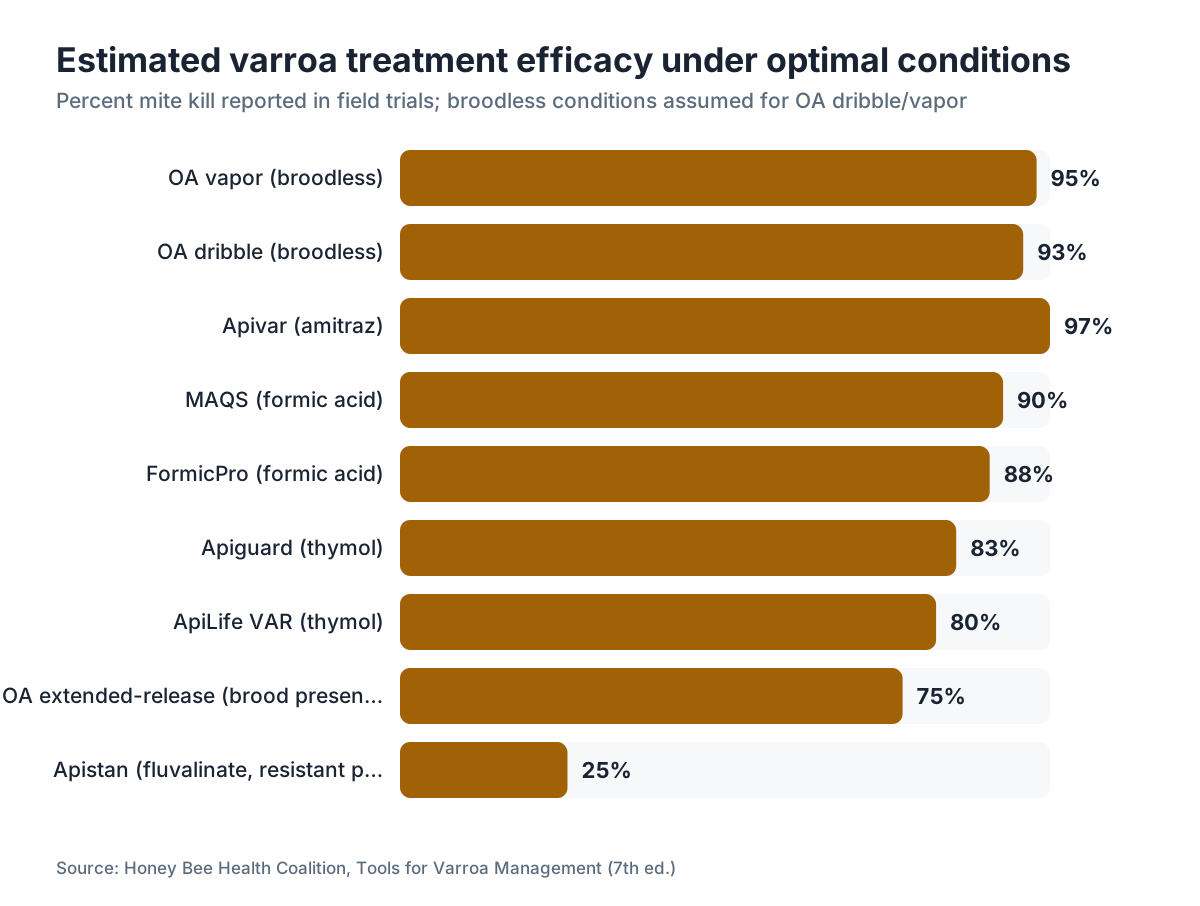
The EPA registers varroa treatments as pesticides. The label is the law. As of 2025, U.S. beekeepers have seven distinct products or formulations across four active ingredients: oxalic acid, amitraz, formic acid, and thymol. Fluvalinate (Apistan) is still registered, but resistance has wrecked its usefulness in most U.S. populations, and I'll explain below why it probably belongs on the skip list.
Here's the whole field at a glance:
| Treatment | Active ingredient | Brood penetration | Temp window | Honey supers allowed |
|---|---|---|---|---|
| Oxalic acid dribble | Oxalic acid | None | Any | No |
| Oxalic acid vapor (OAV) | Oxalic acid | None | Any | No |
| Oxalic acid extended-release (shop towel / Api-Bioxal pads) | Oxalic acid | Partial (over repeated contact) | Any | No |
| Apivar | Amitraz | Yes | 50-105°F | No |
| MAQS / FormicPro | Formic acid | Yes | 50-85°F | Yes |
| ApiLife VAR | Thymol blend | Partial | 59-69°F | No |
| Apiguard | Thymol | Partial | >59°F | No |
The Honey Bee Health Coalition's "Tools for Varroa Management" guide is the best free reference for this whole category, and I'll come back to it throughout [1]. Every beekeeper should have a copy on the shelf.
A word on Apistan (fluvalinate). It still shows up in catalogs. Multiple U.S. studies documented widespread resistance by the early 2000s, and USDA monitoring confirms it stays ineffective against most mite populations [2]. Unless you're starting from package bees with zero prior fluvalinate exposure and confirmed susceptibility, don't spend a dollar on it.
How does oxalic acid work against varroa, and when should you use it?
Oxalic acid (OA) is an organic acid found in rhubarb, spinach, and lots of other plants. It kills mites riding on adult bees by direct contact, probably by disrupting the mite's metabolism, though researchers still argue about the exact mechanism. The limitation that shapes everything: it does essentially nothing to mites sealed inside capped brood cells [1].
Because OA only hits phoretic mites, it shines during broodless periods. Winter in northern climates is the classic window. A single dribble or vaporization on a broodless colony can drop mite loads by 90% or more. The Honey Bee Health Coalition reports 90-99% efficacy for vaporization under broodless conditions [1].
Three delivery methods exist:
Dribble. You mix oxalic acid dihydrate with sugar syrup (the Api-Bioxal recipe is 35g in 1L of 1:1 syrup) and dribble about 5mL per seam of bees. It's cheap, needs no special gear, and works. The downsides: it's slow across many hives, the acid stings your airway and skin, and you need gloves and eye protection at minimum. The U.S. label calls for a 3.2% oxalic acid solution [3].
Vaporization. A sublimation device heats solid OA crystals until they turn to vapor. Bees get coated, mites die on contact. Vapor spreads through the hive more evenly than dribble and adds no moisture, which matters in winter. The cost is equipment. A good vaporizer runs $150 to $250, though cheaper units exist. A proper respirator is non-negotiable. The label requires sealing the entrance for at least 10 minutes [3].
Extended-release. Shop towel strips soaked in glycerin and OA get left in the hive for several weeks, giving mites repeated contact across brood cycles. Efficacy swings more than the broodless methods, roughly 60-90% depending on colony size, mite load, and placement. It's messier than the clean broodless treatments, but it's genuinely useful in spring and summer when you can't make a colony broodless [4].
Oxalic acid breaks down to CO2 and water in the hive and leaves no residue in honey or wax at treatment doses. That's a real edge over the synthetics.
What is Apivar (amitraz) and how effective is it?
Apivar is plastic strips loaded with amitraz, a synthetic acaricide. You hang two strips between frames of bees, leave them 6 to 8 weeks, and the amitraz diffuses out slowly, killing mites that touch the strips or the bees that brushed against them. Because bees carry the active ingredient through the whole cluster, amitraz reaches mites inside capped brood. That makes it one of the strongest tools in the box when you use it right [1].
Well-run field trials put efficacy at 93-99% mite kill when bees cover the strips well [5]. That's near the top of any registered treatment. The temperature window runs wide (50-105°F), so it works across most of the active season.
The downsides are real. Amitraz residue builds up in beeswax over repeated treatments, and studies have found amitraz and its metabolite DMPF in honey, usually below action thresholds for U.S. markets [6]. Supers come off during treatment. Strips must come out on schedule. Leaving them in too long breaks the label and speeds up resistance. Amitraz resistance is documented in Europe and starting to show in the U.S., which is the biggest cloud over this treatment's future [6].
A pack of 10 strips (enough for 5 hives) costs about $30 to $35. That's fair for the knockdown you get. I reach for Apivar on a heavily infested colony heading into fall, when I need deep kill and the temperature won't play nice with formic acid.
How does formic acid (MAQS and FormicPro) work, and what are the risks?
Formic acid is the same compound ants make. At high concentration its vapor pushes into capped brood cells and kills the mites hiding there, more than the mites on adult bees. That puts it among the only two registered treatments with real in-cell efficacy (amitraz is the other), and it leaves no lasting residue in wax or honey because it fully evaporates [1].
Two products are registered in the U.S.:
MAQS (Mite Away Quick Strips): a 7-day treatment using two formic acid gel strips laid on the top bars. The fast release comes with a cost. Studies report queen loss of 5-10% in some cases, especially above 85°F [7]. The label sets a 50-85°F range and bans use when daytime highs top 85°F for more than two days running. Honey supers can stay on during MAQS, a genuine plus for splits during a flow.
FormicPro: a similar pad-based formic acid treatment, applied as two pads for 14 days or one pad at a time for 10 days each. It was built partly to ease the temperature stress of MAQS. Queen loss looks somewhat lower in field reports, but the same temperature ceiling holds.
Both need PPE: gloves and either a respirator or good ventilation. The vapor irritates eyes and lungs. Don't apply it on a hot, still day and then linger in the yard.
Formic acid is my pick for treating during a honey flow when I can't pull supers, and for summer mite bombs when the temperature cooperates. It's not gentle, not on the bees and not on the beekeeper.
Does thymol (ApiLife VAR, Apiguard) actually work for varroa?
Yes, in the right temperature window. Thymol comes from thyme oil and other essential oils. When it warms up it volatilizes and turns toxic to varroa. Both ApiLife VAR and Apiguard are EPA-registered thymol treatments [1].
Apiguard is a thymol gel applied in two 50g doses, two weeks apart. The label wants temperatures above 59°F (60-105°F is the sweet target) for enough volatilization. Trials show efficacy from about 74-93%, depending on colony strength and temperature [1].
ApiLife VAR is a vermiculite tablet with thymol plus camphor, eucalyptol, and menthol. You break it into pieces and set them at the hive corners. The full course runs four applications over roughly 4 to 6 weeks.
Temperature dependency is the catch. Too cold and thymol won't volatilize enough to reach mites. Too hot and it can drive bees out, damage brood, or kill the queen. The window is roughly 60-80°F, which across most of the U.S. means late summer or early fall, not the peak of July.
Thymol products earn their place for beekeepers who want to steer clear of synthetics and can hit the right temperature window. They're listed as organic-compatible in some certification programs, though confirm that with your own certifier. Cost is moderate. A pack of Apiguard (10 treatments) runs about $35 to $50 depending on the supplier.
What's the most effective varroa treatment for a colony that's already in trouble?
When your mite wash comes back at 3% or higher during the active season with a queen and brood present, you need fast, deep efficacy. Your two best options are Apivar and a formic acid product, and temperature decides between them.
Apivar gives the widest temperature range and near-top efficacy, but it takes 6 to 8 weeks. If it's September in the northern U.S. and your colony is loaded with mites, that's time you don't have before winter bees need to be raised. In that spot I'd use MAQS or FormicPro if temps sit under 85°F, because the short window (7 to 14 days) means healthy winter bees start sooner.
If your colony happens to be broodless (early spring, or a queen interruption), a single OA vaporization or dribble is remarkable, hitting 90% or better in one pass. You can also force the issue. Cage the queen for 24 days, then treat. This brood-break trick is one of the most underused tools hobbyists have [4].
For tracking all of this, a structured protocol helps. VarroaVault's free protocol tools are built around this decision tree, matching treatment to season, brood status, and temperature.
Here's what is not a rescue plan: throwing Apistan at a mite-bombed colony. Resistance is widespread enough that you'll likely see 20-30% kill at best, and the colony ends up worse off than before.
Which varroa treatments can be used with honey supers on the hive?
Only the formic acid products (MAQS and FormicPro) are labeled for use with honey supers on the hive in the U.S. [7]. That's the entire list. Every other registered treatment requires supers to come off first. This one matters financially, because you can't contaminate honey headed for sale or your own table.
Oxalic acid is not labeled with supers on. Apiguard says no supers. Apivar prohibits it. ApiLife VAR prohibits it. The reasons differ: amitraz residue for Apivar, flavor and odor transfer for the thymol products, and plain label restriction for OA.
In a spring or summer flow, MAQS or FormicPro is your only legal way to treat with supers on. If the weather won't cooperate (sustained highs over 85°F), you're stuck. Most experienced beekeepers pull supers for the treatment window, run Apivar or OA, and put supers back after. It's a straight tradeoff between honey and colony health. Wait too long and the mites win.
How do varroa treatments differ in cost, and is the cheapest one worth it?
Cost per colony varies a lot, and the cheapest option is sometimes right and sometimes wrong. Here's a realistic breakdown as of mid-2025 (prices move with supplier and region):
| Treatment | Approx. cost per colony | Treatment duration |
|---|---|---|
| OA dribble (Api-Bioxal, bulk) | $1-$3 | Single application |
| OA vaporization (bulk OA + vaporizer amortized) | $2-$5 | 1-3 applications |
| OA extended-release (glycerin shop towel strips) | $3-$7 | 4-6 weeks |
| Apivar strips | $6-$8 | 6-8 weeks |
| MAQS | $12-$16 | 7 days |
| FormicPro | $10-$14 | 14-20 days |
| Apiguard | $5-$8 | 4-6 weeks |
| ApiLife VAR | $5-$9 | 4-6 weeks |
For a hobbyist with 3 to 5 hives, the gap between a $3 and a $15 treatment is small in absolute dollars. Scale to a sideliner with 50 hives and Apivar costs $350 to $400 per round versus $100 to $150 for OA vapor. That math starts to matter.
The cheapest option (OA dribble on a broodless colony) can also be the most effective one in the right conditions. Cost and efficacy don't move in opposite directions here. The priciest option, MAQS, earns its price with unique advantages: honey super compatibility, brood penetration, and a quick window. Buy the product that fits the situation, not the cheapest or dearest on the shelf.
For sourcing and pricing, our roundup of beekeeping supply companies can help you compare across these products.
What is varroa treatment resistance and how worried should you be?
Resistance is when mites survive a chemical that used to kill them, because tolerant genetic variants got selected over generations of treatment. It's real and it's growing [6].
Fluvalinate (Apistan) resistance is basically everywhere in U.S. mite populations after heavy use through the 1990s and 2000s. Coumaphos (CheckMite+), another synthetic that's now harder to find, also carries documented resistance in many populations. That's why I'd steer you off Apistan entirely unless you know your local mites are still susceptible (and you almost certainly don't).
Amitraz resistance is confirmed in commercial populations across several European countries and detected in U.S. samples, though how common it is in U.S. hobbyist apiaries stays uncertain. The Honey Bee Health Coalition flags the risk and recommends rotating treatment classes [1]. Don't lean on Apivar as your only treatment year after year.
Oxalic acid and formic acid tell a different story. So far, mites don't seem to build strong heritable resistance to these organic acids, probably because the kill mechanism is broad rather than tied to one molecular target. That's the best argument for keeping them in steady rotation.
The practical move: rotate your classes. Use a synthetic like amitraz sparingly when you need deep knockdown, and lean on the organic acids (OA, formic) as your baseline. That's the Integrated Pest Management approach the Honey Bee Health Coalition recommends [1].
How do you decide which varroa treatment to use and when?
No single schedule works everywhere. Timing depends on your climate, your colony's brood cycle, your honey goals, and your mite counts. The decision tree is simpler than it looks.
Start with an alcohol wash. The 2% threshold (2 mites per 100 bees) is the common action line during the active season, though some extension programs drop it to 1% before winter prep [8]. Above threshold, treat. Below it, check again in 30 days.
Then answer four questions:
- Do I have capped brood? If no, OA dribble or vapor is cheap and highly effective.
- What's the temperature forecast for the next 2 to 3 weeks? Below 50°F rules out Apivar. Above 85°F rules out formic acid.
- Are honey supers on and staying? If yes, formic acid is your only legal choice.
- What did I use last? Don't repeat the same active ingredient back to back if you can help it.
For most northern hobbyists, a workable annual rhythm looks like this: an OA treatment in the broodless window (January or February), a monitoring check in late spring, a midsummer formic or thymol treatment if mites climb, and a fall Apivar or formic treatment before winter bees start in late August. That rotation hits different active ingredients, catches different mite life stages, and keeps resistance pressure off any one compound.
Varroa mite biology drives all of it. The mite's reproductive cycle inside capped cells is exactly why brood status changes your treatment choice.
VarroaVault's protocol OS runs on this same framework, with free tools to track your monitoring and flag when your situation calls for a switch.
Are there any non-chemical varroa management methods that actually work?
Yes, though none of them replace chemical treatment for a colony already under mite pressure.
Brood breaks. Caging the queen or making a split stops brood production for a stretch. Every mite eventually rides out on an adult bee, phoretic and exposed. One OA treatment during that window can be brutal on the mites. The Bee Informed Partnership and several university extension programs describe this method, and it genuinely works [4].
Drone brood removal. Varroa prefer drone brood by a wide margin (roughly 8 to 10 times more likely to invade a drone cell than a worker cell). Pulling drone comb before it caps drops mite loads, but on its own it rarely does enough. Treat it as a supplement, not a plan.
Resistant genetics. Colonies bred for varroa sensitive hygiene (VSH) suppress mite reproduction by detecting and pulling infested capped brood. USDA's Baton Rouge lab has documented that suppression in VSH-bred colonies [9]. The catch: you need queens from breeders selecting for the trait, and even VSH colonies usually still need occasional chemical help.
Small cell comb. Largely debunked. Controlled studies found no meaningful difference in mite reproduction on small-cell versus standard comb. I wouldn't spend money or effort on it.
Powdered sugar rolls. These don't kill mites. They knock a few phoretic mites loose, but the effect is negligible. The data on this is clear.
What do extension programs and the Honey Bee Health Coalition actually recommend?
The Honey Bee Health Coalition (HBHC) brings together USDA, EPA, university researchers, and industry groups, and publishes the most authoritative free resource on varroa management for U.S. beekeepers. Their "Tools for Varroa Management" guide states: "The frequency of varroa monitoring is the most important factor in keeping mite levels below the economic injury level" [1]. That's the core message. Treatment choice matters, but monitoring frequency is what saves colonies.
The HBHC recommends monitoring at least once a month during the active season and treating at the action threshold (typically 2 mites per 100 adult bees during brood-rearing). They back an IPM approach that combines chemical and non-chemical tactics and rotates active ingredients to slow resistance [1].
University extension programs line up with that. Penn State Extension, the University of Minnesota Bee Lab, and the NC State Apiculture program all publish region-specific varroa calendars [8]. Bookmark the one for your area, because the timing is calibrated to your local climate rather than a national average.
The EPA registers all varroa treatments and publishes the official labels. The label is a legal document. Breaking label directions (wrong dose, wrong timing, supers on when they shouldn't be) is illegal and can void any residue protection on your honey [3].
Frequently asked questions
What is the cheapest way to treat varroa mites?
Oxalic acid dribble during a broodless period costs roughly $1 to $3 per colony and delivers 90-99% efficacy under the right conditions. You need Api-Bioxal (the only EPA-registered OA formulation for honey bee use in the U.S.), sugar syrup, and basic PPE. The main cost is your labor. For beekeepers willing to treat in late fall or winter when colonies are broodless, this is hard to beat.
Can I use oxalic acid when there is brood in the hive?
You can, but efficacy drops sharply. OA has essentially no activity on mites inside capped cells, so a single treatment during brood-rearing leaves most of the mite population untouched. Extended-release OA (glycerin-soaked cellulose pads) gives repeated contact over several weeks and does better with brood present, though still below broodless numbers. The Honey Bee Health Coalition covers this distinction in its Tools for Varroa Management guide.
How long do Apivar strips need to stay in the hive?
The Apivar label requires strips to stay in for a minimum of 42 days and a maximum of 56 days (6 to 8 weeks). Pulling them early cuts efficacy because the amitraz diffuses slowly over the full period. Leaving them in too long breaks the label and raises resistance pressure. Two strips per colony is the standard dose for a full hive, placed between frames in the brood area per the label.
What temperature is too hot for formic acid varroa treatment?
Both MAQS and FormicPro are labeled for use when daytime highs stay at or below 85°F. Above that ceiling, the rapid formic acid release raises the risk of queen loss and brood damage. If your forecast shows sustained highs over 85°F during the window, switch to Apivar or wait for cooler weather. Applying formic acid on a hot day is one of the most common summer mistakes in mite management.
Is Apistan still effective against varroa mites?
In most U.S. populations, no. Resistance to fluvalinate (Apistan's active ingredient) became widespread by the early 2000s after years of heavy use. USDA monitoring confirms the resistance is still prevalent. Unless you can confirm through bioassay that your local mite population is susceptible, which almost no hobbyist does, Apistan is likely to deliver poor efficacy and waste your money while mite loads keep rising.
Can I treat for varroa while the honey supers are on?
Only formic acid products (MAQS and FormicPro) are EPA-registered for use with honey supers on the hive. Every other registered treatment, including oxalic acid, amitraz (Apivar), and the thymol products (Apiguard, ApiLife VAR), requires supers to come off first. Breaking that label rule is illegal and can contaminate your honey. In a flow, MAQS or FormicPro is your only legal way to treat with supers on.
How do I know if my varroa treatment worked?
Do an alcohol wash or sugar roll at the end of the treatment and compare it to your pre-treatment count. A successful treatment should cut mite counts by at least 90% from the baseline. If you're still above the 2% action threshold, think about whether resistance is in play, whether conditions were off (wrong temperature, supers on), or whether reinfestation from neighboring colonies has already started.
How often should varroa mite treatments be applied each year?
Most beekeepers in temperate U.S. climates treat two to three times a year: once in late winter or early spring (often a broodless OA treatment), once in midsummer if counts rise above threshold, and once in late summer or early fall before winter bees are raised. Let monitoring drive the schedule, not a fixed calendar. Monthly monitoring during the active season is the baseline the Honey Bee Health Coalition recommends.
What is a safe mite level (action threshold) for varroa?
The most widely cited action threshold during brood-rearing is 2 mites per 100 adult bees (2%), measured by alcohol wash or sugar roll. Before a colony starts raising winter bees, usually late July through August in northern states, many extension programs drop the threshold to 1% because winter bees are long-lived and mite-damaged winter bees mean spring death. Penn State Extension and the University of Minnesota Bee Lab both publish threshold guidance for their regions.
Can varroa mites become resistant to oxalic acid?
So far, no strong heritable resistance to oxalic acid has been documented in varroa. Researchers think that's because OA works through broad physical and chemical disruption rather than a single molecular target, which makes single-gene resistance less likely. That's a main reason organic acids are treated as the backbone of any long-term rotation. Still, 'no resistance yet' is not 'resistance impossible,' and monitoring continues.
What is the difference between MAQS and FormicPro for varroa?
Both use formic acid and both penetrate capped brood. MAQS (Mite Away Quick Strips) releases its formic acid over 7 days at a higher rate, while FormicPro uses a two-pad protocol over 14 to 20 days with a lower initial release. The practical differences are modest. Some beekeepers report slightly lower queen loss with FormicPro. Both share the 85°F ceiling and both allow honey supers to stay on during treatment.
Do powdered sugar treatments actually reduce varroa mites?
No. Controlled studies have found that powdered sugar dusting does not meaningfully cut varroa populations. The idea was that sugar particles make mites groom off, but the evidence doesn't hold up at any practical scale. It's a popular concept with newer beekeepers hoping to avoid chemicals, but spending time on it while mite loads climb puts your colony's survival at real risk.
Is it safe to eat honey from a hive that was treated with Apivar?
Legally and practically, yes, as long as you followed the label: supers off during treatment, supers back only after strips are removed. Studies have detected trace amitraz metabolites in honey even after label-compliant use, but below EPA and international action thresholds for domestic U.S. honey. The bigger residue concern is beeswax over time with repeated use. Following the label is both your legal protection and your best available safety assurance.
What equipment do I need for oxalic acid vaporization?
You need a sublimation device (vaporizer), a respirator with an organic vapor cartridge (an N95 is not enough), nitrile gloves, and eye protection. You also need Api-Bioxal, the only EPA-registered oxalic acid formulation for this use in the U.S. A quality vaporizer costs $150 to $250. Have entrance-sealing material (foam or folded newspaper) ready to hold vapor in the hive for at least 10 minutes per the label.
Sources
- Honey Bee Health Coalition, Tools for Varroa Management Guide (7th edition): Efficacy figures, treatment comparisons, IPM framework recommendations, and the quote on monitoring frequency
- USDA Agricultural Research Service, Bee Research Laboratory: Fluvalinate resistance prevalence in U.S. varroa mite populations
- EPA, Api-Bioxal Product Label (Reg. No. 84511-6): Label-required 3.2% oxalic acid concentration for dribble, 10-minute hive sealing requirement for vaporization, honey super restrictions
- Bee Informed Partnership, Varroa Management: Brood break strategy and extended-release OA method efficacy ranges of 60-90%
- Journal of Economic Entomology, Gregorc et al. 2018 (amitraz field trial efficacy): Apivar field trial efficacy of 93-99% under adequate bee coverage conditions
- PLOS ONE, Garrido et al. 2023, Amitraz resistance and residue accumulation in Varroa and beeswax: Amitraz resistance documented in European populations, detectable DMPF metabolites in honey and wax
- EPA, MAQS (Mite Away Quick Strips) Product Label (Reg. No. 84346-1): MAQS labeled for use with honey supers on, 50-85°F temperature range, queen loss risk above 85°F
- Penn State Extension, Varroa Mite Management in Honey Bee Colonies: 2% action threshold during brood-rearing season, 1% threshold before winter bee production period
- USDA ARS Baton Rouge Bee Lab, Varroa Sensitive Hygiene research: VSH-bred colonies demonstrate significant suppression of varroa mite reproduction in controlled trials
- University of Minnesota Bee Lab, Varroa Management Resources: Regional varroa monitoring calendars and threshold recommendations calibrated to northern U.S. climates
- NC State University Apiculture Program, Varroa Treatment Guidelines: Region-specific varroa management timing recommendations and treatment windows
- EPA, Apiguard Product Label (Reg. No. 67760-8): Apiguard temperature requirements above 59°F, honey super prohibition during treatment
Last updated 2026-07-09