Varroa treatment spray: what works, what doesn't, and when to use it
TL;DR
- Vaporization and dribble get most of the attention, but sprayed oxalic acid is a real varroa tool with one narrow job: broodless bees.
- Oxalic acid spray is EPA-registered for package bees and swarms only, killing 90 to 95 percent of phoretic mites.
- Alcohol wash isn't a treatment.
- It's the most accurate way to count mites.
- This covers both, with real numbers and honest limits.
What is a varroa treatment spray and does it actually work?
A varroa treatment spray is any liquid applied directly to bees to knock down Varroa destructor. Two products dominate the conversation: oxalic acid in a spray solution, and isopropyl alcohol used in a wash to count mites. They do completely different jobs. Confusing the two is where most beekeepers go wrong.
Oxalic acid spray is a genuine EPA-registered treatment. The label allows a 3.2% weight-per-volume oxalic acid solution sprayed directly onto bees that are off frames: package bees, swarms, and shaken bees. It kills mites on adult bees by contact. Here's the catch. It does nothing to mites sealed inside capped brood, which is where 80 to 90 percent of a colony's mites hide when brood is present [1]. Spray oxalic acid onto a full colony on drawn comb and you're barely touching the problem.
Alcohol wash is a diagnostic tool, not a treatment. You drown roughly 300 bees in isopropyl alcohol, shake hard, and count the mites that wash off. It's the most accurate field method for estimating your infestation rate, more reliable than a sugar roll [2]. Some folks call it an "alcohol varroa spray treatment." That language is wrong. You aren't treating the hive. You're measuring it.
The short version: oxalic acid spray is a real treatment with a narrow legal window. Alcohol wash is a mite count. Know which one you're reaching for and why.
How does oxalic acid spray work against varroa mites?
Oxalic acid (OA) is an organic acid that occurs naturally in plants like rhubarb and spinach. At the label concentration (3.2% w/v in a 1:1 sugar-water syrup), it kills mites on adult bee bodies by direct contact. The mite's cuticle is far more sensitive to organic acids than the bee's is. Coat a mite-carrying bee in OA solution and the acid damages the mite's cuticle, causing desiccation and death [3].
The EPA registered oxalic acid (Api-Bioxal) for U.S. use in 2015. The registered uses are dribble onto bees on frames, vaporization (sublimation), and spray onto package bees and swarms [4]. Spray is the easiest method on packages. Mix the labeled solution, load a hand sprayer, and mist both sides of the cluster screen before you install the bees.
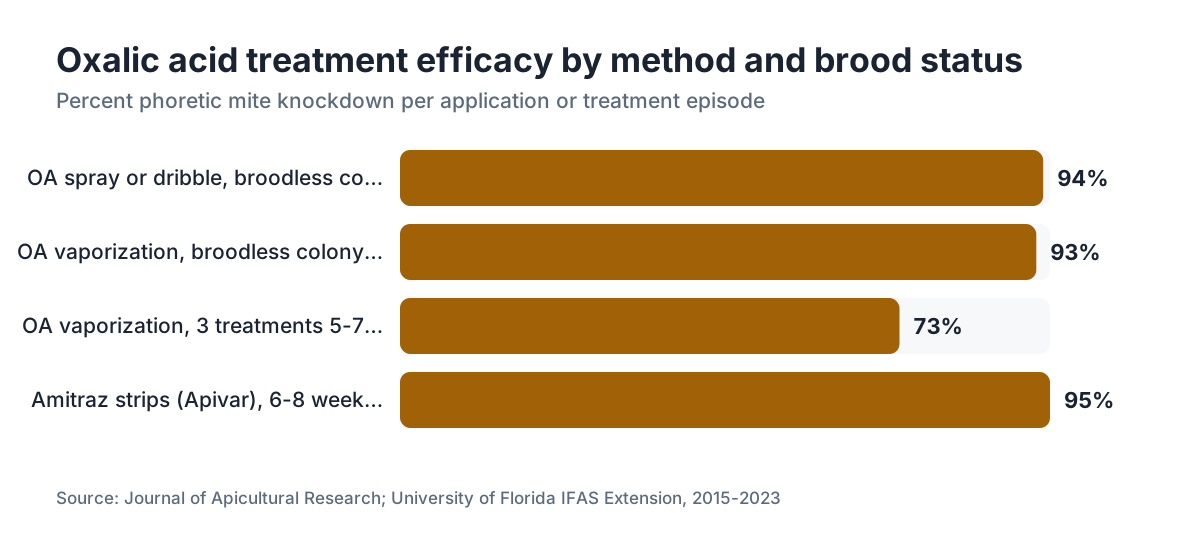
Efficacy on broodless bees is high. A University of Florida study and multiple European trials put single-application kill rates at 90 to 95 percent of phoretic (adult-bee-riding) mites when the bees are genuinely broodless [3]. That number collapses once brood shows up. A colony with even a modest patch of capped brood might see 30 to 50 percent overall reduction from one spray, because the brood-cell mites sit there untouched.
This is why the Honey Bee Health Coalition's Varroa management guide puts timing above everything else. Treatments applied during a natural or managed broodless period are far more effective than the same treatment poured into a colony full of brood [1].
When can you legally spray oxalic acid on bees?
The Api-Bioxal label is the legal line. Under FIFRA (the Federal Insecticide, Fungicide, and Rodenticide Act), using any pesticide in a way that conflicts with its label is a federal violation [5]. The label allows spray application for package bees and swarms only, and explicitly not for colonies on frames.
Dribble application (pouring OA between frames onto clustered bees) is allowed in colonies, but the label limits it to a single application per year and only when brood is minimal or absent. Vaporization has its own conditions that permit multiple treatments at weekly intervals.
The spray method's sweet spot is short:
- Package bees before or during installation (mist the screen cage before releasing)
- Captured swarms clustered on a branch or in a box, before they draw comb
- Shaken bees during splits, once they're off all frames
Some beekeepers spray individual frames of bees during inspections. That's off-label, and it's almost certainly worse than a dribble. Coverage is inconsistent and the bees aren't in a tight cluster. Skip it.
Read the current registered label before you treat. The National Pesticide Information Center links to registered labels, and your state apiarist's office can confirm what's allowed where you live [4][5].
What is the correct oxalic acid spray concentration and how do you mix it?
The Api-Bioxal label specifies 3.2 grams of oxalic acid dihydrate per 100 mL of solution, mixed into a 1:1 sucrose syrup by weight [4]. Pre-mixed Api-Bioxal solution is sold too, and it removes mixing error entirely. For most hobbyists that's worth the small extra cost.
If you're mixing from the registered powder:
- Dissolve the labeled amount of Api-Bioxal in warm water first.
- Add sugar until you hit a 1:1 ratio by weight.
- Cool to room temperature before use.
- Use it inside the labeled window (usually the same day).
Never mix OA in plain water for a spray. The sugar helps the liquid coat bee bodies evenly and cuts bee mortality from the acid alone. And don't crank up the concentration hoping for better mite kill. Higher concentrations just burn bees. The registered number came out of testing. It's the right number.
For packages, the usual dose is 1 to 2 mL per seam of bees. Mist both sides of the screen until the bees look damp, not drenched. For a captured swarm in a nuc box, pull each comb cluster, spray lightly on both sides, and let them regroup before you close up.
How does an alcohol varroa wash work and what's an acceptable mite count?
The alcohol varroa wash (also called an alcohol wash or ethanol wash) is the most accurate field method for counting mites. It kills and dislodges every phoretic mite from a sample of roughly 300 adult bees. You read the result as a percentage: mites per 100 bees [2].
Method:
- Collect about 300 bees (roughly half a cup) straight from a brood frame into a jar. Aim for nurse bees on open brood, not foragers at the entrance. Nurse bees carry the heaviest phoretic mite load.
- Add enough isopropyl alcohol (70% or higher) to cover the bees.
- Cap the jar and shake hard for 30 to 60 seconds.
- Pour the liquid through a fine mesh or paint strainer into a clear container.
- Count the mites in the strained liquid.
- Divide the mite count by 3 (for 300 bees) to get mites per 100 bees.
The Honey Bee Health Coalition and most university extension programs set the action threshold at 2 mites per 100 bees during brood-rearing season [1][2]. At or above that, you treat. Below it, recount in 30 days.
Nobody enjoys killing 300 bees per hive. But the alternative undercounts. Sugar rolls rely on living bees shaking mites loose, and a 2019 Penn State comparison found they detect 30 to 40 percent fewer mites than an alcohol wash on the same sample [2]. On the edge of a treatment call, a sugar roll can tell you you're fine when you're not. Use alcohol wash for decisions. Use sugar rolls for casual trend-watching if you'd rather.
Mite counting is one piece of a stocked apiary. See beekeeping supplies for what you actually need versus what's nice to have.
How does oxalic acid spray compare to dribble and vaporization?
All three methods deliver the same active ingredient. What changes is efficacy, ease, and the legal window each one fits.
| Method | Brood present? | Efficacy on phoretic mites | Application window (U.S. label) | Approx. equipment cost |
|---|---|---|---|---|
| Spray | No (packages/swarms only) | 90-95% | Package or swarm installation | Minimal (hand sprayer) |
| Dribble | No (or minimal) | 90-95% | Once per year, broodless period | Minimal (syringe or dribble bottle) |
| Vaporization | Yes (reduced efficacy) or no | 90-95% per treatment, up to 3 treatments | Multiple applications allowed, including into brood | $70-$250+ for OAV device |
Vaporization is the most flexible because the label allows repeat applications (three treatments spaced 5 to 7 days apart, or extended weekly treatments under some state interpretations). Each round hits newly emerged phoretic mites, so you chip away at the brood-cell population over time even without a broodless break [3][4].
Dribble into a broodless winter cluster is cheap and works. One plastic syringe, one mixing container, done. The limit is the one-application-per-year rule in most states. Miss the broodless window and you've spent your only shot.
Spray is really only useful if you're installing packages or catching swarms. Not your situation this season? Dribble or vaporization is the better fit.
For the biology behind why these windows matter, the varroa mite article walks through the reproductive cycle.
What are the safety requirements for mixing and applying oxalic acid?
Oxalic acid burns skin and eyes and throws off acidic vapor when heated. The Api-Bioxal label sets specific PPE for each method [4].
For spray and dribble:
- Chemical-resistant gloves (nitrile or rubber, not thin disposable ones)
- Chemical splash goggles, more than safety glasses
- Long-sleeved shirt and long pants
- Don't breathe the mist. Apply outdoors or somewhere with real ventilation.
For vaporization (which heats OA to sublimation around 157°C):
- The label also requires a NIOSH-approved respirator rated for OA vapor. An N95 with an organic vapor cartridge is standard practice.
- Seal hive entrances during treatment and leave them shut for at least 10 minutes after.
- Never vaporize inside a closed space like a barn with poor airflow.
Oxalic acid isn't acutely dangerous the way some ag chemicals are. But repeated low-level exposure to acid mist is hard on your airway, and a mist splash in the eyes needs immediate flushing. Take the PPE seriously even for a handful of packages.
Mix outdoors in calm conditions. Keep a bucket of clean water within reach during a spray. The USDA Agricultural Research Service publishes OA handling guidance for beekeepers through its bee research programs [6].
Are there any other varroa treatment sprays beyond oxalic acid?
Oxalic acid is the only spray-applied product with an EPA registration for varroa control in the U.S. The other registered treatments use different delivery systems entirely: formic acid (strips or gels), amitraz (Apivar strips), fluvalinate (Apistan strips), coumaphos (CheckMite+ strips), and thymol (Apiguard gel) [7].
None of those go on as sprays. Formic acid kills bees at high concentrations, which is exactly why it's built into controlled-release strips and pads instead. Spraying amitraz or fluvalinate directly on bees is off-label, likely illegal, and something you should never do.
Some hobbyists try essential oil sprays (thymol in alcohol, clove oil, wintergreen) as a DIY route. The research is thin. Thymol does suppress mites, which is why Apiguard exists, but mixing your own concentration is guesswork and it isn't EPA-registered. Nobody has clean efficacy data on homebrew essential oil sprays against registered treatments. The closest controlled work on thymol found that gel formulations raise colony temperatures enough to kill mites, an effect a light mist would not reliably reproduce.
My honest take: if you want a spray-format treatment, oxalic acid on packages and swarms is the one clear choice with the label, the data, and the safety record. For everything else, use the treatments designed and registered for their delivery method.
How do you build varroa spray treatment into a seasonal management protocol?
Varroa management isn't one event. It's a cycle tied to your colony's brood and your region's seasons. Sprayed oxalic acid fits a narrow window at the start of that cycle. Everything else stacks on top.
Here's a practical framework for a hobbyist in a four-season climate.
Spring, package and swarm season. Installing packages? Spray OA on the package before installation. That gives you a near-clean start at low mite load. Catch a swarm, do the same.
Early summer, brood ramp-up. Monitor with an alcohol wash every 30 days. Hit 2 mites per 100 bees and it's time to consider OA vaporization or an amitraz strip. This is your key monitoring window, because mite populations double roughly every 4 to 6 weeks as brood expands [1][10].
Late summer, the window that decides winter. Your August mite load determines whether the colony survives. Bees raised in August and September become your overwintering population, and if they're heavily parasitized they'll be short-lived and immune-compromised going into fall [10]. Treat if you hit threshold, even if it costs you a honey super.
Winter, the broodless opportunity. Cold-climate broodless periods create the best conditions for dribble or vaporization. Every mite is phoretic. Efficacy peaks. Often the easiest treatment of the year.
VarroaVault's free Varroa tools include a seasonal protocol planner that maps these windows to your zip code's typical colony phenology, so you're not guessing when to schedule monitoring.
To source supplies across the protocol, beekeeping supply companies is a good starting point.
What does the research say about spray treatment efficacy numbers?
The best oxalic acid data comes from European field trials run before the U.S. EPA registration, plus later U.S. university trials supporting the Api-Bioxal label [3][8].
Key numbers:
- Single OA dribble or spray on broodless colonies: 91 to 97 percent knockdown [3]
- Single OA vaporization on broodless colonies: 90 to 96 percent [8]
- OA vaporization, three treatments 5 to 7 days apart, brood present: 67 to 80 percent overall reduction (brood-cell mites survived each round, emerged, and got partly re-knocked by later treatments) [8]
- Amitraz (Apivar) strips over 6 to 8 weeks: 93 to 97 percent in well-managed applications [7]
The honest caveat: field performance drifts below lab numbers. Heavy brood, hot weather changing chemical volatility, bees clustering away from strips, and untreated neighboring apiaries as mite sources all drag real-world results down. The Honey Bee Health Coalition points out that reinfestation from nearby colonies causes a meaningful share of treatment failures, especially where beekeepers cluster tightly [1].
The EPA's pesticide program holds the original efficacy studies submitted for Api-Bioxal's approval, and they're publicly accessible if you want the primary data [5].
What mistakes do beekeepers make with varroa spray treatments?
The biggest one, by far: treating for varroa while brood is present using a method that only kills phoretic mites, then deciding the treatment failed. Spray or dribble OA into a colony with capped brood, do an alcohol wash two weeks later, still see high counts, and it looks like a bust. It wasn't. The treatment probably worked fine on the phoretic mites. The brood-cell mites just emerged and reinfested the adults. That's a timing failure, not a product failure.
Second: skipping the mite count before and after treating. You can't manage what you don't measure. Treat without a pre-count and you don't know if you needed to. Treat without a post-count three to five days later and you don't know if it worked. Each count runs maybe 20 minutes per hive. Do them.
Third: off-label concentrations and homebrew formulas in place of registered products. Beekeepers mix OA way too strong thinking more acid means more dead mites. What it actually means is more dead bees, more rejected brood, and a queen at risk. The label concentration isn't conservative padding. It's the tested optimum.
Fourth: treating once and calling the season done. A colony can rebuild from a 90 percent knockdown in 6 to 8 weeks if brood is present and mite reproduction resumes [1]. One treatment is a reset, not a cure. Keep monitoring.
Fifth: obsessing over mites while ignoring the rest of colony health. A hive weakened by poor nutrition, weak genetics, or disease tolerates treatments worse and rebuilds slower. Mite management and nutrition are linked.
Where can you buy oxalic acid varroa treatment spray products in the U.S.?
Api-Bioxal (the only EPA-registered oxalic acid product in the U.S. as of 2025) is stocked by most major beekeeping distributors [7]. It comes in a 2.5 oz packet (enough for roughly 20 package treatments or dribble applications) and a larger commercial size.
Pre-mixed oxalic acid solution, ready to dribble or spray, sells under several brand names as long as it's registered under the Api-Bioxal label or an equivalent EPA registration. Check the label number on anything you buy. An unregistered OA solution is not legal to use on bees in the U.S., no matter what the supplier claims.
Pricing as of mid-2025: the 2.5 oz Api-Bioxal packet runs roughly $8 to $15 depending on supplier. Pre-mixed solution costs more per application but saves mixing time. OAV (oxalic acid vaporizer) devices range from about $70 for a basic wand unit to $250 and up for battery-powered ProVap-style units.
To compare suppliers, beekeeping supply companies lists reputable distributors with notes on pricing and shipping. If you want to know who ships without minimum order requirements, free shipping honey bee supply companies covers that angle.
Frequently asked questions
Can I spray oxalic acid directly into a hive with brood present?
No, at least not as a spray. The Api-Bioxal label in the U.S. restricts spray application to package bees and swarms. For colonies with brood, dribble (once per year, minimal brood) or vaporization (multiple treatments allowed) are the registered options. Spraying OA into a full colony on frames is off-label and largely useless, since it misses mites inside capped cells.
How accurate is an alcohol wash compared to a sugar roll for counting varroa?
Much more accurate. A 2019 Penn State comparison found alcohol wash detects 30 to 40 percent more mites than a sugar roll on the same bee sample. Sugar rolls rely on living bees shaking mites loose, which doesn't happen consistently. Use alcohol wash for treatment decisions. Sugar rolls are fine for casual trend-watching if you'd rather not sacrifice bees, but they undercount.
What mite count triggers a treatment decision?
The Honey Bee Health Coalition sets the threshold at 2 mites per 100 bees during active brood rearing (roughly spring through late summer). In fall, when you're raising overwintering bees, some practitioners drop it to 1 per 100. Below 2 per 100 in summer, monitor monthly. At or above 2 per 100, treat.
Is oxalic acid safe for bees and honey?
At registered label concentrations, yes. Oxalic acid occurs naturally in honey at low levels. EPA reviewed residue data before registration and found properly applied OA treatments don't raise honey oxalic acid above background. The Api-Bioxal label prohibits application when honey supers are on, so pull supers before treating or use OA only in fall after harvest.
How many times can I treat with oxalic acid in one year?
It depends on method. Dribble is labeled for one treatment per colony per year in the U.S. Vaporization allows multiple treatments per episode (typically three at 5 to 7 day intervals), and some state interpretations allow more. Spray is inherently one-time in context, since it only applies to package bees or swarms at installation, not ongoing colony management.
Does oxalic acid spray kill varroa eggs or mites inside brood cells?
No. Oxalic acid works by contact on exposed mites riding adult bees. Mites inside capped brood cells are fully protected. This is the core limitation of every oxalic acid application, more than spray. The only ways to reach brood-cell mites are to wait until they emerge, use repeated vaporization to hit them as they emerge, or treat during a natural or managed broodless period.
Can I use rubbing alcohol from the pharmacy for a varroa alcohol wash?
Yes. Standard 70 percent isopropyl alcohol from a pharmacy works fine. Higher concentrations (91 or 99 percent) work too. The goal is killing bees and dislodging mites from their bodies, and 70 percent does that reliably. There's no meaningful difference in mite count accuracy between alcohol concentrations in this range.
What happens if I exceed the labeled oxalic acid concentration?
Higher concentrations raise bee mortality, brood rejection, and queen loss risk without meaningfully improving mite kill. The 3.2 percent w/v in the Api-Bioxal label was chosen because it maximizes mite mortality while keeping bee mortality acceptable in trials. Going above it is both off-label and counterproductive. Measure carefully, especially when mixing from powder.
How long after an oxalic acid spray treatment should I do a follow-up mite count?
Wait at least 3 to 5 days for freshly sprayed phoretic mites to die and drop, then run an alcohol wash or sticky board count. For a spray on a package, recount 2 to 4 weeks after installation once the colony has some brood, since that's when newly emerging mites become detectable and you'll want to know if reinfestation is happening.
Can I treat a swarm with oxalic acid spray before hiving it?
Yes, and it's one of the best uses of OA spray. A fresh swarm is usually broodless, so the mite population is entirely phoretic. Lightly misting both sides of the cluster with registered OA solution before or during boxing gives you a near-clean start. An untreated swarm can carry a heavy mite load that explodes once the new colony draws comb and starts raising brood.
Does varroa treatment spray affect the queen?
At label concentrations applied correctly, queen mortality from OA spray or dribble is low but not zero. The research behind the Api-Bioxal label found acceptable queen survival in trial colonies. The main queen risk comes from too-high concentrations, treating in cold temperatures when bees can't thermoregulate, or repeated off-label applications. Follow the label and queen risk stays minimal.
How do I dispose of leftover oxalic acid solution?
Small quantities of diluted OA solution (beekeeping concentrations) can be neutralized with baking soda until the fizzing stops, then flushed with plenty of water in a utility sink. Don't pour concentrated or un-neutralized solution into storm drains. The Api-Bioxal label includes disposal instructions, and those are the legal guidance. Check local hazardous waste rules for larger volumes.
Is there a varroa treatment spray approved for organic or treatment-free beekeeping?
Oxalic acid is approved for certified organic operations in the U.S. under the USDA's National Organic Program because it's a naturally derived substance. It appears on the program's approved materials list. That makes Api-Bioxal the only spray-applicable varroa treatment qualifying for organic certification. Confirm with your certifying agent, since documentation requirements vary.
What is the difference between oxalic acid dribble and spray for varroa?
Both deliver the same 3.2 percent OA solution. Dribble pours measured amounts between frames directly onto clustered bees, giving consistent contact for a wintered colony tight on frames. Spray goes on bees not on frames, mainly packages and swarms. Dribble is the right call for overwintering clusters. Spray is the right call for loose bees during installation. Neither wins in the abstract. The situation picks the method.
Sources
- Honey Bee Health Coalition, Varroa Management Guide (latest edition): Action threshold of 2 mites per 100 bees during brood season; mite population and broodless-period treatment efficacy guidance
- Penn State Extension, Varroa Mite Monitoring Methods comparison: Alcohol wash detects 30-40 percent more mites than sugar roll on the same bee sample
- University of Florida IFAS Extension, Oxalic Acid for Varroa Control: Single OA application on broodless colonies achieves 91-97 percent phoretic mite knockdown; mechanism of mite cuticle damage
- EPA, Api-Bioxal Pesticide Registration Label (Reg. No. 86203-1): Registered uses for Api-Bioxal including spray on package bees and swarms, dribble once per year in broodless colonies, and vaporization; PPE requirements; concentration of 3.2% w/v in 1:1 sucrose syrup
- EPA, Federal Insecticide Fungicide and Rodenticide Act (FIFRA) overview: Using a pesticide inconsistently with its label is a federal violation under FIFRA
- USDA Agricultural Research Service, Bee Research Laboratory: OA safe handling guidance and beekeeper-accessible research on oxalic acid applications
- EPA, Pesticides: Registered Varroa Treatments including Api-Bioxal, Apivar, Apistan: List of EPA-registered varroa treatment products; amitraz strips achieve 93-97 percent mite reduction in field applications
- Journal of Apicultural Research, Oxalic Acid Vaporization Efficacy Trials: OA vaporization repeated three times at 5-7 day intervals in colonies with brood yields 67-80 percent overall mite reduction; single vaporization on broodless colonies yields 90-96 percent
- USDA National Organic Program, Allowed Materials List: Oxalic acid is approved for use in certified organic operations under the National Organic Program
- Michigan State University Extension, Varroa Mite Management in Honey Bee Colonies: Varroa mite populations double roughly every 4-6 weeks during brood-rearing season; late-summer mite loads determine overwintering bee quality
Last updated 2026-07-09