VSH queens: what varroa sensitive hygiene means for your hive
TL;DR
- VSH (Varroa Sensitive Hygiene) is a genetic trait where worker bees detect and pull out mite-infested brood before the mites can reproduce.
- USDA-bred VSH queens suppress varroa reproduction by 90% or more in study conditions.
- The trait is real and measurable.
- Field results vary a lot, because open-mated queens mix with whatever drones fly in your area.
What is VSH and where did it come from?
VSH stands for Varroa Sensitive Hygiene. It's a behavior where worker bees smell or otherwise detect varroa mites reproducing inside capped brood cells, then uncap and clear out those mites and pupae before the mites finish their cycle. No mite offspring, no population explosion.
USDA-ARS researchers in Baton Rouge, Louisiana, identified and named the trait in the late 1990s and early 2000s. The work came out of the USDA Honey Bee Breeding, Genetics, and Physiology Lab, which is still the main institution developing and holding VSH stock today [1]. Before the USDA team gave it the VSH name, people called the same trait "suppressed mite reproduction" or SMR, and you'll still see that term in older papers.
The genetic basis is polygenic. Multiple genes contribute rather than one on/off switch. That's worth keeping in mind. It makes the trait genuinely heritable but also means it dilutes when VSH queens mate with unselected drones, which is almost always what happens in an open-mating situation.
How does VSH actually suppress varroa mites?
Varroa mites reproduce only inside capped brood cells. A mite slips into a cell just before capping, lays eggs, and the offspring mate with each other before emerging with the bee. One good reproductive cycle in a worker cell usually produces one or two new mated female mites [2]. Worker cells stay capped about 12 days, which gives the mite plenty of time if nothing interrupts her.
VSH bees interrupt her. Workers with the trait find infested cells, uncap them, and remove the contents. Researchers measure this by counting mites in the reproductive phase against total mites. In a colony with strong VSH expression, the share of mites that actually finish reproducing drops sharply.
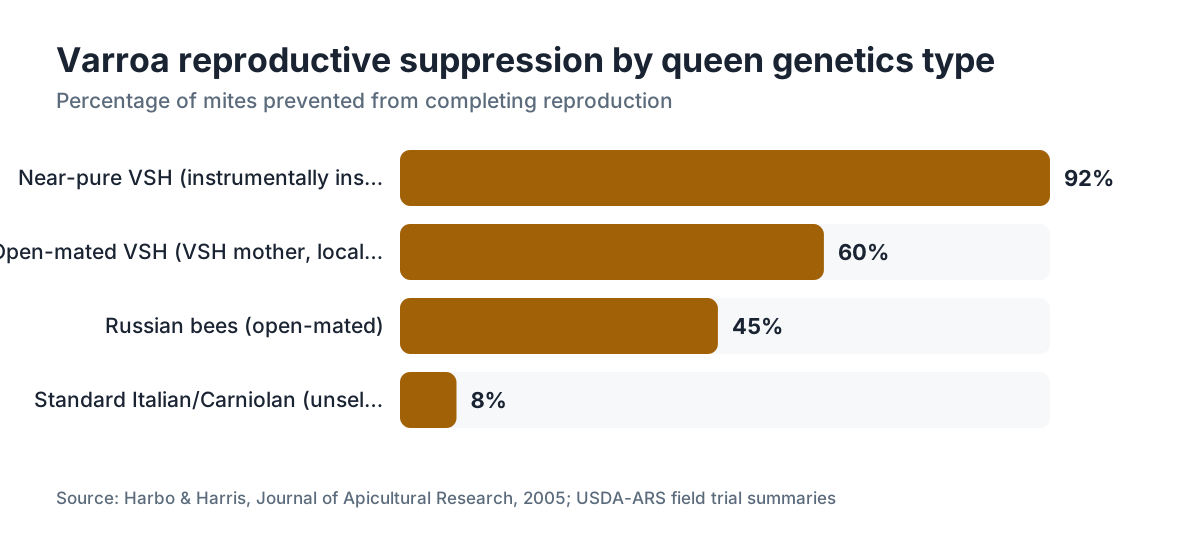
A study by Harbo and Harris in the Journal of Apicultural Research (2005) found that near-pure VSH colonies suppressed varroa reproduction by more than 90% [3]. The phrase researchers use is "proportion of reproducing mites," and in high-VSH colonies that proportion falls close to zero. In colonies with only partial VSH genetics, it's more like 50 to 70%, which helps but won't hold mite loads down on its own.
This works differently from general hygienic behavior, which targets diseased or dead brood. VSH is specific to mite-infested brood. A bee line can score well on standard hygienic tests (like the freeze-killed brood test) without having strong VSH. The two traits overlap. They are not the same thing.
What does a VSH queen actually cost, and where do you buy one?
VSH queens from reputable breeders run roughly $35 to $60 each for mated queens as of recent seasons, though prices move with demand and breeder location. The USDA does not sell queens to hobbyists. It distributes VSH stock to certified breeders who then produce and sell queens commercially [1].
Some breeders sell "VSH-influenced" or "VSH-cross" queens at similar prices, which usually means they're using VSH mothers but open-mating in an area that isn't genetically controlled. That's not a scam, but it does mean the resulting workers carry diluted VSH genetics. Full, instrumentally inseminated VSH queens are harder to find and cost more.
To find suppliers, the USDA Bee Lab keeps breeder contact information, and the Honey Bee Health Coalition's Varroa management guide lists resources for locating improved-genetics queens [4]. Your state apiarist's office is another good stop. If you want to compare beekeeping supply companies that carry VSH stock, look for breeders who can tell you the VSH percentage of their breeder stock and whether queens are open- or instrumentally mated.
One honest note: hobbyist-accessible VSH queens are almost always open-mated. That's fine for most people, but it means you're getting a queen whose workers will be a genetic mix. The VSH effect will be real but partial in most cases.
How much does the VSH trait actually reduce mite loads in real hives?
This is where you separate research conditions from your backyard.
With instrumentally inseminated, near-pure VSH queens in controlled settings, mite reproductive suppression tops 90% and colonies can hold low mite loads without chemical treatment [3]. Those results are real. The USDA has published them repeatedly, and independent labs have replicated the core finding.
Open-mating field conditions get messier. VSH queens mate with 12 to 20 drones on their mating flights [5], and most of those drones come from unselected colonies nearby. The resulting workers are a genetic mosaic. Studies on open-mated VSH colonies in typical U.S. environments show mite load reductions that matter but fall short of elimination. USDA field trials and related Apidologie work suggest open-mated VSH colonies still need monitoring and may need occasional treatment, especially where mite pressure runs high.
The Honey Bee Health Coalition's Varroa management guide states plainly that even bees bred for mite resistance should be monitored regularly, and that genetic resistance is one tool among several, not a replacement for monitoring [4]. That's the right framing. VSH is genuinely useful. It is not a fire-and-forget solution.
Here's a rough comparison of how VSH and non-VSH colonies perform in field research:
| Colony Type | Avg Mite Reproductive Suppression | Typical Field Mite Load Reduction | Needs Treatment? |
|---|---|---|---|
| Near-pure VSH (instrumentally inseminated) | 90%+ | Very high; often treatment-free | Rarely, with monitoring |
| Open-mated VSH (VSH mother, local drones) | 50-70% | Moderate | Sometimes, situation-dependent |
| Standard Carniolan or Italian (no VSH selection) | Under 10% | Minimal | Yes, regular treatment needed |
| Hybrid VSH-cross (commercial queen, unverified) | Highly variable | Low to moderate | Usually yes |
How is VSH different from general hygienic behavior in bees?
People mix these up constantly, and it matters.
General hygienic behavior means workers detect and remove dead or diseased brood. Breeders have selected for this for decades, and it comes with better disease resistance, including less chalkbrood and American foulbrood [6]. The freeze-killed brood test is the standard measure: freeze a section of brood, then time how fast the colony removes it. Most reputable queen breeders test for this.
VSH is narrower. It targets mite-infested cells. The bees don't just clean up dead brood. They detect live, reproducing mites inside healthy-looking capped cells and pull those cells before the mite finishes her cycle. The cue they're reading isn't fully understood. Some research points to chemical signals from the mite or from the pupa's changed physiology. The USDA's own summaries note that the sensory mechanism is still being studied [1].
A colony can score high on the freeze-killed brood test and still have weak VSH. The reverse is often true too: VSH colonies tend to score decently on hygienic tests because there's some genetic correlation. But they're not the same genes.
If a breeder advertises "hygienic queens" without mentioning VSH, assume they're measuring general hygienic behavior. That's still worth selecting for. Just don't assume it means mite-specific suppression.
Will a VSH queen work if there are lots of mites in my area?
High local mite pressure is exactly where VSH matters most, and also where open-mated VSH queens face their biggest fight.
Here's the tension. If your neighbors run untreated colonies or skip monitoring, the drone pool in your area is likely dominated by non-VSH genetics. Every time your VSH queen's daughters mate with those drones, the trait dilutes. Meanwhile, mite pressure from drifting bees and robbing keeps reinoculating your hive. VSH doesn't stop mites from entering. It suppresses their reproduction once they're in.
In areas with isolated apiaries, or where enough beekeepers run VSH or other mite-resistant stock, open-mated VSH queens do much better. This is part of why USDA research apiaries post stronger results than most hobbyist settings: genetic isolation through instrumental insemination or controlled mating stations.
The practical answer: yes, VSH queens help even under high pressure, but you should still monitor with alcohol wash or sugar roll at least monthly during the active season and be ready to treat if mite levels pass the 2% threshold (2 mites per 100 bees) recommended by the Honey Bee Health Coalition [4].
VarroaVault's free varroa tools include a mite wash calculator and a seasonal treatment timeline that factor in your colony's genetics and local pressure. Handy when you're trying to decide whether a VSH colony needs intervention.
How do you test whether your VSH queen's colony is actually expressing the trait?
You cannot tell by looking at the bees. VSH expression doesn't show up in color, size, or anything you can watch at the hive entrance. The only field-practical proxy is tracking mite load trends over time.
If you introduce a VSH queen and your mite load, measured by alcohol wash, stays below 1 to 2% through the active season without treatment, that's strong indirect evidence the trait is expressing. If mite loads climb normally, VSH expression is weak in that colony.
The research-grade method measures the percentage of mites in the reproductive phase by collecting and dissecting capped brood cells and examining the mites. Most hobbyists won't do this. University extension apiculture labs sometimes offer the analysis; contact your state's extension apiarist if you're curious [7].
Monthly alcohol washes are the realistic approach. The USDA recommends a sample of at least 300 bees from the brood nest area for a reliable mite count [8]. A VSH colony that's working well should show mite growth noticeably slower than comparable non-VSH colonies in the same apiary, even if it never fully clears mites.
Can you breed your own VSH queens, or do you have to buy them?
You can try, and plenty of sideliners do. The challenge is genetics and mating control.
Buy VSH queens, then raise daughters from your best-performing (lowest mite load) colonies, and you're doing real selection. Over several generations with consistent selection pressure, you can move your apiary's genetics toward better mite suppression. The research program that built the USDA VSH line started with selection from Africanized bee populations in the Yucatan, then decades of selection and backcrossing [1].
The problem is drones. Your selected queens mate with whatever drones fly in your area. Without a controlled mating station (which needs geographic isolation or instrumental insemination gear), the VSH genetics dilute every generation. Some commercial queen breeders run mating nucs on islands or in remote valleys for this reason.
For most hobbyists with five to fifteen hives, buying VSH queens from a reputable source every one to two years and selecting replacement queens from your lowest-mite colonies is a realistic program. You won't hit near-pure VSH genetics, but you can nudge your apiary's average mite tolerance up over time.
The varroa mite life cycle is worth understanding in detail if you want to judge how well VSH is working in your hives. You can also look at the broader picture of beekeeping species and their natural varroa resistance if you're thinking about switching stock entirely.
Are VSH queens better than treating with oxalic acid or Apivar?
Wrong comparison. VSH and chemical treatments handle different parts of the same problem.
Chemical treatments (oxalic acid, amitraz/Apivar, formic acid/Mite-Away Quick Strips) kill mites directly. They're fast, they work, and the EPA registers them specifically for varroa control [9]. Oxalic acid drip or vapor during a broodless period knocks mite loads down by 90%+ in one application. Apivar (amitraz strips) works over 42 to 56 days and stays highly effective even with brood present.
VSH queens suppress mite reproduction on an ongoing basis without chemicals, but they don't instantly knock down an existing high load. A colony that gets a VSH queen in August at a 4% mite load will not save itself through VSH alone. The load is already too high. You treat first, then the VSH trait helps keep things low going forward.
The sensible program for most beekeepers: run VSH or other mite-resistant genetics as a baseline to cut how often you treat, while keeping oxalic acid or another registered product on hand and using it when mite loads cross the 2% action threshold. The Honey Bee Health Coalition's Varroa guide describes this layered approach directly [4].
Some beekeepers do go treatment-free with near-pure VSH stock in favorable conditions. Most hobbyists with open-mated VSH queens in normal landscapes will still need occasional treatments. Be honest with yourself about which situation you're in.
What are the downsides of VSH queens?
A few real ones.
First, VSH bees sometimes over-remove brood. When the trait runs strong, workers pull mite-infested cells aggressively, which is good, but some research and breeders report that highly selected VSH colonies occasionally remove non-infested brood too, especially under stress. This shows up as spotty brood patterns. Not every colony with spotty brood has excessive VSH expression (chalkbrood, sacbrood, and poor queens all cause it), but it's a documented side effect in near-pure VSH stock [10].
Second, the trait dilutes with every generation in open-mating situations. You pay for VSH genetics, but by the time that queen's daughters raise the next generation, the advantage has faded. You have to keep buying or keep selecting.
Third, VSH queens are not always available. Supply is limited next to standard Italian or Carniolan queens. If you need a queen in an emergency in July, you may not find a VSH breeder who can ship fast.
Fourth, production. Early VSH lines showed some drop in honey production against standard commercial stock, partly because colonies were smaller and partly from trait linkage. More recent breeding has chipped away at this, but if you run a sideliner operation focused on honey yield, ask your breeder about production data. Some breeders track it; many don't.
None of these are dealbreakers. They're tradeoffs to weigh before you pay the premium.
How does VSH compare to other mite-resistant bee stocks like Russian bees or Saskatraz?
Several mite-resistant bee lines exist, each using somewhat different mechanisms.
Russian bees, developed from Primorsky region bees in Far East Russia, suppress mite reproduction through grooming, reduced brood rearing in low-nectar periods, and some hygienic behaviors [11]. The USDA Honey Bee Lab developed the Russian bee program alongside the VSH work [1]. Russian bees tend to show strong grooming, which VSH bees don't emphasize.
Saskatraz bees, developed in Saskatchewan, Canada, are selected for both mite resistance and honey production. The program targets hygienic behavior, mite resistance, and productivity at once. Independent evaluations suggest reasonable mite suppression, but peer-reviewed data is thinner than for VSH or Russian bees.
Mite-biting behavior (also called grooming) is another selected trait, sometimes offered separately from VSH. Bees with strong mite-biting chew the legs off mites or knock them off adults. That's a different mechanism from VSH's brood-targeted approach, and some breeders select for both at once.
The honest summary: VSH has the deepest research base and the most controlled genetic stock behind it, thanks to the USDA program. Russian bees are well documented and federally supported. The newer crosses are interesting but carry less long-term data. None of them are treatment-free guarantees in normal open-mating conditions.
What should you ask a breeder before buying a VSH queen?
A few questions separate serious VSH breeders from marketing hype:
First: What is the VSH percentage of your breeder stock? Reputable breeders sourcing from USDA VSH lines can often tell you the VSH rating of their breeder queens. Ask for it.
Second: Are queens open-mated or instrumentally inseminated? Open-mated queens cost less and are more common, but the genetic dilution is real. Instrumentally inseminated queens carry a much higher share of VSH genetics. Expect to pay more.
Third: Do you track mite loads in your breeder colonies? Breeders who are actually selecting for varroa resistance monitor mite loads across their colonies and breed from the lowest-mite families. Ask how they pick mothers.
Fourth: What production data do you track? Honey production, brood pattern, winter survival. It doesn't have to be formal research, but a breeder who's paying attention will have rough numbers.
Fifth: Where do you source your VSH stock? The USDA Honey Bee Lab has licensed VSH genetics to specific breeders. A breeder who can trace their line to the USDA program is more credible than one who says "we've been selecting for resistance for years" with no paper trail.
For those looking at the broader equipment picture while evaluating hive genetics, a run through beekeeping supplies basics is a reasonable parallel step.
Is VSH worth it for a hobbyist with just a few hives?
My honest opinion: yes, probably, but with realistic expectations.
If you have two to five hives and you're buying replacement queens anyway, paying an extra $10 to $20 per queen for VSH or VSH-cross stock from a reputable breeder is a reasonable bet. You'll likely see slower mite buildup than with standard stock. You'll still need to monitor. You may still need to treat occasionally. But you're moving your apiary in the right direction genetically, and you're supporting breeders doing real selection work.
What's probably not worth it: buying "VSH-blend" queens from a large operation that can't tell you the VSH percentage of their breeder stock, paying $70+ for an instrumentally inseminated queen if you're in a suburban neighborhood ringed by non-selected drone-producing colonies, or skipping your monitoring because you think the VSH queen has it handled. She doesn't, fully.
The bigger payoff for a hobbyist is consistent monitoring and treating at the right time. VSH genetics help, but a beekeeper who does monthly alcohol washes and treats promptly with oxalic acid or Apivar will beat one who installs VSH queens and walks away. Both together is the best combination.
VarroaVault has free tracking sheets and seasonal protocol guides built for beekeepers running resistant genetics alongside standard treatment thresholds. Worth using whether or not you go VSH.
Frequently asked questions
What does VSH stand for in beekeeping?
VSH stands for Varroa Sensitive Hygiene. It's a genetic behavior where worker bees detect varroa mites reproducing inside capped brood cells and remove those cells before the mites finish their life cycle. The USDA-ARS Honey Bee Breeding, Genetics, and Physiology Lab in Baton Rouge developed and named the trait in the late 1990s and early 2000s.
How effective are VSH queens at reducing varroa mite levels?
Under controlled conditions with instrumentally inseminated near-pure VSH queens, mite reproductive suppression tops 90%, per USDA and Journal of Apicultural Research work. In typical open-mating field conditions, the effect is more modest, roughly 50 to 70% suppression, because VSH genetics dilute when queens mate with unselected local drones. VSH colonies still need monitoring and occasional treatment.
Do VSH bees still need varroa treatments?
Most open-mated VSH colonies in normal beekeeping environments still need occasional varroa treatment. The Honey Bee Health Coalition recommends monitoring all colonies regardless of genetics and treating when mite levels pass 2 mites per 100 bees. Only colonies with near-pure VSH genetics under controlled mating reliably hold low mite loads without chemical intervention.
What is the difference between VSH and hygienic bees?
General hygienic behavior means bees detect and remove dead or diseased brood of any kind. VSH is aimed specifically at brood cells infested with reproducing varroa mites. A colony can test well on the standard freeze-killed brood hygienic test and still have weak VSH. The two traits are related and often co-selected, but they're genetically distinct and not interchangeable.
Where can I buy VSH queens?
The USDA doesn't sell VSH queens to the public but licenses VSH stock to certified commercial breeders who sell mated queens. Prices typically run $35 to $60 per open-mated queen. The Honey Bee Health Coalition's Varroa management guide and your state apiarist's office are good starting points for finding reputable breeders. Ask specifically about VSH source genetics and mating method before buying.
Can VSH queens be raised by hobbyist beekeepers?
Yes, hobbyists can raise queens from VSH mothers and select replacements from their lowest-mite colonies over time. The limiting factor is drone genetics: open mating in most areas quickly dilutes VSH traits because local drones carry no VSH selection. You can improve your apiary's genetics incrementally, but near-pure VSH expression without controlled mating or instrumental insemination isn't realistic for most hobbyists.
How is VSH different from Russian honey bees?
Both VSH and Russian bees suppress varroa, but through different mechanisms. VSH workers target mite-infested brood cells specifically. Russian bees combine grooming, reduced brood rearing during low-nectar periods, and some hygienic traits. Both programs came from the USDA. VSH has a more mechanistically specific and deeply studied research base; Russian bees tend to show strong adult grooming and seasonal brood reduction.
Will VSH queen offspring keep the VSH trait?
VSH is heritable, but how much it shows up in offspring depends heavily on the drones the queen mated with. If she mated with unselected drones, roughly half or fewer of her workers will carry meaningful VSH genetics. Each later generation raised from those workers and unselected drones dilutes the trait further. Maintaining VSH expression takes ongoing selection and, ideally, some mating control.
What is the action threshold for treating varroa even in VSH colonies?
The Honey Bee Health Coalition recommends treating when alcohol wash results show 2 or more mites per 100 bees (2%) during the active brood-rearing season. Some extension services suggest a 3% threshold in spring and a tighter 1 to 2% threshold in late summer when winter bees are being raised. These thresholds apply to all colonies, including VSH stock.
How do I monitor a VSH colony to see if the trait is working?
Monthly alcohol washes from a sample of at least 300 bees from the brood nest are the practical approach. A VSH colony expressing the trait well should show slower mite growth than comparable non-VSH colonies in the same apiary. Research-grade evaluation means dissecting capped brood to measure the proportion of mites in the reproductive phase, which is labor-intensive but possible through university extension labs.
Do VSH queens have any production or brood pattern drawbacks?
Some highly selected VSH stock, especially early USDA lines, showed reduced honey production and occasionally spotty brood patterns from over-removal of brood. More recent VSH breeding has worked to address production characteristics, but the tradeoff isn't fully gone. Ask your breeder specifically about honey production data in their VSH colonies before buying if yield is a priority.
What chemical treatments are registered for varroa if VSH isn't enough?
The EPA registers several varroa treatments for U.S. use: oxalic acid (Api-Bioxal), amitraz (Apivar strips), formic acid (Mite-Away Quick Strips and Formic Pro), and hop beta acids (Hopguard). Each has label requirements for temperature range, application method, and timing relative to honey supers. Always follow the registered label, which is a legal requirement.
Is it true VSH was originally called SMR (suppressed mite reproduction)?
Yes. Early USDA publications and breeders used SMR, or suppressed mite reproduction, for the same trait. The USDA team shifted to VSH in the early 2000s to better reflect that the mechanism is a hygienic behavior targeting mite-infested cells rather than a passive suppression of reproduction. You'll find both terms in the literature, especially in papers from before roughly 2002.
How long does a VSH queen typically live, and when should she be replaced?
VSH queens live as long as any other honey bee queen, typically two to three years in practice, though queens can go longer. Most beekeepers running mite-resistant genetics programs replace queens annually or every two years to keep selection pressure and avoid the genetic drift that happens as the queen ages and her sperm supply drops. Annual replacement from selected VSH stock is a reasonable program for sideliners.
Sources
- USDA-ARS Honey Bee Breeding, Genetics, and Physiology Research Laboratory, Baton Rouge: USDA-ARS in Baton Rouge identified, named, and maintains VSH stock, and developed the Russian bee program in parallel; sensory mechanism of the trait is still being studied
- Rosenkranz, Aumeier & Ziegelmann, Journal of Invertebrate Pathology, 2010 - Biology and control of Varroa destructor: Varroa mites reproduce only inside capped brood cells; a female mite in a worker cell typically produces one to two mated daughters per reproductive cycle
- Harbo & Harris, Journal of Apicultural Research, 2005 - Suppressed mite reproduction explained by the presence of Varroa-sensitive hygiene: Near-pure VSH colonies showed varroa reproductive suppression exceeding 90% in controlled trials
- Honey Bee Health Coalition, Tools for Varroa Management Guide (current edition): HBHC recommends monitoring all colonies regardless of genetics and treating when mite levels reach 2% (2 mites per 100 bees); states that genetic resistance is one tool among several, not a replacement for monitoring
- Tarpy & Page, Behavioral Ecology and Sociobiology, 2000 - No behavioral control over mating frequency in queen honey bees: Honey bee queens typically mate with 12 to 20 drones during mating flights, resulting in genetically diverse worker populations
- Spivak & Reuter, Apidologie, 2001 - Resistance to American foulbrood disease by honey bee colonies Apis mellifera bred for hygienic behavior: General hygienic behavior is associated with reduced susceptibility to American foulbrood and chalkbrood in addition to varroa-related benefits
- USDA-ARS Honey Bee Research (varroa monitoring guidance): A sample of at least 300 bees from the brood nest area is recommended for a reliable alcohol wash mite count
- U.S. Environmental Protection Agency, Pesticides program: Oxalic acid (Api-Bioxal), amitraz (Apivar), and formic acid products are EPA-registered for varroa control in honey bee colonies
- Harris, Journal of Apicultural Research, 2007 - Bees with Varroa Sensitive Hygiene preferentially remove mite infested pupae aged five days post capping: Highly selected VSH colonies can exhibit increased removal of both mite-infested and occasionally non-infested brood cells, sometimes producing spotty brood patterns
- Rinderer, de Guzman & Harris, Apidologie, 2010 - Comparison of suppression of mite reproduction in Russian and Italian honey bee stocks: Russian honey bees suppress varroa through grooming behavior and reduced brood rearing during low-nectar periods, a different mechanism from VSH
Last updated 2026-07-09