What is an acceptable mite wash result in spring?

TL;DR
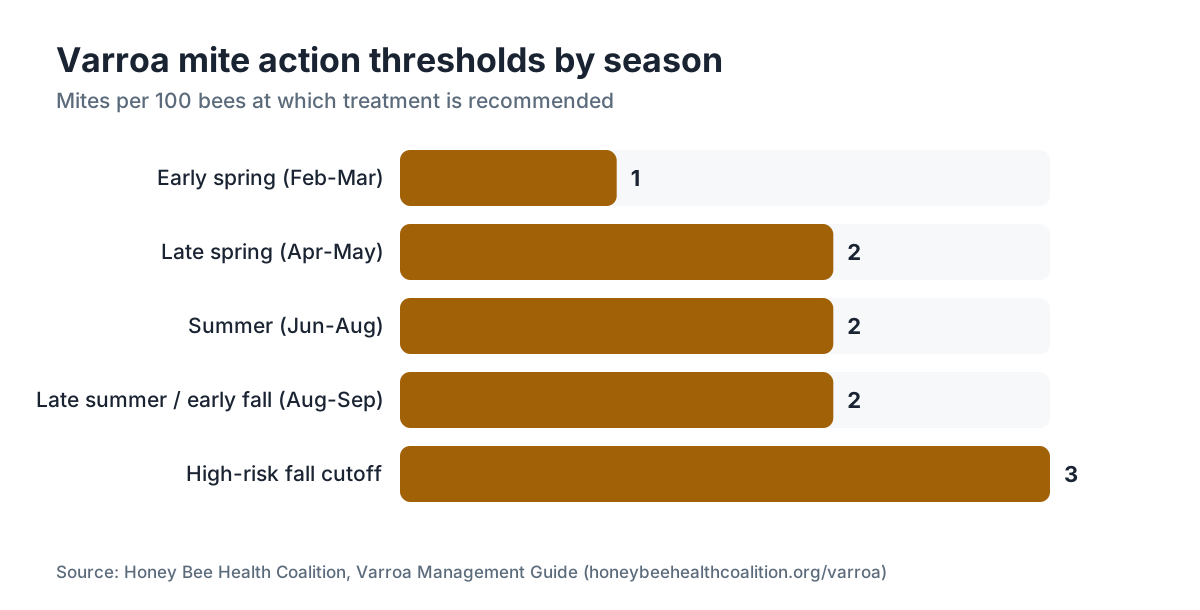
- Most extension programs and the Honey Bee Health Coalition set the spring action threshold at 1-2 mites per 100 bees (1-2%).
- Find more than 2 mites per 100 bees in spring and treat immediately.
- Fewer than 1 mite per 100 bees is genuinely good news.
- Keep monitoring monthly as the colony grows.
What mite count is considered acceptable in spring?
Two mites per 100 bees is the line. That equals a 2% infestation rate, and it is the action threshold most extension programs use for spring [1]. If your alcohol wash or sugar roll returns 2 or fewer mites from a 100-bee sample, you are below the treatment threshold and the colony has a reasonable shot at holding steady without immediate intervention. Find 3 or more mites and you treat. No debate.
Why is spring's threshold lower than summer's? Because spring colonies are growing fast. Every mite in April reproduces into a much larger population of bees and brood cells by June. The Honey Bee Health Coalition's Varroa Management Guide puts the spring threshold at 1-2 mites per 100 bees and warns that mite populations left alone in spring can reach damaging levels by mid-summer before most beekeepers notice anything is wrong [1].
Here is the honest caveat. Nobody has perfect data on the exact point where economic damage begins. The 2% number comes from a mix of field studies and expert consensus, not one clean experiment. Treat it as a well-informed guideline, not a law of physics. What multiple studies do show is that colonies carrying more than 2 mites per 100 bees in early spring are much more likely to collapse by late summer [2].
How do you do an alcohol wash correctly to get an accurate count?
An alcohol wash is the most accurate mite count you can do at home. Sugar rolls are gentler on the bees but they undercount mites by roughly 20 to 40% compared to alcohol washes, so if you are anywhere near the threshold, use alcohol [3].
Here is the procedure, step by step. Find a frame of open brood with nurse bees clustered on it, because nurse bees carry the highest mite loads in the colony. Shake or brush roughly 300 bees into a wide-mouth jar. Add isopropyl alcohol (70% works fine) or windshield washer fluid to cover the bees, seal the lid, and shake hard for 30 to 60 seconds. Pour the liquid through a mesh screen into a white bowl or tray. Count the mites in the liquid. Divide by the number of bees, multiply by 100, and you have your percentage.
The bee count matters. A common mistake is guessing at 300 bees and then doing math on that guess. About 300 bees fills roughly half of a standard 16-ounce mason jar. To calibrate, a half-cup measuring cup holds around 300 worker bees. A rough count still works: 2 mites in what you estimate as 100 bees is a 2% rate. 6 mites in 300 bees is also 2%. The math lands the same place [1].
Skip the honey supers and the outer edges of the cluster. You want bees actively tending brood. Those are the bees most likely to carry phoretic mites riding on them.
For a deeper look at the biology behind all of this, the varroa mite overview on this site covers the mite's life cycle in detail, which makes the threshold logic much easier to follow.
Why does the spring threshold matter more than the summer or fall threshold?
Spring is the inflection point of the varroa year. The colony is expanding brood production fast, which hands mites exponentially more cells to reproduce in. A mite population doubling time of roughly four to six weeks in a growing spring colony means a 2% infestation in April can easily become 6 to 8% by July if nothing changes [2].
Compare that to fall, where some programs allow a slightly higher treatment threshold of 2 to 3% because the colony is shrinking and the damage window before winter prep is shorter. Spring runs the opposite logic. Lower tolerance now heads off an exponential problem later.
University of Minnesota Extension makes the point plainly: colonies that enter summer with high mite loads are far more likely to produce the virus-damaged winter bees that cause spring dieouts [4]. Those winter bees are made in August and September, so the spring and early summer mite trajectory decides whether those bees come out healthy or crippled by deformed wing virus.
What do different mite wash results actually mean for my colony?
Here is a practical read on spring alcohol wash results.
| Mites per 100 bees | Infestation rate | Interpretation | Recommended action |
|---|---|---|---|
| 0 | 0% | Exceptional | Re-test in 4 weeks, verify sample was valid |
| 1 | 1% | Below threshold | Monitor monthly |
| 2 | 2% | At threshold | Treat now or re-test in 2 weeks and treat if unchanged |
| 3-4 | 3-4% | Above threshold | Treat immediately |
| 5+ | 5%+ | High infestation | Treat immediately, evaluate colony viability |
A result of zero mites deserves a word of caution. Either your colony genuinely has no mites (rare but possible from a clean package or mite-resistant stock), or your sample was flawed. If you got zero, check that you actually sampled nurse bees from the brood area and that you shook the jar hard enough. Zero is a legitimate result. Just verify it.
A result sitting right at 2 mites per 100 is a judgment call. My honest approach: if it is early spring and the colony is small with limited brood, I treat. If it is late April, the colony is booming, and the beekeeper knows what they are doing, treating at 2% versus watching for two more weeks probably does not change the outcome much. The safer play is still to treat.
How often should you do mite washes in spring?
Monthly monitoring is the floor most programs recommend, but spring is when I push that to every three to four weeks because the mite population can move fast [1]. In March or April, when colonies are small, a single bad week of brood rearing can shift your numbers noticeably.
If you treated in late winter or early spring, re-test 4 weeks after treatment ends to confirm it worked. Still at 2% or higher? You may be dealing with treatment resistance or an application problem. That calls for switching to a different mode-of-action treatment, rather than repeating the same one.
A practical calendar for most of the continental U.S. looks like this. First wash in late February or early March, when bees are flying but before brood really expands. Second wash in April. Third in May. By June you are into the summer monitoring schedule. Three data points across spring give you a trajectory instead of a snapshot, and a rising trajectory matters as much as any single number.
Which spring treatments are approved and when can you use them?
Your treatment options in spring depend on whether honey supers are on the hive and what your ambient temperatures are doing. This is not optional fine print. Using a treatment outside its labeled conditions is a federal violation under FIFRA and can contaminate your honey [5].
Oxalic acid vaporization is legal in all 50 states and registered by the EPA for use in hives with or without honey supers [6]. It works best during a broodless or very low-brood period, which makes early spring (before significant capped brood is present) an ideal window. Api-Bioxal is the only EPA-registered oxalic acid product approved for honey bee colonies in the U.S. [6]. The label allows a single oxalic acid treatment per colony per year by the dribble method, or multiple applications by vaporization on a prescribed schedule.
Formic acid products (Formic Pro, MAQS) penetrate capped brood, which makes them useful once brood rearing has ramped up. Temperature windows matter. Formic Pro requires ambient temperatures of 50 to 85 degrees F for the standard two-strip, 14-day application [7]. MAQS has a narrower window and a shorter treatment time. Check the current label before every application because these have been revised.
Amitraz strips (Apivar) work across a wide temperature range and are often the pick for colonies already at high mite loads in spring, since they stay effective even in heavy brood conditions. The treatment period is 6 to 8 weeks. Do not use with honey supers on [8].
HopGuard 3 (hop beta acids) is another registered option with a thinner evidence base for efficacy. The closest independent data suggests it works well in broodless conditions but less reliably in heavy brood. Worth knowing it exists. It would not be my first call for a spring emergency.
The Honey Bee Health Coalition's treatment decision tool and the VarroaVault treatment protocol pages can help you match your timing, temperature, and brood situation to the right product.
Does an acceptable mite count mean the colony is definitely healthy?
No. Mite load is one indicator, not the whole picture. A colony can sit at 1% mites and still be failing from a bad queen, nosema, poor nutrition, or pesticide exposure. The mite wash tells you about varroa and nothing else.
The other thing the mite count does not tell you is virus load. Deformed wing virus (DWV) and sacbrood can stay elevated even after mite populations are knocked back, especially if the colony went through a high-mite period the previous season. Some research has found DWV prevalence lags mite reduction by several weeks [2]. So treating promptly when counts rise is the right call, but do not expect the bees to bounce back overnight.
A healthy-looking colony with a low mite count is genuinely good news. Do the full hive inspection anyway. Look for a good laying pattern, adequate food stores, no signs of American foulbrood, and a balanced bee-to-brood ratio. Mite monitoring is part of a complete diagnostic picture, not a substitute for inspection.
What is the difference between a mite wash and a sticky board count in spring?
A sticky board (or bottom board insert) counts the mites that fall off bees naturally over 24 or 72 hours. It is non-lethal to bees and easy to run, but it is far less precise than an alcohol wash, especially in spring.
The problem with sticky boards in spring is that the natural mite fall rate depends on colony size, temperature, and bee activity, all of which swing wildly in March and April. The same number of mites dropping per day can mean a 1% infestation in a large colony or a 5% infestation in a small one. Some extension programs publish conversion charts (roughly 1 to 2 mites per day equals below threshold in an average-sized colony), but those charts assume a full-sized summer colony [3].
For spring, where colony size is often unpredictable and the cost of an undercount is high, I strongly prefer the alcohol wash. Use the sticky board as a between-test screening tool, not as the basis for a treatment decision. A sudden spike on the sticky board is a signal to do a wash, not necessarily a signal to treat on the spot.
How does colony size in spring affect how you interpret mite wash results?
The alcohol wash samples a fixed number of bees, so the percentage result already adjusts for colony size in theory. A 2% result in a small colony of 5,000 bees and a 2% result in a large colony of 30,000 bees both mean 2 mites per 100 bees. In practice, small colonies are more vulnerable to the same percentage because they have fewer bees to buffer viral damage and fewer resources to recover.
Working a small or struggling spring colony at 2% mites? Treat it. Do not wait. A colony that just came through winter on three frames of bees cannot absorb the mite burden a booming five-frame nuc shrugs off. The threshold numbers are calibrated for average-sized colonies. Smaller colonies deserve a more conservative posture.
Big colonies that are splitting well can sometimes get a little grace time while you line up supplies. I would not push it past a week or two if you are at or above the threshold. The math does not care how good the colony looks from the outside.
What if you find mites above the threshold right when honey supers go on?
This is one of the most common and painful timing conflicts in beekeeping. The main honey flow in much of the U.S. starts in late April or May, exactly when spring mite counts can be crossing the threshold.
Your options are limited but real. Oxalic acid vaporization is the only treatment with EPA approval for use while honey supers are on the hive [6]. The catch is that oxalic acid works best in broodless or low-brood conditions, so a late-spring application in a booming colony knocks back phoretic (exposed) mites but does not reach capped brood. You may need multiple applications on a schedule per the Api-Bioxal label.
Formic acid and amitraz both require pulling honey supers before treatment. If you refuse to lose part of a honey crop, the honest answer is that you are accepting more mite damage to the colony. Beekeepers make that trade all the time, but make it with eyes open. A colony that reaches fall with a 5 to 6% mite load is at serious risk of collapse, and it will spread mites to your neighbors' hives through robbing and drifting.
The better long-term answer is to monitor harder in March so you treat before supers go on. Two to three weeks of treatment in March costs you nothing in honey and saves the colony.
For picking up equipment and treatments quickly, the beekeeping supply companies and free shipping honey bee supply companies pages on this site can point you toward fast sourcing.
Can mite-resistant bee stock change what threshold you should use?
If you run VSH (Varroa Sensitive Hygiene) stock, Minnesota Hygienic bees, or other selectively bred mite-tolerant lines, the bees themselves suppress mite reproduction to some degree. Research has shown VSH colonies can tolerate higher mite loads without the equivalent viral damage seen in standard Italian stock [4]. Some beekeepers running well-proven VSH lines use a slightly looser threshold, treating at 3% rather than 2% in spring.
Here is the catch. The genetics of commercially sold VSH-labeled bees vary a lot. Unless you have consistent data from your own colonies showing suppressed mite reproduction (open 100 capped brood cells and count the proportion with reproducing mites), do not assume your bees are hitting the VSH phenotype even if they carry VSH stock.
For most hobbyists running standard Italian or Carniolan colonies, the 2% spring threshold is the right number. Mite-resistant genetics are a useful long-term tool. They are not a reason to skip monitoring or wait longer before treating.
Where do you track your mite results over the season?
Written records beat memory every time. Date, colony ID, sample size, mite count, and any treatment applied are the minimum fields you need. Over two or three seasons, patterns show up: which colonies run consistently low, which ones always spike in May, which nucs need extra attention.
VarroaVault's free monitoring log tools are built around this kind of seasonal record-keeping, so you can plot mite trajectories instead of reacting to single data points. The goal is to catch a rising trend at 1.5% before it turns into a crisis at 4%.
Even a paper notebook works. The record-keeping habit is what matters.
Frequently asked questions
What is the spring varroa mite action threshold?
The standard action threshold in spring is 2 mites per 100 bees (2%) based on an alcohol wash. At or above that number, treat the colony. The Honey Bee Health Coalition sets this threshold lower than summer because spring mite populations grow exponentially as brood rearing expands, and early intervention prevents much larger problems by mid-summer.
Is a result of 1 mite per 100 bees in spring something to worry about?
One mite per 100 bees is below the treatment threshold, so you do not need to treat right now. Re-test in three to four weeks, though, because spring populations build fast. A 1% result in March can become a 3% result in May without treatment, especially in a rapidly expanding colony. Keep monitoring monthly at minimum.
Can I use an alcohol wash without killing a lot of bees?
You lose roughly 100 to 300 bees per sample, which sounds like a lot but is less than 1% of a healthy colony's population. In a colony of 20,000 to 60,000 bees, that loss is negligible next to the cost of missing a mite infestation. A healthy spring colony replaces 300 bees in a matter of hours. Use the alcohol wash. It is the most accurate method available.
How do you do a mite wash with 300 bees?
Shake nurse bees from a brood frame into a wide-mouth jar. Fill to about the half-cup line (roughly 300 bees). Add isopropyl alcohol or windshield washer fluid to cover. Seal and shake for 30 to 60 seconds. Pour through mesh into a white bowl. Count mites in the liquid. Divide mites by bees and multiply by 100. That is your percentage.
What treatments can I use in spring without removing honey supers?
Oxalic acid vaporization (Api-Bioxal) is the only EPA-registered treatment approved for use in honey bee colonies with honey supers on. Formic acid products and amitraz strips both require removing supers before application. If you have supers on and a mite count above 2%, oxalic acid vaporization is your legal option, though it works best during low-brood conditions.
Does a zero mite count on an alcohol wash mean my hive is mite-free?
Not necessarily. Zero is possible from genuinely clean stock, a recent effective treatment, or a broodless period. It can also mean your sample was flawed: bees from the wrong part of the hive, a jar that was not shaken hard enough, or a very small colony. If you get zero, re-check your sampling method and retest in four weeks before assuming the colony is mite-free.
How is the spring mite threshold different from the fall threshold?
Spring threshold is 1 to 2 mites per 100 bees. Some programs allow 2 to 3 mites per 100 bees in late summer or early fall before recommending treatment. The spring threshold is stricter because the mite population has the entire brood season ahead of it to grow. In fall, the damage window is shorter because the colony is winding down brood production.
What mite level causes colony collapse?
There is no single collapse threshold, but research consistently shows colonies carrying more than 2 to 3 mites per 100 bees in spring are much more likely to fail by late summer or fall. Infestations reaching 5% or more are high-risk. The mechanism is mainly deformed wing virus vectored by mites, which damages the winter bee population bees make in late summer.
Should I treat in spring even if I treated in fall?
Test before assuming a fall treatment is still holding. Fall treatments knock down the mite population, but mites can resurge over winter through robbing and drifting from neighboring collapsing colonies, and some survive treatment inside brood cells. Spring monitoring is independent of what you did in fall. Test first, then decide.
How many times should I test for mites in spring?
At minimum, once in early spring when bees are flying and again in late April or May. Three tests across spring (March, April, May) give you a trajectory instead of a single point. A rising line from 0.5% to 1.5% to 2.5% tells you to treat; a flat line at 1% tells you to keep watching. Monthly is reasonable; every three weeks is better.
What is VSH stock and does it change the spring threshold?
VSH (Varroa Sensitive Hygiene) bees are bred to detect and remove mite-reproducing brood cells, which suppresses mite population growth. Some beekeepers using well-proven VSH lines run a 3% treatment threshold in spring rather than 2%. VSH genetics vary widely in commercial stock, though, and unless you have colony-level data confirming suppressed mite reproduction, stick with the standard 2% threshold.
Can a small spring colony handle a 2% mite load as well as a large one?
No. Small colonies are more vulnerable at the same mite percentage because they have fewer bees to buffer virus damage and fewer resources to recover. A three-frame colony at 2% is in more immediate danger than a ten-frame colony at 2%. Apply a more conservative standard to small or struggling colonies and treat at the threshold rather than waiting to see if things improve.
What virus should I worry about most with spring varroa infestations?
Deformed wing virus (DWV) is the top concern because mites inject it directly into developing pupae. DWV causes wing deformities, shortened abdomens, and neurological impairment. Colonies carrying high mite loads in spring and summer produce DWV-damaged winter bees in August and September, which is the main mechanism behind spring dieouts. Getting mites down early in spring protects those future winter bees.
Sources
- Honey Bee Health Coalition, Varroa Management Guide (Tools for Varroa Management): Spring action threshold is 1-2 mites per 100 bees; mite populations left unchecked in spring can reach damaging levels by mid-summer.
- Genersch, E. et al., Journal of Invertebrate Pathology, 2010: The German bee monitoring project: Colonies carrying elevated mite loads are significantly more likely to collapse; DWV prevalence lags mite reduction by several weeks.
- Pennsylvania State University Extension, Honey Bees and Beekeeping program: Sugar rolls consistently undercount mites by 20-40% compared to alcohol washes; sticky board counts are unreliable proxies for infestation rate.
- University of Minnesota Bee Lab (Extension), Varroa mite management resources: Colonies entering summer with high mite loads are far more likely to produce virus-damaged winter bees that cause spring dieouts; VSH colonies can tolerate higher mite loads without equivalent viral damage.
- EPA, Federal Insecticide, Fungicide, and Rodenticide Act (FIFRA) program: Using a pesticide product outside its labeled conditions constitutes a federal violation under FIFRA.
- EPA, Pollinator Protection (Api-Bioxal / oxalic acid registration for honey bee colonies): Api-Bioxal is the only EPA-registered oxalic acid product approved for use in honey bee colonies in the U.S., including colonies with honey supers on, via vaporization.
- Formic Pro product label, NOD Apiary Products (via EPA registration): Formic Pro requires ambient temperatures of 50-85F for the standard two-strip, 14-day application and requires removal of honey supers.
- Apivar (amitraz) product label, Veto-Pharma (via EPA registration): Apivar treatment period is 6-8 weeks and must not be used with honey supers on the hive.
- Traynor, K.S. et al., PLOS ONE, 2016: Multiyear survey targeting disease incidence in US honey bees: Deformed wing virus is the most prevalent and damaging pathogen in U.S. honey bee colonies and is primarily vectored by Varroa destructor.
- University of California Agriculture and Natural Resources (UC ANR), Integrated Pest Management program: Monthly monitoring is the minimum standard; spring monitoring every three to four weeks is recommended because mite population can change rapidly during brood expansion.
Last updated 2026-07-09