Mite wash threshold 2% vs 3%: what the numbers actually mean
TL;DR
- The 2% threshold (2 mites per 100 bees) is the current Honey Bee Health Coalition recommendation for most of the year.
- The older 3% threshold survives in some programs but leaves less room for error.
- The number matters most in late summer, when mite loads can double in two to three weeks and colonies have no time to recover.
What is a mite wash threshold and why does the number matter?
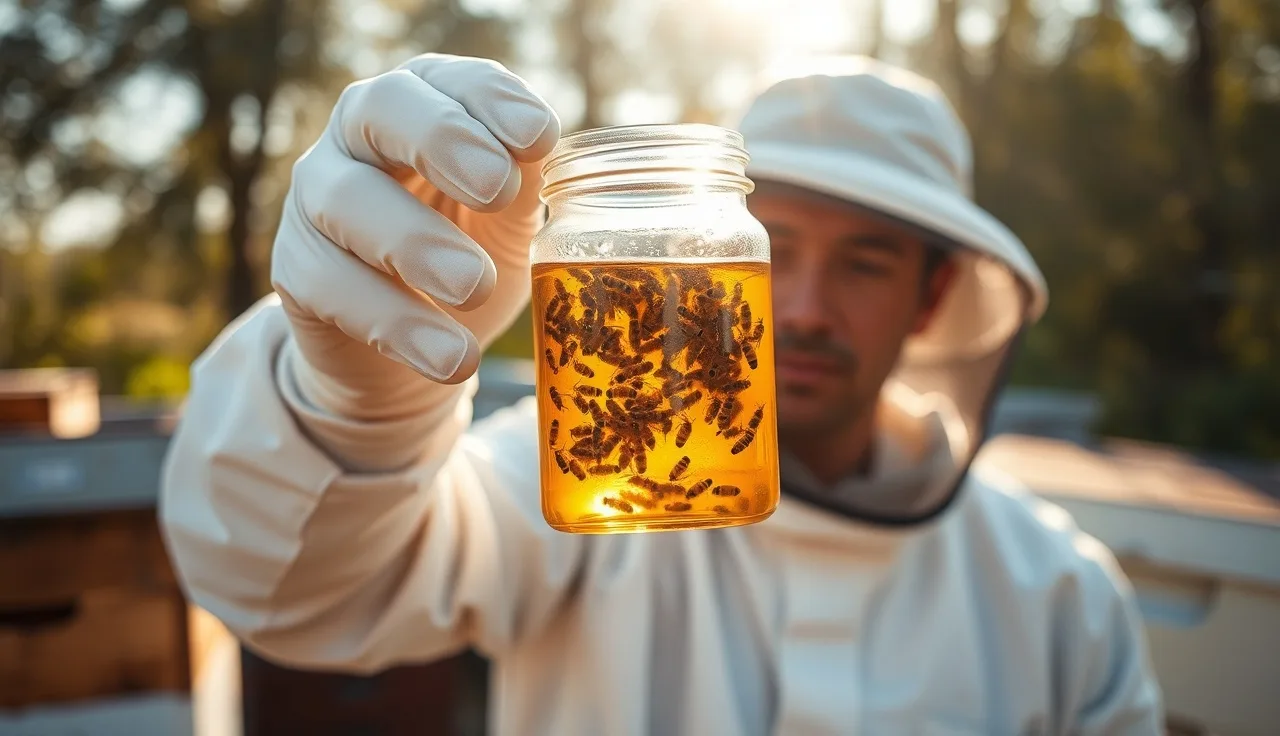
A mite wash threshold is the infestation level at which you treat, expressed as mites per 100 adult bees. Wash a half-cup sample (roughly 300 bees), find 6 mites, and you're at a 2% load. Find 9, you're at 3%. Simple math, big consequences.
The number matters because varroa populations grow exponentially, not in a straight line. A colony sitting at 2% in late July is often at 4% or higher by mid-August, because the mite-to-bee ratio keeps shifting as summer bees die off and fewer new bees replace them [1]. Miss the treatment window by two or three weeks in that stretch and you've traded a colony that overwinters for one that collapses in October.
A threshold is not a magic line, though. It's a probability estimate. Above the number, research and field experience say the colony is more likely to decline without help than to bounce back on its own. Below it, the cost of treatment (to the bees, more than your wallet) may outweigh the benefit. Treat the threshold as a decision tool, not a diagnosis.
Where does the 2% threshold come from?
The 2% threshold was formalized in the Honey Bee Health Coalition's "Tools for Varroa Management" guide, now in its seventh edition [1]. The HBHC working group, which includes researchers from land-grant universities and the USDA Agricultural Research Service, reviewed population dynamics data and settled on 2% as the treatment trigger for the late-summer and fall buildup, roughly August through October across most of North America.
The reasoning traces back to varroa population modeling from the late 1990s and 2000s. That work showed colonies tolerate low mite loads but hit sharp fitness declines above roughly 2 to 3 mites per 100 adult bees during periods of shrinking brood [2]. When a colony is building toward winter with a thinning workforce, a 2% load already stresses individual nurse bees. Each reproductive female mite that finishes a brood cycle on a winter bee cuts that bee's lifespan and degrades her hypopharyngeal glands, the structures behind royal jelly production and the colony's immune baseline.
The HBHC guide states that a mite wash "showing 2% or higher mites per bee during the critical late-summer period warrants immediate treatment" [1]. The word choice is deliberate. "Warrants" means treat now, not after your next monitoring round.
Where does the 3% threshold come from?
The 3% figure has a longer history. It shows up in several state extension publications and older treatment guides, especially those written before roughly 2015 [3]. Some of that history goes back to European research programs and older sampling methods, including sticky boards and sugar rolls rather than alcohol wash, which changes how mites get counted.
Sugar rolls undercount mites compared to alcohol wash, sometimes by 30% or more depending on technique and colony stress [4]. If a program built its threshold on sugar roll numbers, a 3% trigger in that system might match roughly the same true infestation as a 2% trigger measured by alcohol wash. That's one reason the two numbers coexist in the literature without being as contradictory as they look at first.
Some extension programs in states with longer brood seasons (parts of California, Florida, Texas) have used tiered thresholds: 2% during the fall buildup, 3% during the spring honey flow, when fast bee population growth dilutes the mite load and treatment costs (robbing risk, honey contamination concerns) weigh heavier [10]. Those programs aren't wrong. They're calibrating risk to season.
Is 2% or 3% the right threshold for your colony right now?
Honest answer: it depends on the month and your regional climate more than almost anything else.
The HBHC and most current extension guidance agree on 2% as the standard from late summer through fall [1][3]. In spring and early summer, when colonies expand fast and brood is everywhere, some programs use 3% because the colony's momentum stays ahead of the mite population for longer. That flexibility is narrower than it sounds. I'd default to 2% year-round if I wasn't certain about the season in my specific location. Running a 3% spring threshold in a region with an early mite surge can burn you.
Here's the situation where the distinction bites. You monitor in late July and find 1.8%. That's below both thresholds. Do you treat? Under a strict 2% rule, 1.8% is technically under the line, so no. But the direction of travel matters more than the single reading. If your previous wash was 0.9%, you're doubling in about a month. Schedule the next wash for two weeks out, not four.
Colony context matters too. A colony raising the winter bees that will actually carry it to spring deserves tighter management than a split you're still building up. Raising the effective threshold for a struggling nucleus that can't afford the disruption of treatment is defensible, but only if you monitor every week.
For a broader look at what varroa actually does inside a colony, see our varroa mite overview.
How do you actually do a mite wash correctly?
The alcohol wash (also called an ethanol wash or mite wash) is the most accurate field method a hobbyist has. Sticky boards give you relative trends but not the clean percentage a threshold decision needs. Sugar roll is gentler on bees but less accurate. For threshold decisions, use alcohol wash [4].
The steps:
- Find a frame with nurse bees (not the queen) near the brood nest. These are the bees most likely carrying mites.
- Shake or brush bees into a wide-mouth container, then pour them into your wash container until you have about 300 bees, which is roughly half a cup by volume.
- Add 70% isopropyl alcohol (rubbing alcohol) until the bees are fully submerged. Lid on, shake hard for 30 to 60 seconds.
- Pour the liquid through a fine mesh screen into a clear container. Count the mites in the liquid. Count the bees left in the mesh.
- Divide mites by total bees, multiply by 100. That's your percentage.
A half-cup sample gives you reasonable statistical power. Go smaller (100 bees) and your sampling error climbs a lot [2]. The USDA Bee Research Laboratory at Beltsville has published sampling protocols that confirm 300 bees as the practical minimum for reliable results [5].
Temperature matters. Bees sampled in cool morning air clump up and separate poorly. Sample in the afternoon when the colony is active and the population on brood frames represents the nurse bee cohort.
For wash cups and other gear, most beekeeping supply companies carry what you need.
What does a mite percentage actually look like in real numbers?
A table makes this concrete.
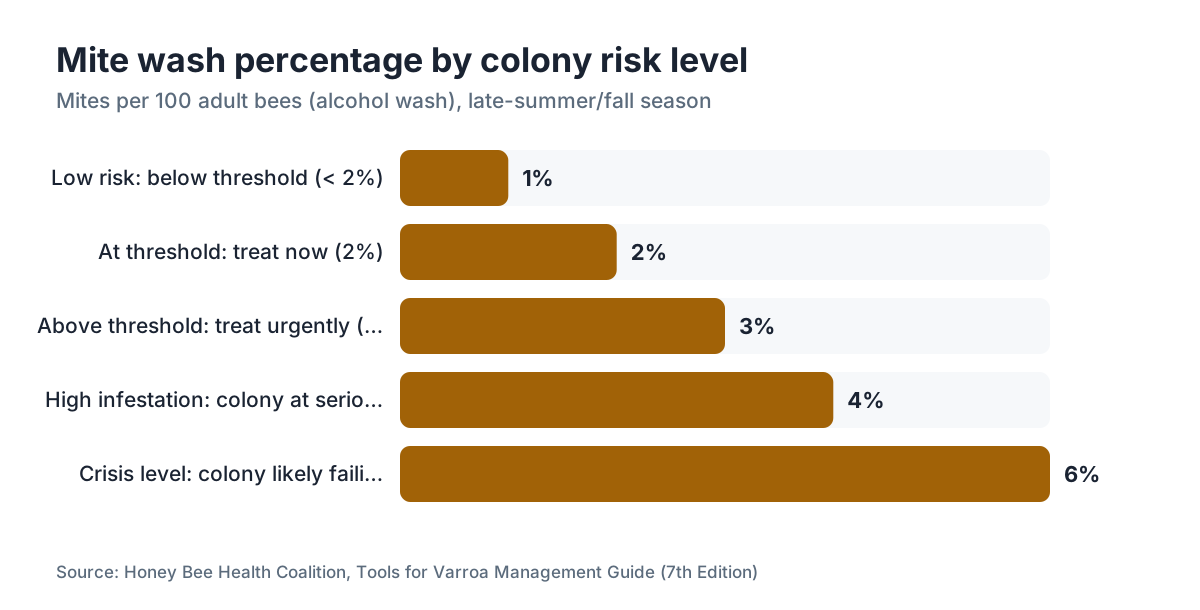
| Mites found in 300-bee sample | Mite % | HBHC guidance (late summer/fall) |
|---|---|---|
| 3 | 1.0% | Below threshold, monitor in 2-3 weeks |
| 6 | 2.0% | At threshold, treat now |
| 7 | 2.3% | Above threshold, treat now |
| 9 | 3.0% | Significantly above threshold, treat urgently |
| 12 | 4.0% | High infestation, colony at serious risk |
| 18 | 6.0% | Crisis level, colony likely failing |
Reaching 3% does not mean you missed the 2% window by a hair. At 3%, there are already far more mites in capped brood cells than on adult bees. The roughly 70:30 brood-to-phoretic ratio [2] means your visible count understates the full population. A 3% alcohol wash often reflects a true colony load that would read 4% or higher if you could count every mite, including the ones sealed in cells.
That's why "treat at 3%" is not a relaxed version of "treat at 2%." It's a different risk posture.
Does the threshold change by season?
Yes, and this is one of the details beekeepers get wrong most often.
Spring (March through May in most of North America): many programs accept something closer to 2-3% in early spring because fast colony expansion dilutes mite loads and brood-affecting treatments cause more disruption during buildup. But a colony entering spring above 2% probably came out of winter already stressed, and treatment is still warranted before the buildup peaks [1].
Honey flow (June through early July): the trickiest period. Some oxalic acid formulations are fine, but applying amitraz strips during an open flow means pulling honey supers per EPA label on most products [6]. Some beekeepers delay treatment during a strong flow and pay for it in August. That's a gamble that rarely pays off.
Late summer and fall (August through October): the 2% threshold applies firmly, no flexibility. This is when the bees being raised will overwinter the colony. The HBHC guide is explicit: treat at or above 2%, then monitor again 3-4 weeks after treatment to confirm it worked [1].
Winter (broodless period): oxalic acid trickle or vaporization is very effective when the colony is broodless because every mite is phoretic (on adult bees) and exposed. During this window, any detectable load (above about 0.5%) may warrant treatment, given how little a single oxalic application costs the colony [7].
Why does the timing of crossing the threshold matter so much?
Varroa populations in a typical colony can double in 4 to 6 weeks during peak brood season [2]. That sounds manageable until you run the numbers on a late-summer colony.
A colony at 1% in late July sits at roughly 2% by mid-August if left alone. By early September it could be at 4%. By the time you notice the signs of a collapsing colony (spotty brood, bees with deformed wings, a patchy irritable cluster), the load may already be 6% or higher, and the winter bees raised in September are already compromised.
Most of the damage happens where you can't see it. Deformed wing virus and other varroa-vectored pathogens suppress the immune function of bees that look perfectly normal [8]. Those bees fly out and die weeks ahead of schedule. The colony shrinks faster than you expect. And because no single day makes the collapse obvious, beekeepers often catch it too late.
Missing the 2% threshold in August by waiting for symptoms is roughly equivalent to treating a 6% colony in September. Some treatments still work, but now you're asking them to rescue bees that are already damaged instead of protecting bees that haven't been exposed yet.
VarroaVault's free monitoring tools track trend lines across multiple washes, so you see the trajectory instead of a single data point.
What treatment options apply once you cross the threshold?
Treatment choice depends on ambient temperature, whether supers are on, and whether the colony has capped brood. This is a threshold article, not a treatment manual, but the two connect: knowing which threshold you're at shapes which treatment makes sense.
Oxalic acid (Api-Bioxal, the only EPA-registered oxalic product in the US) [7]: vaporization works year-round on phoretic mites and hits hardest during broodless periods. Dribble application is label-approved once per year. Oxalic does not penetrate capped cells, so its reach during heavy brood season is limited unless you use extended-release forms.
Amitraz strips (Apivar): registered in the US, used per label, supers off during application under most label interpretations [6]. Works on phoretic and brood mites over a 42-56 day exposure. Very effective when placed correctly. Resistance is a documented concern in some regions [9].
Thymol-based products (Apiguard, ApiLifeVar): temperature-dependent, generally need ambient temps above 59°F (15°C) and work best between 60 and 105°F. Weaker in cool climates during fall windows.
A 3% result calls for the same options as a 2% result, with more urgency. If you've crossed 3%, reach for a treatment with brood-penetrating activity (amitraz) or plan multiple oxalic vaporization rounds to catch mites as they emerge from cells.
Read the EPA label for the specific product every time. The label is the law.
How accurate is your mite wash, and what could throw off the number?
A properly done alcohol wash of 300 bees carries a margin of error of roughly plus or minus 0.5 to 1 percentage point at low infestation levels, based on sampling theory applied to typical colony sizes [2]. So a 2.0% result is genuinely close to the threshold. Don't wave it off as "basically 1.5%." Round toward caution.
Several things bias a result low and make a colony look safer than it is.
Sampling from the wrong bees: bees from honey storage frames carry far fewer mites than nurse bees on brood frames. Sample from the brood nest.
Sample size too small: 100 bees roughly doubles your uncertainty versus 300. Sample small consistently and you're probably underestimating.
Incomplete agitation: mites grip tightly. Shake longer than feels necessary.
Counting error: mites stick to each other and to bee debris. Work in good light, use a magnifier if you need one.
Nobody has great data on how much operator variability shifts results across real beekeepers in the field. The closest work suggests experienced samplers are more consistent but not dramatically more accurate than careful beginners. The technique is learnable. Do a few practice washes with a known sample before you trust threshold decisions to your first attempts.
What do researchers and extension services recommend today?
The current consensus is 2% as the standard for the late-summer period, with some programs keeping a 2-3% range for other seasons. Here's where the major sources land.
Honey Bee Health Coalition (7th edition guide): 2% threshold from August through October, 2-3% guidance in other seasons depending on colony status [1].
USDA Agricultural Research Service: does not set a single national threshold but cites the HBHC framework and confirms the 300-bee sampling standard [5].
Penn State Extension: recommends treating at 2% or above during the late-summer brood-rearing period, consistent with HBHC [3].
University of Minnesota Bee Lab: uses 2% as the treatment threshold and pushes monitoring frequency over rigid threshold application [2].
UC Davis Honey Bee Research Facility: notes some California programs use tiered seasonal thresholds (2% fall, up to 3% spring) based on colony expansion and regional brood season length [10].
The trend over the last decade runs clearly toward 2% and toward more frequent monitoring, not less. Nobody in the research community argues to raise the threshold. The open question, if there is one, is whether to lower it further for certain high-risk periods.
Common mistakes beekeepers make around mite thresholds
Monitoring once a season and treating that single number as the whole story. Mite loads move faster than most beekeepers expect. Monthly monitoring from June through October is the floor. Every two to three weeks during late summer is better.
Treating, then never checking again. Treatment efficacy varies. Apivar sometimes fails to drop mites if strips aren't placed right or resistance exists locally [9]. A post-treatment wash 4 to 6 weeks after starting tells you whether it worked.
Using sugar roll results as if they were alcohol wash results. They aren't the same, and running sugar roll percentages against an alcohol-wash-calibrated threshold hands you a false sense of safety.
Waiting for visible symptoms. Deformed wing virus shows only after a colony is already badly compromised. By then you're not preventing damage, you're doing damage control.
Ignoring the brood-to-phoretic ratio. The mites you count are only the phoretic fraction. At 2%, a big chunk of your total mite population is sealed in cells. Treatment timed to brood cycles (like oxalic vaporization after a split-induced broodless period) beats treating at threshold and hoping the number drops fast enough.
Frequently asked questions
Is a 2% mite wash result always a trigger to treat, no matter the time of year?
For late summer and fall (August through October), yes. The Honey Bee Health Coalition recommends treating at 2% or above during this period with no exceptions. In spring, some programs allow a slightly higher trigger of 2-3% because rapid colony expansion dilutes the load. But 2% year-round is the safest and simplest rule if you aren't certain about seasonal adjustments for your region.
What does 2% mites per wash actually translate to in total mite numbers in a hive?
A colony with 40,000 bees and a 2% phoretic load has roughly 800 mites on adult bees. But about 70% of total mites sit in capped cells at any given time during brood season [2], so the total colony population is closer to 2,600 to 3,000. That's why the visible count understates the real infestation, and why 2% on a wash is already a meaningful problem.
Can a colony recover on its own from a 2% mite load without treatment?
Rarely, and usually not fast enough to matter during the fall window. Some colonies with strong hygienic behavior can suppress mite reproduction, but most do not. The odds of natural recovery above 2% are low enough that the HBHC and major extension programs don't recommend waiting. Treating a colony that might have recovered costs you little. Not treating one that won't recover can cost you the colony.
Does a 3% result mean you've already missed the window to save the colony?
Not necessarily, but you're behind. A 3% wash in late summer means effective treatment needs to start within days, not weeks. Amitraz strips (Apivar) are a reasonable choice because they work on both phoretic and brood mites over a 6-8 week period. Confirm efficacy with a follow-up wash 4-6 weeks into treatment. Colonies at 3% that get timely treatment can still produce healthy winter bees.
Is alcohol wash the most accurate method for measuring mite levels?
Yes, among field-practical methods. Alcohol wash beats sugar roll (which undercounts by 30% or more in some studies [4]) and gives you a clean percentage, unlike sticky boards which show drop rates rather than infestation percentages. For threshold-based decisions, use alcohol wash. The mite washing kits sold by most beekeeping supply companies all use this principle.
How often should I be doing mite washes during the summer?
At minimum, once a month from May through October. During August and September, every two to three weeks is better because mite populations can double in 4 to 6 weeks and the window for protecting winter bees is narrow [1]. If you find a result close to 2% (say, 1.5 to 1.8%), shorten your monitoring interval rather than waiting the full month to check again.
Do different bee strains (like VSH or hygienic bees) have different effective thresholds?
Colonies bred for Varroa-Sensitive Hygiene (VSH) or hygienic behavior suppress mite reproduction more effectively, which can slow mite population growth. But no current research supports a higher threshold for VSH-bred colonies in standard management. The 2% threshold applies regardless of stock, partly because VSH expression varies a lot across commercial sources and local conditions.
What happens if I treat at 2% but the mite count doesn't drop after treatment?
That's a treatment failure and it needs attention now. Do a follow-up wash 4-6 weeks after starting treatment. If mites are still above 2% (or haven't dropped by at least 90% for amitraz), consider resistance, bad strip placement, or a dead product. Switch to a different treatment class, confirm brood isn't interfering with contact time, and recheck. Resistance to amitraz has been documented in some US populations [9].
Can I use the 2% threshold for a nucleus colony or split the same way as a full colony?
The threshold applies, but the stakes differ. A nuc on 4-5 frames with 10,000 or fewer bees has far less buffer than a full colony. A 2% result in a nuc means fewer total mites, but the colony has much less capacity to absorb damage to nurse bees. Treat at 2% in nucs just as you would in a full colony, and monitor more often because small colonies tip from 2% to 4% quickly.
Why do some beekeeping guides say 3% and others say 2%? Aren't they looking at the same research?
Mostly yes, but the research base evolved and sampling methods differ. Older guides built on sugar roll data used 3% because sugar roll undercounts compared to alcohol wash. Newer publications calibrated to alcohol wash arrived at 2% as the equivalent [4]. The HBHC guide represents the current expert consensus. If your extension publication is more than 5-7 years old, its 3% may rest on reasons that no longer apply to your monitoring method.
Is there a threshold for winter or during a broodless period?
During a confirmed broodless period, every mite is phoretic and exposed, so even low counts (0.5% or above) are sometimes treated with oxalic acid because the cost to the colony is minimal and efficacy is very high [7]. The standard 2% threshold is built for active brood season. In midwinter with no brood, the math shifts: treat if there's any meaningful load, because oxalic vaporization during broodlessness is among the most effective interventions available.
Does it matter whether I sample bees from the top or bottom of the brood nest?
It matters less than which frame you sample from. Take bees from a frame with open brood and nurse bees clustered on it, ideally near the center of the brood nest. Frames at the brood nest edge and in honey storage will have fewer mites because nurse bees (the main hosts for phoretic mites) concentrate near uncapped brood. Sample from the wrong place and you can underestimate your true load by a lot.
Sources
- Honey Bee Health Coalition, Tools for Varroa Management Guide (7th Edition): 2% threshold for late-summer/fall treatment trigger; HBHC states a mite wash showing 2% or higher warrants immediate treatment during the critical late-summer period
- University of Minnesota Bee Lab, Varroa Mite Management: Varroa populations can double in 4-6 weeks during peak brood season; approximately 70% of mites are in capped cells at any given time during brood season; 300-bee minimum for reliable sampling
- Penn State Extension, Varroa Mite Treatment and Management: Recommends treating at 2% or above during late-summer brood-rearing period; some southern extension programs retain 3% as a spring threshold
- Macedo et al., Journal of Apicultural Research, Comparison of methods for Varroa sampling: Sugar roll undercounts mites compared to alcohol wash, sometimes by 30% or more depending on technique and colony stress level
- USDA Agricultural Research Service, Bee Research Laboratory (Beltsville): 300-bee sample as practical minimum for reliable alcohol wash results; USDA cites HBHC framework for threshold guidance
- EPA, Apivar (amitraz) product label registration: Honey supers must be removed before Apivar application per EPA label; 42-56 day treatment period
- EPA, Api-Bioxal (oxalic acid) product label registration: Api-Bioxal is the only EPA-registered oxalic acid product in the US; effective during broodless periods when all mites are phoretic; dribble application approved once per year per label
- Nazzi & Le Conte, Annual Review of Entomology, Ecology of Varroa destructor: Deformed wing virus and other varroa-vectored pathogens suppress immune function in bees that appear visually normal
- Rinkevich, USDA ARS, Amitraz resistance in Varroa destructor: Resistance to amitraz has been documented in some US Varroa populations; treatment failure can occur even with correct application
- UC Davis Honey Bee Research Facility, Varroa Monitoring Protocols: Some California extension programs use tiered seasonal thresholds (2% fall, up to 3% spring) based on colony expansion rates and regional brood season length
Last updated 2026-07-09