When to remove Apivar strips after treatment
TL;DR
- Apivar (amitraz) strips have to stay in the hive at least 6 weeks and come out no later than 8 weeks per cycle, per the EPA-registered label.
- Pull them early and mites survive.
- Leave them too long and you breed resistant mites.
- Do a mite wash before you hang the strips and again after you pull them.
What does the Apivar label actually say about removal timing?
The EPA-registered Apivar label is the legal document here, not a forum post and not your mentor's habit from 2015. Each strip has to stay in the colony a minimum of 6 weeks and come out no later than 8 weeks after you hang it [1]. That 6-to-8-week window is the whole ballgame.
Why that range? Amitraz works by contact. Bees pick up the active ingredient as they walk across the strip and groom each other, spreading it through the colony. The mites feeding on adult bees and developing brood die from exposure. But a single worker bee doesn't live 6 weeks. The colony needs enough time for the chemical to cycle through multiple bee generations and reach mites that were sealed inside capped brood the moment you put the strips in [2].
Six weeks is the floor. Not a suggestion. Pulling strips at 4 weeks because your mite counts dropped is one of the fastest ways to leave a reservoir of partly-exposed, maybe-resistant mites in your hive.
Can you leave Apivar strips in longer than 8 weeks?
No. People get this backwards more than any other part of the protocol, and it costs them.
Amitraz resistance in Varroa destructor is documented and spreading. A 2016 study in PLOS ONE found amitraz-resistant mite populations in commercial operations across the United States, and the resistance mechanism (mutations in octopamine receptors) is heritable [3]. Every extra week you leave strips in past the removal date is free selection pressure. You hand sub-lethal amitraz to the mites that already survived, which is exactly how the next generation of resistant mites gets made.
There's a honey contamination problem too. Apivar is not approved for use during a honey flow meant for human consumption [1]. The label says so flatly. Leaving strips in through a nectar flow while also blowing past the 8-week limit stacks two mistakes on top of each other.
Think of Apivar strips as a timed treatment, not a passive slow-release gadget you can forget about. Set a calendar reminder the day you hang them.
How do you know the treatment actually worked before you remove the strips?
Removing strips on day 42 without checking your mite load is flying blind. The Honey Bee Health Coalition recommends an alcohol wash or sugar roll before treatment starts, then another 48 to 72 hours after removal to confirm it worked [4].
Here's what good numbers look like. If your pre-treatment wash showed 3 mites per 100 bees (the common 3% action threshold) and your post-treatment wash comes back at 0 to 1 per 100 bees, the treatment did its job. Still seeing 2 or more mites per 100 bees after a full 6 to 8 week run with fresh, correctly placed strips? That's a signal worth taking seriously: possible resistance, strips placed wrong, or heavy reinfestation from a neighbor's collapsing hive.
The Honey Bee Health Coalition's Varroa management guide says post-treatment monitoring is how you close the loop [4]. Skip it and you're guessing.
A sticky board count is not a substitute. Sticky boards tell you relative mite drop, not infestation rate. Use an alcohol wash.
Does brood presence affect how long you need to leave strips in?
Yes, and it's the most overlooked variable in the whole timing question.
Varroa mites spend roughly 66 to 70% of their reproductive cycle inside capped brood, where amitraz can't reach them [2]. During normal brood-rearing season, a chunk of your mite population is always hiding under cappings. The 6-week minimum on the label is built around this biology. It gives brood time to emerge, time for those mites to ride out on adult bees as phoretic mites, and time for the chemical to hit them.
That's why broodless treatments work so well, and why a lot of beekeepers pair a broodless or near-broodless stretch with their fall treatment. When a colony has little or no capped brood, nearly all the mites are phoretic (riding adult bees) and fully exposed. A 2009 study in Apidologie found treatment efficacy during broodless periods could top 95%, versus 60 to 90% during active brood-rearing [5].
What this means for you: treating in September or October in the northern hemisphere, when brood is present but winding down, run the full 8 weeks. Don't cut it short because the nights got cold.
Where in the hive should the strips be placed, and does placement affect when you remove them?
Placement changes efficacy, not removal timing. You still pull strips at 6 to 8 weeks either way. But bad placement means you wasted those weeks.
The Apivar label says to hang strips vertically between frames in the brood nest, one strip per 5 frames of bees, up to 2 strips per brood box [1]. The strips need to sit in the cluster, in the busy zones where bees are constantly walking across them. A strip jammed into an empty corner does nothing.
A standard 10-frame Langstroth with two brood boxes takes 4 strips total: 2 per box, set in the middle of the brood area, not against the outer walls. If your colony has shrunk down to a single deep going into fall, 2 strips is right.
One practical note: peek at the strips around the 3-to-4-week mark. Not to pull them early. Just to confirm they're still where you put them. Bees sometimes shift them or chew the hanging tab. Reposition if needed.
What's the right removal timing by season?
Season changes your outcomes more than almost anything else. Here's how the calendar plays out in a typical temperate northern-hemisphere operation.
Fall treatment (the one that matters most). Most extension programs recommend hanging strips in late August or early September to protect the brood that becomes your winter bees. Strips in on September 1 means your 6-week mark is October 13 and your 8-week deadline is October 26. Across most of the northern U.S. and Canada, that lands before hard frost shuts down inspections, which is exactly where you want to be [6].
Spring treatment. Less common, but sometimes needed if mite counts spike before the first strong honey flow. Hang strips after the winter cluster breaks and brood-rearing picks back up. Same 6 to 8 week window. Careful, though: no strips in during a honey flow for human consumption [1]. Know your local bloom dates.
Summer between-flow treatment. Controversial and mostly skipped by hobbyists, though some sideliner operations run it. The risk of getting caught by an early flow is real. If you go this route, write your removal date on paper before you hang a single strip.
The Honey Bee Health Coalition's seasonal calendar is a solid reference for lining up treatment windows with your local conditions [4].
A free mite tracking tool like the one at VarroaVault lets you log wash counts and treatment dates so you never lose track of where you are in the cycle.
What happens if you forget to remove Apivar strips on time?
It happens. You get busy, the weather turns bad for two weeks, and suddenly day 56 is in the rearview mirror.
At 9 or 10 weeks you're not staring at a disaster. The amitraz concentration in the strips is dropping over time anyway. But you're doing two things you don't want to do: dragging out low-level amitraz exposure that selects for resistance, and possibly contaminating wax and honey stores past what the label allows.
If you find you've gone past 8 weeks, pull the strips right then. Don't sit there calculating whether it still matters. Pull them, record the actual dates, and factor it into your next treatment decision.
One more thing worth knowing: beeswax accumulates amitraz and its breakdown products, including DMPF (2,4-dimethylaniline). A 2010 study in the Journal of Agricultural and Food Chemistry found amitraz residues in beeswax at levels tied to treatment history [7]. That's not an emergency for your bees, but it's one reason to follow label timing and to rotate out old brood comb on a regular schedule.
Can you do a second Apivar treatment if the first one didn't knock mites down enough?
Yes, with conditions.
The label allows two treatments per year, each running the same 6 to 8 week protocol [1]. If your post-treatment mite wash still reads above 1 to 2 mites per 100 bees after a properly run first treatment, a second round with fresh strips is reasonable. Fresh strips matter. Reusing strips from a finished treatment because they still look intact is a documented cause of poor efficacy. Used strips have depleted amitraz and uneven residual levels.
But if you keep seeing failure with Apivar (mites still high after a full second treatment with fresh strips, correct placement, and proper timing), take amitraz resistance seriously. At that point, rotating to a different mode of action beats a third round of the same chemical. Thymol products (Thymovar, Api-Life VAR), formic acid (MAQS), and oxalic acid products (Api-Bioxal) all use different active ingredients and hit brood differently [8].
For a deeper look at varroa mite biology and why rotation matters, see our overview of varroa mite management basics.
Apivar removal timing vs. other amitraz-based treatments: is it the same?
Apivar is the most widely used amitraz strip in North America, but it's not the only miticide out there, and the others don't share its timing. MiteAway Quick Strips (MAQS) use formic acid on a 7-day protocol. Apistan uses tau-fluvalinate, not amitraz, and carries its own label. None of these are interchangeable.
For amitraz specifically, the Apivar label timing (6 to 8 weeks) is the U.S. standard. Some European amitraz products use different formulations and different labeled times. If you're working outside the U.S., read your country's registered product label directly. In the EU, Apivar's label through Vétoquinol also specifies a minimum 6-week contact period [9].
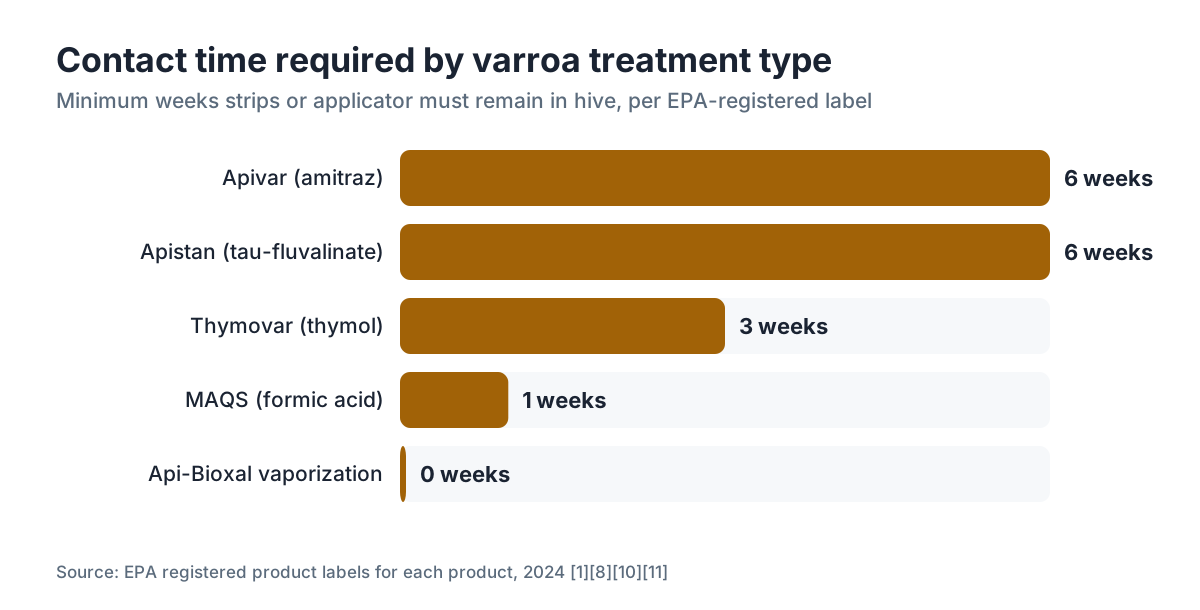
The table below lines up the main treatment families by contact time so you can see where Apivar sits.
| Treatment | Active Ingredient | Min. Contact Time | Max. Contact Time | Brood Penetration |
|---|---|---|---|---|
| Apivar | Amitraz | 6 weeks | 8 weeks | Low (contact only) |
| Api-Bioxal (dribble/vaporize) | Oxalic acid | 1 application | N/A (no strips) | Very low |
| MAQS | Formic acid | 7 days | 7 days | Moderate |
| Thymovar | Thymol | 3 to 4 weeks | 4 weeks | Low |
| Apistan | Tau-fluvalinate | 6 to 8 weeks | 8 weeks | Low (contact only) |
Sources: EPA-registered product labels for each product [1][8][10][11].
How should you dispose of used Apivar strips?
Used Apivar strips still hold residual amitraz, so they don't belong in your household recycling or compost. The label calls for disposal in household trash (in most U.S. jurisdictions) or through a pesticide disposal program if your area runs one [1].
Do not burn used strips. Burning amitraz produces toxic breakdown products, and open burning of pesticide materials is regulated or banned in most states.
Wrap used strips in a sealed bag before you toss them so residual amitraz doesn't reach soil, surface water, or non-target insects. One used strip won't poison a watershed. The habit still matters, especially once you're running dozens of hives.
Keep a treatment log: date in, date out, strip count, mite counts before and after. It takes 5 minutes per cycle and pays off fast the day you need to troubleshoot a resistant mite problem or talk your management through with a local extension apiarist.
What are the signs that Apivar treatment failed, and what do you do next?
Treatment failure rarely shows at the hive entrance. Bees can look and act fine while carrying a mite load that will collapse the colony in 6 to 10 weeks. That's why post-treatment monitoring is non-negotiable.
Signs to watch for after removal:
A post-treatment alcohol wash above 2 mites per 100 bees is the clearest signal. Visual signs of mite damage back it up: deformed wing virus (crumpled wings on emerging bees), bees with shortened abdomens, or spotty brood with sunken cappings. All of that points to a colony under heavy mite pressure where the treatment may not have been enough [4].
If you see these signs, work through the steps in order: (1) recount with a fresh alcohol wash to confirm; (2) check your placement and strip count against the label; (3) if everything was done right, switch modes of action instead of repeating Apivar. Oxalic acid vaporization or formic acid (MAQS) are the most practical alternatives for hobbyist and sideliner beekeepers in the U.S. [8].
For broader guidance on sourcing mite treatments and other hive supplies, see our resource on beekeeping supply companies. Knowing where to grab fresh strips fast matters when you're reacting to a failing treatment.
VarroaVault's free mite count tracker helps you see whether a post-treatment rebound is slow decline or actual resistance-level failure, which makes the next call a lot easier.
Frequently asked questions
Can I remove Apivar strips after 6 weeks if my mite count is already zero?
A zero count at 6 weeks is great news, but it doesn't mean every mite is gone. Mites inside capped brood won't show up in an alcohol wash. The Apivar label requires a minimum 6 weeks for exactly this reason: brood has to emerge and residual mites have to get exposed. Pulling strips the day you hit 6 weeks is fine. Pulling them before 6 weeks because counts look good is not.
What happens if I leave Apivar strips in for 10 weeks by mistake?
Remove them right away and record the actual dates. Going 2 weeks past the 8-week limit isn't catastrophic for your bees, but it drags out low-level amitraz exposure that can select for resistant mites. Amitraz also builds up in beeswax over time. Don't talk yourself into leaving them in even longer. Pull them, note the error, and plan your next treatment around it.
How many Apivar strips does a hive need?
The Apivar label specifies one strip per 5 frames of bees, up to 2 strips per brood box. A standard 10-frame Langstroth with two brood boxes takes 4 strips total. A single-deep hive with a reduced fall cluster takes 2. Base the count on actual frames of bees, not frames of comb. Under-stripping is one of the most common reasons treatments underperform.
Is Apivar safe to use during a honey flow?
No. The EPA-registered Apivar label flatly prohibits use during a honey flow meant for human consumption. Amitraz can move into honey stores. Plan your treatment windows so the whole thing, strip removal included, finishes before your main nectar flow starts. In most temperate U.S. climates, that makes fall treatment the cleanest option.
Do I need to remove the queen before inserting Apivar strips?
No. Apivar doesn't require queen removal. Some beekeepers cage the queen for part of the fall treatment to create a temporary broodless stretch, which increases mite exposure. That's optional and adds work. If you don't cage the queen, the full 6 to 8 week window is designed to account for normal brood cycles anyway.
Can Apivar be used in a nuc or small colony?
Yes, with adjusted strip counts. Use 1 strip per 5 frames of bees, so a 5-frame nuc gets 1 strip. A tiny 3-frame nucleus probably doesn't have the bee population to make Apivar work well; an oxalic acid dribble is often better for very small colonies. The 6 to 8 week timing doesn't change regardless of colony size.
What mite count threshold should trigger an Apivar treatment?
The Honey Bee Health Coalition and most U.S. extension programs use 3% (3 mites per 100 bees by alcohol wash) as the action threshold during brood-rearing season. Some programs drop this to 2% going into fall, because winter bees decide whether the colony survives. Count in late August and treat immediately if you're at or above the threshold.
Can I use Apivar and oxalic acid at the same time?
There's no label prohibition on it, and some research suggests combining Apivar strips with oxalic acid vaporization improves efficacy by hitting mites both in brood (amitraz contact) and in the cluster (oxalic acid). Peer-reviewed data on combined resistance effects is thin. The most common practical approach is to finish one treatment, assess, then run the other if needed.
Will cold temperatures affect Apivar strip efficacy or removal timing?
Amitraz is slightly less volatile at lower temperatures, which can cut efficacy when colonies cluster tight and bees barely touch the strips. The 6 to 8 week label timing doesn't change, but this is another reason to start fall treatment early enough that most of the window falls while bees are still active. Starting in late August in the northern U.S. instead of October keeps you in a better temperature range.
How do I record Apivar treatment dates for inspection purposes?
Keep a simple hive log: date strips inserted, number of strips, pre-treatment mite count, date strips removed, and post-treatment mite count taken 48 to 72 hours after removal. Many state apiary inspectors appreciate records during varroa compliance visits. A paper index card per hive works fine. Digital tools that timestamp entries are even better for multi-hive operations.
Does Apivar resistance in varroa mites affect how long I should leave strips in?
No, not directly. If your mite population has developed amitraz resistance, leaving strips in past 8 weeks won't fix it. Resistant mites survive at full amitraz concentration, so more time doesn't compensate. Post-treatment monitoring is the only way to detect resistance. If counts don't drop much after a correctly run 6 to 8 week treatment, switch to a different mode of action.
What's the difference between Apivar and Apistan removal timing?
Both Apivar (amitraz) and Apistan (tau-fluvalinate) use contact-based mechanisms, and both labels specify 6 to 8 weeks of treatment per cycle. The removal timing is the same. The difference is the active ingredient and resistance profile: tau-fluvalinate resistance is widespread in U.S. varroa populations, which makes Apivar generally more effective in operations that have never used amitraz.
Should I treat with Apivar in both spring and fall?
Fall treatment is almost always the higher priority. The winter bee cohort decides whether your colony survives to spring, and heavy mite loads in September and October wreck it. A spring treatment makes sense if your post-winter mite counts run above the 3% action threshold before the main honey flow. Treating twice a year is allowed on the label, but it should be driven by actual mite counts, not a fixed schedule.
Sources
- EPA, Apivar (amitraz) registered product label: Apivar strips must remain in the hive a minimum of 6 weeks and be removed no later than 8 weeks after insertion; not approved during honey flows for human consumption; disposal instructions
- Pennsylvania State University Extension, Varroa Mite Biology: Varroa mites spend approximately 66 to 70% of their reproductive cycle inside capped brood, where contact acaricides cannot reach them
- Spreafico M. et al., PLOS ONE 2016, Amitraz resistance in Varroa destructor: Amitraz-resistant Varroa mite populations documented in U.S. commercial operations; resistance is heritable via mutations in octopamine receptors
- Honey Bee Health Coalition, Tools for Varroa Management Guide (current edition): Recommends alcohol wash monitoring before and 48 to 72 hours after treatment; 3% action threshold during brood season; post-treatment monitoring is standard protocol
- Nanetti A. et al., Apidologie 2009, treatment efficacy during broodless periods: Varroa treatment efficacy during broodless periods can exceed 95%, compared to 60 to 90% during active brood-rearing
- University of Minnesota Extension, Varroa Mite Management: Recommends fall Apivar treatment insertion in late August or early September to protect the winter bee cohort, with removal before hard frost in northern climates
- Mullin C.A. et al., Journal of Agricultural and Food Chemistry 2010, pesticide residues in beeswax: Amitraz and its breakdown products including DMPF accumulate in beeswax at levels correlated with treatment history
- EPA, Api-Bioxal (oxalic acid) and MAQS (formic acid) registered product labels: Oxalic acid and formic acid products are labeled varroa treatments with distinct modes of action suitable for rotation with amitraz
- Vétoquinol, Apivar EU product label / EMEA registration: EU Apivar label specifies minimum 6-week contact period per treatment cycle
- EPA, Thymovar (thymol) registered product label: Thymovar label specifies 3 to 4 week treatment period, maximum 4 weeks
- EPA, Apistan (tau-fluvalinate) registered product label: Apistan label specifies 6 to 8 week treatment period, same window as Apivar
- USDA Agricultural Research Service, Varroa destructor management: Background on Varroa biology, phoretic mite phase, and treatment timing considerations
Last updated 2026-07-09