Can you save Apivar strips after the pouch is opened?
TL;DR
- Yes, you can save unused Apivar strips after opening the foil pouch, but only for a limited time.
- The EPA-registered label instructs beekeepers to use opened pouches within 6 weeks and reseal them tightly in a cool, dry place away from sunlight.
- Amitraz degrades with heat, humidity, and UV exposure, so proper storage directly affects how well your treatment works.
What does the Apivar label actually say about storing opened strips?
Reseal the pouch and use the remaining strips within 6 weeks of opening. That comes straight from the Veto-Pharma EPA-registered label for Apivar (EPA Reg. No. 83623-5), the legally binding document for how the product can be used in the United States. [1]
The label reads: "Keep in original container. Do not store near heat or open flame. Store in a cool, dry area." It also gives a sealed shelf life of up to 3 years from the manufacture date when stored right. That 3-year clock resets to a much shorter window the moment you open the foil. [1]
Why 6 weeks? An Apivar strip is a plastic polymer matrix loaded with amitraz, the active ingredient. The matrix is built to release amitraz slowly across a 6-to-8 week treatment. Open the foil pouch and that polymer meets ambient air. Humidity and oxygen speed up amitraz oxidation, and UV light breaks the molecule down further. A strip sitting unsealed in your garage for two months before you use it is almost certainly delivering a lower dose than the label rates it for, and that's exactly the scenario that breeds under-treatment and mite resistance.
The six-week window is a manufacturer guideline, not an EPA-tested threshold with published degradation curves, but it matches the general amitraz photostability data in the literature. [2] When in doubt, the label governs.
How should you store Apivar strips to keep them effective?
Resealing the pouch is the step that matters most. Squeeze out as much air as you can, fold the top over, and clamp it shut with a binder clip or tape. If the original foil is intact enough to fold cleanly, use it. If the foil is torn or crinkled and won't hold a seal, a resealable freezer bag with the air pressed out works, though it gives you less UV and moisture protection than the original material.
Store the sealed pouch somewhere cool and dark. A temperature between 32°F and 77°F (0°C to 25°C) is the general target for formamidine acaricides like amitraz. [2] A basement, cellar, or interior closet beats a barn, a truck cab, or a shed that hits 100°F in summer. Don't freeze the strips. Freezing can affect the polymer matrix in ways that aren't well characterized in public literature, and the label does not endorse it.
Keep strips away from other pesticides, fertilizers, and fuels. Amitraz reacts with acidic compounds and some solvents, and off-gassing in a tight storage space can in theory speed up degradation even through a sealed pouch. A dedicated plastic box inside your storage space adds one more layer.
Label your pouch with the date you opened it. It's easy to forget when you cracked that first strip into a hive back in early August. A piece of masking tape and a marker takes five seconds and saves you from guessing in October.
Does amitraz actually degrade, and how fast?
Amitraz degrades by hydrolysis in water and by photolysis under UV light. In soil and water studies, its half-life under sunlight runs from a few hours to a few days depending on pH and temperature. [2] In the dry polymer matrix of an Apivar strip, degradation is much slower. It's not zero.
The metabolite of concern is 2,4-dimethylaniline (2,4-DMA), a breakdown product that has shown genotoxic activity in some lab assays. [3] For most beekeepers that matters less for colony health than for the plain effectiveness question. As amitraz breaks down, the concentration in the strip drops, the slow-release rate falls below therapeutic levels, and your mite-kill numbers fall with it. A strip that looks fine and smells right may still be under-delivering.
Nobody has published clean degradation curves for Apivar strips held in ambient air over 6 to 12 weeks under controlled conditions, or at least no such study is public as of this writing. The manufacturer's 6-week guidance is the most specific number you'll find. The closest relevant science is general amitraz photostability research, which supports the idea that even modest UV and heat exposure meaningfully shortens efficacy. [2]
Don't treat the 6-week rule as conservative padding. It's the best number we have.
Can you reuse Apivar strips that were already in a hive?
This is where the answer gets firm. No. Reusing strips pulled from a hive is not permitted by the EPA label, and it quietly wrecks your own mite management. [1]
Here's why. An Apivar strip spends 6 to 8 weeks in a colony releasing amitraz through bee contact. By the time you pull it, the strip has already handed the bulk of its active ingredient to the colony. Residual amitraz in a used strip is not evenly distributed and not reliably quantifiable without lab testing. Put that strip back in the same or a different hive and you have no idea what dose you're delivering, which is the exact situation that lets high-mite-load hives limp through treatment while resistance pressure builds.
Used strips also carry hive debris, propolis, and possible pathogen material. That physical fouling blocks the bee-contact mechanism even more.
Dispose of used strips per the label. Wrap them in newspaper or seal them in trash for regular household or landfill disposal. Don't burn them. Don't bury them in your beeyard. Amitraz combustion produces toxic compounds, and burning is specifically prohibited by the label in most jurisdictions. [1]
What happens if you use degraded or improperly stored strips?
At best, you get a treatment that works poorly. A colony that should drop from a 5% infestation rate to under 2% might only come down to 3%, which still leaves enough mites to crash the hive by winter. At worst, chronic sub-lethal amitraz exposure paired with a weak kill is exactly the selective pressure that produces amitraz-tolerant varroa. [4]
The Honey Bee Health Coalition's Varroa Management Guide puts it plainly: treatments need to be applied at the right time, dose, and duration to be effective, and "any deviation from the label can reduce efficacy and increase the risk of resistance." [5] Using degraded strips is a silent deviation because you can't see the problem. Your alcohol wash or sugar roll counts drop a little, the colony looks okay for a while, and then in December you find bees with deformed wings crawling on the landing board.
Resistance to amitraz has been documented in European varroa populations. [4] Large-scale resistance in North America isn't yet widespread, but the conditions that create it are exactly what happens when amitraz gets used repeatedly at sub-lethal concentrations over years. Storing and using your strips correctly is one small piece of holding that problem off.
If you're unsure whether your stored strips are still good, the honest answer is: buy a new box. A box of 10 Apivar strips costs roughly $30 to $40 at most beekeeping supply companies and is often available through free shipping honey bee supply companies when you hit order minimums. [6] The cost of a failed treatment, in dead colonies and lost bees, runs much higher.
How long do sealed, unopened Apivar strips last?
The Veto-Pharma label gives a shelf life of up to 3 years from the production date for sealed, properly stored product. [1] The production date is printed on the box and sometimes on the foil pouch, usually as a batch or lot code. If you bought strips you plan to use next season, check that date before you shelve them.
Proper sealed storage means the same thing as post-opening storage: cool, dark, dry, away from other chemicals. A sealed pouch is far better protected than an opened one because the foil barrier is intact, but heat and time still count. Strips stored in a barn that hits 110°F every July for three summers are probably not at full potency by year three, seal or no seal.
Buy what you'll use in a single season if you can. If you end up with leftover sealed strips, store them well and check the production date next spring before you open them.
How many Apivar strips do you need per hive, and why does that affect storage planning?
The Apivar label calls for 2 strips per hive body on colonies covering 5 or fewer combs of bees, and a third strip when bees cover more than 5 combs. For most full-strength colonies in a single or double brood box, plan on 2 strips per hive. [1]
A box of Apivar holds 10 strips, enough for 5 hives at the standard 2-strip dose. Run 6 hives and you open one box, use 10 strips, crack a second box, use 2, and end up with 8 strips in a partially open box. That's the moment storage gets real.
Planning your purchase around your actual hive count heads off the storage problem entirely. If you treat in fall and spring, buy enough for one cycle at a time. Apivar is widely stocked, so stockpiling boxes gains you little, and the 3-year shelf life is long enough that one extra box is fine while three extra boxes is a waste. Check the resources at VarroaVault for tools that calculate strip needs by colony count before you order.
The table below shows typical strip needs by hive count and how many boxes that takes.
What are the legal and EPA compliance issues around Apivar storage and reuse?
The Federal Insecticide, Fungicide, and Rodenticide Act (FIFRA) requires that pesticides be used in a manner consistent with their labeling. [7] The label is a legal document. Using Apivar in ways the label prohibits, whether that's reapplying used strips, storing them past the labeled window and then applying them as if they were fresh, or using them on non-target species, puts you in violation of federal law and, in many states, state pesticide law too.
For hobbyists and sideliners, FIFRA enforcement rarely targets individual beekeepers. The bigger issue is practical. Treat a colony wrong and then sell honey, and you have potential food safety liability. Amitraz and its metabolites can build up in beeswax and honey at detectable levels when treatments are misapplied or overused. [3] Staying inside the label is how you keep on the right side of both the law and food safety standards.
Your state department of agriculture may set additional rules on pesticide storage and disposal. Most state ag departments publish disposal guidance, and many run periodic collection events for unused pesticides. [8] A quick call to your state's pesticide regulatory office is worth it if you end up with product you can't use before it expires.
Understanding the varroa mite biology behind why these protocols exist makes compliance feel less like box-checking and more like something you actually want to do for your colonies.
Are there signs that Apivar strips have gone bad?
There's no reliable visual test. Degraded amitraz doesn't change the color, texture, or smell of a strip in any way your senses can catch. A strip that looks perfectly fine can be delivering 40% less amitraz than it should if it sat in a hot shed for two months after the pouch was opened.
Some beekeepers report that very old or heat-damaged strips turn brittle or slightly discolored next to fresh product. If your strips snap instead of flexing, or look noticeably different from strips out of the same box used earlier in the season, be skeptical.
The only honest way to verify strip efficacy is to monitor mite loads before and after treatment. An alcohol wash before you hang strips and another at the end of the 6-to-8 week window tells you whether the treatment worked. The Honey Bee Health Coalition and most university extension programs recommend this monitoring anyway, no matter which treatment you use. [5] A post-treatment count above 2% infestation in late summer is a flag that something went wrong, whether that's storage quality, application error, or early resistance.
Ohio State University Extension recommends a target of fewer than 2 mites per 100 bees after a fall treatment, the threshold below which winter survival odds hold up. [9] If your post-treatment wash comes back higher and you used older strips, storage quality is one of the first things to check.
How does Apivar compare to other treatments for strip storage concerns?
Apivar's 6-week post-opening window is one of the more forgiving storage guidelines among common varroa treatments, but it still needs attention. Here's how the major options compare on storage sensitivity:
| Treatment | Active Ingredient | Storage Concern After Opening | Shelf Life (Sealed) |
|---|---|---|---|
| Apivar | Amitraz | Use within 6 weeks; reseal, cool/dark | Up to 3 years |
| Mite Away Quick Strips (MAQS) | Formic acid | Temperature-sensitive; do not store opened | ~18 months |
| Hopguard 3 | Hop beta acids | Reseal; refrigerate if storing opened | 1-2 years |
| Oxalic acid (Api-Bioxal) | Oxalic acid | Stable in sealed container; highly hygroscopic if opened | 3 years sealed |
| Apistan | Tau-fluvalinate | Reseal; widely documented resistance issues | 3 years sealed |
Oxalic acid in raw form is relatively stable but grabs moisture fast once a bag is open, which throws off the mixing ratios for dribble or vaporization. MAQS is the most temperature-sensitive of the group. The formic acid off-gassing rate is so tied to ambient temperature that the label sets specific application windows (50°F to 85°F), and opened packages should be used immediately. [10] Apivar is comparatively easygoing, but "easygoing" still means 6 weeks, not 6 months.
For beekeepers running a small number of hives, Apivar's 10-strip packaging means you're almost always dealing with partial boxes unless you have exactly 5 hives. Buying with a neighbor or local club to split boxes on the same treatment cycle solves the storage problem. Your local beekeeping supplies retailer may also sell strips individually in some markets.
What's the best way to plan Apivar use so you don't have leftover strips?
Start with your hive count and round up to the nearest box. Two hives means 4 strips minimum, so one box of 10 with 6 left over. That's a real storage situation. Four hives means 8 strips, still one box with 2 left. Five hives is exactly one box. Six hives is 12 strips, two boxes, no leftovers. Plan around those numbers.
If you run an odd number of colonies, team up with another beekeeper nearby who uses Apivar. Split a box on the same treatment weekend, each of you use your strips fresh, and nobody has a storage problem. Your local beekeeping association is the easiest place to find a treatment buddy.
Time your purchases so you're buying for the specific cycle you're about to run, not months ahead. Apivar is available year-round from major suppliers. There's no shortage risk that justifies forward-buying multiple boxes unless you run a large operation where logistics genuinely matter.
Track your mite counts through the season. Tools from VarroaVault help you build a seasonal protocol so you treat at the right windows, which in turn tells you exactly how many strips you need and when. Planned treatment at defined windows means defined strip counts, which means fewer partial boxes on a shelf.
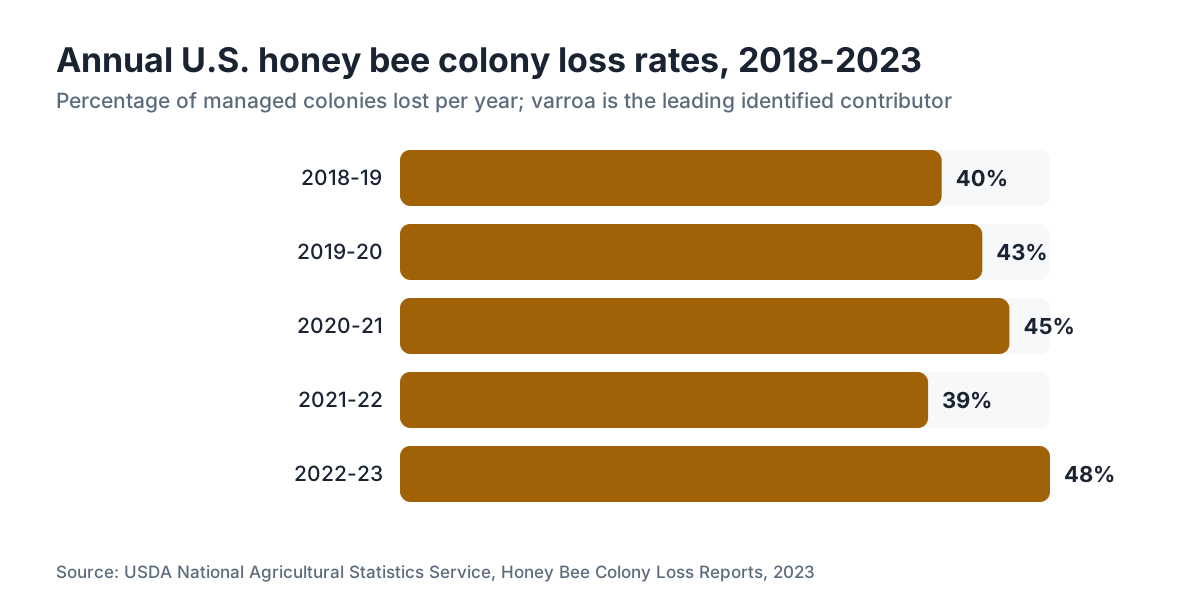
For context on why careful varroa management matters beyond strip economics, the USDA's National Agricultural Statistics Service reported annual U.S. colony losses ranging from 37% to 45% in recent survey years, with varroa identified as the leading contributing factor. [11] Getting your treatments right, storage details included, is how you stay on the right side of those numbers.
Frequently asked questions
Can I use Apivar strips that have been in an open pouch for more than 6 weeks?
The Apivar label says to use opened pouches within 6 weeks. After that, amitraz degradation is likely enough that efficacy is in question. You might get some mite kill, but you can't know how much without post-treatment monitoring. If you're in doubt, buy fresh strips. The risk of a failed treatment outweighs the cost of a new box.
Can I freeze Apivar strips to extend their shelf life?
The label does not recommend or endorse freezing. Sealed strips are rated for up to 3 years at cool, dry room temperature. Freezing could alter the polymer matrix that controls amitraz release in ways that aren't characterized in public data. Store sealed strips in a cool, dark, dry location and use them before the production date expires rather than trying to extend life through freezing.
Do I need to wash my hands after handling Apivar strips?
Yes. The Apivar label recommends wearing chemical-resistant gloves during handling and washing hands with soap and water after contact. Amitraz is absorbed through skin and can cause symptoms including drowsiness and low blood pressure in humans at sufficient exposure. Gloves are the practical solution; don't handle strips bare-handed for extended periods.
Can I cut Apivar strips in half to make them go further?
No. Cutting strips is not permitted by the EPA label and changes the dose delivered to the colony. The label specifies 2 full strips per standard colony. Cutting strips in half gives you a sub-therapeutic dose, which may not clear your mite load and contributes to resistance pressure over time. Use full strips as directed.
How do I know if my Apivar treatment is working?
Do an alcohol wash or sugar roll before treatment starts to establish a baseline mite count, then repeat at the end of the 6-to-8 week treatment window. A successful fall treatment should bring infestation rates below 2 mites per 100 bees. Ohio State University Extension cites this 2% threshold as the target for reasonable winter survival odds. If your post-treatment count is higher, examine your application, timing, and strip condition.
What should I do with leftover Apivar strips I can't use before they expire?
Contact your state department of agriculture or local extension office for pesticide disposal options. Many states run periodic household and agricultural pesticide collection events at no cost. Don't pour amitraz down a drain, bury strips, or burn them. Burning is prohibited by the label because combustion produces toxic compounds. Wrap expired strips in newspaper and seal in a bag for regular trash if no collection event is available.
Can I use Apivar strips in a honey super?
No. The Apivar label explicitly prohibits application when honey supers intended for human consumption are present. Amitraz and its metabolites accumulate in beeswax and can contaminate honey. Remove all honey supers before hanging strips. This is one of the most commonly misapplied rules for Apivar, and violating it creates food safety risk and legal liability.
How long should Apivar strips stay in the hive?
The label specifies a minimum of 6 weeks and a maximum of 8 weeks for a single treatment cycle. Leaving strips in longer than 8 weeks does not improve mite kill and increases the risk of residue accumulation. Remove strips promptly at the end of the treatment window and dispose of them according to the label.
Is there a temperature range where Apivar works best?
Apivar works through bee-to-bee and bee-to-strip contact and is not as temperature-sensitive as formic acid treatments. It is generally effective across a wide ambient temperature range, which is one reason it is a common fall treatment choice. But it needs enough active bees in the hive to distribute the amitraz via contact, so very small or dwindling colonies may not see full efficacy regardless of temperature.
Can I reuse Apivar strips that I pulled out early because I split a hive?
No. Once strips have been placed in a colony, they cannot be reused in another colony. The label prohibits reapplication of used strips. The amitraz remaining in a used strip is not uniformly distributed, the dose is unquantifiable, and the strip carries contamination from the original hive. Start a split with fresh strips at the correct dose for its population size.
Where should I buy Apivar to make sure I'm getting fresh product?
Buy from reputable beekeeping supply retailers that turn over inventory regularly. Check the production date on the box before buying; it should be printed on the outer carton or the foil pouch. Strips within the first year of their 3-year shelf life are your best bet for full potency. Online suppliers with high sales volume generally have fresher stock than retailers who sell only a few boxes a year.
Does the pouch material matter for storing opened Apivar strips?
The original foil pouch offers the best UV and moisture barrier. If the foil is intact enough to fold and seal, use it. A resealable freezer bag pressed flat is a decent backup but offers less protection. Avoid clear plastic bags or containers that allow light through. Whatever you use, label it with the date you opened the pouch so you don't lose track of your 6-week window.
Can amitraz in Apivar strips affect other insects or the environment?
Amitraz is toxic to a range of arthropods beyond varroa mites. Residues in beeswax can affect bee brood development and have been detected in wax samples across the U.S. at varying concentrations. The EPA label restricts use to inside the hive for this reason. Proper strip disposal prevents environmental contamination. Used strips should not be left where wildlife or pets can access them.
Sources
- EPA, Apivar (Amitraz 3.3%) label, EPA Reg. No. 83623-5: Label instructions for Apivar: use opened pouches within 6 weeks, store in a cool dry area, 2 strips per hive body, do not use when honey supers are present, sealed shelf life up to 3 years.
- U.S. National Library of Medicine, PubChem Compound Summary: Amitraz: Amitraz degrades via photolysis and hydrolysis; instability under UV light and aqueous conditions supports manufacturer guidance on limiting exposure after package opening.
- U.S. National Library of Medicine, PubChem Compound Summary: 2,4-Dimethylaniline: 2,4-dimethylaniline (2,4-DMA), a key amitraz metabolite, has shown genotoxic activity in laboratory assays; amitraz residues can accumulate in beeswax and honey when treatments are misapplied.
- Traynor et al., 2021, Journal of Economic Entomology, 'Varroa destructor resistance to amitraz in European populations': Resistance to amitraz has been documented in European Varroa destructor populations; sub-lethal chronic exposure is a contributing selection pressure.
- Honey Bee Health Coalition, Varroa Management Guide (current edition): HBHC states that treatments need to be applied at the right time, dose, and duration to be effective, and any deviation from the label can reduce efficacy and increase resistance risk.
- Dadant & Sons, Apivar product listing, retail pricing reference: A box of 10 Apivar strips retails for approximately $30 to $40 at major beekeeping supply retailers.
- U.S. EPA, Federal Insecticide, Fungicide, and Rodenticide Act (FIFRA) overview: FIFRA requires that pesticides be used in a manner consistent with their labeling; off-label use is a violation of federal law.
- U.S. EPA, Pesticide Disposal: household and agricultural collection programs: State departments of agriculture and EPA-partnered programs offer pesticide disposal collection events for unused or expired product.
- Ohio State University Extension, Varroa Management in Honey Bee Colonies: OSU Extension recommends a post-treatment target of fewer than 2 mites per 100 bees in fall to support reasonable winter survival odds.
- NOD Apiary Products, Mite Away Quick Strips (MAQS) EPA label: The MAQS label sets a specific application temperature window of 50 degrees F to 85 degrees F because formic acid off-gassing rate depends on ambient temperature.
- USDA National Agricultural Statistics Service, Honey Bee Colony Loss Reports (2022-2023): USDA NASS survey data show annual U.S. colony loss rates of 37% to 45% in recent survey years, with varroa cited as the leading contributing factor.
- University of Minnesota Extension, Varroa Mite Management: University extension guidance supports pre- and post-treatment alcohol wash monitoring regardless of which acaricide treatment is used.
Last updated 2026-07-09