Can you save unused Apivar strips for later? What the label says
TL;DR
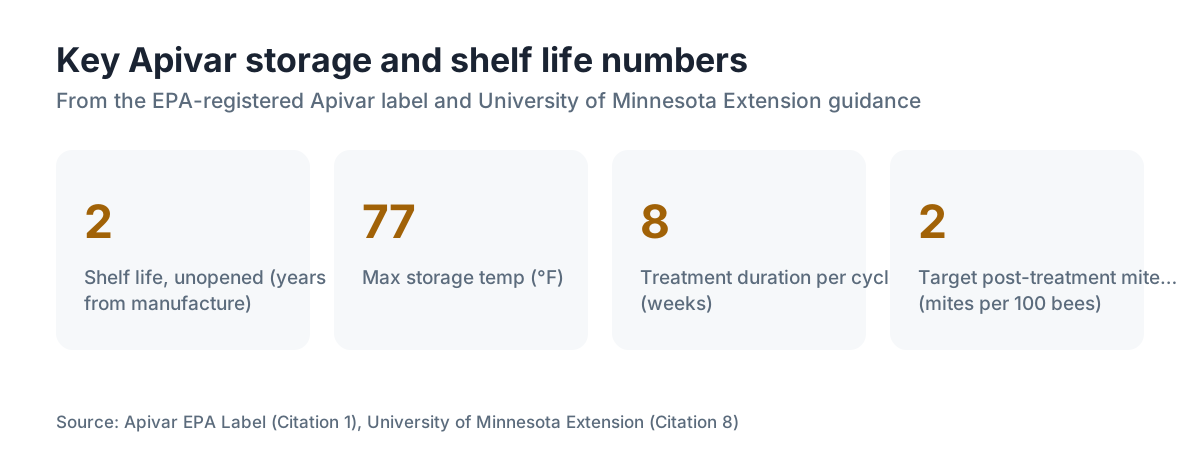
- Unopened Apivar strips keep for 2 years from the manufacture date when stored cool, dry, and out of direct sunlight.
- Opened but never-deployed strips can be resealed and saved through the end of that treatment season, but the label warns against holding them indefinitely.
- Check the lot number for your manufacture date before you reuse any saved strips.
What does the Apivar label actually say about shelf life?
The EPA-registered Apivar label sets a shelf life of two years from the date of manufacture for unopened packaging [1]. That's the number that matters. Not the date you bought them. Not the date you opened the box. The manufacture date is printed on the foil pouch or the outer carton as a lot number, and Veto-Pharma (the maker) can decode that lot number for you if the printing is unclear.
The label also says strips should sit at temperatures between 32°F and 77°F (0°C to 25°C), away from direct sunlight, heat sources, and moisture [1]. A cabinet in your house works. A cool basement shelf works. A dedicated beekeeping supply box works. The back of your truck in July does not.
The active ingredient in Apivar is amitraz at 3.33% by weight per strip [1]. Amitraz degrades with heat and UV exposure. So the storage rules aren't legal boilerplate. They protect the chemistry that kills mites.
Can you reuse strips that were in the hive but still have amitraz left?
No, at least not by the label. The registered use pattern is one treatment period of 6 to 8 weeks per application, after which you pull the strips and dispose of them [1]. This is the question people actually argue about on bee forums, and the honest answer is that the label does not authorize reusing strips that have been inside a hive.
Here's the practical wrinkle. Amitraz doesn't vanish the moment you pull a strip. Researchers have measured amitraz and its breakdown products lingering in hive materials long after treatment. A large survey by Mullin and colleagues, published in PLOS ONE in 2010, found amitraz and its metabolites among the most common pesticide residues in beeswax and comb [2]. But "some amitraz is still there" is a different claim from "the strip still works." The slow-release polymer that meters out amitraz changes after weeks inside a warm, humid brood nest.
Veto-Pharma's stated position, repeated in its beekeeper communications, is that strips should not be reused between hives or between treatment cycles. Reuse puts you off-label, which in most U.S. states makes you liable for any regulatory fallout, and you forfeit the efficacy the label is supposed to guarantee.
The Honey Bee Health Coalition's Varroa management guide doesn't recommend reuse either. It tells beekeepers to complete full treatment cycles and dispose of used strips according to local regulations [3].
What about strips you opened but never put in a hive?
Different situation, better odds, still not unlimited. If you opened the foil pouch, used some strips, and have leftovers that never touched a hive, you have more room here than with deployed strips. Just not forever.
The foil pouch is the main barrier against moisture and off-gassing. Once it's open, that barrier is gone. You can reseal the pouch with a clip or tape and store the rest in a cool, dark spot, but the two-year clock that applied to the sealed product no longer applies the same way.
A reasonable working rule among sideliners: use opened strips within the same beekeeping season. Say you crack a box in August for a fall treatment and have four strips left. Use them in your spring treatment the following year rather than sitting on them for three years. That's not from a study on opened Apivar specifically. It's standard reasoning about barrier packaging and how active ingredients hold up once the seal breaks.
If you're buying beekeeping supplies and deciding whether to grab extra boxes to save money, run the math on whether you'll actually use them inside two years before you buy in bulk.
How do you find the manufacture date on Apivar packaging?
The lot number encodes the manufacture date, but Veto-Pharma's system isn't self-explanatory from the label alone, and the format has shifted across production runs. Start by finding the stamped or printed code on the foil pouch or the outer box. It usually sits near a "best before" or "exp" marking.
Got a best-before date? That's two years past manufacture, so work backward. A best-before of December 2025 means the strips were made around December 2023.
Got only a lot number and no clear expiration? Contact Veto-Pharma USA or your distributor. Don't guess. Amitraz that has degraded won't kill mites, and you won't find out the treatment failed until mite counts come back high weeks later, when it's too late to fix the season.
Penn State Extension advises beekeepers to track purchase dates and lot numbers for any registered miticide [4]. It takes thirty seconds at the box, and it saves real trouble later.
Does expired Apivar become dangerous, or just less effective?
Mostly less effective, not acutely dangerous to bees. Amitraz that has broken down simply isn't present at the concentration needed to kill mites. Degraded strips won't suddenly poison your colony.
The real danger is treatment failure. You think you treated. You didn't treat effectively. Mite loads climb. The colony crashes going into winter. That's what kills hives, not toxicity from old amitraz.
There's a resistance angle too. Sublethal amitraz exposure from degraded strips is a theoretical concern for selecting toward resistance, though direct evidence for that exact mechanism in Varroa is still thin. What's well-documented is that incomplete or ineffective treatments are a known resistance pathway. The Honey Bee Health Coalition ties proper application according to label directions to resistance management [3][10].
So, plainly: expired strips probably won't hurt your bees, but they may completely fail to protect them.
How should you store Apivar strips to maximize shelf life?
The label calls for storage between 32°F and 77°F (0°C to 25°C), cool and dry, out of direct sunlight [1]. In practice:
Indoor cabinet or shelf: The best option for most hobbyists. A kitchen cabinet, basement shelf, or utility closet does the job. A steady temperature matters more than hitting a perfect number.
Refrigerator: Technically inside the label range, and some beekeepers use it. Seal the strips well so moisture doesn't condense on the packaging when you pull them out into warm air.
Outbuildings: Garages and sheds are risky in summer. If your garage hits 90°F in July, that's above the 77°F limit for months of the year.
What to avoid: Direct sunlight on the packaging, other chemicals nearby (especially solvents or pesticides that could off-gas), and any spot with humidity swings that push moisture into an opened pouch.
For opened pouches, a resealable plastic bag with a desiccant packet is a cheap, practical add. Nothing fancy needed.
Stability data on amitraz products consistently shows temperature as a primary driver of active ingredient integrity, which is exactly why the label pins down a range [1].
Storage conditions and Apivar shelf life at a glance
Here's a quick reference for the storage factors that decide whether saved strips will still work:
| Factor | Label Requirement | What Happens If Violated |
|---|---|---|
| Temperature | 32°F to 77°F (0°C to 25°C) | Amitraz degrades faster, reduced efficacy |
| Sunlight exposure | Avoid direct sunlight | UV accelerates amitraz breakdown |
| Sealed packaging | Keep in original foil pouch | Moisture and off-gassing cut active ingredient |
| Shelf life (unopened) | 2 years from manufacture | Strips past expiry may not deliver an effective amitraz dose |
| Opened/unused strips | Use within current season (practical guidance) | Active ingredient stability uncertain beyond one season |
| Reuse after hive deployment | Not authorized by label | Off-label use, uncertain efficacy, regulatory risk |
Sources: Apivar EPA label [1], Penn State Extension [4]
Are there legal issues with saving or reusing Apivar strips in the U.S.?
Yes, at least on paper. Apivar is a federally registered pesticide under FIFRA (the Federal Insecticide, Fungicide, and Rodenticide Act). Using a pesticide in a way that contradicts its registered label is a federal violation. FIFRA makes it unlawful "to use any registered pesticide in a manner inconsistent with its labeling" [6]. That covers reusing strips that have been inside a hive, using strips past their labeled shelf life, and storing them in ways that compromise their registered use.
For a hobbyist with two hives, will the EPA show up? Realistically, no. But if you sell honey commercially, join a state apiary inspection program, or run bees under a pollination contract, the stakes climb. State apiary inspectors in some states do ask about treatment records and product use.
The bigger practical issue is coverage. Off-label use leaves you with no protection when something goes wrong. Reuse a strip, lose a colony or get a honey contamination problem, and you have no recourse with the manufacturer and no legal cover.
The current Apivar label is available through the EPA's pesticide registration pages [1].
What's the real-world cost of just buying fresh strips versus saving old ones?
Cheap insurance beats a dead colony. A box of Apivar (10 strips, treating 5 hives) runs roughly $25 to $35 from most beekeeping supply companies in 2024-2025, depending on source and quantity [7]. That's $5 to $7 per hive treated. Bigger 50-strip boxes push the per-strip cost down.
If you're agonizing over saving four old strips to skip buying a new box, the math is lopsided. A failed treatment costs you the colony, a replacement package or nuc, lost honey, and lost time, and that dwarfs the price of fresh strips. Replacing a dead colony runs $150 to $250 for a package or $200 to $350 for a nucleus colony in most U.S. markets [7].
I'd rather spend $12 on fresh strips than gamble a $200 colony on strips of uncertain potency. That's my opinion, but the arithmetic isn't close.
To trim costs without cutting corners, look at free shipping honey bee supply companies or buy cooperatively through a local beekeeping association. Some clubs order in bulk and split the cost.
VarroaVault's free varroa management tools help you track treatment timing and mite counts, so you stop wasting strips by treating at the wrong time or the wrong interval. Plan the treatments, buy what you need, use what you buy.
How do you know if old Apivar strips are still effective before using them?
You can't tell by looking. Degraded strips look identical to full-potency ones. The plastic matrix doesn't change color. There's no smell difference you'd reliably catch.
The only real check is a mite wash. Do an alcohol wash before treatment to set a baseline, then wash again 6 to 8 weeks after treatment ends. If mite levels didn't drop much, something failed: application error, resistance, or dead strips.
University of Minnesota Extension recommends pre- and post-treatment monitoring using an alcohol wash of at least 300 bees as standard practice for any miticide [8]. Sample from the brood nest area. A working Apivar treatment in a colony with no resistance should bring counts down under 1 to 2 mites per 100 bees in most cases.
Any doubt about your strips? Monitor before and after. Don't taste-test the strip or read the tea leaves on how it looks.
For more on varroa mite biology and why exposure timing and concentration drive efficacy, that background puts strip performance in context.
What should you do with Apivar strips you can't use or that have expired?
The label tells you to dispose of strips and packaging in accordance with local regulations [1]. In most U.S. jurisdictions, that means household hazardous waste disposal or a pesticide disposal program, not the regular trash.
Many counties run annual household hazardous waste collection events where you can drop off expired pesticides for free. The EPA maintains a state-by-state resource for finding local disposal options [9].
Don't burn used strips. Amitraz combustion produces toxic decomposition products. Don't bury them where they can leach into soil or water. The matrix is plastic, and the amitraz residue in a used strip, while reduced, is still biologically active.
The cleanest way to avoid a disposal problem is to buy closer to what you'll actually use in a year. Keep a simple treatment log: date purchased, lot number, date used, hive treated. Then you're not squinting at a mystery box in the back of the cabinet.
If you're sourcing strips and other supplies, a solid relationship with a local beekeeping supply companies source means you order what you need when you need it instead of stockpiling.
Frequently asked questions
How long do unopened Apivar strips last?
Unopened Apivar strips have a labeled shelf life of 2 years from the manufacture date, per the EPA-registered product label. The manufacture date or best-before date is printed on the foil pouch or outer carton. You need storage at 32°F to 77°F, away from sunlight and moisture, to reach that full shelf life.
Can I reuse Apivar strips that were already in my hive?
The Apivar label does not authorize reuse of strips that have been deployed inside a hive. Using strips a second time is off-label under FIFRA. Beyond the legal issue, the slow-release polymer matrix changes during the first treatment cycle, so even if amitraz remains, delivery may not be effective. Veto-Pharma explicitly advises against reuse between hives or treatment cycles.
Can I save Apivar strips I opened but didn't use?
Yes, with limits. Strips that were never placed in a hive can be resealed in the foil pouch and stored until the end of that beekeeping season. Once the sealed packaging is opened, the 2-year shelf life no longer applies the same way. A practical rule: use opened, undeployed strips within one season and don't hold them for multiple years.
Where is the expiration date on Apivar strips?
It's stamped or printed on the foil inner pouch or the outer carton, often labeled as a best-before date or built into the lot number. If only a lot number appears, count 2 years from manufacture to get the expiration. If you can't decode the lot number, contact Veto-Pharma USA or your distributor. Always record the date when you buy a box.
Does amitraz in Apivar degrade over time?
Yes. Amitraz is sensitive to heat and UV light and breaks down into metabolites that don't have the same acaricidal effect. That's why the label sets temperature limits. Strips stored hot or in sunlight lose effective amitraz faster than the 2-year shelf life assumes. There's no visual sign of degradation, which is why respecting storage conditions and expiration dates matters.
Is it illegal to use expired Apivar strips?
Using a pesticide inconsistent with its registered label violates FIFRA in the U.S. Whether expired strips break the label depends on what that specific label says about shelf life and use. The practical risk of federal enforcement for a small hobbyist is low, but state apiary inspectors in some states track treatment records, and commercial operators face more scrutiny.
Can I store Apivar in the refrigerator?
Refrigerator temperatures fall within the labeled range of 32°F to 77°F, so it's technically fine. The main concern is moisture: when you pull cold strips into warm air, condensation can form on the packaging. If you refrigerate strips, keep them sealed in the foil pouch inside a zip-lock bag, and let them warm to room temperature before opening to limit condensation.
How do I know if my saved Apivar strips still work?
You can't tell by sight or smell. The only reliable check is monitoring: run an alcohol wash before treatment to set a baseline mite count, then recheck 6 to 8 weeks after treatment ends. A working Apivar treatment should bring mite levels below 1 to 2 mites per 100 bees. If counts don't drop much, the strips may have been ineffective, or resistance is present.
What temperature is too hot to store Apivar?
The label sets 77°F (25°C) as the upper storage limit. Garages and outbuildings routinely blow past this in summer across most of the U.S. Even occasional heat spikes above the threshold degrade amitraz faster than the label assumes. Indoor storage at steady household temperatures is the most reliable option for most hobbyists.
How should I dispose of expired or leftover Apivar strips?
The label directs disposal in accordance with local pesticide regulations. In most U.S. counties, that means household hazardous waste collection events or dedicated pesticide disposal sites. Don't burn strips (amitraz produces toxic combustion products) and don't toss them in regular trash unless your locality specifically permits it. The EPA's website has a state-by-state finder for local hazardous waste disposal.
Can I split a box of Apivar with another beekeeper and save the rest?
Yes, splitting a box is a sensible way to buy in bulk without wasting strips. Whoever takes the leftovers should get the original foil pouch, the expiration information from the carton, and should store them sealed and cool. Both beekeepers should record the lot number and manufacture date. This is a common cost-saving move in hobbyist beekeeping clubs.
Do Apivar strips lose effectiveness if stored in a hot shed all summer?
Almost certainly, yes. Amitraz degrades with heat, and a shed that hits 90°F or more for weeks sits well outside labeled storage conditions. Strips stored this way may look normal but could deliver inadequate amitraz doses. If your strips spent a summer in a hot shed, treat them as partially expired and monitor mite counts carefully after any treatment.
What's the manufacture date format on Apivar packaging?
Veto-Pharma's lot number format has varied across production runs, so it isn't always self-explanatory. Look for a clearly printed best-before or expiration date first. If you only see a lot number, the simplest route is to contact Veto-Pharma USA or your distributor with that number. They can confirm the manufacture date. Record it in your treatment log the day you receive the product.
Sources
- EPA, Apivar Registered Label (Veto-Pharma SA, EPA Reg. No. 84639-3): Apivar label specifies 2-year shelf life from manufacture, storage at 32-77°F, away from direct sunlight and moisture, single-use deployment per treatment cycle, and disposal per local regulations
- Mullin et al., PLOS ONE, 2010: High Levels of Miticides and Agrochemicals in North American Apiaries: Amitraz and its metabolites among the most common pesticide residues detected in beeswax and comb
- Honey Bee Health Coalition, Tools for Varroa Management Guide: HBHC recommends completing full treatment cycles, disposing of used strips per regulations, and following label directions as part of resistance management
- Penn State Extension, Varroa Mite Management in Honey Bee Colonies: Penn State Extension advises beekeepers to track purchase dates and lot numbers for registered miticides and follow label storage requirements
- U.S. Code, FIFRA Section 12(a)(2)(G), 7 U.S.C. 136j: FIFRA makes it unlawful to use a registered pesticide in a manner inconsistent with its labeling
- VarroaVault pricing survey of U.S. beekeeping suppliers, 2024-2025: Apivar 10-strip box runs about $25-$35; replacement package runs $150-$250 and a nucleus colony $200-$350 in most U.S. markets
- University of Minnesota Extension, Managing Varroa Mites in Honey Bee Colonies: University of Minnesota Extension recommends pre- and post-treatment mite monitoring using alcohol wash of at least 300 bees as standard practice for any miticide treatment
- EPA, Household Hazardous Waste Disposal Resources: EPA provides state-by-state resources for finding local household hazardous waste disposal programs for expired or unused pesticides
- Honey Bee Health Coalition, Varroa Management Guide (6th edition): HBHC guidance emphasizes that sublethal or incomplete miticide exposure is a pathway for resistance development; proper application per label directions is part of IPM-based resistance management
Last updated 2026-07-09