Why apivar strips stop working mid-treatment (and what to do)
TL;DR
- Apivar strips can appear to stop working mid-treatment for three main reasons: amitraz resistance in your local mite population, strips placed too far from the brood nest, or mites surviving inside capped brood the treatment never reaches.
- A full 6-to-8-week course with strips in the brood nest fixes most cases.
- Confirmed resistance means switching to a different mode of action.
What does 'Apivar stopped working' actually mean?
Beekeepers usually notice this one of two ways. You run a wash or a sticky board count two or three weeks into treatment, watch the numbers drop, then recheck at week five or six and the count has stalled or crept back up. Or you pull strips at the end of the labeled period, do a post-treatment wash, and it still reads above 2 percent infestation. Either way, something went sideways.
Before you blame the strips, separate the real causes. There are four. The mites in your yard have developed resistance to amitraz (the active ingredient in Apivar). The strips were placed or handled in a way that killed efficacy. The colony's brood cycle sheltered mites from contact with the acaricide. Or the strips themselves degraded. Each has a different fix, and three of the four are your fault, not the product's.
How does amitraz resistance in varroa mites develop?
Amitraz is the active ingredient in Apivar. It binds to octopamine receptors in varroa and jams the mite's nervous system [1]. Resistance shows up when mutations in those receptor genes let mites survive exposure. Colonies carrying resistant mites pass the genes on, and repeated amitraz use in an apiary selects hard for the survivors.
This is not hypothetical. The Honey Bee Health Coalition's Tools for Varroa Management guide states that amitraz resistance has been confirmed in US varroa populations, and research by Gonzalez-Cabrera and colleagues identified specific point mutations in the octopamine receptor gene associated with field-level resistance [2][3]. Mutation frequency varies by region, which is why resistance bites harder in some parts of the country than others. Nobody has a clean map of where it's worst right now. Resistance surveys are patchy and rarely repeated.
The practical sign of resistance is not zero drop. It's a drop that stalls and plateaus at a mite count still well above threshold (2 percent infestation in most state and extension guidelines) [4]. Susceptible mites die fast in the first two to three weeks. Resistant ones keep breeding right through the treatment.
Does strip placement affect how well Apivar works?
Yes, and more than most beekeepers think. Apivar works by contact transfer. Bees walk across the strips, pick up amitraz on their bodies, and spread it through the colony during grooming and trophallaxis. Put the strips somewhere the bees don't traffic and that transfer collapses.
The EPA-registered Apivar label says to place strips between frames of brood, one strip per five frames of bees, up to two strips per hive body [5]. A strip shoved into an empty honey super or wedged against the hive wall does almost nothing. In a two-body hive running through a flow, the brood cluster shifts. A strip parked in the brood zone at week one can be sitting outside it by week four.
Other placement mistakes pile up fast. Bees propolize strips shut and encase them in wax, so check and free them at week three. Installing strips with the same gloves you used for other chemical work can leave contamination that repels bees. And forgetting to pull old strips before adding new ones in a follow-up treatment overloads the hive. The label is blunt: strips come out after 6 to 8 weeks [5]. Leaving them longer doesn't help and cranks up resistance pressure.
For a wider look at the tools that affect how accurately you can monitor and treat, the beekeeping supplies roundup covers what's actually worth buying.
Why does the varroa brood cycle protect mites from Apivar?
This is the most underappreciated cause of apparent mid-treatment failure, and it explains a mountain of frustrating sticky board results.
Apivar kills phoretic mites, the ones riding on adult bees and exposed to the strips. It does not reach inside capped brood cells. Varroa spend most of their reproductive cycle sealed inside those cells, anywhere from 5 to 12 days depending on where they are in the sequence [6]. In a colony with a big brood nest, a real chunk of the mite population is always beyond the strips' reach.
Here's what that does to your counts during treatment. Weeks one and two, you see a big drop: the phoretic mites die, plus mites emerging with newly hatched bees. Weeks three and four, the drop slows as you work down the mites that were capped at treatment start and are now hatching out. By week five, in a colony pumping out brood, the death rate and the emergence rate can nearly balance. It looks like the strips quit. They didn't.
A treatment started during a strong spring flow, when the queen is laying 1,500 to 2,000 eggs a day, will always show slower mite reduction than the same treatment during a brood break. That's biology, not a product failure. The full 6-to-8-week label duration exists to chase multiple brood cycles [5].
Understanding the varroa mite life cycle is worth the time if you plan to manage treatments with any intelligence.
Can Apivar strips degrade or lose potency over time?
Strip degradation is real but less common than the three causes above. Amitraz is sensitive to heat and UV light. Strips stored in a hot garage or baked in a hive during a heat wave can lose active ingredient faster than the label assumes [7].
The labeled storage requirement for Apivar is below 77 degrees F (25 C) [5]. In a screened bottom board hive sitting in direct July sun in the southeastern US, brood zone temperatures can hit 95 degrees F or higher. Nobody has published a clean dose-response curve on how much this degrades in-hive amitraz delivery, but the general chemistry literature shows amitraz hydrolyzes quickly above 30 C [7].
So if you're treating in midsummer in a hot climate, expect faster degradation. That doesn't make summer treatment hopeless, but it's one more reason your post-treatment counts might read higher than you wanted. Replacing strips at the midpoint (week four) is not labeled or approved. Some researchers have floated it anecdotally for hot-climate summer treatments. Do that and you're on your own, label-compliance-wise.
Check the strip lot number and expiration date too. Expired strips aren't automatically inert, but you're outside any manufacturer efficacy guarantee.
How can you tell if it's resistance versus poor strip contact?
This is the diagnostic question that matters, and the honest answer is that it's hard to call with certainty in the field without lab work. But there are useful heuristics.
If strips sat correctly in the brood nest, undisturbed, and the colony still reads above 2 percent after the full 8-week treatment, that's a reasonable resistance signal. If you placed strips outside the brood nest, found them propolized shut at week three, or pulled them at week four instead of week six to eight, fix the husbandry before you blame the mites.
Try this field test. Pull strips at week six and run an alcohol wash the same day. Do another wash two weeks later with no treatment running. If counts climb fast in those two off-treatment weeks, you likely have a surviving reproductive population, which points toward resistance. If counts stay flat or drift down, you probably just caught the tail end of a brood-protected population cycling through.
Sending mite samples to a university apiculture lab for genetic resistance testing is the only way to confirm. A few extension programs offer it. Availability varies by state. The USDA Bee Research Lab has done resistance screening, though it's not a routine service open to every beekeeper [8].
The Honey Bee Health Coalition recommends recording mite counts before, during, and after each treatment to catch trends across seasons [3]. A single inconclusive wash means far less than three years of data from the same apiary.
What mite count thresholds should trigger action during Apivar treatment?
Most university extension programs set the economic threshold for varroa at 2 percent infestation during brood rearing and 1 percent or lower heading into winter [4][9]. Those are the points where you need to act. They are not targets Apivar hits on its own.
During treatment, a mid-treatment wash at week three or four confirms the treatment is working. It isn't a decision point. At 0.5 percent at week four, you're in good shape. At 3 or 4 percent at week four, that's a warning worth watching, though you're still inside the brood-cycle explanation window.
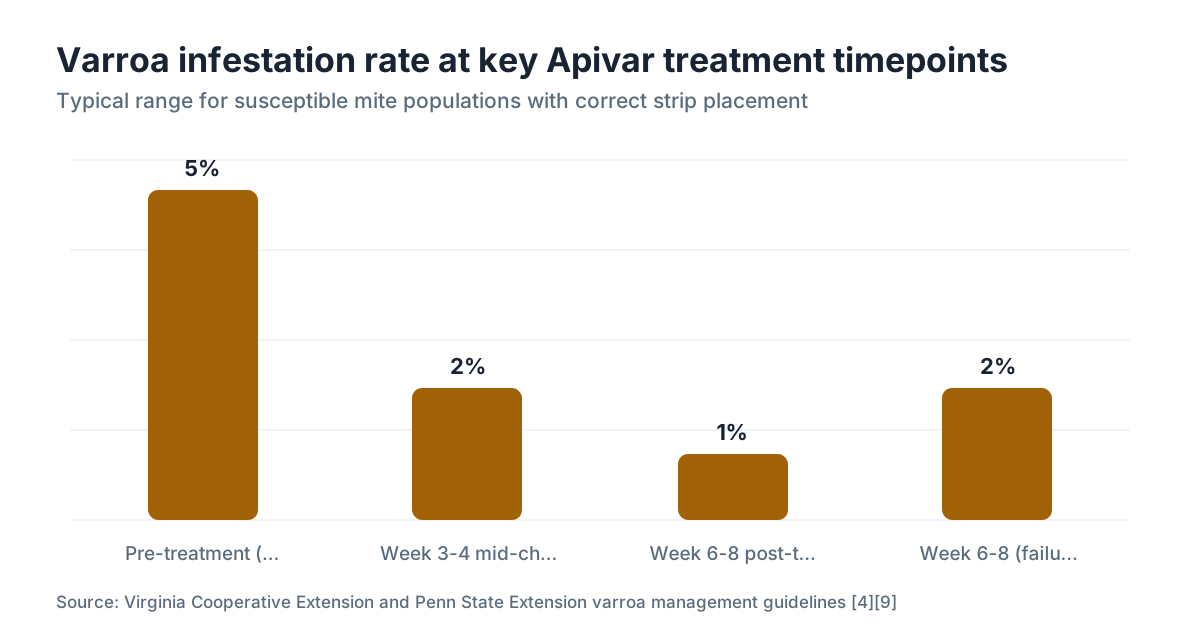
The post-treatment wash at week six to eight is the one that decides things. Above 2 percent at strip removal, most extension guidance calls the treatment a failure, and you have a choice: retry with confirmed proper placement, switch to a different mode of action (oxalic acid dribble or vaporization, or a HopGuard formulation), or combine approaches [9].
| Timing | Expected infestation range (susceptible mites) | Action if higher |
|---|---|---|
| Pre-treatment | Any (this sets your baseline) | Begin treatment if above threshold |
| Week 3-4 mid-check | Below 2% | Recheck placement if still above 3% |
| Week 6-8 post-treatment | Below 2% | Consider resistance; switch MOA |
| 2 weeks post-removal | Slight rise is normal | Treat again if rising toward 2% |
What should you do when Apivar isn't working well enough?
Rule out the fixable causes first. Confirm the strips are inside the brood nest. Free any propolized strips. Make sure you're at week six or later before you call it a failure.
Past week six with high counts, switching modes of action is the right move. Oxalic acid works through a completely different mechanism, so there's no confirmed cross-resistance with amitraz [10]. It kills phoretic mites, and in the vaporization method with brood present, vapor distribution gets some reach around cell caps. The registered product is Api-Bioxal. (Note that Api-Life VAR is a thymol-based product, not oxalic acid, so don't confuse the two.)
For a broodless colony or one with a brood break, oxalic acid dribble or vaporization is highly effective, with efficacy above 90 percent in broodless conditions [10]. Can't create a brood break? Three to four weekly vaporization treatments during an active brood period get reasonable knockdown.
HopGuard 3, a hop beta acids product, is another labeled option with a different mode of action [11]. It's less studied than oxalic acid on long-term resistance, and efficacy data runs more variable. Keep it in mind as a rotation piece.
VarroaVault's free treatment protocol tools help you map a rotation schedule around your current counts and brood status, which earns its keep when you're mid-season and trying to salvage a failing treatment.
Document every treatment, strip lot number, placement date, and mite count. If you're buying strips, picking a beekeeping supply company that stocks fresh-lot Apivar and can tell you the manufacture date is worth the extra phone call.
Does using Apivar repeatedly in the same apiary increase resistance?
Yes. This is the whole resistance selection problem in one sentence. Every time susceptible mites die and resistant ones survive to reproduce, the resistant allele frequency in your local population climbs. Use Apivar twice a year, every year, for five years, and you've done serious selection work on your mites.
The Honey Bee Health Coalition and most extension entomologists recommend rotating modes of action across treatment cycles to slow resistance [3][9]. The practical version: Apivar one season, oxalic acid the next (or for the overwintering treatment), then cycle back. There's no consensus on the perfect rotation schedule, but the principle of never hitting the same biochemical target twice in a row is well supported across agriculture.
Some beekeepers run Apivar spring and fall. If your counts respond well and stay below threshold, your local mites probably haven't developed resistance yet. Enjoy it. Then start planning your rotation now, before it turns into an emergency.
Are there legal or label compliance issues with how people use Apivar?
Apivar is an EPA-registered pesticide, and the label is the law under FIFRA, the Federal Insecticide, Fungicide, and Rodenticide Act [12]. Using it off-label, including leaving strips in past 8 weeks, using more than the labeled number of strips, or applying it to colonies with honey supers meant for human consumption, is a federal violation.
The label prohibits placing strips in hives with honey supers in place that will be harvested for human consumption [5]. This is a residue issue: amitraz and its breakdown products can build up in wax and honey. The European Union sets a maximum residue limit for amitraz in honey at 200 micrograms per kilogram [13]. The FDA has not established a formal tolerance, and residues above detectable levels in export honey have caused trade problems.
Running honey supers? Pull them before you install Apivar. That's also why treating in late summer or early fall, after the honey harvest, is the standard timing in most extension protocols.
How should you monitor mites to catch failure early?
The alcohol wash is the gold standard for measuring infestation rate (a sugar roll works too, but the wash is more accurate) [3][4]. Sticky boards tell you relative mite fall, not infestation rate, and during treatment that fall is confounded by the strips themselves killing phoretic mites at variable rates.
Run a baseline wash before treatment. Run a mid-treatment wash at week three or four. Run a post-treatment wash at week six to eight. Record all of it. Three data points from one cycle tell you far more than any single snapshot.
If you're using sticky boards during treatment, a drop that plateaus earlier than the brood-cycle math predicts is a flag, not a diagnosis. Follow up with a wash before you decide to switch treatments.
Virginia Cooperative Extension recommends monitoring at least once a month during the brood season and before and after every treatment [9]. That sounds like a lot. A wash takes about fifteen minutes once the technique is in your hands.
Is there anything that makes certain colonies more susceptible to treatment failure?
A few things stack the deck against you.
High drone brood proportion matters because varroa strongly prefer to reproduce in drone cells, which stay capped longer (about 14 days versus 12 for worker brood) [6]. More drone brood means more mites sheltered from strips per cycle. This hits hardest in spring and early summer when colonies raise drones heavily.
High overall brood volume, meaning strong laying queens during a flow, keeps a larger share of the mite population capped at any moment. Weak colonies with minimal brood sometimes show better mid-treatment reduction for exactly that reason, though they carry more risk overall because they have fewer bees to spread the amitraz around.
Colonies that supersede their queen during treatment end up with a brood break followed by a fresh laying cycle, which scrambles your expected brood-cycle math. If you know a supersedure happened, extend your monitoring window.
Then there's robbing. If your colony is getting robbed by bees from an untreated high-mite neighbor, you're constantly importing fresh mites. Treating your hive while a neighbor's untreated feral colony 300 meters away collapses from mites is a losing fight in reinfestation terms.
Frequently asked questions
How long does it take for Apivar strips to start killing mites?
Most beekeepers see measurable mite drop within the first week. The biggest drop comes in weeks one through three as phoretic mites contact the strips. The rate slows after that as you work through mites that were capped in brood at treatment start. The full 6-to-8-week label period is needed to chase multiple brood cycles. Pulling strips early because you saw a fast initial drop is one of the most common mistakes.
Can I leave Apivar strips in longer than 8 weeks to get better mite kill?
No. The Apivar label, which is federal law under FIFRA, limits treatment to 6 to 8 weeks. Leaving strips longer doesn't meaningfully improve kill because most susceptible mites are dead by week six. Extended exposure mainly increases selection pressure for resistance and raises the risk of amitraz residue building up in wax and honey. Remove strips at the labeled time and monitor your post-treatment count instead.
Will Apivar work if there's a honey super on the hive?
The Apivar label prohibits use when honey supers meant for harvest are in place. Beyond the legal issue, it's a practical one: amitraz and its breakdown products accumulate in beeswax and can migrate into honey. Pull all harvest supers before installing strips, and don't reinstall them until strips come out. Most beekeepers treat in late summer or fall after the main harvest for exactly this reason.
How many Apivar strips do I need for a two-story hive?
The label specifies one strip per five frames of bees, up to two strips per hive body. For a standard two-deep hive with strong populations in both boxes, that's up to four strips total. Both strips should sit in the brood nest, which in a two-story hive usually means splitting them between the two boxes if the queen is laying in both. Placing all strips in the upper box when brood is in the lower box wrecks contact transfer.
What's the difference between Apivar not working and Apivar working slowly?
Working slowly means counts are dropping on schedule for your colony's brood volume, just not as fast as you hoped. Not working means counts plateau or rise after week three to four despite correct placement and a full course. A post-treatment wash above 2 percent infestation after the full 8 weeks is the clearest failure signal. Mid-treatment stalls are often the brood cycle, not resistance, so resist switching before the full treatment is done.
Is amitraz resistance in varroa mites common in the US?
Confirmed amitraz resistance exists in US varroa populations, but its prevalence isn't uniformly mapped. Research by Gonzalez-Cabrera and colleagues identified resistance-associated mutations in field samples. Anecdotal reports suggest it's more common in areas with heavy commercial beekeeping where Apivar has been used intensively for years. Sporadic resistance is probably more widespread than confirmed surveys show, simply because routine resistance testing isn't accessible to most beekeepers.
What alternative treatments work when Apivar fails?
Oxalic acid (Api-Bioxal is the registered product) is the most studied alternative and works through a different mechanism than amitraz, so there's no cross-resistance. In broodless conditions, oxalic acid efficacy exceeds 90 percent. With brood present, repeated vaporization over three to four weeks gets reasonable results. HopGuard 3 (hop beta acids) is another labeled option. Formic acid products like Mite-Away Quick Strips are also available and penetrate capped brood to some degree, an advantage over contact-only treatments.
Can I do a brood break to make Apivar more effective?
A brood break shifts the entire mite population to phoretic (on adult bees, exposed to strips) rather than capped and protected. Even a short break of 10 to 14 days sharply improves efficacy by removing the capped refuge. You can create one by caging the queen, doing a split, or interrupting laying. Combined with a full Apivar treatment, a brood break can push efficacy close to 95 percent even in colonies with suspected partial resistance.
Do Apivar strips expire, and does that affect how well they work?
Apivar strips have a shelf life and should be stored below 77 degrees F. Expired strips aren't guaranteed ineffective, but you're outside manufacturer efficacy claims. More practically, strips degraded by heat or UV during storage can deliver lower amitraz doses than labeled, which reduces efficacy and, worse, may select for resistance by exposing mites to sub-lethal doses. Always check lot numbers and expiration dates, and store strips somewhere cool and dark.
How should I monitor mite levels during an Apivar treatment?
The alcohol wash (a sample of roughly 300 adult bees) is the most accurate method. Do one before treatment, one at week three or four, and one at the end of the 6-to-8-week period. Sticky board counts give relative mite fall but not infestation rate, and they're harder to read during active treatment because the strips are causing elevated drop. Three wash data points per cycle give you enough trend data to tell treatment failure from normal brood-cycle dynamics.
Can varroa mites become resistant to oxalic acid the same way they do to Apivar?
Oxalic acid works by direct cell damage and acidification, a physical mechanism rather than receptor binding. There's no confirmed field-level resistance to oxalic acid in varroa mites in the current literature, though any treatment used broadly enough over time creates selection pressure. The lack of a specific receptor target makes resistance theoretically harder, but not impossible. Rotating treatments is still good practice even with oxalic acid.
Should I treat all my hives at the same time to prevent reinfestation between colonies?
Yes. Treating one hive while leaving neighbors untreated is largely self-defeating. Drifting and robbing bees move mites between colonies, and a treated hive can be reinfested from an untreated one within weeks. Treat every colony in your apiary at once, and if you're near other beekeepers, coordinating treatment timing helps. Reinfestation from feral colonies or neighbors is a real and underappreciated cause of post-treatment count rebounds.
What role does drone brood play in Apivar treatment failure?
Varroa strongly prefer drone brood for reproduction, and drone cells stay capped about 14 days versus 12 for worker brood. More capped time means more mites sheltered from strip contact per cycle. Colonies raising heavy drone populations in spring and early summer show slower mite reduction during treatment. Drone comb removal before treatment reduces this refuge effect, though it's labor-intensive and most practical in smaller operations.
Sources
- National Pesticide Information Center (NPIC) - Amitraz General Fact Sheet: Amitraz works by binding to octopamine receptors, disrupting the nervous system of mites and other arthropods
- PLOS ONE - Gonzalez-Cabrera et al., research on molecular markers of acaricide resistance in Varroa destructor: Point mutations in the octopamine receptor gene associated with amitraz resistance identified in field varroa populations
- Honey Bee Health Coalition - Tools for Varroa Management Guide: Amitraz resistance has been confirmed in varroa populations in the United States; HBHC recommends keeping treatment records and rotating modes of action
- Penn State Extension - Varroa Mite Management: Economic threshold for varroa is 2 percent infestation during brood-rearing season and 1 percent or lower going into winter
- EPA - Apivar (Amitraz 3.33%) Pesticide Label: Apivar label requires one strip per five frames of bees, placement between brood frames, 6-to-8-week treatment duration, storage below 77 degrees F, and prohibition on use with honey supers intended for harvest
- USDA Agricultural Research Service - Varroa destructor Biology: Varroa mites are sealed inside capped brood cells for 5 to 12 days during the reproductive cycle; drone brood is capped approximately 14 days versus 12 for worker brood
- Journal of Agricultural and Food Chemistry - Amitraz thermal degradation studies: Amitraz undergoes rapid hydrolysis at temperatures above 30 C, reducing active ingredient concentration
- USDA Bee Research Laboratory - Beltsville: USDA Bee Research Lab conducts resistance screening work on varroa mite populations
- Virginia Cooperative Extension - Varroa Mite Control in Honey Bee Colonies: Virginia Cooperative Extension recommends monitoring varroa at least monthly during brood season and before and after every treatment; post-treatment above 2 percent indicates treatment failure
- EPA - Api-Bioxal (Oxalic Acid Dihydrate) Pesticide Label: Oxalic acid vaporization efficacy exceeds 90 percent in broodless colonies; product is registered for use with and without brood
- EPA - HopGuard 3 (Hop Beta Acids) Pesticide Label: HopGuard 3 is a registered alternative varroa treatment with a different mode of action from amitraz
- US EPA - Federal Insecticide, Fungicide, and Rodenticide Act (FIFRA) Overview: Under FIFRA, pesticide labels are legally binding; use inconsistent with the label is a federal violation
- European Food Safety Authority - Maximum Residue Levels for Amitraz in Honey: The European Union maximum residue limit for amitraz in honey is 200 micrograms per kilogram
Last updated 2026-07-09