Why oxalic acid vaporization uses a 5-day interval
TL;DR
- Varroa mites spend roughly 5-6 days in the phoretic (on-bee) phase before entering a cell to reproduce.
- Oxalic acid vapor kills phoretic mites but cannot penetrate capped brood.
- Treating every 5 days catches mites as they emerge from cells and before they cap again, maximizing kill rate across a full reproductive cycle.
What is the 5-day vaporization interval and where does it come from?
The 5-day interval means you apply oxalic acid vapor to the same colony every five days across a series of treatments, depending on your specific protocol. The number is not arbitrary. It comes straight from how Varroa destructor reproduces inside a honeybee colony.
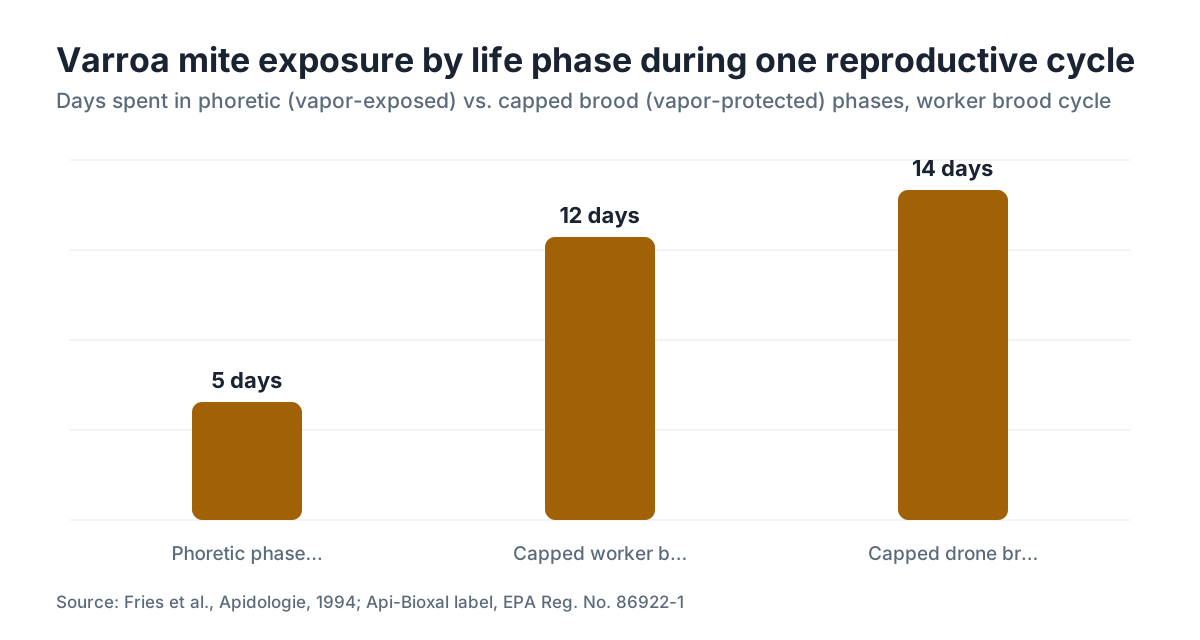
Varroa mites live in two phases: phoretic and reproductive. Phoretic mites ride adult bees and sit fully exposed in the hive air. Reproductive mites slip into a brood cell just before it is capped, lay eggs, and spend the next 11-12 days (for worker brood) locked inside where no vapor can reach them [1]. Oxalic acid vapor kills phoretic mites on contact and does nothing to mites behind sealed wax.
The whole game hinges on one window: the gap between when a mite crawls out of a capped cell and when it dives into another one. Studies on Varroa phoretic periods have documented that mites typically spend 4.5 to 6 days riding adult bees before re-entering a cell [2]. Treating every 5 days threads that needle. You hit mites that just emerged before they can cap again, then repeat before the next cohort finishes its own exposure window.
That is why both the Honey Bee Health Coalition's Varroa management guide and oxalic acid product labels (specifically Api-Bioxal, the only EPA-registered oxalic acid product for U.S. use) build their multi-day treatment series around this biological clock [3][4].
Why can't oxalic acid vapor kill mites inside capped brood?
Oxalic acid works by contact and fumigation. The vapor spreads through hive air, settles on bee bodies, and kills mites through direct contact with the mite's cuticle. A capped brood cell is sealed with a wax layer that blocks the vapor concentration needed to harm anything inside [1].
This is the single biggest limitation of oxalic acid as a varroa treatment. In a colony with zero capped brood, one vaporization can hit 90-plus percent efficacy because nearly every mite is phoretic and exposed [5]. Add a full frame of capped brood and that number falls fast, because the mites sheltering inside those cells survive the treatment and emerge later to reinfest.
The 5-day interval protocol answers that limitation directly. You cannot get through the wax. So you treat again and again to catch mites during the only phase when they are exposed.
How does the varroa reproductive cycle set the treatment schedule?
Worker brood stays capped for about 12 days. During that time a foundress mite can produce 1-2 viable daughter mites (the single male mite dies in the cell). When the worker bee emerges, those daughters ride out phoretically, usually for 4.5-6 days, then enter a new cell [2].
Here is why that math drives your schedule:
| Phase | Duration | Mite vulnerable to OA vapor? |
|---|---|---|
| Phoretic (riding adult bees) | ~4.5-6 days | Yes |
| Pre-oviposition in cell (just entered) | ~0-1 days | No (cell capped within hours) |
| Capped brood (reproducing) | ~11-12 days worker / ~14-15 days drone | No |
| Total reproductive cycle | ~16-18 days | Only ~5-6 of those days |
A single treatment hits only the mites riding bees on the day you vaporize. Any mite that entered a cell yesterday is already behind wax. Any mite that will go phoretic tomorrow is still behind wax today. Treating every 5 days means you run at least 3 treatments across a 15-day window, catching successive waves of emerging mites before they can cap again [3].
The Honey Bee Health Coalition's Varroa Management Guide states that brood-free colony treatment gives the highest efficacy, and that colonies with brood need repeated short-interval treatments to reach the phoretic population between reproductive cycles [3].
What does the EPA-registered label actually say about treatment timing?
Api-Bioxal is the only oxalic acid product registered by the U.S. EPA for varroa treatment in honeybee colonies [4]. The label is the law in the United States. Any application that does not match label directions is both illegal and potentially harmful to bees.
The Api-Bioxal label approved for vaporization sets a maximum of three vaporization treatments per hive per year for the brood-present method, with each treatment separated by at least 5 days [4]. That language is precise: at least 5 days, not exactly 5 days. You can go 5, 6, or 7 days between treatments and stay on-label. Going shorter than 5 days is off-label.
For brood-free colonies, the label allows a single treatment, because the math changes. One treatment hits nearly all mites when there is no capped brood acting as a refuge [4].
Outside the U.S., your national registration may differ. Canada's Pest Management Regulatory Agency has its own oxalic acid registrations with slightly different label language. Always check the label for your jurisdiction.
Does the 5-day interval actually work? What does the research show?
Short answer: yes, but efficacy rides hard on how much capped brood is present and how carefully you hold the interval.
A study published in Apidologie found that oxalic acid vaporization applied to brood-present colonies cut mite loads significantly when repeated at 5-day intervals across three treatments, though efficacy stayed lower than in brood-free colonies [5]. The same work found that single treatments in brood-present colonies left a large share of mites protected inside capped cells.
Penn State Extension work has documented that the 5-day repeated vaporization protocol can drop mite counts by 90 percent or more in colonies with moderate brood when all three treatments land on schedule [7]. Miss even one treatment, or stretch the interval, and a cohort of mites slips through and caps into new brood before the next hit.
Nobody has good head-to-head data comparing 5-day versus 4-day or 6-day intervals in brood-present colonies at scale. The 5-day number comes from the documented phoretic period biology [2] and gets confirmed by the label, but the true optimum could be closer to 4.5 days if you could manage that in practice. Five days is the number that maps onto a real beekeeping calendar.
What protocol should I actually follow: 3 treatments or more?
The Api-Bioxal label for brood-present colonies allows up to three vaporizations at 5-day intervals per year [4]. In practice, plenty of beekeepers run the full series of three treatments spaced 5 days apart, then retest mite loads 48-72 hours after the final treatment to see where they stand.
For a late-summer or fall treatment aimed at protecting winter bees, timing matters enormously. You want mite loads down before the colony raises the long-lived winter bees that carry it through to spring. If mites are high in August, a three-treatment series starting right away gives you the best shot at low loads by late September [3].
Some beekeepers, especially those running nucs or splits with very little capped brood, treat during or after a brood break. Make a colony brood-free and even one vaporization can beat what three treatments do in a brood-heavy hive [5].
To track mite loads before and after treatment, a simple alcohol wash or sugar roll every few weeks gives you the numbers you need to make good calls. VarroaVault has free protocol worksheets and a mite load calculator that make scheduling the 5-day series easier across multiple hives.
You can source equipment and treatments from reputable beekeeping supply companies that stock Api-Bioxal and oxalic acid vaporizers.
Is every-5-day vaporization safe for bees and brood?
Oxalic acid occurs naturally in honey at low levels. At vaporization concentrations, it is toxic to mites but has low toxicity to adult bees when applied correctly [4]. The Honey Bee Health Coalition notes that oxalic acid treatments, used according to label, do not cause measurable harm to adult bee populations [3].
The worry most beekeepers have is open brood. The Api-Bioxal label permits vaporization in colonies with brood present, though some older research on oxalic acid applied as a dribble (a different delivery method) showed higher brood mortality. Vaporization delivers a much lower dose to brood than dribble application, and the label reflects that difference [4].
Operator safety is the bigger practical concern. Oxalic acid vapor is corrosive to human respiratory tissue and eyes. Wear a NIOSH-approved respirator rated for acid vapors (not a dust mask), eye protection, and gloves during every single vaporization. The fumes are invisible and you will not smell them until your lungs are already irritated. This is a hard rule, not a step you skip on a quick check.
Keep the hive entrance closed or restricted for at least 10 minutes after vaporization to let the vapor spread through the cluster before bees fan it out.
How do I know if my 5-day vaporization series worked?
The standard method is an alcohol wash or CO2 wash of roughly 300 adult bees (about half a cup) collected from the brood nest area. Do it 48-72 hours after your final treatment so surviving mites have time to re-attach to bees and become countable.
A mite load below 2 mites per 100 bees is generally acceptable during the active season, though thresholds shift by season and by extension recommendation [3][7]. Heading into the fall buildup of winter bees, many extension services push for 1 mite per 100 bees or lower before September.
If your post-treatment count is still above threshold, look at whether the treatment was applied correctly, whether your vaporizer is calibrated, and how much capped brood was present. Heavy brood means many mites never got exposed. A colony with 8 frames of capped brood going into treatment is a far harder target than one with 2 frames.
For a full look at the organism you are fighting, the varroa mite article here covers its biology, life cycle, and resistance patterns in detail.
Can you vaporize more often than every 5 days to get a better result?
Not legally in the United States if you are using Api-Bioxal. The label sets a minimum of 5 days between treatments and a maximum of three treatments per colony per year [4]. Going shorter than 5 days is off-label.
Set the legal issue aside and treating more often still does not move the needle much. The mites you would target at day 3 or 4 are largely still behind wax, the same ones you could not reach at day 0. You would be stressing the bees with extra vaporization events while hitting almost no new mites.
Going longer than 5 days is technically on-label (the label says at least 5 days) but biologically weaker. A 7-day interval lets some mites that emerged just after your last treatment go phoretic, cap, and vanish behind wax before your next treatment. You lose that cohort. Sticking as close to 5 days as you can, without dipping under, is the practical sweet spot.
When in the beekeeping year should you do a 5-day vaporization series?
A few windows give the 5-day series the most reach, and timing hangs on your local climate and colony cycle.
Late summer (August across most of the northern U.S.) is the window that matters most. Varroa populations are often at their peak, and this is exactly when your colony is raising the long-lived winter bees that need to be mite-free to survive until spring. A mite-infested winter bee carries viruses (especially deformed wing virus) that shorten her life and cut her ability to thermoregulate and care for spring brood [3].
Early spring treatments, before the main nectar flow and while brood levels are still modest, give you a chance to knock mite loads down before the colony population explodes and hands mites more brood to hide in.
Fall, after the honey supers come off but while the colony still holds some brood, is another common window. The advantage here is that you can vaporize without worrying about oxalic acid touching honey meant for harvest, since Api-Bioxal is not approved for use on colonies with honey supers in place for human consumption [4].
Winter treatment of cluster bees (brood-free or near-brood-free colonies) is actually the most efficient time for oxalic acid, precisely because single-treatment efficacy peaks then. But the 5-day series was built for the brood-present situation, so if you treat in winter, one treatment may be enough after you confirm the colony is brood-free [3].
What equipment do you need and what does it cost?
You need three things to run the 5-day protocol: an oxalic acid vaporizer, a supply of Api-Bioxal, and proper personal protective equipment.
Vaporizers range from basic resistive models around $150-$200 to larger propane or 120V plug-in units that cost $250-$400 or more [8]. The Varrox and ProVap 110 are widely used examples, though prices move. Battery-powered units in the $150-$200 range work well for beekeepers with a few dozen hives who cannot run extension cords to every yard.
Api-Bioxal typically runs $30-$50 for a 275-gram container, which covers dozens of treatments depending on dose per application (2.17 grams per application is the label dose) [4].
Personal protective equipment is not optional. A half-face respirator with OV/P100 cartridges (organic vapor plus particulate) costs $30-$60. Safety glasses or goggles, $10-$20. Nitrile or rubber gloves, a few dollars.
Total startup cost for a small operation is roughly $200-$300 including the vaporizer, protective gear, and first Api-Bioxal purchase. That is a one-time equipment cost. Ongoing costs are just the Api-Bioxal and replacement respirator cartridges. For anyone running more than a few hives, this is cheap per treatment compared to Apivar strips at $5-$8 per strip, per application [8].
You can find oxalic acid vaporizers and supplies at most beekeeping supply companies.
Are there situations where the 5-day interval does not apply?
Yes. The 5-day interval is built for colonies with capped brood present. If your colony is brood-free, the label allows a single treatment and the repeated-interval logic drops out [4]. Brood-free conditions happen naturally in winter in cold climates, or you can force them by caging the queen or making a split.
Packages and swarms are a special case too. A newly installed package has no capped brood for the first 9-12 days. A single oxalic acid treatment during that window can knock mites down to near zero before capped brood locks them away. This is one of the most efficient chances to use oxalic acid, and many experienced beekeepers treat every new package within the first week [3].
Running a double-brood-box colony with a prolific queen and wall-to-wall brood? The 5-day series will still cut mite loads, but the starting count has to be low enough that three treatments can drive it below threshold. If your mite load is very high going in, weigh whether a longer-acting treatment like Apivar (amitraz strips) makes more sense, accepting the 42-day application period as the tradeoff for deeper kill through the brood cycle [3].
Frequently asked questions
Why is 5 days specifically chosen for oxalic acid vaporization intervals?
Five days matches the documented phoretic period of Varroa destructor, which averages 4.5 to 6 days. During that window, mites ride adult bees and are exposed to oxalic acid vapor. Treating every 5 days means each application catches a new cohort of mites that emerged from capped cells since the last treatment, before they can re-enter and cap again.
How many vaporization treatments do I need to do at the 5-day interval?
The Api-Bioxal label allows up to three vaporizations per colony per year for the brood-present method, spaced at least 5 days apart. Three treatments across a 10-15 day window covers multiple cohorts of emerging mites. Some beekeepers test mite loads after the final treatment and assess whether a follow-up series is warranted later in the season.
Can I treat more than 3 times a year with oxalic acid vaporization?
Not legally in the U.S. if using Api-Bioxal. The EPA-registered label limits you to a maximum of three vaporization treatments per hive per year. If mite levels stay high after a series, you either wait and re-treat later in the season as one of your three permitted applications, or switch to a different approved treatment like Apivar or Apiguard.
Does oxalic acid vaporization work when brood is present?
It works, but not as well as in brood-free colonies. Mites inside capped cells are protected from vapor. The 5-day repeated treatment series makes up for that by hitting multiple phoretic cohorts. Studies show 90 percent or greater mite reduction is achievable with proper three-treatment protocols even in brood-present colonies, though results depend on brood volume and treatment consistency.
Is it safe to vaporize oxalic acid with open brood in the hive?
Yes, the Api-Bioxal vaporization label permits use in colonies with brood present. Unlike dribble application, vaporization delivers a lower dose and studies show minimal brood mortality at labeled doses. Operator safety is the more serious concern: always use a NIOSH-approved acid-vapor respirator, eye protection, and gloves. Never vaporize without proper PPE.
What time of year is the 5-day vaporization series most effective?
Late summer (August in most northern U.S. regions) is the most impactful window because mite populations peak then and colonies are raising the winter bees that must survive until spring. Treating before those long-lived bees are raised with a high mite load improves winter survival odds significantly. Fall and spring treatments are also common and effective.
What mite count should trigger a 5-day vaporization series?
Most extension services recommend treatment when mite loads reach 2 mites per 100 bees during the active season, and 1 per 100 bees or lower heading into fall. The Honey Bee Health Coalition's Varroa Management Guide has a detailed threshold chart by season. Always use an alcohol wash or CO2 wash for an accurate count before deciding.
How long should I keep the hive entrance closed after each vaporization?
At least 10 minutes. Closing or restricting the entrance keeps the oxalic acid vapor inside the hive long enough to contact mites throughout the cluster rather than being fanned out immediately. Propolis and cluster configuration affect vapor distribution, so some beekeepers close entrances for 15-20 minutes in cold weather when bees are tightly clustered.
Can I treat with oxalic acid vaporization while honey supers are on?
No. The Api-Bioxal label explicitly prohibits vaporization when honey supers intended for human consumption are present. Remove all supers before treatment. Oxalic acid occurs naturally in honey, but treating with supers on can push levels above naturally occurring concentrations. Always read the label and remove supers before any oxalic acid application.
What is the difference between the 5-day vaporization protocol and a single winter treatment?
A single winter treatment works because brood-free colonies have nearly all mites in the phoretic phase, exposed to vapor. One treatment reaches 90-plus percent efficacy in a truly brood-free colony. The 5-day repeated protocol makes up for the brood refuge problem during the active season, when many mites are sealed away and a single treatment is not enough.
How do I calculate the correct oxalic acid dose per vaporization?
The Api-Bioxal label specifies 2.17 grams of product per hive per treatment for vaporization, regardless of hive size. This is a fixed label dose per colony, not a per-box dose for vaporization (unlike dribble, which varies by cluster size). Weigh the product on a gram scale for accuracy; volumetric measuring is imprecise with crystalline oxalic acid.
Why do some beekeepers treat every 5 days for more than 3 rounds, and is that legal?
It is not legal with Api-Bioxal in the U.S., which caps vaporization at three treatments per year. Some off-label extended protocols circulate in beekeeping communities, but using them puts you out of compliance with EPA registration. If you feel three treatments are not enough, testing mite loads after treatment will tell you whether a second series later in the season, within the three-per-year limit, is needed.
What respirator do I need for oxalic acid vaporization?
You need a NIOSH-approved half-face or full-face respirator fitted with OV/P100 cartridges, meaning organic vapor plus particulate filtration. A standard dust mask or N95 does not protect against acid vapor. Replace cartridges according to the manufacturer's schedule or when you detect any smell during use. Eye protection is also required; acid vapor is corrosive to eyes.
Does the 5-day interval change if I am treating drone brood versus worker brood?
The label does not differentiate. Drone brood caps for about 14-15 days versus 12 days for worker brood, so mites in drone cells are sheltered even longer. If your colony has heavy drone brood, the 5-day series is still the correct on-label protocol, but you may find mite counts drop more slowly because of the extended drone brood refuge. Drone trapping before treatment is one way to reduce that protection.
Sources
- Honey Bee Health Coalition, Varroa Management Guide (2022 edition): Oxalic acid vapor kills phoretic mites but cannot penetrate capped brood cells
- Fries I et al., Apidologie (1994) - Varroa jacobsoni phoretic period and reproductive behavior: Phoretic Varroa mites spend approximately 4.5-6 days on adult bees before re-entering a brood cell
- Honey Bee Health Coalition, Varroa Management Guide (2022 edition): Brood-free colony treatment gives highest OA efficacy; repeated short-interval treatments needed for brood-present colonies; late-summer treatment timing for winter bee protection
- U.S. EPA, Api-Bioxal (oxalic acid) product label, EPA Reg. No. 86922-1: Api-Bioxal label specifies maximum 3 vaporization treatments per hive per year, minimum 5-day interval between treatments, 2.17 g dose per colony, prohibition on use with honey supers present
- Gregorc A & Smodiš Škerl MI, Apidologie (2007) - Oxalic acid vaporization efficacy with and without brood: Single oxalic acid vaporization achieves over 90 percent efficacy in brood-free colonies; repeated treatments at 5-day intervals reduce mite loads significantly in brood-present colonies though efficacy is lower
- Penn State Extension, Varroa Mite Management in Pennsylvania (Beeyard): Penn State extension documents that 5-day repeated vaporization can drop mite counts by 90 percent or more in colonies with moderate brood when all three treatments are completed on schedule
- Brushy Mountain Bee Farm / Mann Lake Ltd, retail pricing for oxalic acid vaporizers and Api-Bioxal: Oxalic acid vaporizers range from approximately $150-$400; Api-Bioxal costs approximately $30-$50 per 275g container; Apivar strips cost approximately $5-$8 per strip
- USDA AMS National Honey Report and Extension Resources on treatment thresholds: Treatment threshold of 2 mites per 100 bees during active season, 1 per 100 bees heading into fall, is broadly recommended by extension services
Last updated 2026-07-09