Anti-varroa treatments: every real option ranked and explained
TL;DR
- Registered anti-varroa treatments fall into three chemical families: oxalic acid (OA), synthetic miticides (amitraz, fluvalinate, coumaphos), and organic acids or essential oils (formic acid, thymol).
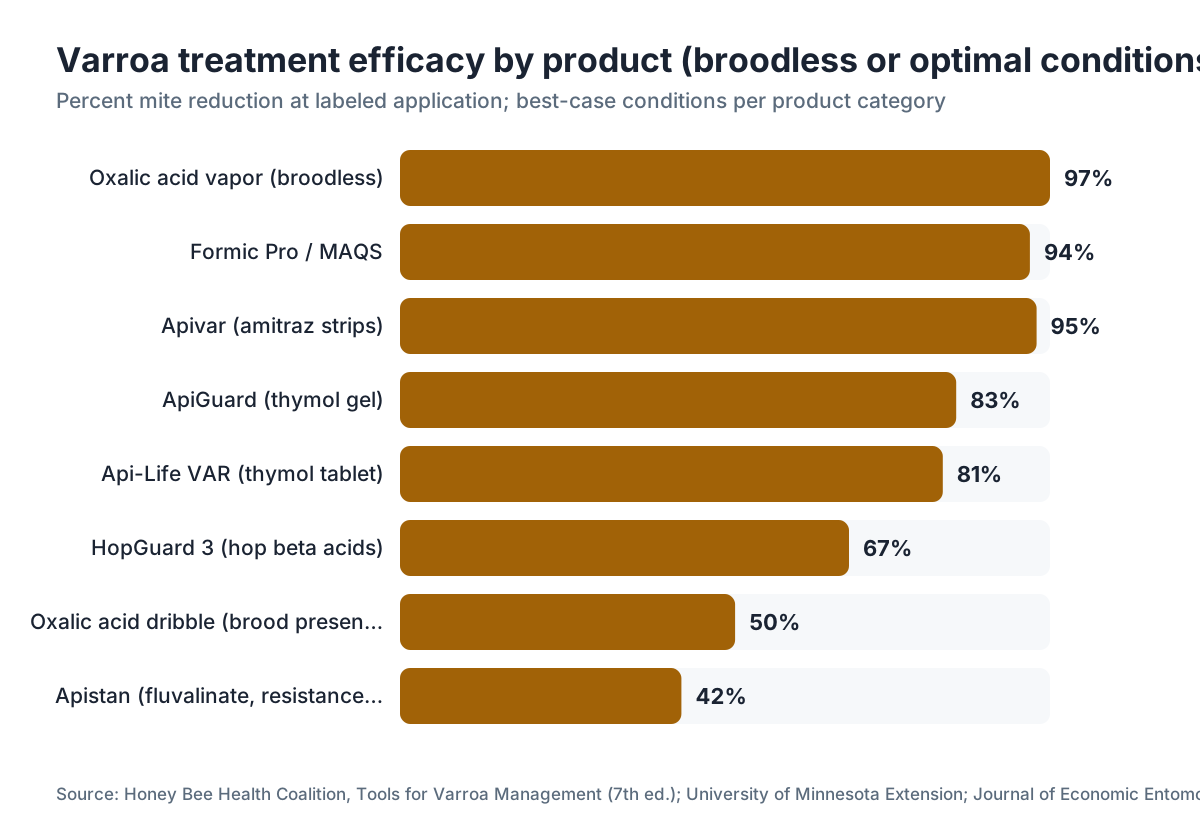
- Oxalic acid dribble or vaporization in broodless colonies reaches 90-99% efficacy.
- Apivar (amitraz strips) runs 93-97% in brood-present colonies.
- Costs range from roughly $1 to $8 per hive per treatment cycle.
What is varroa and why do you need treatment at all?
Varroa destructor is an external parasitic mite that feeds on the fat bodies of honey bees at every life stage. [1] It does more than weaken individual bees. It transmits deformed wing virus and a handful of other pathogens that collapse colonies outright, usually in late fall or winter after mite loads have been building all season.
Skip treatment in North America or Europe and you'll lose most untreated colonies within one to three years. That's not pessimism. It's the consensus from decades of field data. [2] The Honey Bee Health Coalition puts it bluntly in its Tools for Varroa Management guide: "Without management, varroa populations will grow to levels that are damaging or fatal to colonies." [2]
There are no shortcuts here. Mite-resistant stock helps. Brood breaks help. But chemical or organic treatments remain the most reliable tool most beekeepers have. The question is which one, when, and at what cost.
What treatments are registered for varroa in the U.S.?
The EPA registers every pesticide used in managed bee colonies, and the active-ingredient list for varroa is shorter than people expect. [3] Every treatment below is on the U.S. market right now with a valid EPA registration.
| Treatment (brand) | Active ingredient | Application type | Brood-present efficacy | Broodless efficacy |
|---|---|---|---|---|
| Api-Bioxal (OA dribble or vapor) | Oxalic acid | One-time dribble or vaporization | 40-60% (dribble) | 90-99% (vapor/dribble) |
| Apivar | Amitraz | Plastic strip in hive | 93-97% | 93-97% |
| Api-Life VAR | Thymol + eucalyptus | Tablet | 74-87% | Similar |
| ApiGuard | Thymol gel | Tray | 74-90% | Similar |
| Mite Away Quick Strips (MAQS) | Formic acid | Paper strip | 90-95% | 90-95% |
| Formic Pro | Formic acid | Cellulose strip | 91-97% | 91-97% |
| HopGuard 3 | Hop beta acids | Cardboard strip | 50-80% (varies) | Higher |
| Apistan | Tau-fluvalinate | Plastic strip | Resistance widespread; often below 50% now | Same issue |
| CheckMite+ | Coumaphos | Plastic strip | Resistance widespread | Same issue |
Apistan and CheckMite+ are on the list for completeness. Varroa resistance to both is widespread in the U.S., and I wouldn't spend money on either for a primary treatment unless fresh resistance testing in your local population tells you otherwise. [4]
Want the biology behind the parasite? Our varroa mite deep-dive covers the mite's life cycle and why that cycle directly shapes which treatment you choose.
How much does anti-varroa treatment cost per hive?
Anti-varroa treatment costs run from under $1 to about $14 per hive per cycle. The per-hive-per-cycle math is what matters for planning. Below are real retail price ranges based on typical online pricing at major beekeeping supply companies as of 2025. Prices shift, so treat these as ballpark figures.
| Treatment | Pack size | Approx. retail | Cost per hive/cycle |
|---|---|---|---|
| Api-Bioxal (OA vapor) | 35g bag | $25-35 | $0.50-1.50 |
| Api-Bioxal (OA dribble kit) | 35g + supplies | $30-45 | $1-2 |
| Apivar strips | 10 strips (5 hives) | $30-45 | $6-9 |
| Formic Pro | 2-strip pack (1 hive) | $10-14 | $10-14 |
| MAQS | 2-strip pack (1 hive) | $10-14 | $10-14 |
| ApiGuard | 8 trays (4 hives) | $20-30 | $5-8 |
| Api-Life VAR | 4 tablets (2 hives) | $15-22 | $7-11 |
| HopGuard 3 | varies | $12-20 | $6-10 |
Oxalic acid vaporization is the cheapest registered treatment per hive, often under $1.50 a cycle once you own the vaporizer. [5] A vaporizer itself runs $30 to $200 depending on brand and whether it's battery or wired. For a sideliner running 30 hives, the hardware pays for itself in the first season against strip treatments.
The cheapest option isn't always the right one. Formic acid costs more per hive, but it penetrates capped brood and kills mites under the cappings. OA dribble can't do that. Match the tool to the situation, not to the price tag.
How does oxalic acid work, and when should you use it?
Oxalic acid is a naturally occurring compound found in rhubarb, spinach, and other plants. When bees contact it or groom themselves after exposure, it kills varroa by direct contact toxicity. [3] The EPA registered Api-Bioxal for both dribble and vaporization. Extended-release formulations using glycerin-soaked shop towels are technically off-label, though widely practiced. Want to stay strictly legal and protect yourself? Use the labeled methods.
Dribble: You mix Api-Bioxal at 3.5g per 100mL of 1:1 sugar syrup and dribble 5mL per seam of bees, max 50mL per colony. Efficacy in broodless colonies is 90% or better. With open brood present, you're not touching mites under cappings, so efficacy drops to 40-60%.
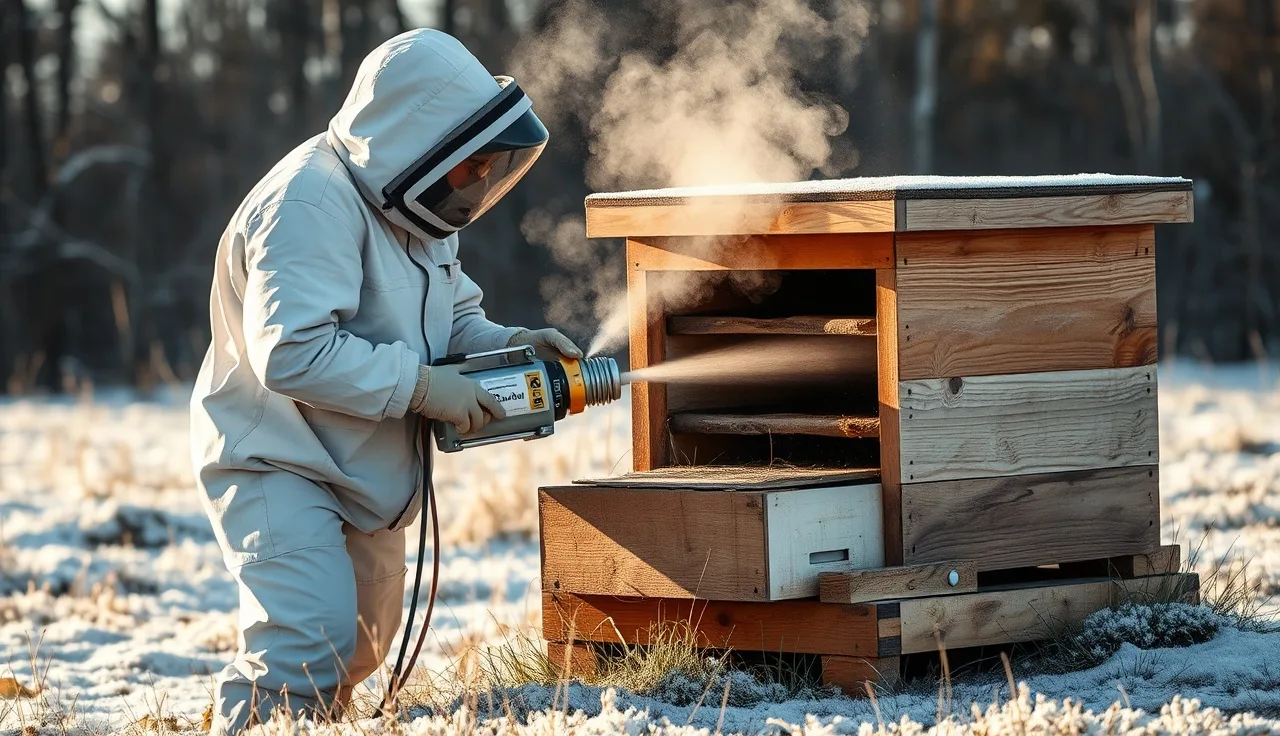
Vaporization: You place oxalic acid crystals (2g per hive) on a heated vaporizer plate and let the vapor fill the hive for at least 2-3 minutes with the entrance sealed. Efficacy in a broodless colony is consistently 90-99% in peer-reviewed trials. [6] You can run multiple treatments spaced 5-7 days apart to catch mites as capped brood hatches, but the label specifies timing, so read it.
Best timing for OA: during a natural or induced winter cluster (broodless period), or after a brood break mid-season. Late November through January in most of the northern U.S. is the natural window. Treating a colony that still has capped brood and want high efficacy? Pair OA vapor with a brood break (queen cage, cull queen, or drone comb removal).
Oxalic acid does not accumulate meaningfully in beeswax or honey at label doses. That's one reason it's approved during honey production in some countries, though U.S. label restrictions still govern when in the season you can treat.
When does Apivar (amitraz) make sense over organic treatments?
Apivar is the most widely used synthetic strip treatment in the U.S., and there's good reason. Its active ingredient amitraz disrupts the mite's octopamine receptors, it works with brood present, and it doesn't need a specific temperature window the way thymol or formic acid do. [4]
You hang two strips per brood box, leave them in for 6 to 8 weeks, and pull them out. Efficacy in most trials lands between 93 and 97% when resistance isn't present. That's genuinely good.
The catch is resistance. Amitraz resistance in varroa is documented in Europe and in isolated U.S. populations. [7] It's not widespread in North America yet, but it's coming, and rotating chemical families slows it down. Use Apivar every single cycle and you're speeding it up. Rotate instead: OA in winter, Apivar in fall, formic acid in late summer. That's the basic chemical rotation.
Amitraz also leaves residues in beeswax. Research published in Pest Management Science has found amitraz and its breakdown products in commercially produced wax. That's not a health emergency for bees at typical residue levels, but it's why some beekeepers hold synthetic strips to one cycle a year and use organics otherwise.
Temperature requirements for Apivar are minimal, which gives it a window that organic acids often lack. You can treat at temperatures as low as 50°F (10°C) without losing efficacy. Formic acid needs 50-85°F and thymol needs consistent temperatures above roughly 60°F to volatilize properly. [8] In a cold September or early October, Apivar is often the practical choice.
How do formic acid treatments (MAQS and Formic Pro) differ from other options?
Formic acid is the only registered treatment that kills mites inside capped brood cells. That matters enormously, because roughly 70% of the mites in an active colony sit under cappings at any given moment. [11] A treatment that can't reach them is solving half the problem.
MAQS (Mite Away Quick Strips) deliver a high initial formic acid dose over 7 days. They work fast, which helps if you're trying to knock down a heavy infestation in a hurry. The downside is that the high vapor load can be hard on the queen, especially in smaller colonies or during hot weather. The label sets a window of above 50°F and no higher than 92°F for MAQS. [8]
Formic Pro releases more gradually over 14-20 days at lower temperatures, down to 50°F, which stretches its usable season. Queen loss risk is lower than with MAQS, but it's still real above 85-90°F. Treat in the early morning or evening during warm weather and keep ventilation open.
Both products can be used during a honey flow if temperatures are in range and you follow the label, though some beekeepers report a slight off-flavor in honey treated during active production. The label permits it. Your palate may not.
For a sideliner whose colonies never get a clean broodless window, formic acid is often the single most valuable tool in the rotation. Pair it with an OA treatment in winter and you cover both phases of the mite's cycle.
What are the thymol-based treatments and when do they work?
Thymol comes from thyme oil and works on mites through fumigation inside the hive. ApiGuard uses a thymol gel in a tray. Api-Life VAR uses tablets blended with thymol, eucalyptus, menthol, and camphor. Both need temperatures above roughly 60°F (15°C) to volatilize, with peak performance between 65 and 80°F (18-27°C). [4]
Efficacy in trials generally runs 74 to 90%. Decent, but lower than OA or formic acid at their best. In a warm late-summer window (late July through August in most of the U.S.), thymol products are a legitimate option and are approved for honey-producing colonies with appropriate withdrawal timing per the label.
Thymol can hurt queen acceptance and brood patterns if used at high temperatures or in confined spaces. Keep ventilation open. It also works better in established colonies than in nucs or small clusters where vapor escapes too easily.
The practical window for thymol in the northern U.S. is roughly July 15 through September 15. Outside that, temperature swings make dosing unreliable. In the deep south or year-round warm climates the window is wider, but summer heat becomes a ceiling.
Should you monitor mite loads before and after treatment?
Yes. Always. No exceptions if you want the colony alive next season.
The standard treatment threshold is 2% infestation in the active brood season, roughly 2 mites per 100 bees on an alcohol wash. The Honey Bee Health Coalition's Tools for Varroa Management guide sets this threshold and explains why acting at 2%, rather than waiting for visible damage, separates colonies that live from colonies that die. [2]
An alcohol wash of a 300-bee sample is the most reliable monitoring method available to hobbyists. [9] A sugar roll is gentler on the bees but consistently underestimates mite load compared to an alcohol wash. Sticky boards give you a trend, not a true percentage. [9]
Post-treatment monitoring tells you whether the treatment worked. Treat with Apivar, recheck 8 weeks later, and find 3% infestation? Something went wrong: resistance, sloppy application, or a mite-loaded swarm that moved in afterward. You won't know without checking.
For free downloadable monitoring worksheets and a mite calculation tool, VarroaVault's protocol OS covers both alcohol wash and sticky board methods with threshold alerts built in.
Monitoring costs almost nothing. A bottle of alcohol, a strainer, a jar. Skipping it costs colonies. There's no honest way to frame that trade-off differently.
Can you combine treatments or use them in sequence?
Yes, and in most cases you should plan a full-season calendar rather than react to crises.
A common two-treatment annual protocol for northern beekeepers:
- Late summer treatment (August): Formic Pro or Apivar to knock down mite loads before the winter bees are raised. Winter bees raised from mite-damaged pupae won't live long enough to carry the colony through winter. This is the most important treatment of the year.
- Winter treatment (November through January, broodless period): Oxalic acid vapor or dribble to clear mites off the bees when there's no capped brood to hide in.
Some beekeepers add a spring check and optional treatment if mite loads approach 2% by May or June.
Do not combine treatments simultaneously unless the label explicitly allows it. Running Apivar strips while also using thymol or formic acid creates unpredictable vapor interactions and can raise bee mortality. The label is the law under FIFRA. [3]
There's solid logic to alternating chemical families across cycles: organic acid in summer, synthetic in fall (or the reverse), OA in winter. This slows resistance in local mite populations and keeps more tools viable long-term.
What are the legal requirements for using anti-varroa treatments?
In the U.S., every varroa treatment listed here is a registered pesticide under the Federal Insecticide, Fungicide, and Rodenticide Act (FIFRA). Using any of them in a manner inconsistent with the label is a federal violation. [3] The application rate, the timing, the temperature windows, the colony conditions (with or without honey supers), and the withdrawal periods aren't suggestions. They're legal requirements.
In practice, most state agriculture departments don't send inspectors to your backyard. But label compliance matters the moment you sell honey commercially, work with a co-op, or face an insurance claim tied to a colony loss. Follow the label.
Some states pile on requirements. California, for example, has specific rules around pesticide use records for commercial operations. Check your state's department of agriculture website for local rules.
Oxalic acid sold in bulk as a wood bleach or wood cleaner isn't the same product as Api-Bioxal, even when the chemical is identical. Using non-EPA-registered oxalic acid in a hive is technically off-label. Api-Bioxal is the only EPA-registered OA product for honey bee use as of this writing. [12]
Sourcing beekeeping supplies and want to stay fully compliant? Buy the labeled product from a reputable supplier.
What are non-chemical methods and how effective are they?
Integrated pest management (IPM) for varroa includes several non-chemical tactics. None replace chemical or organic treatments for most operations, but they lower the treatment burden and slow mite population growth.
Drone comb removal: Varroa reproduces in drone brood at roughly eight times the rate of worker brood. Insert a frame of drone foundation, let it cap, then freeze or cull it, and you pull out a big mite reservoir. Research supports 20-30% mite reduction with consistent drone comb management, though the numbers vary by study. [6] It's labor-intensive and demands timing.
Brood break: Cage the queen or remove her for 24 days and you eliminate new capped brood, leaving all mites on adult bees where OA vapor reaches them. OA vapor efficacy in a fully broodless colony is 90-99%. [6] A genuinely effective tactic if you're willing to risk the queen manipulation.
Mite-resistant stock: Hygienic behavior and varroa-sensitive hygiene (VSH) traits cut mite reproduction rates. Colonies bred from VSH queens show measurably lower mite population growth curves. [4] They're not immune. They still need monitoring and occasional treatment. But they tolerate mite pressure better and need fewer interventions.
Small cell comb: No credible peer-reviewed evidence supports the claim that small cell comb reduces varroa reproduction. Save your money. Skip it.
Powdered sugar: Widely repeated, not supported by evidence. Mites drop at about the same rate as with plain mechanical disturbance. It's a monitoring aid at best, not a treatment.
For the biology behind resistance breeding and how varroa mite genetics are shifting, that article covers the VSH trait in detail.
What does a full-year anti-varroa treatment schedule look like?
Here's a practical calendar for a hobbyist or sideliner in the northern U.S. (USDA hardiness zones 5-7). Adapt the dates for your climate. [10]
April: Alcohol wash once the colony has at least 4 frames of brood. Over 2%, treat now. Under 2%, schedule a recheck in 4-6 weeks.
June: Second alcohol wash. Mite populations double roughly every 3-4 weeks in peak brood season. Catching a rising load in June buys you time to act before the winter-bee-raising window in August.
August 1-15: Primary treatment. The most important intervention of the year. Use Formic Pro, MAQS, or Apivar. August temperatures are usually friendly for all three. The bees raised from mid-August through September carry the colony to spring. Mite-damaged winter bees mean dead colonies by February.
October: Post-treatment alcohol wash. Verify efficacy. Retreat if the load is still above 2%.
November through January (broodless window): OA vapor or dribble. This cleanup treatment clears the mites left on adult bees after brood rearing stops. It's the lowest-cost, highest-efficacy application you'll do all year.
Spring: Start over.
VarroaVault's free protocol OS generates a customized version of this calendar based on your location and colony count, with automated threshold alerts built on the same HBHC monitoring guidelines. Worth a look if you're managing more than five hives.
The calendar above assumes you're monitoring. Without monitoring data, you're guessing at timing, and guessing kills colonies.
Frequently asked questions
What is the most effective anti-varroa treatment available?
Oxalic acid vapor in a broodless colony consistently reaches 90-99% efficacy in peer-reviewed trials, making it the most effective single application available. For colonies with active brood, formic acid (Formic Pro or MAQS) reaches 91-97% and is the only registered treatment that kills mites inside capped cells. Apivar (amitraz) achieves 93-97% with brood present when resistance isn't a factor.
How much does varroa treatment cost per hive per year?
Plan for $10 to $25 per hive per year for a two-treatment annual protocol using oxalic acid in winter and strips or formic acid in late summer. A vaporizer adds a one-time $30-200. The biggest variable is formic acid or thymol treatments (higher cost) versus OA-only approaches. Apivar strips run roughly $6-9 per hive per cycle at current retail prices.
Can you treat for varroa while honey supers are on?
Oxalic acid (Api-Bioxal dribble or vapor) is not labeled for use with honey supers in place in the U.S. Formic acid treatments (MAQS and Formic Pro) are labeled for use with supers on under specific conditions. Apivar and thymol products require super removal. Always read the current product label; it governs regardless of what you've read elsewhere.
What is the difference between Api-Bioxal and oxalic acid from the hardware store?
Api-Bioxal is the only EPA-registered oxalic acid product for honey bee colony treatment in the U.S. Bulk oxalic acid sold as a wood cleaner may be chemically identical but has no EPA registration for bee use. Using it in a hive is technically off-label under FIFRA. For legal compliance, especially for commercial operations or honey sold under a food safety program, use Api-Bioxal.
How do you know if your varroa treatment worked?
Do an alcohol wash on a 300-bee sample 7-14 days after treatment completion and compare it to your pre-treatment count. A successful treatment should drop mite load below 1-2%. If your post-treatment count is still above 2%, suspect resistance (especially with synthetic strips), incomplete coverage, reinfestation from neighboring colonies, or an application error. Sticky board counts show a drop in mite fall but don't give you a percentage.
At what mite level should you treat?
The Honey Bee Health Coalition recommends treating when an alcohol wash shows 2 mites per 100 bees (2%) during the active brood season, dropping to 1% (1 mite per 100 bees) in August and September when winter bees are being raised. Some beekeepers use sticky board counts of 8-10 natural mite fall per day as a rough proxy, but an alcohol wash is far more accurate.
Can varroa mites develop resistance to treatments?
Yes. Resistance to tau-fluvalinate (Apistan) and coumaphos (CheckMite+) is widespread in the U.S. and Europe. Amitraz (Apivar) resistance is confirmed in European populations and isolated U.S. colonies. Organic acids (oxalic acid, formic acid) and thymol show no confirmed resistance to date, likely because they work through physical or non-specific mechanisms rather than a single receptor target. Rotating chemical families across cycles is the main resistance management strategy.
Is oxalic acid safe for bees and honey?
At labeled doses, oxalic acid has low acute toxicity to adult bees. It shouldn't be applied when open brood is present in large quantities because it can damage young larvae. Residues in honey at label application rates sit at or below the oxalic acid already occurring naturally in honey. The USDA and EPA reviewed this data as part of the Api-Bioxal registration.
What temperature do you need for formic acid varroa treatment?
Formic Pro requires a minimum of 50°F (10°C) and a maximum of 85°F (29°C) for the 14-20 day extended release application. MAQS requires 50-92°F. Above the upper limit, vapor concentrations can get high enough to damage brood and raise queen loss risk. Both products have day and night temperature requirements; check the label for your specific product and application method.
How many times can you treat with oxalic acid in one season?
The Api-Bioxal label allows one application per year for the dribble method and up to three applications (spaced 5-7 days apart) for vaporization in a broodless colony. Some beekeepers do extended OA vapor series over 4-5 treatments to catch mites as brood hatches during a queen cage brood break. That goes beyond label directions and is technically off-label, though many practitioners report doing it.
Do you need a license or prescription to buy varroa treatments?
No prescription is needed for any currently registered varroa treatment in the U.S. All are available over the counter from beekeeping suppliers. Some states require a pesticide applicator license if you're treating hives commercially for hire (treating other people's bees for pay), but treating your own colonies doesn't require a license in most states. Check your state department of agriculture for specifics.
What anti-varroa treatments work in winter?
Oxalic acid vapor or dribble is the primary winter treatment and works best when the colony is broodless, typically November through January in the northern U.S. Apivar strips can stay in a hive through winter if placed in fall but shouldn't be left more than 8 weeks. Thymol and formic acid aren't effective at winter temperatures; volatilization drops below functional levels under about 50°F.
Can small hive management practices replace varroa treatments?
Not reliably. Brood breaks, drone comb removal, and VSH-selected queens all reduce mite population growth and lower treatment frequency, but there's no published evidence that any combination of non-chemical methods alone keeps mite loads below damaging thresholds in managed colonies in North America. They're valuable IPM tools that work best alongside, not instead of, registered treatments.
What varroa treatment is best for a new beekeeper?
Oxalic acid vapor in winter plus Apivar in late summer is the most beginner-friendly two-treatment protocol. Both leave wide margins for minor application errors compared to formic acid. Get a vaporizer, learn to do an alcohol wash, and set a calendar reminder for late July to check mite loads before the August window opens. That sequence handles the bulk of varroa pressure a first-year colony faces.
Sources
- USDA Agricultural Research Service, Bee Research Laboratory: Varroa destructor is an external parasitic mite that feeds on honey bee fat bodies and transmits multiple viruses including deformed wing virus
- Honey Bee Health Coalition, Tools for Varroa Management Guide (7th edition): Treatment threshold of 2 mites per 100 bees during brood season; 1% in August-September; and the statement that without management varroa populations will grow to damaging or fatal levels
- U.S. EPA, Pesticides program: All varroa treatments used in U.S. managed colonies are registered pesticides under FIFRA; using them off-label is a federal violation
- University of Minnesota Extension, honey bee and varroa resources: Amitraz (Apivar) efficacy of 93-97% in brood-present colonies; widespread resistance to fluvalinate and coumaphos; temperature requirements for Apivar and thymol treatments
- Penn State Extension, honey bee pest management resources: Oxalic acid vaporization is among the lowest-cost registered treatments per hive; vaporizer equipment costs and OA dose per hive
- Journal of Economic Entomology (Oxford Academic), oxalic acid and brood interruption trials: Oxalic acid vapor efficacy of 90-99% in broodless colonies; drone comb removal estimated at 20-30% mite reduction; brood break plus OA vapor data
- USDA Agricultural Research Service, Bee Research Laboratory: Amitraz resistance documented in European varroa populations and isolated U.S. colonies; rotating chemical families recommended to slow resistance development
- U.S. EPA, Pesticide Registration (Formic Pro and Mite Away Quick Strips labels): Formic Pro temperature window 50-85°F for 14-20 day extended release; MAQS temperature window 50-92°F over 7 days; queen loss risk at high temperatures
- Honey Bee Health Coalition, Tools for Varroa Management Guide (monitoring section): Alcohol wash of 300-bee sample as most reliable monitoring method; sugar roll underestimates mite load compared to alcohol wash; sticky board gives trend not percentage
- USDA Agricultural Research Service, Bee Research Laboratory: Two-treatment annual protocol (late summer plus winter) as the standard recommendation for northern U.S. beekeepers; timing of winter-bee-raising window in August as critical treatment period
- Cornell University, Department of Entomology: Approximately 70% of varroa mites are inside capped brood cells in an active colony at any given time; formic acid penetration of capped cells
- U.S. EPA, Pesticide Registration (Api-Bioxal, EPA Reg. No. 86322-1): Api-Bioxal is the only EPA-registered oxalic acid product for honey bee colony treatment; labeled for dribble and vaporization; one dribble application per year, up to three vapor applications in a broodless colony
Last updated 2026-07-09