Apiguard evaporation rate in different climates explained
TL;DR
- Apiguard (thymol gel) evaporates fastest above 25°C (77°F) and nearly stops below 15°C (59°F).
- Hot, dry climates can empty a 50-gram tray in 10-14 days instead of the label's four-week interval.
- High humidity slows evaporation even in heat.
- Colony size, hive ventilation, and altitude all shift the dose your bees actually get.
What is Apiguard and why does evaporation matter for varroa control?
Apiguard is a slow-release thymol gel made by Vita (Europe) Ltd, registered for varroa control in the United States and the EU. The active ingredient is thymol at 25% w/w in a gel matrix. Thymol kills Varroa destructor by vapor contact, so the treatment only works if the gel releases enough vapor to saturate the hive air. Evaporate too fast and the dose spikes, then collapses before the second application. Evaporate too slowly and thymol never reaches the minimum effective concentration. [1]
The label prescribes two 50-gram doses applied four weeks apart, a total six-to-eight-week window. [1] That schedule assumes temperatures between 15°C and 40°C (59°F to 104°F). Step outside that range and the evaporation kinetics change enough to wreck efficacy or damage brood, and the label says so plainly. That temperature window is the single most important number in Apiguard use. Plenty of beekeepers skip it, slap on the tray, and hope.
Thymol's vapor pressure climbs sharply with temperature, roughly doubling for every 10°C rise near the gel's working range. That physical fact is why climate is the dominant variable in whether Apiguard does its job.
What temperature does Apiguard need to evaporate effectively?
The Apiguard label states the treatment needs a minimum ambient temperature of 15°C (59°F) and works best between 25°C and 40°C (77°F to 104°F). [1] Below 15°C, thymol vapor pressure drops so low that almost no active ingredient reaches the bees or mites. The gel can sit in a cool fall hive for weeks and barely move.
Above 40°C (104°F), the opposite happens. Vapor concentrations can climb high enough to irritate bees, cause queen loss, or drive bees to haul the gel out of the hive. Beekeepers in hot southern climates report that last behavior often. The Honey Bee Health Coalition's Varroa Management Guide lists high temperature as one of the most common reasons thymol treatments fail or disrupt the colony. [2]
The practical bottom line most extension guides agree on: if your daytime highs sit consistently below 60°F, wait. If they sit consistently above 100°F, treat in the cooler shoulder season or the early morning when the hive is cooler, and prop the entrance wide open. Neither edge is a safe place to treat.
How does climate zone change how fast Apiguard evaporates?
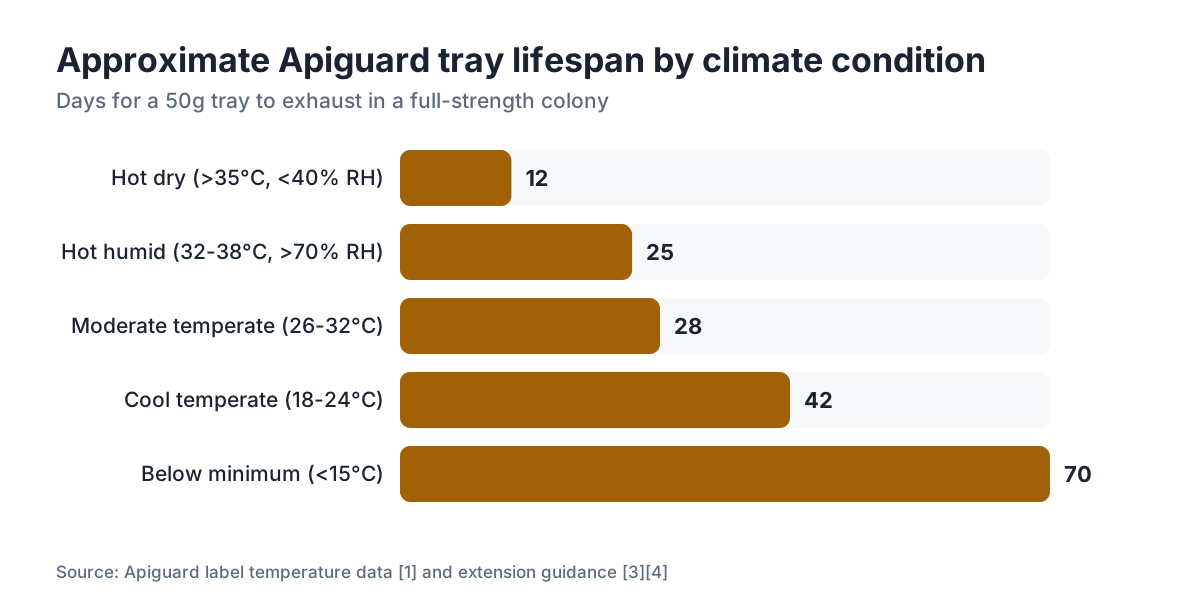
Climate zone is the single biggest predictor of how long a 50-gram tray lasts in a hive. The table below gives approximate evaporation timelines by climate type, drawn from published extension guidance and the label's own temperature data. [1][3]
| Climate type | Typical summer high | Approx. time for 50g tray to empty | Notes |
|---|---|---|---|
| Cool temperate (Pacific NW, N. New England) | 18-24°C (64-75°F) | 5-7 weeks | Often below minimum; fall treatment risky |
| Moderate temperate (Midwest, mid-Atlantic) | 26-32°C (79-90°F) | 3-5 weeks | Label conditions roughly met |
| Hot semi-arid (Southwest high desert) | 33-40°C (91-104°F) | 2-3 weeks | May need to check tray weekly |
| Hot humid (Gulf Coast, SE US) | 32-38°C (90-100°F) with high RH | 3-5 weeks | Humidity slows vapor release despite heat |
| Subtropical/tropical | 35-42°C+ (95-108°F+) | 1.5-2.5 weeks | Above label max; bees may eject gel |
Here is a point people miss: the air temperature outside the hive is not the hive temperature. A healthy summer colony at 32°C ambient holds its brood nest at 34-35°C, which pushes the gel to the top of the optimal range. In a desert at 40°C ambient, the hive interior can top 42°C, past the label maximum, even with good ventilation. [3]
So evaporation is not one number. It is a function of at least four things: outdoor air temperature, hive ventilation, colony population (more bees make more heat), and relative humidity.
How does humidity affect Apiguard evaporation?
Humidity is the variable beekeepers overlook most. Thymol release is a surface event: the gel gives off vapor at its exposed face, and that vapor diffuses into hive air. High relative humidity slows diffusion because the air already carries a heavy moisture load, which shrinks the vapor pressure gradient that pulls thymol off the gel. [4]
Gulf Coast beekeepers treating in August at 35°C and 80% relative humidity often find their trays last nearly as long as a Midwest beekeeper's at 28°C and 50% humidity. Hot and humid does not halve treatment time the way hot and dry does. That matters for how you read a mid-treatment inspection. If you expected the tray gone in two weeks because it is "hot," but humidity stretched it to four, you might crack the hive, see gel still in the tray, and assume something broke. Nothing broke. The tray is just working slowly.
The reverse is more dangerous. Hot plus dry, like August in Arizona, Nevada, or the inland California valleys, can empty a 50-gram tray in 10-14 days. Drop in the first tray, come back at week four to swap it, find it bone dry, and your bees had near-zero thymol exposure for two to three weeks in the middle of treatment. Your mite count almost certainly climbed during that gap.
Treating in a hot, arid climate? Check the tray at two weeks. Swap early if it is empty or close, then watch for signs of queen stress.
Does altitude change how Apiguard performs?
Altitude affects Apiguard two ways. First, air pressure drops with elevation, which slightly lowers the boiling point of volatile compounds including thymol. The practical result is a small bump in thymol volatility at high altitude versus sea level at the same temperature. Real, but modest. A beekeeper at 2,500 meters (8,200 feet) will not see dramatically different results from this effect alone. [4]
The bigger effect is indirect. High-altitude apiaries tend to have cool nights and short warm windows. A Colorado Front Range beekeeper at 1,800 meters might see afternoon highs of 30°C in late summer with nights that dip to 10°C. Thymol vapor production basically stalls at night when hive temperature falls, then restarts each afternoon. The real dosing window each day is shorter than the daily high suggests. Treatment stretches out, and your plan has to account for it.
My honest advice for high-altitude beekeepers: do not start Apiguard after mid-August. Night temperatures will drag you below the 15°C threshold before the six-week protocol finishes. Treat the label's temperature floor as a proxy for your local season end date.
What happens if Apiguard evaporates too fast?
Fast evaporation is more than an efficacy problem. It can hurt your bees. When a 50-gram tray burns through in ten days instead of four weeks, you get a big spike in thymol vapor followed by zero exposure for the rest of the first period. That spike can:
- Push bees to abscond or cluster away from the gel, cutting effectiveness.
- Trigger bees to coat or drag the tray out, a documented response in heat. [2]
- Stress laying queens, sometimes causing brood breaks that look like supersedure.
- Leave mites with no thymol exposure for 2-3 weeks mid-treatment, plenty of time for survivors to rebound.
A 2011 study by Gregorc and Planinc in Acta Veterinaria found that Apiguard applied during summer heat waves produced more brood abnormalities and higher bee losses in the first week than the same treatment in cooler conditions. [5] The mechanism was almost certainly the vapor spike from fast evaporation.
Stuck in a hot climate and can't shift the window to a cooler stretch? Some beekeepers slow evaporation physically: lay a piece of cardboard, a sheet of paper, or a shim board over the tray to cut airflow across the gel. This is not a label method. Extension literature discusses it as harm reduction when timing forces your hand. [3]
What happens if Apiguard evaporates too slowly?
Slow evaporation is the more common trap in northern or mountainous climates, and it hides in plain sight. The tray looks full, the bees seem fine, and your mite load barely moves.
Thymol has to reach a minimum effective concentration in hive air, roughly 0.5 to 1.0 mg per liter by some estimates, before it meaningfully knocks Varroa off adult bees. [4] If hive temperatures stay below 20°C, the vapor pressure may never hit that mark. You run the full six-to-eight-week protocol, do a wash, and find mite levels basically unchanged. That happens to beekeepers who start treatment in September in the northern tier.
The Honey Bee Health Coalition recommends that cool-climate beekeepers consider oxalic acid vaporization or dribble instead of thymol once fall temperatures drop below reliable treatment conditions. [2] Heed that. If your nighttime lows already touch 45°F (7°C) in late August, Apiguard is probably the wrong fall tool. Plan your mite calendar around it, and building that calendar is exactly what the free protocol tools at VarroaVault help with.
For spring treatments in cool climates, wait until you have had at least ten straight days where afternoon hive temperatures will clear 20°C before applying. Do not go by the date. Go by the thermometer.
How should you adjust the Apiguard protocol in hot climates?
Where summer ambient temperatures regularly top 35°C (95°F), a strict reading of the label points you toward spring or early fall treatment, when highs sit in the 25-35°C range, rather than mid-summer. But if varroa pressure forces a summer treatment, these adjustments have real support in extension resources. [3]
Maximize ventilation first. A screened bottom board with the inspection drawer pulled gives the strongest airflow and slows the heat buildup that burns off the gel. Second, set the tray toward the front of the hive, away from the warmest part of the brood nest, to moderate the release rate a little. Third, and the one that matters most, inspect the tray at two weeks instead of four. If it is more than 75% gone, apply the second dose early rather than waiting on the calendar.
One thing I would not do in a 40°C climate: cover the hive to "trap" thymol vapor. That risks pushing hive temperature past the point where bees can thermoregulate and protect brood. In summer heat, ventilation wins every time.
If you're sourcing materials, options at beekeeping supply companies or those offering free shipping honey bee supply companies let you keep replacement trays on hand so you can swap early without running short.
How should you adjust the protocol in cool or northern climates?
In cool climates the whole challenge is fitting a six-to-eight-week treatment into a window where temperatures reliably clear 15°C. In the northern United States that window runs roughly late May through early September, depending on elevation. [3]
Start Apiguard no later than mid-July if you want to finish before the fall mite peak and before nighttime temperatures drop under the minimum. The common mistake is starting in late August. It feels like summer, but it often puts you below 59°F by week four or five in northern New England, the Upper Midwest, or the northern Rockies.
For a colony that will overwinter, timing matters double. Varroa loads need to be low before the winter bees (the long-lived bees that carry the colony through the cold) are reared, which happens roughly August through September in most northern regions. Treat in July and the treatment wraps in August, right when you need it. Treat in August and you're running the protocol into October, in borderline temperatures, trying to protect bees that mites are already chewing on.
Penn State Extension recommends finishing varroa treatments before the winter bee population is in production, using the local first frost date as a rough backward-planning anchor. [6] That is practical advice I would follow.
Does hive type or population size affect evaporation?
Yes, and it matters. A strong colony of 40,000 to 50,000 bees makes far more heat than a four-frame nuc. More bees means a warmer brood nest, which means faster thymol evaporation at the same ambient temperature. The label's 50-gram dose is calibrated for a full-size colony with brood on at least four to five frames, and label guidance says it is not recommended for very small colonies or packages. [1]
A nuc or small split evaporates the gel more slowly but gets proportionally more vapor per bee. The risk in a small colony is thymol irritation: the smaller air volume concentrates thymol faster, which can stress the queen. If you must treat a small colony, some beekeepers cut the dose to 25 grams, though that is off-label and the half-dose efficacy data is thin.
Hive type shifts things too. A 10-frame Langstroth with a screened bottom board ventilates differently than a 5-frame nuc box or a non-standard design. More air exchange means faster vapor dispersal, which keeps the concentration from spiking but also burns off thymol faster. That is one reason heavily ventilated hives in hot climates empty trays so quickly.
For the range of hive designs in use, our overview of beekeeping supplies covers the basic equipment options.
How do you know if Apiguard is working in your climate?
Measure mite loads before and after. A sugar roll or alcohol wash before treatment, then another wash 3-4 weeks after the protocol ends, tells you whether the treatment moved the population the right direction. The Honey Bee Health Coalition's Varroa Management Guide sets an action threshold of 2% infestation (2 mites per 100 bees) for most seasons and 1% going into fall. [2]
Behavior helps too. Bees should be mildly deterred from the gel but not alarmed; a thin rim of bees keeping off the tray is normal. Bees actively hauling gel out, balling in a corner away from the tray, or a sudden drop in egg-laying within two weeks of application all suggest the evaporation rate is too high for your conditions.
A tray that has barely changed after three weeks is the opposite signal: you're probably below the minimum effective temperature. Weigh the tray if you have a small scale. A 50-gram tray that still reads 45 grams after three weeks in a full colony means thymol volatilization has basically stalled.
If your mite counts do not drop by at least 80-90% after a properly timed Apiguard treatment, the most common causes, in order, are temperature out of range, capped brood shielding mites from vapor during the treatment period, and resistance (rare for thymol, but documented). [5] Rule out the climate problem before you call it treatment failure.
For more on the mite and why timing matters, the background on varroa mite biology is worth reading.
Can you use Apiguard in very hot climates at all?
Where summer temperatures regularly top 40°C, like low-elevation Arizona, the Sonoran Desert, or tropical apiaries, Apiguard gets genuinely hard to use in the hottest months. The label maximum is 40°C, and hive interiors can run past that in direct sun. "Close enough" does not work here. The beekeeper in coastal California treating in July at 32°C is playing a different game than the one in Phoenix at 43°C. The Phoenix beekeeper should strongly consider a different summer tool, specifically oxalic acid, which has no temperature ceiling for the vapor method and hits phoretic mites just as hard. [7]
Apiguard does work in hot climates if you pick the right window. In Phoenix that window is roughly late September through October, when highs drop to 30-35°C. In south Florida, late November through January. Match the treatment to the climate's cool season instead of forcing it into the heat.
Beekeepers running Africanized honey bees in hot climates face an extra wrinkle: Africanized colonies sometimes react more aggressively to irritant vapors, though formal comparative data is limited. Go slow and monitor closely.
VarroaVault's free protocol tools can map your local temperature data to the best Apiguard window so you're not guessing at timing. That is where calendar planning pays off.
Frequently asked questions
What is the minimum temperature for Apiguard to work?
The Apiguard label specifies a minimum of 15°C (59°F). Below that, thymol vapor pressure is too low to reach effective concentrations in hive air, and the gel may sit nearly unchanged for weeks. Most practitioners and extension resources recommend consistent daytime temperatures above 20°C (68°F) for reliable performance, rather than just technically meeting the label floor.
How long does one Apiguard tray last in hot weather?
In hot, dry conditions above 35°C (95°F), a 50-gram tray can empty in 10-14 days, well before the four-week mark when the second dose normally goes on. In hot but humid conditions, the same tray may last closer to three to four weeks. Check the tray at two weeks in any warm climate and apply the second dose early if it is more than 75% gone.
Can I use Apiguard in summer in a hot climate?
The label ceiling is 40°C (104°F). If your summer temperatures routinely exceed that inside the hive, mid-summer treatment risks gel exhaustion, queen stress, and brood damage. In very hot climates like the desert Southwest, spring or fall windows with highs of 25-35°C are far more reliable. Oxalic acid vaporization is a better summer option in those regions.
Does humidity slow Apiguard evaporation?
Yes. High relative humidity shrinks the vapor pressure gradient at the gel surface, slowing thymol release. A hot-humid climate like the Gulf Coast sees slower evaporation than a hot-dry climate at the same temperature. Beekeepers in the Southeast should not assume their trays empty as fast as those in arid regions, even during comparable summer heat.
Why are my bees removing the Apiguard tray?
Bees remove or coat the tray when thymol vapor gets uncomfortably high, which usually means hive temperatures are near or above the label maximum of 40°C. More ventilation (screened bottom board, entrance fully open) can ease the problem. If bees are actively ejecting the tray, conditions are probably outside the safe treatment range and you should consider a different method.
Should I use one tray or two Apiguard trays at once?
The protocol calls for one 50-gram tray at a time, applied four weeks apart. Some cool-climate beekeepers have tried two simultaneous trays to raise vapor concentration, but that is off-label and risks thymol toxicity to bees and brood. Stick to the sequential protocol. If temperatures are too low for one tray to work, fix the timing, not the dose.
Does Apiguard work the same in a Langstroth versus a top-bar hive?
Not exactly. Hive design changes airflow and the air volume the vapor has to saturate. Top-bar hives often have different ventilation geometry than Langstroth boxes, and trays may not sit in an ideal spot relative to the cluster. Published data on Apiguard efficacy in top-bar hives is limited, so monitor mite counts closely and adjust tray placement to maximize bee contact with the vapor.
Can I use Apiguard with honey supers on?
No. The label explicitly prohibits use when honey supers intended for human consumption are present. Thymol can accumulate in capped honey above food safety thresholds. Remove all honey supers before applying and do not add them back until treatment is complete and the hive has had time to air out. This is a firm label requirement, not a caution.
How do I know if Apiguard actually reduced my mite load?
Do an alcohol wash or sugar roll before treatment and again three to four weeks after the protocol ends. The Honey Bee Health Coalition recommends a post-treatment threshold below 2% (2 mites per 100 bees) for most seasons and below 1% heading into fall. A properly timed Apiguard treatment in the right temperature range should cut phoretic mite counts by 80-95% in broodless or low-brood colonies.
Does Apiguard affect the queen?
It can, especially when temperatures are high and thymol evaporates fast. Queen problems, including brood breaks, supersedure, and in severe cases queen loss, are most often reported in hot conditions where vapor concentrations spike. In moderate temperatures within the label range, queen effects are usually transient. Watch the brood pattern for the first two weeks after each application.
Is Apiguard legal to use in the United States?
Yes. Apiguard holds an EPA registration (EPA Reg. No. 79671-2) for use in honey bee colonies in the United States. Always follow the label, which is a legal document. Failure to follow label directions is a violation of federal pesticide law under FIFRA.
When is the best time of year to apply Apiguard in northern US states?
Mid-July through mid-August is the target for most northern-tier states. That lets you finish the six-to-eight-week protocol before nighttime temperatures drop below 15°C and before winter bees are heavily in production. Starting after August 15 in states like Minnesota, Maine, or Montana risks the protocol running into cold fall conditions that stall thymol evaporation and leave mite loads high going into winter.
What mite count threshold should trigger an Apiguard treatment?
The Honey Bee Health Coalition's Varroa Management Guide sets the summer action threshold at 2% infestation (2 mites per 100 bees in an alcohol wash). For late summer or early fall, leading into winter bee production, the threshold drops to 1%. These thresholds assume treatment finishes before mite populations damage winter bees, which is why matching timing to your climate's temperature window matters so much.
Sources
- Vita (Europe) Ltd, Apiguard US EPA Product Label: Apiguard label specifies minimum treatment temperature of 15°C (59°F), optimal range 25-40°C, two 50g doses four weeks apart, and prohibition on use with honey supers
- Honey Bee Health Coalition, Varroa Management Guide: Action thresholds of 2% summer and 1% fall mite infestation; high temperatures cited as common cause of thymol treatment failure; oxalic acid recommended for cool-climate fall treatment
- University of Minnesota Extension: Temperature windows for Apiguard use in northern climates; recommendations on checking tray consumption in hot conditions; cardboard cover mentioned as informal mitigation in heat
- Imdorf A, Bogdanov S, Ochoa RI, Calderone NW, Apidologie, Thymol as a control agent for Varroa jacobsoni: Thymol vapor pressure relationship to temperature and humidity; minimum effective hive air concentration estimates of 0.5-1.0 mg/L; altitude effects on thymol volatility
- Penn State Extension: Recommends completing varroa treatments before winter bee population is in production, using local first frost date as backward planning anchor
- UC Agriculture and Natural Resources, Apiculture Program: Oxalic acid vaporization recommended as alternative to thymol in hot climates where temperature exceeds Apiguard label maximum
- US EPA, Pesticide Registration: Apiguard holds EPA registration; FIFRA requires label compliance as a legal condition of use
- USDA Agricultural Research Service, Bee Research Laboratory: Background data on Varroa destructor biology and seasonal mite population dynamics relevant to treatment timing decisions
- Rosenkranz P, Aumeier P, Ziegelmann B, Journal of Invertebrate Pathology, Biology and control of Varroa destructor: Varroa population dynamics and relationship of mite reproduction timing to treatment efficacy windows by season
Last updated 2026-07-09