Formic acid evaporation rate and temperature: what every beekeeper needs to know
TL;DR
- Formic acid kills varroa by turning into vapor inside the hive.
- Its evaporation rate roughly doubles for every 10°C (18°F) rise in temperature.
- Below 50°F (10°C) it barely volatilizes and fails.
- Above 95°F (35°C) it releases too fast, risking queen loss and bee death.
- Products target 50-85°F, with the best kill at 60-85°F.
Why does temperature control how well formic acid works against varroa?
Temperature is not one factor among many for formic acid. It IS the treatment. Formic acid (HCOOH) is a liquid at room temperature, but it's highly volatile, so it turns to vapor at low temperatures compared to most compounds. That vapor is what kills varroa, including mites tucked under capped brood. The vapor concentration inside the hive depends almost entirely on how fast the acid evaporates, and that rate rides on temperature.
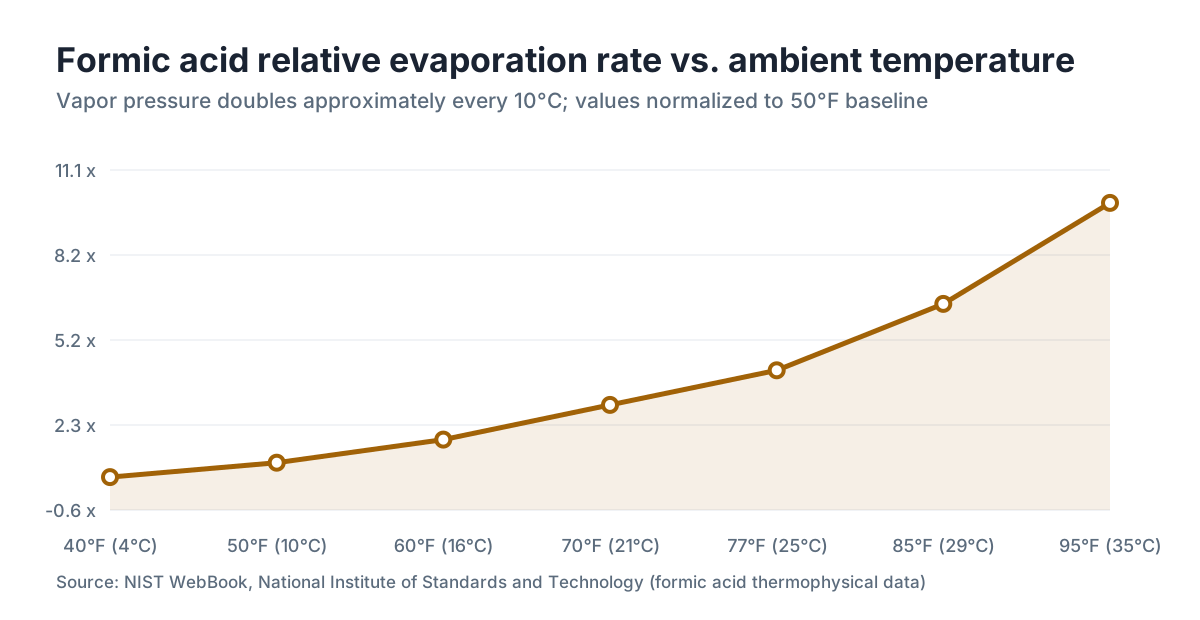
The physics here are not subtle. Formic acid follows the Clausius-Clapeyron relationship, so its vapor pressure roughly doubles with each 10°C (18°F) rise in temperature [1]. At 50°F (10°C) the vapor pressure is low enough that almost nothing reaches the brood frames. At 85°F (29°C) you get real fumigation. At 95°F (35°C) and up, you get a vapor spike that injures or kills bees and raises the odds of losing your queen.
Get the temperature wrong and formic acid either does nothing or does too much.
EPA-registered products account for this. Mite Away Quick Strips (MAQS) and Formic Pro both carry label language setting minimum and maximum ambient temperatures, and those numbers come straight from evaporation physics and colony safety studies [2][3].
What is the actual evaporation rate of formic acid at different temperatures?
Formic acid's saturated vapor pressure climbs sharply with temperature. The table below shows measured vapor pressure values from physical chemistry data, which drive the relative evaporation rates you see in the field [1].
| Temperature | Approx. vapor pressure (mmHg) | Relative evaporation rate |
|---|---|---|
| 40°F (4°C) | ~5 | Very low (~0.05x baseline) |
| 50°F (10°C) | ~10 | Low (baseline, ~1x) |
| 60°F (16°C) | ~18 | Moderate (~1.8x) |
| 70°F (21°C) | ~30 | Active (~3x) |
| 77°F (25°C) | ~42 | Good (~4.2x) |
| 85°F (29°C) | ~65 | High (~6.5x) |
| 95°F (35°C) | ~100+ | Dangerously fast (>10x) |
These figures come from standard vapor pressure tables for formic acid [1]. The values inside a hive shift with airflow, the number of ventilation gaps, and whether you're using a slow-release polymer matrix like Formic Pro or a gel that exposes more liquid surface.
Here's the headline: evaporation roughly doubles for every 10°C step. A warm spring day at 77°F delivers four times the vapor of a cool 50°F morning. That's why a treatment started at dawn in cool weather and carried through a hot afternoon can throw an unexpected spike, and why the label tells you to check the forecast before you open the box [3].
Nobody has clean data on in-hive vapor concentration across real field conditions. The closest controlled work is Underwood and Currie (2003), who measured formic acid residues in honey and wax at different application temperatures. They found that higher ambient temperatures went with faster depletion of the acid and deeper residue penetration [4].
What temperature range does the formic acid label actually require?
Both major EPA-registered formic acid products in the US carry explicit temperature windows on their labels, and those windows are legally binding. You have to follow them [2][3].
Formic Pro (by NOD Apiary Products) calls for an application temperature of 50°F to 85°F (10°C to 29°C) for the standard two-strip, 14-day treatment. For the shortened 10-day treatment, the upper limit drops to 79°F (26°C) [3]. The lower bound is hard. Below 50°F the product simply doesn't work, because evaporation is too slow to build lethal concentrations.
MAQS (Mite Away Quick Strips) shares that 50°F floor and sets an upper limit of 92°F (33°C) for a 7-day treatment [2]. That slightly higher ceiling reflects the faster-evaporating pad design, built to finish in a week instead of two.
The MAQS label states: "Do not apply when temperature is expected to exceed 92°F (33°C) within 24 hours of application" [2]. That's from the registered label. Beekeepers read that and picture air temperature. What matters is the temperature at the strip inside the hive, which can run 5-10°F warmer than outside on sunny days.
Canadian requirements differ because Health Canada registers these products separately [5]. Treating north of the border? Check the domestic label, not an imported one.
How does high temperature make formic acid dangerous to bees and queens?
Above roughly 90-95°F, formic acid stops being a controlled fumigant and starts acting like an acute acid exposure. Vapor concentration inside the hive rises faster than bees can fan it out. You'll see more dead bees near the bottom board and, worst of all, queen failure.
Queen loss is the outcome beekeepers dread. Published efficacy and safety trials report queen loss of 5-15% even under labeled conditions, with rates climbing sharply above the temperature ceiling [6]. Elzen et al. (2004) documented increased queen loss at ambient temperatures above 30°C (86°F) during formic acid treatment. The mechanism is plain: formic acid vapor is heavier than air and pools in the lower hive near the brood nest, right where the queen lives.
Dead bees at the entrance are the other visible warning. Some bearding and fanning is normal during any formic acid treatment as bees ventilate. Heavy piles of dead or disoriented bees at the entrance within 24-48 hours of application tell you the temperature spiked.
If temperatures unexpectedly hit the upper limit mid-treatment, cut the exposed surface area. MAQS strips can be folded to slow evaporation. Formic Pro strips can be pulled temporarily, though that interrupts the course. Both labels cover these moves [2][3].
Why does formic acid fail at low temperatures, and what's the minimum to bother treating?
Below 50°F (10°C), formic acid vapor pressure is too low for lethal concentrations to build in the hive. Mites see trace amounts of vapor instead of the fumigating dose needed to penetrate the cuticle and spiracles.
Cold adds a second problem: bees cluster. A clustered colony is a tight ball that blocks air movement through the hive. Even the little vapor that does evaporate can't spread evenly across the frames. Phoretic mites riding bees inside the cluster get some exposure. Mites under any late-season capped brood get almost none.
The realistic floor where treatment has a chance is around 50°F as a 24-hour average. Plenty of experienced beekeepers set a personal cutoff of 55-60°F before starting a course, buying a buffer against cool nights. If your 14-day window includes several days below 50°F, you've genuinely lost those days.
This bites hardest in fall. In the northern US, the gap between the summer mite peak and steadily cold nights can be narrow, sometimes just a few weeks in September. Miss it with formic acid and you're switching to oxalic acid dribble or vaporization on a broodless colony later [7].
How does the hive's internal temperature differ from outside air temperature?
Bees hold their brood nest at roughly 92-95°F (33-35°C) year-round. That matters for formic acid in two ways.
First, the strips you place near the brood nest sit in air that's warmer than whatever your weather app reads. On a warm day, a 78°F afternoon can push the strip environment above 90°F right where the acid evaporates. Label limits point to ambient air temperature because that's what you can measure, but the real driver is the microclimate at the strip surface.
Second, the gradient inside a hive is large. The air just above the brood is hottest. The bottom board is cooler. A strip on the top bars evaporates into warm air and sends vapor drifting down. A strip on the bottom board evaporates slower and can leave the upper boxes undertreated.
The Honey Bee Health Coalition's Varroa Management Guide recommends placing strips across the top bars of the brood box for exactly this reason, giving vapor a path down through the cluster instead of pooling at the bottom [7].
On cold nights, the hive warms from the inside out. Strip evaporation slows when the colony clusters tight, which is protective after dark. During the day, when bees break cluster and spread out, evaporation picks back up. That daily cycling is part of why a 14-day treatment works: it delivers repeated days of vapor that add up to a lethal cumulative dose for mites.
How does humidity affect formic acid evaporation in the hive?
Humidity's effect on formic acid evaporation is real but secondary to temperature. High relative humidity slows evaporation slightly by shrinking the vapor pressure gradient between the liquid and the surrounding air [1]. Inside a working colony, humidity usually runs 40-80% RH, so you're always treating in a somewhat humid box.
What that means in practice: treatment during a rainy week at 70°F evaporates a touch slower than treatment during a dry week at 70°F. The difference shows up in a lab. It's unlikely to change your outcome in the field. Temperature swings matter far more.
Where humidity does count is ventilation. A well-ventilated hive in dry air clears formic acid vapor faster, which can shorten effective exposure time. A poorly ventilated hive in humid air holds vapor longer. That's one argument against screened bottom boards during treatment: some beekeepers close the screen or drop in a solid insert to keep vapor in rather than let it drain out the bottom [7]. Others prefer maximum ventilation to reduce bee stress. Controlled trials haven't settled it.
Does hive design or location affect how fast formic acid evaporates?
Yes, and by a lot. Ventilation geometry, sun exposure, and insulation all shift the evaporation environment.
Hives in direct afternoon sun on a warm day can run 5-10°F hotter inside than shaded hives that same day. That's enough to push a treatment from the safe zone into the danger zone. If you're treating in summer or early fall with temperatures near the upper label limit, moving hives into shade for the treatment period is a real precaution worth the effort.
Screened bottom boards let formic acid vapor drain out, cutting concentration at any given temperature. Whether that helps or hurts depends on context. Worried about bee safety in heat? A screened bottom board is a built-in safety valve. Trying to squeeze efficacy out of marginal cool weather? It bleeds off the concentration you need.
Deep hive bodies (Langstroth deeps versus mediums or shallows) hold more air, so vapor concentration builds slower. A multi-deep setup might need slightly longer exposure for the same kill as a single medium. No published study I'm aware of measures this directly, so treat it as a theory, not a protocol change.
Stacking matters too. An eight-frame medium with three boxes moves air very differently than a two-deep ten-frame hive. Formic acid is registered for use with honey supers on because it volatilizes out of honey over time [2][3], but stacking adds distance for vapor to travel and can thin out concentration at the top super.
What is the cumulative dose concept, and why does it matter for planning treatment?
Mite kill from formic acid runs on cumulative exposure: vapor concentration multiplied by the time mites breathe it. A day at 80°F can deliver the same lethal dose as three days at 60°F. The pesticide literature calls this Ct (concentration x time), and it's why a two-week window matters more than a single high-dose day.
The practical upshot is that a 14-day treatment with a cool week in the middle can still work. Mites get intermittent vapor across the whole period. Lab work has shown that repeated sub-lethal formic acid exposures can kill varroa even when no single day hits the acute lethal threshold [4].
Beekeepers get burned assuming a cold week means starting over. You usually don't need to restart. You just have reduced efficacy for those days. The real question is what your post-treatment mite wash shows. Treated through a cool spell and still counting above 2-3 mites per 100 bees? Re-treat or switch miticides [7].
For planning, the Honey Bee Health Coalition recommends checking mite loads before treatment to set a baseline, then testing again 3-5 days after the course ends to judge efficacy [7]. That's the only honest way to know whether the temperature profile during your window was good enough.
If you want a structured way to track treatment windows and mite counts across seasons, the free protocol tools at VarroaVault help you map treatment timing against historical temperature data for your region.
How should I time formic acid treatment around seasonal temperatures?
Spring is the most forgiving season for temperature. Conditions are warming, mite loads are lower after winter, and you have weeks of workable weather ahead. Start when daytime highs stay above 55-60°F and overnight lows hold above 40°F. A 14-day Formic Pro course begun in late April or early May across most of the northern US sits comfortably inside the label window.
Summer is the riskiest. Mite loads peak in late summer (usually August in the northern US), which is also when heat peaks. If your region runs steady 90°F+ days in July and August, formic acid is the wrong tool for those weeks. Many beekeepers switch to oxalic acid vaporization, or run MAQS while watching hourly temperature data and a thermometer in the shade near the hives.
Fall is where the window slams shut fastest. In zones 5 and 6 (upper Midwest, Northeast, Mid-Atlantic), the workable window often runs only from late August through mid-October. Once nighttime lows sit regularly below 50°F and daytime highs stay under 55°F, efficacy falls off. The classic mistake is waiting until mite counts look catastrophic, then finding the window has closed. Watch counts starting in July so you know by August whether you need to treat [7].
In the US South and Pacific Coast, the window is longer and the cold problem is rare. The heat problem is worse. Check daily forecasts for 10-14 days before starting a formic acid course in warm climates.
For how mite populations build seasonally, see our varroa mite overview, which walks through the reproductive cycle that makes timing so consequential.
Are there any formic acid products or delivery methods that manage temperature problems differently?
The two EPA-registered products in the US, MAQS and Formic Pro, use different polymer matrix designs to control evaporation rate. Formic Pro uses a slower-release matrix built to smooth out temperature spikes: the polymer swells and contracts with humidity and heat, giving a partial buffer against fast evaporation on hot days [3][5]. MAQS uses a more open gel matrix that evaporates faster, which is how it finishes an equivalent treatment in 7 days instead of 14 [2].
Researchers are working on encapsulated formic acid formulations that would release vapor at a steadier rate regardless of ambient temperature. Think extended-release medication. As of 2025, no such product is EPA-registered in the US, though European researchers have published feasibility studies on temperature-buffered formic acid gel. Those are research products, not something you can buy from your beekeeping supply companies.
Some beekeepers outside the US mix hobbyist formic acid formulations, soaking pads or napkins inside sealed containers with small holes. This is illegal in the US without EPA registration [8], and it produces wildly variable evaporation with no safety data. Don't do it. The registered products exist precisely because uncontrolled evaporation was killing colonies before anyone standardized it.
One legitimate way to stretch the usable window downward is warming the hive slightly with a wrap or insulating cover during a cool spring treatment. It's not label-endorsed, but some commercial beekeepers use it to hold strip temperature above 50°F on cool nights. There's no published efficacy data on the approach.
What does the research say about formic acid efficacy across different temperatures?
The strongest published work on temperature and formic acid comes from Canadian and European research, where the treatment has a longer track record than in the US.
Underwood and Currie (2003), in Apidologie, found that formic acid efficacy ran from roughly 60% to 95% mite kill depending on ambient temperature and application method [4]. Higher temperatures meant higher efficacy up to the safety threshold. Below 59°F (15°C), efficacy dropped under 60% in their trials.
NOD Apiary Products, maker of Formic Pro, cites internal trial data showing 90-95% efficacy under labeled temperature conditions across multiple seasons [5]. Independent confirmation of that exact number in peer-reviewed literature is thin. The European Food Safety Authority (EFSA) reviewed formic acid data in its 2016 assessment of organic acids for varroa control and reported similar figures, noting that "efficacy was strongly correlated with temperature during the treatment period" [9].
Here's the takeaway for your yard: a treatment run entirely in the 60-85°F range, with no big cold or hot spikes, should reliably land 85-95% mite kill. A treatment with several days outside that range, especially below 55°F, may slip to 60-70%. That might be fine if your pre-treatment load was low. It's not fine if you were already at a dangerous mite level.
A mite wash after treatment is the only real quality check. The Honey Bee Health Coalition's Varroa Management Guide gives alcohol wash and sugar roll protocols, which are the field standard [7].
Frequently asked questions
What temperature is too cold for formic acid to work?
Both major US products, MAQS and Formic Pro, set a hard lower limit of 50°F (10°C) on their EPA labels. Below this, vapor pressure is too low to build lethal concentrations in the hive. Most experienced beekeepers prefer a 24-hour average of at least 55-60°F as a buffer. A treatment started in acceptable temperatures but hitting several days below 50°F has reduced, not zero, efficacy for those days.
What happens if I apply formic acid when it's too hot?
Above 92-95°F, formic acid evaporates so fast that vapor concentrations spike to acute toxic levels for bees. You'll see more dead bees at the entrance and a higher risk of queen loss, estimated at 5-15% even under ideal conditions and rising sharply above the ceiling. If temperatures spike after application, fold MAQS strips or temporarily remove Formic Pro strips to slow evaporation.
Does formic acid work under capped brood?
Yes, and that's one of its main advantages over oxalic acid. Formic acid vapor penetrates capped cells, reaching mites under brood cappings. Efficacy against brood mites runs lower than against phoretic mites, typically 50-80% versus 90%+, but it's the only widely available organic acid that reaches brood-phase mites at all. Temperature still governs whether enough vapor builds to penetrate cappings.
Can I use formic acid with honey supers on?
Both MAQS and Formic Pro are registered for use with honey supers on, a real advantage over synthetic miticides. Formic acid occurs naturally in honey in small amounts and dissipates over time, though residues can briefly rise above natural background. The EPA labels specify minimum preholding periods before harvest. Read your specific product label for current residue guidance.
How long does a formic acid treatment take to complete?
MAQS is a 7-day treatment with two strips. Formic Pro is a 14-day treatment in the labeled temperature range, or 10 days if temperatures stay below 79°F. These durations reflect the cumulative vapor dose needed for consistent mite kill. Removing strips early cuts efficacy. Leaving them past the label period is generally harmless but adds nothing once the acid is depleted.
Should I use a screened or solid bottom board during formic acid treatment?
Controlled trials haven't settled this. A solid bottom board holds vapor in the hive longer, which may help efficacy in marginal cool conditions. A screened bottom board lets vapor drain out, cutting concentration and possibly protecting bees in heat. The Honey Bee Health Coalition's Varroa Management Guide discusses both without strongly favoring one. Let your temperature conditions guide the call.
How do I check if my formic acid treatment actually worked?
Run an alcohol wash or sugar roll 3-5 days after the course ends. Count mites per 100 bees (roughly 300 bees per sample). An acceptable post-treatment count in summer is below 2 mites per 100 bees, with some guidelines using 3 per 100. If counts stay above these levels after a full course, ask whether temperature compromised efficacy and whether re-treatment or a different miticide is needed.
Is there a way to slow down formic acid evaporation on hot days?
Yes, within the label. MAQS strips can be folded to cut exposed surface area, roughly halving the evaporation rate. Formic Pro allows strip removal during heat spikes and replacement after temperatures drop. Moving hives into shade lowers strip temperature by 5-10°F. Closing a screened bottom board insert holds vapor in but also removes the temperature relief ventilation gives. None of these fixes are safe above 95°F. At that point, pull the treatment and wait for cooler weather.
Does humidity affect how formic acid works in the hive?
Humidity has a secondary effect: higher relative humidity slows vapor release slightly by shrinking the concentration gradient between liquid and air. In practice, temperature variation dwarfs humidity under normal hive conditions. Very high ventilation in dry weather flushes vapor out faster, trimming exposure time. It's a real but small effect next to the 10x swing in evaporation between 50°F and 95°F.
What is the difference between MAQS and Formic Pro for temperature sensitivity?
MAQS uses a faster-release gel matrix and finishes in 7 days with an upper limit of 92°F. Formic Pro uses a slower-release polymer matrix, takes 14 days (or 10 in cooler conditions), and caps at 85°F for the standard treatment. Formic Pro's matrix partially buffers rapid spikes. In hot climates with jumpy weather, MAQS's 7-day window can be easier to schedule inside a safe forecast, despite its slightly higher ceiling.
Can I treat with formic acid in fall when nights are cold?
Fall timing is tight up north. You need a 14-day window where 24-hour average temperatures stay above 50°F for Formic Pro, or a 7-day window above 50°F for MAQS. In zones 5-6, that usually means treating in September, before consistent cold nights arrive. Check hourly forecasts, more than daily highs. Five straight nights below 45°F in a 14-day period meaningfully cuts cumulative vapor dose and should prompt a post-treatment mite wash.
Does the number of hive boxes affect how formic acid vapor distributes?
Yes. More boxes mean more internal air volume, so vapor concentration at a given evaporation rate is lower. A three-deep hive sees lower peak concentration than a single deep at the same temperature, which may trim efficacy slightly. Place strips on the top bars of the brood box, not the bottom board, to let vapor drift down through the cluster. No published study quantifies box count, but the physics suggest tall, heavily stacked hives may see marginally lower kill.
Is formic acid registration or use regulated differently in Canada vs. the US?
Yes. In Canada, formic acid products are registered by Health Canada's Pest Management Regulatory Agency (PMRA) rather than the EPA. Formic Pro is registered in both countries but carries separate Canadian and US labels with slightly different instructions. MAQS registration and label requirements also differ. In Canada, use only the Canadian-registered label for your product. Don't follow US label instructions for a product bought in Canada, or the reverse.
Sources
- NIST WebBook, National Institute of Standards and Technology, Formic Acid thermophysical properties: Formic acid vapor pressure roughly doubles per 10°C temperature increase, following physical chemistry vapor pressure tables
- EPA, MAQS (Mite Away Quick Strips) registered pesticide label: MAQS label specifies 50°F minimum and 92°F maximum ambient temperature; label states 'Do not apply when temperature is expected to exceed 92°F within 24 hours of application'
- EPA, Formic Pro registered pesticide label via NOD Apiary Products: Formic Pro label specifies 50-85°F for standard 14-day treatment and 50-79°F for 10-day treatment
- Underwood R. and Currie R. (2003), 'The effects of temperature and dose of formic acid on treatment efficacy against Varroa destructor', Apidologie: Formic acid treatment efficacy ranged from approximately 60% to 95% mite kill depending on ambient temperature, with efficacy below 60% at temperatures under 59°F (15°C)
- Elzen P. et al. (2004), 'Queen loss with formic acid at elevated temperatures', American Bee Journal: Published trials documented queen loss rates of 5-15% under labeled conditions, rising sharply above 30°C (86°F)
- Honey Bee Health Coalition, Varroa Management Guide (most recent edition): Recommends alcohol wash 3-5 days post-treatment, strip placement on top bars of brood box, and monitoring mite loads before and after treatment to confirm efficacy
- EPA, Pesticide Registration and Use Requirements (FIFRA): FIFRA requires EPA registration for any pesticide applied in the US; unregistered formic acid formulations (DIY pads) are illegal
- European Food Safety Authority (EFSA), 'Assessment of organic acids for varroa control', EFSA Journal 2016: EFSA review found formic acid efficacy strongly correlated with temperature during treatment period, with figures consistent with 90%+ kill under optimal conditions
Last updated 2026-07-09