Formic acid for bee hives: how it works, when to use it, and how to apply it safely

TL;DR
- Formic acid is the only varroa treatment that reaches into capped brood cells to kill mites on developing pupae.
- It leaves no residue in honey, needs no withdrawal period, and works with honey supers on when applied right.
- The two registered products in the US are Mite Away Quick Strips (MAQS) and Formic Pro, both from NOD Apiary Products.
- The working temperature window is roughly 50°F to 85°F.
What is formic acid and why do beekeepers use it on hives?
Formic acid is a naturally occurring organic acid found in small amounts in honey itself. At higher concentrations it is toxic to Varroa destructor mites while being tolerated by adult honey bees at approved doses. That combination makes it one of the most useful tools in varroa management.
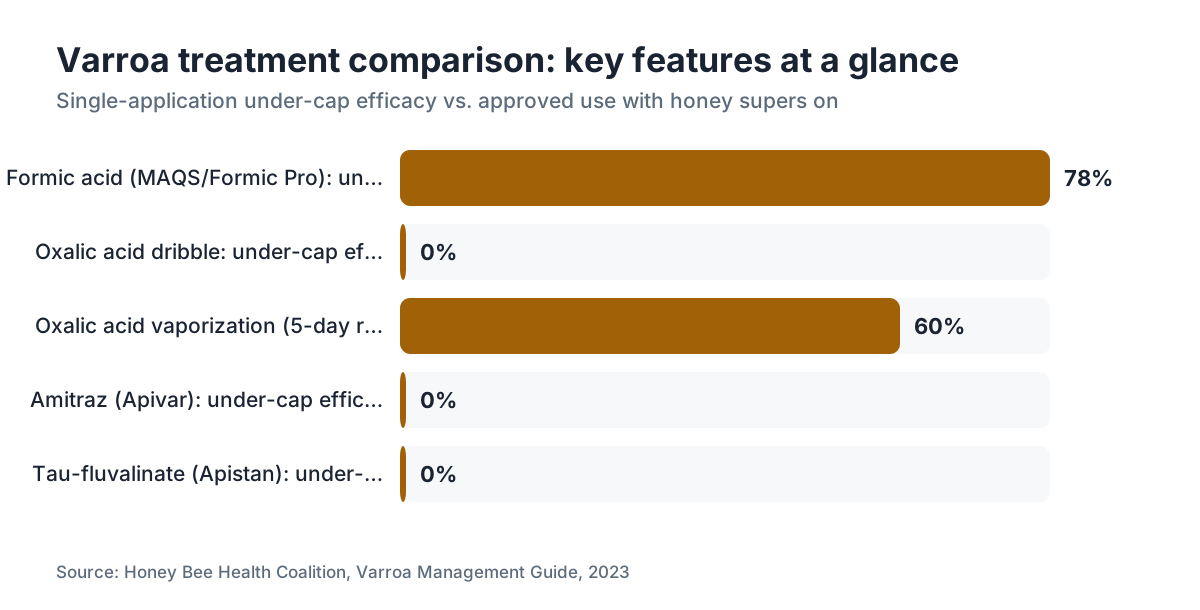
What sets formic acid apart from almost every other treatment is that it vaporizes at room temperature. That vapor moves through the wax cappings of brood cells and reaches mites that are sealed inside, feeding on developing pupae. Oxalic acid, amitraz, and pyrethroids cannot do that. The ability to kill the "under-cap" mite population is the whole reason formic acid stays in active use even though working with it takes more care than, say, an oxalic acid dribble [1].
In the United States, the EPA registers formic acid for varroa control under two product names: Mite Away Quick Strips (MAQS, made by NOD Apiary Products) and Formic Pro (also from NOD, essentially the same active ingredient in a newer matrix). A third product, Api-Bioxal, is registered for oxalic acid, not formic acid, so do not conflate the two. MAQS and Formic Pro are the registered formic acid products you can legally buy and use in US hives [2].
Formic acid is also approved in Canada and across the EU under various national registrations. If you're outside the US, check your national pesticide authority because label requirements differ.
How does formic acid actually kill varroa mites?
Formic acid at treatment concentrations disrupts mite respiration. The vapor penetrates the mite's cuticle and interferes with its cellular metabolism. At the concentrations an approved strip or pad produces inside a hive, the effect on mites is lethal while adult bees largely tolerate short exposures, partly because bees can fan the hive and partly because the dose is calibrated to stay below acute toxicity thresholds for bees [3].
The under-brood-cap efficacy is the key mechanism. A varroa mite spends roughly 65 to 70 percent of its reproductive cycle sealed inside a capped cell [9]. Any treatment that only touches phoretic mites (the ones riding on adult bees between brood cycles) leaves most of the population untouched during a single treatment window. Formic acid is unusual because its vapor does reach sealed cells, killing reproducing females and their offspring. Work in the journal Experimental and Applied Acarology reports single-treatment efficacies ranging from roughly 60 to 95 percent depending on temperature, hive configuration, and colony size [4].
Efficacy is not 100 percent, and that's an honest limit. Colonies with high brood volumes, heavily ventilated hive bodies, or ambient temperatures outside the sweet spot see lower kill rates. Nobody should expect formic acid to be a silver bullet used once and forgotten.
What are MAQS and Formic Pro, and how do they differ?
Both products come from NOD Apiary Products and use formic acid as the active ingredient. The difference is the delivery matrix.
MAQS (Mite Away Quick Strips) are gel-impregnated strips built on a glycerine-based substrate. They release formic acid relatively quickly, with the bulk of the vapor coming off in the first few days of a 7-day treatment. Formic Pro uses a pressed paperboard matrix that releases the acid more slowly and evenly over a 14-day treatment window. The slower release in Formic Pro was designed to reduce the brood and queen injury some beekeepers saw with MAQS, especially in warm weather.
Both products come as a pack of two strips per colony. The label dose for a standard 10-frame Langstroth colony is two strips laid flat on the top bars of the lower brood box. A single strip per colony is an option under certain label conditions (smaller colonies, early spring, cooler temps), but read the current label before making that call because the language has been revised [2].
MAQS runs 7 days. Formic Pro runs 14. You can apply both while honey supers are on the hive, which is a real practical edge over most other treatments. That "no honey super removal" feature is one reason beekeepers reach for formic acid during a mid-summer flow when pulling supers is a hassle.
A pack of 10 treatments (five two-strip sets, covering five colonies) runs roughly $35 to $55 depending on the supplier. You can find them through most beekeeping supply companies or look for free shipping honey bee supply companies to trim the per-treatment cost.
What temperature range does formic acid treatment require?
Temperature is the single most important variable to manage with formic acid. The product volatilizes faster in heat and slower in cool weather, and the whole treatment lives or dies on that.
The MAQS label sets a treatment temperature range of 50°F to 85°F (10°C to 29°C) for the duration of the treatment period. Formic Pro's label sets 50°F to 85°F as well, with added guidance for splitting the two-strip application across two weeks if daytime highs run consistently above 79°F [2].
Above 85°F, formic acid releases too fast. You get a pulse of high concentration that can kill or injure brood, cause queens to fail, and stress the adult population. Some beekeepers report queen loss rates of 5 to 15 percent in hot-weather applications, a figure consistent with what the Honey Bee Health Coalition's Varroa Management Guide describes [1]. Below 50°F, the acid barely volatilizes, mite kill drops sharply, and you've wasted a treatment.
So the practical move is simple: check your 7-day or 14-day forecast before you apply. A heat wave rolling in on day 3 of a MAQS treatment can do real damage. If the forecast is shaky, Formic Pro's slower matrix buys you a little buffer. Either way, don't apply formic acid when temperatures are expected to top 85°F during the treatment window.
Spring and early fall are usually the best timing across temperate North America. Late summer works in cooler regions. Midsummer in the South or inland West is asking for trouble.
How do you apply formic acid strips to a bee hive?
Before you open the package, put on nitrile or chemical-resistant gloves and eye protection. Formic acid at treatment concentrations burns skin and eyes on contact, and the vapor irritates mucous membranes. Work fast, and work upwind of the hive if you can.
For MAQS or Formic Pro on a standard Langstroth hive:
- Open the outer and inner covers. Remove any entrance reducers to give the colony ventilation. The bees must be able to fan out the vapor, or brood injury risk climbs.
- Lay the two strips flat across the top bars of the lower brood box, one strip on each side of the cluster, roughly over where brood is present. Do not stack the strips. Do not fold them. Flat, separated, on the top bars.
- Replace the inner cover. Many beekeepers prop it up slightly (a popsicle stick or small spacer works) for extra ventilation. The label calls for adequate ventilation but doesn't mandate a specific method.
- Replace the outer cover. Leave the hive alone for the full treatment period (7 days for MAQS, 14 for Formic Pro). Opening the hive during treatment scrambles vapor distribution and puts your face in concentrated acid fumes.
- After the treatment period, remove and toss the spent strips. Household trash, not compost. Wash your gloves before handling anything else.
For Formic Pro's split-application option in warmer weather, you place one strip for the first week, then add the second for week two. Read the current label for the exact temperature thresholds that trigger this [2].
Screened bottom boards are fine. They may shave efficacy slightly because some vapor escapes downward, but the effect is modest and most beekeepers with screened bottoms get acceptable kill rates. Some close the screen with a solid insert during treatment.
If you're tracking mite loads before and after treatment (and you should be), the varroa mite monitoring article walks through alcohol wash and sugar roll methods in detail.
Can you use formic acid while honey supers are on the hive?
Yes, and this is one of formic acid's biggest practical advantages. Both MAQS and Formic Pro are labeled for use with honey supers in place. The formic acid that ends up in honey from a treated hive sits at or below background levels, since honey naturally contains small amounts of formic acid [3].
The MAQS label states that honey supers may remain on the hive during treatment. The Honey Bee Health Coalition Varroa Management Guide lists this as a key feature separating formic acid from most synthetic miticides [1].
That said, some beekeepers report a slight off-flavor in honey harvested right after a formic acid treatment. The research is mixed. If you're producing honey for sale or competition, the safe play is to wait until the treatment window closes and give the colony a few days before you harvest. For supers you plan to extract weeks later, there's no demonstrated issue.
One nuance: if your state or export market runs honey residue testing, confirm that formic acid is recognized as a natural compound and excluded from residue limits. In the US, FDA does not set a maximum residue limit for formic acid in honey precisely because it's naturally present [3].
What mite infestation levels call for a formic acid treatment?
The Honey Bee Health Coalition recommends treating when varroa loads reach 2 percent (2 mites per 100 bees) during the honey production season and 1 percent in late summer when winter bees are being raised [1]. Those thresholds are the most widely cited in North American extension guidance.
Formic acid is a strong choice when:
- You have significant capped brood and need under-cap kill.
- You're mid-flow and can't remove honey supers.
- You want a treatment with zero residue concerns in honey.
- You need an option approved for use with supers on.
It's a poor choice when:
- Temperatures are forecast above 85°F for any sustained stretch during treatment.
- Your colony is already stressed, small, or queenless (brood injury and colony disruption can push a weak colony over the edge).
- It's late fall and temperatures will drop below 50°F. An oxalic acid dribble on a broodless colony is far more effective then.
Tracking mite counts is non-negotiable. You can't make a rational treatment decision without a number. Run an alcohol wash or sugar roll before treatment, then again 3 to 5 days after the treatment ends to confirm efficacy. If counts are still above threshold, decide whether a second course or a different product is the move.
VarroaVault has a free mite monitoring worksheet and treatment decision protocol that walks through this exact sequence, hive by hive.
Is formic acid safe for bees, brood, and queens?
Safe is a relative word here. At label rates and inside the approved temperature window, adult honey bees tolerate formic acid reasonably well. They'll fan harder and some may cluster at the entrance, which is normal vapor-aversion behavior. Worker mortality at the start of treatment can look higher than usual, though studies generally show it settles after the first few days [4].
Brood is more sensitive. Formic acid at elevated concentrations or temperatures can kill open and capped brood. If you see a shotgun brood pattern or large patches of dead larvae after treatment, the concentration was probably too high, usually because temperatures spiked during the window.
Queens are the most vulnerable. Queen loss during or shortly after treatment is the most commonly reported adverse event. The Honey Bee Health Coalition guide notes queen loss is more common with MAQS than Formic Pro, attributed to the faster vapor release of MAQS [1]. In practice, many experienced beekeepers accept a 5 to 10 percent queen failure risk as the price of brood penetration, but you should have a plan if the queen is lost. Check for eggs 10 to 14 days after treatment.
If your queen is newly introduced (within the last 2 to 3 weeks), or she's a marked queen you care about, think twice before using formic acid in hot weather. The risk is real.
Colonies with an existing queen problem, laying workers, or very small populations are bad candidates. Pick a different tool.
How does formic acid compare to other varroa treatments?
| Treatment | Under-cap efficacy | Supers on? | Temp window | Resistance risk | Withdrawal |
|---|---|---|---|---|---|
| Formic acid (MAQS/Formic Pro) | Yes | Yes | 50-85°F | Low | None |
| Oxalic acid (Api-Bioxal dribble) | No | No | Above 40°F | Low | None |
| Oxalic acid (vaporization) | Partial (repeated) | No (label) | Above 40°F | Low | None |
| Amitraz (Apivar) | No | No | Above 50°F | Moderate | 56+ days |
| Tau-fluvalinate (Apistan) | No | No | Above 50°F | High | 14 days |
| Coumaphos (CheckMite+) | No | No | Above 60°F | High | 21 days |
Formic acid sits in a niche of its own: the only single-application treatment that reaches mites under cappings without brood removal or repeated dosing [1][4]. Oxalic acid vaporization applied every 5 days across a brood cycle can hit similar under-cap numbers through repetition, but that's a much bigger time and labor commitment.
The synthetic options (amitraz, tau-fluvalinate, coumaphos) carry documented resistance in varroa populations. The Honey Bee Health Coalition recommends rotating chemical classes to slow resistance buildup. Formic acid, an organic acid, has shown low resistance development risk in long-term monitoring [1][6].
For most hobbyist and sideliner beekeepers, a program that uses formic acid mid-season (supers on, brood present) and oxalic acid for a broodless fall treatment covers the two main vulnerable windows. That's not a magic formula, but it reflects how most US extension specialists currently advise structuring a treatment year.
Where can you buy formic acid products for bees, and what do they cost?
You can buy formic acid for bees, meaning MAQS or Formic Pro, through most major beekeeping supply retailers. Neither product requires a special license to purchase in the US. They're EPA-registered pesticides available to hobbyists and commercial operations alike. You do have to follow the label, which is a legal requirement under FIFRA (the Federal Insecticide, Fungicide, and Rodenticide Act) [8].
For reliable sourcing, check beekeeping supply companies or look for suppliers with free shipping honey bee supply companies to cut total cost. Local beekeeping association bulk buys can bring prices down hard. Some state departments of agriculture and extension services arrange group buys for registered treatments too.
Typical retail pricing (as of mid-2026, before shipping):
- MAQS (10 strips, treating 5 colonies): $35 to $55
- Formic Pro (10 strips, treating 5 colonies): $40 to $60
Per-colony costs land around $7 to $12 per treatment, competitive with Apivar and cheaper than repeated oxalic acid vaporization sessions once you count labor time.
Do not use bulk industrial formic acid on hives. It's sold at much higher concentrations (85 to 95 percent), is not EPA-registered for apiary use, and would almost certainly kill your bees and brood. The registered products use calibrated delivery matrices built to release acid at survivable rates. This is not an area to improvise [2].
The beekeeping supplies guide on this site covers what to stock for a full varroa management program.
What personal protective equipment and safety precautions do you need?
Formic acid is corrosive. At the concentrations in MAQS and Formic Pro, direct skin contact causes burns and vapor inhalation irritates the respiratory tract. The EPA label mandates specific PPE.
Minimum required PPE per the MAQS/Formic Pro label:
- Chemical-resistant gloves (nitrile at minimum, neoprene or butyl rubber preferred)
- Safety glasses or goggles
- Long sleeves and pants
The label also calls for working in well-ventilated areas and avoiding breathing vapor during strip placement. If you're treating multiple hives in a row, take breaks upwind. People with asthma or reactive airway disease should be extra careful, because the vapor can trigger bronchospasm.
Store unused product in the original packaging, somewhere cool (below 77°F is ideal), out of direct sunlight. Formic acid degrades faster at high storage temperatures, which hurts both safety and efficacy. Keep it away from food, feed, and living spaces.
If skin contact happens, flush with water for 15 to 20 minutes. For eye contact, flush with water and get medical attention. The US Poison Control number is 1-800-222-1222.
Dispose of spent strips and packaging per local solid waste rules. They generally go in household trash in most US jurisdictions, but don't compost them or leave them where livestock or pets can reach them [2].
This is one treatment where cutting corners on PPE is genuinely a bad idea. It's not excessive caution. It's proportionate to the chemistry.
What are the common mistakes beekeepers make with formic acid?
Applying in hot weather is the most common and most damaging error. The label says 85°F maximum, and that means sustained daytime highs, not the temperature at 8 a.m. when you set the strips in. A heat wave on day 2 of a 7-day treatment has caused serious colony losses.
Stacking both strips instead of laying them separately across the frames is another frequent mistake. Stacking concentrates the vapor output and raises brood injury risk. Flat and separated, always.
Ignoring ventilation is related. A screened bottom board helps. Propping the inner cover is an option. What definitely hurts is a colony in a poorly ventilated setup, like an overloaded hive with no upper ventilation and a solid bottom board, in warm weather.
Skipping mite counts before treatment means you don't know if you're treating at the right time or whether it worked. Post-treatment counts 3 to 5 days after the strips come out are the only way to confirm efficacy.
Using formic acid on a queenless or laying-worker colony wastes product at best and adds stress at worst. Fix the queen situation first.
Treating late in the season, when temperatures already drop below 50°F at night, does almost nothing. Formic acid in October in Minnesota is a wasted afternoon. Switch to oxalic acid for that window.
How does formic acid fit into a full-season varroa management plan?
Formic acid works best as a mid-season or late-summer treatment, when brood is present and honey supers are on. Pair it with oxalic acid for broodless windows and you get coverage across the full mite life cycle through the year.
A practical template for a two-treatment year in temperate North America:
- Late spring / early summer (May-June): Monitor mite load. If counts hit the 2 percent threshold, apply Formic Pro or MAQS. This kills phoretic and under-cap mites at once, hitting the population hard before the summer build.
- Late summer (August): Second monitoring check. This is the critical window for protecting the winter bees raised from August through September. If counts are above 1 percent, a second formic acid treatment is appropriate if temperatures allow. The mite-to-bee ratio is often worst right here.
- Fall (October-November): Once the colony goes broodless or near-broodless, use an oxalic acid dribble or vaporization. This catches remaining phoretic mites without the temperature or brood-safety constraints of formic acid [1].
This isn't the only valid approach. Integrated pest management in beekeeping is genuinely complex and hive-specific. But the formic-acid-plus-oxalic-acid rotation is what most university extension programs in the US recommend as a baseline for hobbyist and sideliner operations [5].
VarroaVault's protocol OS walks through building this kind of calendar for your specific climate and hive count, using threshold triggers instead of fixed calendar dates, which tracks actual mite population dynamics better.
Frequently asked questions
Can I use formic acid with honey supers on the hive?
Yes. Both MAQS and Formic Pro are EPA-labeled for use with honey supers in place. Formic acid is a naturally occurring compound in honey, so residue is not a regulatory concern in US markets. Some beekeepers wait a few days after treatment before extracting to avoid any possible flavor effect, though the research on that is inconclusive.
What temperature is too hot for formic acid bee hive treatment?
The label maximum for both MAQS and Formic Pro is 85°F (29°C). Above that, the acid volatilizes too fast, producing vapor concentrations that can kill brood and cause queen failure. Check your full 7-day or 14-day forecast before applying, more than the day-of temperature. A single hot day mid-treatment can cause significant damage.
How long do formic acid strips stay in the hive?
MAQS strips stay in for 7 days. Formic Pro strips stay in for 14 days, with an option to split the two-strip application across two weeks in warmer weather. After the treatment period, remove and dispose of the spent strips in household trash. Do not leave them in the hive indefinitely.
Does formic acid kill varroa mites under the capped brood?
Yes, and this is its defining advantage over most other treatments. Formic acid vapor penetrates wax cappings and reaches mites reproducing inside sealed brood cells. Studies show single-treatment efficacy ranging from roughly 60 to 95 percent depending on temperature and colony configuration. No other single-application varroa treatment registered in the US achieves meaningful under-cap kill.
Will formic acid hurt my queen?
It can. Queen loss is the most commonly reported adverse effect, and it's more frequent with MAQS (faster vapor release) than Formic Pro. In warm weather, queen failure rates of 5 to 15 percent have been reported. Check for eggs 10 to 14 days after treatment ends. Avoid using formic acid on newly introduced queens or in high-temperature conditions.
How do I know if formic acid treatment worked?
Run an alcohol wash or sugar roll before treatment to get a baseline mite count. Repeat the test 3 to 5 days after the strips come out. A successful treatment should show a meaningful drop in mite load, ideally below the 2 percent action threshold. If counts stay high, decide whether retreatment or a different product is needed before the next brood cycle.
Where can I buy formic acid strips for beehives?
MAQS and Formic Pro are available from most major beekeeping supply retailers in the US without a special license. Pricing runs roughly $35 to $60 for a pack that treats 5 colonies. Local beekeeping clubs sometimes arrange bulk purchases at lower cost. Do not use industrial formic acid; it is sold at concentrations far higher than what bees can survive.
Can I use formic acid in cold weather or fall?
Below 50°F, formic acid barely volatilizes and mite kill drops sharply. It is not an effective fall treatment in most climates once overnight lows sit consistently below 50°F. For late-season and broodless-colony treatment, oxalic acid dribble or vaporization is far more effective and is the standard recommendation from most university extension programs.
Is formic acid treatment safe for humans handling treated hives?
It requires care, not paranoia. Wear chemical-resistant gloves, safety glasses, and long sleeves when placing strips. Avoid breathing vapor and work upwind if you can. If skin contact occurs, flush with water for 15 to 20 minutes. People with asthma should be extra careful. Once strips are placed and the hive is closed, normal inspections away from the source carry minimal risk.
How is Formic Pro different from MAQS?
Both are NOD Apiary Products formulations of formic acid for varroa control. MAQS uses a gel matrix and releases acid faster over 7 days. Formic Pro uses a pressed paperboard matrix with a slower, more even release over 14 days. Formic Pro was developed partly to reduce the brood and queen injury seen with MAQS in warmer temperatures. Both are labeled for use with honey supers on.
Can I use formic acid on a small or nucleus colony?
With caution. The label allows a single-strip application for smaller colonies, but a nuc or very small colony is already stressed and more vulnerable to vapor-induced brood loss and queen injury. If mite loads demand treatment on a small colony, consider whether oxalic acid vaporization (if brood is limited) or waiting until the colony is stronger is a better option.
Does varroa develop resistance to formic acid?
Long-term monitoring programs have found low resistance development risk with organic acids including formic acid. This is one reason the Honey Bee Health Coalition and most extension specialists favor rotating organic acids into varroa management programs. Synthetic miticides like tau-fluvalinate and coumaphos have documented high resistance in many varroa populations across the US and Europe.
How often can I apply formic acid to the same hive in a season?
The label does not set a hard limit on treatments per season, but most practitioners treat once or twice per year with formic acid as part of a broader rotation. Back-to-back treatments without monitoring are generally not advised. If your first treatment didn't achieve adequate mite kill, figure out why before repeating rather than automatically reapplying the same product.
Sources
- Honey Bee Health Coalition, Varroa Management Guide (2023 edition): Formic acid is the only treatment that kills varroa mites in capped brood; action thresholds of 2% during honey production season and 1% in late summer; queen loss more common with MAQS than Formic Pro.
- EPA, Mite Away Quick Strips (MAQS) pesticide registration label: MAQS and Formic Pro are EPA-registered; temperature range 50-85°F; supers may remain on hive; PPE requirements; industrial formic acid not registered for apiary use.
- FDA, Guidance for Industry on naturally occurring compounds in honey: Formic acid is naturally present in honey; FDA does not set a maximum residue limit for formic acid in honey.
- Rosenkranz P. et al., Experimental and Applied Acarology (2010), Varroa destructor biology and control in honey bee colonies: Formic acid single-treatment efficacy ranges from approximately 60 to 95 percent depending on temperature and hive configuration; adult bee mortality normalizes after first days of treatment.
- Penn State Extension, Varroa Mite Management in Honey Bee Colonies: Formic acid plus oxalic acid rotation is a baseline recommendation for hobbyist and sideliner operations in temperate North America.
- University of Minnesota Bee Lab, Varroa Mite Treatment Options: Formic acid temperature window, brood penetration mechanism, and comparison with synthetic miticide resistance risk.
- EPA, Federal Insecticide, Fungicide, and Rodenticide Act (FIFRA) overview: Beekeepers are legally required to follow EPA-registered product labels; use of unregistered formulations (industrial formic acid) on hives is a FIFRA violation.
- USDA Agricultural Research Service, Honey Bee Research: Varroa mite spends 65-70 percent of its reproductive cycle inside capped brood cells.
- Camazine S. and Morse R.A., American Bee Journal, formic acid efficacy review: Historical use and comparative efficacy data for formic acid versus synthetic miticides in varroa management.
Last updated 2026-07-09