Formic acid pad placement in the hive for best results

TL;DR
- Place formic acid pads (Formic Pro or Mite Away Quick Strips) flat on the top bars of the brood box, centered over the brood nest, with the wrapper partially opened per label.
- Airflow through the hive carries vapors down into capped brood cells where mites hide.
- Temperature must stay between 50°F and 85°F for both safety and effectiveness.
How does formic acid actually kill varroa mites?
Formic acid kills varroa by vapor contact. The acid off-gasses from the pad, and those vapors get inside capped brood cells, which is something almost no other treatment can do. That matters because roughly 70-80% of varroa in a colony sit inside capped cells at any given moment [1]. Treatments that only hit phoretic mites on adult bees, like powdered sugar or essential oils, miss most of the infestation.
The vapor rises from the pad, spreads through the hive body, and bees move it around as they fan. Mites die from direct contact with the acid. Bees tolerate the concentration because their spiracles close when irritated. Mites can't do that as well.
This vapor-penetration mechanism is why placement is everything. A pad shoved to the edge of a hive, or buried under a queen excluder with poor airflow, produces vapor that never reaches the brood nest at useful concentrations.
Where exactly should you place a formic acid pad in the hive?
The pad goes flat on the top bars of the lower brood box, centered over the brood cluster. That instruction appears on both the Formic Pro and Mite Away Quick Strips (MAQS) EPA-registered labels, and it's the placement that all published efficacy data are based on [2][3].
Center matters. The brood nest in a typical Langstroth colony sits in the middle 4-6 frames. Put the pad over frame 1 or 10 and the vapor gradient peaks away from where 90% of the mites are. Slide it as close to center as you can.
The pad should lie flat, not folded or propped at an angle. Folding concentrates the off-gassing surface, spikes vapor concentration in one spot, and raises queen mortality risk. The EPA label for Formic Pro states the pad must be placed flat [2].
One pad per brood box is standard for a single-brood-box colony. If you're running a double-deep with brood in both boxes, current label guidance for Formic Pro is one pad per occupied brood box, directly on the top bars of each [2]. Some beekeepers put both pads in the bottom box. Results vary, and that's off-label.
Top bars, not the bottom board. A pad on the floor of the hive sends vapor down and out the entrance rather than up through the frames where mites live.
Does the wrapper need to be opened, and how much?
Yes, and how much you open the wrapper controls the vapor release rate, which controls both efficacy and queen risk.
For Formic Pro, the label tells you to fold back about one-third of the top paper wrapper on each pad before placing it on the top bars [2]. The foil backing stays intact on the bottom. This gives a controlled release timed to the 14-day treatment window.
For MAQS, you remove the outer plastic bag entirely and place the unwrapped pads on the top bars [3]. MAQS has a faster, more intense release designed for a 7-day treatment, which is why the temperature ceiling for MAQS matters even more.
Do not peel the foil from the bottom of a Formic Pro pad. That foil is the rate-limiter. Remove it and you turn a 14-day slow-release pad into something closer to a 2-day bomb, and queen loss climbs sharply.
Some beekeepers score the top wrapper further to speed up release in cool weather. Understandable, but off-label. If your ambient temperature stays below 60°F, you're better off waiting for a warmer window than improvising with the wrapper.
What temperature range gives the best efficacy without killing queens?
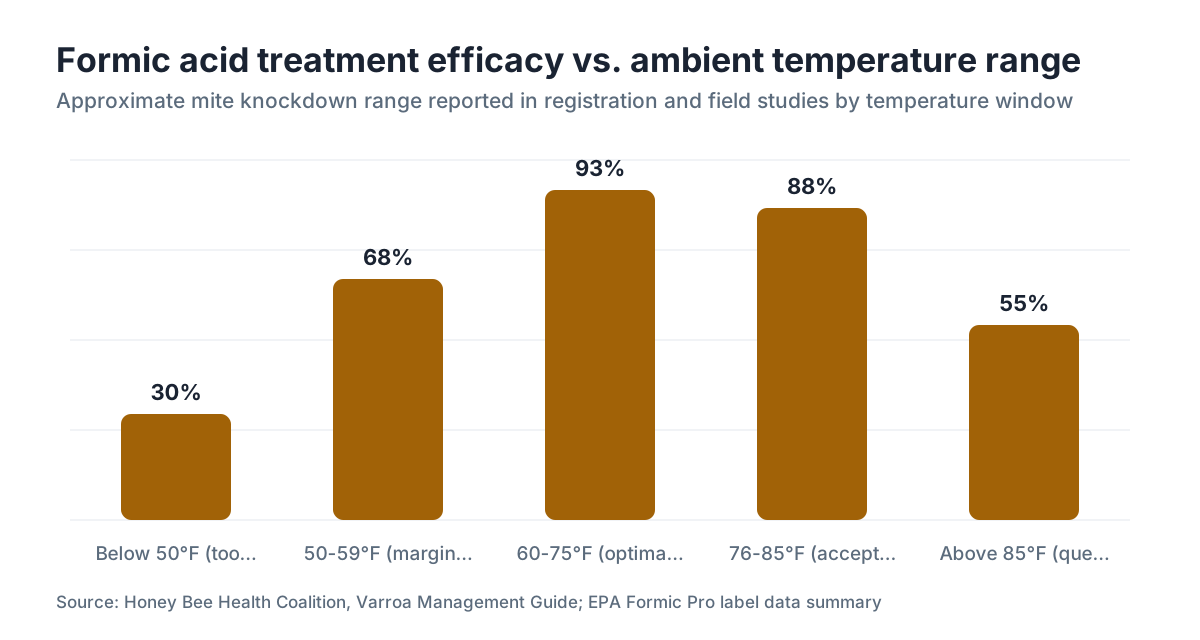
Temperature is the single biggest variable in formic acid outcomes. Both registered products share the same core window: air temperature between 50°F and 85°F during treatment [2][3].
Below 50°F, vapor production drops so far the treatment barely works. At 40°F the pad hardly off-gasses. You'll burn a $15-20 pad and do little to your mite load.
Above 85°F is where queen loss becomes a real risk. The Honey Bee Health Coalition's Varroa Management Guide states that "queen loss is most commonly associated with high temperatures" during formic acid treatment [1]. Some beekeepers report queen loss above 90°F sustained, even with correct placement. Above 85°F, pull the pad or don't start.
The sweet spot in practice is 60-80°F daytime highs with nights above 50°F. Check a 14-day forecast before you commit to a Formic Pro treatment. A 7-day MAQS window is easier to predict.
One practical note: hive interior temperatures run roughly 10-15°F warmer than ambient at the brood nest. That doesn't change the vapor release math (which is driven by ambient conditions at the pad, not brood-nest temperature), but it's a reminder that an 83°F day can feel a lot hotter to a colony already under stress.
Should the pad go above or below a queen excluder?
Put the pad on the same side of the queen excluder as the queen and brood. In a standard setup where supers sit above, that means below the excluder.
Place the pad above a queen excluder and the vapor has to travel down through the excluder and against the warm air rising from the brood nest. Concentrations reaching the brood drop, and the entire point of formic acid (brood-penetrating vapor) falls apart.
Remove honey supers before treatment or accept that honey in those supers may pick up formic acid. Formic acid occurs naturally in honey at low levels, but elevated concentrations from a pad sitting below a super are a concern for honey you plan to sell. The MAQS label requires super removal for honey intended for sale in most states [3]. The Formic Pro label allows treatment with honey supers on under specific conditions (see the current EPA-registered label for your state) [2].
If you're running a nuc or a 5-frame box, the geometry shrinks but the rule holds: pad on the top bars, brood directly below.
Does hive configuration (Langstroth vs. other styles) change placement?
Both Formic Pro and MAQS are registered for standard Langstroth equipment. Their labels don't specifically address top-bar hives, Warré hives, or other setups [2][3].
In a horizontal top-bar hive, some beekeepers rest the pad on a thin shim laid over the top bars above the brood cluster. The open-bottom design of most top-bar hives creates airflow conditions different from Langstroth, and there's essentially no controlled-study data on formic acid efficacy in these hives. If you keep top-bar hives and want to use formic acid, you're working off-label and should watch colony behavior closely.
Langstroth 8-frame and 10-frame boxes don't need different mechanics. Just make sure the pad still reaches center over the brood. In an 8-frame box the brood nest usually sits on frames 3-6, so center placement matters even more.
For beekeepers running varroa mite management across multiple hive styles, keeping thorough notes on the configuration you used and the treatment result is the only way to build your own data.
How long do you leave the pad in, and can you stack two treatments?
Formic Pro: 14 days per pad, two pads applied at once or 14 days apart depending on mite load and label instructions [2]. MAQS: 7 days for the standard treatment, one application [3].
Don't open the hive to check during treatment if you can avoid it. Frequent inspections disrupt vapor distribution, stress bees that are already irritated, and let vapor escape instead of staying at working concentration.
You can run a second round of Formic Pro 14 days after the first if your post-treatment mite wash still shows counts above 2% (2 mites per 100 bees). The label allows this. What you shouldn't do is run formic acid back-to-back with no gap, because queen stress stacks up.
Combining formic acid with oxalic acid in the same window is not label-compliant, and there's no published safety data for concurrent use. Sequential use is fine: formic to knock down brood-stage mites, then an oxalic acid dribble or vaporization after the treated brood hatches to catch remaining phoretics.
What can go wrong with pad placement, and how do you fix it?
The most common mistakes, roughly in order of how often they come up in extension literature and bee health forums:
- Pad placed off-center, toward the wall. Vapor gradient peaks away from brood. Fix: re-center if you catch it within the first day or two.
- Pad placed on top of a queen excluder with brood below. Vapor flow fights the rising warm air. Fix: remove the excluder or move the pad below it.
- Wrapper fully removed on Formic Pro. Release rate spikes. This is the error most tied to queen loss. Fix: you can't un-remove the wrapper. If it's only been a few hours and temperatures are high, pull the pad entirely and let the hive settle before using a fresh pad.
- Treatment started during a heat wave. Stop the treatment. A pad bees have lived with for 2-3 days still holds most of its acid load, so removing it stops ongoing vapor stress, but the colony has already taken some hit.
- Pad placed in a hive that's nearly queenless or in the middle of re-queening. Formic acid is hard on queen cells and virgin queens. Check queen status before you treat.
The Honey Bee Health Coalition recommends a mite wash before and 5-7 days after treatment to actually measure efficacy [1]. A 14-day pad left with poor placement can feel like you did something while mite loads keep climbing.
How do you monitor whether the placement is working?
Alcohol wash or sugar roll before treatment, then again 5-7 days after the treatment period ends. You're looking for at least a 90% drop in mite load on adult bees, which is the threshold the Honey Bee Health Coalition uses to call a treatment effective [1].
A sticky board under a screened bottom board during treatment gives real-time feedback. Heavy mite drop in days 1-4 points to good vapor distribution. If you see essentially no mite drop by day 3, placement or temperature is likely the problem.
VarroaVault's free mite-tracking tools let you log pre- and post-treatment counts to see whether your formic acid protocol actually hits the numbers across multiple hives and seasons, which beats a single data point.
Don't mistake bee die-off at the entrance for proof the treatment isn't working. Some temporary die-off is normal with formic acid, especially in the first 48-72 hours. Large, sustained losses (hundreds of dead bees per day for more than 3-4 days) mean the concentration is too high, which usually traces back to temperature being too high or the wrapper being over-opened.
For a broader look at sourcing treatment supplies and equipment, beekeeping supply companies that carry Formic Pro and MAQS usually stock both and can clear up label questions by phone.
Is formic acid safe to use with honey supers on?
This is genuinely label-dependent and has changed over product generations, so read your current label, not a forum post from 2019.
The Formic Pro label as of its most recent EPA registration allows treatment with honey supers present under certain conditions [2]. The reasoning: formic acid is a naturally occurring compound in honey, and at the concentrations a properly placed pad produces, residue levels in capped honey have measured within natural background ranges in several studies. The University of Guelph's research supporting Formic Pro's registration is the main basis for that claim.
MAQS historically required super removal for commercial honey production in most states [3]. Check the current MAQS label for your state, because this has shifted by registration cycle.
Practically speaking: if you have supers that are mostly capped and you're about to pull them anyway, just pull them, treat, and skip the question. If you're mid-flow with supers filling fast, use Formic Pro per label and watch for any off-flavors in your extracted honey, though reported cases of detectable flavor change in properly run trials have been low.
Either way, treated honey should never be sold as organic unless your certifier has specifically approved the treatment method under your certification program.
What do university extension services and the Honey Bee Health Coalition actually recommend?
The Honey Bee Health Coalition's Varroa Management Guide, the most widely cited practical document in North American beekeeping and updated periodically, lists formic acid as a first-line treatment for varroa in capped brood and names correct temperature range and placement on top bars as essential for efficacy [1].
Penn State Extension, Oregon State, and the University of Minnesota bee labs all publish formic acid guidance that matches the label: top bars of the brood box, centered, temperature within range [4][5]. Penn State's MAAREC resources note that off-label or improper use is the most common cause of treatment failure and queen loss.
The EPA registration documents for both products (Formic Pro EPA Reg. No. 69485-7, MAQS EPA Reg. No. 69485-4) are the legal foundation for all of this [2][3]. When extension guidance and a forum post conflict, the label is the law.
One line from the HBHC guide worth quoting: "Formic acid is unique among varroa treatments in that it can penetrate cappings and kill mites in capped brood" [1]. That sentence is the whole reason placement matters so much. You're trying to get that vapor into those cappings, and placement is how you point it.
Frequently asked questions
Can I place a formic acid pad on the bottom board instead of the top bars?
No. The bottom board is the wrong location. Vapor from a pad at the floor travels down and out the entrance rather than up through the frames where brood and mites are. Both the Formic Pro and MAQS labels specify placement on the top bars of the brood box. Placing pads at the floor is off-label and produces much lower vapor concentrations in the brood nest.
What happens if temperatures go above 85°F during a formic acid treatment?
Above 85°F, queen loss risk climbs sharply. The Honey Bee Health Coalition flags high temperature as the primary driver of queen mortality during formic acid treatment. If a heat spike hits after you've started, the safest move is to remove the pad, wait for cooler weather, and restart with a fresh pad. Don't leave an active pad in through a multi-day heat wave.
How many pads do I use for a double-deep hive with brood in both boxes?
The Formic Pro label instructs one pad per occupied brood box, placed on the top bars of each box. For a double-deep with brood in both boxes, that means two pads total. Putting both pads in one box is off-label. Some beekeepers report acceptable results that way, but efficacy in the upper box will be lower and you have no registered guidance backing the choice.
Do I need to remove bees from the frames before placing the pad?
No. Place the pad directly on top bars that may have bees on them. Bees move away from the pad quickly once the acid vapor irritates them. You don't need to brush frames or disturb the colony more than necessary. Minimizing hive disturbance during placement helps, since keeping the hive open longer lets vapor escape and stresses bees already dealing with the treatment.
Can formic acid kill my queen, and how do I reduce that risk?
Yes, queen loss is a real risk, most often tied to high temperatures or incorrect wrapper removal on Formic Pro. To reduce risk: treat only when temperatures are 50-85°F, place the pad flat and centered, open only the specified portion of the Formic Pro wrapper, and avoid treating colonies with new queens, queens laying less than 2 weeks, or hives actively superseding.
How long after a formic acid treatment can I add honey supers?
After a Formic Pro 14-day treatment, most beekeepers wait at least a few days after removing the pad before replacing supers, though the label does permit super-on treatment under certain conditions. For MAQS, check your current state-specific label for super restrictions. When in doubt, wait 24-48 hours after pad removal before replacing supers and confirm with your label.
Can I use formic acid in a nuc or split?
You can, but with caution. Nucs have smaller populations, less airflow, and often less predictable queen status. Vapor concentration per bee can run higher in a confined nuc box. If you treat a nuc, verify the queen is laying and established (at least 2 weeks old), use only one pad regardless of box count, and monitor closely for the first 48 hours. Temperature management matters even more in small colonies.
What mite count should trigger a formic acid treatment?
The Honey Bee Health Coalition recommends treatment when an alcohol wash shows 2 or more mites per 100 bees (2%) during the active season. Some extension services suggest a lower threshold of 1-2% in late summer when mite populations can double in 3-4 weeks. Post-treatment, you're aiming for counts below 1%, ideally below 0.5% heading into winter.
How is Formic Pro different from MAQS in terms of placement and use?
Placement is the same: top bars of the brood box, centered over brood. The differences are in wrapper handling (fold back one-third of Formic Pro's wrapper; remove the entire MAQS bag), treatment duration (14 days for Formic Pro, 7 days for MAQS), and honey super rules. Formic Pro's slower release is generally considered to produce lower queen mortality in controlled comparisons, though both work when used correctly.
Can I inspect the hive during a formic acid treatment?
Keep inspections to a minimum. Opening the hive lets vapor escape and disrupts distribution. If you need to check (suspected queen loss, heavy bee die-off), do it fast, replace the cover, and accept that you've interrupted the treatment briefly. Routine inspections every 3-4 days during treatment are counterproductive. Wait until the treatment period ends, then do a full inspection and mite wash.
Does formic acid leave residues in honey or wax?
Formic acid occurs naturally in honey at levels of roughly 30-200 mg/kg. Studies supporting Formic Pro's EPA registration found residues in honey from treated colonies stayed within natural background ranges when the product was used per label. Beeswax can absorb formic acid at low levels, but it dissipates. There are no established maximum residue limits for formic acid in honey in the U.S. because of its natural occurrence.
Why is my mite count still high after a formic acid treatment?
Several possible causes: temperature was too low or too high during treatment, cutting vapor efficacy; the pad was misplaced (off-center or above a queen excluder); the brood nest was unusually large and one pad's vapor didn't reach all of it; or the colony was already so heavily infested that one round didn't bring counts below threshold. Do a post-treatment mite wash and consider a second round or switching to oxalic acid for follow-up.
Is formic acid approved for organic beekeeping?
Formic acid is on the National Organic Program's approved materials list for organic livestock production, which includes bees. However, organic certification requires your specific certifier to approve its use, and you must use it per label. Some certifiers have documentation requirements. Using formic acid does not automatically make your honey organic-certified; the whole operation must meet NOP standards.
Sources
- Honey Bee Health Coalition, Varroa Management Guide: Formic acid penetrates cappings and kills mites in capped brood; queen loss is most commonly associated with high temperatures during treatment; treatment threshold of 2 mites per 100 bees recommended.
- EPA, Formic Pro product label (EPA Reg. No. 69485-7): Formic Pro must be placed flat on top bars of the brood box with one-third of top wrapper folded back; temperature range 50-85°F; one pad per occupied brood box.
- EPA, Mite Away Quick Strips (MAQS) product label (EPA Reg. No. 69485-4): MAQS placed on top bars of brood box with outer bag removed; 7-day treatment; temperature range 50-85°F; honey super removal requirements for commercial honey.
- Penn State Extension, Mid-Atlantic Apiculture Research and Extension Consortium (MAAREC): Off-label or improper formic acid use is the most common cause of treatment failure and queen loss; placement on top bars is essential.
- University of Minnesota Extension, Bee Lab varroa resources: Formic acid guidance matching label instructions: top bars of brood box, centered, within temperature range.
- USDA AMS National Organic Program, approved materials for livestock: Formic acid is on the National Organic Program approved materials list for organic livestock including bees.
- Oregon State University Extension, Beekeeping in the Pacific Northwest: Formic acid placement and temperature guidance for Pacific Northwest beekeepers matching EPA label requirements.
- National Pesticide Information Center (NPIC), Oregon State University / EPA cooperative: Formic acid occurs naturally in honey at roughly 30-200 mg/kg; no U.S. maximum residue limits established due to natural occurrence.
Last updated 2026-07-09