Formic acid application in a Langstroth hive: how to do it right
TL;DR
- Formic acid kills varroa mites under capped brood, something almost no other treatment does.
- In a standard Langstroth hive you apply it with commercial polymer strips laid on the top bars, at temperatures of 50°F to 85°F (10°C to 29°C).
- Expect 90 to 95 percent kill when conditions hold.
- It leaves no residue in wax or honey, so supers can stay on.
What is formic acid and why do beekeepers use it on varroa?
Formic acid is an organic acid that already sits in honey at low concentrations. Push it to higher concentrations inside a hive and it turns to vapor, drifts through capped brood cells, and kills varroa mites feeding on developing pupae. That brood penetration is the whole reason beekeepers reach for it. Most other approved treatments, oxalic acid included, only touch phoretic mites riding adult bees, so they leave the mites sealed inside capped cells untouched.
The Honey Bee Health Coalition's Varroa Management Guide puts it plainly: formic acid is one of the few treatments with "efficacy against mites in capped brood" [1]. That matters in summer and early fall, when 80 to 90 percent of a colony's mites can be locked inside capped brood at any moment [7].
European beekeepers have used the acid since the 1980s. EPA-registered products reached U.S. hobbyists in the 2010s. Two products run the U.S. market now: Mite Away Quick Strips (MAQS) and Formic Pro. Both are legal to use with honey supers in place, a real edge over most synthetic treatments.
One thing to say straight: formic acid is not a walk-away treatment. Temperature swings, hive setup, and colony strength all move the outcome. Go in without a plan and you can end up with a stressed queen, a weak kill, or both.
What formic acid products are approved for Langstroth hives in the U.S.?
Two EPA-registered formic acid products are available to U.S. beekeepers as of mid-2025. Both deliver the acid from a polymer strip you lay on the top bars, and both are labeled for use with honey supers in place.
Mite Away Quick Strips (MAQS) are polymer gel strips holding 68.4 percent formic acid by weight. The label calls for two strips laid flat on the top bars of the brood box for a 7-day treatment. Minimum colony size is a 5-frame cluster (bees covering at least 5 frames). The label temperature window is 50°F to 85°F (10°C to 29°C) across the treatment period [2].
Formic Pro uses a similar matrix but runs longer: a 14-day single application, or a 20-day treatment with two applications. Same temperature window, 50°F to 85°F. Strips go on the top bars of the upper brood box [3].
As of 2025, formic acid products are exempt from the veterinary feed directive rules that cover some antibiotics, so you don't need a prescription in most places. Check your state department of agriculture to confirm local rules before you order.
Neither product is cheap. MAQS typically runs $18 to $25 for a two-strip pack that treats one hive. Formic Pro runs roughly $12 to $18 per hive for the standard application. Treat 10 hives twice a year and that adds up fast, so it pays to shop around. A quick comparison of beekeeping supply companies can save real money on larger orders.
| Product | Active % | Strips per treatment | Duration | Min. temp | Max. temp | Supers allowed? |
|---|---|---|---|---|---|---|
| MAQS | 68.4% formic acid | 2 | 7 days | 50°F | 85°F | Yes |
| Formic Pro | 46% formic acid | 1 or 2 | 14 or 20 days | 50°F | 85°F | Yes |
What temperature range is safe for formic acid treatment?
Temperature is the variable that decides everything with formic acid, and getting it wrong can cost you a queen. Both MAQS and Formic Pro specify 50°F to 85°F (10°C to 29°C) across the treatment window [2][3]. Step outside that range and the risk cuts both ways.
Below 50°F the acid evaporates too slowly to build effective concentrations, especially inside capped cells. You get a weak kill and waste your strips.
Above 85°F is the dangerous end. Formic acid flashes off much faster in heat, and hive concentration can spike high enough to kill the queen. Queen loss is the most reported adverse event with both products, and most of it happens during heat waves. The MAQS label warns against applying when temperatures are forecast to top 85°F during the 7-day window.
That makes late summer treatments in the South and Southwest tricky. Many beekeepers there wait until September, when daytime highs reliably drop below 85°F. In the Pacific Northwest or upper Midwest, mid-August often works fine.
Build one habit: check a 10-day forecast before you apply. If even one day in the window shows above 85°F, wait, or run an oxalic acid dribble as a stopgap on phoretic mites while the weather cools.
How do you actually apply formic acid strips in a Langstroth hive?
The physical steps are simple. A few details decide whether the treatment works well or poorly.
Gear up first. Formic acid vapor burns eyes and lungs. You need chemical-splash goggles (not safety glasses), acid-resistant gloves (nitrile is borderline, butyl rubber is better), and a respirator rated for organic vapors. Open the package outdoors or at arm's length. The smell hits fast.
For MAQS, the label protocol is:
- Remove honey supers if you want, or leave them on. The label permits supers in place, though many beekeepers pull them during a heavy flow to sidestep any off-flavor risk.
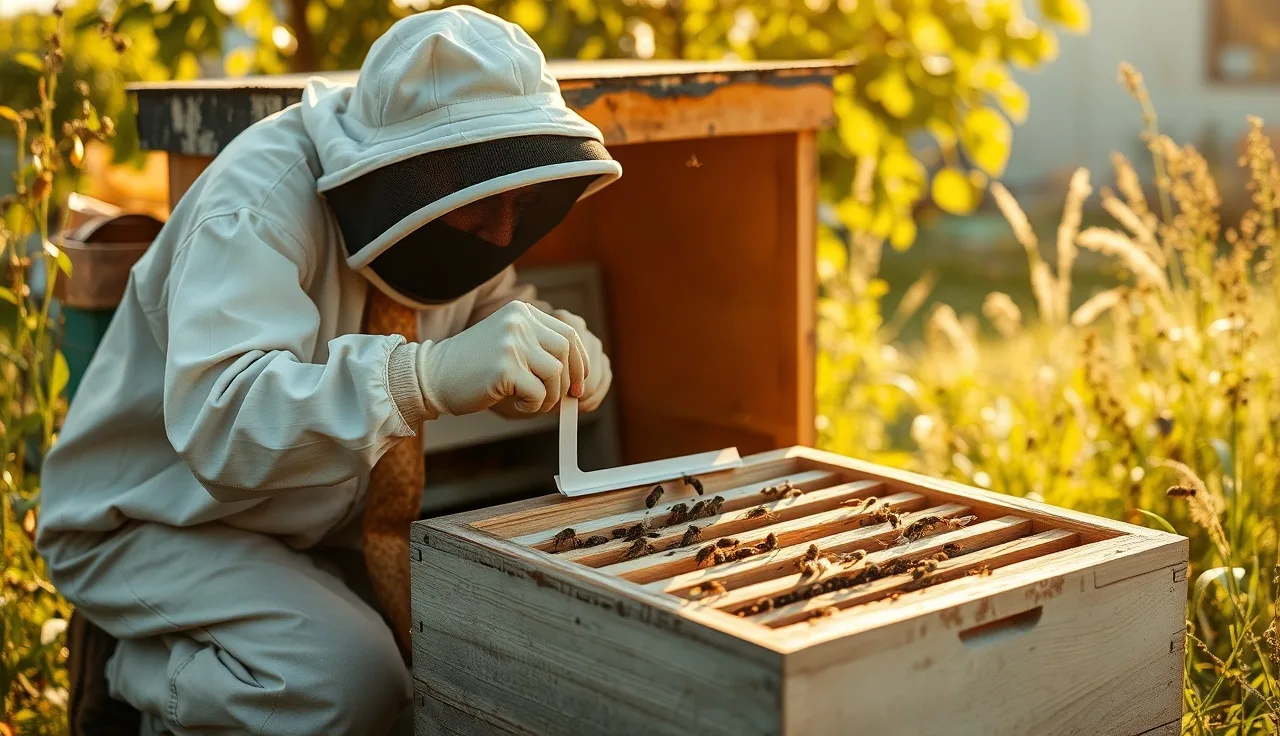
- Open both strips and lay them flat, lengthwise, directly across the top bars of the brood box. One strip toward each side of the hive is standard.
- Leave the entrance fully open. The vapor needs airflow to spread through the hive and vent out instead of pooling at lethal levels. A screened bottom board helps.
- Don't stack another brood box on top of the strips. They need to be the topmost surface, with only the cover above them.
- Leave them 7 full days. Pull them with gloved hands and dispose of them.
For Formic Pro, placement matches, top bars of the upper brood box, but the strips stay 14 to 20 days depending on protocol. The 14-day single application is the common choice.
One practical note. Two brood boxes means strips on the top bars of the upper box. A single-brood-box hive (common for hobbyists running mediums) gets strips on those top bars. The vapor is heavier than air and sinks down through the cluster.
Confirm you actually need treatment before you open a package. Do an alcohol wash or sugar roll count on the varroa mite load first. The strips cost too much to burn on a hunch.
How effective is formic acid at killing varroa compared to other treatments?
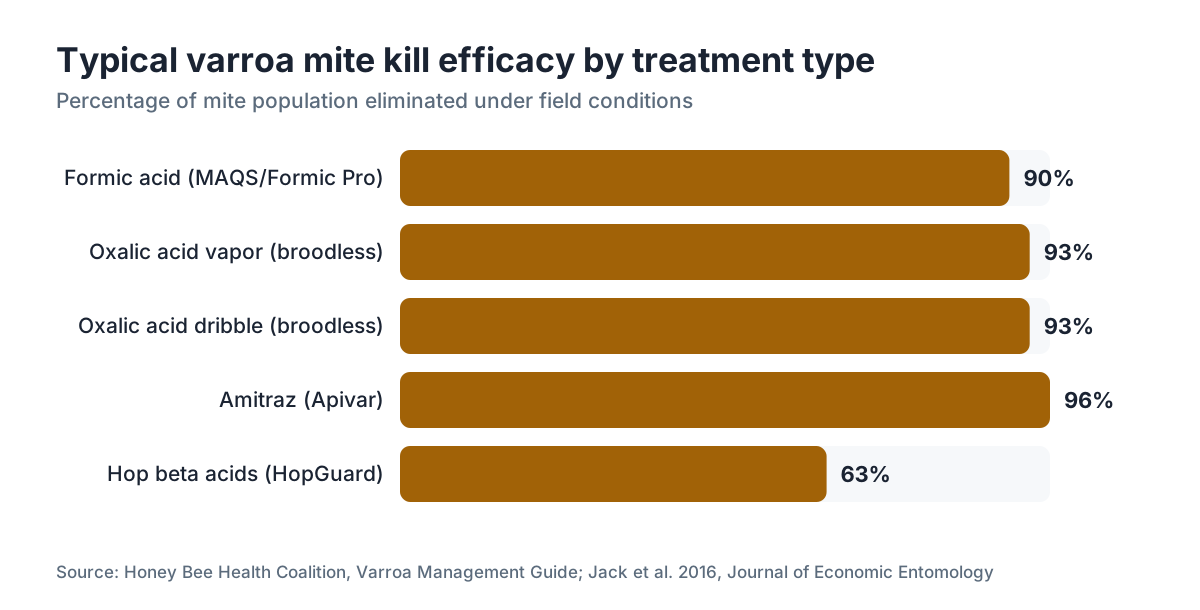
Published efficacy for formic acid lands across a wide range, from about 75 percent to 97 percent, depending on temperature, colony size, hive setup, and which product and protocol got tested.
The most cited field figure for MAQS is around 90 to 93 percent. A 2016 study by Jack and colleagues in the Journal of Economic Entomology reported MAQS efficacy against varroa averaging 93.4 percent in colonies where temperature protocols held [4]. The Honey Bee Health Coalition notes that formic acid's brood reach makes its total mite reduction comparable to a full oxalic acid treatment on a broodless colony, because it hits mites the others can't [1].
Here's how it stacks up:
| Treatment | Efficacy (typical range) | Kills mites in brood? | Residue in wax/honey? |
|---|---|---|---|
| Formic acid (MAQS/Formic Pro) | 75-95% | Yes | No |
| Oxalic acid dribble | 90-99% | No (broodless only) | No |
| Oxalic acid vapor | 90-95% | No | No |
| Amitraz (Apivar) | 93-99% | No | Yes (wax) |
| Hop beta acids (HopGuard) | 50-75% | Partial | No |
The honest read: formic acid isn't as reliable as Apivar on raw kill percentage, but it has two edges Apivar lacks. It works during a honey flow with no residue worry, and it reaches sealed brood. Run colonies year-round in a climate with a warm fall and you can pair a summer formic treatment with a winter oxalic vapor treatment to cover nearly every mite scenario in the annual cycle [8].
Will formic acid hurt the queen or harm the brood?
Yes, it can, and this is the part that deserves a straight conversation.
Queen loss with MAQS and Formic Pro, across studies and beekeeper surveys, typically runs 3 to 15 percent depending on conditions [4][5]. Cornell Cooperative Extension has noted that supersedure rates after MAQS treatment run meaningfully higher than in untreated control colonies [5]. That risk climbs sharply as temperatures near or pass 85°F.
Brood damage happens too. Some beekeepers see a band of uncapped or sunken brood after treatment, worst in the cells closest to the strips. It usually recovers within two to three weeks as the colony backfills.
A few moves cut the risk. Stay strictly inside the temperature window. Give the hive good ventilation, meaning a fully open entrance and a screened bottom board. And consider caging the queen or pulling her into a nuc for the 7-day MAQS window, then reintroducing her. That's extra work, but it protects your most valuable bee.
If you're raising queens or babysitting a freshly mated one, this isn't the cycle for formic acid. Oxalic acid vapor on a near-broodless colony is the safer call there.
Can you use formic acid with honey supers on?
Yes. This is one of formic acid's real selling points. Both MAQS and Formic Pro are labeled for use with honey supers in place. Formic acid already lives in honey naturally, and the small amount these treatments add stays within naturally occurring levels and any regulatory threshold [2][3].
That said, "allowed by label" and "always advisable" aren't the same thing. During a strong nectar flow, some beekeepers report subtle off-flavors in honey cured while strips were in place. The evidence is anecdotal, not published, and plenty of experienced beekeepers treat with supers on and never get a flavor complaint. My own practice: pull supers during the 7-day MAQS window if there's an active flow. Not because the label demands it, but because buyers notice honey flavor and I'd rather not gamble on it.
For Formic Pro's 14-day protocol, the longer window pushes me harder toward pulling supers, especially when the bees are hauling in a lot of nectar. Outside an active flow, supers can stay.
If you're treating honey colonies and cost matters, keeping supers on saves real time once you're past a handful of hives. Resources on beekeeping supplies can help you think through the equipment logistics as you scale up.
What's the right timing in the seasonal calendar for formic acid treatment?
Most extension services and the Honey Bee Health Coalition point to two treatment points a year: late summer (July to September) to protect the long-lived winter bees being raised, and again in late winter or early spring to knock down mite rebound before the population explodes [1][10].
Formic acid fits the late summer window best. It's warm enough for good evaporation, the colony still carries capped brood that needs the brood-penetrating benefit, and a late-season flow doesn't create a residue problem.
Here's a rough calendar by region. Adjust to your actual forecast.
| Region | Ideal formic treatment window |
|---|---|
| Pacific Northwest | Late July to early September |
| Upper Midwest / Northeast | Late July to mid-September |
| Mid-Atlantic / Southeast | September to early October |
| Deep South / Southwest | October, or skip formic for oxalic |
Where summer temperatures ride above 85°F straight through September, formic acid stops being practical for the main summer window [10]. Oxalic acid vapor or Apivar becomes the better call, and some beekeepers save formic for spring.
The spring window (February to April in most of the U.S.) can work, but watch for late cold snaps. A run of 40°F nights after you set strips will tank your efficacy. That's why many beekeepers default to oxalic acid vapor in late winter, when colonies sit broodless or near it, and reserve formic for summer.
How do you know if the treatment worked?
You test. That's the only honest answer.
Do an alcohol wash or sugar roll on 300 bees (roughly half a cup) before treatment, then again 3 to 4 weeks after treatment ends. The wait lets the colony clear the treated mites and gives any surviving reproducing mites time to move onto adult bees where you can count them. If your post-treatment count sits below 2 mites per 100 bees (the 2 percent threshold most extension services and the Honey Bee Health Coalition use), the treatment worked [1][6]. Still above that? You likely need a follow-up, maybe with a different mechanism like oxalic acid vapor.
Don't lean on a sticky board count as your verdict. It shows relative change but not the reliable infestation percentage an alcohol wash gives [6].
VarroaVault has a free mite counting protocol and treatment decision calculator if you want a structured way to track counts and decide when to treat again.
Mite fall after formic acid tends to be fast and obvious. Many beekeepers see a big drop on sticky boards within 24 to 48 hours of placing the strips. That's encouraging, not proof. Count the bees, not the board.
What safety precautions do you need when handling formic acid strips?
Formic acid at MAQS and Formic Pro concentrations is caustic to skin, eyes, and respiratory tissue. The EPA label isn't being dramatic when it lists the protective equipment [2][9].
Minimum kit:
- Chemical splash goggles (not safety glasses)
- Gloves rated for acid exposure. The MAQS label specifies chemical-resistant gloves. Butyl rubber or neoprene beats nitrile for repeated exposure, though nitrile works for a single brief application.
- A NIOSH-approved respirator with organic vapor cartridges if you're treating multiple hives. For a single hive, working upwind and fast may do, but the respirator is always safer.
- Long sleeves and closed-toe shoes.
Open packages outdoors or somewhere with strong ventilation. Acid on skin? Flush with plenty of water for 15 to 20 minutes. Eye contact is a medical emergency: flush with water and get medical attention.
Store unused strips in a cool, dark spot in the original sealed packaging. Heat speeds evaporation and can degrade the product, and strips stored badly deliver inconsistent concentrations.
Dispose of used strips per the label. Most labels allow household trash after the treatment period; they aren't hazardous waste at that point. Even so, keep pets and children away from them.
Can formic acid be used in nucleus colonies or small splits?
This is where beekeepers get burned. Both MAQS and Formic Pro set a minimum of 5 frames of bees covered (roughly 10,000 to 15,000 bees). Below that, queen loss and brood damage jump, because a small colony has less thermal mass to buffer the acid spikes [2][3].
Got a nuc or split under the threshold? Your options:
- Wait for the colony to build to minimum size, monitoring mites with a sugar roll in the meantime.
- Use oxalic acid dribble or vapor, approved for colonies of any size, including packages and nucs.
- Combine a weak, mite-heavy split with another colony to clear the threshold, then treat.
For overwintered nucs headed for spring use as replacement colonies, I'd pick oxalic acid vapor every time. The queen is too valuable and the colony too fragile to risk formic acid below threshold.
One more thing. A standard 5-frame nuc box isn't the right container for formic acid. The label assumes an 8 or 10-frame Langstroth setup. If you adapt to non-standard equipment, read the label's specific guidance and go slow.
Are there situations where you should not use formic acid?
Yes. Several real contraindications exist, and pushing through them is how you lose queens and wreck colonies.
Don't treat if the forecast shows any day above 85°F during the window. Period.
Don't treat colonies below 5 frames of bees. The labels say so, and the queen loss risk in small colonies makes it a bad bet [2][3].
Don't treat during a dearth with heavy robbing pressure. The strong acid smell at the entrance can throw off guard bee behavior, and the entrance gets chaotic on heavy evaporation days. This one is field experience more than a hard label rule.
Don't count on formic acid alone to save a colony already collapsing above a 5 to 6 percent mite load. A single treatment won't pull it back. You need something faster or stronger, like oxalic acid vapor repeated weekly for three weeks on a near-broodless colony, or Apivar.
And don't treat without confirming you have a mite problem. Test, treat on the data, test again. The Honey Bee Health Coalition's Varroa Management Guide lays out the thresholds: treat when you exceed 2 mites per 100 bees in late summer and 1 per 100 in early spring [1].
Frequently asked questions
How long does it take for formic acid to kill varroa mites?
Mite mortality starts within 24 to 48 hours of placing the strips, and you'll often see heavy mite fall on a sticky board in that window. Full efficacy builds over the whole treatment period: 7 days for MAQS, 14 to 20 days for Formic Pro. Wait 3 to 4 weeks after treatment ends before your post-treatment count, so surviving reproducing mites have time to move onto adult bees and become countable.
Can I use formic acid in cold weather?
No. Both MAQS and Formic Pro require sustained temperatures of at least 50°F (10°C) across the entire treatment window. Below that, the acid evaporates too slowly to build effective concentrations inside the hive, especially inside capped brood cells. In cold climates, oxalic acid vapor is the better winter treatment, particularly when colonies sit broodless or near-broodless in late December and January.
Does formic acid kill mites in capped brood?
Yes, and that's its main advantage over oxalic acid. Formic acid vapor penetrates capped brood cells and kills varroa on developing pupae. In peak summer, 80 to 90 percent of a colony's mite population can be inside capped brood, so a treatment that can't reach sealed cells leaves most of the infestation intact. The Honey Bee Health Coalition lists brood penetration as a key property of formic acid.
How many times a year can I apply formic acid?
The MAQS label allows two treatments per year, with a minimum of 14 days between applications. Formic Pro allows two applications as part of one extended treatment protocol. In practice, most beekeepers run one summer formic treatment and one winter oxalic treatment as a yearly rotation, reserving a second formic application only if mite counts stay above threshold after the first.
Do I need a prescription or VFD to buy formic acid strips?
Generally no. As of 2025, formic acid varroa treatments in the U.S. are EPA-registered and sold over the counter without a veterinary feed directive. This differs from some antibiotic treatments. State regulations vary, though: a handful of states add registration or purchase requirements. Check your state department of agriculture's current rules before ordering, especially if you're buying across state lines.
Can formic acid be used in a hive with a screened bottom board?
Yes. A screened bottom board is actually preferred over a solid one during formic acid treatment because it improves airflow and prevents dangerous vapor buildup at the cluster level. Keep the entrance fully open for the same reason. Restricting airflow during treatment raises the risk of queen loss and brood damage from concentrated acid exposure.
What do I do if my queen dies after formic acid treatment?
First confirm she's gone: look for eggs 3 to 5 days after treatment ends. If she's dead, the colony will usually start emergency queen cells within a few days as long as they have young larvae. Let them raise a queen if the colony is strong enough, or introduce a purchased mated queen to save time. Document the loss, note the temperatures during treatment, and adjust your timing for next time.
Is formic acid safe for the bees themselves?
At label-directed doses and temperatures, yes, most colonies tolerate it well. Some brood disruption near the strips is normal and usually recovers within two to three weeks. The main documented risk is queen loss, estimated at 3 to 15 percent depending on conditions. Slightly elevated worker mortality is possible during the first day or two, but it's typically minor in healthy colonies that follow the temperature guidelines.
What's the difference between MAQS and Formic Pro?
Both use formic acid delivered from a polymer strip. MAQS holds 68.4 percent formic acid and treats for 7 days with two strips. Formic Pro carries a lower active concentration in a slightly different matrix and treats for 14 to 20 days with one or two strips. Efficacy is comparable when used correctly. MAQS gives faster confirmation that treatment is done; Formic Pro's longer window may improve brood penetration in cooler conditions.
Can I make my own formic acid treatment instead of buying commercial strips?
In the U.S., using formic acid outside an EPA-registered product label is off-label and potentially illegal for pesticide use. Some European beekeepers use acid-soaked sponges or pads with raw acid, but pure formic acid at handling concentrations is extremely hazardous and not sold for general use in the U.S. in those quantities. Stick to MAQS or Formic Pro. The polymer delivery system also controls evaporation rate, which is key to safety.
How do I store formic acid strips before use?
Store in a cool, dry spot away from direct sunlight, ideally below 77°F (25°C). Keep them sealed in the original packaging until the day of use. Heat speeds evaporation and can cut the active concentration before you even open the package. Don't store near food, children, or pets. Most manufacturers recommend using strips within 12 to 18 months of purchase; check the expiration date on the package.
Will formic acid affect the taste of my honey?
Both MAQS and Formic Pro are labeled for use with honey supers in place, and formic acid is naturally present in honey at low concentrations. At label-directed rates, the added acid typically stays within naturally occurring ranges in finished honey. Some beekeepers anecdotally report subtle off-flavors during heavy flows when treating with supers on. The evidence is thin; removing supers during an active flow is the conservative move if flavor quality is your priority.
Sources
- Honey Bee Health Coalition, Varroa Management Guide (latest edition): Formic acid has efficacy against mites in capped brood; treat when mite load exceeds 2 per 100 bees in late summer and 1 per 100 in early spring
- EPA, MAQS (Mite Away Quick Strips) registered label: MAQS contains 68.4% formic acid; approved temperature window 50°F to 85°F; two strips per hive for 7 days; minimum colony size 5 frames of bees; approved for use with honey supers in place
- EPA, Formic Pro registered label: Formic Pro approved for 14- or 20-day treatment protocols; temperature window 50°F to 85°F; minimum colony size 5 frames; labeled for use with honey supers
- Jack et al. (2016), Journal of Economic Entomology, MAQS efficacy field trial: MAQS efficacy against varroa averaging 93.4% in colonies where temperature protocols were followed
- Cornell University Cooperative Extension, Varroa Mite Management: Queen supersedure rates following MAQS treatment are meaningfully higher than in untreated control colonies; queen loss risk increases above 85°F
- Pennsylvania State University Extension, Varroa Mite Monitoring and Management: Alcohol wash on 300 bees recommended for accurate mite infestation percentage; treatment threshold of 2 mites per 100 bees in late summer
- University of Minnesota Extension, Varroa Mite Control in Honey Bee Colonies: In peak summer 80 to 90 percent of the mite population in a colony can be inside capped brood; formic acid's brood penetration addresses this population
- USDA Agricultural Research Service, Honey Bee Research: Comparative efficacy data across approved varroa treatments including formic acid, oxalic acid, and amitraz
- National Pesticide Information Center, Formic Acid Fact Sheet: Formic acid at high concentrations is caustic to skin, eyes, and respiratory tissue; requires chemical splash goggles, acid-resistant gloves, and organic vapor respirator
- Virginia Cooperative Extension, Integrated Pest Management for Honey Bees: Seasonal treatment timing recommendations: late summer treatment critical for protecting winter bees; formic acid temperature constraints limit use in high-summer in southern regions
Last updated 2026-07-09