Apivar strips active ingredient: what amitraz does to varroa mites
TL;DR
- Apivar strips contain amitraz at 3.3% by weight, about 800 mg per strip.
- Amitraz kills varroa by overstimulating their octopamine receptors, which scrambles the mite's nervous system until it falls off and dies.
- Each strip vapors off slowly over 6 to 10 weeks.
- The dose is two strips per brood box.
- Resistance is real in some US populations, so wash for mites after every treatment.
What is the active ingredient in Apivar strips?
Apivar's active ingredient is amitraz, at 3.3% by weight [1]. Each plastic strip holds about 800 mg of amitraz locked in a slow-release polymer matrix that vapors the compound off gradually across the whole treatment period. That slow trickle is the point. Varroa mites contact the strips again and again as bees move through the brood nest, and the dose builds over weeks instead of hitting all at once.
Amitraz has been around in veterinary and agricultural pest control since the 1970s. It belongs to the formamidine chemical class, which sits apart from the organophosphates and pyrethroids that dominated earlier pest control. That chemical distance matters. It means amitraz works through a different mechanism than many other pesticides, which is part of why it became the default synthetic miticide for varroa when oxalic acid and thymol are less convenient or less effective.
The EPA registered Apivar for use in honey bee colonies in the United States. Veto-Pharma holds the current registration, and the product label is the legal document that governs everything about how you can use the strips [1]. You can look up the exact label language on the Veto-Pharma site or in the EPA's pesticide database. Read the current label before each season. Label language gets updated, and the version you memorized three years ago may not be the one in force.
How does amitraz kill varroa mites?
Amitraz kills varroa by acting as an agonist at octopamine receptors in the mite's nervous system [2]. Octopamine is the invertebrate version of adrenaline. When amitraz jams those receptors wide open, the mite loses coordinated movement, stops feeding right, and dies. Bees carry the same receptors, but at the concentrations the strips produce inside a hive, bees are far less sensitive than mites. The selectivity is real. It isn't absolute, which is why the label dose matters.
The practical result is that exposed mites get disoriented and drop off the bees. This is why sticky boards and alcohol washes light up in the first days after Apivar goes in. The mites are dying and falling. Slide a sticky board under the screen right after installing strips and you'll usually see a sharp spike in drop around day 2 to 5, then a slow decline as the mite population crashes.
Amitraz also has some repellent and reproductive-disruption effects on varroa, though the octopamine receptor action is the main event [2]. Some research suggests it suppresses varroa reproduction inside capped cells, but that evidence is shakier than the contact-kill data. What drives Apivar's results is mites meeting amitraz vapor on treated strips, over and over, for weeks.
How long do Apivar strips stay in the hive and how does the release work?
The label calls for a treatment period of 6 to 10 weeks, with strips left in for the full stretch [1]. The polymer matrix works like a reservoir, releasing amitraz at a rate meant to hold an effective concentration in the hive air without ever hitting acutely toxic levels for the bees. Strip weight-loss studies show strips shed roughly 30 to 50% of their amitraz during a standard cycle, so there's still active ingredient left when you pull them at ten weeks.
Release speed rides on temperature. Amitraz volatilizes faster in a warm hive, which is one reason cold-weather treatment falls short. Once hive temperatures drop below about 50 degrees F (10 degrees C), vapor production slows hard, and mite mortality slows with it. That's a genuine limit. Apivar tolerates cold better than thymol products, but it's the wrong tool for a January treatment in a cold northern climate when the cluster is tight and the inside of the box is near freezing.
Hang the strips between frames in the brood nest, not out on the edges where bees barely touch them. Placement matters more than most beekeepers think. The Honey Bee Health Coalition's Varroa management guide says to put strips in areas of high bee traffic [3]. In a standard 10-frame box, that means between frames 3-4 and 7-8, or flanking the brood cluster as tightly as you can judge it.
What is the correct dose of Apivar per hive?
The label sets the dose at 2 strips per brood box, capped at 4 strips total for a colony with two brood boxes [1]. Don't improvise around this. More strips won't reliably kill more mites, and it does drive residue into your wax and honey. Fewer strips in a big colony means the amitraz concentration in the hive air may never climb high enough to work.
Single brood box gets 2 strips. Double-deep brood nest gets 4, two per box. A colony in a single medium or single deep with a small population still gets 2. Install them for the treatment window, then take them out. Don't leave them in forever.
Strips must come out when treatment ends. Old strips left in the hive feed wax contamination and speed up resistance [4]. Dispose of used strips per the label, which in the US means wrapping them and putting them in household trash. Don't burn them. The degradation products from burning amitraz are harmful to breathe.
Does Apivar contaminate beeswax or honey?
Yes. Amitraz and its main breakdown product DMPF build up in beeswax over repeated treatments [4]. Wax is lipophilic, so it grabs and holds fat-soluble compounds. Studies published in the apiculture literature, including large residue surveys, have found measurable amitraz residues in comb from colonies treated with Apivar over several years [4].
The practical headline: honey contamination during a properly timed treatment is low risk. Apivar is labeled for use with honey supers off, and the EPA registration requires pulling supers before you treat [1]. Follow that rule and honey residues stay below detectable limits in nearly every study. The wax residue issue is the longer game, and it matters most for beekeepers who recycle comb. Comb from repeatedly treated hives carries more amitraz than fresh comb, and some research suggests high wax residues may nudge queen development, though the exact thresholds where that shows up are still being sorted out.
So rotate your comb. Don't let frames stack up ten years of miticide. Pull and replace dark, old comb on a 3 to 5 year rotation as normal hive management, and the wax residue problem stays in hand.
Curious what's actually in your comb? Some labs run residue testing. The Bee Informed Partnership and a handful of university extension programs have done broad surveys. The pattern holds steady: comb in managed colonies carries a mix of miticide residues, with amitraz compounds and coumaphos the most common, at concentrations that haven't shown clear colony-level harm under typical management [4].
When should you use Apivar versus other varroa treatments?
Apivar earns its place when you need to treat in cooler months, when thymol won't perform, and when you want a treatment that asks for almost no hands-on time after you install it. It works whether or not the hive has brood, though a broodless window makes any miticide stronger because phoretic mites are out in the open.
Against oxalic acid dribble or vaporization, Apivar has a longer window and skips the repeated applications. But oxalic acid vapor during a truly broodless period (after a split, or in a natural swarm-season gap) hits very high kill rates, often 95% or more, and leaves no wax residue [5]. Engineer a broodless period and oxalic acid vapor is hard to beat.
Formic acid (MAQS or Formic Pro) is the other option in the synthetic-adjacent lane. It penetrates capped cells and kills mites under the caps, which Apivar doesn't do reliably. But formic acid is more temperature-touchy than amitraz, runs a narrower application window, and puts more stress on the colony.
The Honey Bee Health Coalition's Varroa management guide (free at honeybeehealthcoalition.org) lays out a decision framework across treatments by season, temperature, brood status, and resistance [3]. It's one of the most useful free resources in beekeeping, and I'd tell any beekeeper to read it before locking in a protocol. You can also build your own monitoring and treatment schedule with the free tools at VarroaVault, built for hobbyist and sideliner beekeepers tracking mite loads and matching treatments to colony conditions.
Running several colonies? Our overview of varroa mite biology and life cycle explains why treatment timing against the brood cycle drives Apivar's results.
One honest caution. Apivar is a poor fit for an untimed, year-round habit. Rotating between treatment classes (amitraz, oxalic acid, formic acid) beats leaning on one product forever, both for resistance and for comb hygiene [3].
Is amitraz resistance in varroa mites a real problem?
Yes, and it's documented on three continents. Amitraz resistance in Varroa destructor has been confirmed in apiaries across the United States, Europe, and South America, though how common it is swings widely by region and management history [6]. The mechanism runs through mutations that reshape the octopamine receptor binding site, blunting amitraz's ability to overstimulate it. Mites carrying that mutation survive treatment and hand the trait to their offspring.
A 2021 study in PLOS ONE tied specific mutations to amitraz tolerance in varroa from US colonies [6]. The authors concluded that "amitraz resistance can be attributed to a specific mutation in the octopamine receptor gene." If you're doing everything right with Apivar and still seeing high post-treatment counts, resistance belongs on your list.
How do you check? Alcohol wash or sugar roll 2 to 3 weeks after strip removal. If infestation still sits above 2% after a full 6 to 10 week treatment, that's a red flag. It doesn't prove resistance on its own (bad placement, a short window, or reinfestation from neighbors could explain it), but it should push you to switch class and dig in.
Resistance management in practice means rotating. Don't run Apivar every cycle, every year. Alternate it with formic acid or a broodless oxalic acid treatment at least once a year. That denies amitraz-tolerant mites a continuous advantage across all your treatment events [3].
Is Apivar safe for bees and for humans handling the strips?
At label doses, Apivar has a strong safety record for adult honey bees. The lethal concentration 50 (LC50) for honey bees from amitraz vapor at typical in-hive levels sits well above what the strips produce, which is why bees shrug off months of strip presence while mites die [1]. That said, there are reports of higher brood mortality when strips get placed flat on brood frames instead of between frames, probably from local concentration spikes. Hang strips vertically between frames. Don't lay them across the top of brood.
Queens are the open question. Beekeepers argue over whether amitraz exposure dents queen quality or laying behavior, and some report shorter laying spurts during Apivar treatments. The controlled data is thin and inconsistent. If you're treating during a queen-rearing operation, use extra caution and watch queen performance afterward.
For humans: amitraz is a formamidine, and it has mammalian toxicity through adrenergic pathways adjacent to the octopamine system it hits in mites. The label requires nitrile or latex gloves when handling strips [1]. Don't handle strips bare-handed over and over. A single brief contact carries low dermal risk, but the product isn't harmless. Wash your hands thoroughly after any contact. Don't breathe smoke from burning or overheated strips. The PPE line on the label is there for a reason.
The EPA tolerance for amitraz residues in honey is 200 ppb, and properly run Apivar treatments (supers off, full period, strips pulled at the end) consistently land honey residues well under that [1] [7].
What does a proper Apivar treatment protocol look like, step by step?
Start with a mite wash. Don't treat by calendar. Treat by mite load. An alcohol wash or sugar roll above 2% (2 mites per 100 bees) in late summer is a clear call to act. Some beekeepers use a 1% threshold during the summer brood peak, and that's reasonable. Oregon State Extension recommends a 2% treatment threshold during the brood-rearing season [10].
Remove honey supers before installing strips. Label requirement, not a suggestion [1]. Treat in late summer or fall after harvest and this takes care of itself.
Install 2 strips per brood box. Hang them between frames 3-4 and 7-8 in a 10-frame box, in the densest part of the brood cluster. You can spread the strips a little for wider distribution. Mark the calendar 6 to 10 weeks out.
At week 3 to 4, take a quick peek to confirm strips are still in place and bees haven't chewed them to bits. Light chewing is normal. Strips that have been shredded or hauled out need replacing.
At week 6 to 10, pull the strips. Do a follow-up alcohol wash 2 to 3 weeks after removal to confirm it worked. Target below 2%, ideally below 1%, heading into winter. Still elevated after a full treatment? Consider an oxalic acid vaporization follow-up before the winter cluster forms. Penn State Extension calls fall treatment before winter bee production the highest-impact intervention point in northern climates [11].
For treatment supplies, including sticky boards for monitoring, see our beekeeping supplies resource, and for buying strips and other miticides at competitive prices, our beekeeping supply companies page lists vetted options.
Log the treatment: date in, date out, mite count before and after. That record is worth more than any single treatment decision, because it tells you whether your protocol is actually working year over year.
Can you use Apivar in any climate or season?
Apivar tolerates a wider temperature range than most varroa treatments, but the range isn't unlimited. The label doesn't set a minimum application temperature the way formic acid products do, yet field experience and basic chemistry agree that amitraz volatilization slows hard below 50 degrees F (10 degrees C) hive temperature [1]. Most university extension guidance points to fall treatment before temperatures drop under that mark.
In warmer climates, southern US beekeepers can often run Apivar in early winter without trouble because hive temperatures stay workable even when the air outside is cool. In northern climates, the fall window usually runs August through October. Treat much later than that in harsh-winter zones and you risk an unfinished cycle before the cluster locks the bees in place.
Spring treatment works and is sometimes necessary when colonies come out of winter carrying heavy mite loads. The spring risk is timing around the honey flow and super installation. Strips have to come out before supers go on. If your main flow starts in May and you set strips in early March, you've got a clean 8-week window before supers. Plan it out.
Apivar is not approved for use with honey supers on. Period. If someone in your bee club tells you they leave supers on during treatment, that's an off-label use that risks illegal honey residues and product liability. Don't copy it.
How does amitraz compare to other varroa treatment active ingredients?
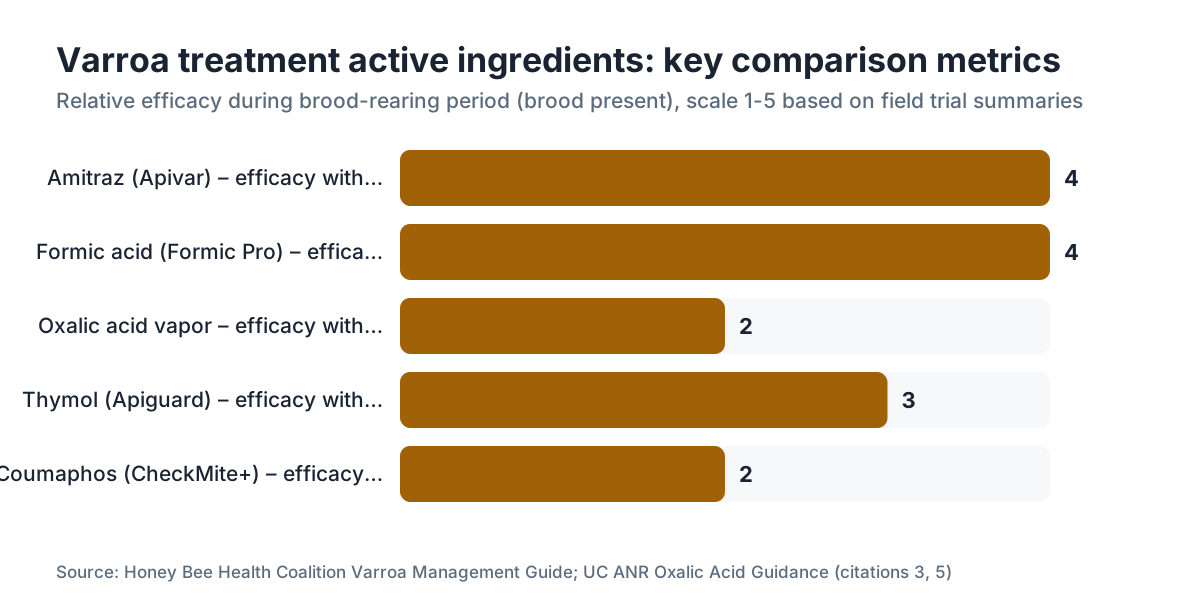
The table below lays out the main varroa treatment active ingredients registered for US use, with chemical class, mode of action, and the practical limits that decide when to reach for each one.
| Active Ingredient | Product Example | Chemical Class | Primary Mode of Action | Brood Penetration | Temp Sensitive | Wax Residue |
|---|---|---|---|---|---|---|
| Amitraz | Apivar | Formamidine | Octopamine receptor agonist | Limited | Moderate | Yes |
| Oxalic acid | Api-Bioxal | Organic acid | Contact/vapor toxicity | None (phoretic only) | Yes (vapor >50°F) | No |
| Formic acid | Formic Pro, MAQS | Organic acid | Vapor toxicity | Yes (penetrates caps) | Yes (narrow range) | No |
| Thymol | Apiguard, Api Life Var | Essential oil | Contact/vapor toxicity | Partial | Yes (>60°F) | Minimal |
| Coumaphos | CheckMite+ | Organophosphate | Acetylcholinesterase inhibitor | Partial | Low | Yes (high) |
Coumaphos (CheckMite+) deserves a footnote. It's still registered, but widespread varroa resistance, heavy wax residue, and damage to drone fertility have pushed it to near-last-resort status in most US programs [8]. Few extension programs still recommend it as a first-line treatment.
Oxalic acid is the cleanest choice for wax and honey. Its limit is that it only kills phoretic mites, so it shines in truly broodless colonies or needs multiple applications through brood-rearing season [5]. Ask me what I'd actually do and here it is: Apivar in fall as the main treatment, oxalic acid vapor in a winter broodless window if you can confirm the cluster is brood-free, and monitor in spring to see what you're facing before you commit to a spring treatment.
Where can you buy Apivar and what does it cost?
Apivar sells through beekeeping supply retailers, farm stores, and online vendors. No prescription, no special license in the US. As of 2024 to 2025, pricing runs roughly $8 to $12 per pair of strips (one brood box), or about $50 to $75 for a pack of 10 pairs, which treats 10 single-box colonies or 5 double-brood-box colonies [9]. Prices move with retailer and pack size.
Bulk buying cuts the per-strip cost noticeably. Several national bee supply companies sell multi-pack quantities that pencil out to $5 to $7 per colony treatment pair. Check a few sources before you buy, especially if you're a sideliner running 20 or more colonies where bulk pricing changes the math. Our beekeeping supply companies page lists major US vendors.
Store unused strips in their sealed original packaging, somewhere cool, dry, and out of direct sun. Shelf life is typically 2 years from the manufacture date printed on the package. Don't stockpile more than you'll use in a season or two, and check dates when buying from secondary sources or clearance sales.
A word on generic or off-brand amitraz strips sold outside normal retail channels: the Apivar registration is specific to Veto-Pharma's formulation and label. Strips sold with no EPA registration, or with different label instructions, are not legal to use in US honey bee colonies and may carry different release rates or concentrations. Stick to products with a valid EPA registration number printed on the label.
What do you do if Apivar doesn't seem to be working?
Rule out placement and timing before you blame resistance. The usual reasons for treatment failure: strips set too far from the brood cluster, a treatment period cut short, treatment in very cold conditions, or reinfestation from neighboring colonies during or after treatment. Walk that checklist honestly before you conclude resistance.
Ruled out the management issues? Do a mite wash 3 weeks post-treatment. Counts above 2% after a full treatment are concerning. Counts above 3 to 4% after a full treatment with well-placed strips are a strong signal to switch mode of action.
Next move: switch to oxalic acid vapor, ideally during a broodless period. That gives you a kill event with zero mode-of-action overlap with amitraz. If oxalic acid vapor in a broodless window drops the count sharply, you've confirmed the mites are still killable and the strips were the weak link. If counts stay high even after several oxalic acid vaporizations during a broodless period, you're probably fighting persistent reinfestation from feral or neighboring colonies.
Surveillance across an apiary area is genuinely hard. Mites move between colonies on drifting and robbing bees, especially in late summer when robbing peaks [3]. A colony can go from clean to 3% in 3 to 4 weeks during a robbing event. If you're seeing post-treatment failures across several colonies in one geographic area, coordinating treatment timing with nearby beekeepers (if you know them) is the most underused practical tool in varroa management.
For a closer look at the biology behind all this timing, see our varroa mite article. Once the mite's reproductive cycle clicks, the whole treatment logic falls into place.
Frequently asked questions
What percentage of amitraz is in Apivar strips?
Apivar strips contain 3.3% amitraz by weight. Each strip holds about 800 mg of amitraz in a slow-release polymer matrix. That concentration is set to hold effective mite-killing vapor levels inside the hive across a 6 to 10 week treatment period without reaching acutely harmful levels for adult honey bees.
Can you use Apivar with honey supers on?
No. The Apivar EPA label explicitly requires removing honey supers before installing strips. Using Apivar with supers on is an off-label use that risks amitraz residues in honey above the legal EPA tolerance of 200 ppb. Pull all honey supers before treatment and don't reinstall them until after strips come out.
How long do Apivar strips stay in the hive?
Apivar strips stay in the hive for 6 to 10 weeks, per the label. Pulling them early shortens the treatment window and may leave surviving mites. Leaving them past 10 weeks feeds wax residue buildup. Set a calendar reminder the day you install them so you don't lose track.
Can varroa mites develop resistance to Apivar?
Yes. Amitraz resistance in Varroa destructor has been documented in the US and several other countries. A 2021 PLOS ONE study tied specific mutations in the octopamine receptor gene to amitraz tolerance in US varroa populations. Rotating between treatment classes, instead of running Apivar every cycle, slows resistance development.
Does Apivar kill mites in capped brood cells?
Apivar has limited brood-penetrating ability. Amitraz vapor reaches some mites under capped cells, but its effect on reproductive mites in sealed brood is inconsistent. This is a key reason Apivar works best when the colony is broodless or has reduced brood, when most mites are phoretic on adult bees and out in the open.
How many Apivar strips do you use per hive?
Two strips per brood box. A single-brood-box colony gets 2 strips; a double-deep gets 4 total, two per box. The label caps it at 4 strips maximum per colony. Don't try to boost efficacy by adding extra strips. It raises residue risk without a matching gain in mite kill.
Is amitraz in Apivar safe for queen bees?
At label doses, Apivar generally doesn't kill queens directly, but some beekeepers report disrupted laying during treatment. The controlled data is thin. If you're running a queen-rearing operation, time Apivar treatments carefully and watch queen performance during and after treatment rather than assuming there's no effect.
What protective equipment do you need to handle Apivar strips?
The Apivar label requires nitrile or latex gloves when handling strips. Wash your hands thoroughly after any contact. Don't breathe smoke from burning strips; the amitraz degradation products from combustion are harmful to inhale. This PPE requirement is a legal label obligation, not optional guidance you can skip.
Does Apivar leave residue in beeswax?
Yes. Amitraz and its breakdown product DMPF accumulate in beeswax over repeated treatment cycles. This is well documented in the apiculture research literature. Rotating to non-accumulating treatments like oxalic acid, and replacing old dark comb on a 3 to 5 year schedule, keeps residue levels manageable over the life of your equipment.
What is the best time of year to use Apivar?
Late summer to fall, typically August through October in most of the US, after honey harvest and when mite populations climb ahead of winter. This timing treats the mite load before winter bees are produced, protecting the long-lived bees that carry the colony through cold. Spring treatment is also possible but needs careful timing around super installation.
Can you use Apivar in cold weather?
Apivar works in cooler conditions than thymol products, but amitraz volatilization slows sharply below about 50 degrees F (10 degrees C) hive temperature. Treatments started in late fall in northern climates lose effectiveness as temperatures fall. Aim to finish your Apivar treatment before the colony clusters tightly for winter.
Where should Apivar strips be placed inside the hive?
Hang strips vertically between frames in the brood nest, in areas of high bee traffic. In a 10-frame box, frames 3-4 and 7-8 flanking the brood cluster are the typical spots. Don't lay them flat on brood or set them on outer frames where bees barely contact them. Placement quality directly drives treatment efficacy.
How do you know if an Apivar treatment worked?
Do an alcohol wash or sugar roll 2 to 3 weeks after strip removal. Infestation below 2% (2 mites per 100 bees) confirms an effective treatment. Counts still above 2% after a full 6 to 10 week treatment are a signal to check strip placement, treatment timing, possible reinfestation, or amitraz resistance.
How does Apivar compare to oxalic acid for varroa treatment?
Apivar works during brood-rearing periods and needs no repeated applications. Oxalic acid vapor kills only phoretic mites but leaves no wax residue and has no documented varroa resistance. Oxalic acid during a true broodless period can hit 95% or more mite kill. Most experienced beekeepers use both in rotation instead of leaning on one.
Sources
- EPA / Veto-Pharma, Apivar (amitraz) product label: Apivar contains 3.3% amitraz; label requires 2 strips per brood box, supers off, 6-10 week treatment period, and glove use; EPA tolerance for amitraz in honey is 200 ppb
- Enan E, Matsumura F. Insect Science and its Application, 1995, amitraz octopamine receptor mechanism: Amitraz acts as an agonist at octopamine receptors, overstimulating the invertebrate nervous system and causing loss of coordinated movement and death in arthropod pests
- Honey Bee Health Coalition, Varroa Management Guide (current edition): HBHC recommends placing Apivar strips in areas of high bee traffic, rotating treatment classes to manage resistance, and treating below 2% infestation threshold; late-summer reinfestation through robbing is a documented failure mode
- Mullin CA et al., PLOS ONE 2010, pesticide residues in US bee wax and pollen: Amitraz and its metabolite DMPF accumulate in beeswax from repeated miticide treatments; comb from managed colonies shows a mix of amitraz and coumaphos residues
- UC Cooperative Extension / University of California Agriculture and Natural Resources, Oxalic Acid for Varroa Control: Oxalic acid vaporization during a broodless period can achieve 95% or greater varroa mite kill and leaves no detectable wax or honey residue
- Beaurepaire AL et al., PLOS ONE 2021, Amitraz resistance mutations in Varroa destructor: Specific mutations associated with amitraz tolerance in Varroa destructor were identified in US colony populations in 2021; the study concluded that "amitraz resistance can be attributed to a specific mutation in the octopamine receptor gene"
- USDA Agricultural Marketing Service, National Residue Program, honey residue monitoring: Properly conducted Apivar treatments with supers removed produce honey amitraz residues well below the 200 ppb EPA tolerance
- Haarmann T et al., Apidologie 2002, coumaphos effects on drone fertility and comb accumulation: Coumaphos accumulates at high levels in beeswax and has documented negative effects on drone reproductive quality, reducing its use as a first-line treatment
- Mann Lake Ltd. and Dadant & Sons, retail pricing survey 2024-2025: Apivar strips retail at approximately $8-12 per pair and $50-75 per 10-pair pack from major US beekeeping supply vendors as of 2024-2025
- Oregon State University Extension Service, Integrated Pest Management for Varroa in Honey Bee Colonies: OSU Extension recommends monitoring mite loads with alcohol wash or sugar roll, with a treatment threshold of 2% infestation rate during the brood-rearing season
- Pennsylvania State University Extension, Varroa Mite Treatment Decision Tool: Penn State Extension identifies fall treatment timing before winter bee production as the highest-impact intervention point for varroa management in northern US climates
Last updated 2026-07-09