Buying Apivar strips on Amazon: what you need to know first

TL;DR
- Apivar (amitraz 3.3%) is the most widely used hard-chemical varroa treatment in the US.
- You can find it on Amazon, but the safest purchase is through an authorized beekeeping supplier who stores strips properly.
- Expect to pay roughly $35-$55 for a 10-strip pack.
- Always verify the EPA registration number (EPA Reg.
- No.
- 72967-1) on the label before treating.
What is Apivar and how does it kill varroa mites?
Apivar is a plastic strip loaded with amitraz at 3.3% concentration. Bees walk across the strips, pick up tiny amounts of the active ingredient, and carry it through the colony. Amitraz belongs to the formamidine class of acaricides. It scrambles the nervous system of Varroa destructor mites, and the mites stop moving and die. It does not touch eggs, so the treatment has to stay in long enough for mites emerging from capped brood to bump into the strips.
Each strip treats one brood chamber. Two strips go into a 10-frame Langstroth hive, placed between the second and third frames from each side of the brood nest. A full course runs 6 to 10 weeks, and the EPA-approved label is blunt about the ceiling: strips must come out after 10 weeks at the absolute latest [1].
Amitraz breaks down in beeswax over time, but residue builds with repeated use. That matters, because amitraz resistance in varroa has already been documented in the US. Rotating with other treatment classes every few years is a real recommendation, more than boilerplate.
Learn more about the varroa mite itself, including its life cycle, if you want to understand why treatment timing matters so much.
Is Apivar available on Amazon, and is it legal to buy there?
Yes, Apivar strips show up on Amazon, sold by third-party marketplace sellers. Buying a registered pesticide online for use on your own colonies is legal in all 50 US states for hobbyist and sideliner beekeepers, as long as you follow the label. The EPA label is the law. That holds whether you buy from Amazon, a local bee supply store, or a cooperative.
The legal question isn't really about Amazon the platform. It's about the seller. Amazon is a marketplace, so anyone who clears the seller requirements can list a product. Apivar's manufacturer, Veto-Pharma, sells through authorized distributors in North America, and some of those distributors keep Amazon storefronts. Others don't. That opens the door to gray-market stock: strips that may have been stored badly, repackaged, or even counterfeited.
The EPA registration number for Apivar in the US is EPA Reg. No. 72967-1 [1]. If a listing doesn't show that number clearly, or if the packaging looks off when the box lands on your porch, don't use it. Pesticide fraud isn't common, but it happens, and an impotent strip is the best-case scenario. A contaminated strip is much worse.
One practical check: search Amazon for the seller's name and see whether they appear on Veto-Pharma's or their US distributor's authorized dealer list. Mann Lake, Dadant, and a handful of other established suppliers sometimes sell through Amazon. A random seller with no bee supply history is a different story.
What does a 10-strip pack of Apivar cost, and is Amazon cheaper?
A 10-strip pack of Apivar typically runs $35 to $55 from authorized US bee supply companies as of mid-2025. Prices move with import costs, distributor agreements, and exchange rates, since Veto-Pharma is a French company. A 50-strip pack, which makes sense once you have 10 or more colonies, generally lands between $140 and $185.
Amazon pricing for the same packs usually sits in the same range or slightly higher once you factor in shipping, which Prime may or may not cover depending on the seller. Once in a while a seller undercuts the normal price by 15 to 25 percent. That discount should raise a question, not a celebration. Apivar has a shelf life, and strips close to or past expiration get dumped cheap to clear inventory.
The honest comparison: if you need strips fast and you have Prime, Amazon can be convenient for a reputable seller's listing. For routine seasonal buying, dedicated beekeeping supply companies usually beat it on bulk pricing, phone support, and the confidence of knowing the product moved through a proper supply chain. Many also offer free shipping for bee supply orders over a certain threshold.
Amazon is not reliably cheaper for Apivar. The savings, when they exist, are usually small enough that they don't justify the sourcing uncertainty.
Comparison: buying Apivar on Amazon vs. authorized bee supply stores
The table below lays out the main trade-offs. None of these factors is absolute, and a well-run authorized seller on Amazon can beat a sloppy local store on every line. The point is knowing what to ask.
| Factor | Amazon (third-party seller) | Authorized bee supply store |
|---|---|---|
| Price per 10-strip pack | $35-$55, variable | $35-$55, stable |
| Storage confidence | Unknown (varies by seller) | Usually climate-controlled warehouse |
| Counterfeit risk | Low but nonzero | Very low |
| Expiration transparency | Often not listed in the ad | Usually available on request |
| Label/EPA number verification | Must check yourself | Pre-vetted |
| Bulk pricing | Rare | Common |
| Phone/email support | None | Usually yes |
| Return policy if strips are defective | Amazon A-to-z guarantee | Varies, often better |
Storage matters more than most beekeepers realize. Amitraz degrades faster when strips sit in heat or high humidity. Apivar's label recommends storage between 41°F and 77°F [1]. A seller who keeps inventory in an un-air-conditioned warehouse in Georgia in July is shipping a degraded product, whether the label looks perfect or not.
How do you verify an Apivar seller on Amazon is legitimate?
Start with the EPA registration number. Every Apivar package sold legally in the United States carries EPA Reg. No. 72967-1 and should display Veto-Pharma's name as the registrant [1]. Check the listing photos for that number before you add the item to your cart.
Next, look at the seller's storefront name and history. Amazon lets you click through to a seller's profile, where you can see their other listings, their feedback rating, and how long they've been active. A seller whose other listings have nothing to do with agriculture or beekeeping, or who has a very short history, deserves more scrutiny.
Search Veto-Pharma's US distribution network. The relationship between Veto-Pharma and its North American partners has shifted over the years, so check Veto-Pharma's own site for current US distribution partners [10]. If the Amazon seller doesn't appear anywhere in that network, you're buying through an unauthorized channel.
When the package arrives, inspect it before opening. The strips should be sealed inside foil sachets inside the box. If the outer box is crushed, the sachets are open, or the lot number or expiration date is missing, contact Amazon and report the problem. Don't use strips you can't verify.
One more thing: the cost of a failed treatment is an entire colony. For 10 hives, losing one or two to preventable amitraz-resistant mite loads or degraded strips costs far more than the few dollars saved by buying from a questionable source.
How do you use Apivar strips correctly?
The full protocol is on the EPA-approved label, and you should read the label every time you treat, more than the first time [1]. Here's the practical summary.
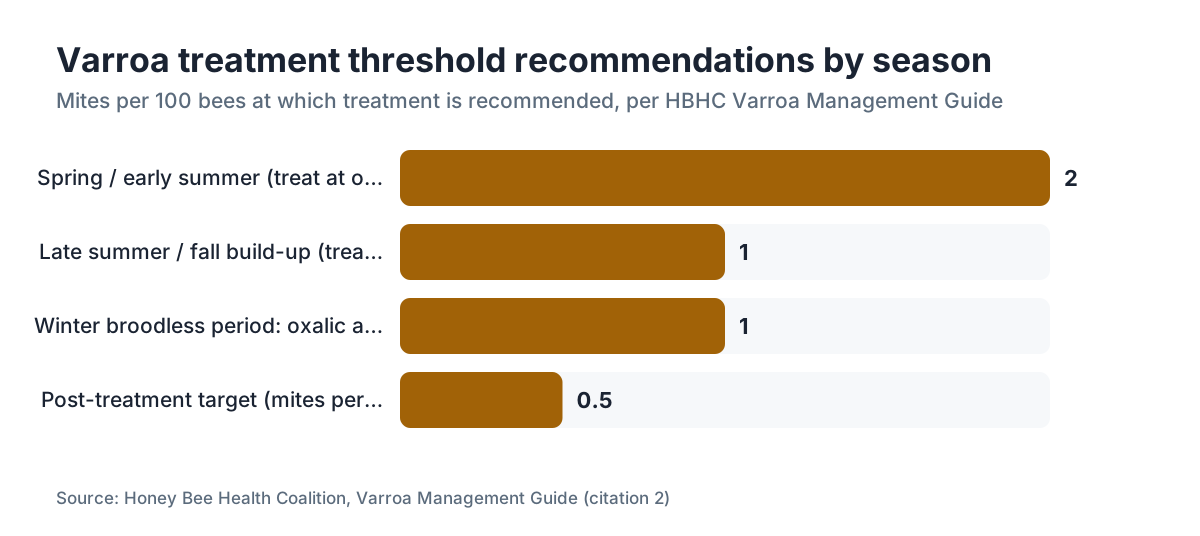
Before you open the box, do an alcohol wash or sugar roll to set your baseline mite load. The Honey Bee Health Coalition's Varroa management guide recommends treating when your mite level reaches 2 mites per 100 bees in spring or summer, or 1 per 100 bees heading into the fall build-up [2]. Treating with any miticide before you know your mite count wastes product and throws away a chance to track resistance.
Installation: wearing nitrile gloves, pull the strips from their foil sachet and hang them vertically between frames in the brood area. Two strips per brood box, one between frames 3-4 and one between frames 7-8 in a 10-frame box. The strips need direct bee contact to work. If your colony is packed into one side of the box, position accordingly.
Leave strips in for at least 6 weeks. Eight weeks is the standard duration in most US extension guidance, because it gives mites that were capped at installation time to emerge and touch the strips [3]. Don't leave strips in past 10 weeks. That's on the label.
After removal, record the treatment date, lot number, and post-treatment mite count. A reduction of 90 percent or more is a rough benchmark for a treatment that worked. If you're not seeing that, you may have an efficacy problem worth chasing down, including possible amitraz resistance.
Never use Apivar with honey supers on. The label is explicit, and this is a food safety issue, more than a suggestion [1].
What are the real risks of amitraz resistance, and how common is it?
Amitraz resistance in Varroa destructor has been confirmed in the United States. A 2017 study published in PLOS ONE identified mutations in the octopamine receptor gene of varroa collected from US colonies, the same kind of mutation tied to amitraz resistance in other mite species [4]. That doesn't mean Apivar has quit working everywhere. It does mean beekeepers who lean on Apivar year after year, cycle after cycle, are breeding for resistant mites.
The practical version: if you do a post-treatment wash and find the mite count barely moved, don't just reach for more Apivar. Report it to your state apiarist. Several university extension programs, including Penn State's and North Carolina State's, track resistance patterns, and your data point matters [3][9].
Rotation is the standard defense. The Honey Bee Health Coalition recommends alternating chemical classes, for example reaching for oxalic acid or Formic Pro in years when you've used Apivar, rather than hammering every cycle with amitraz [2]. This isn't about limiting your options. It's about keeping your options alive five years from now.
Nobody has clean national prevalence data on confirmed amitraz resistance in US bees right now. The closest published work is the 2017 PLOS ONE study and later regional surveys. Anecdotally, beekeepers in areas with high colony density and heavy Apivar use report more treatment failures, but that's anecdote, not surveillance data.
When is the best time of year to use Apivar strips?
Apivar is a warm-season treatment. Amitraz spreads through bee-to-bee contact, and that contact depends on bees being active enough to move around the hive and across the strips. Below about 50°F, bees cluster and stop covering the strips, and efficacy drops. That limitation pushes Apivar toward early spring or late summer in most US climates [3].
The two windows most extension programs recommend:
Spring: after the cluster breaks and brood is expanding, usually when daytime highs stay above 50°F. Spring treatment gets ahead of the exponential mite build-up that tracks summer brood.
Late summer / early fall: after your last honey super comes off and before your winter bees are being raised, roughly late July through mid-September in most of the northern US. This is arguably the bigger window. The bees raised in August and September are the ones that overwinter. If they're mite-damaged, your colony dies in January no matter how strong it looked in October.
Never treat with Apivar when honey supers are on. Amitraz can contaminate honey, and the label prohibition is flat [1].
In the Deep South and parts of California, where brood rearing runs year-round or close to it, the timing math changes. Check with your state extension apiarist for region-specific guidance. The University of Florida IFAS extension and Texas A&M AgriLife both publish state-specific varroa management calendars [6][7].
Can you use Apivar in a nuc or small colony?
Yes, but scale the strip count to the colony size. A standard 5-frame nucleus colony gets one strip, centered in the brood area. The goal is the same: maximum bee contact with the strip surface.
Small colonies have less buffer against high mite loads. If your nuc has gone untreated and you're moving into late summer, check the mite level first. A small colony with a 5-per-100 infestation is in serious trouble, and a single Apivar strip, correct as it is in scale, may not save it if the colony is already sliding.
One thing to watch in nucs: because the bees are more concentrated, a strip can get propolized or wax-coated faster than in a full colony. Check the strip at the two-week mark to make sure it's still exposed and sitting in bee traffic.
What are the alternatives to Apivar, and when should you use them instead?
Apivar isn't the only option, and it shouldn't be. The Honey Bee Health Coalition groups varroa treatments into organic acids (oxalic acid, formic acid), essential oil-based products (thymol, as in ApiLife Var and Apiguard), and synthetic acaricides (amitraz in Apivar, coumaphos in Checkmite+) [2].
Oxalic acid (Api-Bioxal) is the first thing I'd reach for in a broodless winter colony. It hits phoretic mites hard, costs almost nothing, and leaves negligible residue. The catch: it doesn't work well when brood is present, because it can't reach inside capped cells.
Formic acid (Formic Pro, Mite Away Quick Strips) works during honey flows and kills mites under capped brood, which Apivar can't do. The downside is temperature: efficacy drops below 50°F, and the risk of brood and queen damage climbs above 85°F. Narrow window.
Thymol-based treatments (Apiguard, ApiLife Var) work well in the right temperature range (59-69°F) and leave no meaningful residue, but they need a longer treatment period and can trigger absconding if you place them wrong.
Coumaphos (Checkmite+) works, but it carries significant residue concerns in beeswax and documented varroa resistance. Most experienced beekeepers have dropped it as a primary treatment.
The point isn't that Apivar is bad. It's one of the most effective and reliable treatments out there, and it's easy to apply across multiple hives. But rotating treatments matters, and knowing your alternatives makes you a sharper diagnostician when something doesn't work.
What do you do if Apivar strips don't seem to be working?
Do a post-treatment alcohol wash six to eight weeks into treatment, before you pull the strips. If you're seeing less than an 80 to 90 percent drop from your baseline, something is wrong.
First, check your protocol. Were the strips in the right place, in direct contact with bees? Was the colony queenright and actively brooding? Did the temperature stay above 50°F during treatment? Were the strips in for at least six weeks? These explain most treatment failures long before you jump to a resistance verdict.
If protocol checks out, look at the product source. Degraded or counterfeit strips produce exactly this pattern: the colony looks treated, but mite levels hold high. This is one reason sourcing from a verified supplier matters.
If you've ruled out protocol and sourcing, contact your state apiarist. Suspected resistance cases get tracked, and some states have formal reporting processes. Penn State Extension's Varroa management resources include guidance on what to do when treatments fail [3].
Meanwhile, your bees can't wait for a diagnosis. Switch treatment classes. An oxalic acid treatment with Api-Bioxal applied by vaporization can knock down phoretic mites within a few days and buy you time while you figure out what went wrong.
VarroaVault's free varroa tracking tools can help you log baseline and post-treatment counts, so you have real data rather than guesses when you troubleshoot.
What do beekeepers need to know about Apivar labeling and EPA registration?
Apivar is a registered pesticide under the Federal Insecticide, Fungicide, and Rodenticide Act (FIFRA). The EPA-approved label for Apivar in the US carries registration number EPA Reg. No. 72967-1 [1]. The label is a legal document. Using a pesticide in a manner inconsistent with its labeling is a federal violation under FIFRA Section 12 [5].
Key label requirements beekeepers sometimes miss:
- Personal protective equipment: the label requires at minimum chemical-resistant gloves when handling strips. Amitraz absorbs through skin.
- No supers: honey supers must be off before treatment begins and cannot go back on during treatment [1].
- Removal deadline: strips must come out within 10 weeks of installation.
- Disposal: used strips get disposed of according to the label, usually wrapped in their original foil sachets and placed in household trash. Don't burn, compost, or leave them in the hive.
- One treatment per active-ingredient class per season is the label's implied limit. Running Apivar for multiple back-to-back cycles in one season isn't supported by the label and drives resistance selection.
The current Apivar label is available through the EPA's pesticide registration database [1]. Read it. It's four pages and takes about eight minutes.
Where should you actually buy Apivar strips to be safe?
The cleanest path is an established, authorized bee supply retailer. Mann Lake, Dadant, Brushy Mountain (now merged), Kelley Bees, and a handful of regional distributors all carry Apivar and source it through proper channels. These are the beekeeping supply companies that have been in the business long enough to stake their reputation on product quality.
If you prefer Amazon for convenience, narrow your search to sellers who are themselves recognized bee supply retailers with an Amazon storefront. Mann Lake, for one, has an Amazon presence. Buying from them on Amazon isn't meaningfully different from buying off their website. The product ships from the same warehouse.
Your state's beekeeping association or local bee club often negotiates group-buy pricing on Apivar in spring and fall. For a hobbyist with two to five hives, this is genuinely the best option: verified product, group pricing, and the bonus of meeting your local beekeeping community.
For a full look at what to stock before treatment season, the beekeeping supplies overview is a useful starting point.
VarroaVault also keeps a reference list of varroa management tools and vetted suppliers if you want a curated starting point rather than searching from scratch.
Frequently asked questions
Is it safe to buy Apivar strips from Amazon?
It depends entirely on the seller. Apivar from a recognized bee supply retailer running an Amazon storefront is fine. Apivar from an unknown third-party seller with no beekeeping history carries risk of bad storage, near-expired product, or in rare cases counterfeit strips. Always verify EPA Reg. No. 72967-1 on the listing and packaging before use.
How much do Apivar strips cost on Amazon compared to bee supply stores?
A 10-strip pack runs $35 to $55 at most US suppliers, on Amazon or off. Amazon pricing is rarely lower by more than a few dollars, and when it's significantly cheaper, question the expiration date and storage conditions. Bulk packs of 50 strips typically cost $140 to $185 through authorized channels.
How many Apivar strips do I need per hive?
Two strips per standard 10-frame brood box. One strip for a 5-frame nucleus colony. If you're running a double brood box, use two strips per box for a total of four. The strips hang vertically between frames in the center of the brood nest to maximize contact with nurse bees.
How long do Apivar strips stay in the hive?
A minimum of 6 weeks and a maximum of 10 weeks, per the EPA-approved label. Most US extension programs recommend 8 weeks as the standard duration, to give mites emerging from brood that was capped at installation a chance to contact the strips. Remove strips promptly after 10 weeks.
Can I use Apivar when my honey supers are on?
No. The Apivar label explicitly prohibits use when honey supers are present. Amitraz can contaminate honey meant for people. Supers must be off before treatment begins and cannot go back on until treatment is complete and the strips are removed.
What temperature does Apivar work best at?
Apivar needs active bee movement for amitraz to spread through the colony. Efficacy drops sharply when temperatures fall below roughly 50°F. Most US extension programs recommend treating in spring when daytime highs stay above that threshold, or in late summer before fall bees are being raised.
Does Apivar kill mites in capped brood?
No. Amitraz doesn't penetrate capped brood cells. That's why the treatment window needs to span 6 to 10 weeks: mites that were under capped brood at installation need time to emerge, become phoretic, and contact the strips. It's a key difference from formic acid, which has some sub-cap activity.
Can varroa mites become resistant to Apivar?
Yes. Amitraz resistance in Varroa destructor has been documented in US colonies. A 2017 PLOS ONE study identified resistance-linked mutations in the varroa octopamine receptor gene in US samples. Rotating between chemical classes, such as alternating Apivar with oxalic or formic acid treatments, is the standard strategy to slow resistance.
What's the shelf life of Apivar strips, and how should they be stored?
Apivar strips should be stored between 41°F and 77°F in their sealed foil sachets. Shelf life is typically two to three years from manufacture when stored correctly, but the exact expiration date prints on the box. Strips kept in hot, humid conditions degrade faster, which is a real concern with unknown Amazon sellers.
Do I need a license or prescription to buy Apivar in the US?
No. Apivar is a general-use pesticide in the US and does not require a veterinary prescription or pesticide applicator license for hobbyist or sideliner beekeepers using it on their own colonies according to the label. That's different from some other animal medications. Always follow the EPA-approved label regardless.
What should I do with used Apivar strips after I remove them?
Wrap used strips in their original foil sachets and toss them in household trash, per the label. Don't burn them, compost them, leave them in the hive, or place them where children or animals can reach them. Amitraz residue stays on used strips.
How do I know if my Apivar treatment worked?
Do an alcohol wash or sugar roll before treatment to set a baseline mite count, then repeat the test 6 to 8 weeks in, before pulling the strips. A reduction of 90 percent or more in mites per 100 bees is a rough benchmark for success. If reduction is under 80 percent and your protocol was correct, suspect product quality or resistance.
Can I use Apivar in the same season as oxalic acid or formic acid?
Yes, and this is actually recommended for integrated varroa management. A common protocol is an oxalic acid vaporization in the broodless winter period, followed by Apivar in spring or late summer when brood is present. Using different modes of action in the same season isn't a problem and slows resistance.
Where can I find the official Apivar label and usage instructions?
The EPA-approved Apivar label is available through the EPA's pesticide registration database, searchable by EPA Reg. No. 72967-1. Veto-Pharma also publishes the current label on their website. Always read the current label before each treatment season, since label language can change between registrations.
Sources
- US EPA, Apivar pesticide label, EPA Reg. No. 72967-1: Apivar carries EPA Reg. No. 72967-1; label requires strips be removed within 10 weeks, prohibits use with honey supers present, requires chemical-resistant gloves, and mandates storage between 41F and 77F
- Honey Bee Health Coalition, Varroa Management Guide: HBHC recommends treating when mite loads reach 2 per 100 bees in spring/summer or 1 per 100 heading into fall; recommends rotating between chemical classes to slow resistance
- Penn State Extension, Varroa Mite Management: Penn State recommends 8-week Apivar treatment as standard duration; identifies late July through mid-September as critical treatment window for overwintering bee health in northern US
- Mitton GA et al., PLOS ONE 2017, Amitraz resistance in Varroa destructor: 2017 PLOS ONE study identified mutations in the octopamine receptor gene of Varroa destructor collected from US colonies, consistent with amitraz resistance mechanisms
- US EPA, Federal Insecticide Fungicide and Rodenticide Act (FIFRA): FIFRA Section 12 makes it a federal violation to use a registered pesticide in a manner inconsistent with its labeling
- University of Florida IFAS Extension, Varroa Mite Management in Florida: UF IFAS publishes state-specific varroa management timing calendars noting that year-round brood rearing in warm climates changes optimal treatment windows
- Texas A&M AgriLife Extension, Honey Bee Varroa Management: Texas A&M AgriLife provides region-specific varroa treatment calendar guidance for southern US beekeepers
- USDA Agricultural Research Service, Bee Research Laboratory: USDA ARS Bee Research Laboratory conducts ongoing research on varroa resistance mechanisms and miticide efficacy in US honey bee populations
- North Carolina State University Apiculture, Varroa Mite Treatment: NCSU Extension apiculture program tracks amitraz resistance patterns and provides updated treatment failure reporting guidance for North Carolina beekeepers
- Veto-Pharma, Apivar product information: Veto-Pharma is the French manufacturer of Apivar and publishes the current US-approved product label and authorized North American distribution information
Last updated 2026-07-09