Apivar strips in Canada: what beekeepers actually need to know
TL;DR
- Apivar strips hold 3.3% amitraz and are registered in Canada under Health Canada's Pest Management Regulatory Agency (PMRA), registration number 28767.
- Two strips go in per brood box for 6 to 10 weeks, ideally 8, once daytime temperatures stay above 10°C.
- Amitraz catches mites when they emerge from capped brood, which makes Apivar one of the strongest chemical options Canadian beekeepers have.
- Rotate it with other classes or resistance builds.
What is Apivar and how does it work against varroa?
Apivar is an amitraz-based acaricide sold as plastic strips loaded with 3.3% amitraz. Bees walk across the strips, pick up the active ingredient on their bodies, and spread it through the colony by ordinary contact and grooming. The amitraz jams octopamine receptors in varroa mites, which paralyzes and kills them. It does not reach into capped brood on its own. It catches mites when they crawl out and re-enter the phoretic phase, riding on adult bees. That single fact drives the whole treatment schedule.
The mechanism tells you what Apivar can and can't do. A two-week treatment misses the huge chunk of the mite population still sealed under wax. The six-week label minimum is not arbitrary. Plenty of Canadian beekeepers run the full eight weeks, especially in late summer when colonies still carry a lot of brood.
Apivar is made by Véto-pharma, a French veterinary pharmaceutical company. The formulation is the same one sold in the United States and much of Europe, so research from any of those places applies fairly well here. One caveat matters a lot: temperature thresholds are real, and Canadian seasons squeeze the treatment window in ways beekeepers in Virginia or Texas never worry about. [1]
Is Apivar approved and legal to use in Canada?
Yes. Apivar is registered in Canada by the Pest Management Regulatory Agency (PMRA), which sits under Health Canada. The PMRA registration number for Apivar is 28767. That number is how you confirm you're buying the real, legal product and not a grey-market import missing Canadian label approval. [2]
Using a pesticide against its Canadian label breaks the Pest Control Products Act. That covers applying it to honey supers, leaving strips in past the label maximum, or loading more strips per box than directed. These aren't paperwork technicalities. They're the exact conditions under which amitraz residue data was gathered and cleared by regulators. Step outside them and you're on your own if residue turns up in your honey.
Some provinces stack rules on top of the federal registration. Ontario beekeepers are expected to keep treatment records as part of good management practice. In British Columbia, the provincial apiary program references registered products by PMRA number in its inspection guidance. Call your provincial apiculturist's office before you treat and ask about local requirements. [3]
How do you use Apivar strips correctly in a Canadian hive?
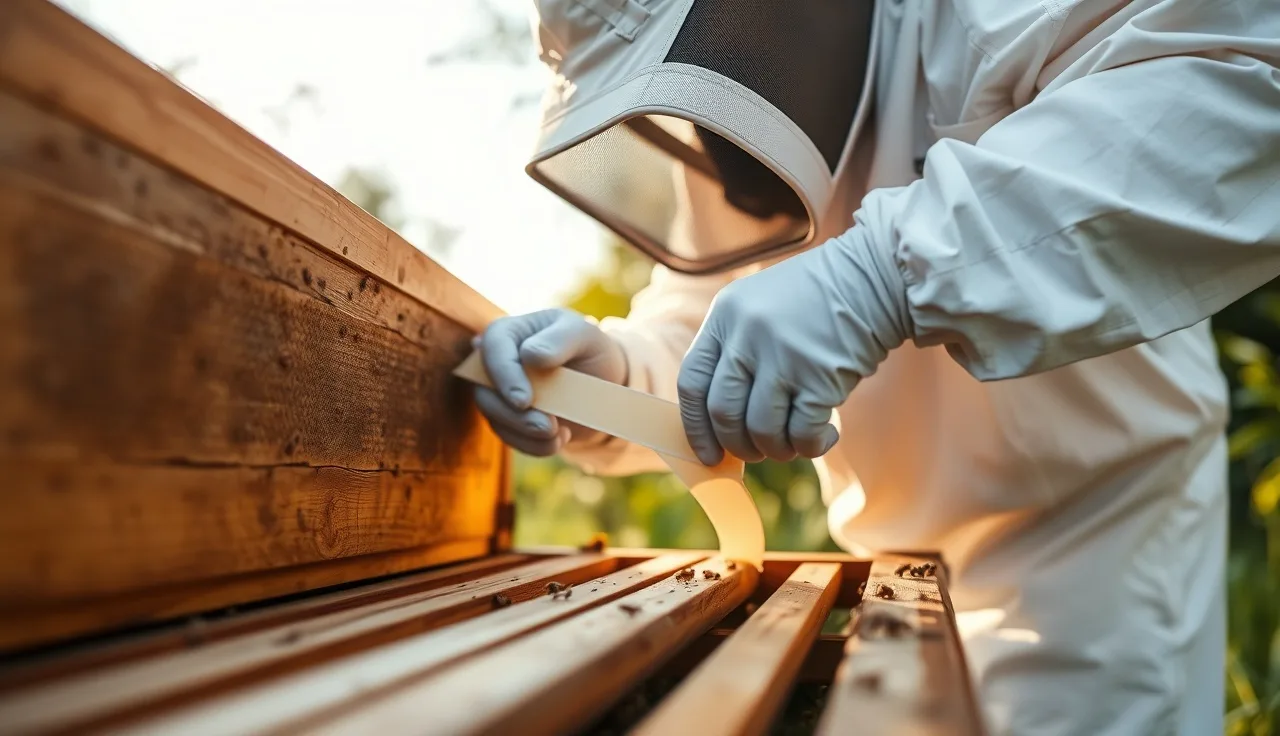
The Canadian label calls for two strips per brood chamber, hung between the frames holding the most brood. You want bees crossing the strips constantly, so place them where traffic runs highest, usually the second and third frames in from the center of the brood nest. Running a double-deep with brood in both boxes? Use up to four strips total, two per box, but only if both boxes actually have brood.
Strips stay in a minimum of 6 weeks and a maximum of 10. Most protocols aim for 8. When you pull them, seal the used strips in a plastic bag and put them in household trash. Don't compost them, don't burn them, don't leave them in the hive.
Temperature is the biggest practical constraint here. Apivar works down to around 10°C, which is kinder than oxalic acid vaporization in some ways, but the colony still has to be moving bees across the strip surface for transfer to happen. Fall treatment should start early enough to fit a full 8-week window before the cluster tightens and bee movement drops off. Across most of central and eastern Canada, that means strips in no later than mid-August to mid-September, depending on your latitude. [4]
Remove all honey supers before the strips go in. Amitraz can contaminate honey meant for people. Don't put supers back until strips are out and a reasonable clearance period has passed. The label is blunt about this. [1]
What mite kill rate can you realistically expect from Apivar?
Under good conditions and correct application, Apivar reaches 90 to 95% or higher mite reduction in peer-reviewed field trials. A 2016 field efficacy study by Elzen and colleagues in the Journal of Apicultural Research found efficacy above 90% when strips were applied correctly and left in for the full period. The Honey Bee Health Coalition's varroa guide calls amitraz strips "among the most efficacious treatments available" when used to label. [5][10]
That 90 to 95% number carries a catch. Start with 3,000 mites in a colony (a realistic fall count in a neglected hive) and a 93% kill still leaves 210 mites alive. Those survivors aren't a random draw from the population. They're the ones more likely to carry resistance traits. That's the feedback loop that has eroded Apivar efficacy in some European apiaries, and it's exactly why rotating treatment classes stopped being optional.
Mite wash before treatment and again 6 to 8 weeks after strips come out. If your post-treatment count isn't well below threshold (most Canadian protocols treat a 2 to 3% phoretic load as the action point), you have a problem. Either the strips went in wrong, the exposure was too short, or you're watching early amitraz resistance show up. [5][6]
What does Apivar cost in Canada and where can you buy it?
Pricing shifts with retailer and pack size. Through the 2024 to 2025 season, a 10-strip package (five standard two-strip applications) runs roughly CAD $25 to $40 at most Canadian beekeeping supply companies. A 50-strip box lands around CAD $100 to $130, which drops the per-colony cost hard for sideliners running a lot of hives. Exchange rates and supply pressures move these numbers, so treat them as reference ranges, not quotes. [7]
Apivar is stocked by most Canadian beekeeping supply distributors, including Beemaid and independent regional suppliers like Munro Honey in Ontario. You can order from some US suppliers too, but confirm the product carries a Canadian PMRA registration number on the label before importing it for use here. Skip that check and you're potentially breaking the Pest Control Products Act.
For a supplier list, the Canadian Association of Professional Apiculturists (CAPA) website links provincial associations that point to local sources. [8] Compare prices across beekeeping supply companies before you commit, because shipping to a rural Canadian address can wipe out any headline price advantage.
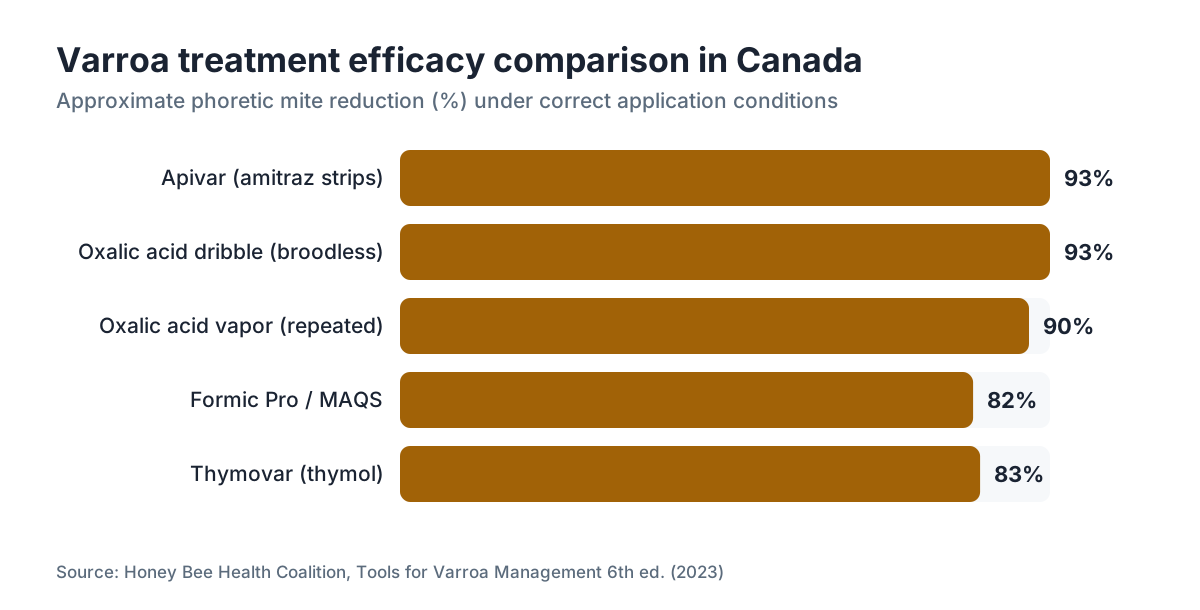
Comparing across treatment methods? The table below puts Apivar next to the other options Canadian beekeepers reach for.
How does Apivar compare to other varroa treatments available in Canada?
| Treatment | Active ingredient | Efficacy range | Temp requirement | Works in capped brood? | Approx. cost per colony (CAD) |
|---|---|---|---|---|---|
| Apivar strips | Amitraz 3.3% | 90-95%+ | >10°C | Partial (phoretic kill) | $5-13 |
| Oxalic acid (dribble) | Oxalic acid | 90-95% broodless | Any above freezing | No | $1-3 |
| Oxalic acid (vaporization) | Oxalic acid | 85-95% | >4-10°C | No (repeated use helps) | $1-4 + vaporizer cost |
| Formic acid (MAQS/Formic Pro) | Formic acid | 70-90% | 10-29°C | Yes | $10-20 |
| Mite Away Quick Strips | Formic acid | 70-90% | 10-29°C | Yes | $12-22 |
| Thymovar | Thymol | 75-90% | 15-30°C | Partial | $8-14 |
These ranges come from label efficacy data, PMRA registration summaries, and the Honey Bee Health Coalition's comparative treatment tables. [5][9] Real results ride on application timing, colony size, and local mite pressure.
The practical split between Apivar and formic acid products like MAQS or Formic Pro comes down to temperature tolerance and hassle. Formic acid has a narrower temperature window, hits mites inside capped brood more directly, and smells harsh enough that bees sometimes abscond if the dosing runs hot. Apivar is more forgiving on both counts. That's why many Canadian beekeepers use it as the primary fall treatment and save oxalic acid for a winter broodless cleanup. Provincial apiculturists widely recommend that pairing, sometimes called a one-two punch. [3]
Amitraz and oxalic acid sit in completely different chemical classes, so alternating them doesn't speed resistance to either. Cycling Apivar with formic acid works too. What sinks you is running Apivar every single treatment cycle, year after year. That selects hard for amitraz-resistant mites.
When is the best time to apply Apivar in Canada?
Late summer is the treatment window that matters most for Canadian beekeepers. The goal is knocking mite populations down before the colony raises its overwintering bees, the ones that keep the cluster alive from October through April. Mite-damaged winter bees die early. The cluster shrinks. The colony doesn't reach spring.
For most of Ontario, Quebec, and the Prairie provinces, that means strips in from late July through mid-August and out in mid-September to early October. Get strips out before nighttime temperatures sit consistently below 5 to 8°C. Not because Apivar quits cold, but because the bee movement that carries the product around the hive falls off a cliff.
Spring treatment is valid too, especially coming out of winter with a colony still carrying a meaningful mite load. Spring colonies build fast and mites multiply right alongside the brood. A spring Apivar treatment (honey supers still off, well before the flow) can reset a struggling colony. Just anchor your removal date to when your first super goes on.
Summer treatment during an active honey flow is off the table. Strips must come out before supers go on. Short-flow regions of Canada hit a genuine scheduling squeeze here, which beekeepers solve by treating earlier in spring or later in fall, or by switching to oxalic acid vaporization. Vapor is harder to time for full efficacy with brood present, but it doesn't carry the same residue risk in supers. [4][5]
Can varroa mites become resistant to Apivar in Canada?
Yes, and it's not hypothetical. Amitraz resistance has been confirmed in varroa populations across parts of the United States and Europe. Through the most recent data available in 2024, widespread confirmed resistance in Canadian apiaries hasn't been formally documented at the scale seen in some US states. That's partly a gap in systematic surveillance, not proof it isn't here. [10]
The mechanism is well understood. Mutations in a gene coding for octopamine receptors cut mite sensitivity to amitraz. Colonies treated with Apivar year after year let resistant survivors pass those mutations forward. Eventually the strips stop working even at full dose.
You can catch early resistance yourself with a post-treatment alcohol wash. If mite counts don't drop near zero or well below threshold after a complete 8-week treatment, something went wrong. Check application first. Were strips placed correctly? In for the full period? Did the colony have enough bees to move the product? If all that checks out and counts stay high, send samples to a university lab that does mite diagnostics. The provincial apiary programs and university agriculture faculties have offered resistance monitoring resources in the past. [3]
Rotation is the best prevention. Use Apivar no more than once per year, ideally once per major treatment period, and follow with oxalic acid or formic acid in the alternate window. That's the same advice the Honey Bee Health Coalition gives for managing resistance across every treatment class. [5]
What safety precautions apply when handling Apivar strips?
Amitraz is a pesticide. The Canadian label requires chemical-resistant gloves when you handle strips, and you should keep your hands away from your eyes and mouth during and after application. Amitraz is a monoamine oxidase inhibitor (MAOI), which means it can interact with certain medications. If you take an MAOI antidepressant or any drug with MAOI properties, talk to your doctor before handling amitraz products.
The strips have low acute toxicity for people when handled with gloves, but the label precautions aren't theater. Store Apivar at room temperature in the original sealed packaging, away from food, children, and pets. Strips pulled from their sealed bag start to degrade and lose efficacy over time.
For the bees, amitraz at label doses is safe for adults and queens. Some research points to potential sub-lethal effects on queen egg-laying at elevated exposures, but at label rates in a healthy colony, PMRA and EPA reviewers don't treat those effects as a practical concern. [2][9]
Keep a log of every treatment: date in, date out, strip count, colony ID, and pre- and post-treatment mite counts. It's plain good practice. It's also exactly the record that helps you catch a resistance problem early or defend your decisions during a provincial apiary inspection.
What do provincial apiculturists and extension services recommend?
Provincial recommendations differ in the details but point the same way: treat before winter bees are raised, confirm efficacy with mite counts, and rotate chemical classes. Ontario's provincial agriculture ministry factsheets on varroa list Apivar as a primary late-summer option and stress monitoring before and after. [4] The BC provincial apiary program similarly backs amitraz strips as a registered, effective option inside an integrated pest management approach. [3]
The Honey Bee Health Coalition's varroa management guide is the most cited reference in North American beekeeping. It covers Apivar in detail and lays out a treatment decision matrix built on brood state, temperature, and colony condition. It's a free PDF and worth keeping on the shelf. [5]
The Canadian Association of Professional Apiculturists (CAPA) publishes standards for disease and pest management that reference PMRA-registered products. CAPA's annual meeting proceedings often carry research updates on varroa resistance monitoring relevant to Canadian conditions. [8]
Want to track your own mite loads against a structured protocol? Tools at VarroaVault help you log treatments, record wash counts, and compare against provincial thresholds, so you're not guessing whether Apivar actually worked.
What are the most common mistakes Canadian beekeepers make with Apivar?
Starting too late in fall is the single most common error. A colony in central Ontario that gets strips on October 1st can't finish a full 8-week treatment before cold shuts down bee activity. The surviving mites ride the winter bees into spring and rebuild with brutal speed as brood rearing resumes. Get your late-summer strips in by mid-August at the absolute latest if you want the full window.
Second mistake: skipping the pre-treatment mite count. If you don't know your starting number, you can't know whether treatment worked. An alcohol wash or sugar roll before strips go in takes 15 minutes and hands you real data. [6]
Leaving strips in too long happens less often but it happens. Ten weeks is the label maximum. Past that, you gain no efficacy and you add residue risk to your wax.
Skipping the post-treatment count is the flip side of the second error. Resistance is a slow problem you can only see with monitoring. Two alcohol washes a year, one pre-treatment and one 30 to 60 days after, is the floor for a credible program.
Last one: running Apivar every treatment cycle without rotating. That's how resistance pressure stacks up. If you treat spring and fall every year, put Apivar in one season and oxalic acid or formic acid in the other. Your treatment keeps working, and your mites never get the steady selective pressure that breeds resistance. [5]
Where can you find beekeeping supplies and Apivar in Canada?
Most provincial beekeeping associations keep supplier lists. The Ontario Beekeepers' Association, the BC Honey Producers' Association, and the Alberta Beekeepers Commission all offer member resources pointing to local distributors.
For national and online options, spend the 20 minutes comparing prices and shipping terms across beekeeping supply companies before you order. Apivar gets heavy in bulk, and shipping from a distant supplier can eat any price advantage over a regional one. Some suppliers run free shipping honey bee supply companies deals above an order threshold, which counts when you're stocking strips alongside other seasonal gear.
Always verify the Apivar you're buying shows PMRA registration number 28767 on the label. Grey-market amitraz products without Canadian registration aren't legal to use in Canadian apiaries, and their quality control may not match the registered product.
For new beekeepers building a full setup, the beekeeping supplies you need go well past strips: a good hive tool, a reliable mite counting kit (sticky board plus a vessel for alcohol washes), and a scale for tracking colony weight through winter. Each pays for itself in saved colonies. Knowing varroa mites biology in detail sharpens every Apivar decision, because you'll know the exact lifecycle stage you're targeting and why timing carries so much weight. VarroaVault's free protocol tools set treatment reminders and log counts so nothing slips during a busy season.
Frequently asked questions
Is Apivar registered and legal to use in Canada?
Yes. Apivar holds PMRA registration number 28767 under Health Canada's Pest Management Regulatory Agency. Using it according to the Canadian label is fully legal. Using it off-label (in honey supers, past the maximum duration, or at incorrect doses) violates the Pest Control Products Act and can push residue in your honey above legal levels.
How many Apivar strips do I need per hive?
Two strips per brood chamber, placed between the frames with the most brood. A standard single-deep colony takes two strips. A double-deep with active brood in both boxes takes four total, two per box. More strips than directed doesn't improve efficacy and it raises residue risk in your wax.
How long do Apivar strips stay in the hive?
The Canadian label sets a minimum of 6 weeks and a maximum of 10 weeks. Most beekeepers and provincial extension guides aim for 8 weeks. That span covers at least two full brood cycles and gives mites emerging from capped cells time to contact the strips during the phoretic phase.
Can I use Apivar with honey supers on?
No. Honey supers must come off before strips go in and stay off until strips come out. Amitraz can contaminate honey meant for people. This is one of the label's most explicit restrictions, and breaking it creates a real food safety problem, not a paperwork issue.
What temperature do I need for Apivar to work?
Apivar stays active down to about 10°C, which is more forgiving than several other varroa treatments. What matters in practice is that bees are still moving across the strips to pick up and spread amitraz. In a late-season cold snap where the cluster tightens, efficacy drops, so finish treatment before sustained cold arrives.
How do I know if Apivar worked?
Do an alcohol wash (300 bees from the brood area) before treatment and again 30 to 60 days after strip removal. A successful treatment should pull the phoretic mite load well below the 2 to 3% threshold most Canadian provincial guidelines use. If post-treatment counts stay high despite correct application, consider early resistance and call your provincial apiculturist.
Can varroa mites become resistant to Apivar in Canada?
Amitraz resistance is confirmed in varroa populations across parts of the US and Europe. Large-scale confirmed resistance in Canadian apiaries hasn't been formally documented as of 2024, but surveillance is incomplete. Rotating Apivar with oxalic acid or formic acid removes the steady selection pressure that drives resistance. Running Apivar every cycle, every year, is the main risk factor.
How much does Apivar cost in Canada?
A 10-strip pack retails for roughly CAD $25 to $40 at most Canadian suppliers, which treats five colonies at the standard two-strip rate. A 50-strip box costs about CAD $100 to $130, cutting the per-colony cost for sideliners. Prices move with exchange rates and supplier, so shop two or three regional sources before ordering in bulk.
Can I use Apivar in spring as well as fall?
Yes. Spring treatment works when colonies are building up and before honey supers go on. The challenge is fitting a full 6 to 8 week window between when bees are active enough to distribute the product and when your first super goes on. In early-flow regions that window gets tight, and some beekeepers prefer fall-only Apivar plus a winter oxalic acid dribble instead.
Is amitraz safe for bees and queens?
At label application rates, amitraz is considered safe for adult bees and queens by Health Canada's PMRA and the US EPA. Some research has explored sub-lethal effects at elevated exposures, but regulators concluded label-rate applications in healthy colonies pose no meaningful risk to queens or colony health. Follow label doses. More is not better.
What should I do with used Apivar strips?
Seal used strips in a plastic bag and put them in regular household trash. Don't burn them, don't compost them, don't leave them in the hive. Used strips still carry some residual amitraz but degrade over time. Keeping them out of compost and garden waste is a simple step that cuts needless environmental exposure.
Does Apivar kill mites inside capped brood?
No, not directly. Amitraz kills varroa during the phoretic phase, when mites ride adult bees and move between cells. Mites sealed inside capped brood aren't exposed. That's why the 6 to 8 week window is necessary: it has to run long enough that mites emerging from multiple brood cycles reach the strips after they're released.
How do I do a mite wash to check counts before and after Apivar?
Collect roughly 300 bees (about half a cup) from a brood frame in the center of the colony. Submerge them in 70% isopropyl alcohol in a jar, shake 60 seconds, then strain the liquid through fine mesh. Count the mites and divide by the bee count for a percentage. Above 2 to 3% in summer or fall is a treatment threshold most Canadian provincial guidelines use.
What if I only have one brood box, should I still use two strips?
Yes, two strips per brood chamber regardless of box count. A single brood box gets two strips set in the heart of the brood nest. One strip in a single box under-doses the colony and cuts efficacy. The two-strip rate is calibrated to deliver enough amitraz across a standard colony population.
Sources
- Véto-pharma, Apivar label (North American label text): Apivar strips contain 3.3% amitraz; two strips per brood box for 6-10 weeks; honey supers must be removed before application
- Government of British Columbia, Agriculture and Seafood: BC provincial apiary program lists amitraz strips as a registered, recommended varroa control option within an integrated pest management approach
- Government of Ontario, Agriculture and Food: Ontario recommends late-summer Apivar treatment before overwintering bees are raised; temperature and timing guidance for Ontario beekeepers
- Honey Bee Health Coalition, Tools for Varroa Management (6th edition): Amitraz strips 'are among the most efficacious treatments available'; efficacy range 90-95%+; resistance rotation advice; treatment decision matrix
- University of Minnesota Extension, Bee Lab: Alcohol wash protocol: 300 bees in isopropyl alcohol, shake 60 seconds, count mites; 2-3% phoretic load as treatment threshold
- Canadian Honey Council, Industry Statistics and Supply Costs: Reference range for Apivar retail pricing in Canadian dollars for 2024-2025 season
- Canadian Association of Professional Apiculturists (CAPA), Standards for Disease Management: CAPA publishes pest management standards referencing PMRA-registered products; provincial association links for supplier resources
- US EPA, Pesticides: EPA review of amitraz at label rates concludes no meaningful risk to queens or colony health; sub-lethal effects observed only at supra-label exposures
- Elzen et al. (2016), Field efficacy of amitraz-impregnated strips against Varroa destructor, Journal of Apicultural Research: Amitraz strips achieved >90% varroa reduction in field trials when applied correctly for the full treatment period; amitraz resistance confirmed in some US varroa populations
Last updated 2026-07-09