Apivar strips instructions: the complete how-to guide
TL;DR
- Apivar strips contain 3.33% amitraz.
- Use 2 strips per brood box, hung between frames where bees cluster, for 6 to 10 weeks.
- Pull every strip before honey supers go on.
- Retreat with a different product if your mite wash stays above 2% after treatment.
- The label range is roughly 50°F to 105°F, so it works when the weather is too cool for most other treatments.
What is in Apivar strips and how does it kill varroa?
Apivar strips are polyethylene strips loaded with amitraz at 3.33% (500 mg per strip). Amitraz is an acaricide in the formamidine class, so it works differently from oxalic acid or formic acid. It binds to octopamine receptors in the varroa mite's nervous system, causing paralysis and death [1].
Bees pick up amitraz residue as they walk across the strip. They spread it through the colony by normal grooming and contact. That contact transfer is why placement matters so much. If bees aren't walking on the strip, the active ingredient never reaches most of the mites.
Amitraz does not vaporize at hive temperatures, so it is not a fumigant. It also isn't water-soluble the way oxalic acid is, which means rain and high humidity won't wash it out. The downside: it builds up in wax over repeated treatments, so rotating with other classes matters.
The EPA-registered label for Apivar (registration number 89459-1) sets the 3.33% concentration. That label is the legal document governing use in the United States. Any deviation from it, including leaving strips in past 10 weeks or using more strips than directed, is an off-label violation [2]. Read it before you start.
When is the right time to use Apivar strips?
The two best windows are late summer or early fall right after you pull honey supers, and late winter or early spring before supers go back on. Both share the same logic. No supers in the hive, brood volume is manageable, and there's time to run a full 6 to 10 week course before the next nectar flow or the winter cluster forms.
The late-summer treatment is the one that matters most for beekeepers in North America. Mite populations peak in August and September as bee numbers drop. The bees raised in August and September are the long-lived winter bees that carry the colony to spring. If those bees emerge carrying varroa-transmitted viruses, deformed wing virus especially, the colony dies over winter even when your October counts looked fine [3].
Apivar has a temperature advantage over formic acid and oxalic acid vapor. The label allows use from about 50°F to 105°F, so a late-fall or early-winter treatment still works in most climates as long as the cluster is moving on the frames [2]. Oxalic acid dribble also works in winter, but only when there's no brood. Apivar works with sealed brood present because amitraz penetrates capped cells somewhat, though it kills fewer mites inside cells than phoretic mites riding on adult bees.
Here's the timing in plain terms. Treat before July 15 if you're in a heavy mite-pressure region and want to protect your summer honey bees. Treat after your last super comes off, no later than mid-September in most northern climates, to protect your winter bees. A spring treatment before the first super goes on can reset a colony that came through winter with climbing counts.
How many Apivar strips do you use per hive?
The label calls for 1 strip per 5 frames of bees, with a minimum of 2 strips per colony no matter how small [2]. A standard 10-frame Langstroth deep with a good-sized colony gets 2 strips. A double-deep, or a colony that has spread into two brood boxes, gets 2 strips per box, so 4 strips total.
Don't guess at colony size. Pull frames and count the ones covered in bees. Six frames of bees in a single box still means 2 strips. Eleven to fifteen frames of bees across two boxes means 4 strips.
Nucleus colonies also get 2 strips minimum. A 5-frame nuc gets 2. With a single strip, bees push it to the side and ignore it. Two strips means they run into the treatment more often.
Small boxes (8-frame equipment, top-bar hives, Warré boxes) don't change the math much. Count occupied frames, divide by 5, round up to a whole number, and never drop below 2. A top-bar hive with 7 or 8 occupied bars gets 2 strips.
Some beekeepers trim a strip to fit a 5-frame nuc, but the label doesn't formally allow that. If your equipment is non-standard, contact the manufacturer (Veto-Pharma) or your state apiarist before you cut anything.
Where do you place Apivar strips inside the hive?
Placement is the most-botched part of Apivar use. Strips go between frames in the brood nest, not at the edges of the box. You want them in the middle third of the cluster so bees contact them all day [2].
In a single-box colony, hang the two strips in the middle of the brood area, roughly at frame positions 4 and 7 out of 10. Each strip hangs between two frames with the tab hooked over the top bar. The strip should reach down into the bee space without touching the bottom board. Touch the floor and the bees will propolize or wax it down, which cuts contact.
In a two-box colony, put one strip in each box, again centered in the brood. If brood is only in the lower box, both strips go there, but shift them apart so they're not side by side.
One thing trips people up. As the population shifts during treatment, check at week 3 or 4 that the strips still sit inside the active cluster. Bees sometimes pull their cluster away from a poorly placed strip, especially in fall. Move the strip if that happens.
Don't lay strips flat on comb. The goal is strips hanging in the bee space between frames, where foragers and nurse bees walk constantly.
How long do you leave Apivar strips in the hive?
The label says a minimum of 6 weeks and a maximum of 10 [2]. The 6-week floor exists because varroa spend roughly 12 days sealed inside brood cells. You need at least two full brood cycles for amitraz to reach mites that were capped in cells during the early weeks of treatment.
Most experienced beekeepers leave strips in for 8 weeks. Eight weeks catches every major brood cycle and gives the amitraz concentration time to peak and do its work. Pulling at exactly 6 weeks can leave mites alive if the colony had a lot of sealed brood when you started.
Don't leave strips past 10 weeks. The amitraz degrades and the strip stops working, and worse, prolonged exposure selects for resistant mites faster. Resistance is already documented in parts of the U.S. [4], and dragging out exposure speeds it up.
Mark your calendar the day you install strips. Set a phone reminder. Beekeepers lose track of treatment dates more often than you'd think, and it gets harder with every extra hive.
Can you use Apivar with honey supers on?
No. The label flatly prohibits use when honey supers meant for human consumption are on the hive [2]. Amitraz and its breakdown products contaminate honey. The main metabolite, DMPF (2,4-dimethylphenylformamide), turns up in honey and beeswax in studies tracking residue from repeated treatment cycles [5].
Pull all supers before you install strips. Don't add supers while strips are in. Wait until every strip is out before supers go back on. The label sets no waiting period between strip removal and super placement, but a day or two of airing out is sensible.
Sometimes a late-summer treatment collides with an early fall flow, and you face a real choice: rush the harvest, skip treatment and eat the mite pressure, or treat and give up the fall honey. For colony survival, treating and protecting your winter bees is almost always right. A colony dead in February costs far more than one honey harvest.
Equipment planning tends to run alongside treatment timing. If you're sorting out your setup, the list of beekeeping supply companies that carry Apivar and monitoring gear is handy to keep.
How do you monitor mite levels before and after treatment?
Always run a mite wash (alcohol wash or sugar roll) before you install Apivar. It confirms treatment is warranted and sets your baseline. The Honey Bee Health Coalition's Varroa management guide recommends an action threshold of 2 mites per 100 bees (2%) for most of the season, dropping to 1% or lower heading into late summer to protect winter bees [3].
To run an alcohol wash: collect about 300 bees (roughly half a cup) from a brood frame, avoiding the queen, into a jar with 70% rubbing alcohol. Shake for one minute. Pour through a mesh screen into a white tray. Count the mites, divide by the number of bees you collected, and multiply by 100 for your percentage [3].
After treatment, run a follow-up wash 1 to 2 weeks after you pull the strips. A count still above 2% points to one of three things: poor strip placement, an amitraz-resistant mite population, or heavy reinfestation from neighboring colonies. When counts stay high after a properly done Apivar treatment, switch to a different mode of action for the next round instead of running amitraz again.
The varroa mite biology article on this site walks through the full mite lifecycle and why brood cycle timing drives treatment efficacy.
VarroaVault's free mite-tracking tools log counts across hives and flag colonies that spike above threshold. That gets useful once you're past four or five hives and can't hold every count in your head.
What are the most common Apivar application mistakes?
Hanging strips at the edges of the box instead of the brood center is the single most common error. A strip between frames 1 and 2 in a 10-frame box barely gets touched. Bee traffic is heaviest in the middle of the cluster.
Underdosing a large colony is a close second. A double-deep colony in late July with brood in both boxes needs 4 strips, not 2. Too few strips doesn't just leave mites alive. It creates sublethal amitraz exposure that speeds up resistance.
Leaving strips in too long because you forgot to pull them does real harm. Mark the date. Pull on schedule.
Using Apivar with honey supers on breaks the label and creates a food safety problem. No exceptions.
Skipping monitoring leaves you blind. You don't know if the treatment was needed, and you won't know if it worked.
Rotating treatment classes is the last piece. If Apivar has been your primary treatment for two or three years running, test for amitraz resistance (post-treatment counts that won't drop) and rotate to oxalic acid, formic acid, or hop beta acids (Hopguard). The Honey Bee Health Coalition recommends rotating chemical classes to slow resistance [3].
What do you do with used Apivar strips after removal?
Seal used strips in a plastic bag and throw them in household trash. Don't compost them, burn them in the open, or leave them on the ground near your hives. Amitraz is toxic to dogs and some other animals, and there are documented cases of dog poisoning from discarded varroa strips [6].
Don't reuse strips. After 6 to 10 weeks in a hive, the amitraz has degraded enough that efficacy drops way off. Reusing them exposes mites to sublethal doses, which is exactly the condition that breeds resistance.
Keep unused strips in their original packaging, out of direct sun, at room temperature. The label spells out storage conditions. Strips that spent time in a hot truck or a freezing garage may lose efficacy before the expiration date.
How does Apivar compare to other varroa treatments?
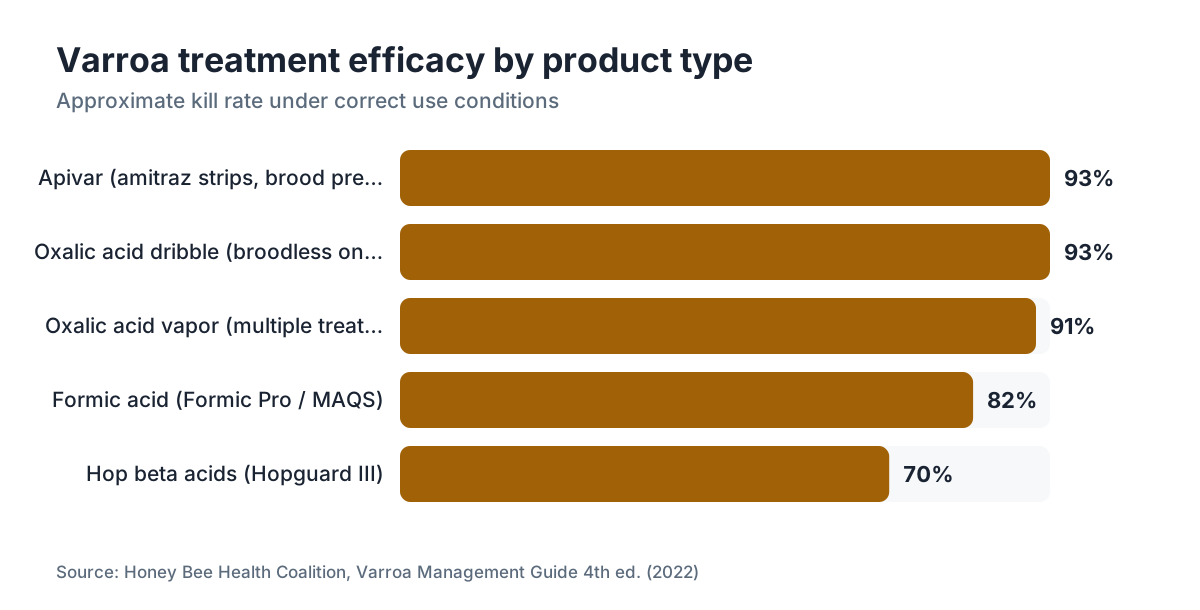
The four registered treatment categories in the U.S. are amitraz (Apivar), oxalic acid (Api-Bioxal and others), formic acid (Mite-Away Quick Strips, Formic Pro), and hop beta acids (Hopguard III). Each has a real niche.
| Treatment | Active ingredient | Works with brood? | Temperature range | Honey supers allowed? | Typical efficacy |
|---|---|---|---|---|---|
| Apivar | Amitraz 3.33% | Yes (moderate in cells) | 50°F to 105°F | No | 90-95% when applied correctly [7] |
| Api-Bioxal (dribble) | Oxalic acid | No (broodless only) | 40°F to 59°F ideal | No (for dribble) | 90-95% broodless [3] |
| Api-Bioxal (vaporizer) | Oxalic acid | Partial with repeat apps | 40°F+ | No (check label) | 90%+ with multiple treatments [3] |
| Formic Pro / MAQS | Formic acid | Yes, kills in-cell mites | 50°F to 84°F max | MAQS: yes at low dose | 75-90% varies by temp [3] |
| Hopguard III | Hop beta acids | Limited | Above 50°F | Yes (check label) | 60-80%, best as rotation tool [3] |
Apivar's strengths are reliability across a wide temperature range, kill with brood present, and predictable results when used right. Its weaknesses are the no-supers restriction, the growing resistance problem, and wax residue that builds over years.
Formic acid (Formic Pro or MAQS) is the only registered treatment that kills mites inside capped cells at a meaningful rate, and it can go on with supers at lower doses (check the specific label). The catch is a narrow temperature window. Above 84°F it can kill queens and cook brood, so summer use in warm climates is a gamble.
Oxalic acid dribble is cheap and highly effective, but only in broodless colonies. It's the standard for a late-fall or midwinter treatment up north when the cluster is tight and broodless.
The honest answer: most serious beekeepers run more than one class per year. A typical protocol is Apivar in late summer after supers come off, then oxalic acid dribble in December during the broodless stretch. That hits mites twice with two modes of action and keeps resistance pressure down.
Is Apivar safe for bees, queens, and brood?
At label rates, Apivar has a good safety record for adult bees and queens. The amitraz dose is calibrated to kill mites while bees tolerate it, because bees carry far fewer octopamine receptors than mites do [1].
Still, some beekeepers report queen loss during Apivar treatment. The published research is mixed, and no large controlled study has proven Apivar causes supersedure at higher rates than in untreated colonies. If you keep losing queens during treatment, check that strips aren't jammed against the cluster center where the queen spends her time, and confirm you're not overdosing.
Amitraz isn't approved for brood areas destined for cut-comb or chunk honey, because wax residue becomes an issue there. For beekeepers producing extracted honey, residue from one or two annual treatments stays well below the European Union maximum residue limit of 200 micrograms per kilogram [5], though the U.S. sets no formal tolerance for amitraz in honey.
Brood damage at label rates is rare. The real brood risk comes from overdosing or from contact with agricultural amitraz products like cattle tick treatments, which are far stronger than Apivar strips.
How much do Apivar strips cost, and where do you buy them?
Apivar sells in packs of 10 strips and packs of 50. As of 2024, a 10-strip pack runs roughly $25 to $35 depending on the supplier, enough for 5 colonies at 2 strips each [8]. The 50-strip pack costs less per strip, usually $95 to $120, and makes sense once you're running more than 10 hives.
Most major beekeeping supply companies stock it. If you're comparing sources, many beekeeping supply companies carry it year-round, though regional suppliers sometimes run dry in late summer when demand peaks.
No prescription is needed in the U.S. for amitraz as Apivar strips. It's an EPA-registered pesticide sold over the counter for apiary use. Some states add their own rules, so check with your state department of agriculture if you're unsure.
Cost per colony per cycle runs roughly $5 to $10 for a standard 2-strip application. That's one of the more affordable registered treatments. Oxalic acid dribble costs less per application, but it needs broodless conditions that won't always line up with your calendar.
What does the Honey Bee Health Coalition say about Apivar use?
The Honey Bee Health Coalition (HBHC), whose Varroa management guide is one of the most-referenced practical documents in U.S. beekeeping, lists amitraz strips as an effective treatment for colonies with brood present. The guide, now in its fourth edition as of 2022, calls for rotating treatment classes and monitoring mite levels before and after any chemical treatment [3].
The guide states plainly that "No single management method can be used exclusively to manage varroa," and it recommends beekeepers combine monitoring, genetic selection, and targeted chemical treatments rather than lean on one product forever [3]. That isn't a knock on Apivar. It's how resistance management works.
The coalition also says to treat when monitoring shows counts over the economic threshold, not on a fixed calendar. Unnecessary treatments speed up resistance without protecting colonies that aren't under pressure.
University extension programs echo the HBHC guidance. Penn State Extension's varroa resources and the University of Minnesota Bee Lab materials both list amitraz strips as a primary treatment tool under the same conditions: no supers, correct dosing, and post-treatment monitoring [9][10].
Frequently asked questions
Can I put honey supers back on immediately after removing Apivar strips?
The Apivar label sets no mandatory waiting period between strip removal and super placement, but most extension programs suggest at least a day or two. Amitraz degrades fairly quickly once the strips are out. The firm rule is that supers cannot be on while strips are in. Once strips are fully removed, the main residue concern shifts to wax rather than honey made after removal.
What temperature is too cold to use Apivar?
The Apivar label sets the lower bound at roughly 50°F. Below that, bee activity drops enough that contact transfer of amitraz across the colony slows and efficacy falls. In practice, if bees are still moving on the frames and forming a loose cluster, a fall treatment can work. If the colony is in a tight winter ball barely moving, wait for a warmer stretch or use oxalic acid dribble if the colony is broodless.
How do I know if Apivar treatment worked?
Run an alcohol wash 1 to 2 weeks after you pull the strips. Your count should sit below 1 to 2 mites per 100 bees. If a correctly dosed, correctly placed treatment leaves you above 2%, you may have amitraz-resistant mites or heavy reinfestation from neighbors. Either way, running Apivar again is not the fix. Switch to a different active ingredient and hunt down the source of the high counts.
Can Apivar strips harm dogs or other pets?
Yes. Amitraz is toxic to dogs. Signs of amitraz poisoning include sedation, low heart rate, low blood glucose, and vomiting. Seal used strips in a bag and put them in household trash right after removal. Don't leave used strips on the ground or in open compost. Keep children and dogs away from hives during treatment and away from any discarded strips.
Can I use Apivar in a top-bar or Warré hive?
Yes, with some adaptation. The dosing principle holds: 1 strip per 5 frames of bees, minimum 2 strips. In a top-bar hive you hang strips in the bee space between bars in the active brood area, with the tab hooked over the bar. Confirm strips hang freely and aren't wedged against comb. No honey comb should sit adjacent if that honey is meant for eating, the same super rule that applies to Langstroth hives.
What is the difference between Apivar and Apistan?
Both are strip treatments for varroa with different active ingredients. Apivar contains amitraz (3.33%). Apistan contains tau-fluvalinate (10%). Tau-fluvalinate resistance in varroa is widespread, so Apistan efficacy is poor across much of North America and Europe. Amitraz resistance is less common but growing. Most current extension guidance does not recommend Apistan as a primary treatment because of resistance.
Can I use Apivar while queens are being raised or mated?
Apivar can go on during the active season, but if you have open queen cells or newly mated queens, work the colony minimally. There are anecdotal reports of higher queen loss during Apivar treatment, though controlled research hasn't confirmed causation. If you're rearing queens in a colony, some beekeepers wait until queens are laying before starting a course. Mite pressure is a real threat to young queens too, so don't stall forever.
Does Apivar kill mites inside capped brood cells?
Partially. Amitraz penetrates capped cells somewhat, but it kills far fewer mites in sealed brood than phoretic mites on adult bees. That's why the minimum duration is 6 weeks. You need enough time for newly emerged bees to carry amitraz residue to mites that were sealed in cells early on and then emerged as phoretic mites later in the treatment.
How often can I use Apivar in the same hive per year?
The label allows two treatments per year. Most beekeepers do one or two: a late-summer treatment after supers come off, and sometimes a spring treatment before supers go on. Running Apivar more than twice a year in the same colony is off-label and speeds up resistance. If you need more than two treatments a season, your monitoring or your colony management needs a hard look.
What should I do if my mite counts are still high after Apivar treatment?
First confirm strips were placed correctly and left in the full 6 to 10 weeks. If so, you likely have one of three problems: amitraz-resistant mites, heavy reinfestation from neighboring feral or poorly managed colonies, or a new swarm that moved in. Switch to a different class (oxalic acid or formic acid) next time. If reinfestation is the cause, no product will win without addressing the source.
Do I need a prescription to buy Apivar in the United States?
No. As of 2024, Apivar sells over the counter as an EPA-registered apiary pesticide. You don't need a veterinary prescription to buy or use it for varroa in your own hives. Some states have extra pesticide-use registration rules for beekeepers, so check with your state department of agriculture if you're running more than a few hives commercially.
Can I treat a package or new swarm with Apivar?
Yes. New packages and swarms can take Apivar once they've drawn comb and the queen is laying. A package with no brood yet carries mostly phoretic mites and responds well to oxalic acid dribble, which is cheaper. But if you're standardizing on Apivar, treating a new package after frames are drawn and brood is present works fine at the standard 2-strip minimum.
What is amitraz resistance in varroa and how common is it?
Amitraz resistance happens when mites survive exposure through genetic mutations in their octopamine receptor genes. It has been confirmed in apiaries in the United States, Europe, and South America. A 2020 study in the journal Scientific Reports confirmed resistant populations in multiple U.S. states [4]. Resistance is still less widespread than tau-fluvalinate resistance, but rotating classes and doing post-treatment monitoring are the practical responses.
Sources
- Veto-Pharma, Apivar EPA-Registered Label (EPA Reg. No. 89459-1): Apivar strips contain 3.33% amitraz (500 mg per strip); amitraz acts on octopamine receptors causing mite paralysis and death
- EPA, Apivar Pesticide Label (Reg. No. 89459-1) via National Pesticide Information Retrieval System: Label specifies 1 strip per 5 frames of bees, minimum 2 strips, 6 to 10 week treatment duration, no use with honey supers present, temperature range approximately 50 to 105 degrees F
- Honey Bee Health Coalition, Varroa Management Guide, 4th Edition (2022): Action threshold of 2 mites per 100 bees recommended; rotation of treatment classes advised; no single method sufficient for long-term varroa management; oxalic acid 90-95% effective in broodless colonies; formic acid 75-90% efficacy
- Scientific Reports, 'Amitraz resistance in Varroa destructor populations', 2020: Amitraz-resistant varroa populations confirmed in multiple U.S. states
- European Food Safety Authority (EFSA), 'Maximum residue levels for amitraz in honey', EFSA Journal: EU maximum residue limit for amitraz and metabolite DMPF in honey is 200 micrograms per kilogram; amitraz metabolites including DMPF detected in honey and beeswax after repeated treatment cycles
- ASPCA Animal Poison Control Center, amitraz toxicity in dogs: Amitraz is toxic to dogs; documented cases of dog poisoning from discarded varroa treatment strips
- University of Florida IFAS Extension, 'Varroa Mite Control in Honey Bee Colonies': Apivar (amitraz strips) efficacy approximately 90-95% when applied correctly per label instructions
- Dadant & Sons, Apivar pricing 2024: Apivar 10-strip pack retails for approximately $25 to $35; 50-strip pack approximately $95 to $120 from major U.S. suppliers in 2024
- Penn State Extension, 'Managing Varroa Mites in Honey Bee Colonies': Amitraz strips listed as primary treatment tool with conditions: no honey supers, correct dosing, post-treatment monitoring
- University of Minnesota Bee Lab, varroa management resources: Amitraz strips recommended with same conditions as HBHC guidance; rotation emphasized to slow resistance
- USDA AMS National Honey Board, honey production and colony loss data 2023: Varroa mite cited as primary factor in U.S. colony losses; treatment timing relative to winter bee rearing critical for overwinter survival
Last updated 2026-07-09