Apivar strips safety data: what the SDS actually tells you
TL;DR
- Apivar strips contain 3.3% amitraz on a polymer matrix.
- The Safety Data Sheet classifies amitraz as harmful if swallowed or absorbed through skin, requires nitrile gloves and eye protection during handling, and mandates storing strips away from food, feed, and children.
- The EPA-registered label (EPA Reg.
- No.
- 64771-4) is the legal use document; the SDS covers worker safety separately.
What is the Apivar SDS and where do you find the official version?
The SDS (Safety Data Sheet, formerly called an MSDS under the old OSHA HazCom 1994 standard) is a 16-section document that describes the hazards of a chemical product, how to handle it safely, what to do in an emergency, and how to dispose of it legally. For Apivar, the current SDS is published by Veto-Pharma, the French manufacturer, and distributed through its North American partners. [1]
The fastest way to get the correct version is to search "Apivar SDS Veto-Pharma" or go directly to the Veto-Pharma website. Bee supply distributors like Mann Lake and Dadant also host it. Always check the revision date in Section 1 of the document. The version in circulation as of 2024 carries an amitraz concentration listed as 3.33% w/w. If the sheet you have shows a different concentration, it may be an older or foreign-market formulation and you should get the current one. [1]
One important distinction: the SDS is not the same as the EPA-registered product label. The label (EPA Reg. No. 64771-4) is the legal use document that tells you how many strips to use, for how long, and in what colonies. The SDS is about worker safety during handling. You need both, and they complement each other. [2]
What is the active ingredient in Apivar and how hazardous is amitraz?
Apivar strips contain amitraz at 3.33% w/w on a plastic polymer matrix. Each strip holds approximately 500 mg of amitraz. Amitraz is a formamidine acaricide that works by binding to octopamine receptors in the varroa mite's nervous system, causing hyperexcitation and death. It does not work the same way in mammals, but it is still toxic if you get enough of it. [3]
The SDS classifies amitraz under GHS (Globally Harmonized System) hazard categories as: harmful if swallowed (Category 4), harmful in contact with skin (Category 4), and harmful if inhaled (Category 4). That's a "Warning" signal word, not "Danger," which puts it in the lower tier of acute toxicity but not zero risk. The oral LD50 in rats is approximately 600-800 mg/kg, which is moderate toxicity by regulatory standards. [3]
Amitraz is also a known alpha-2 adrenergic agonist in mammals and can cause sedation, low blood pressure, and bradycardia in accidental exposures. Children and pets (especially dogs) are more sensitive. There are documented veterinary cases of amitraz poisoning in dogs via tick collar products, which contain much higher concentrations than Apivar strips, but the mechanism is the same. [3]
For environmental hazard: amitraz is classified as very toxic to aquatic organisms with long-lasting effects. That matters for disposal, which the SDS addresses in Section 13. Amitraz is a real chemical with real risks at sufficient exposure. At 3.33% on a solid strip, though, the exposure risk during normal hive treatment stays manageable with the right PPE.
What PPE does the Apivar SDS require when handling strips?
Section 8 of the Apivar SDS covers exposure controls and personal protection. The requirements are straightforward and honestly not that burdensome. [1]
Hands: chemical-resistant gloves, specifically nitrile or neoprene. Latex is not recommended because amitraz can permeate it more readily. Most beekeepers already wear nitrile gloves for hive work, so this is usually a non-issue.
Eyes: safety glasses or chemical splash goggles. The product is a solid strip, so splash risk is low during normal insertion, but if you're cutting strips or handling damaged ones, eye protection matters.
Body: standard protective clothing. The EPA label separately recommends long sleeves and long pants. Your normal bee suit covers this.
Respiration: the SDS does not require a respirator for normal outdoor use because amitraz vapor pressure at ambient temperatures is very low. If you're working in a confined space (like an enclosed barn) with many strips simultaneously, consider a half-face respirator with organic vapor cartridges. Most hobbyist beekeepers treating outdoors don't need one.
The EPA label language on PPE is: "Wear chemical resistant gloves... and protective eyewear." That's the legally enforceable requirement for registered use. The SDS adds the underlying toxicological rationale. [2]
Practically speaking: put on your nitrile gloves before you open the package, keep strips away from your face, and wash your hands thoroughly after. That covers 95% of what the SDS is asking you to do.
What are the first-aid procedures if someone is exposed to Apivar or amitraz?
Section 4 of the SDS covers first aid. These are the recommended responses by exposure route. [1]
Skin contact: remove contaminated clothing immediately, wash the affected area with soap and water for at least 15 minutes. If irritation persists, seek medical attention. Don't underestimate skin absorption; amitraz does penetrate skin, just slowly at low concentrations.
Eye contact: flush immediately with large amounts of water for at least 15 minutes while holding eyelids open. Remove contact lenses if present and easy to do. Get medical attention.
Inhalation: move the person to fresh air. If breathing is labored or the person is unconscious, call emergency services. Amitraz vapor at room temperature from a single packet is unlikely to cause inhalation injury outdoors, but in an enclosed space with many open packages, symptoms could include headache and dizziness.
Ingestion: this is the serious one. Do not induce vomiting. Call Poison Control immediately: in the US, the number is 1-800-222-1222 (available 24 hours). The SDS recommends rinsing the mouth with water. Get medical help fast. Keep the product container or SDS with you when you call so the medical team knows exactly what was ingested. [4]
One real note here: the antidote for amitraz poisoning in mammals is atipamezole (an alpha-2 adrenergic antagonist), sometimes used by veterinarians in dog exposures. Human cases are rarer but the clinical management is supportive. If you suspect significant exposure in a child, don't wait for symptoms. Call Poison Control now.
How should Apivar strips be stored and how long do they last?
Section 7 (handling and storage) and Section 10 (stability and reactivity) of the SDS give you the storage requirements. [1]
Store Apivar in the original sealed packaging, in a cool, dry, well-ventilated area away from direct sunlight. The recommended temperature range is between 0°C and 30°C (32°F to 86°F). Heat accelerates amitraz degradation, so a hot truck cab or a greenhouse is a bad storage location.
Keep strips away from food, feed, and drinking water. This is both an SDS requirement and basic common sense for any pesticide. Store in a locked cabinet if children are in the household.
Shelf life: Veto-Pharma states a shelf life of 3 years from the date of manufacture when stored correctly. The expiration date is printed on the packaging. [1] Using expired strips is more than a safety question; amitraz degrades over time, and efficacy data on expired product is thin. I wouldn't use strips more than a few months past expiry.
Do not store opened packages of strips for reuse between seasons if you can avoid it. Amitraz off-gases slowly from exposed polymer, and the open package starts losing active ingredient concentration. If you have half a package left, seal it in an airtight bag and use it within the same treatment cycle.
What does the Apivar SDS say about disposal?
Section 13 (disposal considerations) is where beekeepers most often skip reading and then wonder if they're doing something illegal. Amitraz residues are toxic to aquatic invertebrates and fish. You cannot legally dump used strips, wash water, or packaging into drains, waterways, or unlined pits in most US jurisdictions. [1]
Used strips: the SDS recommends disposing of them as hazardous waste through an approved facility, or following local regulations for pesticide waste disposal. The EPA label adds that you should offer the container for recycling or reconditioning if available, or puncture and dispose in a sanitary landfill. Check with your county extension office or local solid waste authority for what's permitted in your area. [2]
Empty packaging: triple-rinse and offer for recycling if permitted, otherwise dispose in trash per local rules.
Practically, most state departments of agriculture run annual pesticide disposal events. The Honey Bee Health Coalition's Varroa management guide also notes that used strips should not be left in the hive longer than the label-specified 6-8 week treatment window, both for efficacy reasons and to reduce unnecessary amitraz exposure to hive products. [5]
One thing I want to be clear about: burning used strips is explicitly listed as a disposal method to avoid in some formulations of acaricide SDS documents because combustion can produce toxic decomposition products including carbon monoxide and nitrogen oxides. Check your specific SDS version for this language.
How do Apivar SDS hazard classifications compare to other varroa treatments?
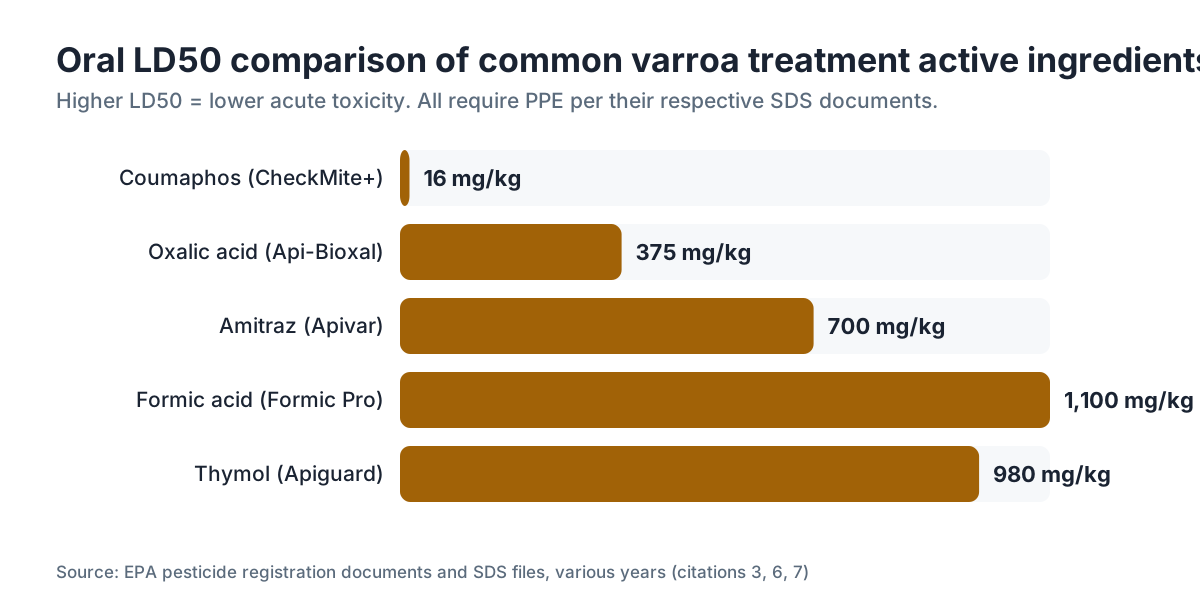
It helps to put amitraz's hazard profile in context with the other main varroa treatment chemistries. This table uses GHS signal words and oral LD50 values where publicly available from their respective SDS documents. [3][6][7]
| Treatment | Active ingredient | GHS signal word | Approx. oral LD50 (rat) | Requires gloves? |
|---|---|---|---|---|
| Apivar strips | Amitraz 3.33% | Warning | ~600-800 mg/kg | Yes (nitrile) |
| Oxalic acid (Api-Bioxal) | Oxalic acid 5.7% | Danger | ~375 mg/kg | Yes (chemical-resistant) |
| Formic acid (MAQS/Formic Pro) | Formic acid ~65-74% | Danger | ~1,100 mg/kg | Yes (acid-resistant) |
| Apiguard / ApiLife Var | Thymol ~25-81% | Warning | ~980 mg/kg | Recommended |
| CheckMite+ | Coumaphos 10% | Danger | ~16 mg/kg (high toxicity) | Yes (nitrile) |
Amitraz sits in a middle range. Oxalic acid is more acutely toxic by the numbers but less systemic. Formic acid is the most immediately dangerous to handle because of the concentrated acid burns it causes. Coumaphos (CheckMite+) has the highest acute toxicity of the group. Thymol treatments have the lowest acute toxicity to humans but cause significant eye and skin irritation.
Here's what the comparison actually tells you: every varroa treatment chemical requires PPE and careful handling. "Natural" does not mean "safe to handle without protection." The SDS for each product is specific to that formulation, so reading the one for the product you're actually using is the only way to know what's required. [6][7]
For a broader look at varroa mite biology and why we need these treatments at all, the varroa mite article covers the parasite's lifecycle and why chemical intervention is often unavoidable.
Does amitraz residue end up in honey, wax, and bee products?
Yes, and this is one of the more important sections of the EPA label and is referenced in the SDS environmental data. Amitraz and its breakdown metabolite DMPF (2,4-dimethylaniline-N-formamide) accumulate in beeswax. Studies have found amitraz residues in commercial wax samples worldwide. [8]
The EPA label is explicit: "Do not use during a honey flow." Apivar is approved for use when honey supers are off the hive. The concern is primarily wax accumulation and potential honey contamination during treatment. [2]
A 2010 study published in Apidologie found detectable amitraz residue in wax from treated colonies at concentrations up to several hundred ppb, and the residue persists in wax for multiple seasons. That old comb you're reusing has likely been exposed to amitraz if it came from treated colonies. This does not pose a known acute risk to bees at typical residue levels, but it is a data point worth knowing. [8]
For honey: the US does not have a published EPA tolerance (MRL) for amitraz in honey, which means the legal threshold is effectively zero detectable residue. This is why the label's requirement to remove supers before treatment is not optional. If you leave supers on during Apivar treatment and sell that honey, you are out of compliance with the label, which is a federal violation under FIFRA. [2][9]
Beeswax sold commercially, propolis, and pollen collected from treated colonies can also carry residues. If you're selling beehive pollen or other hive products, this matters for your marketing claims and potentially for your customers' safety.
What does the EPA registration say that the SDS doesn't cover?
The EPA label (EPA Reg. No. 64771-4) and the SDS are two parallel documents that serve different purposes. Confusing them is one of the most common mistakes I see beekeepers make. [2][9]
The EPA label tells you: the approved colonies (Apis mellifera only), the correct dose (2 strips per brood chamber, 1 strip per 5 frames of bees in smaller colonies), the treatment duration (6-8 weeks, no longer), the timing restrictions (no honey supers on hive), the re-entry interval, and the requirement to remove all strips after treatment. It also specifies that Apivar is not approved for use in colonies intended for package bee production.
The SDS tells you: the chemical hazards, the PPE requirements, the first-aid procedures, storage and disposal requirements, and the physical/chemical properties of the formulation.
Under FIFRA (Federal Insecticide, Fungicide, and Rodenticide Act), the label is law. The SDS is an OSHA-required document under the Hazard Communication Standard (29 CFR 1910.1200). Both are legally relevant but in different regulatory frameworks. [9][10]
When the SDS and the label seem to conflict on a point, the EPA label controls for use-related decisions. The SDS controls for occupational safety decisions. In practice they don't often conflict on the key points, but it's worth knowing which document governs which question.
VarroaVault's free treatment tracking tools can help you log your Apivar application dates, strip counts, and removal dates so you have a record of label compliance if you're ever audited or need to document your residue management practices.
Can you use Apivar strips in nucleus colonies, splits, and packages?
The EPA label specifies use in "Apis mellifera" colonies and describes dosing by frame count: 2 strips per full brood chamber (8-10 frame boxes), or 1 strip per 5 frames of bees in smaller colonies. Nucleus colonies with 4-5 frames get 1 strip. [2]
Package bees: the label does not approve Apivar for use in package bee production colonies. If you're running a commercial operation that sells packages, this matters. For a hobbyist treating a purchased package that you're keeping, the label restriction is about the production colonies at the source operation, not what you do with your own package after you receive it. Read the label carefully on this point if you're uncertain.
Splits and walk-away splits: you can treat a split once it has enough bees to justify the strip count. A 5-frame split with a laying queen or emerging brood gets 1 strip. The strip needs to contact the bees to work because amitraz transfer is contact and vapor-based within the hive environment.
One nuance the SDS doesn't address but the label implies: a queenless colony during treatment may respond differently to infestation dynamics because there's no capped brood and thus no phoretic mites cycling through. Some beekeepers deliberately use a brood break combined with Apivar to hit mite populations hard. That's a management decision, not a safety one, but knowing the label permits it gives you flexibility. [2][5]
What does resistance to amitraz look like and does it change the safety picture?
Amitraz resistance in Varroa destructor has been documented in the US, particularly in areas with high treatment pressure and years of continuous amitraz use. [11] The resistance mechanism involves mutations in the octopamine receptor gene (oct-beta-2R) in the mite population. A 2020 study found that some US Varroa populations showed significantly reduced sensitivity to amitraz-based treatments. [11]
From a safety standpoint, resistance doesn't change the hazard profile of the chemical or the SDS requirements at all. Amitraz is still amitraz; the concentration is still 3.33%. What changes is the treatment efficacy, not the handling risk.
What resistance means practically: if you've been using Apivar exclusively for several years and you're seeing treatment failures (mite counts not dropping adequately 8 weeks after treatment), rotating to a different mode of action like oxalic acid or formic acid is the right call. The Honey Bee Health Coalition's Varroa Management Guide recommends rotating between chemical classes to slow resistance development. [5]
Monitoring for resistance isn't something most hobbyists can do directly (it requires bioassay testing at a lab), but the indirect signal is simple: run an alcohol wash or sticky board count after the 8-week treatment period. If your mite levels didn't drop significantly, the treatment either wasn't applied correctly or resistance may be developing in your mite population. At that point, consult your state apiarist or a university extension apiculture specialist. [12]
For sourcing quality treatments, looking at established beekeeping supply companies that carry multiple treatment options gives you the flexibility to rotate chemistries as the science recommends.
How do you read each section of the Apivar SDS and what matters most?
The GHS standard requires 16 sections in every SDS. Here's a practical guide to which ones you actually need to read as a beekeeper and what to look for in each. [10]
Section 1 (Identification): confirms the product name, manufacturer, emergency contact number, and SDS revision date. Check the revision date. If it's more than 3-4 years old, find the current version.
Section 2 (Hazard Identification): the GHS hazard statements and precautionary statements. This is the most readable summary of what the product can do to you. Look for the signal word (Warning vs. Danger) and any environmental hazard statements.
Section 3 (Composition): lists amitraz at 3.33% CAS No. 33089-61-1, plus the polymer carrier. The CAS number is useful if you ever need to look up additional toxicology data independently.
Section 4 (First Aid): covered above. Know this one before you open the package, not after something goes wrong.
Section 7 (Handling and Storage): the practical rules for keeping strips safely. Temperature limits, incompatible materials, ventilation requirements.
Section 8 (Exposure Controls/PPE): what you need to wear. The most practically relevant section for day-to-day use.
Section 13 (Disposal): often skipped, often important. Know what your jurisdiction allows before you have a pile of used strips.
Sections 14-15 (Transport and Regulatory): tells you if there are shipping restrictions (Apivar is not classified as hazardous goods for road transport in most jurisdictions at its concentration) and lists applicable regulations.
Sections you can mostly skip unless there's an incident: 9 (physical properties), 10 (stability), 11 (toxicology), 12 (ecological), and 16 (revision history). They contain supporting data but not your day-to-day handling information.
OSHA requires employers to keep SDS documents accessible to workers who may be exposed to a chemical. If you have employees helping with your apiary, this is a legal requirement, more than a recommendation. [10]
Frequently asked questions
Is the Apivar MSDS the same as the Apivar SDS?
Yes, same document. MSDS (Material Safety Data Sheet) was the older OSHA terminology under HazCom 1994. After OSHA adopted the GHS standard in 2012, the document became the SDS (Safety Data Sheet) with a standardized 16-section format. Veto-Pharma publishes it as an SDS now. Any older MSDS you find for Apivar may have outdated hazard classifications; get the current GHS-format SDS from the manufacturer or your distributor.
Where can I download the official Apivar SDS?
Get it directly from Veto-Pharma's website or from major US distributors like Mann Lake, Dadant, or BetterBee, which all host current SDS documents for products they sell. You can also request it from your state department of agriculture or find it in the EPA's pesticide product database by searching EPA Reg. No. 64771-4. Always verify the revision date in Section 1 to confirm you have the current version.
Do I need to wear a respirator when inserting Apivar strips?
The current Apivar SDS does not require a respirator for normal outdoor hive treatment. Amitraz vapor pressure at ambient temperatures is very low, and the exposure duration during strip insertion is brief. If you're treating many colonies in an enclosed space with poor ventilation, a half-face respirator with organic vapor cartridges is a reasonable precaution. Outdoors with normal hive-work, your standard PPE of nitrile gloves and eye protection is sufficient per the SDS.
How long should Apivar strips stay in the hive?
The EPA label requires 6 to 8 weeks, no longer. Leaving strips in past 8 weeks increases the risk of amitraz residue accumulation in wax and gives no additional treatment benefit once the brood cycle has been fully covered. Mark your calendar when you insert them. Remove all strips after the treatment window even if you think they still have active ingredient; the label requirement is firm on this point.
Can amitraz from Apivar strips harm my dog or children?
Direct ingestion or significant skin contact is the concern. Dogs are particularly sensitive to amitraz due to their alpha-2 adrenergic receptor response; symptoms of poisoning include sedation, vomiting, bradycardia, and low blood pressure. Children are also at higher risk of adverse effects per unit of body weight. Store strips in a locked cabinet away from both. If a child or pet ingests any part of a strip, call Poison Control (1-800-222-1222) or your vet immediately. Do not wait for symptoms.
Can I use Apivar strips when honey supers are on the hive?
No. The EPA label for Apivar explicitly states do not use while honey supers intended for human consumption are on the hive. Amitraz can accumulate in honey and beeswax, and the US has no established tolerance (MRL) for amitraz in honey, making any detectable residue a label violation under FIFRA. Remove all supers before treatment and do not add supers until after strips are removed and a reasonable clearance period has passed.
What happens if I accidentally get Apivar strip residue in my eyes?
Flush immediately with large amounts of clean water for at least 15 minutes, holding the eyelids open throughout. Remove contact lenses if they come out easily. After flushing, seek medical attention even if irritation seems mild. Amitraz is classified as causing eye irritation under GHS. The Section 4 first-aid guidance in the SDS specifies this procedure, and Poison Control (1-800-222-1222) can advise on whether further evaluation is needed based on the exposure.
Is Apivar safe to use in a top-bar hive or Warré hive?
The EPA label specifies dosing in terms of frames of bees (1 strip per 5 frames), which you can adapt to other hive formats by estimating equivalent bee-covered comb surface area. The label does not restrict use to Langstroth equipment specifically. The SDS hazard and PPE requirements apply regardless of hive style. Some beekeepers using beekeeping supplies for non-Langstroth formats improvise strip placement to maximize contact with bees on the brood nest; the goal is the same as in any format.
How do I dispose of used Apivar strips legally?
The SDS Section 13 recommends disposing of used strips as pesticide waste through an approved facility or following local regulations. Do not dump in drains or waterways; amitraz is very toxic to aquatic organisms. The EPA label says to place in trash per local regulations if hazardous waste collection is unavailable. Many states hold annual pesticide disposal events; contact your county extension office or state department of agriculture for local options.
Does Apivar affect queen bees?
There is some evidence that prolonged amitraz exposure can affect queen reproductive quality, though the data is not definitive. The Honey Bee Health Coalition notes this as a concern to be aware of when planning treatment timing. The main practical precaution is to follow the label's 6-8 week treatment window and remove strips promptly. Treating in fall after the main honey flow, when colonies are moving toward a smaller winter cluster, reduces the window of queen exposure to the compound.
What is the CAS number for amitraz and why does it matter?
Amitraz CAS number is 33089-61-1, listed in Section 3 of the Apivar SDS. The CAS number is the universal chemical identifier that lets you look up independent toxicology databases (like EPA's ChemView or the National Library of Medicine's PubChem system) for additional data beyond what the SDS provides. It's also what a physician or poison control specialist will use to pull up clinical toxicology information if there's an exposure incident.
Can I cut Apivar strips in half to treat small colonies?
The EPA label specifies using 1 strip per 5 frames of bees for smaller colonies but does not explicitly authorize cutting strips. Cutting could change the surface-area-to-air-ratio of amitraz release and is not a label-approved modification. For a very small nuc, the standard recommendation is 1 full strip. Check with your state apiarist if you're uncertain about a specific situation; some extension services have guidance on small-colony treatment protocols.
Does amitraz resistance in varroa mean I need higher doses?
No, and using more strips than the label allows is a federal violation under FIFRA regardless of resistance concerns. If you suspect amitraz resistance because mite counts aren't dropping after a full treatment cycle, the right response is to switch chemical classes, not to increase dose. Rotate to oxalic acid or formic acid for your next treatment cycle. Consult your state apiarist or a university extension apiculture specialist to confirm resistance versus an application error.
What's the shelf life of Apivar strips and can I store opened packages?
Veto-Pharma states a shelf life of 3 years from manufacture when stored correctly at 0-30°C in original sealed packaging, away from direct sunlight and moisture. Opened packages should be sealed in an airtight bag and used within the same treatment cycle if possible. Amitraz degrades from exposed polymer surfaces over time, so open packages stored season-to-season may have reduced efficacy. Check the expiry date printed on the box before each use.
Sources
- Veto-Pharma, Apivar Safety Data Sheet (current GHS format): Apivar contains amitraz at 3.33% w/w; storage requirements include 0-30°C, away from sunlight; 3-year shelf life when sealed
- EPA, Apivar EPA-registered product label (EPA Reg. No. 64771-4): Label requires removal of honey supers before treatment, 6-8 week treatment window, 2 strips per brood chamber dosing, and nitrile glove PPE
- EPA, Amitraz pesticide registration review, hazard assessment: Amitraz GHS classification: harmful if swallowed (Cat 4), harmful in contact with skin (Cat 4); oral LD50 in rats approximately 600-800 mg/kg; very toxic to aquatic organisms
- America's Poison Centers, Poison Help Hotline: US Poison Control hotline number is 1-800-222-1222, available 24 hours
- Honey Bee Health Coalition, Varroa Management Guide (most recent edition): HBHC recommends rotating between chemical classes to slow resistance development and states used strips should be removed after the label-specified treatment window
- EPA, Api-Bioxal (oxalic acid) EPA product label and SDS: Oxalic acid (Api-Bioxal) carries GHS Danger signal word; oral LD50 approximately 375 mg/kg; requires chemical-resistant gloves and eye protection
- EPA, Formic Pro (formic acid) EPA product label: Formic Pro contains formic acid at approximately 65-74%; GHS Danger signal word; acid-resistant gloves required; oral LD50 approximately 1,100 mg/kg
- Mullin et al., 2010, PLOS ONE, 'High levels of miticides and agrochemicals in North American apiaries': Detectable amitraz/DMPF residues found in beeswax from treated colonies at concentrations up to several hundred ppb; residue persists in wax across multiple seasons
- EPA, Federal Insecticide, Fungicide, and Rodenticide Act (FIFRA) overview: Under FIFRA, the EPA-registered label is legally binding; use inconsistent with label directions (including leaving supers on during treatment) is a federal violation
- OSHA, Hazard Communication Standard 29 CFR 1910.1200: OSHA HazCom standard requires 16-section GHS SDS format and employer obligation to keep SDS documents accessible to workers exposed to chemicals
- USDA Agricultural Research Service, research on amitraz resistance in US Varroa populations: Amitraz resistance in Varroa destructor documented in US populations; resistance involves mutations in octopamine receptor gene oct-beta-2R; some US populations showed significantly reduced sensitivity by approximately 2020
- Penn State Extension, Bee Lab, Varroa monitoring protocols: Alcohol wash and sticky board monitoring recommended after treatment to assess efficacy; failure to see mite load reduction after 8 weeks may indicate resistance or application error
- University of Minnesota Extension, Bee Lab, Varroa treatment options: Treatment rotation between amitraz, oxalic acid, and formic acid recommended to reduce resistance selection pressure in Varroa populations
Last updated 2026-07-09