Apivar strips price: what you'll actually pay in 2025
TL;DR
- Apivar (amitraz 3.2%) strips run roughly $28, $35 for a 10-strip pack and $55, $75 for a 50-strip pack in 2025, putting per-strip cost at about $1.10, $1.50.
- A standard two-hive treatment needs 4 strips.
- Buying larger packs and watching for spring pre-season sales cuts that cost by 20 to 30%.
- No prescription required in the US.
What does a pack of Apivar strips actually cost right now?
As of mid-2025, the street price for Apivar breaks down like this across the most common pack sizes:
| Pack size | Typical price range | Per-strip cost |
|-----------|--------------------|-----------------|
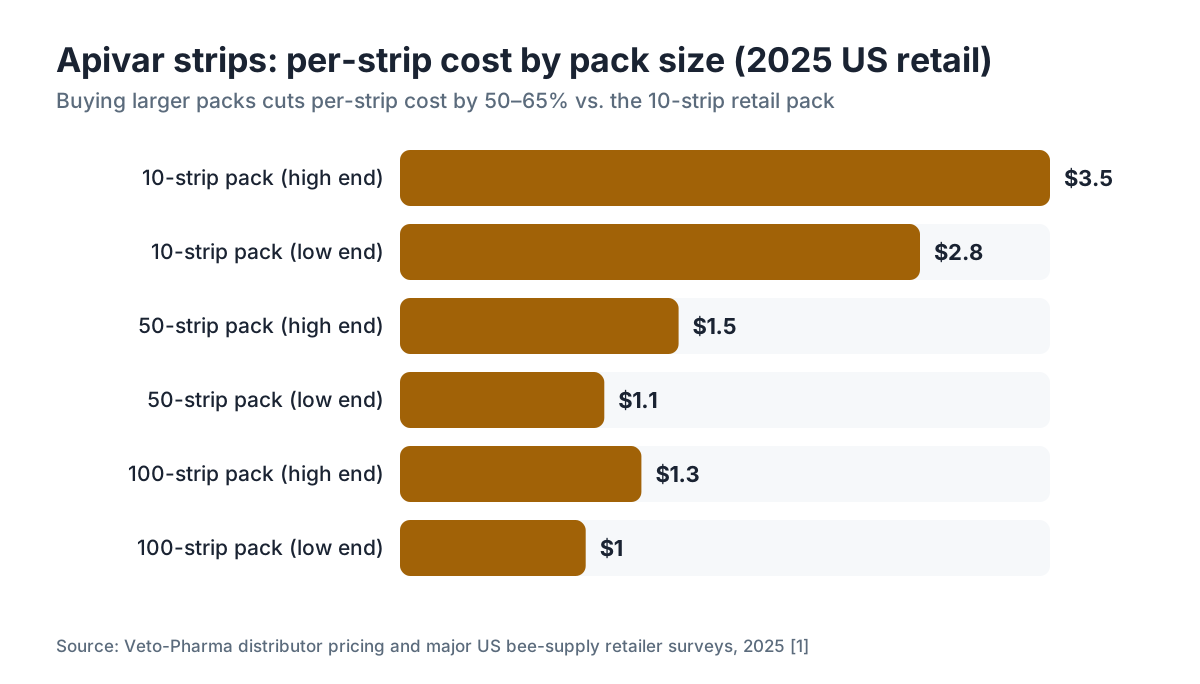
| 10 strips | $28, $35 | $2.80, $3.50 |
| 50 strips | $55, $75 | $1.10, $1.50 |
| 100 strips | $100, $130 | $1.00, $1.30 |
Those ranges are real, not theoretical. The low end usually comes from large bee-supply distributors buying direct from Veto-Pharma, the French manufacturer that owns the Apivar label. The high end is small local shops or Amazon third-party sellers who mark up for convenience. [1]
The 10-strip pack gets most press because hobbyists grab it for one or two hives, but the math on a 50-strip pack is hard to argue with if you run more than four colonies. You're paying roughly half as much per strip, and Apivar has a two-year shelf life when stored at room temperature away from light, so buying ahead is not risky. [2]
If you're searching for the best price apivar 4 strips, note that no retailer sells a 4-strip unit. You buy 10 or 50. Four strips treats two hives, which is exactly what the label calls for.
Why does the price vary so much between retailers?
Apivar is a prescription-exempt, EPA-registered miticide (EPA Reg. No. 79892-3). Because it doesn't require a vet prescription in the United States, any licensed retailer can stock it, and the distribution chain has a lot of layers. [3]
Veto-Pharma sells to US distributors, distributors sell to bee-supply companies, and bee-supply companies set their own margins. Some of the big catalog suppliers (Mann Lake, Dadant, Brushy Mountain, BetterBee) buy in large enough volume to pass savings along. Smaller shops can't, and they don't.
Shipping matters too. Apivar ships as a pesticide product, and some carriers flag it for hazmat fees even though it's not DOT-regulated as a hazardous material at retail quantities. That can add $5, $12 to an otherwise cheap online order. A supplier that offers free shipping on bee supplies above a dollar threshold can genuinely change the comparison.
Canadian beekeepers pay more in CAD terms and face Health Canada DIN requirements, so pricing guidance here applies only to US purchases.
Where are the cheapest places to buy Apivar strips?
Based on consistent price checks by beekeeping forums and extension-linked buying guides, these source types tend to land cheapest, roughly in order:
- State and regional beekeeping associations that run group buys. Some state associations negotiate bulk rates and pass them to members at $1.00, $1.20 per strip even on 10-strip quantities.
- Large mail-order bee-supply companies: Mann Lake, Dadant, BetterBee, and similar catalog operations consistently land in the $55, $68 range for 50-strip packs and often run spring sales. Comparing a few of the major beekeeping supply companies before ordering takes five minutes and can save $15, $20.
- Local farm co-ops and feed stores. Irregular availability, but when they stock it they often price it at distributor-adjacent rates.
- Amazon. Convenient but rarely cheapest once shipping is factored in. Watch for third-party sellers listing near-expiry product at inflated prices.
The worst value is buying a 10-strip pack from a local bee shop at $35 when you need 4 strips for two hives. You're spending $3.50 per strip instead of $1.10. If you have any beekeeper neighbors, splitting a 50-strip pack makes sense on every level.
Also check whether any free shipping honey bee supply companies are running promotions. Free shipping at a $75+ order threshold can make a 50-strip pack cheaper than a 10-strip pack at a local store, even if the list price looks similar.
How many Apivar strips do you need, and what does a full treatment cost?
The EPA-registered label for Apivar says to use 1 strip per 5 frames of bees, with a minimum of 2 strips per colony and a maximum of 4 strips per colony. [3] The treatment window is 6 to 8 weeks, after which strips must be removed.
For a single Langstroth colony in peak summer, two strips is the minimum, four strips is appropriate for a very strong double-brood-box colony. Most beekeepers default to two strips per colony for a single brood box, four per colony for a double.
So in dollar terms:
| Colony count | Strips needed (2 per hive) | Strips needed (4 per hive) | Cost at $1.50/strip | Cost at $1.10/strip |
|-------------|--------------------------|--------------------------|----------------------|----------------------|
| 1 | 2 | 4 | $3, $6 | $2.20, $4.40 |
| 2 | 4 | 8 | $6, $12 | $4.40, $8.80 |
| 5 | 10 | 20 | $15, $30 | $11, $22 |
| 10 | 20 | 40 | $30, $60 | $22, $44 |
For a hobbyist with two hives, a single treatment costs $6, $12 in Apivar alone, not counting the 6 to 8 weeks of time the strips are in the hive. Two treatments per year (which the Honey Bee Health Coalition recommends in most climates) brings annual per-hive cost to roughly $6, $24 depending on strip usage and pack pricing. [4]
That's genuinely cheap compared to losing a colony, which costs $150, $250 to replace as a package or nuc in 2025.
Is Apivar cheaper than other varroa treatments?
Direct cost comparison requires holding efficacy and colony impact equal, which gets complicated. But here's an honest side-by-side on pure dollar cost for treating one colony once:
| Treatment | Active ingredient | Approx. cost per colony per treatment | Treatment length |
|-----------|------------------|---------------------------------------|------------------|
| Apivar | Amitraz | $3, $10 | 6 to 8 weeks |
| Oxalic acid dribble (Api-Bioxal) | Oxalic acid | $1, $3 | Single application |
| Oxalic acid vapor (Api-Bioxal) | Oxalic acid | $1, $3 per treatment + $200, $400 vaporizer | Single or multiple |
| Mite Away Quick Strips (MAQS) | Formic acid | $8, $14 | 7 days |
| ApiLife Var | Thymol blend | $5, $10 | 3 to 4 applications |
| Apistan | Tau-fluvalinate | $6, $15 | 6 to 8 weeks |
Oxalic acid dribble is the cheapest per-application option, but it only kills mites on adult bees, not mites inside capped brood. That means it works well in broodless conditions (winter) and poorly during the main season without repeated treatments or vaporization. Apivar works through contact with bees that then spread amitraz through the colony, reaching mites in brood cells indirectly over the 6 to 8 week treatment period. [4]
The Honey Bee Health Coalition's Varroa management guide, which is the most widely cited US practitioner reference, recommends using multiple modes of action across the year rather than relying on one product. Apivar in summer, oxalic acid in winter is a common and cost-effective rotation. [4]
Resistance to amitraz has been documented in some US varroa populations, though it remains less widespread than tau-fluvalinate resistance. If your mite counts don't drop after a proper Apivar treatment, that's a reason to test resistance, not to buy more Apivar.
When is the best time to buy Apivar to get the lowest price?
Late winter to early spring, roughly January through March, is when the major suppliers run pre-season sales. Many beekeepers are planning treatments for the spring build-up, and suppliers use promotions to move inventory and capture orders early. Discounts of 10 to 25% off list price are common in that window.
Fall is the other logical buying window. After the main summer treatment is done, some shops discount remaining stock. Fall treatments to protect winter bees are standard practice in most US climates, so demand stays reasonable, but prices soften slightly in September, October.
Summer, especially June and July, tends to be worst for price if you're buying urgently because you just got a high mite count. You buy at retail with no room to negotiate.
Group buys through state associations or local clubs often run in February, March to coincide with pre-season planning. If you're a member of your state beekeeping association, watch their mailing list in January. A state association negotiating 200+ strip orders can often get below distributor retail for its members.
Apivar's shelf life supports advance buying. According to the product label, strips are stable for two years at room temperature. Buying a 50-strip pack in February when prices are lowest and using it across two seasons is completely reasonable as long as storage conditions are right (out of direct sunlight, not in a hot car or barn).
Does the Apivar label restrict when and how you can use it?
Yes, and the restrictions have cost implications if you ignore them. The EPA-registered Apivar label (EPA Reg. No. 79892-3) specifies: [3]
- Maximum two treatments per year per colony.
- Strips must be removed after 6 to 8 weeks. Leaving them in longer is a label violation and increases resistance pressure.
- Do not use during a honey flow intended for harvest. Amitraz residues can appear in honey if the hive is actively curing honey over strips. The label says to remove honey supers before treatment or not add supers while strips are in.
- Do not use more than 4 strips per colony at any time.
The honey flow restriction is the one that bites beekeepers financially. If your local main flow runs June through August and you need to treat in that window (because your mite count says you have to), you're either sacrificing that honey crop or choosing a different treatment. Many beekeepers in heavy-flow areas switch to formic acid (MAQS or Formic Pro) for the summer treatment precisely because formic acid has a shorter window and different residue profile, then use Apivar in the fall.
Two treatments per year at two to four strips per colony per treatment means your annual strip budget per colony is 4 to 8 strips. At $1.50/strip from a 10-strip pack, that's $6, $12/colony/year. At $1.10/strip from a 50-strip pack, it's $4.40, $8.80.
For more on understanding varroa biology and why treatment timing matters as much as treatment choice, the varroa mite overview covers the basics well.
Are there any ways to reduce costs without cutting corners on treatment?
A few that actually work:
Buy the 50-strip pack and split with neighbors. If you and two other hobbyists in your club each run two hives, a 50-strip pack gives all three of you a full year of treatments with strips left over, and you each pay $18, $25 instead of $56, $70. This is the single best cost move for small operations.
Time your purchase to pre-season sales. Already covered above, but worth repeating: a 20% discount on a $65 pack saves $13. Not trivial.
Don't over-treat. Two strips for a single-brood-box colony is the label minimum and works fine. Four strips is for strong double-brood-box colonies. Using four where two would do wastes money and increases residue concerns.
Don't under-treat either. Using one strip because you're trying to stretch the pack is a label violation and almost certainly ineffective. Mite counts that don't drop after treatment mean you've wasted the strips you did use and now face a resistant population you've helped select for.
Track your mite counts. An alcohol wash or sugar roll before treatment tells you whether you actually need Apivar right now or can wait. The Honey Bee Health Coalition's monitoring guidelines suggest treating when varroa loads reach 2% or higher in summer (2 mites per 100 bees). [4] A beekeeper who monitors and treats only when thresholds are hit uses fewer strips than one who treats on a fixed calendar regardless of mite load.
VarroaVault has a free treatment scheduler and mite-count tracker that can help you figure out when to treat and how many strips you'll actually need across a season, which helps with both advance ordering and budget planning.
What should I look for when comparing Apivar prices online?
A few things that will burn you if you skip them:
Check the expiration date. Reputable retailers list it. If a listing doesn't mention expiry or the photo shows a date within 6 months, the savings aren't real.
Verify it's genuine Apivar (Veto-Pharma). The active ingredient is amitraz at 3.2% (roughly 325 mg per strip). Counterfeit or incorrectly labeled amitraz products have appeared in some markets. Buying from a known US bee-supply retailer or directly through a distributor eliminates this risk almost entirely.
Factor in shipping. A $29 pack with $12 shipping is $41. A $33 pack with free shipping over $50 is $33 if you're buying other beekeeping supplies anyway.
Check if the retailer is USDA-licensed to sell restricted pesticides in your state. Apivar is not a restricted-use pesticide federally, but some states have their own registration requirements. Texas, California, and Florida occasionally have quirks on this. Your state department of agriculture website is the authoritative source for your state.
University extension services from major apiculture programs, including Penn State's Apiary Extension and the University of Minnesota Bee Lab, periodically publish cost-benefit analyses of varroa treatments that compare Apivar against alternatives in real colony survival data. Those are worth reading before you commit to a treatment strategy, more than a price comparison. [5][6]
How does Apivar pricing fit into a full-year varroa management budget?
For a hobbyist running two to five hives, here's a realistic annual varroa management budget in 2025:
| Item | Typical annual cost (2 hives) | Typical annual cost (5 hives) |
|------|-------------------------------|-------------------------------|
| Apivar strips (summer, 2 treats × 4 strips/hive) | $12, $28 | $30, $70 |
| Oxalic acid (Api-Bioxal, winter dribble) | $5, $10 | $10, $20 |
| Alcohol wash supplies (isopropyl, jars) | $3, $5 | $3, $5 |
| Total monitoring + treatment | $20, $43 | $43, $95 |
That's the cost of not losing your colonies. A replacement package or nuc in 2025 runs $150, $250 per colony depending on your region. A single lost colony more than pays for three to four years of treatment supplies.
The Honey Bee Health Coalition states in their Varroa Management Guide (2023 edition) that "colonies left untreated rarely survive more than one to two years in most regions of North America." [4] That's not scare language; it's the baseline population biology of varroa infesting temperate-climate colonies without management.
Putting $20, $95 per year into monitoring and treatment is one of the more obvious economic decisions in beekeeping. The variable is whether you spend it efficiently by buying the right pack size at the right time, not whether to spend it at all.
For a full protocol that walks through when to treat, when to monitor, and how to rotate chemistries, the VarroaVault treatment protocol tools can map a calendar to your local climate and colony count. The second mention is deliberate: if you're spending money on Apivar, having a plan for how and when to use it is as important as the price you pay.
Frequently asked questions
How much does a 10-pack of Apivar strips cost?
A 10-strip pack of Apivar costs $28, $35 at most US bee-supply retailers in 2025. That works out to $2.80, $3.50 per strip, which is the most expensive per-strip price tier. It's the right size if you have one or two hives and only need a single treatment. For multiple hives or two treatments per year, moving to a 50-strip pack cuts per-strip cost roughly in half.
How much does a 50-pack of Apivar strips cost?
A 50-strip pack of Apivar runs $55, $75 at major bee-supply distributors in 2025, putting per-strip cost at $1.10, $1.50. This is the best value for beekeepers with three or more hives or those doing two treatments per year. Apivar stores for two years at room temperature, so buying a 50-pack and using it across multiple seasons is practical and saves meaningful money.
Do I need a prescription to buy Apivar in the US?
No. Apivar is registered by the EPA (Reg. No. 79892-3) and is not classified as a restricted-use pesticide at the federal level, so no veterinary prescription is required for US beekeepers to buy it. Most states follow federal classification, though it's worth checking your state department of agriculture for any state-level variations. Canada has different rules under Health Canada's DIN system.
How many Apivar strips do I need per hive?
The Apivar label says to use 1 strip per 5 frames of bees, with a minimum of 2 strips and a maximum of 4 strips per colony per treatment. A single Langstroth brood box typically gets 2 strips. A strong double-brood-box colony in peak summer gets 4 strips. Using fewer than the label minimum is a violation and likely ineffective; using more than 4 is also a label violation.
Can I use Apivar during a honey flow?
The EPA label says to remove honey supers before treatment or refrain from adding them while strips are in place. Amitraz residues can transfer into honey being cured over active strips. If your main honey flow coincides with your needed treatment window, most beekeepers switch to formic acid (MAQS or Formic Pro) for that treatment, then use Apivar in the fall when supers are off.
What is the cheapest way to buy Apivar strips?
Buy a 50-strip or 100-strip pack through a large mail-order bee-supply company during pre-season sales (January, March) or split a large pack with beekeeper neighbors. Group buys through state beekeeping associations sometimes reach $1.00 or below per strip. Avoid small 10-strip packs from convenience retailers if you're treating more than two hives per year, as the per-strip premium is substantial.
How long do Apivar strips last in storage?
Apivar has a stated shelf life of approximately two years when stored at room temperature away from direct sunlight and heat. The manufacturer (Veto-Pharma) prints an expiration date on the packaging. Buying a larger pack in winter and using it across two seasons is a valid cost strategy as long as you check the expiration date on the pack you purchase and store it properly.
How does Apivar compare in price to oxalic acid treatments?
Oxalic acid (Api-Bioxal) costs $1, $3 per colony per application and is the cheapest varroa treatment available, but it only kills mites on adult bees. Apivar costs $3, $10 per colony per treatment and works over 6 to 8 weeks to reduce mites associated with brood cells too. Most beekeepers use both: Apivar in summer when brood is present, oxalic acid in winter when colonies are broodless.
Is there varroa mite resistance to Apivar?
Yes, amitraz resistance in Varroa destructor has been documented in some US apiaries, though peer-reviewed surveys suggest it remains less prevalent than tau-fluvalinate resistance. If mite counts measured by alcohol wash don't drop substantially 3 to 4 weeks into a proper Apivar treatment, resistance is a possibility worth investigating. Rotating modes of action across seasons is the main management tool against resistance development.
When should I treat with Apivar to get the best results?
The Honey Bee Health Coalition recommends treating when varroa infestation reaches 2% or higher during summer (2 mites per 100 bees on an alcohol wash). Common windows are late July through September after honey supers come off, and again in spring before the main nectar flow. Treatment at high mite loads earlier in the season protects the long-lived winter bees that determine colony survival.
Can I reuse Apivar strips for a second treatment?
No. The Apivar label specifies single-use strips. Once strips have been in a colony for 6 to 8 weeks, they must be removed and disposed of properly. Reinserting used strips is a label violation and the amitraz has already been substantially depleted. For a second treatment the same season, you need fresh strips, which is another reason buying the 50-strip pack at the start of the year makes sense.
What happens if I leave Apivar strips in longer than 8 weeks?
Leaving strips in longer than the labeled 6 to 8 week window is a federal label violation and increases selection pressure for amitraz resistance in the local varroa population. Residue risk in beeswax also rises with prolonged exposure. Mark your calendar when you insert strips and pull them on schedule. The 6 to 8 week window is long enough for the treatment to be effective when used correctly.
Where is the best place to check current Apivar prices?
Directly on the product pages of Mann Lake, Dadant, BetterBee, and similar large bee-supply catalog operations, since they update prices regularly and show current stock. State beekeeping association websites often post group-buy prices in late winter. Avoid relying on Amazon list prices without checking shipping costs and third-party seller expiration dates, which can make the apparent savings disappear.
Does splitting a 50-pack of Apivar with other beekeepers affect efficacy?
No. Apivar strips are individually wrapped and sealed until use. A 50-pack split among multiple beekeepers means each person gets sealed, intact strips identical to what they'd buy in a 10-pack. There is no efficacy difference from pack size. The only thing that matters is proper storage after the pack is opened: keep unused strips in a sealed bag away from heat and light.
Sources
- Veto-Pharma, Apivar product page: Apivar strips (amitraz 3.2%) are manufactured by Veto-Pharma; US distribution pricing tiers determine retailer floor costs.
- Apivar EPA product label (EPA Reg. No. 79892-3), via National Pesticide Information Center: Apivar has a two-year shelf life when stored at room temperature away from light, supporting advance purchase as a cost strategy.
- EPA, Apivar label EPA Reg. No. 79892-3: Label specifies 1 strip per 5 frames of bees, minimum 2 strips, maximum 4 strips per colony; two treatments per year maximum; remove honey supers before treatment.
- Honey Bee Health Coalition, Varroa Management Guide (2023): HBHC recommends treating when varroa infestation reaches 2% in summer and states that untreated colonies rarely survive more than one to two years in most regions of North America.
- Penn State Extension, Apiary and Honey Bee Program: Penn State apiculture extension publishes treatment cost-benefit analyses comparing Apivar against alternative varroa treatments.
- University of Minnesota Bee Lab: University of Minnesota Bee Lab research covers amitraz efficacy and resistance monitoring in Varroa destructor populations.
- USDA Agricultural Research Service, Varroa destructor management page: USDA ARS documents amitraz resistance in some US varroa populations and supports rotation of treatment modes of action.
- EPA, Pesticide Registration, Oxalic acid (Api-Bioxal) label: Oxalic acid dribble application kills mites on adult bees only; most effective in broodless winter colonies.
- Virginia Cooperative Extension, Varroa Mite Management: Extension guidance supports combining Apivar for summer brood-present treatment with oxalic acid in winter as a cost-effective dual-mode rotation.
- North Carolina State University Apiculture, Varroa Treatment Guide: NCSU extension confirms 2% threshold for summer treatment and discusses amitraz (Apivar) as a primary summer miticide option.
- Journal of Economic Entomology, amitraz resistance in Varroa destructor (2020): Peer-reviewed surveys document amitraz resistance in a subset of US varroa populations, though less prevalent than tau-fluvalinate resistance.
- USDA National Agricultural Library, Bee Health resources: USDA NAL provides aggregated colony loss data and treatment cost context for US commercial and hobbyist beekeepers.
Last updated 2026-07-09