Apivar strips review: does amitraz actually work in 2025?
TL;DR
- Apivar (amitraz 3.3%) is one of the most effective varroa treatments registered, with field trials showing 90-99% mite kill when applied to brood-present colonies correctly.
- Two strips per brood box, left in 6 to 8 weeks, covers most situations.
- The two real downsides are amitraz resistance and residue buildup in wax.
- Use it in rotation, not forever.
What is Apivar and how does it work against varroa?
Apivar is an EPA-registered miticide sold as plastic strips, with amitraz as the active ingredient at 3.3% concentration [1]. Each strip is impregnated with amitraz. The compound diffuses slowly across the strip surface and gets picked up by bees walking over it. Those bees then spread it through the colony by contact, reaching mites riding on adult bees and mites about to enter brood cells.
Amitraz is a formamidine. It jams the octopamine receptor system in arthropods, overstimulating the mite's nervous system until it detaches and dies [2]. Honeybees have octopamine receptors too, but the amitraz concentration in a properly dosed hive stays low enough that bees tolerate it at label rates.
The strips work slowly, not all at once. Varroa spend most of their reproductive cycle sealed inside capped brood, where the strips can't touch them. So the treatment has to run long enough to catch emerging mites on adult bees before those mites duck back into cells. That's why the label sets a 6 to 8 week minimum [1]. Pulling strips early is one of the most common mistakes beekeepers make, and it's exactly how you get a partial kill that breeds resistant mites.
Apivar has been registered in the U.S. since 2013 and is made by Veto-Pharma. It ships as a pack of 10 strips, enough for two standard Langstroth colonies at full dose.
How effective is Apivar compared to other varroa treatments?
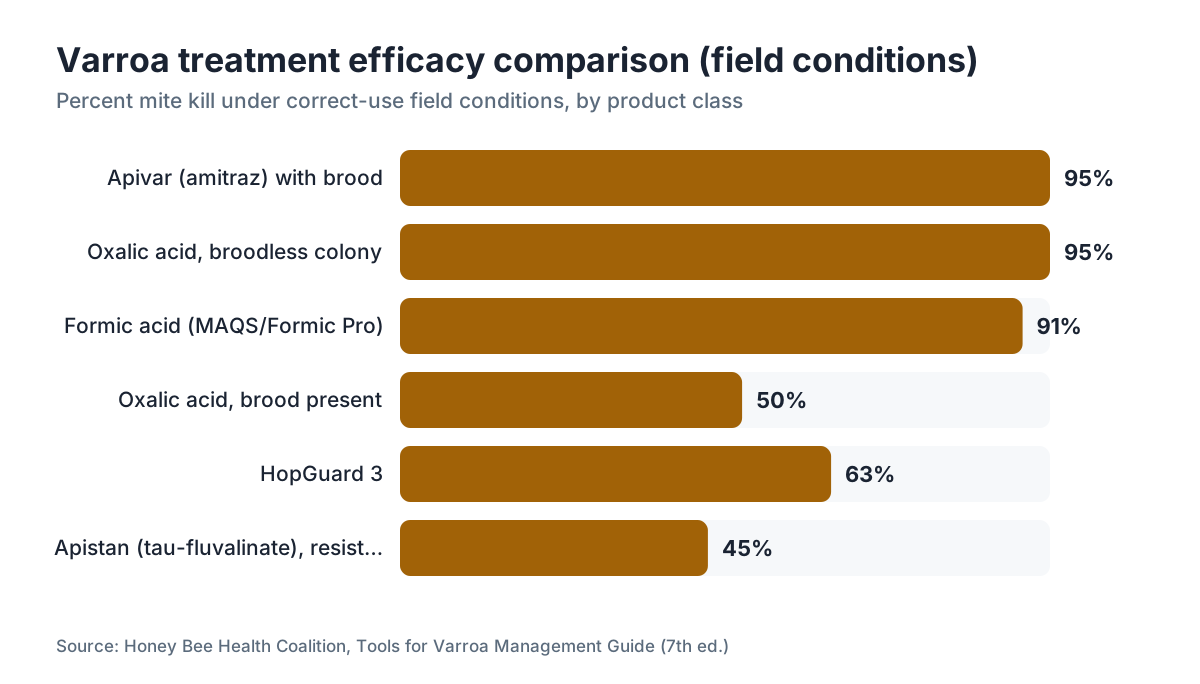
Amitraz strips land in the top tier of registered treatments, with field efficacy of 90 to 99% when the label is followed. University trials and large field studies back this up. The Honey Bee Health Coalition's varroa guide pulls efficacy data across product classes, and amitraz sits alongside oxalic acid (in broodless colonies) and formic acid as the strongest options [3].
Here's an honest comparison of the main registered choices:
| Treatment | Active ingredient | Efficacy range (field data) | Temp restrictions | Brood present? |
|---|---|---|---|---|
| Apivar strips | Amitraz 3.3% | 90-99% [3] | None significant | Yes, required |
| Mite Away Quick Strips | Formic acid 68.2% | 85-97% [3] | 50-85°F | Yes |
| Api-Bioxal (dribble/vaporize) | Oxalic acid 5.7% | 90-99% broodless; 40-60% with brood [3] | Above 40°F for OAV | Broodless for best kill |
| Apistan strips | Tau-fluvalinate 10% | Highly variable; resistance widespread [4] | None significant | Yes |
| HopGuard 3 | Hop beta acids | 50-75% in studies | None significant | Yes |
Apivar's edge over oxalic acid is simple: it works with brood present. You can treat during spring build-up or mid-summer without stopping the colony's cycle, while oxalic acid dribble or vapor needs a broodless gap to reach mites in capped cells. That practicality is why so many sideliners lean on Apivar. Nobody wants to requeen a hundred colonies just to open a broodless window.
Against Apistan (tau-fluvalinate strips), Apivar wins on reliability right now. Tau-fluvalinate resistance is documented across the U.S., Europe, and elsewhere, and plenty of beekeepers find Apistan does almost nothing [4]. Amitraz resistance exists too, but through the peer-reviewed literature to 2024 it's still less widespread in North America than pyrethroid resistance.
What does the Apivar label actually require you to do?
The EPA-approved label is the legal document that governs how you use Apivar, and following it matters for both efficacy and compliance. Here's what it requires [1].
Dosing: 1 strip per 5 frames of bees, maximum 2 strips per brood box. A single Langstroth deep gets 2 strips. Running double deeps, you still use 2 strips per brood chamber, set between frames 3-4 and 7-8 counting from one side.
Placement: Hang strips in the center of the brood cluster, between frames where bees are actively working. Strips parked in empty space do almost nothing.
Duration: Leave strips in a minimum of 6 weeks, no more than 8. Pulling at 4 weeks because you don't see dead mites piling up is a mistake. The kill happens continuously through slow exposure, not in a visible burst.
Honey supers: Remove every honey super before applying. Don't put supers back until strips come out. Amitraz can contaminate honey meant for people, and treating with supers on is a label violation.
Frequency: The label allows two treatments per year. Most protocols run a late-summer or early-fall treatment (after the flow, before winter bees are raised) and sometimes a spring treatment if mite loads call for it.
Gloves: The label requires nitrile or chemical-resistant gloves. Amitraz is a pesticide and it absorbs through skin. Wear gloves every single time.
When is the best time to use Apivar strips?
Late July through August is the window that matters most across the continental U.S.: after the main honey flow ends, before the queen starts laying the long-lived winter bees [3]. Timing drives whether Apivar works for you more than anything else. You want brood present (that's what Apivar protects) but you want the mites down before winter bees are raised.
Winter bees born in September and October need to emerge mite-free. If mite loads run high during that stretch, those bees carry deformed wing virus and live short lives, and the colony dies over winter or fades in early spring. Start treatment in late July and the 6 to 8 week run ends by mid-September, right before winter bee production peaks.
Spring treatment makes sense if your spring count (taken around dandelion bloom) comes back over threshold. The Honey Bee Health Coalition recommends treating when counts pass 2% of adult bees sampled, roughly 2 mites per 100 bees, during the active season [3]. Spring Apivar is fine for brood, but you have to pull honey supers, which can cost you the early crop.
What I'd actually do: run an alcohol wash or sugar roll in late July, every year, no exceptions. Above 2 mites per 100, strips go in that week. Borderline at 1 to 2%, monitor weekly and treat if it climbs. Under 1% in late July, keep watching through August, but don't start later than mid-August if you want a full 8 weeks before winter bees are underway.
For varroa mite monitoring methods and threshold charts, that page walks through the alcohol wash protocol in detail.
Does Apivar leave residues in wax and honey?
Yes, and this is the most honest concern about the product. Amitraz and its breakdown metabolite DMPF (2,4-dimethylaniline) build up in beeswax with repeated treatments [5]. Wax is highly lipophilic, meaning it soaks up fat-soluble compounds easily, and amitraz is fat-soluble.
Studies have found amitraz residues in commercial beeswax ranging from trace amounts up to 3,000 ppb, depending on treatment history [5]. The European Food Safety Authority sets a maximum residue limit for amitraz in honey at 200 ppb [12], and U.S. EPA registration bars treating while supers are on precisely because of contamination risk [1].
Follow the label (no supers during treatment, strips out by 8 weeks) and honey contamination risk stays low. Wax accumulation is the longer game. Old brood comb that has been through many Apivar treatments can carry amitraz levels that may affect queen rearing and brood survival, though the literature on the exact threshold for harm is not settled as of 2024. The honest answer is nobody has a clean number for where wax residue starts hurting a colony.
What careful beekeepers do: rotate wax out of the brood nest every 3 to 5 years, swap dark old comb for fresh foundation, and rotate treatments so Apivar isn't running every cycle. That limits wax buildup and slows resistance at the same time.
Is amitraz resistance a real problem?
It's real and growing, and anyone saying otherwise hasn't read the recent literature. Amitraz resistance in Varroa destructor is documented in the U.S., Europe, and South America [6]. The mechanism is mutations in the octopamine receptor gene that reduce how well amitraz binds, so mites survive doses that would kill a susceptible population.
A 2021 study in Scientific Reports found amitraz-resistant varroa in at least 5 U.S. states, with resistance allele frequencies high enough in some apiaries to cause measurable treatment failures [6]. Apply Apivar correctly, leave strips in the full 8 weeks, and if your counts don't drop, resistance is one explanation. Other suspects: bad strip placement, expired product, or a starting mite load so high the colony was already crashing.
Slow resistance by rotating. Don't run Apivar every treatment cycle. Alternate with formic acid (MAQS or Formic Pro) or oxalic acid during broodless windows. The Honey Bee Health Coalition names rotation as the main resistance management tool [3]. Two modes of action per year means a mite that shrugs off amitraz still has to survive a structurally different compound, a much steeper evolutionary climb.
If you're in a region with documented high resistance, check with your state apiarist and don't make Apivar your primary tool. Oxalic acid in a broodless period, or repeated OAV, may be more reliable.
How much does Apivar cost and where do you buy it?
Apivar sells in packs of 10 strips, enough to treat 5 colonies at the standard 2-strip dose (or up to 10 single-deep nucs at 1 strip each). As of mid-2025, a 10-strip pack runs roughly $35 to $45 from major beekeeping suppliers, depending on vendor and quantity discounts [7].
That's about $7 to $9 per colony per treatment, one of the cheaper registered miticides per hive. Formic acid products (MAQS, Formic Pro) run $10 to $15 per colony. Oxalic acid is cheaper per dose but demands more labor for repeated vaporization.
Apivar is stocked by most major U.S. beekeeping supply companies. You'll find a vendor comparison at beekeeping supply companies, including notes on who carries miticides. Some suppliers offer free shipping honey bee supply companies over an order threshold, which adds up when you're buying strips in bulk for a sideliner operation.
One practical note: buy from a reputable supplier and check the expiration date. Amitraz degrades, and strips past their date may have weaker kill. Expired product is a common but underappreciated cause of treatment failure.
What are the most common Apivar mistakes beekeepers make?
The same errors show up again and again across extension publications and beekeeper forums.
Pulling strips too early tops the list. Eight weeks is the minimum, not the target. Varroa spend about 70% of their life cycle in capped cells where strips can't reach. You need the full run to catch mites as they emerge onto adult bees across multiple brood cycles.
Leaving strips in too long is the flip side. Strips left past 8 weeks have mostly spent their active ingredient, but leaving plastic in the hive longer than needed adds stress and residue risk for no benefit. Set a calendar reminder the day you put strips in, and pull them on schedule.
Bad placement. Strips sitting in an empty corner, away from the cluster, do almost nothing. Bees have to physically walk across the strips to pick up amitraz. Push them into the heart of the brood nest, between frames covered in bees.
Treating without monitoring. If you don't know your mite count before and after, you have no idea whether Apivar worked. Alcohol wash before you place strips, another 1 to 2 weeks after you pull them. If the post count is still above 2%, something failed and you need to diagnose why before your next move.
Using Apivar every cycle. Rotation isn't optional for sustainable amitraz use. It's resistance management, and skipping it carries real long-term cost for your apiary and your neighbors' too.
The VarroaVault varroa management protocol tracker handles treatment timing and mite counts for you. It's free, and it reminds you when strips need to come out and when your next count is due.
Is Apivar safe for queens and brood?
At label rates, Apivar has a good safety record for queens and open brood in healthy colonies. The Honey Bee Health Coalition and several university extension sources rate its bee safety profile as acceptable at recommended doses [3].
There are nuances. Colonies under stress (queenless, very low population, heavy disease) can show more sensitivity. Queen introduction gets trickier during Apivar treatment because the hive's pheromone environment shifts a little, and some beekeepers report higher queen rejection while strips are in. If you're introducing a new queen, plenty of experienced hands wait until strips are out, or use a push-in cage for a slower acceptance.
Wax moth and small hive beetle larvae are more sensitive to amitraz than adult bees, which is a small side benefit. Don't treat Apivar as wax moth control though. It isn't labeled for that, and a strong colony is your real defense against wax moth.
High heat doesn't trigger the queen-loss events you can get with formic acid above 85°F. That's one real advantage Apivar holds over formic acid in hot climates and summer treatments.
How do you monitor whether Apivar actually worked?
Efficacy monitoring is non-negotiable if colony survival is the goal. The protocol is short: alcohol wash before treatment, then again 2 to 4 weeks after you pull strips [3].
For the pre-treatment wash, collect about 300 adult bees (roughly a half cup) off a brood frame, not the frame the queen is on. Add isopropyl alcohol, shake 60 seconds, and count the mites in the liquid. Divide mites by bees counted, multiply by 100, and you have your percent infestation. Above 2% in the active season means treat. Above 3% from late summer on is a colony emergency.
Post-treatment counts (2 to 4 weeks after strip removal) should ideally land below 1%, and preferably below 0.5% heading into winter. If your post count is still above 2%, you have a problem. Options: a follow-up with a different miticide class (oxalic acid vaporization works well if you can catch or create a broodless gap), or figuring out whether the failure came from resistance, poor placement, or expired product.
Some beekeepers count natural mite drop on sticky boards, but alcohol wash is far more accurate for population estimation and it's what most university extension programs recommend [8]. Sticky boards give you trends, not the percentage number you need to make a treatment decision.
What do university and extension programs say about Apivar?
University apiculture extension programs are among the most reliable sources on registered miticides, and their guidance on Apivar lines up closely. The short version: it works, use it in rotation, monitor your results.
Penn State Extension recommends amitraz strips inside an integrated pest management (IPM) approach, noting that efficacy hinges on correct timing and placement, and pushing monitoring before and after any treatment [8].
Oregon State University's extension materials include Apivar in their approved treatment list and flag treatment rotation as the way to manage resistance [9].
The University of Minnesota Bee Lab lists amitraz as effective when rotated with other chemical classes, citing both its efficacy and its resistance risk [10].
The Honey Bee Health Coalition's "Tools for Varroa Management" guide, now in its seventh edition, is the most thorough summary of peer-reviewed efficacy data and field protocols out there. The Coalition states that "amitraz (Apivar) is one of the most efficacious treatments currently registered," and gives efficacy ranges of 90 to 99% under field conditions when the label is followed [3].
No university or extension source I found recommends Apivar as a standalone fix or a forever product. Across every one of these programs the consensus holds: it works well, rotate it, watch your numbers, and be honest about resistance when the counts don't move.
Frequently asked questions
How many Apivar strips do I use per hive?
The label calls for 1 strip per 5 frames of bees, up to 2 strips per brood box. A standard single-deep or double-deep colony gets 2 strips total per brood chamber. Place them between frames 3-4 and 7-8 from one side, in the heart of the brood cluster where bees are moving. Using more strips than the label allows is illegal and doesn't improve the kill.
Can I put honey supers on while Apivar strips are in the hive?
No. The EPA label bars honey supers during Apivar treatment. Amitraz can contaminate honey meant for people. Remove all supers before placing strips and don't put them back until strips are fully out. Treating with supers on is a federal label violation, more than a best-practice slip.
How long do Apivar strips take to work?
You won't see a sudden mite drop the way oxalic acid vaporization delivers. Apivar works through slow diffusion and contact over 6 to 8 weeks. The kill accumulates across the treatment as emerging mites contact treated bees. Run your efficacy check 2 to 4 weeks after removing strips, not during treatment.
Can I use Apivar in cold weather?
Apivar carries no significant temperature restriction on its label, unlike formic acid products that need 50 to 85°F. That makes it useful for late-season treatments as temperatures fall. Still, the colony needs an active population moving across the strips for amitraz to spread. A cluster tight in winter with little movement won't distribute the compound well.
Is Apivar safe to use in a nucleus colony or nuc?
Yes, at reduced dose. A standard nuc on 5 frames needs 1 strip. Place it in the center of the cluster between occupied brood frames. The same 6 to 8 week duration applies, and the same honey super ban holds. Nucs have fewer bees to spread amitraz, so putting the strip in the active cluster matters even more than in a full colony.
What happens if I leave Apivar strips in longer than 8 weeks?
The strips mostly exhaust their active ingredient by 8 weeks anyway, so leaving them longer adds residue exposure, can stress the colony, and puts you out of label compliance for no gain. Set a calendar reminder when you place strips. If you forget and they run 10 to 12 weeks, pull them and do a mite count to see where you stand.
Can varroa mites become resistant to Apivar?
Yes. Amitraz resistance in Varroa destructor is documented in at least 5 U.S. states and several European countries. If your counts don't drop after a correctly applied treatment, resistance is a possible cause. Rotate with formic acid or oxalic acid to slow it. Contact your state apiarist if you suspect resistance in your area.
Should I use Apivar in spring or fall?
Most protocols prioritize a late-summer treatment (July to August) after the main flow, before winter bees are raised. That's when low mite loads matter most for overwintering. Spring treatment fits if your count tops 2% around dandelion bloom, but you'll have to pull honey supers. Both windows are valid; late summer is usually the one that decides survival.
Does Apivar kill mites in capped brood cells?
No. Apivar kills mites on adult bees, not mites sealed under cappings. That's why the 6 to 8 week window exists: it spans multiple brood cycles, catching mites as they emerge onto adult bees. It also means Apivar is far weaker in broodless colonies, where a single oxalic acid treatment would be faster and just as effective.
What is the shelf life of Apivar strips?
Apivar strips carry a printed expiration date on the packaging. Amitraz degrades over time, and expired strips can have meaningfully less active ingredient, which cuts efficacy. Store them in a cool, dark spot in the original sealed packaging. Buying from a high-volume supplier who turns inventory fast lowers the odds of getting product near expiration.
How does Apivar compare to oxalic acid for varroa?
They shine in different situations. Oxalic acid (dribble or vaporization) is extremely effective in broodless colonies, killing 90 to 99% in a single shot. Apivar is more practical with brood present, where OAV alone hits only mites on adults and misses those under cappings. Many beekeepers run both: Apivar in summer, OAV during the winter broodless period.
Do I need a prescription or license to buy Apivar?
No. Apivar is an over-the-counter pesticide in the U.S. and needs no veterinary prescription. It's EPA-registered and must be used strictly per its label, which is a legal requirement under FIFRA. Some states add requirements for pesticide use, so check with your state department of agriculture if you're unsure.
Sources
- EPA - Apivar Pesticide Registration (Reg. No. 92964-1): Apivar label requirements: 1 strip per 5 frames of bees, maximum 2 strips per brood box, 6-8 week treatment duration, no honey supers during treatment, amitraz 3.3% active ingredient
- National Pesticide Information Center - Amitraz Technical Fact Sheet: Amitraz disrupts the octopamine receptor system in arthropods, causing overstimulation and death in mites
- Honey Bee Health Coalition - Tools for Varroa Management Guide (7th ed.): Amitraz (Apivar) shows 90-99% efficacy in field conditions; 2% infestation threshold recommended for treatment; rotation recommended for resistance management; amitraz described as one of the most efficacious treatments currently registered
- Sammataro D. et al. - Parasitic Mites of Honey Bees: Life History, Implications, and Impact, Annual Review of Entomology: Tau-fluvalinate (Apistan) resistance is widespread in U.S. and European varroa populations, rendering it unreliable in many apiaries
- Bogdanov S. - Beeswax: quality issues today, Bee World journal: Amitraz and its metabolite DMPF accumulate in beeswax with repeated treatments; residue levels up to 3,000 ppb detected in commercial beeswax
- Morfin N. et al. - Amitraz resistance in Varroa destructor, Scientific Reports 2021: Amitraz-resistant varroa populations documented in at least 5 U.S. states; resistance allele frequencies sufficient to cause treatment failures in some apiaries
- Mann Lake Ltd. - Apivar pricing reference (mid-2025): Apivar 10-strip pack retails for approximately $35-$45 from major U.S. beekeeping suppliers as of mid-2025
- Penn State Extension - Varroa Mite Management: Penn State recommends amitraz strips as part of IPM, emphasizes correct timing and placement, recommends alcohol wash over sticky board for mite population estimation
- Oregon State University Extension - Managing Varroa Mites in Honey Bee Colonies: OSU includes Apivar in approved treatment list and flags treatment rotation as important for resistance management
- University of Minnesota Bee Lab - Varroa Mite Resources: University of Minnesota recommends amitraz in rotation with other chemical classes, citing both efficacy and resistance risk
- USDA AMS National Honey Report: Varroa mite management is a leading reported cause of colony loss in annual USDA colony loss surveys
- European Food Safety Authority - Maximum Residue Limits for Amitraz in Honey: EFSA MRL for amitraz in honey is 200 ppb
Last updated 2026-07-09