Apivar strips temperature: what actually works and what doesn't
TL;DR
- Apivar (amitraz 3.3%) strips are labeled for use when ambient temperatures stay between 50°F and 85°F (10°C to 29.4°C) for most of the treatment period.
- Below 50°F, amitraz volatilizes too slowly to reach lethal doses on mites.
- Above 85°F, the strips off-gas too fast, shorten effective contact time, and risk queen toxicity.
- Fall and early spring hit the sweet spot in most North American climates.
What is the labeled temperature range for Apivar strips?
Apivar works between 50°F and 85°F (10°C to 29.4°C). The EPA-registered label specifies that strips should be used when colony temperatures permit adequate amitraz volatilization, and the manufacturer Veto-Pharma states that effective ambient range [1][2]. That range isn't arbitrary. Amitraz is a contact acaricide that releases vapor slowly over a 6-to-8-week treatment window. Temperature drives that release rate directly. Too cold, and the active ingredient barely moves off the plastic matrix. Too hot, and it blows off all at once, leaving you with near-inert strips for the back half of treatment.
The label does not ask you to hold those temperatures every single hour. The majority of the treatment period should fall within range. A single cold night at 45°F probably won't ruin a treatment that's otherwise running through a warm September. A week of 95°F days in August is a different problem.
For most North American hobbyist and sideliner beekeepers, this puts the ideal Apivar windows at late summer to fall (roughly August through October) and early spring (March through April, depending on latitude). Mid-summer treatments in hot climates and mid-winter treatments in cold climates both carry real risks that the label temperature range is designed to flag.
For a broader look at what varroa actually is and why treatment timing matters so much, see varroa mite.
Why does temperature affect how Apivar strips work?
Temperature controls whether amitraz ever leaves the strip. Amitraz, the active ingredient in Apivar at 3.3% concentration, is a formamidine compound [3]. It kills Varroa destructor by binding to octopamine receptors and disrupting neural function in the mite. But it only reaches the mite if it first volatilizes off the strip and lands on the bee or mite's cuticle, or if the bee physically contacts the strip and transfers residue during normal hive movement.
At low temperatures, vapor pressure drops sharply. A 2019 study published in PLOS ONE that evaluated amitraz pharmacokinetics in hive conditions found that volatilization from slow-release strips is strongly temperature-dependent, with measurable reductions in air-phase concentration below 15°C (59°F) [4]. At 50°F (10°C), you're already at the bottom edge of meaningful volatilization. Below that, you're putting expensive inert plastic in your hive.
Heat works the opposite way. Higher temperatures speed up amitraz breakdown, especially with the organic acids already present in beeswax and propolis. The half-life of amitraz on the strip shortens. Some studies found that above 30°C (86°F), amitraz degrades measurably faster on the strip matrix [4]. The practical result is a treatment that front-loads its efficacy and then runs out early, leaving the back half of your window doing very little.
There's also a direct toxicity concern for the colony. Amitraz at elevated concentrations is toxic to bees, and particularly to queens. Field reports and lab studies have linked high-temperature Apivar treatments to increased queen failure, though the mechanism isn't fully established. The Honey Bee Health Coalition's Varroa Management Guide names queen loss as a known risk factor for Apivar use and notes that following label conditions, including temperature, reduces that risk [5].
So temperature isn't a vague precaution. It decides whether the drug does its job and whether it damages your colony in the process.
What happens if you use Apivar when it's too cold?
Efficacy falls off. If ambient temperatures stay consistently below 50°F, the strips volatilize so slowly that mite-lethal concentrations likely never build up in the cluster. Your mite load may drop a little, because some contact transfer still happens when bees brush the strips, but you won't get the full kill you need.
Worse, you may think it worked. You see some mite drop, pull the strips after 8 weeks, and declare victory, never knowing your real infestation was barely touched. That's the scenario that sets up catastrophic colony loss the following spring when the population boom begins.
No published study I'm aware of precisely quantifies efficacy loss at, say, 45°F versus 55°F, and that's honest. The closest data come from the PLOS ONE pharmacokinetics work, which shows a non-linear relationship between temperature and volatilization. Efficacy doesn't drop proportionally with temperature. It falls off a cliff below a threshold [4].
Practically, if overnight lows dip into the mid-40s but daytime temperatures still hit 55 to 65°F regularly, you're in marginal territory. Plenty of beekeepers in northern climates push treatments into early November with acceptable results. If you're asking whether to start Apivar in late October in Minnesota when the forecast shows mostly 40s, the honest answer is you're better off with oxalic acid dribble or vapor, which has no lower temperature limit.
What happens if you use Apivar when it's too hot?
Heat causes more acute damage than cold. At sustained temperatures above 85°F, you run three real risks.
First, amitraz burns off the strips faster than the label intends. You may get high initial efficacy in week one or two, then declining activity through weeks four through eight. Mites that survive initial exposure, often those inside capped brood cells during peak treatment, emerge into a hive where strip potency has already dropped hard. You miss the cleanup kill on emerging mites.
Second, high amitraz concentrations in a hot hive can be directly toxic to adult bees. Signs include trembling, disorientation at the hive entrance, and crawling bees. These symptoms overlap with pesticide poisoning generally, so diagnosis is hard without lab analysis, but the pattern is documented well enough that the Honey Bee Health Coalition explicitly names heat as a risk modifier for Apivar [5].
Third, and the one that stings most: queen failure. This is the most-reported field problem with summer Apivar use. Queens exposed to elevated amitraz concentrations may stop laying, lay erratically, or die. The colony then raises an emergency queen, and you lose 4 to 6 weeks of brood production right when you may need to be building up for winter. University extension programs in the southeastern United States have noted higher queen failure rates in summer Apivar treatments compared to fall [6].
If you're in a climate where July and August regularly hit 90°F, Apivar is the wrong tool for summer treatment. Formic acid products (Mite-Away Quick Strips or Formic Pro) have their own temperature constraints but are at least built for the reality of hot summer hives.
What is the ideal temperature window for Apivar treatment in practice?
Aim for a stretch where daytime highs run 65°F to 80°F and overnight lows stay above 50°F. That covers a good chunk of fall in most of the northern United States and Canada, roughly late August through early October in zones 4 and 5. In the Southeast and Southwest, that window shifts to October and November.
Spring treatments work but demand more care about timing. Get strips in after your last hard freeze keeps nights consistently above 50°F, but early enough that you're treating before the spring population explosion drives your mite-to-bee ratio down to a point where monitoring gets unreliable. Most extension guidance targets March or April, depending on latitude [6][7].
Apivar doesn't need every day to be warm. It needs most of the 42-to-56-day treatment window to stay in range. Check your 8-week forecast at treatment start. If average daily temperatures will sit in the 55 to 75°F range, you're in good shape. If you're starting in mid-August in Georgia with consistent 95°F forecasts, wait a month.
One thing many beekeepers underestimate: the inside of a well-populated hive runs warmer than ambient air. The brood nest holds at roughly 95°F regardless of what's happening outside. That internal heat helps with volatilization. But it doesn't fully cancel out cold ambient air, especially in a colony that has pulled its cluster tight.
How do Apivar temperature requirements compare to other varroa treatments?
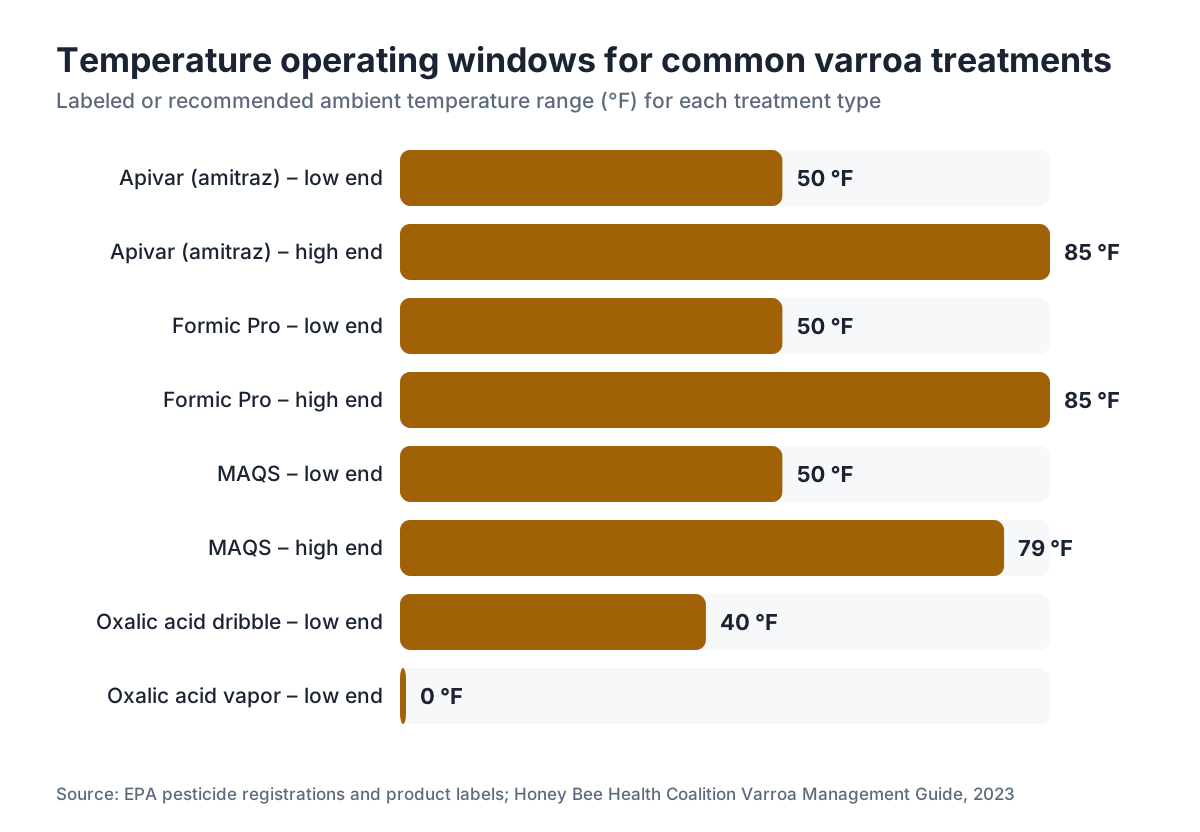
Treatment choice usually comes down to what's feasible in your climate and season. Here's a direct comparison of the labeled or recommended temperature ranges for the main chemical options.
| Treatment | Active Ingredient | Low Temp Limit | High Temp Limit | Notes |
|---|---|---|---|---|
| Apivar strips | Amitraz 3.3% | 50°F (10°C) | 85°F (29.4°C) | 6-8 week exposure; broodless not required |
| Formic Pro | Formic acid 65% | 50°F (10°C) | 85°F (29.4°C) | 14-day treatment; high-temp queen risk |
| Mite-Away Quick Strips | Formic acid 68.2% | 50°F (10°C) | 79°F (26°C) | 7-day treatment; tighter upper limit |
| Oxalic acid dribble | Oxalic acid 3.2% | 40°F (4.5°C) | No stated upper limit | Broodless period required for full efficacy |
| Oxalic acid vapor | Oxalic acid | Below freezing usable | No stated upper limit | Broodless ideal; widely used in winter |
| HopGuard 3 | Hop beta acids | 40°F (4.5°C) | No stated upper limit | Multiple applications needed |
[1][2][7][8]
Apivar and formic acid products share nearly identical temperature constraints, which is why oxalic acid vapor has become the dominant winter treatment for hobbyists. No treatment does everything. Match the tool to the season you're actually in.
For sourcing treatment supplies, beekeepers often compare beekeeping supply companies to find Apivar and competing products at the best prices. Some suppliers also offer free shipping on honey bee supply orders, which matters when you're buying in bulk for multiple hives.
How long do Apivar strips need to stay in the hive?
The label says 6 to 8 weeks, and you should take that seriously on both ends [1][2]. Pulling strips at 4 weeks because the mite drop looks good is a mistake. Varroa has a roughly 12-to-14-day reproductive cycle inside capped brood, so a single treatment needs to run long enough to catch multiple mite generations as they emerge and expose themselves to the strip surface.
The 6-week minimum assumes a well-populated colony with normal brood cycles. Eight weeks gives you the margin to catch late-emerging mites and cover any gaps in strip contact caused by comb rearrangement.
Leaving strips in longer than 8 weeks brings a different problem. Extended amitraz exposure raises the risk of resistance and builds up amitraz residues in wax. A 2018 review in Science of the Total Environment documented amitraz and its metabolite DMPF accumulating in beeswax and honey at levels correlated with treatment duration and frequency [9]. That residue matters most for beekeepers producing comb honey.
Strips also lose potency over time. By week 10 or 12 you're getting essentially nothing from strips that have already off-gassed their active ingredient. Keep them in exactly as long as the label says, then pull them.
Does the brood cycle change how temperature affects Apivar timing?
Yes, and most hobbyist resources skip this part. Apivar's efficacy against phoretic mites (mites riding on adult bees) runs much higher than its efficacy against reproductive mites sealed inside capped cells. The strips can't penetrate capped wax. The 6-to-8-week window exists to cover the full brood cycle, so you're waiting for those reproductive mites to come out of cells and touch the strip or the residue on adult bees.
Temperature feeds into this in a second-order way. Colder fall temperatures signal the colony to cut back brood rearing. A colony heading into November in Minnesota may have little to no capped brood by week 3 of treatment. That helps efficacy, because the phoretic mite load is high and every mite is accessible. But if your temperature is at the same time below 50°F, you've lost the volatilization you need.
So early fall treatments in northern climates hit a sweet spot: the colony still has some brood (you're treating before you lose winter bees), temperatures mostly stay in range, and the shrinking brood area raises the share of accessible phoretic mites. Aim to have strips in by early September in zone 4, early October in zone 7.
The Honey Bee Health Coalition's Varroa Management Guide walks through this brood-cycle logic in detail and is worth reading in full if you want to understand why timing isn't just about the calendar [5].
Can you use Apivar during a broodless period?
You can, and treating during a natural or induced broodless period may get you better results. Without capped brood, every mite is phoretic and accessible. Treatment duration can potentially be shortened (some research suggests 4 weeks is enough in a fully broodless colony), though the label still specifies 6 to 8 weeks as the standard [2].
Broodless periods in temperate climates often line up with cold temperatures, which creates the tension described above. If your colony is broodless because it's January and 25°F, you don't want Apivar, you want oxalic acid. If your colony is broodless because you pulled the queen for a few weeks in October while temperatures still sit at 55 to 65°F, that's a genuinely good setup for Apivar.
Some researchers and experienced beekeepers cage the queen in late summer to force broodlessness, then run Apivar for a shorter, high-efficacy cycle before reintroducing her. This isn't on the label and isn't standard practice, but the biology supports it. If you go that route, you're working off-label, so write down what you do and watch your mite counts closely to see whether it's actually working.
How do you monitor whether Apivar is working?
The alcohol wash is the gold standard for pre- and post-treatment assessment. The recommended treatment threshold in most extension guidance is 2 mites per 100 bees (2%) from a 300-bee sample, though some sources put the action threshold as low as 1 to 2% in late summer when winter bee production begins [5][7].
Do a wash before you put strips in so you know your baseline. Do another one 6 to 8 weeks later, after you've pulled the strips. A successful treatment should knock mite levels below 1% in most cases. If you're still above 2% after a full course of Apivar under good temperature conditions, you have two suspects: amitraz resistance in your mite population, or treatment failure from the temperature conditions above.
Natural mite drop (sticky boards) is less precise but gives you a directional read on whether mites are dying. A spike in drop in the first week or two, followed by a sustained low rate, is the pattern you want. Flat or declining drop from day one may mean volatilization is poor, either from temperature or from strips placed away from the brood area.
VarroaVault has free mite counting tools and seasonal protocol worksheets to help you set up a monitoring schedule around your treatment windows. Keeping records across multiple seasons is the only way to catch resistance trends before they turn into a colony-loss event.
Placement matters for reaching every mite. Put one strip per 5 frames of bees, hanging directly in the brood area where worker traffic runs highest. Move them once at the 3-to-4-week midpoint to a slightly different position to improve contact as the colony reorganizes.
Does Apivar resistance develop, and does temperature affect resistance risk?
Amitraz resistance in Varroa is real and documented. The mechanism involves increased expression of a monoamine oxidase gene that breaks down amitraz faster in resistant mite populations [10]. Resistance has been confirmed in commercial operations in the United States, and there are credible field reports from hobbyist beekeepers in areas with heavy Apivar use, especially where people run Apivar year-round.
Temperature doesn't directly cause resistance, but it connects to resistance risk in a quiet way. Sublethal amitraz exposure, which is exactly what you get when temperature runs too low or too high and strips underperform, is a known driver of resistance selection. Mites that survive marginal treatments and reproduce pass on whatever resistance traits they carry. If your cold treatments knock out 60% of mites instead of 90%-plus, you're selecting for the most tolerant individuals in your population every cycle.
Rotating modes of action is the standard resistance management recommendation [5][11]. Don't run Apivar every treatment cycle year after year. Alternate with oxalic acid, which has a completely different mechanism and no known resistance pathway. A common rotation is Apivar in fall (when temperatures support it) and oxalic acid vapor or dribble in winter when the colony is broodless or near-broodless.
The EPA's registration requirements for Apivar include resistance monitoring provisions, which shows this is a recognized regulatory concern and more than a field observation [1].
Where do beekeepers commonly go wrong with Apivar and temperature?
The costly mistakes aren't the extreme cases. Nobody debates whether January in Vermont is wrong for Apivar. The errors happen in the gray zones.
The most frequent one is starting too late in fall. A beekeeper checks mites in September, sees a high count, orders Apivar, and by the time it arrives it's mid-October with nighttime lows already hitting 45°F. They put strips in anyway because they're worried about the mite load. The treatment runs for 8 weeks mostly below the effective range, gets marginal knockdown, and the colony goes into winter still carrying a mite load that finishes it off in February.
The second common error is summer treatment in hot climates without thinking through alternatives. A southern beekeeper sees mite counts spike in July, reaches for Apivar because it's familiar, runs a treatment through August at 95°F ambient, gets queen failure at week three, and loses both the queen and the treatment efficacy at once.
A third, less-discussed problem is storing unused strips in a hot vehicle or shed. Apivar has a shelf life of roughly 3 years from manufacture under cool storage. Strips baked repeatedly at 90°F-plus lose amitraz concentration before they ever go in the hive. Store them at room temperature, ideally below 77°F, and check the expiration date before use [2].
Last, some beekeepers reuse strips from a previous cycle to save money. The strip matrix is built for a single use. A second cycle with depleted strips will not deliver adequate amitraz concentration no matter how good your temperature is. That's a false economy that costs you a colony.
Frequently asked questions
What is the minimum temperature for Apivar strips to work?
The manufacturer and EPA label set 50°F (10°C) as the practical lower limit for Apivar efficacy. Below that threshold, amitraz volatilizes too slowly off the strip matrix to reach lethal concentrations in the hive. You may see some mite drop from direct contact, but it won't approach the 90%-plus knockdown a properly timed treatment achieves. If your temperatures stay consistently below 50°F, switch to oxalic acid vapor or dribble.
Can I use Apivar strips in summer if I live in a hot climate?
The label says to avoid use when temperatures exceed 85°F (29.4°C). In consistently hot summers (90°F-plus days), Apivar is the wrong tool. It off-gases too quickly, loses efficacy in the back half of the window, and raises the risk of queen failure from elevated amitraz exposure. In hot climates, schedule Apivar for October and November when ambient temperatures drop into range. For summer mite control, formic acid or oxalic acid usually fit better.
Will one or two cold nights ruin my Apivar treatment?
Probably not. A few nights dipping to 45°F during an otherwise warm fall treatment likely won't cut efficacy much. Amitraz volatilization slows on cold nights but picks back up when temperatures warm. The concern is sustained cold, meaning multiple weeks where daytime highs rarely clear 50°F. If you're starting treatment during a stretch of mostly 55 to 70°F days with occasional cold nights, you're in a reasonable range.
How long should Apivar strips stay in the hive?
The Apivar label specifies 6 to 8 weeks. The 6-week minimum is needed to span multiple Varroa reproductive cycles and reach mites that were sealed inside capped brood at the start of treatment. Pulling strips early because mite drop looks low is a common mistake. Leaving strips past 8 weeks raises amitraz residue in wax and doesn't improve efficacy, since the strip is essentially spent by that point.
Does Apivar work during a broodless period?
Yes, and often more effectively, since all mites are phoretic and accessible rather than hidden inside capped cells. During a broodless period you may get high mite kill faster. But broodless periods in northern climates often land in cold winter months when temperatures sit below the 50°F lower limit. If you have a broodless colony in October at 55 to 65°F, that's an ideal Apivar scenario. In January, use oxalic acid instead.
What is the right number of Apivar strips per hive?
The label recommends one strip per 5 frames of bees (roughly one strip for every 5,000 bees), with a maximum of two strips per brood box. A full double-brood-box colony typically gets 2 strips. Place them directly in the brood area where bee traffic runs highest. At the 3-to-4-week midpoint, shift each strip slightly within the brood zone to improve contact with frames the bees may have been avoiding.
Can Apivar cause queen failure?
Yes, this is a documented risk, particularly during hot-weather treatments. Elevated temperatures speed up amitraz release, which can expose queens to concentrations high enough to impair or stop laying. Queen failure from Apivar shows up most in summer treatments. The Honey Bee Health Coalition's Varroa Management Guide lists queen loss as a known risk and recommends following label conditions, including temperature limits, to reduce it.
Is amitraz resistance a real problem with Apivar?
Yes. Confirmed resistance has been found in commercial Varroa populations in the United States, and field reports from hobbyists are rising, especially where Apivar use is heavy. Resistance develops partly through selection pressure from sublethal exposures, which off-label temperature conditions can cause. Rotating to oxalic acid, which has a different mechanism, is the main resistance management strategy. If a full-course Apivar treatment under good conditions underperforms, consider having mites tested.
How should I store Apivar strips before use?
Store Apivar strips at room temperature, ideally below 77°F (25°C), away from direct sunlight and heat sources. Don't leave them in a hot car, barn, or shed in summer. Shelf life is roughly 3 years from manufacture under proper storage. Strips baked repeatedly at high temperatures lose amitraz concentration before use, so your treatment may underperform even under ideal in-hive conditions. Always check the expiration date before opening a package.
When is the best time of year to apply Apivar?
In most of North America, the primary window is late summer to early fall, roughly August through October depending on latitude, when ambient temperatures reliably stay between 50°F and 85°F for the 6-to-8-week treatment period. A secondary spring window, typically March to April, works well in northern climates after the last hard freeze. The goal is to treat before winter bee production begins in fall and before the spring population explosion in spring.
How do I know if my Apivar treatment is working?
Run an alcohol wash (300-bee sample) before treatment and again 6 to 8 weeks after strips come out. A successful treatment typically drops mite infestation below 1 to 2%. During treatment, a mite drop board can show elevated drop in the first two weeks as phoretic mites die. Flat or minimal drop early on is a warning sign of poor efficacy, possibly from temperature conditions or from strips placed away from the brood area.
Can I reuse Apivar strips from a previous treatment?
No. Apivar strips are single-use. The plastic matrix releases its amitraz load over one treatment cycle. After 6 to 8 weeks in the hive, the strip is largely depleted. Reusing spent strips will not deliver a therapeutic amitraz dose no matter how good your temperature conditions are. Reuse also feeds resistance by creating sublethal exposure. Dispose of used strips according to local regulations and use fresh strips for each treatment.
Does it matter where in the hive I place Apivar strips?
Yes, placement matters a lot. Hang the strips vertically in the brood area where worker traffic runs highest, typically between the two most central brood frames. Bees brushing the strip surface pick up amitraz residue and spread it through grooming and trophallaxis. Strips placed outside the brood nest in honey supers or near the walls see far less contact. Never place strips in honey supers meant for harvest, since amitraz can contaminate honey.
What mite infestation level justifies an Apivar treatment?
Most university extension guidance and the Honey Bee Health Coalition recommend treatment when mite loads reach 2% from an alcohol wash (2 mites per 100 bees in a 300-bee sample). In late summer, before winter bee production begins, some sources recommend treating at 1 to 2% given the higher stakes. Below 1% in early spring or early summer, monitoring rather than immediate treatment is reasonable, but recheck monthly.
Sources
- EPA, Apivar Pesticide Registration (Reg. No. 86468-1): Apivar is an EPA-registered acaricide (amitraz 3.3%) for use in honey bee colonies; label specifies application conditions including temperature.
- Veto-Pharma, Apivar Product Label and Instructions: Manufacturer specifies effective ambient temperature range of 50°F to 85°F (10°C to 29.4°C) and 6-to-8-week treatment duration.
- National Pesticide Information Center (NPIC), Amitraz Technical Fact Sheet: Amitraz is a formamidine compound that acts on octopamine receptors; NPIC is an EPA-funded resource at Oregon State University.
- PLOS ONE, 'Pharmacokinetics of amitraz and metabolites in honey bees' (2019): Amitraz volatilization from slow-release strips is strongly temperature-dependent; measurable reductions in air-phase concentration below 15°C, and accelerated degradation above 30°C.
- Honey Bee Health Coalition, Varroa Management Guide (2023): Queen loss is a known risk factor for Apivar use; following label temperature conditions reduces risk; action threshold of 2% mites from alcohol wash; rotation with oxalic acid recommended.
- University of Florida IFAS Extension, Varroa Mite Management in Florida (Publication ENY-158): Elevated queen failure rates noted in summer Apivar treatments in southeastern US; spring treatment window timing guidance.
- Pennsylvania State University Extension, Varroa Mite Treatment Options: Oxalic acid dribble effective at lower temperatures than Apivar; fall treatment timing guidance for northern climates; HopGuard lower temperature threshold.
- EPA, Formic Pro and MAQS Pesticide Registrations: Formic Pro label specifies 50°F to 85°F effective range; MAQS label specifies 50°F to 79°F upper limit.
- Science of the Total Environment, 'Amitraz residues in beeswax and honey' (2018): Amitraz and metabolite DMPF accumulate in beeswax and honey at levels correlated with treatment duration and frequency.
- PLOS Genetics, 'Molecular mechanism of amitraz resistance in Varroa destructor' (2017): Amitraz resistance in Varroa involves increased expression of a monoamine oxidase gene that breaks down amitraz faster in resistant mite populations.
- USDA Agricultural Research Service, Honey Bee Research: Rotating acaricide modes of action is the standard resistance management recommendation for Varroa control in managed colonies.
Last updated 2026-07-09