How to apply Apivar strips correctly for varroa control
TL;DR
- Apivar (amitraz 3.3%) strips hang in the brood nest, two strips per colony no matter the hive size, for 6 to 10 weeks.
- Leave them in the whole window, pull them promptly when it ends, and confirm the kill with an alcohol wash around week eight.
- Where you place the strips decides whether the treatment works.
What is Apivar and how does amitraz kill varroa mites?
Apivar is a slow-release polymer strip loaded with 3.3% amitraz, a formamidine acaricide the EPA registered specifically to control Varroa destructor in honey bee colonies [1]. Each strip holds 500 mg of amitraz. Bees brush the strip, pick up a residue on their bodies, and spread it through the hive by grooming and moving around. The amitraz then reaches mites riding on adult bees.
Amitraz acts on octopamine receptors in the mite's nervous system. At working concentrations it scrambles Varroa behavior, makes mites detach from their host bee, and kills them [2]. It does not reach mites sealed inside capped brood at any meaningful concentration. That single fact is the core limitation of the treatment, and it's why the full 6-to-10-week window matters so much. Mites hiding in capped cells emerge across that stretch of weeks and only then meet the strips, once they're back on adult bees.
Veto-Pharma makes Apivar, and it's a prescription-exempt, EPA-registered product in the United States [1]. No veterinarian's script needed to buy it. That's a big part of why it's one of the more reachable hard miticides for hobbyists and sideliners.
When is the right time to apply Apivar strips?
Two rules set the timing. Treat when mites cross your threshold, and treat when you can do it without contaminating honey.
Apivar cannot go on a hive that has honey supers [1]. Amitraz and its metabolite DMPF build up in wax and honey, and the label flatly bans supers during treatment. That rules out any treatment that overlaps a nectar flow with supers in place. For most North American beekeepers the two clean windows are late summer into early fall (after the main harvest, before the winter cluster forms) and early spring (before supers go on and before the population booms).
Fall is the window that matters most. A high mite load going into winter is one of the leading causes of colony death, and a University of Maryland Extension study on Varroa management found that colonies treated in August had higher winter survival than untreated colonies or those treated later [3]. If your alcohol wash or sugar roll reads more than 2 mites per 100 bees, the Honey Bee Health Coalition action threshold, treat before the colony raises its winter bees [4]. Those are the long-lived bees that carry a colony to spring, and mite damage done to them now shows up as a dead-out in February.
Spring treatments earn their place if you missed fall, if you're starting fresh with packages or nucs, or if your post-winter wash shows the mite population climbing back toward 2%. Do them before your spring flow if you want supers on inside the treatment window.
How many Apivar strips does a colony need?
The Apivar label calls for two strips in a standard colony and one strip in a nucleus colony or a very small hive [1]. This is not a number you adjust because the colony looks strong. The dose is built around the hive volume and bee population needed to spread amitraz far enough.
A two-story Langstroth running two deeps gets two strips. That's the labeled dose. If you've got a monster colony packing three brood boxes, some beekeepers and extension resources float a third strip, but strictly speaking that's off label. When you're unsure, run two and get the placement right.
Nucs get one strip, centered in the brood cluster.
Under-dosing wastes the treatment. One strip in a full-sized colony makes sub-lethal amitraz concentrations, kills fewer mites, and pushes on resistance over time. Two strips, placed right, is the prescription.
Exactly where do you place Apivar strips inside the hive?
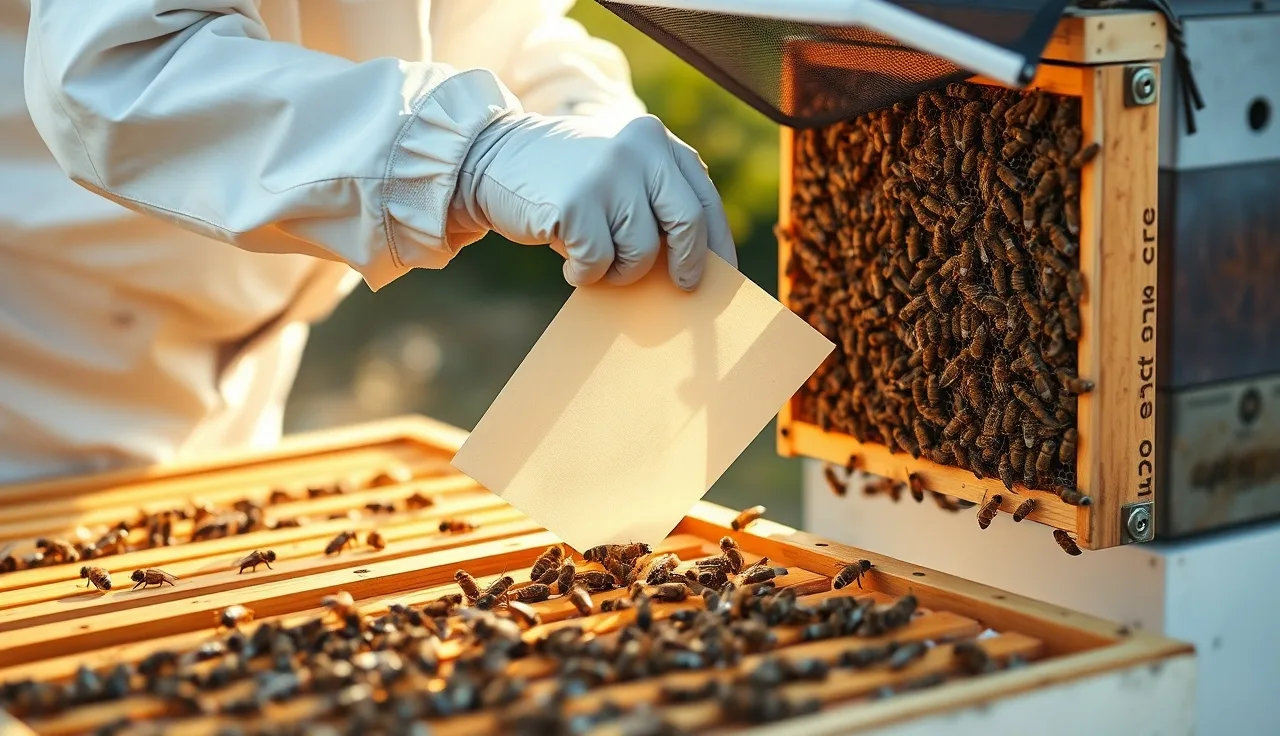
Placement is where most application errors happen, and it decides whether the treatment works or wastes six weeks. The strips have to hang in the brood nest, between frames that hold capped or open brood and bees.
You want heavy bee contact. Bees need to rub against the strip over and over as they tend brood, so a strip parked in a frame gap bees rarely cross delivers almost no active ingredient to the colony.
For a single-brood-box colony, hang the two strips on either side of the brood cluster. A common layout: count your brood frames (say seven frames of brood centered in a ten-frame box), then set one strip around frames three and four from one side and one strip around frames seven and eight. Keep them inside the brood nest, not out in the honey frames at the edges.
For a two-story colony with brood in both boxes, put one strip in the upper box and one in the lower, each inside the brood.
Hook the tab over the top bar so the strip hangs straight down between frames. It should touch neither comb face (contact limits surface exposure and can trap the strip in wax) nor curl at the bottom. A strip wedged flat against comb needs repositioning. It should swing a little when you lift the frame.
Don't put strips in the honey super. Don't put strips in empty drawn comb with no brood or bees. Both kill your efficacy.
How long do you leave Apivar strips in the hive?
The label says 6 to 10 weeks [1]. Six is the floor, and it's firm. Anything shorter gives mites cycling out of capped brood too little time to meet the strips after they emerge. Ten is the ceiling, and it matters just as much. Strips left past ten weeks stretch amitraz exposure for no benefit and raise the odds of wax contamination.
Most experienced beekeepers shoot for 6 to 8 weeks, then run a mite wash to confirm the kill before pulling strips. If the count is still high at week six or seven, finish the full eight to ten weeks before you call the treatment a failure.
Write the install date on masking tape and stick it inside the hive cover, or log it. Sounds obvious. But a colony mid-treatment looks exactly like an untreated one, and when you're running ten hives it's easy to lose the thread.
One field note for fall: if the colony forms its winter cluster before ten weeks is up, you still pull the strips. A clustered colony barely moves past the strips, so the last weeks of treatment in a cluster may put out next to no active ingredient anyway. Wait for a mild day (roughly above 50°F) and get them out.
Do you need to wear gloves and PPE when handling Apivar strips?
Yes. The Apivar label requires chemical-resistant gloves when you handle the strips [1]. Amitraz absorbs through human skin, and while each strip holds a low dose, there's no upside to skipping it. Nitrile or latex exam gloves aren't enough for extended contact. The label wants chemical-resistant gloves, which in practice means neoprene or similar.
Your usual bee gloves (leather, nitrile-coated fabric) may or may not be rated chemical-resistant. Read the glove label. Plenty of beekeepers keep a dedicated pair of neoprene gloves just for miticide work.
Wash your hands well after handling strips, gloves or not. Toss used strips in household trash, never by burning, per the label [1]. Spent strips still carry residual amitraz.
How do you check if Apivar treatment actually worked?
Run a post-treatment mite wash. Don't skip it. This is the only step that tells you the truth.
At week seven or eight, or within a week after you pull the strips, do an alcohol wash on roughly 300 bees (about a half-cup) taken from the brood nest [4]. The Honey Bee Health Coalition's Varroa management guide calls the alcohol wash the most accurate method for counts.
Below 1 mite per 100 bees (1%), the treatment worked. Between 1% and 2%, watch the colony and retest in two to three weeks. Still above 2% after a complete Apivar course, you've got a problem that needs answers before you retreat.
A count over 2% despite good application usually points to one of three things: re-infestation from neighboring colonies (drift and robbing pour mites back in faster than treatment kills them), placement that starved the strips of bee contact, or amitraz resistance in your local mites, which is less common but increasingly documented [2].
Moving to oxalic acid vaporization, either as a follow-up or as your next cycle, is a sensible answer to suspected resistance. Rotating active ingredients is standard integrated pest management.
For tracking counts across a season, the free protocol calculator at VarroaVault logs washes and flags when a colony crosses its action threshold, so you're not running the whole year on memory.
Can you use Apivar when there are queen cells or a laying queen present?
Yes, and queen status doesn't change the dose or the placement. Apivar is fine to use in colonies with a laying queen, virgin queens, or queen cells [1]. Nothing in the label literature says amitraz harms queens at labeled concentrations.
Still, some beekeepers report the odd queen loss during or right after Apivar treatment. Pulling correlation apart from causation here is genuinely hard. Queens die for many reasons, and a colony already beaten up by a high mite load (which damages brood and kills bees) may lose a queen for reasons that have nothing to do with the strips. The label doesn't flag queen sensitivity as a hazard.
If you're re-queening inside a treatment window, introduce the new queen, confirm she's accepted and laying, then run the treatment as normal.
Does Apivar work in cold weather or can you treat in fall?
Amitraz spreads and volatilizes far slower in the cold. The Apivar label and several extension resources note reduced efficacy once temperatures sit below about 50°F (10°C) for extended stretches [5]. That's the whole reason fall timing matters. You want the bulk of the window done while there's still enough warmth and bee movement to carry amitraz through the colony.
Across most of the continental U.S., a start in August or early September buys a full six-to-ten-week window before cold turns into a constant factor. A late-October start in a northern climate is a gamble. You may finish the window on paper, but the low temperatures during treatment can gut the efficacy.
You can't treat in the middle of a hard winter cluster. This is one spot where oxalic acid dribble or vapor beats Apivar outright: oxalic goes onto a clustered, broodless colony in a single treatment and needs no long exposure window. Missed your fall Apivar window and the colony is already clustered? A single-dose oxalic acid treatment is the better call.
What are the risks of Apivar resistance, and how do you manage them?
Amitraz resistance in Varroa is real and documented. A 2016 paper in PLOS ONE reported amitraz-resistant mite populations in the United States and identified specific genetic mutations in V. destructor tied to that resistance [2]. The Honey Bee Health Coalition names resistance monitoring as a main reason to always run post-treatment washes instead of assuming the treatment worked [4].
Resistance isn't yet common enough to make Apivar unreliable as a first-line treatment across most regions, but it's climbing. The moves that slow it are the same ones that slow resistance in any pest program: rotate active ingredients (don't reach for Apivar every single cycle), finish the full window instead of pulling strips early, dose correctly, and wash after treatment so you catch resistance before it costs you the colony.
The main hard-chemistry rotation partner for amitraz in the U.S. is oxalic acid, which works by a completely different mode of action. (Thymol products like ApiLife Var give you a third option, and they're neither amitraz nor oxalic.) Alternating Apivar cycles with oxalic acid, or using oxalic as a mop-up after Apivar, is the approach the Honey Bee Health Coalition recommends [4].
For the biology behind why resistance develops, the varroa mite article walks through the mite's life cycle and what it means for treatment strategy.
How much does Apivar cost, and where do you buy it?
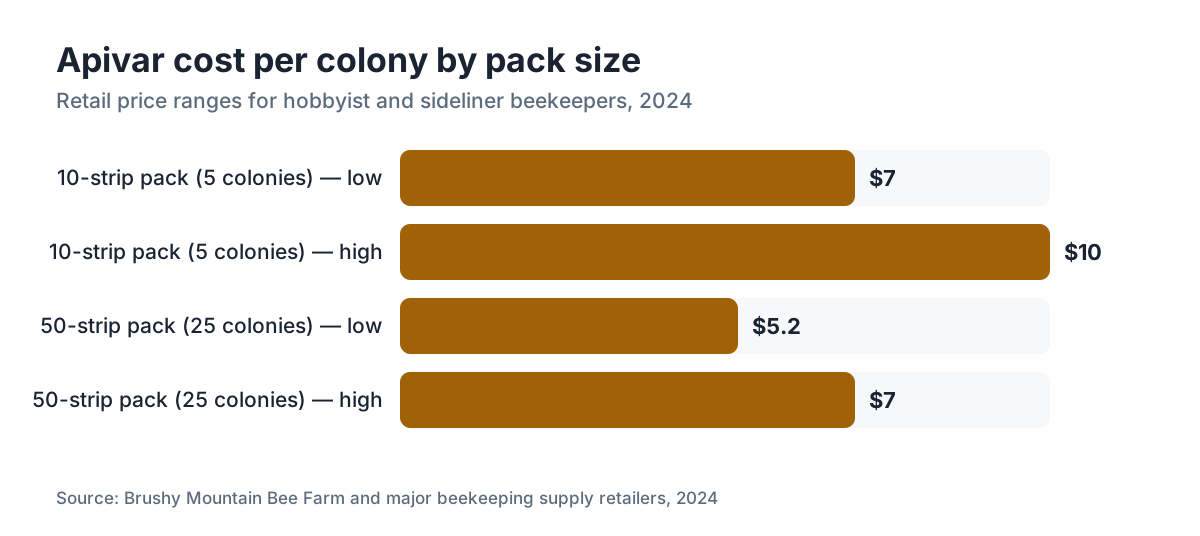
Apivar usually ships in packs of 10 strips, which treats five standard colonies. As of 2024, pricing from major beekeeping suppliers runs roughly $35 to $50 per 10-strip pack, or about $7 to $10 per colony per treatment [6]. Bigger packs (50 strips, treating 25 colonies) run roughly $130 to $175 at most suppliers, dropping the per-colony cost to around $5.20 to $7. Prices move with supplier and import costs.
You can buy Apivar without a prescription from most beekeeping supply companies. Major online retailers stock it, and so do plenty of local supply stores. For miticides and the rest of your kit, the beekeeping supply companies page lists vetted options with pricing notes.
| Pack size | Colonies treated | Approx. cost | Cost per colony |
|---|---|---|---|
| 10 strips | 5 | $35-$50 | $7-$10 |
| 50 strips | 25 | $130-$175 | $5.20-$7 |
Store unused strips somewhere cool, dry, and out of direct sun. Each package lists a shelf life. Check it, and don't run expired strips.
What mistakes do beekeepers most often make when applying Apivar?
The number one error is wrong placement. Strips dropped into empty comb, honey frames, or a box with little brood activity get almost no bee traffic, which means almost no amitraz transfer and near-zero mite kill. Put strips in the brood nest, every time.
Second most common: pulling strips early. Six weeks is the floor. Week four feels done because you see no dead mites and no obvious activity, but a huge share of the mite population is still sealed inside capped cells. Pulling at four weeks ends the window before those mites ever surface.
Leaving strips in too long is its own problem. Strips sitting for sixteen or twenty weeks load wax with amitraz metabolites at higher concentrations than a proper window ever would, and the extended sub-lethal exposure speeds up resistance selection.
Skipping the post-treatment wash carries the worst downstream cost. You walk off thinking the colony is clean, mite levels rebound over the next weeks unchecked, and by the time you notice, the winter bees are already being born into a mite-heavy hive.
And treating with supers on. That's a label violation and a food safety issue at once. Pull supers before you install strips, full stop.
To confirm you've got everything before you crack the lid, a solid checklist of beekeeping supplies saves a wasted trip to the truck.
Is there anything Apivar can't do, and what do you use alongside it?
Apivar does not kill mites inside capped brood during the treatment window. That's structural: amitraz moves bee-to-bee and bee-to-mite, but it doesn't cross capped wax at a killing concentration. Any mite in a cell on day one survives until it emerges and enters its phoretic phase [7]. That's the whole reason six weeks is a rule and not a suggestion.
Apivar also does nothing about the virus load a colony already carries. Mites inject deformed wing virus (DWV) and other pathogens straight into developing pupae, and bees already infected or damaged don't bounce back just because the mites are dead. USDA ARS work on Varroa notes that mite-vectored pathogens cause brood damage that outlasts mite control [8]. A badly mite-damaged colony can still dwindle through winter on that virus damage alone, even with a clean post-treatment count. Treating early, before the winter bee cohort is raised, is how you get ahead of it.
Some beekeepers follow Apivar with oxalic acid vaporization, timed to the broodless or low-brood stretch that shows up in fall or that you create by caging the queen. It isn't required, but it can drive counts lower when you start from a high baseline. VarroaVault's seasonal protocol planner helps you map when to stack treatments across the year without tripping the no-super restriction.
On hive style: the label is written for Langstroth gear, and the strip-between-frames method works in any frame hive. Top-bar hives with no vertical frames make placement trickier, though you can rig improvised hangers to get a strip into the brood area. The label doesn't cover non-Langstroth equipment, so you're off label there.
Frequently asked questions
Can I use Apivar with honey supers on the hive?
No. The Apivar label bans use when honey supers meant for human consumption are on the hive. Amitraz and its breakdown products can contaminate honey and wax. Pull every super before you install strips, and don't add supers back until the strips are out and the window is complete. It's a label requirement and a food safety issue at the same time.
How do I know if Apivar is working during treatment?
You won't see obvious daily signs the way a sticky board shows natural mite fall. The strips work slowly across 6 to 10 weeks. The only reliable check is a post-treatment alcohol wash at week seven or eight. A count below 1 mite per 100 bees after a full course means it worked. Don't assume success without counting.
What temperature range does Apivar work in?
Apivar performs best when temperatures stay consistently above 50°F (10°C). Amitraz volatilizes slower in cold air, which chokes its distribution through the colony. In practice, start fall treatments early enough that most of the 6-to-10-week window lands before steady cold sets in. Late-October starts in northern climates carry real efficacy risk.
Can I use Apivar in a nucleus colony?
Yes, and the label addresses it directly: one strip per nucleus colony instead of two. Center it in the brood nest. The lower count matches the smaller bee population. If a nuc grows into a full colony during the window, you don't add a second strip mid-treatment, but keep the existing strip in the brood area as the cluster expands.
Does Apivar hurt the queen or brood?
At labeled doses, Apivar isn't documented to harm queens or developing brood, and the label lists no queen toxicity hazard. Occasional queen loss reported during treatment is hard to pin on amitraz, since high mite loads present before treatment independently cause colony stress and brood damage. Confirm the queen is present before blaming any loss on the strips.
How do I dispose of used Apivar strips?
Wrap used strips and put them in household trash, per the label. Don't burn them; amitraz combustion products are potentially hazardous. Don't compost them or discard them where livestock or other animals could reach them. Spent strips hold residual amitraz, so keep them away from children and pets during handling and disposal.
How often can I use Apivar and how do I rotate treatments?
Most beekeepers run one or two Apivar cycles a year, usually fall and sometimes spring. To slow amitraz resistance, alternate with a different mode of action, mainly oxalic acid, at least every other cycle. The Honey Bee Health Coalition recommends monitoring post-treatment mite counts to catch early resistance before it turns into a colony loss.
What's the difference between Apivar and Apistan?
Apivar contains amitraz (3.3%). Apistan contains tau-fluvalinate, a pyrethroid acaricide. Fluvalinate resistance in Varroa has been widespread in the U.S. for more than two decades, which makes Apistan largely useless in many regions. Apivar is generally the more reliable choice in North America today. Run a post-treatment wash no matter which product you use, to catch resistance early.
Can Apivar strips touch the comb or wax?
The strip should hang freely between frames, not pressed flat against comb. Comb contact lets the strip stick to wax or get propolized shut, which limits surface exposure and cuts efficacy. If a strip goes in pinched tight against comb, reposition it. Done right, the strip swings slightly when you lift the frame.
What mite count level requires Apivar treatment?
The Honey Bee Health Coalition recommends treating when a 300-bee alcohol wash returns 2 or more mites per 100 bees (a 2% infestation) during brood rearing. Some extension services suggest a lower 1% threshold in late summer, when winter bees are being raised, because even moderate mite levels then can cause severe winter bee damage.
Can I move frames or requeen during an Apivar treatment?
You can requeen during treatment; the label doesn't restrict it, and Apivar isn't documented to interfere with queen acceptance. Moving frames between boxes in the treated hive is fine too, as long as the strips stay in the brood nest. Avoid moving frames from a treated hive into an untreated one mid-treatment, since that could transfer strip residue.
Does Apivar work against all varroa life stages?
Apivar kills phoretic mites (those riding adult bees) well. It doesn't reach reproductive mites inside capped brood at effective concentrations, so those are protected until they emerge. That's why the 6-to-10-week window is necessary: it gives every mite time to cycle through the phoretic stage and contact the strips. No single Apivar treatment kills 100% of the mites.
Sources
- EPA, Apivar (amitraz) product label: Apivar contains 3.3% amitraz, requires two strips per colony, prohibits use with honey supers, mandates chemical-resistant gloves, and specifies a 6-to-10-week treatment window
- Mitton G.A. et al., PLOS ONE, 2016, Amitraz resistance in Varroa destructor: Amitraz-resistant Varroa mite populations with specific genetic mutations have been documented in the United States
- University of Maryland Extension, Varroa Management: Colonies treated for varroa in August showed significantly higher winter survival rates than untreated colonies or those treated later in the season
- Honey Bee Health Coalition, Tools for Varroa Management Guide: The alcohol wash is the most accurate mite sampling method; the action threshold is 2 mites per 100 bees; rotating active ingredients is recommended to manage resistance
- Penn State Extension, Varroa Mite Management: Amitraz-based treatments have reduced efficacy when colony temperatures drop below approximately 50°F (10°C) for extended periods
- Brushy Mountain Bee Farm and major beekeeping supply retailers, 2024 price data: Apivar 10-strip packs retail for approximately $35-$50; 50-strip packs retail for approximately $130-$175 from major beekeeping suppliers as of 2024
- Oregon State University Extension, Varroa Mite Biology and Control: Varroa reproductive mites are protected inside capped brood cells and are not killed by contact acaricides during that stage
- USDA ARS Bee Research Laboratory, Varroa Management Resources: Deformed wing virus and other pathogens vectored by Varroa cause brood damage that persists after mite control is achieved
- Honey Bee Health Coalition, Varroa Management Guide (Threshold guidance): The coalition recommends a lower treatment threshold of 1 mite per 100 bees during late summer when winter bees are being raised
- North Carolina State University Apiculture, Varroa Mite Treatment Timing: Fall is the most critical treatment window for varroa because mite levels directly affect the quality and longevity of winter bees raised from August through October
Last updated 2026-07-09