Artificial swarm for varroa control: step-by-step guide
TL;DR
- An artificial swarm splits a colony so the laying queen moves to a fresh box with no sealed brood.
- Mites trapped in the emptying combs can't reproduce, and the brood break drops the phoretic load in both units.
- Pair it with one well-timed oxalic acid treatment and you reach 90 to 95% of the mites.
- Done in spring or early summer, it's the strongest non-chemical varroa tool a hobbyist has.
What is an artificial swarm and how does it control varroa?
An artificial swarm is a colony split that copies what happens when a real swarm leaves a hive. You move the laying queen to a fresh box with no brood, her flying bees follow her, and the original hive keeps the brood, nurse bees, and queen cells to raise a new queen. The varroa payoff comes from the brood break that follows in both units.
Varroa destructor reproduces inside capped brood cells. A female mite slips into a cell just before it's capped, lays eggs, and her daughters mate inside before emerging with the bee. Take away sealed brood and that cycle stops cold. The Honey Bee Health Coalition's Varroa management guide describes brood breaks as one of the strongest population-reduction tools, because mites stranded on adult bees (phoretic mites) can be wiped out with a single well-timed oxalic acid treatment [1].
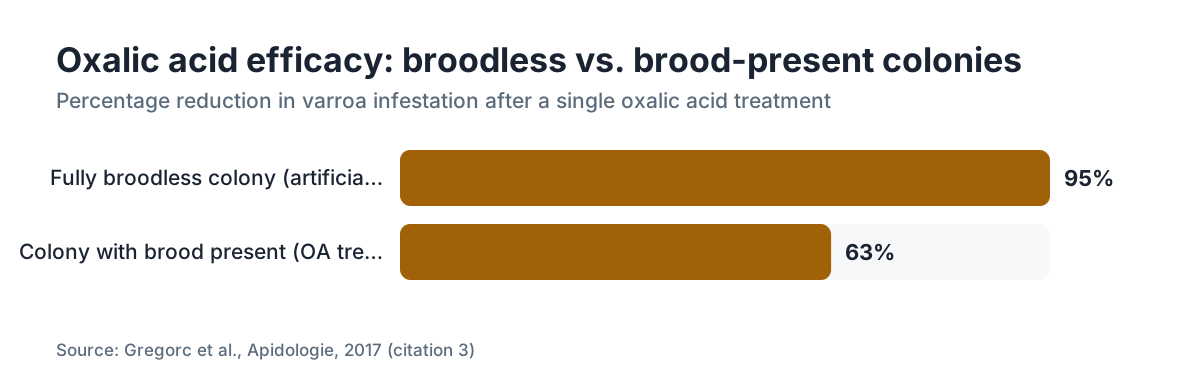
The phoretic window is the number that matters. Phoretic mites live roughly 5 days during the summer brood season and up to 6 months over winter [2]. During a brood break, every mite in the colony is phoretic. One oxalic acid dribble in that broodless window kills around 90 to 95% of phoretic mites, versus roughly 40 to 60% when brood is present [3].
So the artificial swarm is not a standalone trick. It's a setup move. It makes your treatment far more effective, or optional entirely if your counts were low to begin with.
When is the right time to do an artificial swarm for varroa?
Timing decides everything here. The best window is late spring through early summer, roughly late April through June across most temperate northern climates, when colonies are big, drones are plentiful for queen mating, and there's enough season left for both units to build before fall.
Go too early and queen mating fails because drone numbers are low. Go too late, say July or August, and you squeeze the queenright colony's time to rebuild before the fall nectar dip and winter prep. A colony split in early August in a short-season place like the upper Midwest may never stack enough winter stores.
Read the colony's own biology too. The sweet spot is when you see queen cups or a pre-swarm buildup, before the bees actually leave. A colony that already threw a natural swarm has given away much of its population and gets less out of the artificial version.
Your mite count sets the last condition. The artificial swarm earns its keep when your alcohol wash or sugar roll reads 1 to 2% infestation or higher [1]. Below 1%, the hit to colony productivity may not pay for the brood break alone, though plenty of beekeepers run it every spring for swarm control no matter what the mites read.
What equipment do you need before you start?
You don't need much, but it has to be ready before you crack the hive open. Realizing you forgot the entrance reducer while the queen is loose somewhere on a frame is a rough moment.
Here's what to have on hand:
- A complete new hive (floor, brood box, frames with foundation or drawn comb, crown board, roof). Drawn comb beats foundation because the queen starts laying sooner, and that speeds how fast the new colony makes up lost brood.
- Fresh foundation or a couple of drawn frames for the queenright unit.
- An entrance reducer or a strip of mesh to partly block the new hive entrance on day one.
- Your usual protective gear.
- A marking pen or a cage if you need help spotting the queen.
- A notebook or your phone to log the date. You track days to know when the broodless window peaks.
Complete hive setups are available from beekeeping supply companies that carry everything from nucleus boxes to full ten-frame Langstroth hives. If money's tight, free shipping honey bee supply companies can trim the cost of outfitting a second hive.
Skip the nucleus box (nuc) for this if you can. Sure, a real swarm settles into tight quarters in nature, but the goal here is fast rebuild. A full brood box lets the queen lay without a ceiling from day one.
Step-by-step: how to perform an artificial swarm
Work through these steps on a warm, calm day with foragers flying. Morning or midday both work. Don't do this in rain or when it's below about 12°C (54°F).
Step 1. Set up the new hive on the original hive's stand. Move the original hive to one side or the back of the apiary. Put the new empty hive exactly where the old one stood. Returning foragers land in the new hive by default, which is what you want, because foragers stay with the queen.
Step 2. Find the queen. Go through the original hive frame by frame. Take your time. She's in there. Mark her if she's unmarked with the year's color code. Once you find her, rest that frame gently on a frame holder or lean it against the original hive.
Step 3. Move the queen and her frame to the new hive. Set the queen's frame, bees and all, into the center of the new box. Add three or four frames of foundation or empty drawn comb around her. Transfer no sealed brood to the new box. Open brood is fine (a frame or two of eggs and young larvae) but sealed pupae stay in the original hive.
Step 4. Close up the new hive. Fit the entrance reducer to a 2 to 3 cm opening. That helps the small returning-forager crew guard the door while the queen settles back into laying.
Step 5. Check the original hive for queen cells. It should hold sealed brood, nurse bees, and ideally one or more capped queen cells or fresh cups with larvae swimming in royal jelly. No cells started yet? The bees will build them within 24 hours once they sense they're queenless. Leave the best cell and cut the rest at day 9 to 10 to curb swarming from this unit, or let the bees sort it out themselves.
Step 6. Mark the date and plan your treatment. The queenright unit (the artificial swarm on the original stand) has a laying queen almost at once. Within 24 days, all the brood she carried into the new box has emerged. Watch that frame and your calendar. The original hive stays broodless for roughly 23 to 28 days, from the split until a new queen emerges and her brood starts getting capped.
Step 7. Treat the original hive during the broodless window. This is where you bank most of the varroa benefit. While the original colony is queenless and broodless (roughly day 7 to 14 after the split, before the new queen's first brood caps over), apply oxalic acid by dribble or vaporization [3]. The Honey Bee Health Coalition rates oxalic acid vaporization as effective even in strong colonies, but the broodless window makes a plain dribble nearly as good and it needs no vaporizer [1].
Step 8. Monitor and decide next steps. Around day 21 to 28, confirm the original hive has a laying queen. Alcohol wash both units around day 30. If counts still top 2%, line up a follow-up Apiguard or Apivar treatment once both colonies have laying queens and growing populations [4].
How does the brood break actually reduce mite numbers?
Most varroa in a colony aren't riding on bees. In a typical late-summer colony, roughly 80 to 90% of the total mite population sits inside capped brood at any moment [2]. That's the hiding place. Pull the laying queen, let all sealed brood hatch out over the following 12 days, and those mites have nowhere to go but onto adult bees.
Phoretic mites are exposed mites. They cling to adult bees waiting for the next cell to enter. In a broodless colony, they're stuck in the phoretic phase with no cell to hide in, and that's exactly when oxalic acid, which only touches phoretic mites, does its full work.
A 2017 study in Apidologie found oxalic acid cut mite infestation by an average of 95% in fully broodless colonies, against 63% in colonies with brood present [3]. That gap is huge. Say your pre-split wash shows 3% infestation, about 3,000 mites in a colony of 40,000 bees. A broodless oxalic treatment can in theory bring that down to roughly 150 mites, well under a safe threshold.
The queenright unit (the artificial swarm box) gets a semi-broodless period of its own. The queen came over on a frame with eggs and maybe open brood, so she was never fully broodless. But her colony is small and building from scratch, and its varroa load starts low anyway, because most of the mites stayed behind with the original hive's brood.
For the full picture of how varroa mite biology drives all of this, including the reproduction timeline inside the cell, that background makes every split decision easier to call.
What mite levels should you expect before and after?
Real numbers tell you whether it worked. The economic threshold most extension services use is 2% infestation on an alcohol wash (about 2 mites per 100 bees) during the main brood season, or 1% heading into fall [1][9].
Here's a rough picture of what the artificial swarm method does to mite loads, drawn from published research and extension guidance:
| Timing | Typical mite infestation % | Notes |
|---|---|---|
| Pre-split (May/June) | 1 to 4% | Threshold action often warranted |
| Queenright unit (day 30) | 0.5 to 1.5% | Small colony, most mites stayed with brood |
| Original hive, no treatment | 2 to 5% | Mites from capped brood re-emerge |
| Original hive, OA during broodless window | 0.3 to 1.0% | ~95% efficacy on phoretic mites [3] |
| Both units combined (day 60) | 1 to 2% | Rebuild underway, monitor closely |
These aren't guarantees. Your starting load, mite immigration from nearby feral or neglected colonies, and whether your oxalic timing actually hit the true broodless peak all move the result. Nobody has a tightly controlled, large-sample field study on hobbyist operations. The figures here draw from the Apidologie 2017 study [3] and Honey Bee Health Coalition guidance [1].
Alcohol wash both colonies at day 30 and again at day 60. Don't assume the split worked. Measure it.
Should you treat the queenright (artificial swarm) unit too?
Probably yes, but not right away. The artificial swarm box starts with very few mites. It got the queen's frame and some foragers, almost no sealed brood. Mite levels there run low for the first few weeks.
Then the queen ramps up laying, sealed brood piles in, and any mites present start breeding fast. By week 4 to 6, that colony can grow mites at the same exponential clip as any other. Check it with an alcohol wash at day 30. If the count tops 2%, treat with a thymol product (Apiguard, ApiLifeVar) or oxalic acid vaporization, following the label for colony size and temperature [5].
Under 1% at day 30? Hold off and monitor weekly. Plenty of beekeepers find the artificial swarm box stays clean for 6 to 8 weeks, simply because it started nearly mite-free and its first brood cycle came from an almost clean queen.
What can go wrong and how do you fix it?
The most common failure is queen loss in the original hive. If the queen cells all get destroyed (chilled, balled, or knocked off by accident), the original hive goes hopelessly queenless. Check at day 10 to 14. No queen cells and no laying queen means you pick from a few fixes: combine the original hive back with the artificial swarm using the newspaper method, introduce a mated queen, or drop in a frame of fresh eggs from another colony.
A second problem is the queen in the artificial swarm box not getting accepted or dying soon after the split. That's rare when you moved her carefully on her own frame, but it happens. Check for eggs at day 5 to 7. No eggs and no queen means act fast: source a new queen or combine units.
Foragers not following the queen trips up first-timers. If you put the new hive on the original stand and the foragers still cluster at the old spot, check that the new hive sits exactly where the old one did. Shift it inch by inch if you have to. Bees home in to within a foot or two of the original entrance.
Some beekeepers find the original hive still swarms after the split. That usually means too many queen cells left standing. Knock them all down but one at day 9 to 10 if swarm prevention matters too. The method works best when you stay ahead of what's left behind.
How does an artificial swarm compare to other varroa control methods?
No single method wins everywhere. The artificial swarm takes time and a spare hive, but it does things chemical treatments alone can't.
| Method | Efficacy vs. varroa | Cost | Colony disruption | Resistance risk |
|---|---|---|---|---|
| Artificial swarm + OA | 85 to 95% [3] | Low (equipment cost) | High short-term | None |
| Oxalic acid vaporization (broodless) | 90 to 95% [3] | Low ($5 to 15/treatment) | Low | None |
| Apiguard (thymol) | 74 to 93% [4] | Moderate ($10 to 20/hive) | Low-moderate | Low |
| Apivar (amitraz) | 91 to 99% [4] | Moderate ($15 to 25/hive) | Low | Emerging concern |
| Checkmite+ (coumaphos) | 80 to 90% | Moderate | Low | High in some regions |
The artificial swarm alone, with no follow-up treatment, gives you the brood break but misses the phoretic mites riding adult bees in the original hive. The real power is pairing the brood break with oxalic acid, which the EPA has approved for use in honey bee colonies, including during honey flow when applied by vaporization [6].
If you want a system that tracks your mite counts, split timing, and treatment windows across several colonies, VarroaVault's free protocol tools build a calendar around your specific split date and colony size. Date-specific tracking is easy to lose in a notebook and easy to need once you run more than two or three hives.
Against Apivar alone, the artificial swarm needs more skill and an extra hive, but it leaves no residue in wax, carries zero resistance risk, and hands you a bonus colony to keep or sell. For sideliners with 10 to 50 hives, that's a real economic case.
Can you use the artificial swarm method to also control swarming?
Yes, and this is often why hobbyists learn the technique in the first place. The artificial swarm answers the colony's urge to swarm by staging the swarm event for them. The queen leaves (from the bees' point of view) and the original hive runs the queen-rearing process it was already building toward.
A colony that's done an artificial swarm rarely throws a natural swarm afterward, because the reproductive drive is spent. You still manage queen cells in the original hive around day 10 to be thorough, but the swarm-prevention success rate runs high.
For beekeepers in town or the suburbs, where a swarm on a neighbor's fence turns into a real community-relations headache, this double benefit (varroa control plus swarm prevention) makes the method especially attractive. The Honey Bee Health Coalition names swarm-based management among the recognized non-chemical varroa approaches [1].
If you're newer to colony management and want to see how genetics like africanized honey bee traits or defensive behavior shape split management, that background is worth having before you handle queens from unknown stock.
How do you monitor success after the split?
Monitoring isn't optional. You can do everything right and still watch mite levels rebound from reinfestation by neighboring colonies inside six weeks. The Honey Bee Health Coalition recommends alcohol wash monitoring every 30 days during brood season and before winter prep [1].
For each resulting colony, do an alcohol wash or a soapy water roll at day 30 and day 60 post-split. Use a 300-bee sample, count the mites in the liquid, and figure it: (mites / bees) x 100 = infestation percentage. Six mites in 300 bees is 2%, the action threshold during brood season.
If levels climb back above 2% in either colony before fall, you still have options. Apiguard works down to about 15°C ambient and has strong efficacy in colonies with brood present [4]. Apivar strips go in during any brood-present period outside honey flow, following label directions exactly [5].
The EPA requires every varroa treatment be used strictly by the approved label. The label is the law. Never double-dose, never mix products, and never use treatments in honey supers unless the label allows it [6].
For beekeepers building a full seasonal protocol, the tools and monitoring forms on VarroaVault link your post-split counts to a treatment calendar that covers both colonies through fall.
Is the artificial swarm suitable for every colony and every beekeeper?
Honest answer: no. A few situations call for a hard pause before you split.
Don't split weak colonies. If a colony holds fewer than about 8 to 10 frames of bees, splitting it risks both units ending up too weak to survive. Build it up first, then split when each half is sure to get a viable population.
Late-season splits are risky in short-summer climates. In Minnesota or Vermont, a split after July 1 can leave the original hive without enough time to pack winter stores. In cold country, treat the artificial swarm as an early-season tool.
Beekeepers who've never found a queen should practice on a calm inspection day first. Losing the queen mid-split in a defensive colony is stressful for beekeeper and bees. Still building confidence? Ask a more experienced beekeeper to walk the process with you the first time.
And if you run one hive with no spare gear, you'll need a second setup. A basic Langstroth setup runs roughly $150 to $300 new depending on supplier [7]. That's a real barrier. Some beekeepers start the artificial swarm in a nuc box as a cheaper stopgap, planning to move it to a full box later.
Frequently asked questions
How long is the broodless window after an artificial swarm?
In the original hive, the broodless window usually runs 23 to 28 days. The last sealed brood from before the split hatches within about 12 days, and the new queen won't have her first brood capped until day 23 to 28 from the split. Your best oxalic acid window is roughly day 10 to 20 after the split, before new brood caps over.
Can I do an artificial swarm without a second hive?
You need at least a nucleus box, a floor, and a cover for the queenright unit. Five frames is the minimum workable space. A full second hive is better because the queen gets more room and the colony rebuilds faster, but a nuc gets you through the brood-break window. Budget about $60 to $100 for a basic nuc setup from most suppliers.
Do I need to treat the queenright unit after the split?
Usually not right away. The artificial swarm box starts with almost no sealed brood and very few mites. Do an alcohol wash at day 30. Below 1% infestation, you can monitor and hold off. Above 2% at day 30, treat with oxalic acid vaporization or a thymol product following label directions. The mite population in that unit climbs fast once brood ramps up.
What if the original hive has no queen cells after the split?
Give it 24 to 48 hours. Bees start emergency queen cells as soon as they sense they're queenless, as long as young larvae (under 3 days old) are present. If you check at day 3 and still find no queen cells and no young larvae, give them a frame of eggs from another colony, introduce a mated queen, or combine the unit back with the artificial swarm.
How many mites does an artificial swarm actually remove?
The split itself removes no mites. It concentrates them. Roughly 80 to 90% of total colony mites sit in sealed brood at any moment. After the split, those mites emerge as phoretic. A single oxalic acid treatment during the broodless window then reaches about 90 to 95% of all mites. A 2017 Apidologie study found broodless OA treatment cut infestation by about 95% versus 63% with brood present.
Can the artificial swarm method cause more swarming?
Done right, it prevents swarming rather than triggering it. The original hive works through its reproductive biology in the queen-rearing process. Still, check the original hive at day 9 to 10 and cut queen cells to one if swarm prevention is a goal. Leaving several viable queen cells standing risks afterswarms from the original colony.
What is the best treatment to pair with an artificial swarm?
Oxalic acid, by dribble or vaporization, applied during the broodless window in the original hive. Dribble is effective and cheap when the colony is truly broodless. Vaporization (OAV) is faster across multiple hives and slightly more thorough. Both are EPA-approved. The Honey Bee Health Coalition's Varroa guide covers application rates and timing in detail.
Will the original hive be weak after the artificial swarm?
Temporarily, yes. You pulled the queen and many foragers went with her to the new stand. The original hive stays noticeably quieter for 2 to 4 weeks during queen rearing. But it keeps all the sealed brood, which hatches into nurse bees and then foragers. By week 5 to 6, a well-managed original hive is usually back to normal population.
Can I do multiple artificial swarms from the same yard?
Yes, and many sideliners run it as a routine spring protocol. Each split needs its own box and stand. Keep stands at least 3 to 4 feet apart and face entrances in different directions to cut drift. Running more than four or five splits? Stagger them by a week or two so you're not managing several broodless windows across the whole yard at once.
How soon after the split can I add honey supers?
On the original hive, wait until a new queen is laying actively and the population clearly builds, usually 5 to 7 weeks post-split. On the artificial swarm unit, the queen lays almost right away, but the colony is small. Add supers only once bees cover 7 to 8 frames. Supering a small colony too early drops temperature regulation and slows brood development.
Does the artificial swarm work with top-bar hives or Warre hives?
The principle works in any hive type, but the mechanics change. In a top-bar hive, you move the queen bar and the neighboring bars into a second top-bar hive. The catch is that top-bar frames aren't interchangeable between hives the way Langstroth frames are, so you need a second compatible body. The brood-break biology is identical whatever the hive style.
What mite count warrants an artificial swarm rather than just a chemical treatment?
The Honey Bee Health Coalition recommends action at 2% infestation during brood season. An artificial swarm paired with oxalic acid earns the extra work when you want to skip chemical residues, when you want a bonus colony, or when the colony already shows pre-swarm buildup. Below 1% in spring, a standalone oxalic acid treatment or watchful monitoring may be all you need.
Do I need a marked queen to do this successfully?
No, but it helps enormously. Finding an unmarked queen in a populous colony can eat 20 to 30 minutes of careful searching. If your queen is unmarked, mark her during your next routine inspection before planning the split. Queen-marking pens cost a few dollars and use an internationally agreed color code by year (white, yellow, red, green, blue in a five-year cycle).
Sources
- Honey Bee Health Coalition, Varroa Management Guide (2023 edition): Brood breaks are among the most effective varroa population-reduction tools; swarm-based management recognized as a non-chemical approach; action threshold of 2% infestation during brood season recommended.
- University of Minnesota Extension, Varroa Mite Management: Roughly 80 to 90% of total varroa population is in capped brood at any time during brood season; phoretic mites live about 5 days in summer and up to 6 months overwinter.
- Gregorc A. et al., Apidologie (2017), Oxalic acid efficacy in broodless vs. brood-present colonies: Oxalic acid treatment in fully broodless colonies reduced varroa infestation by approximately 95%, compared to approximately 63% in colonies with brood present.
- Penn State Extension, Varroa Mite Treatment Options: Apiguard (thymol) efficacy range 74 to 93%; Apivar (amitraz) efficacy 91 to 99%; treatment thresholds and Apiguard temperature requirements (~15°C minimum).
- Apivar (amitraz) EPA-approved label, Veto-Pharma: Apivar strips approved for use in honey bee colonies with brood present, outside of honey flow; label directions govern application rates and timing.
- U.S. EPA, Oxalic Acid for Varroa Mite Control (pesticide registration): EPA has approved oxalic acid for use in honey bee colonies including by vaporization during honey flow; label is the legal requirement for application.
- University of California Cooperative Extension, Beginning Beekeeping Equipment Costs: Basic Langstroth hive setup costs approximately $150, $300 new depending on supplier and configuration.
- Virginia Cooperative Extension, Managing Varroa Mites in Honey Bee Colonies: 1% infestation threshold recommended going into fall for winter preparation; monitoring every 30 days during brood season.
- USDA Agricultural Research Service, Honey Bee Lab: Varroa destructor reproductive biology: female mite enters cell before capping, lays eggs, and daughters mate inside the cell before emerging with the bee.
Last updated 2026-07-09