Australia and varroa mite: how it arrived and what happens next
TL;DR
- Australia confirmed its first Varroa destructor detection on June 22, 2022, at the Port of Newcastle, New South Wales.
- After roughly four decades as the last major honey-producing nation free of the mite, eradication was officially abandoned in June 2023.
- Australian beekeepers now manage varroa like everyone else does: monitoring, treating, and running hard seasonal protocols.
Does Australia have varroa mites now?
Yes. Australia has varroa mites, and it will keep them. The country spent roughly four decades as the only significant honey-producing nation on earth without Varroa destructor established in its bee populations. That run ended in 2022. In 2023, New South Wales officially shifted from an eradication response to a management response, which means the mite is treated as permanently established. Australian beekeepers now do what beekeepers in Europe, North America, and most of Asia have done for decades [1].
The shift is a big deal for the industry. Australian beekeeping had built real advantages around varroa-free status: lower production costs with no miticide bill, the ability to export queens and package bees to varroa-affected countries, and a large reservoir of feral bees that had never dealt with varroa-driven viral amplification. All of that is now changed or at risk.
For backyard and sideliner beekeepers, the message is short. Learn to monitor. Learn to treat. Accept that untreated colonies will likely collapse within one to three years of infestation, which matches what researchers have documented in every other country where varroa took hold [2].
When did varroa mite arrive in Australia?
The first confirmed detection of Varroa destructor in Australia came on June 22, 2022, at the Port of Newcastle in New South Wales [1]. Inspectors from NSW Department of Primary Industries found mites on honey bees tied to a vessel arriving from overseas. That single find triggered an emergency biosecurity response under Australia's national framework.
Surveillance expanded within weeks. More detections followed in the Newcastle and Hunter Valley regions, then progressively south and west as tracing showed how far mite-carrying bees had already moved. By the end of 2022, detections reached well beyond the first containment zone.
Australia had seen varroa scares before. Varroa jacobsoni, a related but less damaging species that mostly parasitizes Apis cerana, turned up in 2016 in the Torres Strait and far north Queensland on Asian honey bees. Authorities handled that incursion differently because V. jacobsoni was not then considered a primary threat to the European honey bee (Apis mellifera) that runs commercial beekeeping. Later research muddied that picture. Some V. jacobsoni populations had already switched hosts to reproduce on A. mellifera [3]. The 2022 detection was Varroa destructor, the same species behind colony losses across every other major beekeeping region. Nobody argued about its threat level.
How did the varroa mite get to Australia?
The honest answer is that investigators strongly suspect international shipping, but the exact pathway was never fully confirmed publicly. The Newcastle detection fits mites arriving on bees tied to a ship: direct contact with vessel-associated bees, smuggled bees or bee products, or a stowaway swarm that settled on cargo or the vessel itself [1].
Australia's bee biosecurity is strict by world standards. You cannot legally import live bees. Bee products face heat treatment rules designed to kill mites and pathogens. Ports still leak. Ships attract swarms. Equipment moves in ways inspectors cannot always catch. The Honey Bee Health Coalition's Varroa Mite Management Guide notes that varroa spreads through the movement of bees and beekeeping equipment, and that international trade pathways stay a persistent introduction risk for countries not yet infested [2].
Once inside the country, spread ran on the usual mechanics that make varroa so hard to contain anywhere. Drifting and robbing bees carry mites between colonies. Swarms set up new infested sites. Beekeeper movement of equipment and colonies, even the well-meant movement during the emergency response, can push mites ahead of surveillance zones. The NSW eradication attempt destroyed thousands of hives and locked down movement, but by mid-2023 authorities decided the infestation was too widespread to eradicate [1].
How did varroa mite enter Australia through the border, and why wasn't it stopped?
Australia's biosecurity framework, governed by the Biosecurity Act 2015, bans importing live Apis mellifera bees and puts strict conditions on bee products [4]. The Australian Border Force and the Department of Agriculture, Fisheries and Forestry (DAFF) had long flagged varroa as a priority threat, and it sat on the national list of Emergency Animal Diseases.
So why didn't the border hold? A few honest reasons.
Port surveillance for bees targets cargo and passengers, but a ship itself can carry a feral swarm that has nothing to do with the manifest. A swarm settles on rigging or a container, the ship moves, and the swarm either transfers to a local tree or contacts managed bees in the port. This isn't hypothetical. Exotic bee species and parasites have entered countries exactly this way before.
Bee products get inspected at a sample level, not exhaustively. Heat treatment protocols for pollen and wax are built to kill pathogens and mites, but enforcement leans on accurate declaration and correct treatment by the exporting country.
The Torres Strait already had V. jacobsoni established, which may have softened the broader public biosecurity conversation, even though the two species carry different threat profiles.
The Australian government's post-incursion review acknowledged that even with rigorous border controls, zero probability of varroa entry was never achievable given global shipping volumes [4]. The question was always when, not if. Plenty of Australian apiculture researchers had been saying so for years.
What was Australia's eradication response, and why did it fail?
NSW Department of Primary Industries launched an Emergency Response right after the June 2022 detection, working under the National Bee Pest Surveillance Program and Emergency Plant Pest Response protocols [1]. The response included mandatory hive registration checks, movement restrictions across defined red, purple, and yellow zones, compulsory destruction of infested hives with compensation, and an aggressive tracing program.
At its peak, the program destroyed tens of thousands of hive units across the affected zones. Some beekeepers got compensation. Others disputed the amounts, or the way their hives were designated. The human cost was real for professionals whose whole livelihood sat inside a destruction zone.
Detections kept appearing outside the containment boundaries anyway. By mid-2023, the NSW government concluded varroa had spread into too many feral populations to make eradication feasible. In June 2023, about a year after the first detection, NSW formally moved to a management response [1]. Other states started building their own management frameworks, knowing cross-border spread was a matter of time.
This path matches New Zealand's in 2000, when V. destructor was detected, eradication was attempted, and the effort was eventually abandoned. It also matches what researchers have long documented about varroa once it reaches feral bees: those populations become a reservoir that no hive destruction program can realistically reach.
How fast does varroa spread once it's established?
Faster than most beekeepers expect, and Australia proved it. Within twelve months of a single port-of-entry detection, the mite had moved across a large stretch of coastal New South Wales.
The mechanics are well understood. Robbing is one of the fastest routes. When a collapsing infested colony gets robbed by healthy bees from nearby hives, those robbers carry mites home. Drifting bees, which in dense beekeeping areas can be 20 to 30% of returning foragers landing at the wrong hive on any given day, transfer mites continuously [11]. Swarms take their mites with them when they leave. And beekeeper movement of queens, packages, nucs, and equipment carries mites across distances bees could never cover on their own.
The Hunter Valley has both a high density of commercial and hobby operations and a large feral bee population. Once mites reached feral colonies, the eradication effort was fighting a self-sustaining reservoir that no regulatory boundary could touch.
Here is the lesson for beekeepers anywhere. The mite does not stay local. It moves, it finds feral bees, and within a few years it is everywhere in the region. Biosecurity isn't useless. But once varroa gets in, the eradication window is short, and it may demand a response speed that large bureaucracies struggle to match.
What varroa treatments are available to Australian beekeepers now?
Australian beekeepers now work with the same toolkit used everywhere varroa is established, except product registration runs through the Australian Pesticides and Veterinary Medicines Authority (APVMA), not the US EPA [5]. Registration for specific miticides has moved fast since 2022, so check the current APVMA register before you buy or apply anything.
Here are the core categories.
Oxalic acid (OA): Approved for use in Australia through the APVMA. OA hits phoretic mites (the ones riding on bees, not sealed in capped brood) and works best during broodless periods or as a trickle on package bees. The US EPA registration for OA products like Api-Bioxal names oxalic acid dihydrate as the active ingredient, and efficacy studies consistently show 90-plus percent knockdown of phoretic mites when applied right [6]. Same chemistry applies in Australia.
Formic acid: Products such as Formic Pro have been considered for Australian use. Formic acid gets into capped brood cells and kills mites in the reproductive stage, so it reaches more of the mite population than OA alone [2].
Amitraz (Apivar): A synthetic strip miticide used heavily worldwide. Registration status in Australia was under review as of 2023. It works, but you have to rotate it with other modes of action to slow resistance, which is already documented in some overseas populations.
Thymol-based products (Apiguard, ApiLifeVar): Temperature-dependent treatments that shine in certain seasonal windows and do poorly in very hot or very cold weather.
The Honey Bee Health Coalition's Varroa Mite Management Guide, now in its third edition, is the best single reference for how these categories work, when to use each, and how to rotate them against resistance [2]. Read it next to the APVMA label for whatever you actually apply.
Building a protocol from scratch? VarroaVault's free protocol tools help structure a full-season plan around whichever registered treatment you land on.
See the comparison table below for a side-by-side look at the categories.
What mite levels should trigger treatment in an Australian hive?
The most widely used action threshold is 2 to 3 mites per 100 bees (a 2 to 3% infestation rate), measured by an alcohol wash or sugar roll on a sample of about 300 bees from the brood nest [2]. Hit that number and treat. Some programs drop to 1 mite per 100 bees during peak brood-rearing season, when mite populations can explode in weeks. This threshold is used by extension programs across North America and Europe and referenced by the Honey Bee Health Coalition.
Run the alcohol wash like this. Scoop roughly half a cup (about 300 bees) from a frame of open brood where nurse bees cluster. Add 70% isopropyl alcohol. Shake for 30 to 60 seconds. Pour through a mesh and count the mites. Divide mite count by bee count, multiply by 100, and you have your percentage. At or above the threshold, treat. Don't wait for it to improve. It won't.
Beekeepers new to varroa should set a baseline in every hive as soon as possible, then monitor monthly through the active season and before and after every treatment. Early months of establishment in a region feel deceptively quiet, because populations sit low before the exponential phase hits.
For the full picture on varroa mite biology, lifecycle, and monitoring methods beyond the Australia angle, that resource covers it.
What does varroa mean for Australia's beekeeping industry and food supply?
Australia's commercial honey industry produces roughly 20,000 to 30,000 tonnes a year, though the figure swings hard with season and drought [7]. Beyond honey, pollination by managed honey bees sits behind a commonly cited AUD $14.2 billion in agricultural production per year in Australian government and industry documents. Methods for valuing pollination vary a lot, so treat that number as an order of magnitude, not a precise measure.
Varroa pressures both. Beekeepers who never budgeted for miticides now have to. Those costs are real. Oxalic acid, formic acid pads, and synthetic strips all cost money and time per hive per year. For an operation running hundreds or thousands of hives, that reshapes the economics.
The feral bee question may matter just as much. Australia has a large, spread-out feral Apis mellifera population that has never faced varroa. Those feral colonies quietly pollinate across farmland and bush. Varroa will move through them with nothing to slow it, and without treatment feral colonies typically collapse within one to three years of infestation [2]. The ecological fallout of a big drop in Australia's feral bees is genuinely uncertain and outside anything the country has experienced.
Some researchers point to a long-game possibility. Over decades, survivor feral populations carrying varroa-sensitive hygiene (VSH) behavior or suppressed mite reproduction (SMR) traits may re-establish, as documented in parts of Europe and in the Gotland Island study in Sweden. That process is slow and comes with enormous colony losses along the way [8].
How does Australia's varroa situation compare to other countries?
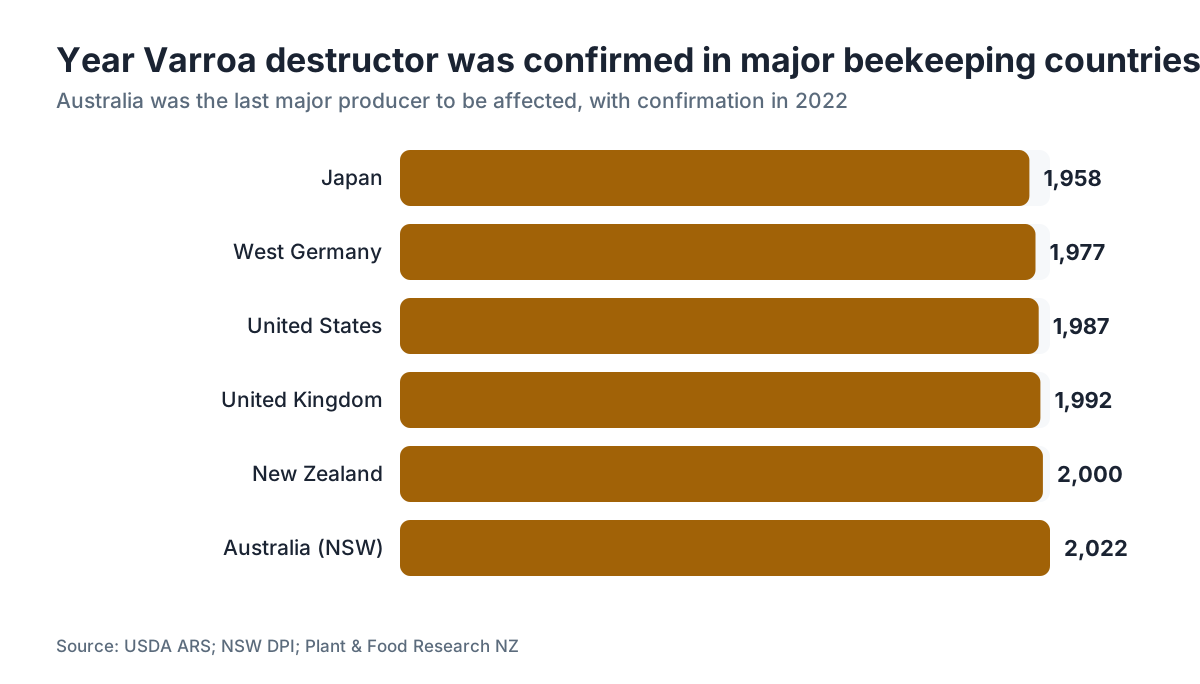
Every major beekeeping nation eventually got varroa. Australia was simply last, at 35 years behind the United States and 22 behind New Zealand. The table below lines up the timeline.
| Country / Region | Year V. destructor confirmed | Eradication attempted? | Current status |
|---|---|---|---|
| Japan | 1958 | No | Fully endemic, managed |
| Europe (most countries) | 1970s-1980s | No | Fully endemic, managed |
| United States | 1987 | No | Fully endemic, managed |
| New Zealand | 2000 | Yes (abandoned) | Fully endemic, managed |
| Australia (NSW) | 2022 | Yes (abandoned 2023) | Transitioning to management |
Sources: USDA ARS [9], Plant & Food Research New Zealand [10], NSW DPI [1].
New Zealand is the sharpest comparison because the biosecurity and agricultural setups are so alike. New Zealand detected V. destructor in 2000 near Auckland, tried eradication, gave up, and moved to a mandatory treatment and registration framework. New Zealand beekeepers now run OA, formic acid, and amitraz under a structured national program. Varroa-related colony losses stay a persistent problem, but the industry adapted.
The US shows a different angle. Varroa arrived in 1987, no national eradication was attempted, and the mite is now so deeply endemic that treatment is baseline practice. The US lost most of its feral bee population in the years after 1987, which changed wild plant pollination and reshaped the economics of commercial pollination services [9].
Australia is walking a road others already walked, with the one advantage of learning from their experience directly.
What should Australian beekeepers do right now?
If you keep bees in Australia today, here is what matters.
Register your hives. Most states require it, and the requirements got tighter after 2022. Unregistered hives are a compliance problem and cut you off from official support and information during ongoing responses [4].
Learn the alcohol wash. It has the best evidence base of any monitoring method. Do it on every hive, ideally monthly through spring and summer, and keep records. You cannot manage what you don't measure.
Check APVMA registration before buying any treatment. The product landscape changes quickly, and what was permitted in 2022 may differ from what's approved now. The APVMA public register is searchable online [5].
Don't move equipment or bees across state borders without knowing the current restrictions. Those rules are in flux, and violations carry serious penalties under the Biosecurity Act 2015 [4].
Connect with your state apiarist or a local beekeeping association. NSW DPI, Agriculture Victoria, and equivalent bodies in other states put out updated guidance regularly. That guidance is more current than any static article.
For structured protocol support, VarroaVault's free varroa management tools help you build a monitoring and treatment calendar mapped to your climate and hive count, which is genuinely useful when you're starting from zero.
Lining up beekeeping supplies and beekeeping supply companies that ship to Australia is practical groundwork too, since gear for alcohol washing and treatment application is new to many Australian beekeepers.
Frequently asked questions
How did the varroa mite get to Australia?
Investigators strongly suspect international shipping. The first detection was at the Port of Newcastle in June 2022, consistent with mites arriving on bees tied to a vessel. Australia bans live bee imports, but ships can carry feral swarms on hulls or rigging, and port environments create contact between ship-associated bees and local managed colonies. The exact chain of events was never fully confirmed publicly.
When did varroa mite arrive in Australia?
Varroa destructor was first confirmed on June 22, 2022, at the Port of Newcastle, New South Wales. NSW Department of Primary Industries launched an emergency biosecurity response immediately. By June 2023, after finding spread too broad to contain, NSW officially abandoned eradication and moved to a management framework. Other states have been building management programs since.
Is varroa mite in Australia now?
Yes. Varroa destructor is established in Australia, centered in New South Wales as of mid-2023. The mite is expected to spread to other states over time, matching patterns in every other country where it has established. Eradication was abandoned in 2023 after the infestation proved too widespread, including in feral bee populations no program can fully reach.
How did varroa mite enter Australia through the border?
Australia's Biosecurity Act 2015 bans live bee imports and regulates bee products. Ports are still hard to fully seal: ships attract feral swarms, and sample-level inspection of bee products cannot catch every risk. The Australian government's review acknowledged that zero probability of varroa entry was never achievable given global shipping volumes. The 2022 Port of Newcastle detection fit a shipping-related introduction.
Did Australia try to eradicate varroa?
Yes. NSW launched a major eradication effort in mid-2022, with mandatory movement restrictions, hive destruction plus compensation, and aggressive tracing across defined zones. The effort destroyed tens of thousands of hive units. By June 2023, authorities concluded the mite had spread too broadly, including into feral bee populations, to make eradication feasible. NSW formally moved to a management response then.
Was Australia the last country without varroa?
Australia was the last major honey-producing country without established Varroa destructor. Some small island nations and remote territories stay varroa-free, but no other significant beekeeping nation had avoided the mite as long. That status gave Australian beekeepers real advantages, including lower production costs and the ability to export queens and package bees internationally.
What varroa treatments can Australian beekeepers use?
Oxalic acid is approved through the APVMA and is the most accessible starting point. Formic acid products and amitraz strips are used internationally and were being considered or provisionally registered in Australia as of 2023. Check the APVMA public register for current approvals before buying, since the landscape has changed fast since 2022. The Honey Bee Health Coalition's Varroa Mite Management Guide covers treatment biology and rotation in detail.
What mite count is too high in an Australian hive?
The internationally used action threshold is 2 to 3 mites per 100 bees, measured by alcohol wash on about 300 nurse bees. At or above that level, treat immediately. During peak brood-rearing season, when populations accelerate quickly, some extension programs recommend treating at 1 mite per 100 bees. Untreated colonies above threshold typically collapse within one to three years.
What happened to Australia's feral bee population after varroa arrived?
Varroa is moving through Australia's feral Apis mellifera population with no human intervention. Without treatment, feral colonies typically collapse within one to three years of infestation, matching what happened in the United States after 1987 and in Europe. Australia had a large, widespread feral bee population providing unmanaged pollination. The ecological effects of major feral bee losses in the Australian landscape are genuinely uncertain.
How is Australia's varroa situation similar to New Zealand's?
New Zealand detected Varroa destructor in 2000, attempted eradication, abandoned it, and moved to a management framework. The trajectory mirrors Australia's almost exactly: port-area detection, emergency response, then abandonment once feral spread made containment infeasible. New Zealand now runs a mandatory treatment and registration program. Australian beekeepers can learn directly from New Zealand's two decades of managing varroa under similar conditions.
Do I need to register my hives in Australia because of varroa?
Yes. Most states required hive registration before 2022, but requirements and enforcement tightened significantly after varroa was detected. Registration connects you to official surveillance, movement restriction updates, and compensation programs if your hives are caught in a biosecurity response. Operating unregistered hives carries compliance risk under the Biosecurity Act 2015. Check your state's department of primary industries for current requirements.
How much does varroa treatment cost per hive per year?
Costs vary by product and number of applications. As a rough US reference, oxalic acid runs about $1 to $3 per hive per application, formic acid pads around $5 to $10 per treatment, and amitraz strips around $2 to $4 per strip with two strips per hive per treatment. Annual per-hive costs typically land between $20 and $50 USD depending on the protocol. Australian pricing will differ with APVMA-registered availability and import costs.
Can Varroa jacobsoni (the Asian bee varroa) also infest European honey bees in Australia?
Some V. jacobsoni populations can reproduce on Apis mellifera. Australia has had V. jacobsoni in Torres Strait Apis cerana populations since at least 2016. Research published after that detection found certain V. jacobsoni strains had already shifted host to reproduce on European honey bees, which complicated the earlier assumption that V. jacobsoni posed no significant threat. The 2022 detection was V. destructor, a separate and more established threat.
Where can I find up-to-date information on varroa rules and treatments in Australia?
The NSW Department of Primary Industries varroa response pages are the primary source for current zone maps, movement restrictions, and compensation details. The APVMA public register lists approved treatments. The Honey Bee Health Coalition's Varroa Mite Management Guide covers treatment science. Your state apiarist or local beekeeping association will have the most current practical guidance, since rules have changed regularly since mid-2022.
Sources
- NSW Department of Primary Industries, Varroa Mite Response: Varroa destructor first confirmed June 22, 2022 at Port of Newcastle; eradication abandoned and transition to management announced June 2023
- Honey Bee Health Coalition, Varroa Mite Management Guide (3rd edition): Action threshold of 2-3 mites per 100 bees; varroa spreads through movement of bees and equipment; untreated colonies typically collapse within 1-3 years; treatment categories and rotation guidance
- Roberts, J.M.K. et al., PLOS ONE 2015 - Varroa jacobsoni reproducing on Apis mellifera: Some Varroa jacobsoni populations have shifted host to reproduce on Apis mellifera European honey bees
- US EPA, Pesticide Registration (Api-Bioxal / Oxalic Acid): Oxalic acid dihydrate is the active ingredient in Api-Bioxal; EPA-registered for use against Varroa destructor in honey bee colonies; efficacy studies show 90-plus percent knockdown of phoretic mites
- Fries, I. et al., Apidologie 2006 - Survival of mite-infested honey bee colonies on Gotland Island: Survivor feral populations with VSH or SMR traits can re-establish after varroa pressure over many years, as documented in the Gotland Island study in Sweden
- USDA Agricultural Research Service, Honey Bee Research: Varroa destructor confirmed in the United States in 1987; no national eradication attempted; mite now fully endemic; US lost most feral bee population in years following arrival
- Plant & Food Research New Zealand, Varroa Management: New Zealand detected V. destructor in 2000 in Auckland, attempted eradication, abandoned it, and transitioned to mandatory treatment and registration framework
- University of Florida IFAS Extension, Varroa Mite Monitoring and Management: Alcohol wash on approximately 300 nurse bees is the evidence-based monitoring method; drifting bees can represent 20-30% of returning foragers moving to wrong hives, enabling mite spread
Last updated 2026-07-09