Autumn varroa treatment: the complete seasonal guide

TL;DR
- Autumn is where colonies live or die.
- Knock mite loads below 2 percent before your colony raises its winter bees, usually late July through September.
- Miss it and the colony coasts into winter on damaged bees, then dies in February looking fine right up until it isn't.
- Treat when an alcohol wash hits 2 to 3 percent, while daytime temperatures still suit your product.
Why is autumn the most important time to treat for varroa?
Autumn is where most colonies are won or lost, and the reason is biology, not tradition. The bees your colony raises in August and September carry the whole thing through winter. These "winter bees" are built differently from summer bees. They carry more fat body reserves, live four to six months instead of six weeks, and they are the colony's entire future. If those bees develop inside capped cells crammed with mites, they emerge damaged. Varroa feeding during pupal development impairs fat body development and suppresses the immune response [1]. A colony of damaged winter bees looks fine in September and is dead by February.
That damage is permanent. You cannot treat your way back to healthy winter bees once they've eclosed. The only window to protect them is before and during their development, which puts your treatment in late July through September across most of North America.
The second reason is arithmetic. Varroa reproduce in capped brood, and a summer colony cycles more than 100,000 brood cells over a season, so mite populations can double every four to six weeks at peak [2]. A hive that started spring at a comfortable 1 percent can reach 5 or 6 percent by late August if you leave it alone. High mite loads in August mean high mite loads in the bees that raise your winter cluster. It compounds fast, and it compounds quietly.
When exactly should you do your autumn varroa treatment?
Treat six to eight weeks before your first hard frost, while daytime temperatures still let your product work. That's the rule of thumb that holds up across climates. The exact calendar dates shift north to south, but the goal never changes: protect the winter bee cohort before it develops.
In most of the northern United States and Canada, that means mid-August through September. In the South and along the Pacific Coast, the window often stretches into October. The Honey Bee Health Coalition's Varroa Management Guide puts the target window in "late summer/early fall" specifically to protect winter bees [1].
Watch for the queen ramping down egg-laying. As days shorten past the summer solstice, most queens slow production. When the population contracts, mites concentrate into fewer brood cells, so each cell carries more mites. Your mite-per-bee ratio can spike sharply even as the total hive population falls. That combination kills colonies.
Here's what I actually do. First alcohol wash of autumn goes in during late July. Above 2 percent, I treat right then. Below 2 percent, I wash again in two to three weeks. Don't wait until September and hope it sorts itself out. The beekeepers who skip the July check are the ones posting photos of dead clusters in March.
For reference, the University of Minnesota Extension recommends treating when varroa levels reach 2 percent or higher in the pre-winter period [3]. The Honey Bee Health Coalition uses the same 2 percent (2 mites per 100 bees) as the point demanding immediate action in late summer [1].
How do you accurately measure varroa levels before treating?
Use an alcohol wash. It's more accurate than the alternatives and it's what researchers and serious hobbyists rely on. The sugar roll is gentler on bees but it undercounts mites by 20 to 30 percent compared to an alcohol wash, which means it hands you false confidence right when you can't afford it [1].
For an alcohol wash, collect roughly 300 bees (about half a cup) from a brood frame, and check that you didn't grab the queen. Pour them into a jar of rubbing alcohol or windshield washer fluid, shake for 30 to 60 seconds, then pour the liquid through a mesh screen over a white tray. Count the mites. Divide by the number of bees washed to get your percentage. Wash 300 bees, see 9 mites, that's 3 percent. Treat.
The sticky board (bottom board count) is another option, but it's hard to read without a conversion formula, and the numbers swing with colony size, season, and whether you run a screened bottom board. I wouldn't make an autumn treatment call from a sticky board alone.
The Honey Bee Health Coalition has a free downloadable guide that walks through the wash step by step, including how to adjust counts for colony population [1]. To track counts across the season in one place, VarroaVault's free monitoring tools let you log wash results and flag the moment you cross threshold.
Wash from the brood area, never the honey supers. Mites spend most of their lives in capped brood, so nurse bees on brood frames give you the sample that actually represents your infestation. A wash off a honey frame tells you almost nothing.
What are your treatment options in autumn and how do they compare?
The active ingredients you'll actually meet are oxalic acid, formic acid, thymol, amitraz (Apivar), and fluvalinate (Apistan). Each has its own mechanism, temperature window, and brood-penetration profile. Pick based on your calendar and whether supers are still on.
| Treatment | Active Ingredient | Works in Capped Brood? | Temperature Range | Brood-Free Required? | Typical Duration |
|---|---|---|---|---|---|
| Apivar strips | Amitraz | Yes (contact through wax) | 50-95°F (10-35°C) | No | 6-8 weeks |
| Mite Away Quick Strips | Formic acid | Yes | 50-85°F (10-29°C) | No | 7 days |
| Oxalic acid (dribble/vaporization) | Oxalic acid dihydrate | No (adult mites only) | Above 40°F for dribble; above freezing for vapor | Yes for best efficacy | 1 treatment (vapor) or 5 days (dribble) |
| Apiguard / Api Life Var | Thymol | Partial | 59-105°F (15-41°C) | No | 3-4 weeks |
| Apistan strips | Tau-fluvalinate | Yes | 50-90°F | No | 6-8 weeks |
A few honest notes on that table. Apistan (fluvalinate) resistance is widespread in North America after decades of heavy use in the 1990s and 2000s [4]. Skip it unless you have specific evidence it still works where you are. Apivar (amitraz) stays highly effective where resistance hasn't developed, but documented amitraz resistance exists in some European populations, so rotating chemistries is worth the effort [5].
Formic acid in MAQS is the only product that penetrates capped brood and can be used with supers on, which matters if you're still extracting in August. Read the label. The 85°F ceiling is real, and heat plus formic acid can kill queens and damage brood.
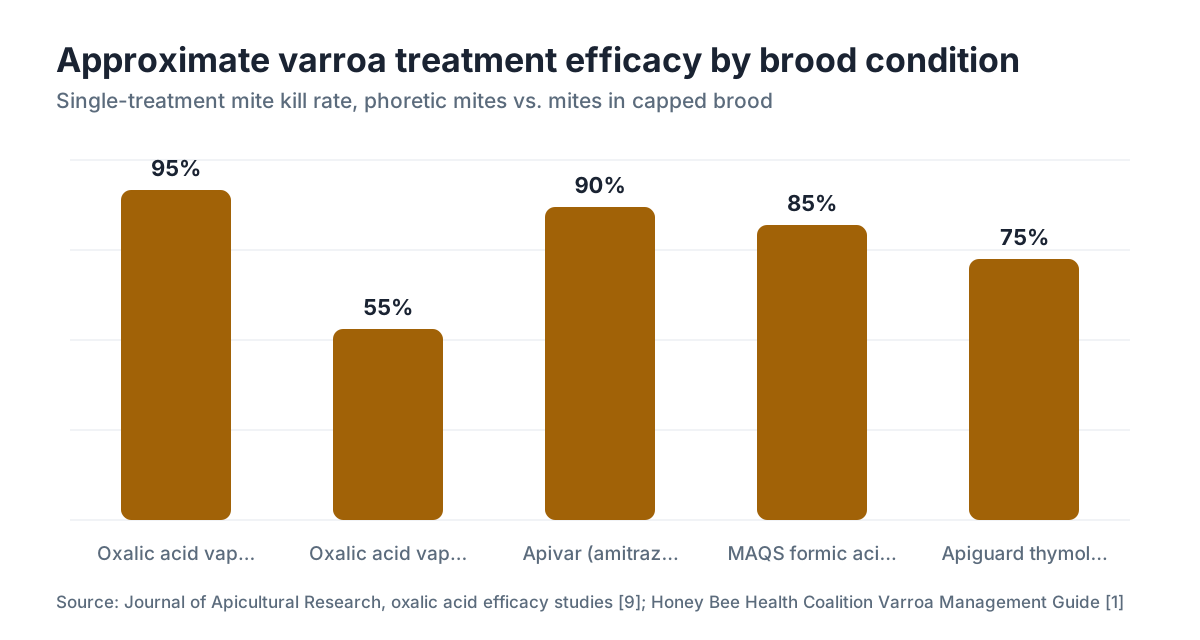
Oxalic acid vaporization got popular for good reasons. It hammers phoretic mites (mites riding adult bees), costs pennies per treatment, and leaves no detectable residue in wax or honey. The catch: it can't touch mites inside capped cells [6]. In autumn, as the brood nest shrinks toward the end of the season, that limitation fades. Once brood is minimal or gone, a single oxalic vapor treatment can clear over 90 percent of mites [6]. Plenty of beekeepers pair an early-autumn brood-penetrating treatment (Apivar or MAQS) with a late-autumn oxalic vapor to sweep up the stragglers.
Is it safe to treat while honey supers are on the hive?
It depends entirely on the product, and that answer matters most in late summer when you may still have honey flows and full supers. Some treatments are legal with supers on. Most are not.
Formic acid (MAQS) is the exception. The EPA-registered label permits use with honey supers present, because formic acid occurs naturally in honey and dissipates [7]. That's a genuine advantage in August.
Oxalic acid labels, both the dribble and vaporization registrations, require that honey supers meant for human consumption come off before treatment [6]. This is a label requirement, more than a suggestion. The Api-Bioxal label states supers must be off.
Amitraz (Apivar) and thymol products also require super removal, because they can leave residues in honey. That makes them a better fit for September and October, after your final extraction, which is honestly when I'd use them anyway since they need six-plus weeks of brood contact time.
Treating in August with supers still on? MAQS is your main play, or an oxalic treatment after you pull and extract. Plan your extraction around your treatment window, not the other way around.
What temperature ranges do autumn treatments actually need?
Temperature kills more autumn treatments than any other single mistake. The classic failure: a beekeeper buys Apiguard in August, gets a September cold snap, then pulls the strips at three weeks thinking the job is done when the thymol barely volatilized.
Thymol products need consistent daytime temperatures above 59°F (15°C) to volatilize at rates that actually kill mites. Below that, efficacy falls off a cliff. Apiguard's label says don't start if temperatures will drop below 59°F during the treatment period [8]. In the North, that can shrink your window to a few weeks in late summer.
Formic acid (MAQS) has an upper ceiling around 85°F (29°C) and a floor near 50°F (10°C). You need a seven-day stretch that never breaches the ceiling. In an August heat wave, that's a real problem.
Amitraz (Apivar) is the most forgiving. The label lists an effective range of 50 to 95°F, and because it works by contact (bees walk the strip and pick up the miticide), it doesn't depend on volatilization like thymol or formic acid do. That makes it a strong pick for October in variable climates.
Oxalic acid vaporization works anywhere above freezing, but you want the cluster loose enough that bees move around and contact the vapor. A tight cold cluster (below about 40°F) distributes the acid poorly. Most people do their final oxalic vapor in late October or November, when the colony is broodless but still warm enough to be mobile.
Can you do an oxalic acid treatment in autumn if there's still brood?
Yes, but know what you're buying. Oxalic acid only kills mites in the phoretic stage, meaning mites riding adult bees. Mites sealed inside capped cells are fully protected. With significant capped brood in the hive, a single oxalic treatment misses a large slice of your mite population and leaves you thinking you fixed the problem.
A study in the Journal of Apicultural Research found that under high brood presence, oxalic acid vaporization reached only about 50 to 60 percent efficacy, against over 95 percent in broodless colonies [9]. That's the gap between solving the problem and barely denting it.
There are workarounds. Some beekeepers run three to five oxalic vapor treatments at five to seven day intervals across a full brood cycle (roughly 21 days) to catch mites as they emerge from cells and before they re-enter new brood. It works, but it's labor and the evidence base is thinner than for broodless treatment.
The cleaner move is a brood-penetrating product (Apivar or MAQS) while brood is still present in early autumn, then oxalic vapor in November once the colony is naturally broodless or close to it. That two-stage approach is what I'd use and what the Honey Bee Health Coalition lists as best practice [1].
For a deeper look at the mite's life cycle and why brood penetration matters, see our article on varroa mite biology.
How do you know your autumn treatment actually worked?
Treating is half the job. Verifying is the half most hobbyists skip, and it's the half that tells you whether your colony makes it to spring.
Do a follow-up alcohol wash two to three weeks after treatment ends. You want mite levels below 2 percent for a late-summer colony. If you ran Apivar for eight weeks and your October wash still reads 3 percent, something is wrong: the treatment failed, you have a resistance problem, or mites are pouring in from neighboring colonies.
Reinfestation is real and underrated. Collapsing mite-heavy colonies shed drifting and robbing bees into your hive, delivering mites even after a clean treatment. In an area thick with hives (other beekeepers or feral colonies), a freshly treated hive can climb back over threshold in weeks. People call it a "mite bomb," and it's common in September and October as weak colonies die out and get robbed [1].
If your post-treatment count is still high, a follow-up oxalic vapor to knock down phoretic mites is reasonable. If your count sits well under 1 percent, you're set for winter. Most extension services want colonies entering winter below 1 to 2 percent [3].
Log your results. One data point is worth less than a trend across seasons. Once you know your apiary spikes every August, you start monitoring earlier next year without having to think about it.
What's the right autumn varroa protocol for a beginner?
Running one to five hives and want a clear, defensible plan? Here's what I'd do, based on the current evidence, with no wasted steps.
Step 1: Alcohol wash in late July. Above 2 percent, jump to step 2. Below 2 percent, wash again in two weeks.
Step 2: If supers are on and you need to treat, use formic acid (MAQS) and check the temperature forecast first. If supers are off or you can remove them, Apivar strips are my first choice for most hobbyists. They work across a wide temperature range, penetrate brood, and application is dead simple.
Step 3: Leave Apivar in for the full six to eight weeks on the label. Pulling strips early is one of the most common errors out there. Incomplete treatment cycles are among the factors researchers link to faster resistance development [5].
Step 4: Post-treatment alcohol wash in October. Confirm you're below 2 percent.
Step 5: In late October or November, once the cluster is broodless or near it, do a single oxalic acid vaporization to clear any remaining phoretic mites. You need an approved vaporizer and Api-Bioxal, the only EPA-registered oxalic acid product for use in the US [6].
To track wash counts, treatment dates, and threshold alerts across your hives, VarroaVault's free protocol tools are worth bookmarking. Log results, get threshold warnings, and keep a season-long record that makes patterns obvious.
For supplies, beekeeping supply companies that specialize in varroa management usually stock Api-Bioxal, vaporizers, and Apivar. Some offer free shipping on honey bee supply orders above a minimum.
Does treatment-free beekeeping work in autumn, and what does the evidence say?
It's a fair question and it deserves a straight answer, not a sermon. Some beekeepers go treatment-free, leaning on hygienic behavior, mite-resistant stock (VSH bees, Russian bees), and management like splits instead of chemicals.
The evidence says treatment-free is possible, but it's hard and it isn't for everyone. Studies on Varroa Sensitive Hygiene (VSH) show that colonies bred hard for the trait can hold lower mite loads without treatment [10]. Russian honey bees, evaluated by the USDA Baton Rouge lab, show moderate resistance under certain conditions. The operative word is selection. Sustained treatment-free outcomes come from active breeding for resistance, more than from simply stopping treatment.
Most hobbyists buying packages or nucs from commercial sources are getting stock that almost certainly hasn't been selected for real mite resistance. Going treatment-free with those bees means tolerating high mite loads, which usually means colony death in one to three years. It also means your dying colonies become mite bombs that seed mites into neighboring apiaries. That's a real ethical problem, not a side note.
If you want lower-intervention management, the path is clear: treat now, requeen with locally bred VSH or mite-resistant stock, monitor obsessively, and treat when you cross threshold no matter your philosophy. That isn't abandoning treatment-free goals. It's being honest about where you are on the road to them.
How do autumn varroa loads affect winter survival rates?
The data is clear enough that the whole timing argument rests on it. Multiple studies tie autumn mite loads straight to winter survival.
A study cited across extension services found that colonies entering winter above 3 percent mite load had significantly higher winter mortality than colonies below 2 percent [3]. The USDA-ARS Bee Research Lab reports the same pattern: September mite load is one of the strongest predictors of whether a colony sees the next spring.
The Honey Bee Health Coalition states that mite levels above 2 percent in late summer "warrant immediate treatment," and it names the winter bee damage mechanism as the reason [1]. That threshold rests on cumulative evidence, not a single paper, and it's the standard most serious beekeepers and researchers in North America use.
There's a disease angle too. Varroa is the primary vector for Deformed Wing Virus (DWV) and several other bee viruses. When a mite feeds on a developing pupa, it injects virus directly into the bee's hemolymph. High autumn mite loads mean high virus titers in your winter bees, which cuts their longevity and immune capacity further [11]. A colony can post a "normal" 3 percent mite count and still carry viral loads high enough to wreck winter survival, because the relationship between mite counts and virus titers isn't perfectly linear.
Getting mite loads below 2 percent before October isn't a cautious extra. It's the baseline for reasonable winter survival odds.
Frequently asked questions
What mite count is too high going into winter?
Most extension services and the Honey Bee Health Coalition set the threshold at 2 percent (2 mites per 100 bees on an alcohol wash) as the point demanding immediate treatment in late summer and early fall. Above 3 percent by September, winter survival odds drop sharply across multiple field studies. Aim to enter October below 1 to 2 percent.
Can I use oxalic acid in October if my colony still has brood?
You can, but efficacy is limited. Oxalic acid kills only mites on adult bees, not those inside capped cells. With significant brood present, a single treatment may reach only 50 to 60 percent efficacy versus over 90 percent in a broodless colony. If you have brood in October, use Apivar instead, or run repeated oxalic vapor treatments every five to seven days over three weeks to catch emerging mites.
How long do Apivar strips need to stay in the hive?
The label specifies six to eight weeks. Pulling them early is a common mistake. Incomplete exposure reduces efficacy and may contribute to resistance. Follow the full label duration, do your post-treatment alcohol wash two to three weeks after removal, and confirm your mite load dropped below threshold before you call it done.
Is it too late to treat for varroa in October?
In most of the northern US, October treatment is late but still worth doing. You've likely missed the window to protect winter bees raised in August and September. Even so, a late treatment reduces mite loads on surviving adults and improves winter odds. Use oxalic acid vaporization in late October or November once brood is minimal.
Do I need to remove honey supers before treating with oxalic acid?
Yes. The Api-Bioxal label requires that honey supers intended for human consumption come off before treatment. This is an EPA label requirement, not optional guidance. If you need to treat with supers on, formic acid in MAQS format is the only EPA-registered option labeled for use while supers are present.
What is the difference between an alcohol wash and a sugar roll for counting mites?
Both sample about 300 bees from a brood frame. The alcohol wash kills the bees and detaches mites reliably, giving an accurate count. The sugar roll spares the bees but undercounts mites by 20 to 30 percent versus the alcohol wash. For autumn treatment decisions, use the alcohol wash. A falsely low sugar roll count can cost you a colony.
Can varroa mites reinvade a treated hive in autumn?
Yes, and more often than most beekeepers realize. As mite-heavy colonies collapse in late summer, robbing bees and drifters carry mites into neighboring hives. A hive you treated successfully in August can be back above threshold by October from reinfestation alone. Always do a post-treatment wash to confirm results, and consider reducing entrances in September to limit robbing.
How many oxalic acid vaporization treatments are needed in autumn?
If your colony is broodless, a single treatment clears over 90 percent of phoretic mites. If brood is still present, three to five treatments spaced five to seven days apart across a full brood cycle catch mites as they emerge. Many beekeepers do one brood-penetrating treatment in September, then a single oxalic vapor in late October or November.
What's the best varroa treatment for a new beekeeper in autumn?
Apivar (amitraz strips) is a strong first choice for most beginners. It works across a wide temperature range, penetrates capped brood, applies simply, and doesn't require the temperature watching that thymol or formic acid demand. Remove honey supers first, insert two strips per brood box, leave for six to eight weeks, then do a follow-up alcohol wash to confirm results.
Does a screened bottom board help control varroa in autumn?
A screened bottom board lets some fallen mites drop out of the hive instead of reclimbing, but the reduction is modest, estimated around 10 to 15 percent fewer mites in some studies, and nowhere near enough to replace chemical treatment. It's useful for monitoring with a sticky board insert. Don't rely on it as your primary control during autumn.
Can I treat for varroa and feed syrup at the same time?
Yes in most cases. Feeding syrup while using Apivar or oxalic acid is not contraindicated. Feeding while using formic acid is generally discouraged, since bees may store syrup in capped cells and complicate the treatment. Check the specific product label. Feeding in autumn for adequate winter stores is a separate and valid concern that shouldn't get skipped because you're treating.
Will treating for varroa in autumn hurt my bees?
Used correctly and within labeled temperature ranges, registered varroa treatments pose minimal risk to bees. Formic acid in high heat can damage brood or harm queens. Thymol below its minimum temperature stresses bees without killing mites. Follow labels, check forecasts, and never exceed recommended dosages. The risk of untreated varroa to your colony is far greater than the risk of correct treatment.
How does Varroa affect winter bee development specifically?
Varroa feeds on the fat body tissue of developing pupae, impairing the bees' ability to store protein reserves. Winter bees depend on those reserves to survive months without foraging. Mite-damaged winter bees show lower vitellogenin levels, shorter lifespans, and weakened immune responses. High mite loads during the August and September brood cycle directly compromise the bees that must carry the colony to spring.
Sources
- Honey Bee Health Coalition, Varroa Management Guide (latest edition): 2% mite infestation rate in late summer warrants immediate treatment; mite-damaged winter bees result from varroa feeding during pupal development; broodless oxalic acid treatment efficacy exceeds 90%
- USDA Agricultural Research Service, Honey Bee Research: Varroa mite populations can double approximately every four to six weeks during peak summer brood cycles
- University of Minnesota Extension, Varroa Mite Management: Treatment recommended at 2% or higher during pre-winter period; colonies above 3% mite load show significantly higher winter mortality
- NC State University Apiculture, Varroa Resistance to Fluvalinate: Fluvalinate (Apistan) resistance is widespread in North American varroa populations following decades of use in the 1990s and 2000s
- Pennsylvania State University Extension, Managing Varroa Mites in Honey Bee Colonies: Incomplete treatment cycles and failure to rotate chemistries are associated with accelerated miticide resistance development in varroa
- EPA, Api-Bioxal Oxalic Acid Product Label: Honey supers intended for human consumption must be removed before Api-Bioxal treatment; oxalic acid does not penetrate capped brood and kills only phoretic mites
- EPA, Mite Away Quick Strips (MAQS) Product Label: MAQS formic acid may be used with honey supers present; effective temperature range is approximately 50-85°F
- Vita (Europe) Ltd, Apiguard Product Label and Guidance: Apiguard thymol-based treatment requires consistent daytime temperatures above 59°F (15°C) for adequate volatilization and efficacy
- Journal of Apicultural Research, Oxalic Acid Efficacy in Brood-Present vs Broodless Colonies: Oxalic acid vaporization achieved approximately 50-60% efficacy with high brood presence versus over 90% in broodless colonies
- USDA ARS Baton Rouge Bee Lab, Varroa Sensitive Hygiene (VSH) Research: Colonies strongly selected for Varroa Sensitive Hygiene traits can maintain lower mite loads under certain conditions without chemical treatment
- Genersch E. et al., Journal of Invertebrate Pathology, Deformed Wing Virus and Varroa: Varroa mites are primary vectors for Deformed Wing Virus, injecting viruses directly into bee hemolymph during pupal feeding; high mite loads produce high DWV titers in winter bees
- Cornell University Dyce Lab for Honey Bee Studies, Varroa Seasonal Management: Autumn is the critical treatment window for protecting winter bees; post-treatment wash should confirm loads below 2% before November
Last updated 2026-07-09