Bayer varroa mite treatment: what Flumethrin and Fluvalinate actually do
TL;DR
- Bayer's main varroa product is Bayvarol, a plastic strip carrying flumethrin (a synthetic pyrethroid).
- It's approved across the EU and many other countries but not registered in the US.
- American beekeepers get a cousin product, Apistan (fluvalinate), from a different maker.
- Both kill mites on contact.
- Both hit serious resistance in a lot of varroa populations.
What varroa mite treatments does Bayer actually make?
Bayer Animal Health makes Bayvarol, a slow-release plastic strip carrying 3.6 mg of flumethrin per strip. You hang four strips in the brood nest for six to eight weeks. The active ingredient migrates onto bees moving past the strips and spreads through the colony bee-to-bee. That's the whole mechanism: contact transfer. Not fumigation. Not systemic uptake.
Bayvarol has regulatory approval across much of Europe, Australia, and several other markets [1]. It is not registered with the US Environmental Protection Agency for use in American hives, and that's a hard stop. If you're in the US and you've seen "Bayer varroa treatment" online but can't find it at your local supplier, that's the reason.
Flumethrin sits in the synthetic pyrethroid class, the same broad family as fluvalinate (the active ingredient in Apistan, which comes from a different company). Both disrupt sodium channel function in mite nervous systems. That shared chemistry is the problem: resistance to one pyrethroid usually crosses over to the other. A colony carrying fluvalinate-resistant varroa is very likely to shrug off flumethrin too [2].
Bayer sells other veterinary and agricultural acaricides, but Bayvarol is the bee-specific one. Don't confuse their broader chemistry catalog with what's actually labeled for hive use.
How does flumethrin (Bayvarol) kill varroa mites?
Flumethrin binds to voltage-gated sodium channels in invertebrate nerve cells and holds them open, which triggers continuous nerve firing. For a varroa mite, that means fast paralysis and death. For a honey bee, the story is more forgiving. Bees tolerate pyrethroids better than mites do, partly because they break the compound down faster in the fat body, and partly because the sodium channels differ slightly between bee and mite [3].
The selectivity gap, meaning how much more toxic flumethrin is to mites than to bees, is wide enough that strips applied correctly are considered safe for adult bees at labeled rates. The real risk is sublethal harm to queens and developing larvae when strips get placed wrong or left in too long. Follow the label placement guidance every time.
Strips work best when mites ride on adult bees in the phoretic phase, because that's when strip residue can reach them. Mites sealed inside capped brood cells are largely protected. This is the built-in limit of every strip-based pyrethroid: they knock down phoretic mites well, but capped brood stays a reservoir. The six to eight week window exists to outlast several brood cycles, so emerging mites keep bumping into treated bees before they find fresh cells to enter.
Is Bayvarol approved and available in the United States?
No. As of mid-2026, Bayvarol is not registered with the US EPA under FIFRA (the Federal Insecticide, Fungicide, and Rodenticide Act). Putting an unregistered pesticide product in a US hive is a federal violation, no matter how well the product performs abroad [4].
US beekeepers have four main legally registered varroa treatment categories: oxalic acid (Api-Bioxal and generics), formic acid (Mite-Away Quick Strips, FormicPro), amitraz (Apivar), and fluvalinate (Apistan). From the pyrethroid class, fluvalinate is what's on the US market. Not flumethrin.
Outside the US, check your national pesticide registry. In the EU, Bayvarol holds authorization under the framework for veterinary medicinal products, along with national authorizations in individual member states. Australia's APVMA has also granted registration [1]. Verify your country's current status before you buy, because registrations change.
One more thing. Even where Bayvarol is legal, some jurisdictions require treatment records, particularly in the EU under veterinary product traceability rules. Keep records whether or not your country mandates them. It makes your varroa decisions much sharper season over season.
What is pyrethroid resistance and how bad is it for varroa treatments?
Pyrethroid resistance in varroa isn't a hypothetical. It's everywhere. The mechanism is a specific mutation in the varroa sodium channel gene, often called the kdr mutation (knockdown resistance), which drops the binding affinity of pyrethroids at their target [2]. Once a mite population carries that mutation at high frequency, neither fluvalinate nor flumethrin gives you reliable control, even at labeled doses.
The Honey Bee Health Coalition's "Tools for Varroa Management" guide states plainly that resistance to tau-fluvalinate is common in the United States and that efficacy can be poor in some regions [5]. The same cross-resistance concern lands on flumethrin products like Bayvarol.
How do you know if you've got a resistant population? Honestly, you usually can't tell without an alcohol wash or sugar roll before and after treatment, plus a little arithmetic. Apply strips correctly for the full labeled period, and if mite counts barely move, suspect resistance. The fix is switching to a different mode of action (amitraz or an organic acid), not piling on more strips.
Resistance management is why beekeepers get told to rotate active ingredients across cycles instead of leaning on pyrethroids year after year. The Coalition recommends monitoring at every treatment interval and rotating between chemical classes [5]. This isn't overcaution. It's the only approach that has kept multiple treatment options working across decades.
How does Bayvarol compare to Apivar, oxalic acid, and formic acid?
| Treatment | Active ingredient | Class | Brood penetration | Resistance risk | US registered |
|---|---|---|---|---|---|
| Bayvarol | Flumethrin | Pyrethroid | No (phoretic mites only) | High (cross-resistance with fluvalinate) | No |
| Apistan | Tau-fluvalinate | Pyrethroid | No | High | Yes |
| Apivar | Amitraz | Formamidine | Partial (residue on bees reaches emerging mites) | Moderate (lower than pyrethroids) | Yes |
| Api-Bioxal (OA dribble/vaporization) | Oxalic acid | Organic acid | No (broodless periods only for full efficacy) | Very low | Yes |
| Mite-Away Quick Strips / FormicPro | Formic acid | Organic acid | Yes (penetrates capped cells) | Very low | Yes |
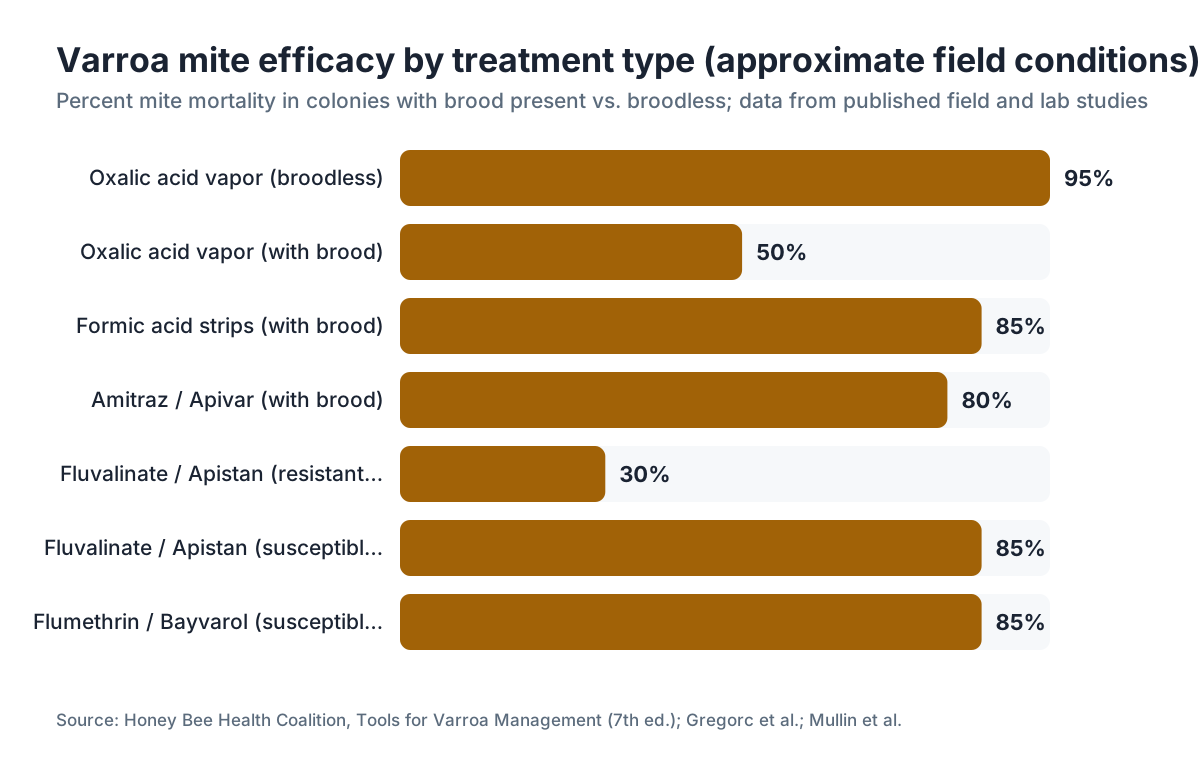
The big practical split between pyrethroids and the organic acids is brood penetration. Formic acid is the only widely available treatment that kills mites inside capped cells. That makes it useful during high-infestation stretches when most of the mites are buried in the brood. Oxalic acid vaporization is highly effective, but only when the colony is broodless or close to it, which puts late fall and winter in the prime window across most climates [6].
Amitraz (Apivar) sits in the middle. It doesn't crack open capped cells the way formic acid does, but amitraz residue on bees contacts mites as they emerge, so it covers the brood cycle better than pyrethroids do in practice. Recent work has found amitraz resistance showing up in some populations, so it isn't bulletproof. Just less far along right now [7].
If I were building a rotation from scratch, I'd anchor it on oxalic acid vaporization in broodless periods, formic acid in spring or early summer when I need brood penetration, and amitraz as a fall option if counts run high and I have brood to protect. Pyrethroids (fluvalinate or flumethrin) would be a last resort in regions where resistance hasn't turned up, never a first pick.
What are the correct application instructions for Bayvarol strips?
The Bayvarol label calls for four strips per colony, hung vertically between frames in the brood nest, one strip per space between brood frames. The treatment period is six to eight weeks. You pull the strips at the end of that window regardless of what you think the mite pressure is, because longer exposure ramps up selective pressure for resistance and leaves more residue in wax [1].
Timing matters. Bayvarol and every pyrethroid strip work best during active brood-rearing, because that's when mite pressure peaks and bees move constantly through the nest and brush the strips. The brood itself never gets treated. You're relying on killing phoretic mites before they climb back into cells.
Don't run strips during a honey flow you plan to harvest. Fluvalinate and flumethrin residues build up in beeswax, and while legal residue limits exist, less exposure is better practice [8]. Take honey supers off before placing strips and leave them off until the strips are out.
Wear nitrile gloves when you handle them. Pyrethroids pass through skin and are toxic to aquatic life, so don't rinse your hands in a stream or toss strips near water. Used strips go in the household trash, not the compost or the burn pile.
For US readers, the Apistan (fluvalinate) instructions run parallel: two strips per brood box for six to eight weeks. The products aren't interchangeable, but the management logic matches.
Can you use varroa strip treatments during a honey flow?
No, not if you plan to sell or eat that honey. This holds for both flumethrin strips and fluvalinate strips. The EPA labels for pyrethroid varroa treatments require pulling honey supers before application and prohibit adding supers during the treatment period [9].
The issue is lipophilic residue buildup. Flumethrin and fluvalinate are fat-soluble. Beeswax is fat. Those molecules move into wax readily and sit there a long time. One survey found fluvalinate residues in wax samples years after the last known application in some apiaries [8]. That wax becomes your foundation for future comb, and the residue doesn't clear between seasons.
Organic acid treatments (oxalic acid, formic acid) have much friendlier residue profiles. Formic acid already occurs in honey at trace levels, and oxalic acid shows up naturally in many plants. Neither loads into wax the same way. That residue math is one reason a lot of beekeepers have moved organic acids into the primary slot even where pyrethroids still work.
How do you monitor varroa levels to know if treatment worked?
You need counts, not vibes. The two standard methods are the alcohol wash (most accurate, kills the sample bees) and the sugar roll (less accurate, spares the bees). Both use roughly 300 adult bees (about half a cup) pulled from a brood frame. You count the mites that drop off and figure infestation as mites per 100 bees [5].
The Honey Bee Health Coalition recommends treating at 2% or higher during the brood-rearing season (2 mites per 100 bees), though some extension services set the bar at 3% [5][10]. The decision threshold isn't the emergency threshold. At 2% you have time to treat carefully. At 5% and up, winter survival gets genuinely shaky.
Monitor before treatment for a baseline. Monitor again two to three weeks after the strips come out to check efficacy. Counts dropping from 4% to 0.5% means it worked. Counts limping from 4% to 3.2% means resistance or an application problem.
For a protocol that ties monitoring to calendar windows and treatment calls, the free tools at VarroaVault pull it into one place. Use whatever system keeps you counting on schedule, because the monitoring matters more than which product you pick.
Want to understand the animal you're fighting? Read the full overview of the varroa mite life cycle. Knowing when mites go phoretic versus when they reproduce changes how you time every treatment.
What does pyrethroid residue in beeswax mean for your hive long-term?
Old comb keeps a record of your treatment history. Beeswax from conventionally managed hives has tested positive for fluvalinate, coumaphos, and other acaricides at measurable levels, and those residues persist for years [8]. At very high concentrations, some studies have flagged sublethal effects on queens and larvae, though at typical field residue levels the direct toxicity to bees looks low [3].
The sharper worry might be synergistic effects. Lab work has shown that sublethal miticide residues combined with fungicides (which ride into the hive on pollen) can be more toxic to bees than either compound alone. How often that plays out in real colonies is still debated, and nobody has strong field data on how frequently hives hit those combinations at meaningful levels.
Practical move: rotate old comb out of the brood nest every three to five years. If you've run heavy pyrethroids for years, starting a new box on fresh foundation isn't a bad idea. Clean wax also cuts the spore load of several pathogens that build up in old comb, so it pays off beyond the residue question.
When you're sourcing gear to replace comb or set up new hives, comparing beekeeping supply companies is worth the time. Foundation quality varies more than most beginners expect.
What treatment rotation schedule actually makes sense for varroa management?
The Honey Bee Health Coalition's integrated approach recommends monitoring at least four times a year: early spring, late spring or early summer, late summer, and before the winter cluster [5]. Treatment calls follow the counts, not the calendar alone.
Here's a rotation that works for most temperate climates.
Early spring (before the main flow, colony with brood): formic acid if counts run above threshold. Formic penetrates capped brood and can clean up overwintered mites before they explode into the summer buildup.
Late summer (post-harvest, still with brood): amitraz (Apivar) is a solid pick. It works with brood present, resistance is lower than the pyrethroids, and it hands you a different mode of action from spring.
Fall or winter (broodless or nearly so): oxalic acid vaporization. This is where OA earns its keep, because efficacy against phoretic mites in a broodless colony runs very high, close to 95% in well-designed studies [6]. Repeated vaporization (one dose every five days for three treatments) during a broodless stretch is now a well-supported approach.
Where do pyrethroids fit? For most US beekeepers dealing with common fluvalinate resistance, honestly, they may not fit anywhere. Where Bayvarol is available and resistance hasn't shown up locally, it could slide into the late summer slot as a short-term option, but watch efficacy closely and switch if the numbers stall.
The best treatment for your hives is the one that actually drops mite counts below threshold given the resistance picture in your specific apiary. No product deserves loyalty that survival numbers haven't earned.
Are there any natural or integrated approaches that reduce reliance on chemical strips?
Yes, and they belong in your management even if you still run chemical treatments. None of them replaces monitoring.
Brood breaks through queen manipulation are the strongest non-chemical mite tool. Cage or remove the queen for three to four weeks and you interrupt varroa reproduction, because there are no capped cells for mites to enter. During or right after a brood break, a single oxalic acid vaporization on the now-broodless colony hits hard [6]. The catch is labor. You're managing queens actively, and that takes time and skill.
Small cell foundation gets promoted in some circles as a way to cut mite reproduction. The evidence doesn't back it as a reliable standalone move, and multiple controlled studies found no meaningful difference in mite infestation between standard and small cell foundation [10].
Hygienic behavior and Varroa Sensitive Hygiene (VSH) traits in queen lines are the most promising long game. VSH bees detect and pull infested pupae before mites finish reproducing, which suppresses mite population growth. The USDA Baton Rouge Bee Lab has done extensive work on VSH genetics [11]. Requeening with VSH-tested stock won't end monitoring or occasional treatment, but it can meaningfully lower how often you have to step in.
Trap combs (drone comb removal) play on varroa's preference for drone brood. Set a frame of drone foundation, let it fill and cap, then remove and freeze it before the drones emerge and take the mites with them. It won't stand in for treatment at high infestation, but it trims reproductive mite loads during buildup.
Where can beekeepers in the US buy legal varroa treatments and get current guidance?
For registered varroa treatments in the US, your state's department of agriculture is the authority on what's legal where you keep bees. The EPA's pesticide product database lists every federally registered product, searchable by active ingredient [4]. Your state can add restrictions on top of that.
Reputable sellers who carry the main registered treatments include many of the established beekeeping supply companies that also stock protective gear and hive equipment. Prices swing more than you'd think, so check a few sources, especially if you run multiple hives.
University extension apiculture programs are the best free resource for state-specific guidance. Penn State Extension, the University of Minnesota Bee Lab, University of Florida IFAS, and NC State Apiculture all publish updated treatment guides that account for local resistance patterns and climate [10][12]. Use your own state's program when it's available.
The Honey Bee Health Coalition's "Tools for Varroa Management" guide is free online and probably the single best consolidated reference for hobbyist and sideliner beekeepers in North America [5]. It covers every registered treatment, the monitoring protocols, and the resistance angles in plain language. Read it once and keep it bookmarked.
For ongoing protocol tracking and mite count logs, the free tools at VarroaVault help you build a record across seasons. That record is the only way to know whether your rotation is actually working over time.
Frequently asked questions
Is Bayvarol available in the United States?
No. Bayvarol (flumethrin) is not registered with the US EPA and can't legally go in American hives. The registered pyrethroid option in the US is Apistan (tau-fluvalinate). Using an unregistered pesticide product violates FIFRA. US beekeepers should stick to EPA-registered treatments: oxalic acid, formic acid, amitraz, or fluvalinate.
What is the difference between flumethrin and fluvalinate for varroa?
Both are synthetic pyrethroids that kill varroa by disrupting sodium channels in the mite nervous system. Flumethrin is the active ingredient in Bayvarol (Bayer). Tau-fluvalinate is the active ingredient in Apistan. They share a resistance mechanism, so mites resistant to one are usually resistant to the other. Neither penetrates capped brood cells, so both rely on contacting phoretic mites on adult bees.
How long do you leave Bayvarol strips in the hive?
The Bayvarol label calls for six to eight weeks. Leaving strips in past eight weeks doesn't improve efficacy and does ramp up selective pressure for resistance and residue in wax. After removal, monitor mite counts two to three weeks later to confirm it worked. If counts didn't drop much, resistance is the likely explanation.
Can varroa mites become resistant to Bayvarol?
Yes, and it's documented. The kdr (knockdown resistance) mutation in the varroa sodium channel gene lowers pyrethroid binding affinity. Populations resistant to fluvalinate (Apistan) typically show cross-resistance to flumethrin (Bayvarol) because the mechanism is identical. In the US, fluvalinate resistance is common enough that the Honey Bee Health Coalition flags poor efficacy in many regions.
Is it safe to use varroa strip treatments during a honey flow?
No. Pyrethroid strips, both fluvalinate and flumethrin, require removal of honey supers before application, and the labels prohibit adding supers during treatment. These compounds are fat-soluble and build up in beeswax, so honey produced in treated hives during treatment can't be sold as food. Organic acid treatments have much better residue profiles for use closer to harvest.
What varroa treatment has the best efficacy when there is capped brood in the hive?
Formic acid (Mite-Away Quick Strips, FormicPro) is the only widely available registered treatment that penetrates capped brood cells to kill reproducing mites. Amitraz (Apivar) gives partial coverage through residue on emerging bees. Pyrethroid strips and oxalic acid only reach phoretic mites on adult bees, so mites in the brood stay protected until they emerge.
How often should I test for varroa mites if I'm using strip treatments?
Monitor before treatment for a baseline, then again two to three weeks after strips come out to check efficacy. The Honey Bee Health Coalition recommends at least four monitoring events a year: early spring, late spring or early summer, late summer, and pre-winter. An alcohol wash of 300 bees is the most accurate method. Treatment threshold is generally 2% infestation during brood-rearing season.
Do varroa strips leave residues in honey or wax?
Yes. Pyrethroid strips leave residues mostly in beeswax because these compounds are fat-soluble, and those residues can persist for years after treatment stops. Honey residue levels are generally much lower. Cycling old comb out of the brood nest every three to five years cuts accumulated residue. Organic acids (oxalic, formic) persist far less in wax, which is why some beekeepers prefer them.
Can I combine varroa strip treatments with other varroa treatments at the same time?
Generally, no. Running two acaricides at once raises residue load without a matching bump in efficacy and can harm bees. Sequential rotation across cycles is the right approach. The exception is an oxalic acid vaporization at the end of a strip treatment to catch remaining phoretic mites, though timing and colony condition matter. Always follow each product's label.
What is the varroa treatment threshold at which I should act?
Most extension services and the Honey Bee Health Coalition recommend treating at 2% infestation (2 mites per 100 bees) during active brood-rearing. In late summer and early fall, some beekeepers drop the threshold to 1 to 2%, because the winter bees being raised then live longer, and high mite loads at that point hit colony survival hard.
How do I know if my varroa mites are resistant to pyrethroid treatments?
Do an alcohol wash before and after a full treatment period. If mite counts drop less than 50 to 60%, suspect resistance or a serious application error. There's no quick field test for the kdr gene mutation itself. If resistance is likely, switch to a different mode of action (amitraz or an organic acid) and test again. Check with your local extension service for regional resistance patterns.
Are there genetic or breeding approaches to reduce varroa without chemicals?
Yes. Varroa Sensitive Hygiene (VSH) is a heritable trait where bees detect and remove mite-infested pupae, suppressing mite reproduction. USDA-developed VSH queen lines and commercial breeders offering VSH-tested stock are available. VSH alone rarely ends the need for treatment, but colonies with strong VSH genetics usually need less frequent intervention and hold lower baseline mite levels.
What should I do if strip treatments aren't lowering my mite counts?
First, confirm correct application: full number of strips, placed right in the brood nest, left for the full labeled period. If application was correct and counts didn't move, assume resistance and switch active ingredients immediately. Move to amitraz or an organic acid. Contact your state's apiculture inspector or a university extension apiarist for regional resistance data to guide your next choice.
Can new beekeepers use Bayvarol or Apistan strips without prior experience?
The mechanics of strip application are simple enough for beginners, but the missing piece is monitoring. Without pre- and post-treatment alcohol washes, you have no idea whether the treatment worked. New beekeepers should learn the alcohol wash before any treatment decision. University extension programs and the Honey Bee Health Coalition guide both offer beginner-friendly monitoring instructions with step-by-step photos.
Sources
- Bayer Animal Health, Bayvarol product page and EU veterinary authorization documentation: Bayvarol contains 3.6 mg flumethrin per strip, four strips per colony for six to eight weeks, registered in EU and several other markets
- Sammataro D et al., Annual Review of Entomology, 2000 - 'Parasitic Mites of Honey Bees: Life History, Implications, and Impact': kdr-type resistance mutations in varroa sodium channel gene confer cross-resistance across pyrethroid class including fluvalinate and flumethrin
- Johnson RM, Apidologie, 2015 - 'Honey bee toxicology': Selectivity of pyrethroids between bees and mites attributed to differences in metabolic detoxification rates and sodium channel structure; sublethal residue effects on queens and larvae documented at high concentrations
- US EPA, Pesticide Product Registration - FIFRA requirements: Using a pesticide product not registered with the EPA in the United States is a violation of FIFRA; all varroa treatment products must carry EPA registration
- Honey Bee Health Coalition, Tools for Varroa Management Guide (7th edition): Resistance to tau-fluvalinate is common in the United States; treatment threshold of 2% infestation during brood-rearing season; four monitoring events per year recommended; rotation between chemical classes advised
- Gregorc A, Honey Bee Research Centre, University of Maribor; also summarized in UC Davis Bee Research Facility notes on oxalic acid efficacy: Oxalic acid vaporization in broodless colonies achieves close to 95% mite mortality; repeated vaporization every five days for three treatments supported by field studies
- Traynor KS et al., Scientific Reports, 2021 - 'Varricides affect non-target bees and amitraz resistance emergence': Amitraz resistance emerging in certain varroa populations; resistance lower frequency than pyrethroid resistance but documented
- Mullin CA et al., PLOS ONE, 2010 - 'High Levels of Miticides and Agrochemicals in North American Apiaries': Fluvalinate residues detected in beeswax samples years after last known application in some apiaries; lipophilic miticides accumulate persistently in wax
- EPA Apistan product label (EPA Reg. No. 432-1236), Elanco Animal Health: Apistan label requires removal of honey supers before strip application and prohibits adding supers during treatment period
- Penn State Extension, Varroa Management in Honey Bee Colonies: Treatment threshold of 2-3% mite infestation depending on season; small cell foundation not supported by controlled studies as effective standalone mite management
- USDA ARS Baton Rouge Honey Bee Breeding, Genetics and Physiology Research Laboratory: USDA Baton Rouge Bee Lab developed and characterized VSH (Varroa Sensitive Hygiene) trait; VSH queens available commercially for suppressed mite reproduction
- University of Minnesota Bee Lab, Varroa Mite Management resources: University extension programs provide state-specific guidance on varroa treatment timing, resistance patterns, and monitoring protocols
Last updated 2026-07-09