Bayvarol varroa treatment: how it works, when to use it, and what to watch
TL;DR
- Bayvarol is a plastic strip loaded with fluvalinate (a pyrethroid) that hangs between brood frames and kills varroa mites on contact.
- You hang two strips per brood box for six to eight weeks.
- It kills 90-99% of mites where fluvalinate resistance hasn't built up, and leaves no honey residue when applied per label.
- But resistance is widespread, so check local mite counts before you commit.
What is Bayvarol and how does it kill varroa mites?
Bayvarol is a contact acaricide in strip form, made by Bayer Animal Health and registered for managed honey bee colonies. Each strip is a white plastic matrix loaded with 3.6 mg of fluvalinate, a synthetic pyrethroid. Bees walk across the strip, pick up a trace of fluvalinate on their body hairs, and spread it through the colony by normal contact. Varroa mites riding those bees absorb the compound through their cuticle and die when it disrupts their sodium channels.
The delivery is passive and continuous. You hang the strips between frames, bees circulate, and the active ingredient spreads across the cluster over roughly six to eight weeks. No mixing, no measuring, no heating. That simplicity is why Bayvarol caught on with hobbyist beekeepers after it launched in Europe in the 1990s.
At the doses in these strips, fluvalinate is highly toxic to varroa but far less toxic to adult honey bees. The selectivity comes from differences in the sodium channel proteins between the two species. "Far less toxic" is not "harmless," though, and queen deaths have been reported when strips sit in very tight clusters or press right against the queen.
Bayvarol hits phoretic mites (the ones riding on adult bees) hard. It does not reach into capped brood cells, so mites sealed inside only die after they emerge with the new bee and start riding around. That's why the treatment window has to span several brood cycles, and why efficacy sags in colonies stuffed with capped brood [1].
Is Bayvarol approved for use in the United States?
This is where beekeepers trip up. Bayvarol is registered and sold across Europe, Australia, New Zealand, and Canada, but as of this writing it holds no active EPA registration for the United States [2]. The US fluvalinate product is Apistan, same active ingredient at a higher load per strip (about 800 mg versus Bayvarol's 3.6 mg, because Apistan strips are much larger).
If you keep bees in the US, you cannot legally run Bayvarol strips even if you buy them from a foreign supplier. The Federal Insecticide, Fungicide, and Rodenticide Act (FIFRA) requires that any pesticide used in the US be registered with the EPA, and putting an unregistered product on a hive is a federal violation no matter how safe the chemistry is [3]. Your legal fluvalinate choice here is Apistan.
Readers in the UK, EU, Canada, and Australia can use this whole article directly. Bayvarol is registered and stocked by beekeeping retailers in those markets. US readers can apply nearly all of the underlying detail to Apistan, since the active ingredient and the resistance story are almost identical.
Check current registration in your own country before you buy. Registrations change. In the UK, the Veterinary Medicines Directorate keeps the live authorisation list [4].
How do you use Bayvarol strips correctly?
The label is the law. Read the version for your country. The general protocol across most registered markets: hang two strips per brood box, one in the gap between the third and fourth frames from each side wall, so they sit centrally in the brood nest. Leave them six to eight weeks. Pull them out on schedule.
A few details decide whether it works.
Frame spacing: The strips have to touch bees. If you run wide spacing (some do in winter), tighten it so bees brush the strips as they move. A strip hanging in a gap the bees never cross does nothing.
Honey supers: Take supers off before treatment if that honey is headed for people, unless your national label plainly says otherwise. Most labels forbid strips in supers. Fluvalinate builds up in beeswax over time, and repeated cycles raise wax residue in measurable amounts [5].
Treatment timing: Start when the adult population is big enough that bees contact the strips often. Early spring before the buildup, or late autumn as the cluster shrinks, both work well. Many temperate beekeepers treat in August or September after pulling the last super, knocking down mites before they ride into winter on the bees that must live until March or April.
Temperature: Fluvalinate isn't as fussy about temperature as oxalic or formic acid. It works across a wide range, which is one of its real practical edges.
Colony size: Two strips per brood box. Running a double brood box? Use four total, two in each box.
After you pull them, wrap used strips in their original foil and dispose of them by your local pesticide rules. Don't leave them in past the window. Extra exposure just breeds resistance [6].
What mite kill rate can you actually expect from Bayvarol?
On fluvalinate-susceptible mites, efficacy runs 90-99% under field conditions [7]. That's genuinely good. A well-timed late-summer Bayvarol treatment, in a colony where resistance hasn't set in, drops mite loads from dangerous to near zero within a few weeks.
The words that matter are "susceptible mites." Varroa destructor developed fluvalinate resistance across much of Europe and North America in the late 1990s and early 2000s, after roughly a decade of heavy use. The main mechanism is a target-site mutation in the voltage-gated sodium channel (the kdr mutation), the same change that makes many insect pests shrug off pyrethroids [8]. In some regions the resistance allele is now so common that fluvalinate delivers only 20-40% kill, which won't save a colony.
Before you reach for Bayvarol or Apistan, find out whether resistant mites are common near you. Ask your local beekeeping association, your extension service, or the beekeepers down the road. If your neighbors have leaned on fluvalinate strips for years, assume resistance until the evidence says otherwise.
You can also run a before-and-after alcohol wash. Count mites per 100 bees before treatment, then again two weeks in. If the load isn't falling in a real way, you likely have a resistance problem and need a different mode of action [9].
How does fluvalinate resistance develop, and is it in your area?
Fluvalinate resistance in varroa is not a theory. Peer-reviewed work has documented it since the late 1990s, first confirmed in US commercial operations and quickly found across Europe [8]. The resistance is heritable and spreads through mite populations generation by generation. Once the kdr mutation runs high in a population, fluvalinate mostly stops working, and switching products won't scrub that gene back out.
Resistance is one reason the Honey Bee Health Coalition's varroa guide pushes an integrated program instead of leaning on one compound [9]. Rotating modes of action (a pyrethroid like fluvalinate, then organic acids like oxalic or formic, or an amitraz product like Apivar) slows resistance and keeps each tool useful longer.
Nobody has good real-time mapping of fluvalinate resistance at the county or postcode level. The closest thing in the US is data from state apiarists and a few university monitoring programs, and the coverage is spotty. The honest read: assume resistance risk is high if fluvalinate products have been used heavily in your region for more than five to ten years without rotation.
For the bigger picture on how varroa spreads and why it's so hard to control, read our varroa mite overview. If you're building a rotation calendar, our treatment rotation guide walks through pairing modes of action across the season.
How does Bayvarol compare to other varroa treatments?
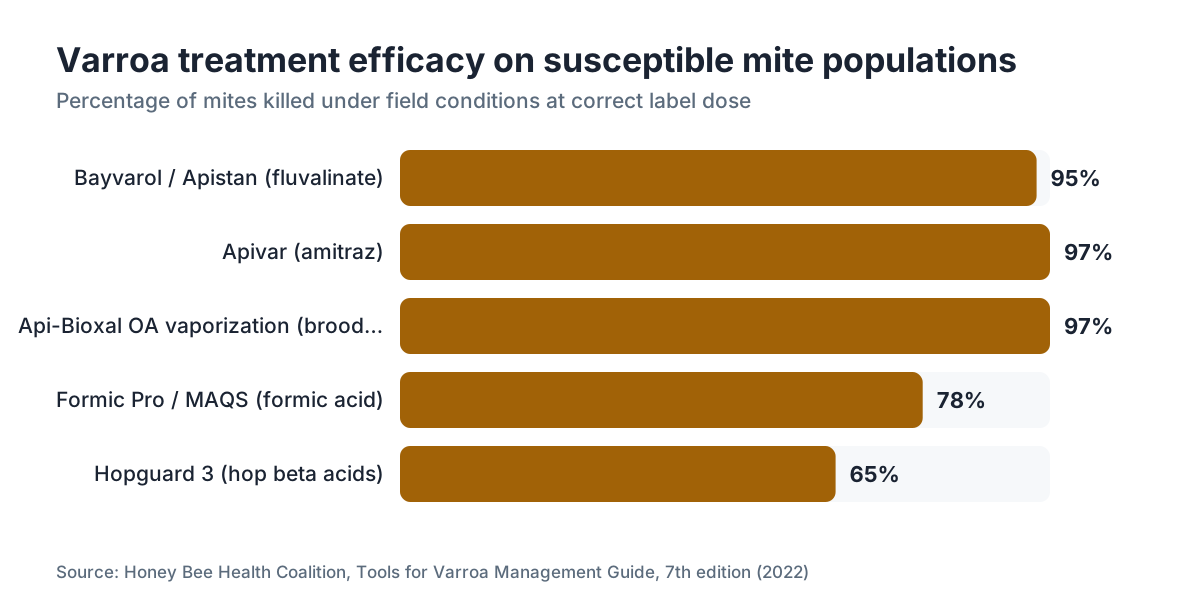
Here's a practical side-by-side. The efficacy ranges come from peer-reviewed field trials and the Honey Bee Health Coalition's 2022 guide [9].
| Treatment | Active ingredient | Mode of action | Efficacy (susceptible mites) | Brood penetration | Temperature window | Resistance documented |
|---|---|---|---|---|---|---|
| Bayvarol | Fluvalinate | Pyrethroid (sodium channel) | 90-99% | No | Broad | Yes, widespread |
| Apistan | Fluvalinate | Pyrethroid (sodium channel) | 90-99% | No | Broad | Yes, widespread |
| Apivar | Amitraz | Octopamine agonist | 93-99% | No | Broad | Emerging |
| MAQS / Formic Pro | Formic acid | Vapor, multi-site | 60-95% | Yes (partial) | 50-85°F (10-29°C) | None confirmed |
| Api-Bioxal | Oxalic acid | Unknown, multi-site | 90-99% (broodless) | No | >40°F (4°C) for drizzle | None confirmed |
| Hopguard 3 | Hop beta acids | Unknown | 50-80% | No | Broad | None confirmed |
A few things jump out. Oxalic acid (Api-Bioxal) matches or beats Bayvarol on kill, carries no documented resistance, and costs less per treatment for small outfits. The catch: you need a broodless colony, or a trickle timed to broodless conditions, for the best result. Formic acid reaches into capped brood, which nothing else does without a broodless window, but it's temperature-sensitive and harder to run safely.
Bayvarol's real edge is simplicity and that wide temperature range. For a hobbyist with a few hives who monitors carefully and knows resistance isn't a local problem yet, it's a fair choice. If you're already seeing weak fluvalinate results in your yard, switch modes of action and don't look back.
When you're building a treatment calendar and tracking counts across the year, the free protocol builder at VarroaVault maps the timing across multiple colonies and products so you're not holding it all in your head.
Can you use Bayvarol when honey supers are on?
No. This is one of the non-negotiable label requirements on every national registration I know of. Supers come off during Bayvarol treatment, full stop. Fluvalinate is lipophilic, so it binds readily to fats and waxes. Beeswax, which the bees use to cap honey cells, soaks it up and holds it. Honey stored in comb during treatment can pick up residues.
A study by Chauzat and Faucon in Pest Management Science (2007) found fluvalinate residues in beeswax from hives with a treatment history, and those residues stuck around in the wax for years after treatments stopped [5]. Levels in honey generally stayed below EU maximum residue limits, but the buildup in wax is documented, not hypothetical.
So treat in late summer or early autumn after your last harvest, or in early spring before supers go on. That timing also lines up with the moments when knocking down mites does the most good anyway.
Is Bayvarol safe for bees, queens, and brood?
For adult workers, at correct doses under normal conditions, Bayvarol is considered safe. Decades of European field use back that up. Bees are far less sensitive to fluvalinate than mites are, and that gap is the whole point of the treatment.
Queens are the wildcard. She spends most of her time in the brood nest, which is exactly where the strips hang. Reported queen losses after fluvalinate treatment show up in the beekeeping literature, though a clean incidence rate is hard to pin down because queen failure has many causes. Extension apiculture programs advise keeping strips out of the frame space where the queen is most active, and checking the colony is still queenright a week or two after strips go in [7].
Brood is mostly shielded. Fluvalinate doesn't reach capped cells, so sealed pupae aren't directly exposed. Open larvae get covered by nurse bees, and trace fluvalinate on those nurses could in theory reach larvae during feeding, but at label doses field studies haven't shown consistent sub-lethal effects.
Overdose changes everything. More than two strips per brood box, strips left in far past eight weeks, or a full dose in a weak colony all raise the exposure per bee and can kill adults and damage brood. Stick to the label.
How do you know if Bayvarol treatment actually worked?
You monitor. Always. Treating without checking mite levels before and after is like taking antibiotics without knowing you have an infection. You burn money and learn nothing.
The standard method is an alcohol wash (a sugar roll works but reads less accurately). Sample roughly 300 bees (about half a cup) off a brood frame, wash them in isopropyl alcohol, and count the mites that drop. Divide mites by bees for mites per 100 bees. The Honey Bee Health Coalition recommends treating at 2 mites per 100 bees or higher during the main season [9]. Alcohol wash is the most accurate field method, and before-and-after counts are the only way to judge whether a treatment worked [10].
For a proper Bayvarol efficacy check:
- Alcohol wash before treatment starts. Record it.
- Wash again two weeks in.
- Final wash right after strip removal at eight weeks.
If the two-week count isn't dropping sharply, that's a resistance flag. If the removal count still sits above your threshold, either the treatment failed (resistance) or mites reinvaded from neighboring colonies (drift and robbing can reload a hive within weeks of a clean treatment).
For tracking counts across hives and seasons, our varroa mite monitoring section has step-by-step protocol guidance.
What are the correct storage and disposal requirements for Bayvarol?
Store unopened Bayvarol packets below 25°C (77°F), out of direct sun, in the sealed original foil. Most labels list a shelf life of two to three years from manufacture if stored right. A hot car or shed over summer will degrade the active ingredient.
Used strips still hold residual fluvalinate. They're pesticide waste. Rules vary by country and locality, but the general guidance holds everywhere: fold the used strip back into the original foil, seal it, and take it to your local pesticide disposal program or household hazardous waste. Don't compost them, toss them in general recycling, or leave them anywhere they could touch water or soil.
One word on reuse. Some beekeepers try to run strips a second season. Don't. Efficacy falls as the fluvalinate depletes, so you undertreat, and undertreating is exactly what selects for resistance without protecting your bees.
When is the best time of year to use Bayvarol?
Timing matters more than most beekeepers realize. The goal is to catch the largest share of mites in the phoretic phase, on adult bees, because that's the only stage Bayvarol can touch. Mites in capped cells are invisible to it.
Late summer is the single most important window in temperate climates, roughly July through September depending on latitude. The logic: colonies sit at or near peak population, mite loads have climbed all season, and the bees born in August and September are the ones that must live until spring. If those winter bees hatch from high-mite cells, they emerge physiologically damaged and the colony often dies before the next year. A well-timed late-summer treatment resets the mite load before those bees are reared.
Early spring is the second common window, before supers go on and before the brood nest swells. Mite-to-bee ratios often run high then because the colony shrank over winter.
Mid-season treatment with supers on isn't practical with Bayvarol, because of the super prohibition. That's a real disadvantage next to oxalic acid dribble or vaporization in some management systems.
In warm climates where bees never fully stop brooding, there's no broodless window. Bayvarol still works, but efficacy runs lower because a big share of mites is always sealed in cells. There, treatments that reach mites in brood (like formic acid) often do better.
Where can you buy Bayvarol and how much does it cost?
In registered markets (UK, EU, Canada, Australia), Bayvarol sells through most beekeeping supply retailers and some agricultural co-ops. Packs usually hold four strips, enough for two hives. In recent years UK retail has run roughly £8-12 per four-strip pack, putting the per-hive cost around £4-6 for one treatment cycle. EU and Australian pricing runs broadly comparable in local currency.
If you're stocking up on other beekeeping supplies, most sellers that carry Bayvarol also stock mite-monitoring gear, replacement strips for other treatments, and protective clothing.
US beekeepers wanting a legal fluvalinate option will find Apistan at most beekeeping supply companies, usually $15-25 per pack of ten strips (five hives). Per-hive cost lands near Bayvarol once you adjust for the different strip count.
Don't let price drive the choice. A treatment that fails to resistance costs you the colony, which is worth far more than the gap between products.
Frequently asked questions
Can I use Bayvarol strips in the United States?
No. Bayvarol is not EPA-registered in the United States as of this writing. Using unregistered pesticides in the US violates FIFRA. The legal fluvalinate option for US beekeepers is Apistan, which uses the same active ingredient. Check with your state apiarist or the EPA's pesticide registration database if you need to confirm current status.
How many Bayvarol strips do I need per hive?
Two strips per brood box. A colony on a single brood box gets two strips total. A double brood box gets four, two in each box. Place them in the brood nest area between frames where bees will contact them often. Using fewer strips risks undertreating and pushes resistance selection along.
How long do Bayvarol strips stay in the hive?
Six to eight weeks. Most labels set a minimum of six weeks so the treatment covers enough brood cycles, and a maximum of eight. Remove them promptly at the end of the window. Leaving strips in longer raises the risk of speeding resistance development without adding meaningful mite control.
Does Bayvarol work on varroa mites inside capped brood cells?
No. Fluvalinate in Bayvarol strips only kills phoretic mites, the ones riding on adult bees. Mites sealed in capped cells are shielded from exposure. That's why the six to eight week window is necessary: it spans multiple brood cycles so mites exiting cells become phoretic and get killed before they reproduce again.
What are the signs of fluvalinate resistance in my varroa population?
The main sign is a mite count that won't drop after two to three weeks of treatment. Do an alcohol wash before treatment, then again two weeks in. If mites per 100 bees haven't fallen by at least 50-70%, suspect resistance. Talk to local beekeepers and your extension service about resistance prevalence before assuming the product is just slow.
Can Bayvarol harm my queen?
There are anecdotal and some reported cases of queen loss after fluvalinate treatment, most likely from prolonged close contact with the strip. The risk looks low at correct label doses, but check that the queen is still laying normally about 10-14 days after inserting strips. Keep strips out of the exact frame space where the queen is most active.
Can I use Bayvarol and oxalic acid together?
These two hit mites by completely different mechanisms, so there's no direct chemical conflict. But combining them in one treatment window isn't standard and isn't backed by clear evidence. The common approach is to run Bayvarol for a full cycle, monitor results, and if needed follow up with a separate oxalic acid treatment in a broodless window.
Does Bayvarol affect honey quality?
Used per label (supers off), fluvalinate residues in honey should stay below regulators' maximum residue limits. The bigger worry is residue building up in beeswax over repeated cycles. Studies have found fluvalinate persisting in wax for years after treatment. That's a reason not to treat more often than needed and to rotate comb out over time.
How do I know if my mite load requires treatment?
The Honey Bee Health Coalition recommends treatment at 2 mites per 100 bees during the main season, and some advisors use a lower 1-2% threshold before the critical late-summer brood rearing period. Run an alcohol wash on 300 bees from a brood frame for the most accurate count. Monitor monthly through the active season.
What happens if I leave Bayvarol strips in too long?
Leaving strips past eight weeks carries two main risks. First, the continued low-level exposure selects for resistant mites faster than a properly timed treatment. Second, some studies suggest extended exposure can suppress colony health. The label maximum exists for a reason. Pull the strips on schedule, even if you think more time might kill more mites.
Are there organic or natural alternatives to Bayvarol that actually work?
Yes. Oxalic acid (as Api-Bioxal in most markets) is approved as an organic treatment, hits 90-99% efficacy in broodless colonies, and has no documented varroa resistance. Formic acid products like MAQS or Formic Pro also have no documented resistance and partially reach capped brood. Both need more careful timing and temperature management than Bayvarol strips.
Can Bayvarol be used in a nuc or small colony?
Yes, but carefully. Small colonies have fewer bees per unit of fluvalinate, so the dose per bee runs effectively higher. Most national labels still specify two strips for a standard colony. For a very small nuc (fewer than four to five frames of bees), some beekeepers use one strip and monitor closely. Always follow your specific national label.
How do I dispose of used Bayvarol strips safely?
Used strips still carry residual fluvalinate and count as pesticide waste. Fold them into the original foil, seal, and take them to a household hazardous waste facility or a local pesticide take-back program. Don't put them in regular recycling, compost, or leave them in soil or near water. Disposal rules vary by country, so check your local authority's pesticide waste guidance.
Is Bayvarol the same as Apistan?
Both contain fluvalinate and work the same way, but they're different products with different registrations, strip sizes, and fluvalinate loads. Apistan strips carry about 800 mg of fluvalinate per strip; Bayvarol strips carry 3.6 mg. The different concentrations are designed to reach similar field efficacy through different delivery geometry. They are not interchangeable without checking your country's specific label.
Sources
- Honey Bee Health Coalition, Tools for Varroa Management Guide (7th edition, 2022): Bayvarol and other fluvalinate strips target phoretic mites only; mites in capped brood are not killed; treatment must span multiple brood cycles for efficacy.
- US EPA, Pesticide Product Label System: Bayvarol does not appear in the EPA active pesticide registration database for use in the United States.
- US EPA, Federal Insecticide Fungicide and Rodenticide Act (FIFRA) overview: FIFRA requires EPA registration for any pesticide used in the US; using unregistered products is a federal violation.
- UK Veterinary Medicines Directorate, Product Information Database: Bayvarol is authorised in the UK as a veterinary medicine for use in honey bee colonies against Varroa destructor.
- Chauzat, M-P. & Faucon, J-P. (2007) Pesticide residues in beeswax samples collected from honey bee colonies, Pest Management Science: Fluvalinate residues accumulate and persist in beeswax for years following strip treatments, even after treatments are discontinued.
- European Medicines Agency, Bayvarol product information: Strips should be removed at the end of the treatment period; extended exposure to sub-lethal residues promotes selection for resistant mites.
- University of Minnesota Extension, Varroa mite management: Field trials of fluvalinate strips on susceptible mite populations show efficacy of 90-99%; queen monitoring post-treatment is recommended.
- Milani, N. (1999) The resistance of Varroa jacobsoni to acaricides, Apidologie: Fluvalinate resistance in varroa is documented in peer-reviewed literature from the late 1990s, confirmed in commercial operations in the US and Europe, and linked to a target-site sodium channel mutation.
- Honey Bee Health Coalition, Tools for Varroa Management Guide (7th edition, 2022) treatment thresholds: The HBHC recommends treating when mite loads reach 2 mites per 100 bees during the main season and advocates product rotation to slow resistance.
- Penn State Extension, Varroa Mite Monitoring and Management: Alcohol wash is the most accurate field method for estimating mite loads; before-and-after monitoring is essential to assess treatment efficacy.
- USDA Agricultural Research Service, Bee Research Laboratory: Fluvalinate residues accumulate in beeswax with repeated treatments; concentrations in beeswax are typically higher than in honey.
- NC State Extension, Apiculture Varroa mite control options comparison: Comparison of registered varroa acaricides shows oxalic acid and amitraz have no documented resistance, while fluvalinate resistance is widespread in many US regions.
Last updated 2026-07-09