Brood break for varroa control: what it is and how to do it
TL;DR
- A brood break interrupts the queen's egg-laying for at least 21 days.
- That forces every varroa mite out of capped cells and onto adult bees (the phoretic phase), where oxalic acid kills them best.
- Combined with oxalic acid vapor, a brood break drops mite loads 90 to 97%.
- It's one of the highest-impact tools a hobbyist has.
What is a brood break and why does it matter for varroa?
A brood break is exactly what it sounds like. You deliberately stop the queen from laying eggs. No eggs, no young larvae, no capped brood. For a few weeks the colony has open comb and adult bees, and nothing else.
Here's why that wrecks varroa. The mite Varroa destructor reproduces only inside capped brood cells: worker cells capped for roughly 12 days, drone cells for about 14 days [1]. Take away the capped brood and every mite in the colony gets stranded on adult bees in what researchers call the phoretic phase. Phoretic mites are exposed. Oxalic acid applied as vapor (OAV) kills roughly 95% or more of them, and almost none of the mites tucked under wax cappings [2]. A brood break makes the whole mite population phoretic at the same moment.
Skip the brood break and oxalic acid against a colony full of brood falls to somewhere around 40 to 60% of total mites, because most of the population is hidden under caps the vapor can't reach [2]. That's the arithmetic that trips people up. A treatment that hits 95% of phoretic mites still only touches 95% of whatever fraction happens to be phoretic that day. If 70% of your mites are capped up when you treat, your real kill rate falls apart.
For how this pest actually ticks, see our full article on the varroa mite.
No exotic gear, no special chemicals. A brood break needs timing, a plan, and one reliable way to shut the queen down for a while.
How long does a brood break need to be to work?
Plan on 24 days minimum, measured from the last day the queen was laying. That comes straight from bee biology. Worker brood stays capped for about 12 days and drone brood for about 14 [1]. To be sure every mite that entered a cell before the break has finished reproducing and climbed back out, you wait out the longest-capped drone cells and add a few days of buffer.
Most experienced beekeepers and extension guides land on 3 to 4 weeks, 21 to 28 days [3]. Under 21 days risks leaving late-capped drone brood with live mites inside. Going longer isn't dangerous. It just costs you more of your worker cohort, since no new bees are emerging to replace the ones aging out.
Pairing the break with oxalic acid vapor? The Honey Bee Health Coalition's Varroa Management Guide says to treat once the colony is confirmed broodless, or in the last few days of the window when capped brood is minimal [4]. Some folks treat twice, 7 days apart, to catch mites that rode out on late-hatching cells.
The colony will feel oddly quiet during a full break. That's normal. You won't see the usual mix of capped, open, and hatching brood. The adult population ages down but should hold together fine for 3 to 4 weeks, especially with solid nectar and pollen stores.
What methods actually create a brood break?
Beekeepers use five practical methods. They differ in cost, reversibility, and how much handling they demand.
1. Queen caging
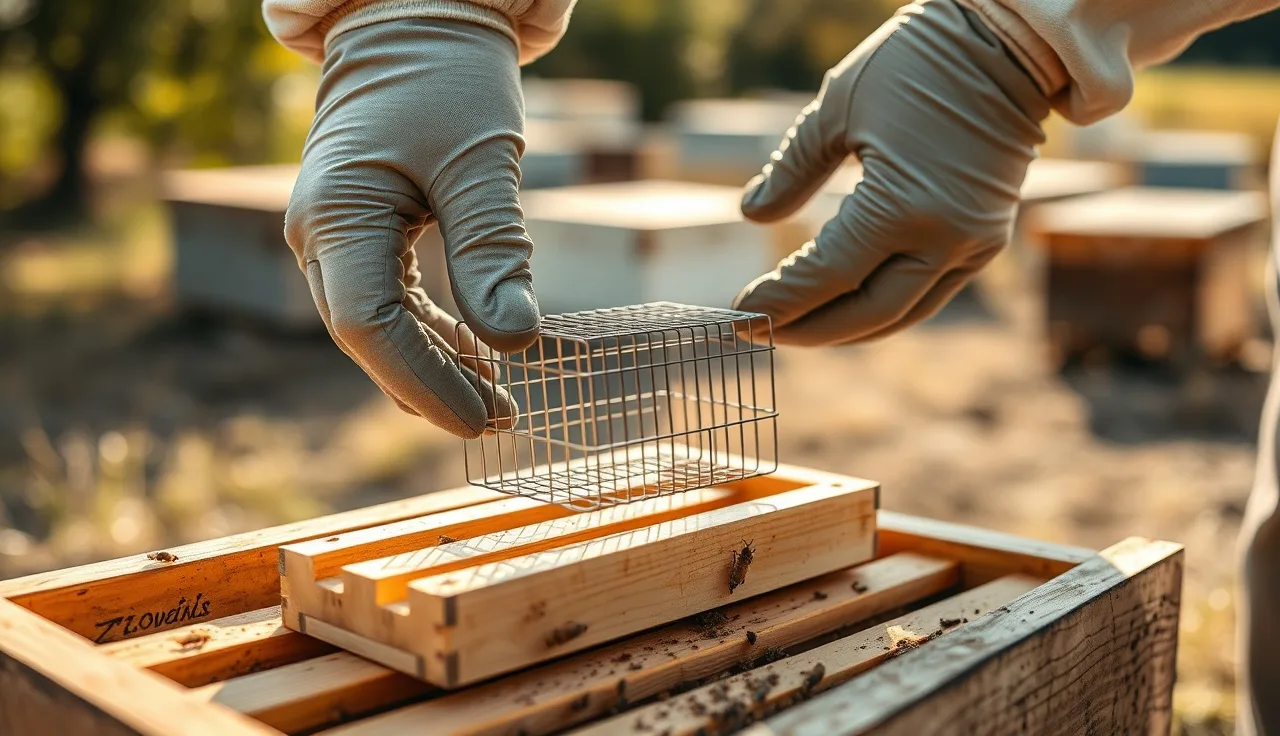
Find the queen, put her in a cage (a push-in cage or a JZ-BZ style cage both work), and leave her on a frame of empty comb inside the hive. She can't lay. Workers feed her through the screen. Release her after 24 days. This is the most reversible, lowest-risk method. The one failure point is missing her when you cage the wrong bee, so the colony keeps laying while you think it stopped. Confirm the break by checking for eggs 4 days after caging.
2. Queen removal (walkaway split)
Pull the old queen and let the colony raise a new one from existing larvae. The gap between removal and the new queen laying runs 4 to 5 weeks: 16 days to emergence, 5 to 7 days to mating flights, 2 to 3 days to first eggs. You get a brood break as a byproduct, and it's often the right call when you wanted to requeen anyway. Risk: the new queen might mate poorly in bad weather or thin drone populations.
3. Splitting the colony
Divide the hive into two, one half with the queen, one without. The queenless half gets a natural break as its capped brood hatches out over about two weeks with nothing new added. Treat that half with oxalic acid once it goes fully broodless. This is common in late-summer splits where you want mite control and increase at once.
4. Natural swarm or reproductive impulse
When a colony swarms, the parent hive often sits queenless for 3 to 5 weeks while virgins emerge and mate. That's a brood break, just not a managed one. Some beekeepers lean into it. Others find unmanaged swarms too unpredictable to count on.
5. Chemical queen suppression (skip it)
Some research protocols use CO2 or specific compounds to suppress laying, but no registered hobbyist product exists for this in the U.S. Stick to the mechanical methods above.
Queen caging plus oxalic acid vapor is the combination extension literature most often calls reliable for the average hobbyist [3].
When is the best time of year to do a brood break?
Late summer wins. July and August across most of the U.S., before the colony raises its overwintering bees [3]. The logic is simple. Your winter bees get raised in August and September. If they emerge into a hive with low mite loads, they go into winter healthy, long-lived, and fat on fat. Raise them in a mite-heavy colony and they come out physiologically damaged, their fat bodies compromised, and you lose them to a dead-out before March no matter how well you wrapped the hive.
A late-summer brood break with OAV is probably the highest-return move in the entire beekeeping calendar.
Spring is a harder sell. Colonies are growing fast, swarm pressure is up, and the honey flow makes people reluctant to disrupt anything. Still, if you come out of winter with high mite counts (above 2% on an alcohol wash) and a colony that's manageable in size, a spring cage-and-treat beats letting the population explode.
Winter does the work for you in cold climates. Colonies in northern states often go fully broodless for 8 to 12 weeks [5]. If yours does, that's your free window. Treat once with oxalic acid in late November or December while brood is absent, and you knock out a large share of the mite load heading into the new year.
How do you actually do a brood break on honey bees, step by step?
Here's the simplest, most controllable version: cage the queen, then treat with oxalic acid vapor.
Step 1: Find your queen. Work the hive methodically. Check frames with open brood first, since she stays near fresh eggs. Mark her if she isn't already. A marked queen saves you 15 minutes every visit.
Step 2: Cage the queen. Put her in a cage (push-in cages clip right onto a frame of empty comb so she can't lay through the mesh). Double-check her workers can reach her through the screen to feed her.
Step 3: Note the date. Day zero is the day you cage her. Write it on the box. You're aiming for Day 24 to 28 for OAV.
Step 4: Confirm the break at Day 4. Open up four days later and look for fresh eggs. None means the cage is working. Eggs mean you either caged the wrong bee or the cage failed.
Step 5: Check mite load at Day 14. Run an alcohol wash on 300 bees. Above 2 mites per 100 bees and OAV is clearly warranted. Below that you can still treat preventively.
Step 6: Treat with OAV at Day 24 to 28. By now nearly all brood has hatched. Apply oxalic acid vapor per the product label. The EPA-registered Api-Bioxal label currently allows up to 3 treatments per year at 1 gram of oxalic acid per hive body occupied by bees [6]. Some beekeepers add a second treatment 7 days later for coverage.
Step 7: Release the queen. Open the cage after treatment. She'll resume laying within 24 to 48 hours. Watch for normal egg patterns over the next week to confirm she's healthy and accepted.
The whole thing runs about 4 weeks of calendar time and maybe 45 minutes of actual hive work, spread across 3 or 4 short inspections. VarroaVault's free protocol templates and mite-count trackers keep you on schedule across multiple hives.
What mite reduction can you realistically expect from a brood break?
Results vary, and anyone quoting you a fixed percentage without knowing your starting mite load, colony size, and treatment execution is guessing. The data we have, though, is good.
A brood break alone, no treatment, cuts mite levels because the population can't grow without brood to reproduce in. Add oxalic acid and the numbers jump. Al Toufailia et al. (2015), in the Journal of Apicultural Research, found oxalic acid during a brood break reduced mite loads by roughly 90 to 97% [7]. Single OAV applications on broodless colonies consistently beat repeated treatments on colonies carrying brood [2].
The Honey Bee Health Coalition's Varroa Management Guide puts it plainly: "oxalic acid applied when no capped brood is present will kill over 95% of mites in the colony" [4]. That's a direct quote from a reference nearly every U.S. beekeeper leans on.
Hit a full nest of brood with any miticide and you're fighting yourself. The mites surviving under the cappings are the exact ones already reproducing.
One honest caveat. Start at a 10% infestation and a 95% kill still leaves a 0.5% residual, which sounds fine until you remember those survivors start breeding again the moment the queen resumes laying. So the follow-up isn't optional. Run an alcohol wash 4 to 6 weeks after releasing the queen. That's how you confirm the treatment worked and catch a rebound early.
Does a brood break harm the colony?
Every beekeeper asks this, and it's the right question. Honest answer: done correctly and at the right time of year, a managed brood break causes little lasting harm. Done at the wrong time or dragged out too long, it can push a colony into a weaker spot.
The risks worth knowing:
Population decline. Bees live about 4 to 6 weeks in summer. A 4-week break means the bees alive at the start age out while no new ones replace them until the queen resumes and those eggs hatch 21 days later. Go in with 40,000 bees and expect noticeably fewer adults by release day. The colony recovers once she's back, but don't run a break so late in fall that you can't rebuild before winter.
Queen failure on release. Caged queens sometimes fail, especially if they're old, if the screen was damaged, or if workers starved her. Confirm the colony returns to a normal brood pattern within 10 days of release. No eggs by Day 7 post-release means something went wrong.
Laying workers. Queenless conditions that run too long (usually past 3 to 4 weeks) can trigger workers to lay unfertilized eggs. Rare when the queen is simply caged rather than gone, but it shows up with removal-based breaks if the new queen stalls or fails to mate. Laying-worker colonies are miserable to fix.
Robbing pressure. A brood-break colony is often smaller and less able to defend itself. If you're treating in a late-summer dearth, be careful with entrance reducers and time your inspections to avoid setting off a robbing frenzy.
None of these are reasons to skip a brood break. They're reasons to plan it and check on the colony while it runs.
Can you do a brood break on a package or new hive?
No. Please don't. A spring package or nuc is racing to build population before winter. Interrupt that queen's laying in the first 60 days and you slow growth at the worst possible moment, sometimes enough that the colony never makes it through its first winter.
New colonies usually carry low mite loads early anyway, because they started small with few mites. Monitor them with monthly alcohol washes, but wait until late summer (August at the earliest) before considering any brood break. By then the colony should be big enough to ride out the brief dip without real risk.
For packages especially, your year-one tools are monitoring and threshold-based treatments with formic acid or thymol products that work with brood present. Save the brood break for established colonies that carry the population reserves to absorb it.
How does a brood break compare to other varroa treatment approaches?
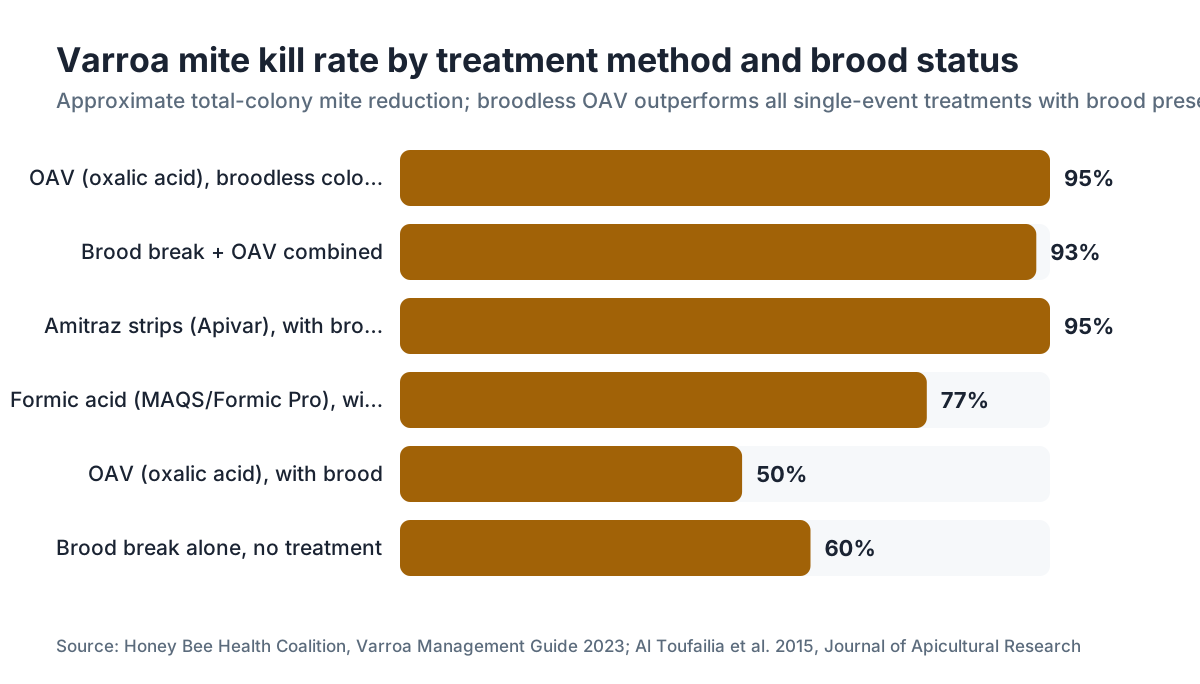
A brood break isn't a standalone treatment. It's a tool that makes a chemical or organic treatment, mostly oxalic acid, far more effective. Alone, with no miticide, it slows mite reproduction but doesn't clear the infestation. Here's how the options stack up:
| Approach | Effective against capped brood? | Kill rate (approx.) | Requires broodless colony? | Registration (U.S.) |
|---|---|---|---|---|
| OAV (oxalic acid vapor), broodless colony | N/A (no brood) | 95%+ phoretic [4] | Yes (for single treatment) | Yes, Api-Bioxal [6] |
| OAV, with brood present | No | 40 to 60% of total mites [2] | No | Yes, up to 3 treatments |
| Amitraz strips (Apivar) | Yes, slowly | 95%+ over 6 to 8 weeks [8] | No | Yes |
| Formic acid (MAQS, Formic Pro) | Partial | 60 to 95% depending on temp [8] | No | Yes |
| Brood break alone, no treatment | N/A | 50 to 70% over several weeks (mites starved/die naturally) | Yes | N/A |
| Brood break + OAV | N/A | 90 to 97% [7] | Yes | Yes |
Amitraz (Apivar) is often the right pick when you can't or won't do a brood break, especially in spring when colonies are growing fast and you need to treat without stopping the queen. Formic acid works with brood present and penetrates cell caps to a degree, which helps when a full break isn't practical.
Brood break plus OAV is the most effective single-event move a hobbyist can make in late summer. The catch is you have to find the queen, and not everyone's confident doing that. If finding your queen is a struggle, a marked queen or the skill to spot her reliably is worth more than almost any gear you'll buy. For beekeeping supplies that help with queen finding and mite management, the right kit makes the work a lot easier.
What do you do after the brood break? Post-treatment monitoring
The break and the treatment are only as good as the follow-up. Mite populations rebound faster than people expect once the queen ramps back up, especially with robbing from nearby untreated colonies.
Run an alcohol wash 4 to 6 weeks after releasing the queen. That's enough time for any survivors to breed through a brood cycle and give you a real count. Below 1% (1 mite per 100 bees) and you're in good shape. Between 1 and 2% in late summer, watch closely and think about a follow-up. Above 2% in August or September, treat again before the winter bees are born.
The Honey Bee Health Coalition's Varroa Management Guide sets a treatment threshold of 2% (2 mites per 100 bees) for colonies heading into winter [4]. That number exists because mite-damaged winter bees have reduced fat bodies and shortened lifespans, so colonies above it in fall are far more likely to die before spring.
Keep records. A notebook with date, mite count, colony ID, and treatment is enough. Patterns show up within 2 to 3 seasons: which colonies run hot, whether your timing hits the right window, whether you're managing the load or just knocking it down each summer only to watch it bounce back.
VarroaVault's free tracking tools are built for exactly this kind of season-over-season record-keeping. Want a protocol template that walks the full late-summer brood break cycle? Start there.
What about doing a brood break on honey bees by pulling all the brood frames?
Yes, this works, and some beekeepers prefer it to caging because you don't have to find the queen. Remove every frame with capped or open brood and put them in a separate box (a nuc or a spare hive body with a screened bottom). Leave the queen and all adult bees with only empty comb, honey, and pollen frames.
The brood you pulled hatches over the next 12 to 14 days. Treat that split with OAV once it's fully broodless, roughly 14 to 16 days after the pull. The parent colony has no brood from Day 1, so you can treat it with OAV almost right away (24 to 48 hours after the split, to let the adults settle back onto the queen).
This makes two broodless units fast and lets you treat both inside the same 3-week window. The pulled brood box can go back to the parent hive, start a new colony, or make increase. It's efficient if you're comfortable with big manipulations.
The risk: pulling the queen out with the brood frames if she's hard to spot. Scan every frame before you move it and watch for the ring of workers facing inward around her. Not confident? Cage her first, then pull brood.
Frequently asked questions
How long should a brood break last to kill varroa effectively?
At minimum 21 days from the last day the queen was laying, since drone brood stays capped for about 14 days and you want buffer time. Most extension resources and the Honey Bee Health Coalition recommend 24 to 28 days as the practical target. Shorter breaks may leave some late-capped drone cells still harboring mites when you treat.
Can I use oxalic acid without a brood break?
Yes. Oxalic acid (Api-Bioxal) is EPA-registered for colonies with brood present, up to 3 treatments spaced 7 days apart. But the kill rate drops hard, from over 95% in a broodless colony to roughly 40 to 60% of total mites when heavy brood is present. Multiple treatments compensate partially, but a broodless application is far more efficient.
What is the best time of year to do a brood break for varroa control?
Late July through August in most U.S. climates. This targets the mite population before your colony raises its overwintering bees in August and September. Those winter bees carry the colony through the cold months, and mite-damaged bees live shorter and fight infection worse. Getting mites down before those bees are raised is the highest-impact timing.
Does a brood break kill the varroa mites by itself?
Partly. With no brood to reproduce in, the mite population can't grow and some mites die naturally on adult bees over several weeks. But a brood break alone typically cuts mite loads 50 to 70%, not the 90 to 97% you get combining it with oxalic acid vapor. A brood break alone is not enough treatment for a colony above threshold.
How do I know if my colony is actually broodless after a brood break?
Open the hive and inspect every frame. You want zero capped cells, no tan or dark-capped worker or drone cells. Adult bees and stored honey and pollen are fine. A flashlight helps on dark frames. Unsure? Wait another 3 to 4 days and check again. Drone cells can fool you because they bulge above the comb surface.
Will the colony swarm during a brood break?
Unlikely, especially with a late-summer break. Swarm impulse peaks in spring when colonies expand fast. A caged queen in summer or early fall isn't the same trigger as an overcrowded colony with swarm cells. Still, check for queen cells during your inspections, especially if you used a removal method instead of caging.
How do I do a brood break without finding the queen?
Pull all frames with brood and place them in a separate nuc or hive body. The parent hive keeps its adult bees and the queen, with only empty comb, honey, and pollen. The parent colony is broodless from Day 1. Treat with oxalic acid after 24 to 48 hours once the bees settle. The pulled brood hatches out separately over the next 12 to 14 days.
Can a brood break hurt my bees or weaken the colony?
Yes, if the timing or duration is wrong. The adult population ages normally during the break with no new bees replacing them, so the colony is smaller when it ends. Run it too late in fall and you may not rebuild before winter. Done in late July through August with a colony in good shape, the impact is manageable and the mite reduction far outweighs the temporary dip.
How many times a year can I use oxalic acid after a brood break?
The EPA-registered Api-Bioxal label allows up to 3 treatments per year. During a brood break, one treatment at broodlessness plus a follow-up 7 days later uses 2 of them. Many beekeepers also use the natural winter broodless period for a third treatment in late fall or early winter. Always follow the current label, since it can be updated.
What mite count should trigger a brood break and treatment?
The Honey Bee Health Coalition recommends treating at 2% (2 mites per 100 bees on an alcohol wash) for colonies heading into fall and winter. In summer, some beekeepers use a lower threshold of 1 to 1.5% to stay ahead of the growth curve. Hit 3% or above in August and treat immediately, regardless of other timing.
Is a brood break different from a split?
Related but not identical. A split divides a colony into two, one half with the queen, one without. The queenless half gets a natural brood break as existing brood hatches with no new eggs added. A split can create a brood break, but a split's main goal is sometimes increase or swarm prevention. A managed brood break with queen caging is more controlled and doesn't require permanently dividing the colony.
Can I do a brood break on a first-year hive or package colony?
No. A first-year colony needs every laying day it can get to build population and stores. Interrupting the queen in the first 60 to 90 days risks a colony too small to overwinter. Wait until late summer of year one, and only then if it's well-established with at least 6 to 8 frames of bees. Monitor monthly and treat with formic acid or amitraz strips if counts rise before the colony is strong enough.
What happens to mites that were in capped cells before the brood break?
They finish their reproductive cycle, emerge with the hatching bees, and become phoretic mites on adults. That's exactly what you want. Once they're on adult bees, oxalic acid can kill them. The 24-day minimum ensures even the last mites to enter cells, in drone brood capped before you caged the queen, have emerged before you treat.
Sources
- Pennsylvania State University Extension, Varroa Mite Reproductive Biology: Varroa reproduces exclusively inside capped brood cells; worker brood capped ~12 days, drone brood ~14 days
- University of Florida IFAS Extension, Oxalic Acid for Varroa Control: Oxalic acid kills over 95% of phoretic mites but penetrates capped cells poorly; efficacy drops to 40-60% in colonies with heavy brood
- University of Minnesota Extension, Varroa Mite Management: Queen caging for 21-28 days followed by oxalic acid treatment is recommended as a high-efficacy late-summer intervention
- Honey Bee Health Coalition, Varroa Management Guide (2023): Oxalic acid applied when no capped brood is present will kill over 95% of mites in the colony; treatment threshold set at 2 mites per 100 bees heading into fall
- USDA Agricultural Research Service, Honey Bee Research: Colonies in northern U.S. climates commonly go broodless for 8-12 weeks during winter, creating a natural treatment window
- EPA, Api-Bioxal (oxalic acid) Pesticide Registration Label: Api-Bioxal EPA-registered label permits up to 3 treatments per year at 1 gram oxalic acid per hive body occupied by bees
- Al Toufailia et al. (2015), Journal of Apicultural Research, Oxalic Acid Efficacy: Oxalic acid treatment during a brood break reduced mite loads by approximately 90-97% in experimental colonies
- Michigan State University Extension, Integrated Pest Management for Varroa: Amitraz strips reach 95%+ control over 6-8 weeks; formic acid reaches 60-95% depending on temperature; brood break plus organic acid is a high-priority late-season IPM strategy
- North Carolina State University Apiculture Program, Varroa Sampling and Thresholds: Summer treatment threshold of 1-2 mites per 100 bees recommended to prevent exponential mite population growth before winter bee rearing
Last updated 2026-07-09