Brushy Mountain Bee Farm oxalic acid: what beekeepers need to know
TL;DR
- Brushy Mountain Bee Farm was a major U.S.
- supplier of oxalic acid vaporizers and dribble supplies before it closed in 2018.
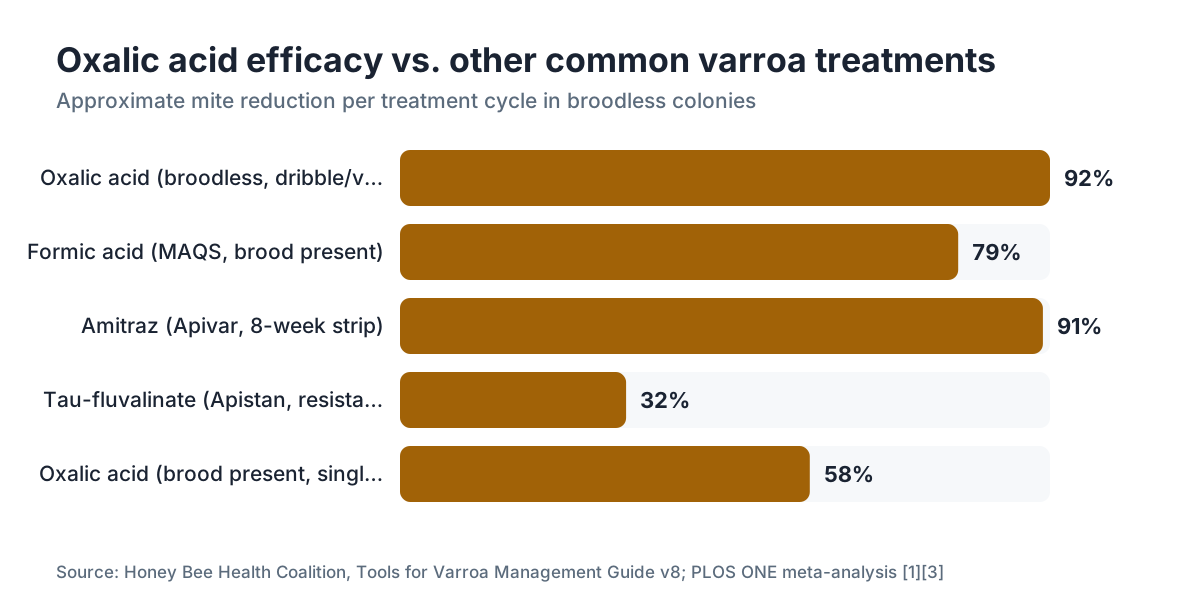
- Oxalic acid itself is still one of the best varroa treatments you can buy, with efficacy above 90% on broodless colonies.
- Here's how it kills mites, which products replaced Brushy Mountain's lineup, the correct doses, and what the EPA label requires for safety.
What was Brushy Mountain Bee Farm and why do beekeepers still search for it?
Brushy Mountain Bee Farm was a beekeeping supply retailer in Moravian Falls, North Carolina, and one of the oldest in the country. Founded in 1978, it sold hive hardware, protective gear, and just about everything in between. It got a reputation for stocking oxalic acid vaporizers back when almost no U.S. supplier carried them. The company closed in 2018 when its founder retired, and the remaining inventory was liquidated [10].
People still type the name into search because Brushy Mountain taught a whole generation of hobbyists how to fight varroa. Half the tutorials, forum threads, and YouTube videos from the 2010s point at a Brushy Mountain vaporizer by name. If you came here to buy one of those units, here's the short version: the company is gone, but everything it popularized is still on the shelf at other beekeeping supply companies. The chemistry hasn't changed a bit. Neither have the protocols.
This article sticks to that chemistry. What oxalic acid does to mites, how to apply it under the current EPA label, which vaporizers and dribble kits you can buy today, and what the research actually shows.
How does oxalic acid kill varroa mites?
Oxalic acid kills varroa on contact. It's a dicarboxylic acid that shows up naturally in rhubarb, spinach, and plenty of other plants, and at hive concentrations it damages the mite's cuticle and disrupts ion transport. Researchers are still arguing about the exact mechanism, but the result is reliable: mites that touch treated bees or vaporized crystals die within hours to days [1].
Here's the catch that trips up beginners. Oxalic acid has essentially zero reach into capped brood cells. Any mite hiding under a wax cap during treatment walks away untouched. That single fact explains everything about timing. A broodless colony can hit efficacy above 90%, while the same dose on a colony full of open and capped brood might knock down only 50 to 70% of the total mite population [2]. Timing against the brood cycle is the whole game.
Oxalic acid has no documented resistance as of 2025. Mites developed resistance to synthetic acaricides like tau-fluvalinate and coumaphos, but they haven't managed it against OA in field populations. The Honey Bee Health Coalition lists this as one of OA's main advantages in its integrated pest management guidance [3].
Bees handle it well at label doses. You get some short-term irritation and a slight dip in adult bee longevity, but that's nothing next to what untreated varroa does to a colony.
What oxalic acid products are EPA-registered for use in U.S. hives?
One product is legal for hive use in the United States: Api-Bioxal (EPA Reg. No. 84736-3). The EPA registered it in 2015 as the only oxalic acid formulation labeled for honey bee colonies, and the label covers three application methods: vaporization (sublimation), dribble (trickle), and sponge [4][8]. The active ingredient is oxalic acid dihydrate at 97.3% purity.
Grab wood bleach off a hardware shelf or crack open a pool chemical instead, and you've broken federal law under FIFRA. That's more than paperwork. The residue limits, dose rates, and safety studies were all run on Api-Bioxal. Other sources carry different purity levels and unknown impurities that can hurt bees or leave illegal residues in your honey.
Api-Bioxal comes in 35-gram sachets and larger packs. As of mid-2025, a 35-gram sachet runs about $8 to $14 depending on the retailer. Most of the suppliers who used to sell Brushy Mountain's oxalic acid products carry it now, including Mann Lake, Dadant, and other major beekeeping supply companies.
| Application method | Approved timing | Typical efficacy (broodless) | Typical efficacy (brood present) |
|---|---|---|---|
| Vaporization (sublimation) | Any time; multiple treatments allowed | 90-97% [2] | 50-70% per application [2] |
| Dribble (trickle) | Broodless colonies only per label | 90%+ [2] | Not labeled |
| Sponge | Broodless colonies only per label | Limited data | Not labeled |
Vaporization is the only method approved for colonies with brood, though the kill rate per treatment drops hard when brood is present. Space several vaporization treatments 5 to 7 days apart and the cumulative kill climbs back up, even during the brood-rearing season.
What vaporizers did Brushy Mountain sell, and what are the current alternatives?
Brushy Mountain carried several oxalic acid vaporizers, from battery-powered pan units to propane heated models. The hobbyist favorite was a 12-volt resistive heating plate style that ran off a car battery or a dedicated battery pack. These sold under a handful of brand names and came mostly out of Eastern Europe.
The vaporizer market kept moving after the company closed. Today's units break down into a few groups.
Battery-powered pan vaporizers are still the common starting point. You measure a dose of Api-Bioxal crystals into a metal cup, slide it into the hive entrance, hook it to a 12-volt battery, and the element sublimates the crystals into vapor over 2 to 3 minutes. Varrox, ProVap 110, and the Lyson vaporizer are all easy to find. Expect roughly $70 to $200 depending on the features [5].
AC-powered vaporizers plug into the wall. The ProVap 110 runs on 110-volt AC, which suits a stationary apiary near an outlet. It heats faster and steadier than a battery unit but isn't much use in a remote yard.
Continuous flow vaporizers like the Varomorus keep vaporizing for a stretch, which cuts per-hive time in big operations. Those run $150 to $400.
Under 20 colonies? A basic battery pan vaporizer does everything you need. Paying more doesn't buy you better efficacy, because the chemistry does the killing, not the price tag on the tool. What actually moves the needle is dose accuracy, a well-sealed hive, and treatment timing.
If you're also stocking up on other gear, comparing free shipping honey bee supply companies can shave the total cost of a treatment setup.
How do you do an oxalic acid dribble treatment correctly?
The dribble mixes Api-Bioxal crystals into sugar syrup and pours the solution straight onto the bees between the frames. The EPA label calls for 1 gram of Api-Bioxal per 20 mL of 1:1 sugar syrup (weight to volume). You apply about 5 mL per seam of bees, capped at 50 mL per colony per treatment [4].
Dribble is labeled for broodless colonies only. That makes it a good fit for late fall or winter cluster treatments in cold climates, or for package bees and freshly hived swarms that haven't started laying.
In practice, you mix the solution ahead of time (it keeps a few days sealed), open the hive, and slowly run the syrup down the seams with a squeeze bottle or syringe. The bees pick up the OA-laced syrup and spread it through grooming. One application, and that's it. The label allows a single treatment per broodless period.
The dribble has real upsides. It needs no gear beyond a kitchen scale and a squeeze bottle, it suits small operations, and honey residues stay well inside safe limits when you follow the label [2][9]. The downside is simple: one shot only. Miss the broodless window and you don't get a second bite.
How do you do an oxalic acid vaporization treatment correctly?
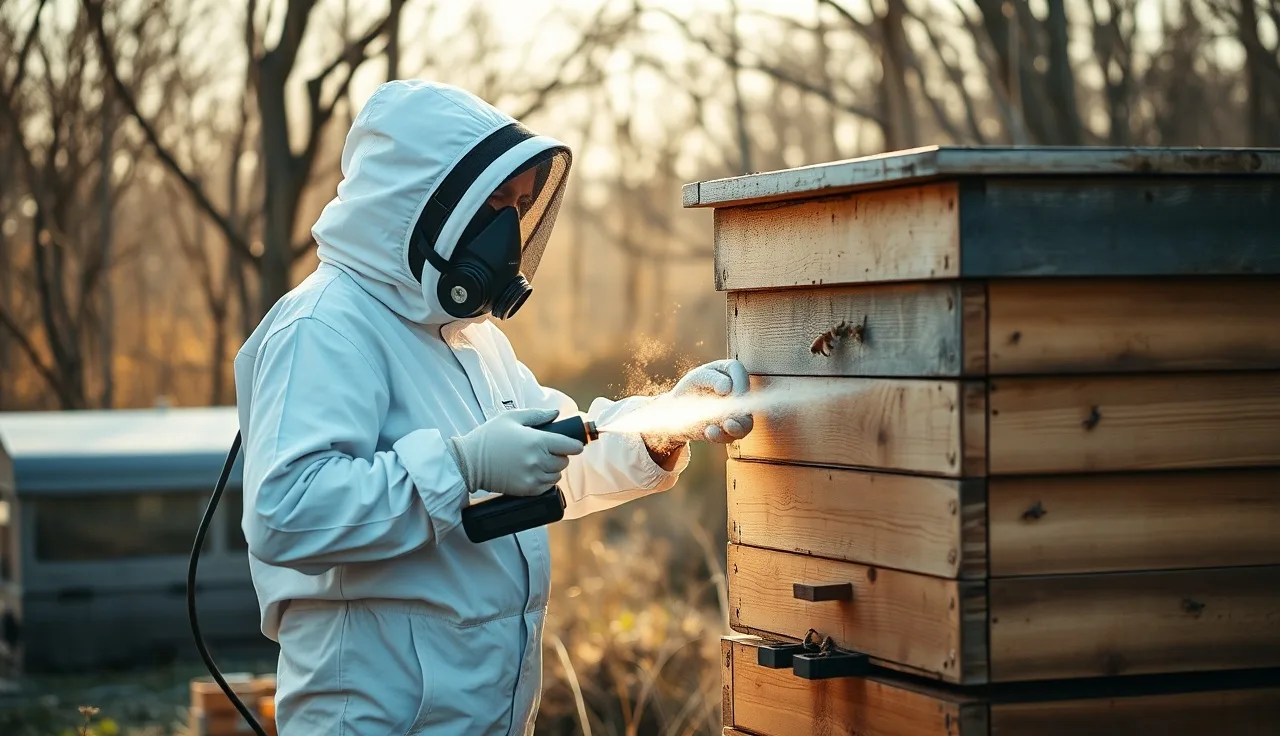
Vaporization takes more equipment but gives you flexibility. Load 1 gram of Api-Bioxal per brood box into the vaporizer pan, slide the vaporizer into the bottom entrance or a hole drilled in the hive body, seal the entrance, and run the heating cycle. On most battery units the cycle runs 2 to 3 minutes. Leave the hive sealed another 10 minutes so the vapor circulates, then unseal [4].
The label allows repeated vaporization treatments 5 to 7 days apart to get control when brood is present. A common brood-season protocol is three treatments at 7-day intervals. Research from the University of Florida and others shows three applications across the capped brood cycle can reach 90% or higher cumulative mite reduction even in colonies packed with brood [7].
Some beekeepers drill a small access hole in the bottom board or a lower box instead of going through the entrance, which seals up tighter. The point is keeping vapor in for those first 10 minutes.
Sealing matters a lot. An open mesh bottom board needs a temporary solid insert or a sheet of cardboard underneath, or the vapor pours out the bottom. Skip that and you're burning chemical for a weak, inconsistent treatment.
Dose accuracy matters too. Push past 2.5 grams per brood box and some studies show real bee mortality and queen loss. Weigh every dose on a gram scale. Don't eyeball it.
What does the research say about oxalic acid efficacy?
The evidence for oxalic acid is strong. A 2019 meta-analysis of oxalic acid trials published in PLOS ONE found mean efficacy of 91.7% in broodless colonies treated by dribble or vaporization, and concluded that "oxalic acid was the most effective of the organic acids tested" [1]. That's the study's own wording, not a marketing line.
Brood-present colonies are murkier. Single vaporization treatments on colonies with capped brood usually show 40 to 70% knockdown per application in controlled trials. The cumulative effect from repeated treatments is what carries the day. Oregon State University Extension reports that three vaporization treatments 5 days apart during the brood season reached 95% cumulative reduction in some trials, though results swing with timing and colony strength [6].
Residue studies keep landing in the same place: OA at label rates doesn't push honey past its natural oxalic acid content. Untreated honey already holds 8 to 40 mg/kg depending on the floral source, and properly treated colonies show no measurable bump above that baseline [9].
Here's the caveat nobody says out loud. Most efficacy data comes from research colonies with carefully measured mite loads. In a real hobbyist hive with uneven management, plan on results below the published numbers. Monitor with an alcohol wash or sugar roll before and after treatment so you know what you actually got. The Honey Bee Health Coalition's Varroa management guide is the best free reference for the method [3][11].
When is the best time of year to treat with oxalic acid?
Late fall is the sweet spot across most of North America. When queens slow down or quit laying for winter, the colony hits a natural broodless window that runs 3 to 8 weeks depending on climate. One dribble or vaporization treatment in that window hits nearly every phoretic mite in the hive, with no capped cells left to hide them [3].
Warm climates change the math. In Florida, Texas, and the deep South, that broodless window is short or never shows up at all. Beekeepers there lean on repeated vaporization instead, because their colonies rarely stop brooding [7].
Spring is easy. Vaporize after packages go in or when early splits are broodless. A freshly shaken package has zero brood, so treat in the first few days before the new queen lays.
Summer works with repeated vaporization but demands follow-through. Blow one of your 7-day intervals and the cumulative benefit slips away. Mite populations bounce back fast at peak brood.
A calendar that works for most temperate-climate hobbyists:
- Early spring: treat packages, splits, and any artificially broodless nucs
- Summer: monitor mite loads monthly; vaporize if counts pass 2% (2 mites per 100 bees on an alcohol wash)
- Late summer to early fall: reach for your strongest synthetic or organic acid option if mite loads run high going into your fall bees
- Late fall to early winter: one dribble or vaporization during the broodless window as a cleanup
The Honey Bee Health Coalition sets 2% as the action threshold for most of the year and drops it to 1% just before and during fall bee rearing [3].
What safety gear do you need when using oxalic acid?
Oxalic acid vapor is a real respiratory hazard, and you treat it like one. The Api-Bioxal label calls for a NIOSH-approved half-face respirator with an organic vapor/P100 combination cartridge during vaporization [4]. A dust mask does nothing here. OA vapor condenses in your airways and can burn lung tissue with repeated exposure.
For skin and eyes, wear chemical splash goggles (more than safety glasses) and nitrile gloves. Oxalic acid solution and vapor irritate skin and eyes. It won't kill you at these concentrations, but chronic unprotected exposure is asking for trouble.
The label language from Api-Bioxal is direct: "Do not enter treated area without a NIOSH-approved respirator with an OV/P100 cartridge/filter combination" during and for a period after vaporization [4].
Store Api-Bioxal cool and dry, away from kids and pets. The 35-gram sachets ship sealed and stable. Don't dump the powder into an unlabeled jar.
Dribble treatments put out very little vapor, but still glove up and keep the concentrated powder off your skin when you mix.
Don't vaporize with people standing around. The vapor drifts farther than you'd guess, especially on a still day. Work upwind.
How does oxalic acid compare to other varroa treatments?
Oxalic acid sits in the organic acid group with formic acid and thymol. Against synthetic acaricides like Apivar (amitraz) and Apistan (tau-fluvalinate), OA wins on two counts: no documented resistance and almost no honey residue worry. The cost is that it can't reach into capped cells the way amitraz partly can.
Formic acid (Mite Away Quick Strips, Formic Pro) does penetrate capped brood and kills mites there, which OA never does. In colonies loaded with brood at peak season, some research shows formic acid beats OA on a single treatment. But formic acid is fussy about temperature (dead weight below 50 degrees F, and it can kill queens above 85 degrees F) and it's harder to handle safely.
Amitraz (Apivar) is still the workhorse for a lot of sideliners because it's a slow-release strip that keeps working over 6 to 8 weeks no matter the brood status. The problem is documented, spreading resistance in U.S. varroa populations [12].
For the biology behind why treatments hit different life stages, the varroa mite reference article breaks it down.
| Treatment | Penetrates brood | Resistance risk | Temperature window | Honey residue concern |
|---|---|---|---|---|
| Oxalic acid (OA) | No | None documented | Works any temp | Minimal at label dose |
| Formic acid | Yes | Low | 50-85 degrees F | Minimal |
| Amitraz (Apivar) | Partial | Moderate and rising | Broad | Yes, slow accumulation |
| Tau-fluvalinate (Apistan) | No | High (widespread) | Broad | Yes |
| Coumaphos (CheckMite+) | Partial | Moderate | Broad | Yes, persistent |
Run fewer than 50 colonies and a late-fall OA treatment plus summer monitoring, with targeted vaporization or Apivar when counts spike, is a solid protocol. There's no perfect single answer. Integrated approaches beat any one treatment every time in the literature [3].
Want to track counts alongside your treatment calls? VarroaVault's free mite management tools let you log alcohol wash results and schedule treatment windows without a spreadsheet.
Can you make oxalic acid solution at home, or do you need to buy Api-Bioxal?
In the United States you're legally required to use Api-Bioxal, the EPA-registered product, for treating managed honey bee colonies. Any other oxalic acid source is a FIFRA violation, no matter how pure the chemical is [4]. This isn't a loophole worth chasing. The EPA registration locked in the specific formulation, dose rates, and safety data that make legal hive use possible.
Other countries run different rules. Canada, EU member states, and the UK each register their own OA products, and the approved formulations vary. Canadian beekeepers, for instance, can buy OA formulations not sold here. Outside the U.S., check your national pesticide registration authority for what's approved.
For U.S. hobbyists asking because Api-Bioxal looks pricey: it isn't, per treatment. One 35-gram sachet covers roughly 35 hive-entrances by vaporization at 1 gram each, or several colonies by dribble. At $10 a sachet, that's under $1 per vaporization treatment. The DIY cost argument falls apart fast.
Where can you buy oxalic acid vaporizers and Api-Bioxal now that Brushy Mountain is closed?
The U.S. beekeeping supply market closed the gap fast. Mann Lake Ltd., Dadant & Sons, and BetterBee are the three biggest national suppliers, and all three carry Api-Bioxal plus a range of vaporizers. Kelley Beekeeping and local co-ops stock OA supplies too.
Local beekeeping associations and state apiarist programs sometimes negotiate bulk Api-Bioxal pricing for members. If you belong to a club, that can cut the cost noticeably.
For vaporizers, whether a supplier stocks OEM replacement parts matters more than the brand on the box. Heating elements burn out. Before you commit to a model, confirm the supplier or a U.S. distributor keeps the 12-volt heating element for that exact unit.
A word on used vaporizers: they turn up on eBay and beekeeping Facebook groups all the time. A used unit is fine if the heating element is in good shape, but check that the model is built for Api-Bioxal and not for some other oxalic acid product that isn't registered here.
Compare a few beekeeping supply companies before you buy. The same vaporizer model can swing $30 to $50 in price between retailers.
What mistakes do hobbyist beekeepers most often make with oxalic acid?
Treating without measuring first. If mite loads are low enough to wait, treating anyway wastes product and stresses bees for nothing. Run an alcohol wash before and again 3 to 5 days after so you know your real numbers.
Missing the broodless window. The biggest single win in varroa management is catching that late-fall broodless period. Miss it and you fight uphill all winter. Put a note on your calendar in early October to start checking for reduced brood.
Under-sealing during vaporization. If vapor escapes right away, efficacy craters. Block every gap with foam or tape, including the slot around the vaporizer cord. A mesh bottom board with no solid insert underneath is probably the most common miss of all.
Overdosing. More isn't better. Two grams per brood box is about the ceiling before queen loss and higher adult mortality start showing up. Stay at 1 gram per brood box, per the label.
Skipping the respirator because "it only takes a minute." Lung damage comes from cumulative vapor exposure, not one big hit. Every skipped mask adds up. Wear it every single time.
Treating once and calling it done. A single treatment during the brood season rarely finishes the job. If a July wash shows counts above 2%, plan a full three-treatment vaporization series, not one shot.
To pull all the gear together and compare prices, the beekeeping supplies overview is a practical place to start.
Frequently asked questions
Is Brushy Mountain Bee Farm still in business?
No. Brushy Mountain Bee Farm closed in 2018 when its founder retired. The inventory was liquidated and the website eventually went offline. No successor company operates under that name. Major national suppliers like Mann Lake, Dadant, and BetterBee carry the same oxalic acid products and vaporizers Brushy Mountain used to stock.
Can I use hardware store oxalic acid to treat varroa mites?
Not legally in the United States. The EPA requires Api-Bioxal (EPA Reg. No. 84736-3) for treating honey bee colonies under FIFRA. Hardware-store oxalic acid isn't registered for this use and can carry impurities at different concentrations. Using it breaks federal pesticide law regardless of the actual chemistry involved.
How many treatments of oxalic acid does a colony need per year?
At minimum, one during the broodless period in late fall or winter. If mite counts pass 2% during the brood season, add a series of three vaporization treatments spaced 5 to 7 days apart. Many beekeepers also treat packages and early splits in spring when colonies are naturally broodless. Annual totals run from one to six depending on mite pressure and region.
How long after an oxalic acid treatment can you harvest honey?
The Api-Bioxal label sets no pre-harvest interval, because oxalic acid at label doses doesn't raise residues above the natural background in honey. Studies consistently show treated colonies produce honey within the normal oxalic acid range of 8 to 40 mg/kg. Follow the label and skip treating during an active honey flow if you can.
What temperature is too cold to use oxalic acid?
Vaporization works well below freezing because the chemistry doesn't hinge on volatility the way formic acid does. Bees still cluster and groom in the cold, spreading OA by contact. The practical floor for dribble treatments is around 40 degrees F so the syrup doesn't chill the cluster too much. Vaporization is fine as long as you can safely work.
Does oxalic acid kill mites inside capped brood cells?
No. That's the key limitation. Oxalic acid kills phoretic mites on adult bees by contact but has essentially no reach into capped brood cells. That's why one OA treatment during the brood season usually gets only 50 to 70% reduction. High overall efficacy needs either multiple treatments or a broodless window.
What respirator do I need for oxalic acid vaporization?
The Api-Bioxal label requires a NIOSH-approved half-face respirator with an OV/P100 combination cartridge (organic vapor plus particulate filter). A dust mask or surgical mask won't protect you from OA vapor. Chemical splash goggles and nitrile gloves are required too. Never treat without full personal protective equipment on.
How much Api-Bioxal do I use per hive for vaporization?
The label specifies 1 gram of Api-Bioxal per brood box treated. A standard two-box hive gets 1 gram per box, 2 grams total maximum. Weigh it on a gram-accurate scale instead of estimating. Going past 2.5 grams per brood box has been tied to higher bee mortality and queen loss in some trials.
How do I know if my oxalic acid treatment worked?
Run an alcohol wash or sticky board count 3 to 5 days after treatment and compare it to your pre-treatment number. A good broodless-period treatment should drop mite load by 90% or more. If counts stay above 1 to 2%, check whether the colony was truly broodless, whether the hive sealed well during vaporization, and whether your dose was accurate.
Can oxalic acid harm the queen bee?
At label doses, queen loss is uncommon but not zero. The main risk factor is overdosing. Trials at 1 gram per brood box consistently show acceptable queen survival. Some beekeepers skip colonies with freshly mated queens or queens in their first days of laying. Watch for normal egg-laying 7 to 10 days after treatment.
What is the difference between the dribble and vaporization methods for oxalic acid?
Dribble pours an OA-sugar syrup straight onto clustered bees. It needs no special gear but is labeled for broodless colonies only and limited to one application per broodless period. Vaporization sublimes OA crystals into vapor that circulates through the hive; it can be repeated and is approved when brood is present, though per-treatment efficacy is lower. Both use Api-Bioxal as the registered product.
Does varroa mite resistance to oxalic acid exist?
As of 2025, no field populations of varroa show meaningful resistance to oxalic acid. Compare that with tau-fluvalinate and coumaphos, where resistance is widespread in the U.S. The Honey Bee Health Coalition cites the absence of known resistance as one of OA's core advantages for integrated pest management. Researchers keep monitoring for it.
How do I treat a colony with a solid bottom board versus a screened bottom board?
With a screened bottom board, slide a solid tray or piece of cardboard underneath before vaporizing to stop vapor loss through the screen. Skip it and a big share of the vapor escapes before it circulates, sharply cutting efficacy. Solid bottom boards don't need this step. For dribble treatments, bottom board type doesn't meaningfully change the outcome.
Are there any situations where oxalic acid should not be used?
Skip dribble treatments when brood is present; that method is labeled for broodless colonies only. Never exceed label dose rates. Avoid treating during an active nectar flow if you can, to reduce brood stress from vapor. Very weak colonies (fewer than two frames of bees) may be stressed further by any treatment, so decide whether the colony is even viable before you treat.
Sources
- PLOS ONE, Gregorc & Smodiš Škerl, 2019 meta-analysis of oxalic acid efficacy: OA achieved mean efficacy of 91.7% in broodless colonies; 'oxalic acid was the most effective of the organic acids tested'
- USDA AMS National Organic Program, Oxalic Acid Technical Report: Efficacy, residue, and brood-penetration data for oxalic acid applications in honey bee colonies
- Honey Bee Health Coalition, Tools for Varroa Management Guide (v8): No known resistance to OA; 2% mite load action threshold; integrated management recommendations
- EPA, Api-Bioxal Label (Reg. No. 84736-3): Label requirements: 1 g Api-Bioxal per brood box for vaporization; NIOSH OV/P100 respirator required; dribble rate of 1g per 20 mL 1:1 syrup, max 50 mL per colony
- Penn State Extension, Varroa Mite Management: Vaporizer types, pricing ranges, and hobbyist recommendations for oxalic acid application equipment
- Oregon State University Extension, Varroa Mite Control in Oregon: Three vaporization treatments spaced 5 days apart during the brood season can achieve 95% cumulative mite reduction in some trials
- University of Florida IFAS Extension, Honey Bee Varroa Mite Management: Oxalic acid vaporization timing, multi-treatment protocols, and warm-climate considerations
- EPA, Api-Bioxal Federal Register Registration Notice, 2015: Api-Bioxal registered in 2015 as the only oxalic acid product for use in U.S. honey bee colonies; three application methods approved
- USDA ARS Carl Hayden Bee Research Center, Organic Acid Efficacy Studies: Residue studies showing OA-treated colonies do not exceed naturally occurring oxalic acid levels in honey (8-40 mg/kg baseline)
- North Carolina State University Apiculture Program: Regional beekeeping supply history, Brushy Mountain Bee Farm founding and closure context, OA treatment protocols for southeastern U.S.
- Honey Bee Health Coalition, Varroa Mite Monitoring Methods: Alcohol wash method; pre- and post-treatment monitoring protocol; action thresholds by season
- Journal of Economic Entomology, amitraz resistance in Varroa destructor: Amitraz resistance documented and spreading in U.S. varroa mite populations
Last updated 2026-07-09