How to buy Apivar strips: prices, sources, and what to know first
TL;DR
- Apivar amitraz strips cost roughly $55, $75 for a 10-pack and $90, $120 for a 50-pack, depending on the seller.
- You can buy them from most beekeeping supply retailers, online or in-store, without a prescription in the US.
- Each hive needs 2 strips for 6 to 8 weeks.
- This article covers pricing, sourcing, dosing, and how to avoid common mistakes.
What is Apivar and why do beekeepers use it?
Apivar is an amitraz-based miticide in strip form, registered by the EPA specifically for controlling Varroa destructor mites in honey bee colonies [1]. Each plastic strip is impregnated with 3.3% amitraz, which transfers to adult bees as they walk across the strip, and those bees then carry it into the brood area and distribute it through contact with nestmates. The mechanism is contact-based, not fumigant, so the strip has to sit inside the cluster where bees are actively moving over it.
For most hobbyist and sideliner beekeepers, Apivar is the default fall treatment. It works when mite loads are below a threshold that suggests resistance, it doesn't demand a temperature window as tight as oxalic acid vaporization, and it's approved for use when honey supers are off. The Honey Bee Health Coalition's Varroa management guide lists amitraz strips as one of a small number of treatments with a track record strong enough to be a primary option [2].
One thing to understand upfront: Apivar is not a magic reset. If your colony has already crashed to a low population, the strip won't rebuild the bees. It kills mites, not the damage mites already caused. You need to treat before the population collapses, which means monitoring with a sugar roll or alcohol wash first, not treating by calendar alone [2].
Apivar is sold under several brand names in different countries. In the US, Apivar is the registered trade name. In Canada and Europe you may see Apitraz or generic amitraz strips. What matters on the label is the 3.3% amitraz concentration and the EPA registration number (EPA Reg. No. 84051-3) [1].
Where can you buy Apivar strips?
You can buy Apivar from any major beekeeping supply retailer in the United States without a veterinarian prescription. It is not a prescription product under current US regulations. That makes sourcing simple compared to antibiotics like oxytetracycline.
The main online sources are the large beekeeping supply companies. Mann Lake, Dadant, Brushy Mountain (now part of Mann Lake), and BetterBee all carry it reliably [3]. Amazon also lists Apivar from third-party sellers, though pricing there tends to run higher per strip once you factor in shipping. If you want to compare across vendors before ordering, the beekeeping supply companies and free shipping honey bee supply companies pages on this site have vendor breakdowns worth checking.
Local farm supply stores sometimes stock Apivar, particularly Tractor Supply Co. and regional co-ops that serve agricultural customers. Availability is seasonal and inconsistent, so call ahead before making a special trip. Your local beekeeping association often runs group buys in late summer that bring the cost per strip down meaningfully, sometimes to prices competitive with the best online deals.
One sourcing mistake I see over and over: people buy Apivar on eBay or from unknown international sellers. Amitraz degrades when stored badly, and there's no way to know the storage history of strips bought through unverified channels. Stick to established beekeeping retailers. The EPA label applies only to the US-registered product, and using an unregistered version puts you outside label compliance [1].
For a broader look at what else you'll want on hand for hive health, beekeeping supplies covers the full kit.
How much does Apivar cost, and what pack sizes are available?
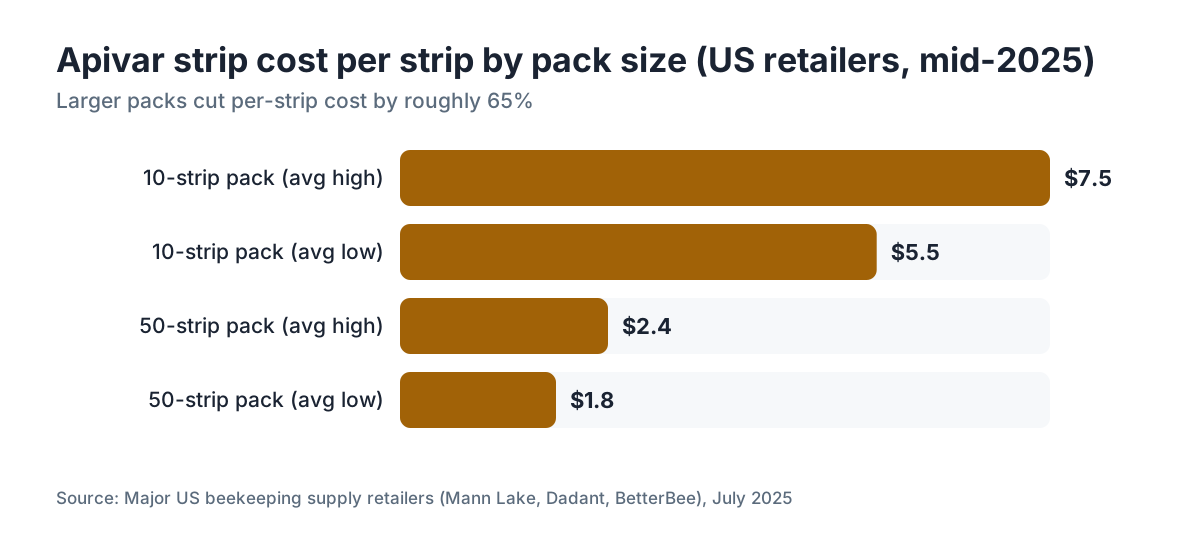
Apivar comes in two standard pack sizes in the US: 10 strips and 50 strips. Pricing as of mid-2025 runs roughly as follows:
| Pack size | Typical price range | Cost per strip | Treats this many hives |
|-----------|--------------------|--------------|-----------------------|
| 10 strips | $55, $75 | $5.50, $7.50 | 5 hives (2 strips each) |
| 50 strips | $90, $120 | $1.80, $2.40 | 25 hives (2 strips each) |
The 50-strip pack is the better deal per strip by a wide margin. If you have 5 or more hives, buy the 50-pack with a friend or through a club if you can't use all 50 yourself in a single season. Strips stored in a sealed bag in a cool, dry spot typically hold potency through their labeled expiration date, usually 2 to 3 years from manufacture.
Shipping cost matters here. Some vendors offer free shipping over a threshold (often $75, $100), which can tip the math toward a larger pack or a consolidated order. A single 10-strip pack sometimes costs nearly as much to ship as the strips themselves if you're ordering from a distant warehouse.
Prices have crept up since 2020. In 2019 a 10-pack was commonly available for $45, $55. The increase tracks with broader supply chain pressures and rising demand as varroa awareness has grown among newer beekeepers. Nobody has published a formal price index for Apivar, so these figures come from current retailer listings; expect some variation.
Generic amitraz strips from some suppliers claim the same 3.3% active ingredient at lower price points. The honest answer is that efficacy data comparing generics to Apivar specifically is thin. The EPA registration and label requirements give you a known standard with Apivar [1]. If you try a generic, confirm the EPA registration number on the label before use.
How many Apivar strips do you need per hive?
The Apivar label specifies 2 strips per colony for standard 10-frame Langstroth hives [1]. For nucleus colonies or 5-frame hives, 1 strip is the labeled dose.
Do not use more than 2 strips per full-size colony. This is a common mistake among beekeepers who think more is better. Higher amitraz concentrations raise the risk of residues in wax and can stress the colony. The label dose is calibrated to exposure time and colony surface area.
Placement matters as much as quantity. The strips go in the brood nest, between frames where bees are clustering. A strip hanging in an empty part of the box away from the cluster does almost nothing. In a two-story hive, put one strip in each box if brood spans both, or both strips in the lower box if that's where the cluster is concentrated.
The treatment period is 6 to 8 weeks [1]. That window is set to span two full mite reproductive cycles in the brood. Pulling strips early is one of the most common reasons treatments underperform. Mark your calendar when you install them and leave them in for the full duration.
When is the right time to treat with Apivar?
The standard protocol across most of North America is a late-summer or early-fall treatment, after the honey supers come off and before the winter bees start being raised in earnest [2]. The exact window depends on your latitude. In the upper Midwest and Northeast, that often means treating in August. In the mid-Atlantic states, September is typical. In the South, the calendar shifts because overwintering looks different.
The Honey Bee Health Coalition recommends treating when your mite count exceeds 2 mites per 100 bees (2%) for most times of year, or 1 mite per 100 bees (1%) going into winter, because high mite loads during winter bee production translate directly into reduced colony survival [2]. Those thresholds come from field research and should drive your decision more than any date on the calendar.
Apivar also works for spring treatments when mite loads spike after spring buildup. Spring treatment is less common than fall but absolutely appropriate if your alcohol wash comes back above threshold. The restriction is simply that honey supers must be off during treatment [1]. You cannot treat through a nectar flow with Apivar.
For a primer on what varroa mites actually are and why they're so damaging, the varroa mite article covers the biology in detail.
How do you install Apivar strips correctly?
You need gloves and should wash your hands after handling amitraz strips. Amitraz is an insecticide and some people are sensitive to it. Nothing elaborate, but basic precautions matter.
Open the package, separate the strips (they come as pairs joined at the top), and hang them over the top bar of the frames in the brood area. The strips have a built-in hanger that hooks over the top bar. They should hang down between frames, not resting flat. Flat strips have less surface area in contact with bee traffic [9].
For a single-story colony, hang both strips in the center of the cluster, roughly frames 3 to 5 and 6 to 8 in a 10-frame box. If bees are in two boxes, one strip per box, centered in the brood [9].
Leave them in for 6 to 8 weeks. Come back once mid-treatment (around week 4) just to confirm the colony is still healthy and the strips are still in place. Bees occasionally move strips or chew them, though this is uncommon.
When you pull strips at the end of treatment, dispose of them per label instructions. Used strips still contain residual amitraz and should not be composted or left in fields where other insects can contact them [1]. Bag them and put them in household trash.
After treatment, do an alcohol wash to confirm efficacy. If mite counts are still elevated after a full 8-week treatment, suspect resistance or improper installation, not a product failure.
Can Apivar be used with honey supers on?
No. The Apivar label explicitly prohibits use when honey supers are in place or when a honey flow is in progress [1]. Amitraz and its metabolites can contaminate honey intended for human consumption. This is a hard label restriction, not a guideline.
If you have supers on and a flow is running, your options are oxalic acid dribble (though efficacy is limited with capped brood present) or formic acid products like Mite-Away Quick Strips, which have a narrower temperature window but are approved through the honey super in some formulations. Neither is as convenient as Apivar, but the label compliance requirement is not negotiable.
Plan your treatment timing around super removal. Most beekeepers pull supers by late July or early August in temperate climates, which opens the window for a full 6 to 8 week Apivar treatment before winter bees need to be mite-free.
Is Apivar effective, and what does the research say?
Efficacy data for Apivar is strong when the product is used correctly. Multiple university extension trials have found 90 to 95% mite reduction over a full 6 to 8 week treatment in populations without documented amitraz resistance [4]. The University of Florida's Honey Bee Research and Extension Lab and Penn State Extension have both published on amitraz strip performance [4][5].
The qualification "without documented amitraz resistance" carries a lot of weight. Resistance to amitraz in Varroa mites has been documented in some US populations, primarily in regions where amitraz has been used heavily and repeatedly [5]. If you treat with Apivar and your post-treatment alcohol wash still shows elevated mite counts (above 1 to 2%), resistance is one possible explanation. Improper installation or short treatment duration are more common explanations, but resistance exists and ignoring it is a mistake.
The Honey Bee Health Coalition's guide states that rotating treatment modes of action reduces selection pressure for resistance [2]. In practice, that means alternating Apivar with oxalic acid or formic acid treatments across seasons rather than using Apivar every single cycle. Most experienced beekeepers treat with Apivar in fall and use oxalic acid vaporization for winter or early spring supplemental treatments.
The EPA's efficacy review, part of the registration process, confirmed mite kill rates sufficient for registration [1]. That's a regulatory bar, not a guarantee of field performance, but it gives you a baseline.
VarroaVault's free mite count tracking tools help you evaluate pre- and post-treatment counts over time, which is the only honest way to know if your treatments are working at your apiary.
What is the risk of amitraz resistance, and how do you detect it?
Amitraz resistance in Varroa has been confirmed in laboratory assays from samples collected across the US, Europe, and South America [5]. It's not uniform. Your local mite population may or may not carry resistance alleles, and there's no commercial test you can order to check your hive's specific population.
The practical detection method is monitoring. Do an alcohol wash before treatment to establish your baseline mite count. Do another wash 2 to 3 weeks after pulling the strips. If mite levels have not dropped substantially (below 1 to 2% ideally), and you're confident the strips were placed correctly and left in for the full period, resistance is worth considering [8].
Some beekeepers in heavy-use regions, particularly Florida and Texas where year-round treatment pressure runs higher, report consistently poor Apivar performance. That pattern matches areas where resistance has been detected in assay studies [5].
If you suspect resistance, switch treatment classes. Oxalic acid (different mode of action, no documented resistance in the US as of mid-2025) is the logical alternative. Do not simply increase the Apivar dose or stretch the treatment beyond 8 weeks. That accelerates resistance without reliably solving the problem.
How does Apivar compare to other varroa treatments?
The main treatments in use in the US are amitraz strips (Apivar), oxalic acid (Api-Bioxal, vaporization or dribble), and formic acid (Formic Pro, Mite-Away Quick Strips). Each has a different profile.
| Treatment | Active ingredient | Mode | Temp window | Super-safe | Brood penetration | Resistance risk |
|-----------|------------------|------|-------------|------------|-------------------|-----------------|
| Apivar | Amitraz | Contact strip | Broad (cold tolerant) | No | Partial (contact) | Yes, documented |
| Api-Bioxal vaporization | Oxalic acid | Vapor | Any (bees clustered) | No | Phoretic only | None documented |
| Formic Pro | Formic acid | Vapor | 50 to 85°F | Some formulations | Penetrates capped brood | Low |
| Api-Bioxal dribble | Oxalic acid | Liquid | Above 40°F, no brood | No | Phoretic only | None documented |
Apivar wins on ease of use and forgiveness. You hang strips and leave them. Oxalic acid vaporization needs equipment (a vaporizer costs $100, $300) and multiple treatments if brood is present. Formic acid works through brood but has a narrow temperature window and can cause queen loss above 85°F.
My honest take: Apivar is the right primary fall treatment for most hobbyists who aren't in a region with documented resistance. Oxalic acid vaporization is the right winter supplemental treatment and a good primary treatment for heavily broodless colonies. Use both strategically. Relying on Apivar alone, every cycle, every season, is how resistance problems get worse.
Are there any legal restrictions on buying or using Apivar?
In the United States, Apivar is EPA-registered and sold as a general-use pesticide for beekeepers. No veterinarian prescription is required [1]. You can buy it from any licensed retailer.
Label law is federal law. The EPA label sets the application rate, timing, and restrictions. Using Apivar in a way that contradicts the label (such as leaving strips in during a honey flow or using more than the labeled number of strips) violates the Federal Insecticide, Fungicide, and Rodenticide Act (FIFRA) [7]. This isn't abstract: if contaminated honey reaches commercial channels, there are real regulatory and liability consequences.
Some states layer on additional pesticide rules. California, for example, has its own Department of Pesticide Regulation registration process, and Apivar must be registered there separately for it to be legal to use. Check with your state's department of agriculture if you're unsure about your jurisdiction.
In Canada, amitraz-based products for bees are regulated by Health Canada's Pest Management Regulatory Agency and require a prescription from a licensed veterinarian as of regulations that took effect in 2019. If you're in Canada, the sourcing and legal situation is meaningfully different.
What should you do after treatment to check if it worked?
Pull the strips after 6 to 8 weeks. Within 1 to 2 weeks of removal, do an alcohol wash or sugar roll on a 300-bee sample from the brood area [8]. Your target post-treatment mite count is below 1 mite per 100 bees (1%) going into fall, and ideally below 0.5% if you're in a short-season northern climate where colonies won't get another treatment window before spring [2].
If the count is still at or above 2%, something went wrong. Think it through: were the strips in the active cluster? Did they stay in for the full 8 weeks? Was the colony very small, cutting bee contact with the strips? These are fixable problems. Only after ruling them out should you seriously consider resistance.
Keep records. A simple notebook or spreadsheet with pre-treatment count, treatment dates, strip placement notes, and post-treatment count gives you real data over seasons. Most beekeepers who struggle with varroa are struggling partly because they're treating blind. The monitoring step is not optional if you actually want to know whether you're succeeding.
For planning your full seasonal mite management calendar, the tools at VarroaVault help you schedule alcohol washes, set treatment thresholds, and track hive-by-hive counts across your apiary without any spreadsheet math.
Frequently asked questions
Do you need a prescription to buy Apivar strips in the US?
No. In the United States, Apivar is registered by the EPA as a general-use pesticide for beekeepers and does not require a veterinarian prescription. You can order it directly from beekeeping supply retailers online or buy it in-store at farm supply stores. Canada is different: amitraz products for bees require a veterinary prescription there as of 2019 regulations.
How many Apivar strips do I need for one hive?
The labeled dose is 2 strips per full-size (10-frame Langstroth) colony. For a nucleus colony or 5-frame hive, 1 strip is the correct dose. Do not exceed 2 strips per full colony. A 10-pack treats 5 standard hives. A 50-pack treats 25 hives, and the cost per strip is roughly three times cheaper in the larger pack.
Where is the cheapest place to buy Apivar strips?
The 50-strip pack from major beekeeping supply retailers (Mann Lake, Dadant, BetterBee) is the cheapest per-strip option, typically $1.80, $2.40 per strip. The 10-pack runs $5.50, $7.50 per strip. Local beekeeping association group buys can match or beat retailer pricing. Avoid unknown sellers on eBay or Amazon marketplace due to storage history concerns.
How long do Apivar strips last once installed?
Apivar strips should stay in the hive for 6 to 8 weeks per the EPA label. This covers two full Varroa reproductive cycles in the brood. Removing them early is a common reason treatments underperform. After pulling them, the strips should be disposed of in household trash, not composted, since residual amitraz remains on used strips.
Can I use Apivar when my honey supers are on?
No. The Apivar label explicitly prohibits use when honey supers are present or when a honey flow is active. Amitraz can contaminate honey intended for human consumption. This is a hard legal requirement under FIFRA, not a suggestion. If you need to treat during a flow, consider formic acid products or plan your treatment after super removal in late summer.
Does Apivar work in cold weather?
Apivar is more temperature-tolerant than formic acid treatments and works as long as bees are active enough to contact the strips. It is generally effective down to about 50°F because the amitraz transfer is contact-based rather than fumigant-based. In very cold weather with a tight winter cluster, bee traffic over the strips drops, which can reduce efficacy. Most beekeepers install Apivar in late summer to early fall before temperatures fall significantly.
How do I know if Apivar is working or if my mites are resistant?
Do an alcohol wash before treatment to establish your baseline mite count. Repeat 1 to 2 weeks after pulling the strips. If mite counts have not dropped below 1 to 2%, consider whether strips were properly placed in the active cluster and left for the full 8 weeks. If placement and duration were correct and counts remain high, amitraz resistance is possible. Resistance has been documented in some US mite populations.
How should I store unused Apivar strips?
Store unused Apivar strips in their original sealed packaging in a cool, dry location away from direct sunlight. Proper storage preserves potency through the labeled expiration date, typically 2 to 3 years from manufacture. Avoid storing near heat sources or in areas with wide temperature swings. Degraded amitraz is less effective, which is one reason buying from reputable retailers with good inventory turnover matters.
Can I use Apivar and oxalic acid in the same season?
Yes, and this is actually good practice. A common protocol is Apivar for the main fall treatment (6 to 8 weeks after supers come off) followed by an oxalic acid vaporization treatment in late fall or early winter when the colony is broodless or near-broodless. The two products have different modes of action, so alternating them reduces selection pressure for resistance in either direction.
How do I dispose of used Apivar strips?
Used Apivar strips still contain residual amitraz and should be placed in a sealed bag and disposed of in household trash. Do not compost them, bury them, or leave them in fields or near water. The EPA label provides specific disposal guidance. Improper disposal of pesticide materials is a violation of FIFRA and can harm non-target insects and soil organisms.
What happens if I leave Apivar strips in longer than 8 weeks?
Leaving strips in beyond 8 weeks raises the risk of amitraz residue building up in beeswax, which can persist for years and affect future colonies raised on that comb. Chronic sublethal amitraz exposure from contaminated wax has been associated with reduced queen quality and brood development issues in some studies. Follow the label duration, then pull and dispose of strips.
Is Apivar safe for the beekeeper to handle?
Wear nitrile gloves when handling Apivar strips. Amitraz is an insecticide and can be absorbed through skin. Wash hands thoroughly after handling. Avoid touching your face or eyes. The exposure level from normal strip installation is low, but some people have heightened sensitivity to amitraz. The label includes standard pesticide handling precautions that are worth reading before your first installation.
Can Apivar be used in a top-bar or Warré hive?
The Apivar label is written for standard Langstroth equipment. Using it in top-bar or Warré hives is technically off-label. That said, the principle is the same: hang strips in the brood cluster where bee traffic is highest. Many beekeepers use Apivar in non-Langstroth setups, but you're operating outside label specifications if you do, which is your legal and practical judgment call to make.
Sources
- EPA - Apivar Pesticide Registration Label (EPA Reg. No. 84051-3): Apivar is EPA-registered at 3.3% amitraz; label specifies 2 strips per colony, 6 to 8 week treatment, no use when honey supers are present
- Honey Bee Health Coalition - Varroa Management Guide: Treatment threshold of 2 mites per 100 bees during the season and 1 per 100 bees going into winter; amitraz strips listed as a primary treatment option; rotation of modes of action recommended
- Mann Lake Beekeeping Supplies - Product Catalog: Apivar available in 10-strip and 50-strip packs from major US beekeeping supply retailers
- University of Florida IFAS Extension - Honey Bee Research and Extension Lab: Amitraz strip treatments have shown 90 to 95% mite reduction in colonies without documented resistance when used correctly
- Penn State Extension - Varroa Mite Management: Amitraz resistance in Varroa has been documented in some US populations; post-treatment monitoring recommended to detect resistance
- EPA - Federal Insecticide, Fungicide, and Rodenticide Act (FIFRA): Using a pesticide in a manner inconsistent with its label is a violation of FIFRA
- University of Minnesota Extension - Varroa Mite Management for Honey Bees: Alcohol wash method described for pre- and post-treatment mite count monitoring; 300-bee sample from brood area recommended
- North Carolina State University Apiculture Program: Apivar strips should be placed between frames in the brood nest where bee contact is maximized; placement in empty boxes reduces efficacy
- USDA Agricultural Research Service - Bee Research Laboratory: Amitraz residues in beeswax can persist for extended periods; repeated or excessive use increases wax contamination risk
Last updated 2026-07-09