Can you fog bees at night with oxalic acid? What actually works
TL;DR
- Yes, you can fog bees at night with oxalic acid vapor, and for most beekeepers it's the best time to do it.
- Every forager is home, the cluster is tight, and you disturb the colony less.
- The EPA-registered Api-Bioxal label requires a sealed entrance and proper PPE at any hour.
- Brood-free timing still gives the strongest mite kill.
Is it legal and label-compliant to vaporize oxalic acid at night?
Yes. The EPA-registered label for Api-Bioxal, the only oxalic acid product with legal vaporization approval in the United States, says nothing about time of day [1]. It specifies proper PPE, a sealed entrance, and brood-free conditions for the best kill rate. Time of day isn't a variable it regulates. Night fogging is fully compliant as long as you meet every other requirement.
Here's the catch. "Label is law" under FIFRA (Federal Insecticide, Fungicide, and Rodenticide Act, 7 U.S.C. § 136 et seq.) [2]. Deviate from any instruction that IS printed on the label and you're in violation, full stop. Read your specific Api-Bioxal label before you head out after dark, and confirm nothing has changed since this article was written.
Why do so many beekeepers choose to treat at night?
Because at night, every bee is home. That's the whole case in one sentence. Foragers are back by dusk, so you're treating the full adult population. Varroa mites ride on adult bees, and any mite that's phoretic when you fog gets hit with vapor. Treat at midday and some foragers are out in the field, carrying their mites back into a hive you've already sealed and finished.
Night is calmer too. Bees are less defensive in the dark and cool, so you need less smoke, fewer bees fly at your face, and neighboring colonies don't get riled up by the activity next door. That matters when you're running twenty or thirty hives on a schedule.
There's a benefit for you, the beekeeper. Oxalic acid vapor is a serious respiratory and eye hazard, and the label requires a full respirator with an acid gas cartridge plus goggles [1]. Wind tends to drop after dark, and nobody else is around, so working at night can lower your own exposure risk. That assumes you're already suited up correctly. It doesn't replace the PPE.
How does oxalic acid vaporization kill varroa mites?
Vaporized oxalic acid deposits as fine crystals on bees and comb, and mites absorb the acid through their cuticle until it kills them [3]. Oxalic acid is a natural organic acid found in plants like rhubarb and spinach. Heat it inside a hive with a wand or sublimation device and it turns to gas, then settles back out as crystals across every surface.
The limitation is simple and unforgiving. OA vapor only reaches phoretic mites, the ones riding on adult bees. Mites sealed inside capped brood cells are completely protected. That's why the Honey Bee Health Coalition and most university extension programs push you to treat during a brood-free window, usually late fall or early winter, or right after an artificial brood break [4].
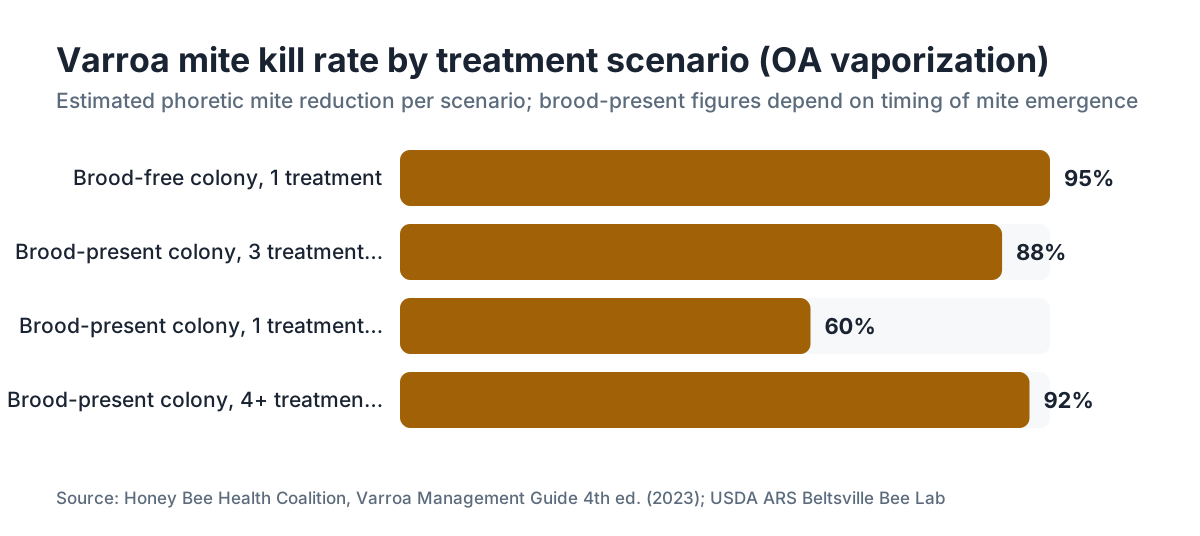
On a brood-free colony, one vaporization pass typically knocks down 90 to 95% of phoretic mites. But if 70 to 80% of your mite population is tucked inside capped cells that day, you've barely dented the real number. You can chase this with multiple treatments 5 to 7 days apart, though efficacy per pass drops each time [3]. Timing around a brood break is the smarter play by a wide margin.
For the biology behind all of this, the varroa mite article on this site walks through the mite's reproductive cycle in full.
What equipment do you actually need to fog bees with oxalic acid?
You need a vaporizer, PPE, a light, an entrance seal, and a timer. That's the short list. The Varrox and ProVap 110 are the vaporizers most hobbyists and sideliners reach for, but there are others. What matters is that your device is covered by your Api-Bioxal label or an applicable state registration. Some states pile on extra restrictions, so check your state department of agriculture site before you buy anything.
PPE is non-negotiable. The Api-Bioxal label requires [1]:
- A NIOSH-approved respirator with acid gas cartridge (OV/P100 combination cartridge is standard)
- Chemical-resistant gloves
- Long sleeves and pants
- Chemical splash goggles (glasses alone don't count)
At night, add reliable lighting. A headlamp keeps both hands free. Don't skip it because you think you know your yard by feel. You're holding a device that heats to several hundred degrees Fahrenheit and burning off a chemical that can scar your lungs.
You also need a way to seal the entrance, which most people do with folded screen or a foam plug, and a timer. Standard treatment time on most wands is about 2.5 minutes per hive body, but follow your device's instructions. After the cycle, leave the entrance sealed another 10 minutes before you reopen [1].
Stocking up on gear? The beekeeping supply companies roundup covers where to source vaporizers and PPE without overpaying.
What is the step-by-step protocol for nighttime oxalic acid fogging?
Here's how I'd run a nighttime vaporization pass, assuming your gear is ready and you've read your label.
Before you go out:
Check the weather. Below about 50°F the bees cluster tight, which is fine for OA contact. Wind matters more than temperature. You don't want gusts yanking the wand around or scattering vapor before it spreads through the hive. Pick calm nights.
At the apiary:
- Put on all PPE before you touch anything. Respirator first.
- Weigh your dose. The Api-Bioxal label specifies 1 gram of oxalic acid dihydrate per hive body, up to 3 grams per colony [1]. Use a pre-measured packet if your device supports one.
- Seal the entrance with your foam plug or screen insert.
- Insert the wand through the sealed entrance or the bottom board opening, per your device's instructions.
- Start the cycle. Most wands take 2 to 3 minutes to fully sublimate the dose.
- Withdraw the wand and keep the entrance sealed for 10 minutes.
- Unseal and move to the next hive.
- Keep PPE on until you're clear of the hive yard and any OA residue.
After you're done:
Wash your hands and face. Store the vaporizer safely. Log the date, the mite count before and after (retest 3 to 5 days later with an alcohol wash), and the temperature. That log is what tells you whether you need another round.
VarroaVault's free treatment tracking tools let you log all of this in one place, which makes it easier to spot patterns across hives and seasons.
How many treatments do you need, and how far apart?
One treatment on a brood-free colony. Multiple treatments 5 to 7 days apart when brood is present. That's the core answer. Some studies report 95%+ mite kill from a single vaporization when a colony is truly brood-free [3], and in that case one pass is often enough.
With brood in the hive, the math flips. The Honey Bee Health Coalition's Varroa management guide recommends that when you treat with OA during the brood-rearing season, you consider multiple applications 5 to 7 days apart to catch mites as they emerge from previously capped cells [4]. Three treatments over three weeks is a common sideliner protocol. Some people stretch it to four.
Watch your mite load, not your treatment count. Run an alcohol wash or a sticky board count 3 to 5 days after your final treatment. If you're still above threshold (the Honey Bee Health Coalition puts that at roughly 2% infestation during brood-rearing season and 1% in fall [4]), you need another round or a different treatment.
Nighttime treatment doesn't change any of this. You expose the full adult population every pass, which is the ceiling for what OA vapor can do no matter the hour.
| Scenario | Recommended treatments | Expected mite kill |
|---|---|---|
| Brood-free colony | 1 | ~95%+ phoretic mites |
| Colony with brood, 3 applications 5-7 days apart | 3 | 80-90% total population (estimate) |
| Extended brood-present protocol, 4+ applications | 4+ | Higher, but diminishing returns |
Source: Honey Bee Health Coalition Varroa Management Guide, 2023 edition [4]
Does nighttime fogging affect oxalic acid efficacy compared to daytime?
No published study I know of compares night vs. day vaporization efficacy under controlled conditions. So here's the honest version. The mechanism doesn't care about darkness: crystals settle on bees, mites absorb acid, mites die. Temperature and brood status drive efficacy far more than the clock does.
What night reliably changes is the population you're treating. All foragers are home. That's a real difference in how complete your knockdown can be. On a warm afternoon a colony might have 20 to 30% of its workforce out in the field, and those bees plus their hitchhiking mites skip treatment entirely. At night, they're in the box.
One wrinkle. On very cold nights (below roughly 45°F), the cluster pulls in tight and vapor may not spread evenly across all the combs. Most experienced folks treat in the 45 to 65°F range when they can. That window is easy to hit on fall and spring evenings across most of North America.
What PPE is required, and why is this more serious than other treatments?
A NIOSH-approved respirator with acid gas cartridges, chemical-resistant gloves, chemical splash goggles, and full skin cover. Oxalic acid vapor is genuinely dangerous, and the EPA's Api-Bioxal label lists it as a serious respiratory, eye, and skin hazard [1]. This isn't boilerplate. OSHA hazard information on oxalic acid notes that repeated inhalation can cause permanent respiratory damage [5].
The respirator has to be a NIOSH-approved full-facepiece unit, or a half-facepiece unit paired with chemical splash goggles, fitted with OV/P100 combination cartridges. A dust mask won't do. A standard N95 won't do.
For hands, use chemical-resistant gloves. Nitrile is fine, butyl rubber is better for long sessions. Don't reuse your everyday beekeeping gloves and then treat them as clean. OA residue builds up on surfaces you touch over and over.
Why night work can be a bit safer: wind usually drops after dark, so vapor is less likely to blow back at you. You also move slower in the dark, which cuts the careless moments that cause exposure. Neither of these replaces PPE. They're small helpers, nothing more.
Can you vaporize oxalic acid when the temperature is cold or in winter?
Yes, and cold weather is one of the best times to do it. In late fall and winter, most colonies in temperate climates are brood-free or close to it, which is exactly when OA efficacy peaks. The bees are clustered and calm. Foragers aren't flying in the cold, so the full-population-home advantage applies even during a daytime treatment.
The practical floor is roughly 25 to 30°F. Below that, the vaporizer may not fully sublimate the dose in standard time, and you get crystallization patterns that spread poorly. The bigger issue is opening the hive at all in deep cold, which can break the cluster and chill the colony. Most beekeepers stay in the 35 to 55°F range for winter treatments.
The USDA ARS Beltsville Bee Lab identifies the midwinter brood-free period as one of the most effective OA vaporization timing windows [6]. Plenty of sideliners run a December or January treatment for exactly that reason, and doing it at night is just convenient for people who work day jobs.
Are there any risks to the colony from nighttime vaporization?
Done right, nighttime vaporization adds no meaningful risk to the colony over daytime treatment. The bees are home, they're calm, and the vapor clears within 10 to 15 minutes after you unseal the entrance.
The real risks are the same at any hour. OA at high concentrations or with repeated exposure does cause some bee mortality and can affect queen quality over time. A 2018 study in the Journal of Apicultural Research found that single OA vaporization treatments at label doses showed low toxicity to adult bees, while repeated applications during the brood-rearing season were tied to higher adult bee mortality and some negative effects on brood viability [7]. That's a live concern for the extended multi-treatment protocols people run when brood is present.
The takeaway: treat as few times as it takes to get mite control. Brood-free timing plus one or two clean treatments beats four or five passes on a colony full of brood. And keep monitoring. The target is a mite count below threshold, not a number of applications you feel good about.
One thing to skip, night or day: treating a weak or stressed colony in cold weather when you'd have to crack the hive wide open. A quick wand insertion through a sealed entrance barely disturbs them. Breaking the colony fully apart does.
How does oxalic acid vaporization compare to other varroa treatments?
OA vaporization is one of several registered varroa tools, and the right choice depends on your season and colony state. Its edge is low honey residue, no temperature ceiling, and easy winter use. Its weakness is the brood-protection problem, which it shares with the dribble method and thymol.
| Treatment | Active Ingredient | Kills Mites in Brood? | Temperature Limits | Colony State Required |
|---|---|---|---|---|
| Oxalic acid vaporization (Api-Bioxal) | Oxalic acid | No | Works 35-105°F | Any, but brood-free preferred |
| Formic acid pads (Mite-Away Quick Strips) | Formic acid | Yes, partially | 50-85°F | At least 2 boxes of bees |
| Amitraz strips (Apivar) | Amitraz | No (indirect over time) | Above 50°F | Not during nectar flow |
| Thymol (ApiLife Var, Apiguard) | Thymol | No | 60-105°F | Must remove before supers |
| Oxalic acid dribble | Oxalic acid | No | Works in cold | Brood-free only |
Sources: EPA product labels, Honey Bee Health Coalition Varroa Management Guide [1][4]
For a full look at sourcing these products, see the beekeeping supplies guide.
What do university extension programs and HBHC actually recommend?
They recommend OA vaporization for brood-free colonies and allow it during brood season with repeated applications. None of them restrict it to daytime. The Honey Bee Health Coalition's Varroa Management Guide, updated in 2023, lists oxalic acid vaporization as a Tier 1 option for brood-free colonies and notes its growing use during the brood season with repeat treatments [4]. The guide states: "Oxalic acid vapor is effective against phoretic mites when applied correctly and is approved for use any time of year." (Honey Bee Health Coalition, Varroa Management Guide, 4th edition)
Penn State Extension's apiculture program reports that OA vaporization is one of the most-used treatments among hobbyist and small commercial beekeepers in the northeastern United States, mostly because of its low cost per application and minimal honey residue concerns [8].
The University of Minnesota Bee Lab gives similar guidance and points to the midwinter brood-free window as a strong opportunity for OA vaporization. Their protocol suggests treating in fall when the colony is brood-free or near it, which in Minnesota usually falls between October and early December [9].
The night vs. day question just doesn't show up in the primary guidance documents. It isn't a meaningful efficacy or safety variable for the bees. It's a convenience and exposure-risk question for you.
How do you know if your nighttime treatment actually worked?
You count mites before and after. That's the only honest answer. You can't read efficacy off how the bees look or how many mites you spot crawling around. A varroa infestation looks normal from the outside right up until the colony collapses.
The two standard methods are the alcohol wash and the sugar roll. Alcohol wash is more accurate: it kills the mites and lets you count them precisely off a 100-bee sample. The Honey Bee Health Coalition recommends reporting results as a percentage, mites per 100 bees [4].
After a vaporization treatment, wait 3 to 5 days before retesting. That gives treated phoretic mites time to die and drop, and lets the colony settle. Compare the post-treatment count to your baseline. If you treated a brood-free colony and you're still above 1% (one mite per 100 bees) after one pass, something went wrong: a light dose, an equipment issue, or brood you didn't know was there.
Sticky board counts (mite drop over 24 to 72 hours on a white board under the screened bottom) are less precise but good for tracking trends. A sharp jump in 24-hour mite fall in the days after treatment tells you it landed. No change at all is a warning sign.
Tracking this across treatments and seasons is where you catch resistance building or equipment wearing out early. VarroaVault's tracking tools are built for exactly this kind of long-term mite monitoring across multiple hives.
Frequently asked questions
Can you fog bees with oxalic acid in the rain or on a humid night?
Skip heavy rain and very high humidity. Oxalic acid vapor needs to settle as dry crystals on the bees and comb, and high moisture can make the vapor condense early and spread poorly inside the hive. Light dew or mild humidity is generally fine. The bigger worry is your own PPE: wet conditions can compromise a respirator's face seal.
How long do you leave the hive sealed after oxalic acid vaporization?
The Api-Bioxal label requires leaving the entrance sealed for at least 10 minutes after the vaporization cycle finishes. Most beekeepers use 10 to 15 minutes as their standard. Once you reopen, vapor concentrations inside drop fast. There's no proven benefit to sealing longer than the labeled minimum, though some practitioners stretch to 15 minutes for peace of mind.
Will nighttime oxalic acid treatment hurt the queen?
At label doses, a single nighttime treatment poses minimal risk to a healthy queen. She's inside the hive and gets exposed to vapor the same way workers do. Queen problems show up with repeated applications during brood-rearing season: a 2018 Journal of Apicultural Research study found some negative queen effects from multiple OA vaporization treatments. One or two well-timed passes carry far less risk than four or five in a short window.
Do you need to check for a mite infestation before deciding to treat at night?
Yes, always. Treating without knowing your mite load is guesswork. Run an alcohol wash first to set your baseline. If you're below threshold (roughly 2% during brood season, 1% in fall per the Honey Bee Health Coalition), you may not need to treat at all. If you're above it, treat and retest 3 to 5 days after your final application to confirm it worked.
Is oxalic acid vaporization safe around honey supers?
The Api-Bioxal label says not to treat while honey supers meant for human consumption are on the hive. OA residues can end up in honey above background levels. Remove supers before you treat. This applies at any time of day. Once you've treated and harvested, you can return supers after the treatment cycle is complete.
How many grams of oxalic acid do you use per hive?
The Api-Bioxal label specifies 1 gram of oxalic acid dihydrate per hive body, up to a maximum of 3 grams per colony no matter how many boxes are stacked. Weigh your dose rather than eyeballing it. Under-dosing cuts efficacy, and over-dosing raises toxicity risk to bees and to you. A small postal scale accurate to 0.1 gram handles this fine.
Can you treat a nucleus colony or a split at night with oxalic acid?
Yes, and nucs and splits are strong candidates for OA vaporization. They're often brood-free or near it right after the split, and a small population sits neatly in a 5-frame nuc box with little dead air space, so vapor spreads efficiently. Use 1 gram for a single nuc body. Nighttime treatment works the same way: all the bees are home, so coverage is complete.
What respirator do I actually need for oxalic acid vaporization?
The Api-Bioxal label requires a NIOSH-approved respirator with acid gas cartridges, not a dust mask or N95. The standard choice is a half-facepiece respirator (3M 6500 series or equivalent) with OV/P100 combination cartridges, paired with chemical splash goggles. A full-facepiece respirator with the same cartridges is better because it drops the separate goggle requirement and covers more of your face.
How much does oxalic acid vaporization cost per hive?
At current pricing, Api-Bioxal runs roughly $1.00 to $1.50 per treatment at label dose when bought in 35-gram or larger sizes. The vaporizer is the bigger upfront cost: entry-level wand devices run $150 to $200, while the ProVap 110 and similar units run $300 to $400. Spread over many hives and seasons, the per-treatment equipment cost drops to cents. It's among the cheapest varroa treatments available.
Does oxalic acid vaporization leave residue in beeswax?
Some OA deposits on wax after vaporization, but background OA occurs naturally in wax anyway. Residue from label-compliant treatment is generally considered low against detection thresholds. The EU has set a maximum residue limit for OA in honey at 25 mg/kg, described as naturally occurring background in untreated hives. The EPA bars treatment with honey supers on as a precaution.
Can oxalic acid vaporization be used as the only varroa treatment, or do you need to rotate?
Some beekeepers use OA vaporization exclusively, especially in climates with a reliable brood-free period each year. For colonies with continuous brood, relying on OA alone is harder because of the brood-protection problem. Most extension programs recommend pairing OA with at least one other mode of action (like amitraz or formic acid) to reduce mite pressure during brood season and slow resistance.
Is there any difference between fogging and vaporizing oxalic acid?
In beekeeping, 'fogging' and 'vaporizing' often mean the same thing, but they're technically different. True vaporization (sublimation) heats solid OA crystals until they become gas, which redeposits as fine crystals. Some cold fogger devices aerosolize an OA solution instead. In the US, only the sublimation method is covered under the Api-Bioxal label. Cold fogging OA solutions is not EPA-approved and is illegal under FIFRA.
Sources
- EPA, Api-Bioxal Product Label (Registration No. 84170-1): Api-Bioxal label requirements for dose (1 gram per hive body, max 3 grams per colony), PPE, entrance sealing, and post-treatment sealed period; no restriction on time of day
- U.S. Congress, Federal Insecticide, Fungicide, and Rodenticide Act (FIFRA), 7 U.S.C. § 136 et seq.: Pesticide labels have the force of law under FIFRA; deviating from label instructions is a federal violation
- USDA ARS, Oxalic Acid for Varroa Control (Fact Sheet): OA vapor kills phoretic mites by acid absorption through cuticle; single brood-free treatment achieves 95%+ phoretic mite kill; mites in capped cells are not reached
- Honey Bee Health Coalition, Varroa Management Guide, 4th edition (2023): Treatment threshold of 2% during brood season and 1% in fall; OA vaporization recommended as Tier 1 for brood-free colonies; multiple applications 5-7 days apart recommended when brood is present; quote that OA vapor is approved for use any time of year
- OSHA, Occupational Chemical Database entry for Oxalic Acid: Repeated inhalation exposure to oxalic acid can cause permanent respiratory damage; skin and eye hazard information
- USDA ARS Beltsville Bee Research Laboratory, Varroa Management Resources: Midwinter brood-free treatment window identified as one of the most effective OA vaporization timing opportunities
- Gregorc, A. et al. (2018). Journal of Apicultural Research, 'Oxalic acid treatment effects on honey bee colony health and queens': Single OA vaporization at label doses showed low toxicity to adult bees; repeated applications during brood season were associated with increased adult bee mortality and some negative effects on brood viability
- Penn State Extension, Varroa Mite Management for Beekeepers: OA vaporization is one of the most widely used treatments among hobbyist and small commercial beekeepers in the northeastern US due to low per-application cost and minimal honey residue concerns
- University of Minnesota Bee Lab, Varroa Management Guidelines: Fall brood-free or near brood-free OA vaporization recommended; in Minnesota this typically means October through early December
- EPA, Pesticide Tolerances (40 CFR Part 180): Oxalic acid exempted from tolerance requirements for use on honey bees; residue framework context for honey super restriction
Last updated 2026-07-09