Checkmite+ strips: when is it appropriate to use them
TL;DR
- Checkmite+ strips (coumaphos 10%) fit one narrow spot: your mite load is dangerously high, other treatments failed or won't work in your conditions, and no honey supers are on.
- They kill mites well when placed right.
- But coumaphos breeds resistance fast and sticks in wax for years.
- Reach for it deliberately, not by habit.
What is Checkmite+ and what does it actually do to varroa?
Checkmite+ is an EPA-registered strip treatment containing 10% coumaphos, an organophosphate acaricide [1]. Each strip is a slow-release plastic matrix. You hang two strips in the brood chamber between frames of brood. The coumaphos volatilizes slowly and kills mites that contact treated bees or wax. The label exposure period is 42 to 45 days [1].
Coumaphos blocks acetylcholinesterase, the enzyme mites and insects need to switch off nerve signals. Mites pick it up through contact, not ingestion, so the chemical has to be where the mites are moving. Under good conditions, efficacy against phoretic mites runs 90% or higher [10]. Efficacy against mites sealed inside capped cells is much lower and swings a lot.
The active ingredient has been registered in the U.S. for varroa control since the mid-1990s. It is an over-the-counter product in most states. Check with your state apiarist first, because some states now require a veterinary prescription for in-hive mite treatments. The Honey Bee Health Coalition's Tools for Varroa Management guide lists coumaphos as a registered option and flags it as one with resistance concerns [2].
Want the biology behind what you're killing? The varroa mite page walks through the mite's life cycle and why timing any treatment around the brood cycle matters so much.
When is Checkmite+ actually appropriate to use?
Checkmite+ is a last resort, not a first line. It earns a spot only when four things are true at once: your mites are past threshold and climbing, softer treatments have failed or genuinely won't work, no honey supers are on, and you've accepted the wax tradeoff.
Start with the count. The Honey Bee Health Coalition recommends treating when alcohol wash or sugar roll counts hit 2% or higher (2 mites per 100 bees) during the flow season, and some extension programs drop that to 1% in late summer when winter bees are being raised [2][3]. If you're sitting at 4% or 5% with a colony that still has population, you don't have weeks to wait on a slow-cycling treatment.
Next, softer options. Oxalic acid vaporization is the standard for brood-free colonies and is also approved with capped brood present, though efficacy drops there. Formic acid (Api-Life VAR, Formic Pro, MAQS) works through capped brood and is often the right call before you touch coumaphos. If your local temperatures make formic acid impractical, or you have a real oxalic resistance concern, Checkmite+ gets more justifiable.
Third, it can't be honey flow season. Coumaphos cannot be used with honey supers on or with nectar coming in, because it contaminates honey [1]. That's a hard label restriction.
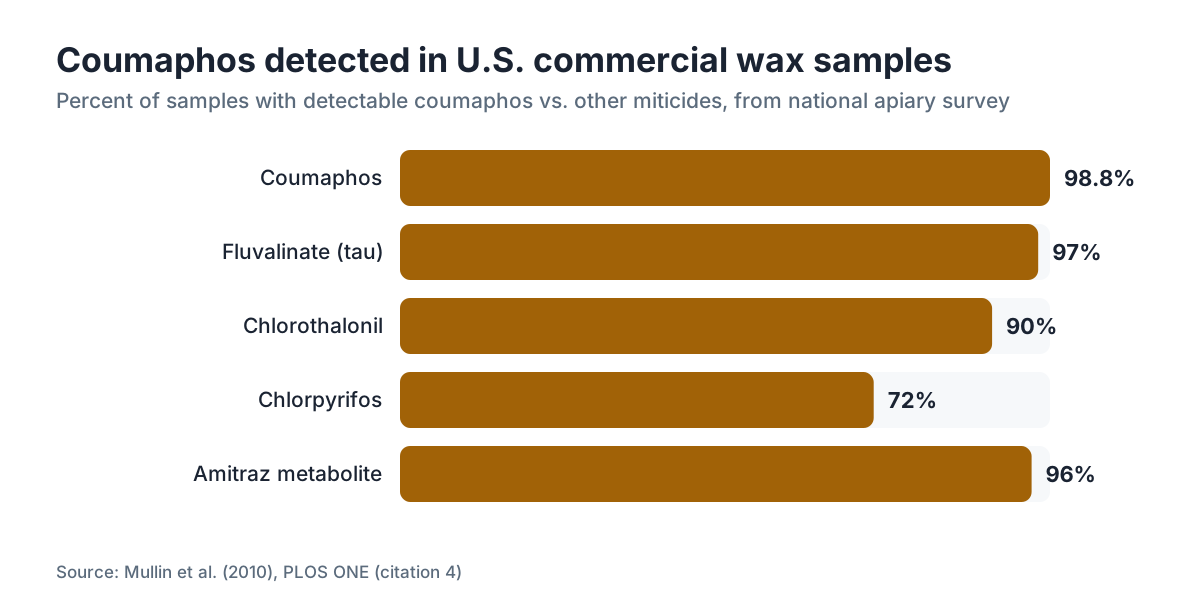
Fourth, think about wax. Coumaphos is highly fat-soluble. It binds to beeswax and lingers there for years at detectable levels. A 2010 survey of U.S. beeswax found coumaphos in 98.8% of samples [4]. That wax goes back into brood comb. There's evidence, though the picture isn't settled, that high wax residues cut queen sperm viability and drone reproductive success [5]. If you rotate comb between hives, that contamination stacks up.
Mite emergency, no supers, other tools out of reach, eyes open on the wax cost. That's the window.
What does resistance to Checkmite+ look like, and how common is it?
Resistance is the biggest practical problem with coumaphos. U.S. varroa developed detectable resistance within a few years of widespread use in the 1990s [6]. By the early 2000s, researchers were tracking treatment failures in commercial operations that leaned on Checkmite+ as their main tool.
The mechanism is clear. Some mite populations carry mutations in the acetylcholinesterase gene that weaken organophosphate binding. Selection pressure is brutal because you apply the same mode of action to the same mites on the same comb, and low-level residues in wax keep selecting between treatments [6].
Here's the signal to watch. Run Checkmite+ for the full 42 to 45 days, pull the strips, count again, and if your mite number barely moved, you probably have a resistant population. Do not respond by cramming in more strips or leaving them longer. That just piles on contamination for no gain. Switch mode of action right away.
The Honey Bee Health Coalition recommends rotating treatment classes to slow resistance [2]. If you've used coumaphos recently, move to a different mode of action (oxalic acid, formic acid, amitraz) before you come back to it. Nobody has published a hard interval, but most extension programs suggest at least a full year between exposures to the same mode of action.
How do you use Checkmite+ strips correctly?
The label is the law. That's a federal requirement under FIFRA: using any pesticide in a manner inconsistent with its label is illegal [7]. So read your specific label version, because Bayer has updated the language over the years.
The Checkmite+ label prescribes the following for varroa control [1]:
- Apply 2 strips per colony, placed between the 3rd and 4th frames on each side of the brood nest (one strip per side)
- Leave in place a minimum of 42 days and no more than 45 days
- Remove and dispose of strips properly after treatment; do not leave them in the hive
- Do not use when honey supers are present or being added
- Do not treat more than 2 times per year with coumaphos
- Wear nitrile gloves during application and removal
Placement decides everything. Strips need to sit in or right next to the brood cluster where mites ride on bees. A strip dangling in a dead corner does almost nothing. In a strong colony on two brood boxes, some beekeepers place one strip in each box. Check your label version for multi-story guidance.
Timing the end of treatment before nectar flow takes planning. If your main flow starts in May and the treatment runs 45 days, strips need to come out by late February or early March if you want a brood-present late-winter window. In practice, most beekeepers use Checkmite+ as an emergency fall treatment after pulling supers, once an alcohol wash comes back alarming.
Monitor after treatment, always. Do an alcohol wash or sticky board count two to three weeks after the strips come out. Still above threshold? Don't re-treat with coumaphos. Change mode of action.
How does Checkmite+ compare to other varroa treatments?
The table lines up the major registered varroa treatments on the dimensions that drive the decision: brood penetration, honey restrictions, wax residue, resistance, and cost.
| Treatment | Active ingredient | Works in capped brood? | Honey super restriction | Wax contamination | Resistance documented? | Approx. cost per treatment |
|---|---|---|---|---|---|---|
| Checkmite+ | Coumaphos 10% | Partial | No supers | High, persists years | Yes, well-documented | $5-8 per colony [8] |
| ApiVar | Amitraz 3.2% | Partial | No supers | Low | Emerging in some regions | $8-12 per colony [8] |
| Formic Pro / MAQS | Formic acid | Yes | Check label* | None | Not documented | $8-14 per colony [8] |
| Api-Life VAR | Thymol blend | No | No supers | None | Not documented | $5-10 per colony [8] |
| Oxalic acid (vapor) | Oxalic acid dihydrate | Reduced in brood | No supers | None | Not documented | $1-3 per treatment [8] |
*Formic Pro allows use with honey supers present under some conditions; verify the current label.
A few things jump out. Oxalic acid is cheap and leaves no residue but works best in brood-free colonies or with repeated doses during a brood-free window. Formic acid gets into capped brood, which is its whole reason for existing when a colony carries heavy sealed brood and you need mites dead in cells. Checkmite+ and ApiVar are both strip treatments that look alike in placement and timing but carry different resistance profiles and wax residue loads.
Haven't used amitraz this season and your mites are in the danger zone? ApiVar usually beats Checkmite+ for most situations, because resistance is less established and wax residue is lower. But if you already ran amitraz that season, Checkmite+ and its different mode of action can be the rotation move.
VarroaVault's free treatment protocol tools help you map a rotation calendar so you stop defaulting to the same product every year.
Sourcing the rest of your setup? The beekeeping supplies and beekeeping supply companies pages are worth bookmarking.
Does Checkmite+ work when brood is present?
Yes. Checkmite+ is labeled for colonies with brood present, and that's one spot where it beats oxalic acid vapor, which is far stronger in brood-free colonies. There's a catch, though, and it's about how the kill actually happens.
Coumaphos kills phoretic mites, the ones riding on adult bees. It barely touches mites sealed in brood cells, because the vapor concentration inside a cell stays low. So across the 42 to 45 day window, new mites emerge from cells, go phoretic, run into coumaphos on bees and wax, and die. The treatment leans hard on brood turnover. The longer it runs against the roughly 21-day worker brood cycle, the more complete the kill.
That's why the label calls for 42 days minimum. It's about two brood cycles, which gives most in-cell mites a chance to emerge and get exposed [1]. Pulling strips early is one of the most common mistakes and drives both treatment failure and resistance.
In a heavily infested colony, some mites will still survive and reproduce inside cells during treatment. Don't expect zero. The goal is to drop back under action threshold and hold the colony together until you can run a cleaner treatment, ideally oxalic acid vapor during a natural or induced brood-free window the following late winter.
What are the safety and legal requirements for using Checkmite+?
Coumaphos is a cholinesterase-inhibiting organophosphate. It hits the mammalian nervous system too, harder than it hits mites. EPA classifies it as a general use pesticide for in-hive varroa treatment, but general use does not mean harmless [1][7].
PPE the label requires: chemical-resistant gloves (nitrile or rubber), and wash your hands thoroughly after handling. Long sleeves and eye protection are sensible additions. Don't breathe the fumes in an enclosed space.
Disposal is simple and non-negotiable. Used strips go in the trash. Not the compost, not the burn barrel. Coumaphos is toxic to aquatic organisms and must not reach waterways [1].
Legal requirements:
- Follow the label. Using more than 2 strips per colony, leaving strips past 45 days, or treating with supers on is a federal pesticide violation under FIFRA [7].
- Some states require a veterinary client-patient relationship (VCPR) and a prescription for in-hive mite treatments. This has been an evolving area. Confirm current rules with your state department of agriculture or state apiarist.
- Keep records. If you sell nucs or packages, or a state apiarist inspects you, a log of what you applied and when is your protection.
For the current label language and registration status, EPA's pesticide registration section is the authoritative source [7].
Can Checkmite+ be used for small hive beetle control?
Yes, and it trips people up because Checkmite+ carries a second registered use. The label has a separate section for small hive beetle (Aethina tumida) using a completely different method: a small piece of strip goes inside a specialized bottom-board trap (the Bayer Beetle Blaster or similar), not hung between frames [1].
The beetle and varroa uses differ in placement, dose, and trap design. Hanging strips to kill beetles doesn't work. Using the beetle trap to kill varroa doesn't work either.
Treating for varroa? Use the frame-hanging method at the prescribed dose. Treating for beetles? Follow the trap instructions. Don't try to do both with the same strips, and remember that total coumaphos load in the hive climbs if you run varroa strips and beetle traps at the same time.
Small hive beetles are a serious regional problem, especially across the southeastern U.S. Fighting both pests at once? Sequence your treatments and account for the total chemical burden on the colony.
What does wax contamination from Checkmite+ mean for your operation long-term?
This is the reason most experienced beekeepers avoid Checkmite+ when they can. Coumaphos is exceptionally fat-soluble. It dissolves into beeswax and stays put. A 2010 PLOS ONE study found coumaphos in 98.8% of wax samples from U.S. commercial apiaries, at concentrations from trace levels up to 94 parts per million [4]. The median was around 5 ppm.
Above roughly 10 to 15 ppm, laboratory studies have found effects on queen sperm viability and drone sperm quality [5]. Whether field concentrations reach that threshold in most hives is debated. The direction of the finding is consistent: more coumaphos in wax is worse for reproduction.
The contamination compounds. Every Checkmite+ treatment adds coumaphos to that brood box. Wax you render from treated equipment carries the residue forward. Sell or trade wax or cappings? That's worth knowing before you do.
Here's the fix if you've been using Checkmite+ and want to bring the wax burden down. Rotate old brood comb out on a schedule. Pull two or three frames of old dark comb per year, drop in fresh foundation, and send the meltdown to candles or the trash rather than recycling it back into your hives. Good practice for anyone, and it matters more with a coumaphos history.
For a different take on how hive materials shape bee health over time, the mud beehive piece offers an interesting contrast in how low-tech setups handle these residue questions.
What should you do if Checkmite+ treatment fails?
Treatment failure means your mite count didn't drop meaningfully after the full 42 to 45 day window. Get concrete. Started at 5% and still above 2% when strips come out? That's a failure. Started at 5% and landed at 0.8%? That's a success, even if imperfect.
If it fails, do not add more Checkmite+ strips. The usual culprits are resistance, bad placement, or heavy reinfestation pressure from neighboring feral or managed colonies.
Switch mode of action immediately. Your options:
- Haven't used amitraz this season? ApiVar is a strong pick for a colony with brood.
- Can you induce a brood-free period by caging the queen for three weeks? Oxalic acid vapor twice in that window is very effective.
- Formic acid (Formic Pro) gets through capped brood and is a reasonable emergency choice when daytime temperatures sit in the 50 to 85 degrees F range.
Also ask the hard question: is the colony worth saving? A badly varroa-damaged colony with a failing brood pattern, sacbrood, or deformed wing virus running through the population may not recover even after you kill every mite. Sometimes the best move for the rest of your apiary is a managed combine, or a more drastic call if disease is severe. That's tough to hear, but it's true.
Track where the pressure comes from. Feral colonies nearby or neighbors running untreated hives mean you fight reinfestation every time foragers drift. That argues for tighter monitoring intervals and being ready to treat again sooner than you'd like.
How do you monitor mite levels before and after using Checkmite+?
Never apply Checkmite+ (or any varroa treatment) without a before-and-after count. Treating by calendar instead of by mite load is how you rack up needless chemical exposure, breed resistance, and miss failing treatments until it's too late.
The alcohol wash is the most reliable way to get an accurate infestation rate. Take a half cup (about 300 bees) from a brood frame, not a honey frame, seal them in a jar with rubbing alcohol (70% isopropyl or higher), shake 30 to 60 seconds, and count the mites that drop [2][3]. Divide mites by bees. Penn State Extension has a detailed protocol with printable counting sheets [3].
Action thresholds by season [2][3]:
- Spring (colony building, before main flow): treat at 2% or above
- Summer (during or just after main flow): treat at 2% or above
- Late summer (August to September, winter bees being raised): treat at 1% or above, because mite pressure on winter bees does outsized damage
- Fall (before winter cluster): treat at 2% or above if there's still time for treatment to finish before clustering
After you pull Checkmite+ strips, wait 7 to 10 days before testing to let any residual knockdown finish, then run another alcohol wash. Still above threshold? Move to a different treatment.
Sticky boards give you a directional sense of mite load, not an infestation rate. Use them to spot trends, not to make the treatment decision. Alcohol wash is the standard.
Where can you buy Checkmite+ and what does it cost?
Checkmite+ sells through beekeeping supply retailers and some farm supply stores. It comes in packs of 10 strips (enough for 5 colonies) or larger commercial quantities. Retail runs roughly $25 to $40 for a 10-strip pack, which works out to about $5 to $8 per colony at 2 strips per treatment [8]. That's on the low end compared to other treatments.
Availability is regional. Not every bee supply retailer stocks it year-round, and because it's a pesticide, shipping rules vary by state. Some states make you buy it locally from a licensed pesticide retailer.
Hunting for suppliers? The free shipping honey bee supply companies and beekeeping supply companies pages have curated lists that save time.
Store Checkmite+ cool and dry, away from food, feed, and gear you're actively using. Shelf life is typically 2 years from manufacture date when stored right. Don't stockpile if you only use it occasionally. The savings aren't worth putting degraded product on a struggling colony.
Frequently asked questions
Can I use Checkmite+ when honey supers are on the hive?
No. The Checkmite+ label prohibits use when honey supers are present or being added. Coumaphos contaminates honey and is not approved during nectar flow. Remove all supers before applying strips, and don't add supers back until treatment is done and strips have been out for at least a few weeks. This is a federal label requirement under FIFRA, not a precaution you can waive.
How many Checkmite+ strips do I use per hive?
The label calls for 2 strips per colony, placed between the 3rd and 4th frames on each side of the brood nest. Using more than 2 is a label violation under FIFRA and adds contamination without improving the kill. In a two-story hive, check your current label version for multi-box placement. Proper placement inside the brood cluster matters as much as the strip count.
How long do Checkmite+ strips need to stay in the hive?
A minimum of 42 days and no more than 45. The 42-day floor covers about two worker brood cycles, giving most mites sealed in cells a chance to emerge, go phoretic, and hit the coumaphos. Pulling strips early is one of the most common causes of treatment failure. Leaving them past 45 days is a label violation and adds contamination with no extra mite kill.
Is Checkmite+ safe for the queen and brood?
At labeled doses, coumaphos is generally tolerated by adult bees and open brood. The larger concern is cumulative wax contamination. Repeated treatments build residues that laboratory studies link to reduced queen sperm viability and drone reproductive issues above roughly 10 to 15 ppm. A single labeled treatment in a colony with otherwise clean wax carries lower risk than repeated treatments across seasons in the same equipment.
Can varroa mites develop resistance to Checkmite+?
Yes, and it's well-documented. Coumaphos resistance in U.S. varroa turned up within years of widespread use in the 1990s. The mechanism is a mutation in the acetylcholinesterase gene. If a full 42 to 45 day treatment produces little or no mite reduction, resistance is the likely cause. The right response is to switch to a different mode of action, not to re-treat with coumaphos.
What mite count should trigger Checkmite+ treatment?
The Honey Bee Health Coalition recommends treating at 2% (2 mites per 100 bees) by alcohol wash during spring and summer, and 1% in late summer when winter bees are being raised. Checkmite+ isn't the first choice at any threshold. It fits when softer treatments have failed or are impractical. Treat on a measured count, never on the calendar alone.
Can I use Checkmite+ and ApiVar at the same time?
No. Running two synthetic acaricides at once isn't on the label, isn't recommended, and piles chemical burden on the colony with no clear benefit. ApiVar (amitraz) and Checkmite+ (coumaphos) have different modes of action, but layering them hits bees with two neurotoxic agents at once and speeds residue buildup in wax. Pick one based on your treatment history and rotate to the other in a future season.
How do I dispose of used Checkmite+ strips safely?
Seal used strips in a plastic bag and put them in household trash. Don't burn them, compost them, or dispose of them anywhere they could reach waterways. Coumaphos is toxic to aquatic organisms. Wear gloves during removal and wash your hands afterward. Some beekeepers double-bag the strips with the used gloves. Check local rules; in some areas, pesticide-containing waste qualifies for household hazardous waste collection events.
Does Checkmite+ work better than oxalic acid for varroa control?
It depends on brood status. Oxalic acid vapor in a brood-free colony reaches 95% or higher efficacy, above Checkmite+ in most studies. In a colony with heavy sealed brood, oxalic acid's efficacy drops and Checkmite+'s 42-day window gives it a practical edge through brood turnover. For most beekeepers, oxalic acid is the preferred tool whenever a brood-free window exists. Checkmite+ fills the gap when brood is present and other options are exhausted.
Can I use Checkmite+ in a nucleus colony or package?
It's possible, but the risk-benefit is worse than in a full colony. A nuc has less adult bee mass to buffer chemical exposure, less wax to dilute residues, and often a newly established queen. If a nuc has a serious mite problem, oxalic acid vapor in a brood-free window or Formic Pro at the right dose usually fits better. Check the Checkmite+ label for any minimum colony size or brood-box guidance.
What PPE is required when handling Checkmite+ strips?
The label requires chemical-resistant gloves (nitrile or rubber) during application and removal. Many beekeepers add long sleeves and safety glasses, which is sensible given that coumaphos is an organophosphate. Avoid prolonged skin contact, and don't eat, drink, or smoke while handling strips. Wash your hands afterward. If you feel dizzy, salivate heavily, or get nauseous after handling coumaphos, seek medical attention and bring the product label.
How does Checkmite+ affect wax and can I reuse treated comb?
Coumaphos is highly fat-soluble and binds to beeswax, staying detectable for years. A 2010 PLOS ONE study found it in 98.8% of U.S. commercial wax samples. You can reuse treated comb, but residues climb with each treatment cycle. The fix is systematic comb rotation: cycle out two or three frames of old dark brood comb per year and replace with fresh foundation instead of recycling treated wax back into your hives.
How many times per year can I use Checkmite+?
The label allows a maximum of two treatments per colony per year. Most extension programs and the Honey Bee Health Coalition recommend using coumaphos far less than that, rotating to a different treatment class between uses to slow resistance. Two treatments in one season is a hard ceiling, not a target. If you must treat twice in a year, the second one should almost certainly be a different mode of action.
Does Checkmite+ affect small hive beetles too?
Yes. Checkmite+ carries a separate registered use for small hive beetles with a different method: a small piece of strip placed in a specialized beetle trap at the hive bottom, not hung between frames. The beetle and varroa applications differ completely in placement and setup. Don't use one method to do both jobs. Treating for both pests? Use the correct method for each, and account for total coumaphos load in the hive.
Sources
- EPA, Checkmite+ (Coumaphos) product label (Bayer registration): Label mandates 2 strips per colony, 42-45 day treatment period, prohibition on use with honey supers, and maximum 2 treatments per year
- Honey Bee Health Coalition, Tools for Varroa Management Guide (6th edition): Coumaphos listed as registered treatment option with documented resistance concerns; action thresholds of 2% during season and 1% in late summer
- Penn State Extension, Varroa Mite Monitoring and Management: Alcohol wash protocol for mite counting; seasonal action thresholds by colony development stage
- Mullin et al. (2010), 'High Levels of Miticides and Agrochemicals in North American Apiaries', PLOS ONE: Coumaphos detected in 98.8% of commercial U.S. wax samples; concentrations ranged from trace to 94 ppm
- Haarmann et al. (2002), 'Effects of Fluvalinate and Coumaphos on Queen Honey Bees', Apidologie: Coumaphos residues in wax above approximately 10-15 ppm linked to reduced queen sperm viability and drone reproductive effects in laboratory studies
- Sammataro et al. (2005), 'Varroa destructor Resistance to Coumaphos', Journal of Economic Entomology: Resistance to coumaphos documented in U.S. varroa populations via acetylcholinesterase gene mutation; resistance linked to repeated use and wax residue selection pressure
- EPA, Federal Insecticide Fungicide and Rodenticide Act (FIFRA) overview: Using any pesticide in a manner inconsistent with its label is a federal violation under FIFRA
- Mann Lake Ltd., varroa treatment product pricing: Approximate retail cost ranges for Checkmite+, ApiVar, Formic Pro, Api-Life VAR, and oxalic acid treatments per colony
- University of Florida IFAS Extension, Varroa Mite Management in Honey Bee Colonies: Coumaphos efficacy against phoretic mites reported at 90% or higher under proper application conditions; reduced efficacy against mites in capped cells
- North Carolina State University Apiculture Program, Integrated Pest Management for Varroa: Extension recommendation to rotate treatment modes of action to reduce resistance development; formic acid and oxalic acid listed as preferred alternatives when conditions allow
Last updated 2026-07-09