Counting varroa mites: every method, threshold, and mistake
TL;DR
- The most accurate way to count varroa mites is the alcohol wash: collect roughly 300 adult bees, wash them in isopropyl alcohol, count the mites that fall out, and divide mites by bees to get a percentage.
- A result of 2% or higher (2 mites per 100 bees) during the brood-rearing season is the widely used treatment threshold from the Honey Bee Health Coalition.
Why does counting varroa mites actually matter?
Most varroa-related colony losses happen because the beekeeper never knew the mite load was climbing. The mites are small enough to miss on a casual inspection, and by the time you see bees with deformed wings dragging across the bottom board, the infestation is already severe. A numerical count takes the guesswork out.
Varroa destructor reproduces inside capped brood, so most mites in a colony are hidden in cells at any given moment. What you can count are the phoretic mites, the ones riding adult bees between reproductive cycles. Those phoretic mites are your sample window into the whole population.
The Honey Bee Health Coalition, whose field guide is probably the most widely cited practical resource for U.S. beekeepers, puts it plainly in its 2022 guidance: a mite count is "the only reliable way to know if a colony needs treatment." [1] You can have a strong, booming hive and a mite population heading toward a crash at the same time. Counting is the only thing that tells you which situation you're actually in.
For anyone buying or sourcing equipment, the supplies for mite monitoring are cheap and easy to find at most beekeeping supply companies.
What are the main methods for counting varroa mites?
Four methods are in common use: alcohol wash, sugar roll, natural mite drop (sticky board), and drone brood examination. Each has real trade-offs.
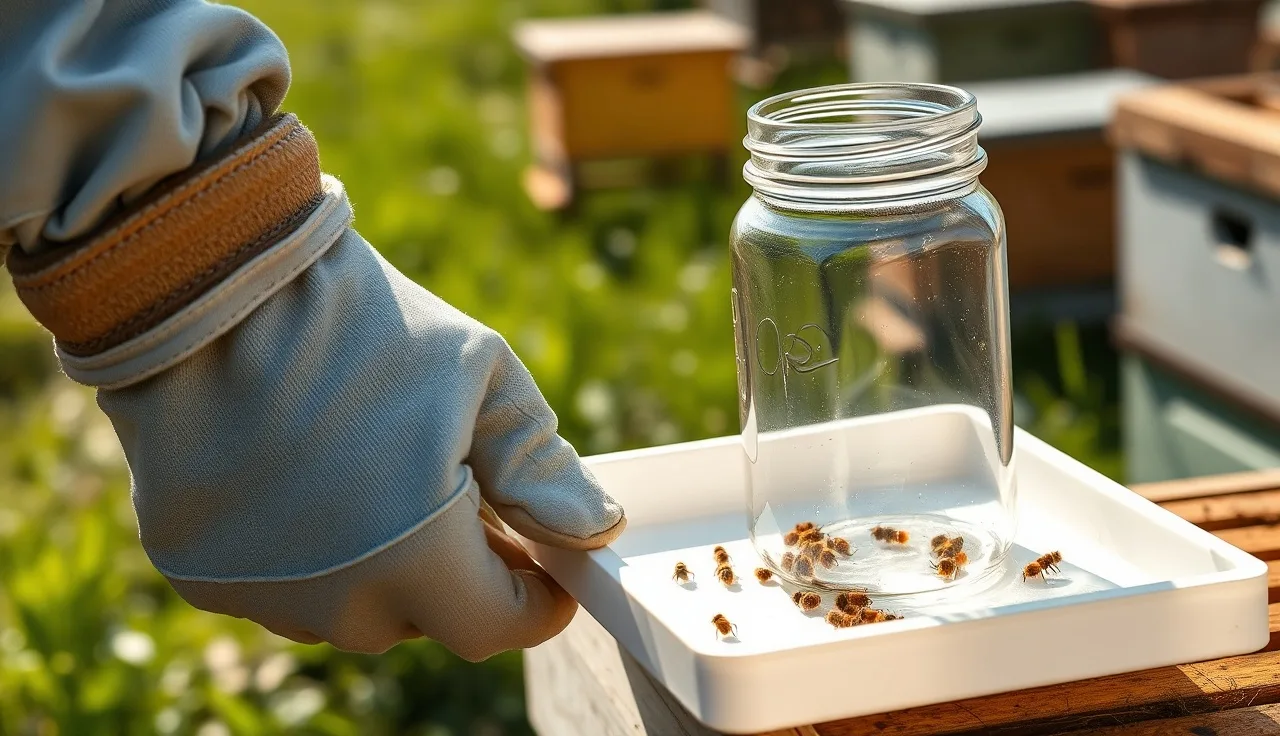
Alcohol wash is the gold standard for accuracy. You collect about 300 bees (roughly half a cup) from a brood frame, wash them in isopropyl alcohol (70% is common), and count the mites that fall into the liquid. The method kills the sample bees, which is the main objection beekeepers raise, but it gives you a reliable phoretic mite count.
Sugar roll uses powdered sugar instead of alcohol. The sugar coats the bees and causes mites to lose their grip, falling into a container where you can count them. The bees survive and go back in the hive. The problem is accuracy: multiple university studies have found sugar roll consistently undercounts mites compared to alcohol wash, sometimes by 30-40% [2]. In a low-infestation hive that might still look fine, that margin matters.
Sticky board (natural mite drop) means placing a sticky white board under a screened bottom board for 24 or 72 hours and counting fallen mites. No bees are harmed. The weakness is interpretation. Mite drop counts get pushed around by colony size, season, and whether you've treated recently. You need conversion factors to estimate infestation rate, and those factors vary. Many extension programs have moved away from recommending sticky boards as a primary diagnostic.
Drone brood examination takes uncapped drone pupae, the preferred reproductive site for varroa, and physically checks them for mites. It gives you a sense of reproductive mite pressure but doesn't translate cleanly to a percentage-based threshold.
For practical mite management, alcohol wash is what I'd do every time, at least until you've done it enough to trust your sugar roll technique against a parallel wash sample.
How do you do an alcohol wash step by step?
You need a half-cup (~240 mL) measuring container or a commercial mite washing jar, 70% isopropyl alcohol (rubbing alcohol from any pharmacy), a fine mesh lid or strainer, and a white tray or bowl to count mites against.
Step 1: Find a brood frame with nurse bees. Locate a frame that has capped brood. Nurse bees clustered on brood frames carry the highest phoretic mite loads and give you the most representative sample. Do not collect from frames near the entrance where foragers concentrate.
Step 2: Shake bees into a bucket or tray. Give the frame a firm shake over your collection container. You want roughly 300 bees, which is about half a cup by volume. Don't include the queen. If you accidentally do, pick her out.
Step 3: Add alcohol. Pour enough 70% isopropyl alcohol into your container to fully submerge the bees. Put the lid on and shake hard for 30 to 60 seconds. The mites detach and sink.
Step 4: Drain and count. Pour the liquid through your fine mesh into the white tray. The bees stay in the mesh; the mites wash into the tray. Count every mite you see. Use a magnifier if you need one. Varroa mites are reddish-brown, roughly 1.1 mm wide, and roughly circular [3].
Step 5: Calculate infestation rate. Count the actual bees in your sample (or use the half-cup as a 300-bee estimate, though counting is more accurate). Divide mites by bees, multiply by 100. Ten mites in 300 bees is a 3.3% infestation rate.
The whole process takes about ten minutes once you've done it a few times. The math is genuinely simple.
What is the treatment threshold for varroa mites?
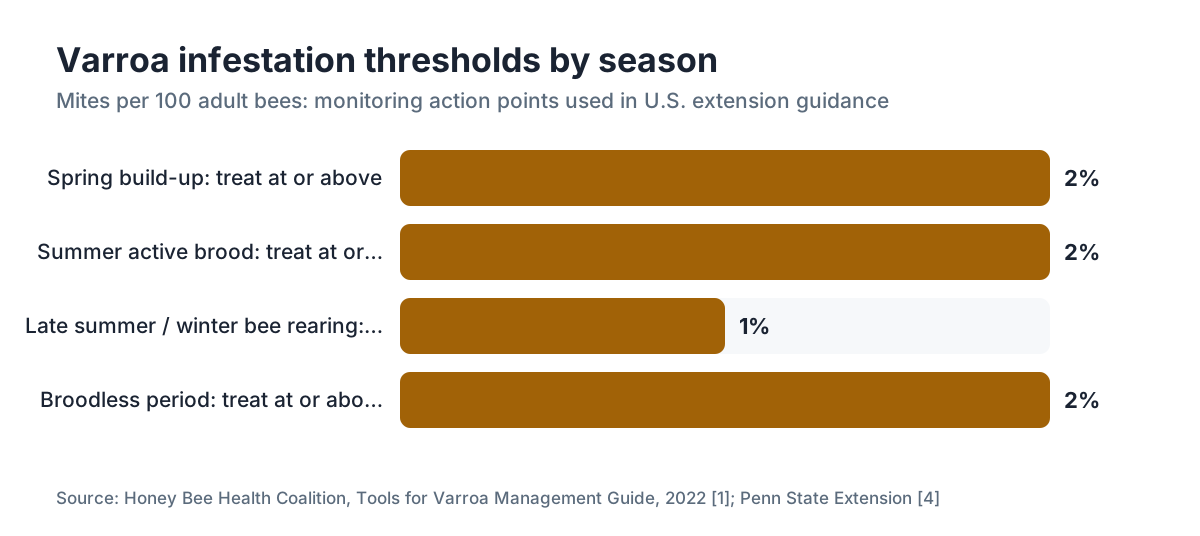
The number that shows up in most U.S. extension guidance and in the Honey Bee Health Coalition field guide is 2%: two mites per 100 adult bees. At or above 2% during brood-rearing season, treatment is warranted [1].
That threshold is not a hard biological law. It's a practical decision point built from colony survival research, and it comes with nuance.
Season changes the math. In late summer and fall, when the colony is raising the winter bees that have to survive until spring, some researchers argue for a lower threshold, closer to 1%, because those long-lived winter bees can't afford to carry virus loads picked up from mites during their development [4]. A 2% count in August is a different risk than a 2% count in May.
Colony size matters too. A nuc or a fresh split may tolerate mite pressure differently than a full production colony. Smaller bee populations mean each infected bee is a larger share of the workforce.
Here's a table of common threshold guidance by season:
| Season | Recommended Treatment Threshold | Notes |
|---|---|---|
| Spring build-up | 2% | High reproduction risk as brood increases |
| Summer (active brood) | 2% | Standard threshold, monitor monthly |
| Late summer / early fall | 1-2% | Winter bee rearing makes this window matter most |
| Broodless period | 1-2 mites per 100 bees | All mites are phoretic; easier to treat |
Some beekeepers treat prophylactically on set calendar dates instead of waiting for a threshold. That approach has merit in certain climates, but it doesn't replace monitoring, because you can't know whether a treatment worked without counting again afterward.
How often should you count varroa mites?
Monthly monitoring during the active season is the standard recommendation from most university extension programs [5]. That gives you enough data points to catch a trend before it turns into an emergency.
At minimum, count at these moments: early spring as the colony expands, midsummer before the late-season mite spike, late summer while winter bees are being raised, and after any treatment to confirm it worked.
Post-treatment monitoring is where a lot of hobbyists fall short. A treatment that brought a 4% infestation down to 0.5% looks like a success. A treatment that brought it from 4% to 3% is a problem you need to know about. You won't know without counting.
The broodless period, if your climate produces one, is the best window of all. With no capped brood, nearly all mites are phoretic and exposed. A wash during this window gives you the clearest population picture of the year, and treatments applied then are often the most effective.
Is sugar roll accurate enough to use instead of alcohol wash?
Short answer: it beats no count, but it's less reliable than alcohol wash, and the gap isn't trivial.
A study in the Journal of Economic Entomology found that sugar roll detected significantly fewer mites than alcohol wash on matched samples, with underestimation running roughly 30% to 40% depending on conditions [2]. If your colony is hovering right at the 2% threshold, a sugar roll could report 1.2% and send you home without treating.
The mechanism is simple. Alcohol kills mites and causes complete detachment. Sugar physically displaces mites but relies on gravity and vigorous shaking, and some mites grip or re-grip the bees before they fall.
Sugar roll isn't useless, though. If you're monitoring a queen-right nucleus colony where you genuinely can't spare 300 bees, sugar roll gives you a directional read. If you want to avoid any alcohol residue risk (minimal, but real if you're paranoid about it), sugar roll is a reasonable substitute, as long as you understand that your real mite load is probably higher than what you count.
If you're committed to sugar roll, run parallel samples with alcohol wash at least once or twice a season to calibrate your personal accuracy. See how far off you are in your specific conditions.
How do you read a sticky board mite count?
A sticky board goes under a screened bottom board (not a solid one) for a set period, usually 24 or 72 hours. You pull it, count every varroa on the surface, then do math to convert that drop count into an estimated infestation rate.
The conversion factors are where sticky boards get slippery. Older extension guidance suggested a 24-hour natural mite drop below 10 mites is low risk, 10 to 30 is moderate, and above 30 warrants treatment. But those numbers assume a colony of typical size, and they were developed before the high-mite-pressure conditions now common in North America [6].
Natural mite drop is affected by brood nest size (more brood means more mites returning to cells and fewer on adults at any given time), temperature (mites move more when it's warm), and recent treatments (even a partial treatment can inflate drop counts as mites die and fall). None of those confounders exist with alcohol wash.
Sticky boards are genuinely good for one thing: confirming that mites are present and getting a rough sense of whether the population is climbing or falling over several consecutive counts. They also help you spot varroa in colonies you haven't yet sampled by wash. But if you're making a treatment decision, back it up with a wash count.
What sample size do you need for an accurate varroa count?
The 300-bee sample (roughly half a cup by volume) is the standard because it gives you a statistically reliable estimate of the phoretic mite infestation rate without being so large that it hurts the colony.
Researchers at Pennsylvania State University and elsewhere have modeled the confidence intervals for different sample sizes. At 300 bees, a count of 6 mites gives you a 2% rate with reasonable confidence. Drop to 100 bees and your confidence interval widens sharply, so a count of 2 mites in 100 could represent anywhere from roughly 0.5% to 5% in the actual colony with overlapping probability [5].
In practice, many beekeepers estimate 300 bees using a half-cup measuring cup instead of counting bees one by one. That's close enough. If your container gives you 200 bees, still run the wash, but base your calculation on the actual bee count, not the assumed 300.
Do not sample from the honey super. Bees in supers are older foragers with lower mite loads than nurse bees. You'll get an artificially low count. Always pull from frames with capped brood.
What do varroa mites look like in a sample?
Varroa destructor adults are reddish-brown to dark reddish-brown, flattened, and roughly 1.1 mm wide by 1.6 mm long [3]. They're wider than they are long, so they look more like a small flat button than a typical oval mite. Against a white tray with the alcohol wash, they stand out clearly.
The reddish color is distinctive enough that even a beginner can usually spot mites after the first few. Debris from the bee bodies, bits of wax and pollen, washes out too, so you'll be sorting through some visual noise. Take your time. The mites don't move (they're dead) so you can sweep the tray in sections and count methodically.
If you've read our article on the varroa mite itself, you already know the life cycle details. The female mite you're counting in a wash is the reproductive adult. Males are rarely seen outside cells.
First-time counters often ask whether immature mites show up in a wash. They don't, except very rarely if you happen to disturb heavily infested capped cells during collection. What you're counting is almost entirely phoretic adult females.
How do you count varroa in a broodless colony or a winter cluster?
A broodless period is an ideal time to monitor, because every mite in the colony is phoretic. There's nowhere to hide in cells. The alcohol wash method doesn't change: find a cluster of bees, collect your sample, wash, count.
The challenge is reaching the cluster. In deep winter with a tight ball of bees, you may not want to open the hive at all. Some beekeepers skip winter counts for this reason and monitor heavily in early spring instead, right as the queen begins laying but before there's much capped brood.
In climates with a reliable broodless period in late fall (roughly November in many northern U.S. states), timing a treatment to hit that window can be extremely effective. Oxalic acid in its vaporization or dribble form, for example, has no effect on mites inside capped cells, so a broodless application hits the full mite population [7].
If you do a broodless count and find even 1 to 2% infestation, take it seriously. That's the floor before winter, and mites will resume reproduction the moment laying starts in late winter.
What tools and supplies do you need to count mites?
The basic kit is cheap, and most of it is reusable.
You need a collection container with a fine mesh lid. Commercial mite-washing jars with built-in mesh run from most beekeeping suppliers, typically $15 to $30. You can also build your own from a mason jar and hardware cloth. A half-cup measuring cup, or any container you've calibrated to hold about 300 bees, handles the collection side.
For the alcohol wash, standard 70% isopropyl rubbing alcohol from any pharmacy works fine. Some beekeepers use windshield washer fluid (which contains methanol) because it's cheaper in bulk, but 70% isopropyl is reliable and easy to find.
A white plastic tray, a disposable foam plate, or even a white paper plate gives you a counting surface. A white background matters for contrast against the reddish mites.
A magnifying loupe (10x is plenty) helps with low counts where you want to be sure you're not missing small or partially hidden mites.
VarroaVault has a free monitoring log that tracks counts over time and shows whether your mite population is climbing or falling between checks. A log like that makes it easier to catch the slow-creep infestations that catch beekeepers off guard.
For sourcing gear, comparing options from established beekeeping supply companies is worth the few minutes it takes.
What common mistakes lead to wrong varroa counts?
Sampling from the wrong bees is the most common error. Shake bees off a honey frame at the outer edge of the box, or from a frame near the entrance where foragers cluster, and you get older bees with lower mite loads. Always sample from a frame with capped worker brood.
Not shaking hard enough during the wash is the second big one. Thirty seconds of gentle swirling does not detach all the mites. Shake hard for a full 30 to 60 seconds.
Counting on a dark background, or against a blue or red tray, makes mites easy to miss. Always use white.
Using old or diluted alcohol is an underappreciated problem. Reuse alcohol from a previous wash without refreshing it, and the concentration drops and detachment goes incomplete. Fresh alcohol every time.
Not counting after treatment is the mistake that costs colonies. Treatments fail for reasons including heat (formic acid in high temperatures), resistance (amitraz resistance has been documented in North American varroa populations) [8], and sloppy application. The only way to know whether a treatment worked is to count three to four weeks after applying it.
How do varroa counts connect to treatment decisions?
A count is only useful if you do something with it. The decision tree is simple: below threshold, monitor again in 30 days; at or above threshold, pick and apply a treatment that fits your conditions and honey super status.
EPA-registered varroa treatments available in the U.S. include oxalic acid products (Api-Bioxal and others), formic acid products (Mite-Away Quick Strips, Formic Pro), amitraz strips (Apivar), and thymol-based products (ApiLife VAR, Apiguard) [7][9]. Each has its own temperature requirements, honey super restrictions, and efficacy against phoretic versus brood-stage mites.
Choosing a treatment without knowing your infestation level is flying blind. A colony at 1.8% might not need treatment yet. A colony at 6% needs an effective treatment fast, not a mild one. The count drives both the urgency and the product choice.
After any treatment, count again. The Honey Bee Health Coalition recommends a follow-up count three to four weeks after treatment completion to confirm efficacy [1]. If the count is still above threshold, you may need a second treatment, a different product, or you may be dealing with a resistance issue worth digging into.
Nobody has clean data on how widespread treatment resistance is in any given region, but if you're seeing counts stay high after correct application, report it to your state apiarist and look at switching treatment classes.
Frequently asked questions
How many bees do I need for a varroa alcohol wash?
About 300 adult bees, which is roughly half a cup (about 240 mL) by volume. Smaller samples produce less reliable percentage estimates. Collect from frames with capped worker brood, not from honey frames or near the entrance, so you get nurse bees that carry the highest phoretic mite loads.
What percentage of varroa mites is dangerous to a colony?
The widely used treatment threshold is 2%, meaning 2 mites per 100 adult bees. In late summer during winter bee rearing, some researchers recommend acting at 1%. Above 3-4%, colonies are at serious risk of collapse before winter. The Honey Bee Health Coalition's field guide uses 2% as the standard intervention point for the brood-rearing season.
Can you count varroa mites without killing bees?
Sugar roll is the main alternative that returns live bees to the hive. It's less accurate than alcohol wash, with studies showing it can undercount mites by 30-40%. Sticky board counts also don't harm bees but require conversion math and have significant confounders. For critical treatment decisions, alcohol wash accuracy is worth the loss of roughly 300 worker bees.
How do I count varroa mites from a sticky board?
Insert a sticky white board under a screened bottom board for 24 or 72 hours, then remove it and count every reddish-brown mite on the surface. Divide the 24-hour count by your colony's approximate bee population estimate to get a rough infestation indicator. Sticky boards are useful for trend tracking but less reliable for treatment threshold decisions than alcohol wash.
What time of year should I count varroa mites?
Count monthly during the active season, and always at four key moments: early spring, midsummer, late summer before winter bees are reared, and after any treatment. The late summer count is arguably the most important because high mite levels during winter bee rearing lead to compromised bees that won't survive until spring.
Why is my varroa count higher after treatment?
A short-term spike in mite drop on a sticky board after treatment is normal and shows the treatment is working, killing mites that then fall. If you do an alcohol wash three to four weeks after treatment completion and the count is still at or above threshold, that's a real problem: the treatment may have failed due to poor application, temperature issues, or resistance.
How do I count varroa mites in winter?
Alcohol wash still works during a broodless winter period, and it's actually ideal because all mites are phoretic. Carefully collect a sample from the edge of the winter cluster without chilling the cluster excessively. Many beekeepers skip mid-winter counts and do their first spring count as soon as the queen begins laying in late winter or very early spring.
Does the type of alcohol matter for a varroa wash?
Standard 70% isopropyl alcohol (common rubbing alcohol) is the go-to and works reliably. Some beekeepers use windshield washer fluid as a cheaper bulk alternative. Avoid concentrations much below 70%, since mite detachment gets less complete. Don't reuse wash alcohol across multiple samples without refreshing it, as the concentration drops.
How accurate is the sugar roll method for varroa?
Less accurate than alcohol wash. Multiple studies, including a comparison published in the Journal of Economic Entomology, found sugar roll underestimates mite loads by roughly 30-40% compared to matched alcohol wash samples. It's acceptable for directional monitoring but risky for threshold decisions, since a colony sitting at 2.5% could test at under 2% by sugar roll.
Can I count varroa mites without a commercial mite-washing jar?
Yes. A mason jar with a hardware cloth or fine window screen lid secured with the ring works well. The jar holds your bees and alcohol; the screen holds the bees while the liquid pours through into a white tray where you count mites. A half-cup measuring cup handles bee collection. Total materials cost under five dollars if you improvise.
How do I know if my varroa count sample came from the right bees?
You want nurse bees from brood frames. If you sampled correctly, the bees in your container will be younger, mostly without pollen loads, and collected from a frame with a mix of capped brood and open larvae. Foragers from entrance frames look older, darker, and more worn. Nurse bees give you the most honest read of phoretic mite pressure.
What does a varroa mite look like in an alcohol wash sample?
Reddish-brown, flattened, roughly circular (slightly wider than long, about 1.1 mm wide). Against a white tray they're visible to the naked eye, though a 10x loupe helps with low counts. They don't move since they're dead. Debris and wax bits also wash out, so take your time scanning the tray methodically.
How do I count varroa mites in a newly hived package or nuc?
Wait until there's capped brood before doing an alcohol wash, typically two to three weeks after hiving a package. A wash before capped brood exists will underestimate total mite load because mites haven't had a reproductive cycle to build up. You can do a wash on day one to set a baseline phoretic load, just understand it doesn't capture mites that entered the colony and haven't yet reproduced.
Sources
- Honey Bee Health Coalition, Tools for Varroa Management Guide (7th edition, 2022): A mite count is 'the only reliable way to know if a colony needs treatment'; 2% infestation rate is the standard treatment threshold during brood-rearing season
- Journal of Economic Entomology, Ostiguy & Sammataro 2000, sugar roll vs alcohol wash accuracy: Sugar roll consistently undercounts mites compared to alcohol wash, with underestimation in the range of 30-40%
- USDA Agricultural Research Service, Varroa destructor biology page: Adult female Varroa destructor is approximately 1.1 mm wide by 1.6 mm long, reddish-brown in color
- Pennsylvania State University Extension, Varroa Mite Monitoring and Management: Late summer threshold may be lower (1%) due to winter bee rearing vulnerability; winter bees carry mite-vectored viruses through the cluster
- Pennsylvania State University Extension, How to Estimate Varroa Mite Populations: Monthly monitoring during the active season is recommended; 300-bee sample provides statistically reliable infestation rate estimates
- University of Minnesota Extension, Varroa Mite Monitoring Methods: Sticky board 24-hour drop thresholds are difficult to interpret due to confounders including colony size, season, and recent treatments
- EPA, Oxalic Acid for Varroa Mite Control in Honey Bee Hives: Oxalic acid has no efficacy against mites inside capped cells; approved products include Api-Bioxal; broodless application is most effective
- USDA AMS National Honey Report / ARS varroa resistance documentation: Amitraz resistance has been documented in North American Varroa destructor populations
- EPA, Pesticide Product Label System for registered varroa treatments (Apivar, Formic Pro, Apiguard, ApiLife VAR): EPA-registered varroa treatments include amitraz strips (Apivar), formic acid products (Formic Pro, MAQS), thymol products (ApiLife VAR, Apiguard), and oxalic acid formulations
- University of California Agriculture and Natural Resources, Integrated Pest Management for Honey Bees: Post-treatment monitoring 3-4 weeks after treatment completion is necessary to confirm efficacy
- Cornell University College of Agriculture and Life Sciences, Honey Bee Program, Varroa Monitoring Guide: Alcohol wash is described as the most accurate field method for quantifying phoretic varroa mite loads
Last updated 2026-07-10