Dead varroa mites: what they look like and what they tell you
TL;DR
- A dead varroa mite is a reddish-brown, crab-shaped oval roughly 1.1 mm wide and 1.6 mm long, smaller than a period on this page.
- Finding dead mites on a sticky board is normal and expected after treatment.
- What matters is how many you find, how fast the count drops, and whether your infestation level was already dangerous before you treated.
What does a dead varroa mite look like?
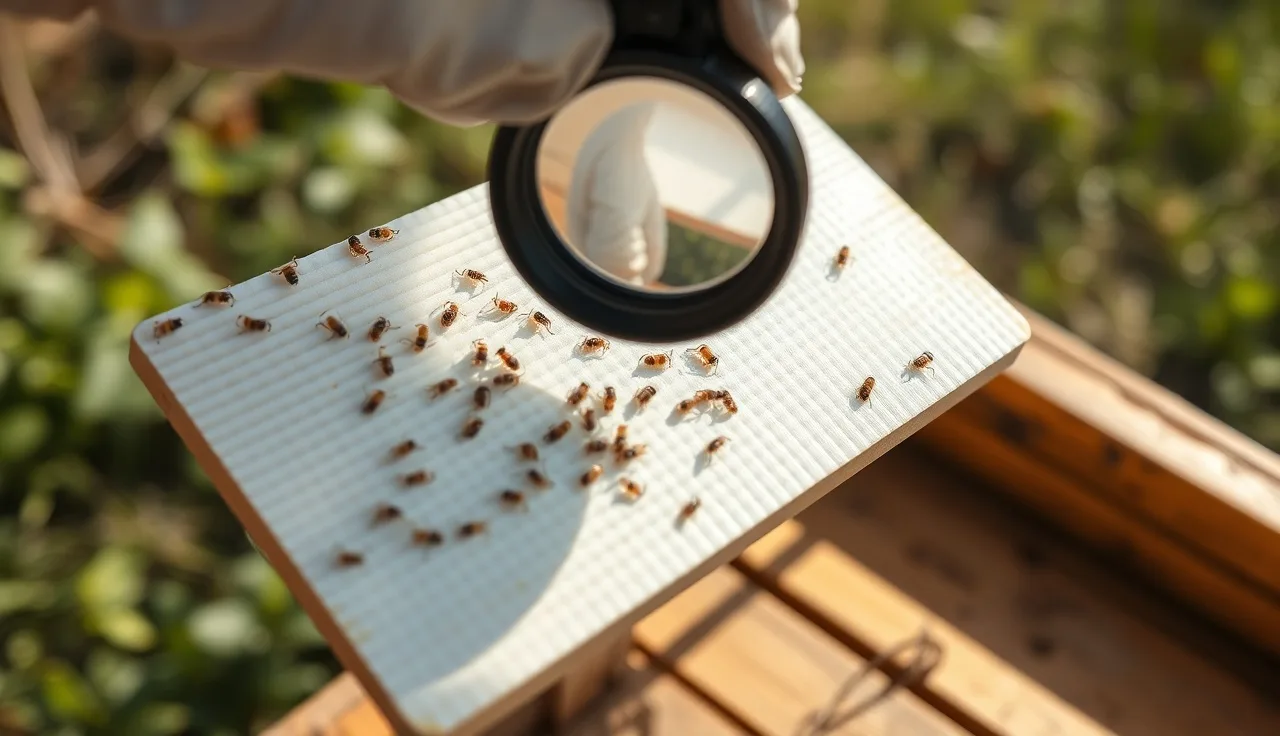
A dead varroa mite looks almost identical to a live one. It's a flattened, oval-shaped parasite in a reddish-brown to mahogany color, with eight stubby legs clustered toward its front end. The body is about 1.1 mm wide and 1.6 mm long [1]. That's roughly the width of two human hairs side by side.
Once dead, the legs curl inward slightly, which is often your first clue that what you're looking at is no longer alive. Live mites move. Dead ones don't, obviously, but the curled-leg posture becomes more obvious when you're counting mites on a sticky board insert under a magnifier.
The exoskeleton holds its shape well after death. You won't find mites that have collapsed or turned black the way some insects do. Varroa has a hard cuticle, so a week-old dead mite on a sticky board can look nearly the same as one that fell yesterday. That persistence is part of why sticky boards work as a monitoring tool, though it's also why you need a baseline period (usually 24 hours) to get a meaningful daily drop count rather than a cumulative smear of whenever-they-died.
Naturally dead mites (old age, grooming damage) tend to look intact. Mites killed by oxalic acid or synthetic miticides can sometimes appear slightly desiccated or have a faint residue on the body, but not reliably enough that you can diagnose cause of death from appearance alone. If you want to confirm what you're seeing is actually varroa and not a pollen grain or debris, use a 10x hand lens or a loupe. The eight legs are unmistakable.
How do you find and count dead mites on a sticky board?
A sticky board (also called a varroa tray or bottom board insert) is a sheet of paper or cardboard coated with petroleum jelly, cooking oil spray, or a commercial sticky adhesive. You slide it under a screened bottom board for a set period, pull it out, and count the mites stuck to it [2].
The standard monitoring period is 24 hours. Count every mite, divide by the number of days the board was in, and you get your natural mite drop rate (mites per day). Some beekeepers leave boards in for 72 hours and divide by three. Longer periods average out variation from cold nights when bees cluster and fewer mites fall, but they also blur your picture if you're trying to track a fast-moving infestation.
Counting technique matters. Pull the board, lay it on a flat surface in good light, and use a magnifying loupe or even a phone camera zoomed in. Work in a grid pattern so you don't miss the corners. Pollen, wax flakes, and small beetle larvae can fool you. A mite has a very specific profile: flat oval, reddish, eight legs. Anything that doesn't match gets set aside.
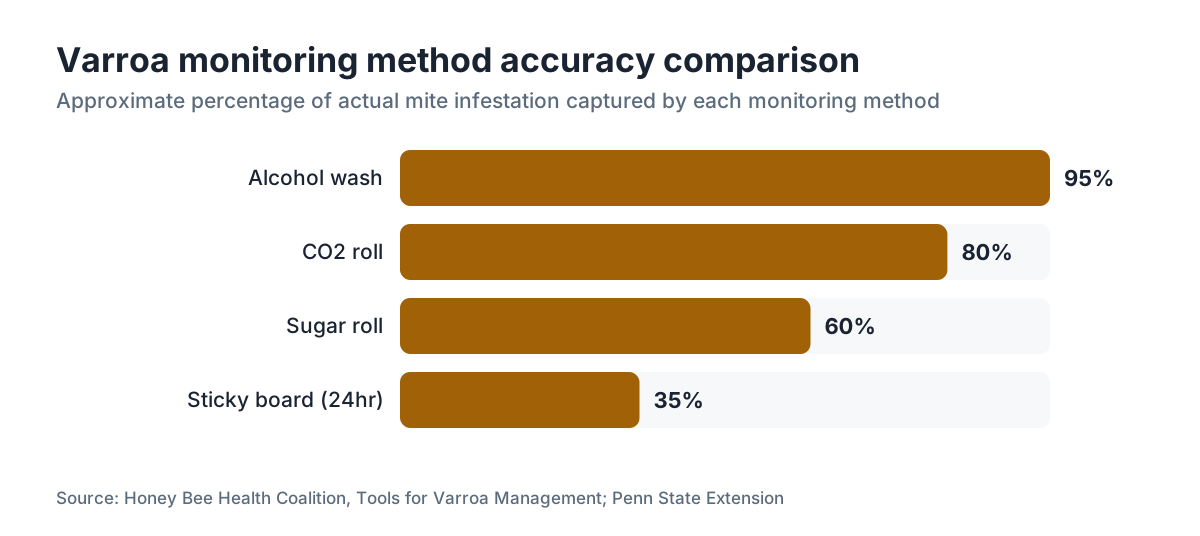
The Honey Bee Health Coalition recommends a threshold of roughly 2 mites per day natural drop as a point where you should test with a more accurate method (alcohol wash or sugar roll), because the sticky board undercounts mites by a large margin [2]. A sticky board is a screening tool, not a census. It catches maybe 30 to 40 percent of falling mites depending on debris coverage and airflow, so a low count doesn't mean you're safe [10].
For supplies to set up a proper monitoring station, check out what's available through beekeeping supply companies.
What does a high dead mite count mean for your colony?
A high dead mite count after treatment is a good sign. It means the treatment is working.
Before treatment, a high natural drop is a warning. The Honey Bee Health Coalition's Varroa Management Guide sets an economic threshold of 2 percent infestation in summer (2 mites per 100 bees in an alcohol wash) and 1 to 2 percent in late summer heading into winter [2]. If your sticky board is consistently showing 10 or more mites per day in a period where you haven't treated, you're almost certainly above those alcohol-wash thresholds, and your colony is in trouble.
After a treatment like oxalic acid vaporization or an Apivar strip, you expect a surge in dead mites on the sticky board. During that surge, counts in the hundreds per day are not unusual in a heavily infested colony. That's the treatment doing its job. The surge typically peaks in the first few days after an oxalic acid treatment, then drops off over the following week.
If you treat and see almost nothing on the sticky board, that's the concerning result. Either your infestation was already low (good), the treatment wasn't applied correctly (bad), or your mite population is largely in capped brood where oxalic acid can't reach them (expected with a single OA treatment, which is why repeated applications or a different product is often needed when brood is present) [3].
Counts that stay elevated weeks after a treatment ended, without re-treatment, may point to resistance or treatment failure. Nobody has rock-solid published thresholds for post-treatment drop rates specifically, but most experienced beekeepers look for the count to drop at least 80 to 90 percent from its peak within 2 weeks as a rough sign that a treatment worked.
Is finding a few dead mites normal even without treatment?
Yes. Completely normal.
Varroa mites die from a few natural causes: old age (adult female mites live about 27 days during the foraging season outside of brood cells [1]), physical damage from bee grooming behavior, failed reproduction inside brood cells, and occasionally disease. A colony will always have some background drop.
The question is how many. A truly low-mite colony in midsummer might drop 0 to 2 mites per day naturally. A colony that's been quietly building a varroa problem since spring might be dropping 10 to 20 per day without you noticing, meaning your population is already dangerously high.
Seasonal variation matters too. In winter, when colonies are tightly clustered and little to no brood is present, the natural drop looks different. There's less bee movement to dislodge mites, so the sticky board may seem low even if the colony has a real problem. Spring, when brood production ramps back up and bee traffic is heavy, tends to produce higher natural drops.
The takeaway: a few dead mites on an untreated board is fine and expected. The sticky board result only gets alarming when the count is consistently elevated. And even then, verify with an alcohol wash before you assume the worst.
How is an alcohol wash different from a sticky board count?
The alcohol wash (also called an ethanol wash or 70 percent isopropyl wash) is the gold standard for measuring actual infestation rate. You take a sample of roughly 300 bees (about half a cup) from the brood nest, add rubbing alcohol, shake vigorously, and pour the solution through a mesh screen to catch the bees while the mites fall through. Count the mites, divide by bees, multiply by 100, and you get a percentage [4].
The sticky board tells you how many mites are dying. The alcohol wash tells you what percentage of your live bees carry mites. Those are different questions, and you need both for a full picture.
A 2 percent alcohol wash result means 2 mites per 100 bees. At that level in late summer, the Honey Bee Health Coalition's threshold guidance says treat now [2]. At 1 percent in early spring, you might monitor more frequently rather than immediately treating. Context, season, and what's happening with brood all shape the decision.
For hobbyist beekeepers, the alcohol wash is worth the mild discomfort of sacrificing 300 bees. Those 300 bees represent about 1 percent of a healthy-sized colony, and the data you get beats a sticky board guess by a wide margin. The USDA maintains standardized survey protocols for varroa sampling, and your state's extension apiculture program likely has a printed guide as well [4].
The sugar roll is a non-lethal alternative to the alcohol wash. It's less accurate (it misses mites that stay attached through the shaking) but gives a rough estimate without killing bees. For a definitive pre-treatment threshold decision, most researchers prefer the alcohol wash.
A comparison of monitoring methods:
| Method | Accuracy | Mite metric | Kills bees? | Cost |
|---|---|---|---|---|
| Sticky board | Low (30-40% capture) | Mites/day natural drop | No | Near zero |
| Sugar roll | Moderate | % infestation (undercount) | No | Near zero |
| Alcohol wash | High | % infestation | Yes (~300) | Near zero |
| CO2 roll | Moderate | % infestation | No | Low |
Sources: [2][4]
What treatments kill varroa mites and how do you know they worked?
There are four categories of EPA-registered varroa treatments available in the United States: oxalic acid, formic acid, thymol, and synthetic miticides (amitraz, fluvalinate, coumaphos) [5].
Oxalic acid dihydrate (OAD) is probably the most widely used by hobbyist and sideliner beekeepers right now. It's available as Api-Bioxal, the only EPA-registered oxalic acid product for use in honey bee colonies in the U.S. [3]. You can apply it by vaporization (sublimation) or dribble. It kills phoretic mites (mites on adult bees) very effectively, but it does not penetrate capped brood cells. That's the fundamental limit of a single OAD treatment: if brood is present, a large portion of your mite population sits protected and will emerge after the treatment ends.
Formic acid (sold as Formic Pro or Mite-Away Quick Strips) does penetrate capped brood, which makes it more effective when brood is present, but it has a narrower temperature window (Formic Pro's label specifies 50 to 85 degrees F for the 14-day strips) and can damage brood or queens if applied wrong [6].
Amitraz (Apivar strips) works by contact over a 6 to 10 week period and reaches mites in brood as bees emerge and touch the strips. It's consistently effective, but resistance has been documented in some varroa populations, and there are honey contamination concerns with extended use [7].
How do you confirm a treatment worked? Sticky board counts during and after treatment give you a rough sense. A formal post-treatment alcohol wash 3 to 4 weeks after finishing (to allow emerging bees from brood to pick up and shed any remaining mites) is the more reliable check. If you wash out above 1 to 2 percent after a treatment, ask whether you applied it correctly, whether resistance is a factor, or whether you need a follow-up.
VarroaVault has a protocol comparison tool that can help you match treatments to your local conditions and brood status, if you want a structured way to work through the decision.
For a broader look at varroa mites and their biology, that foundational article covers the full lifecycle in detail.
Can you see varroa resistance by watching dead mite counts?
Indirectly, yes.
If you apply a treatment correctly, under the right conditions, and your dead mite count on the sticky board barely moves, that's a red flag. Resistance to synthetic miticides like fluvalinate (Apistan) and coumaphos (CheckMite+) is well-documented and widespread. Resistance to amitraz is emerging in some populations, though it's not yet as common in North America [7].
The practical test for resistance is the alcohol wash efficacy check. Wash 300 bees before treatment to establish baseline infestation. Complete the full treatment course. Wait about 3 weeks after the treatment ends (to account for bees that were in brood during treatment). Wash again. If efficacy was good, you'd expect the infestation rate to have dropped by 90 percent or more. A drop of only 50 percent or less points to either application error or genuine resistance.
A 2021 review in the journal Insects noted that fluvalinate and coumaphos resistance is now common enough in the U.S. that many extension apiculturists recommend against using them as primary treatments [7]. If you've been using the same synthetic miticide for years without rotation, resistance is a real possibility.
Rotating treatment classes is the standard advice. Use oxalic acid or formic acid in brood-free periods (late fall in many climates), and reserve amitraz strips for the main season when brood is heavy. Don't run the same synthetic product back-to-back in the same yard without a confirmed efficacy check in between.
What do dead mites from grooming behavior mean for colony health?
Some bees actively remove mites from nestmates and from brood cells. The trait is called grooming behavior (or hygienic behavior when it involves removing infested brood) [8]. Colonies with high grooming rates show a measurably higher proportion of damaged mites in natural drop samples. Damaged mites, meaning mites missing legs or with punctured bodies, in your sticky board count are evidence of this trait.
You can actually screen for this. Place a sticky board under the colony for 24 hours without any treatment. Pull it, count total mites, then count how many have visible leg damage or punctures. A ratio of damaged to total mites above about 10 to 15 percent is considered a reasonable indicator of grooming activity, though the science here is imprecise and no single threshold has been universally validated.
This matters for breeding decisions. The USDA Baton Rouge Bee Lab has done substantial work selecting for grooming and hygienic behavior as breeding traits, and some commercial queen producers now sell stock tested for these behaviors [8]. If you're seeing a lot of damaged mites on your sticky board from an untreated colony, your bees may carry some genetic resistance worth preserving.
Even the best-grooming colony in North America still needs chemical intervention at some point. Grooming behavior alone has never been shown to keep varroa below economic thresholds indefinitely in typical managed colonies. It's a helpful genetic bonus, not a replacement for treatment.
How do seasonal timing and brood cycles affect your mite drop?
Varroa populations track brood production. More brood means more reproductive chances for mites, which means faster population growth. The mite-to-bee ratio in a colony can roughly double every 3 to 4 weeks during the peak summer brood season [1][2].
The timing of your dead mite observations matters a lot:
Spring buildup (March through May in most of the U.S.): Mite populations build alongside bee populations. Even a low spring sticky board count can mask a fast-growing problem because the colony is also growing fast. Test frequently in spring.
Summer peak (June through August): This is when colonies hit maximum size and mite populations climb fastest. The window from July to September is when most colony collapses from varroa happen. A count that looks manageable in June can cross the treatment threshold by August if you don't intervene [11].
Late summer to early fall (August through September): The most important window. Winter bees (the long-lived bees that carry the colony through winter) are being raised now. If those bees are reared in a heavily infested colony, they emerge with viral loads, shortened lifespans, and immune suppression. Colonies that look alive in October can crash by January because of damage done to winter bees in August [11].
Winter: Brood stops or nearly stops in most northern climates. Mite reproduction also stops. This is the ideal window for oxalic acid treatment (dribble or vaporization), because essentially all mites are phoretic (on adult bees) and fully exposed [3]. Natural dead mite drop in winter is low but steady.
Plan your monitoring and treatment calendar around these phases, more than around when it's convenient.
What's a normal post-treatment mite drop, by numbers?
Nobody has published a universally agreed-upon table of expected post-treatment drops by infestation level and colony size, which is frustrating but honest. What exists is general practitioner experience and indirect data.
A rough framework based on available guidance [2][3][9]:
| Pre-treatment infestation (alcohol wash) | Expected post-OA vaporization peak drop (mites/day) | Drop expected to normalize within |
|---|---|---|
| <1% (low, <3 mites/100 bees) | 5-30 mites/day | 4-7 days |
| 1-3% (moderate) | 30-150 mites/day | 7-14 days |
| >3% (high, crisis level) | 150-500+ mites/day | 14-21 days |
These ranges are wide and the numbers are approximations. Colony size, temperature, treatment method, and whether brood is present all shift them. A colony of 80,000 bees has far more mites at 2 percent than a colony of 30,000 at 2 percent, so drop counts look very different even at the same infestation rate.
The more reliable signal is relative change, not absolute count. If your peak post-treatment drop was 200 mites per day and it's now at 10 mites per day two weeks later, that's a 95 percent reduction and suggests the treatment worked. If it dropped from 200 to 80 and plateaued there, investigate.
Tracking your results systematically makes these judgments much easier over time. A spreadsheet or a tool like the one at VarroaVault, used to log your counts across multiple treatments and seasons, lets you see patterns that single-point observations miss.
What other mite-like things might you confuse with dead varroa?
A few things on a sticky board can fool a new beekeeper:
Pollen grains: Often reddish, oval, and about the right size. A 10x loupe settles it fast. Pollen has no legs and usually shows a waxy or textured surface without the flat disc shape of varroa.
Tracheal mites (Acarapis woodi): Much smaller than varroa (about 0.17 mm long) and living inside the trachea of adult bees. You will not see individual tracheal mites on a sticky board without a microscope. If you're seeing varroa-sized oval shapes, it's not tracheal mites.
Small hive beetle eggs or larvae: Small hive beetles (Aethina tumida) lay eggs that can appear as white oval specks. They're much lighter in color than varroa and lack the reddish-brown cuticle.
Bee lice (Braula coeca): These are wingless flies, not true mites, occasionally found on bees in some regions. They're a bit larger than varroa (about 1.3 to 1.5 mm) and look different under magnification. They're rare in North America.
Wax moth frass and debris: General sticky board detritus can include reddish wax fragments that look mite-sized until you examine them closely.
When in doubt, use magnification. The eight-legged, flat, crab-shaped profile of varroa is distinctive enough that a decent loupe (10x or 15x) will remove any doubt.
When should you worry about dead mites, and when can you relax?
Here's a simple decision framework.
You can relax if: you see a modest number of dead mites (0 to 5 per day) on a sticky board in a colony you haven't treated, you're not in late summer, and your most recent alcohol wash was below 1 percent. That's a healthy background drop.
Pay attention if: your natural drop is consistently above 2 mites per day before any treatment. Confirm with an alcohol wash. If the wash comes back above 1 to 2 percent, treat according to the season and brood status.
Act now if: you're in late summer (July to September), you haven't treated yet this year, and your sticky board shows more than 5 to 10 mites per day, or your alcohol wash is above 2 percent. This is the scenario that kills colonies before winter. The Bee Informed Partnership's annual colony loss surveys have repeatedly found varroa management to be the management factor most correlated with winter survival [9].
Relax post-treatment if: you're seeing high dead mite counts in the first week or two after a correctly applied treatment. That's the expected result. Monitor until the count drops, then confirm efficacy with a follow-up alcohol wash.
Worry post-treatment if: the sticky board count barely changed after a full treatment course, or if it drops and then rebounds sharply within 4 to 6 weeks, which suggests surviving mites are reproducing fast again. This is where you investigate application error, resistance, or reinfestation from drifting bees.
For everything you need to run this monitoring cycle properly, the beekeeping supplies available through reputable suppliers include sticky boards, alcohol wash kits, and magnifiers.
Frequently asked questions
How big is a dead varroa mite compared to everyday objects?
A dead varroa mite is about 1.1 mm wide and 1.6 mm long. That's roughly the size of a sesame seed or the period at the end of this sentence printed in normal text. You can see them with the naked eye on a white background, but a 10x loupe makes identification much easier and cuts the chance of confusing them with pollen grains or debris.
How long do dead varroa mites stay visible on a sticky board?
Dead varroa mites hold their shape well because of their hard cuticle. On a sticky board with moderate debris coverage, they stay identifiable for several weeks. This is why you record results from a defined monitoring period (24 to 72 hours) rather than leaving a board in for a month and counting everything, which would mix mites from very different time windows and make the daily drop rate meaningless.
What does it mean when dead mites on the sticky board have broken or missing legs?
Mites with damaged legs or punctured bodies are likely victims of bee grooming behavior. Bees that actively groom their nestmates physically dislodge mites and sometimes damage them in the process. A high proportion of damaged mites in your natural drop (some practitioners use 10 to 15 percent as a loose benchmark) suggests your colony may carry genetically stronger grooming behavior, a trait worth noting and potentially preserving through queen selection.
Can dead varroa mites spread disease to other hives?
Dead mites themselves are not contagious. The viruses varroa transmits (deformed wing virus, sacbrood, others) need a live mite to inject them into bee hemolymph during feeding. A dead mite sitting on a sticky board poses no disease transmission risk. The concern is always live mites on live bees, particularly when infested bees drift or rob between colonies.
How many dead mites per day is too many before treatment?
The Honey Bee Health Coalition uses a threshold of about 2 mites per day natural drop as a trigger to confirm with an alcohol wash, not necessarily to treat immediately. The sticky board undercounts (capturing only 30 to 40 percent of falling mites), so even a low daily drop warrants checking. An alcohol wash result above 2 percent in summer or 1 percent in late summer is the actual treatment trigger.
Does seeing zero dead mites mean your hive is varroa-free?
No. A zero count on a 24-hour sticky board almost never means varroa-free in a managed colony in North America. It more often means your mite population is very low or that the board's position and debris coverage stopped mites from sticking. Confirm with an alcohol wash if you want real assurance. Truly mite-free managed colonies are exceptionally rare outside isolated island populations.
How do you count dead mites accurately without missing any?
Work in good light with a 10x magnifier. Draw a grid on the back of the sticky board insert before you put it in, so you can see the grid lines through the paper and work one cell at a time. Use a fine-tip marker to dot each mite as you count it so you don't double-count. A phone camera with zoom can substitute for a loupe in a pinch. The goal is a systematic sweep, not a quick glance.
What's the difference between a sticky board and an alcohol wash for monitoring varroa?
A sticky board measures how many mites are dying naturally per day, expressed as mites per day. An alcohol wash measures the actual percentage of live bees carrying mites, expressed as mites per 100 bees. The alcohol wash is more accurate and gives a directly actionable number against published treatment thresholds. A sticky board is a screening tool; an alcohol wash is the confirmation test.
How soon after an oxalic acid treatment should you see dead mites?
With oxalic acid vaporization, you typically see the first surge in dead mites on the sticky board within 24 to 48 hours of treatment. The peak drop usually lands in the first 3 to 5 days, then tapers over the following 1 to 2 weeks as phoretic mites die off. If you see essentially nothing in the first 3 days, check your application: sublimator temperature, seal on the hive entrance, and whether the Api-Bioxal dose was correct.
Do dead varroa mites smell or look different from live ones?
You won't notice a smell from dead mites on a sticky board. Visually, dead mites often have legs curled slightly inward compared to the spread posture of a live mite actively gripping a bee. With a loupe, a dead mite also shows no movement even when you breathe warm air across the board (live mites sometimes react to warmth). For small numbers, the distinction rarely matters for counting purposes.
Can you tell which treatment killed a mite just by looking at it?
Not reliably. Some practitioners report that oxalic acid-killed mites sometimes look slightly desiccated or dusted with residue from vaporization, and formic acid-killed mites can look bleached. But there's no published standard for visual diagnosis of cause of death in varroa. If you need to know whether a treatment worked, measure the change in infestation rate with before-and-after alcohol washes, not mite appearance.
Is it safe to handle dead varroa mites directly?
Yes. Dead varroa mites pose no known health risk to humans. They don't bite, they carry no diseases transmissible to people, and handling a sticky board insert with bare hands is standard practice. If you've applied a miticide recently, wear gloves when handling the board because of potential pesticide residue on the board itself, not because of the mites.
How do winter mite drops differ from summer drops?
In winter, when most colonies are broodless or nearly so, natural mite drop is typically lower than summer because bees are clustered and moving less, so fewer mites get dislodged. The proportion of the total mite population that is phoretic (on adult bees rather than in cells) is at its maximum in a broodless cluster. This makes winter the most effective time for oxalic acid treatment, even though the sticky board count may look deceptively low.
What's the best way to track dead mite counts over time?
Keep a simple log: date, how long the board was in, total mites counted, daily average, and any treatments applied. A spreadsheet works well. Graphing counts over a season quickly shows whether your mite population is rising, stable, or declining post-treatment. Many beekeepers find that seeing a visual trend over months changes how they read any single data point, preventing both panic over a one-day spike and complacency from a temporarily low count.
Sources
- USDA ARS Bee Research Laboratory (Beltsville, MD): Varroa destructor biology: Adult female varroa mites are approximately 1.1 mm wide and 1.6 mm long, and live about 27 days on adult bees during the foraging season
- Honey Bee Health Coalition, Tools for Varroa Management: Treatment thresholds of 2% infestation in summer and 1-2% in late summer; sticky board threshold of ~2 mites/day as prompt for confirmatory alcohol wash; mite populations can roughly double every 3-4 weeks during peak brood season
- EPA, Pesticide Registration (Api-Bioxal / oxalic acid): Api-Bioxal is the only EPA-registered oxalic acid product for honey bee colonies in the U.S.; effective against phoretic mites; does not penetrate capped brood; winter broodless treatment is most effective
- USDA National Agricultural Statistics Service, Honey Bee Colonies survey program: Alcohol wash using approximately 300 bees and 70% isopropyl alcohol is the recommended standardized method for measuring varroa infestation percentage
- EPA, Pollinator Protection: registered bee-related pesticides and miticides: Four categories of EPA-registered varroa treatments in the U.S.: oxalic acid, formic acid, thymol, and synthetic miticides (amitraz, fluvalinate, coumaphos)
- EPA, Pesticide Product and Label System (Formic Pro label): Formic Pro 14-day strips should be applied at temperatures between 50 and 85 degrees F; product penetrates capped brood and can damage brood or queens if applied outside the temperature range
- Insects (MDPI), review on acaricide resistance in Varroa destructor, 2021: Fluvalinate and coumaphos resistance is now common enough in the U.S. that extension apiculturists recommend against using them as primary treatments; amitraz resistance is emerging but less widespread in North America
- USDA ARS Honey Bee Breeding, Genetics and Physiology Research (Baton Rouge, LA): USDA Baton Rouge has done substantial work selecting for grooming and hygienic behavior as heritable traits; damaged mites in sticky board samples are an indicator of grooming activity in a colony
- Bee Informed Partnership, Annual Colony Loss Survey: Varroa management was the single management factor most correlated with winter survival in annual Bee Informed Partnership colony loss surveys
- Penn State Extension, honey bee and varroa mite resources: Sugar roll and alcohol wash methods described; sticky board captures only 30-40% of falling mites depending on debris and airflow
- University of Minnesota Bee Lab: Seasonal timing guidance for varroa monitoring; late summer (July-September) identified as the critical window for protecting winter bees from viral damage caused by high mite loads
Last updated 2026-07-09