Diatomaceous earth for varroa mites: does it actually work?
TL;DR
- Diatomaceous earth does not reliably control varroa mites.
- Lab studies show some mite death from desiccation, but no field trial has shown a meaningful mite drop in real colonies.
- At doses high enough to hurt mites, DE also injures bees and lowers brood survival.
- Oxalic acid and other registered miticides remain the evidence-based standard.
What is diatomaceous earth and why do beekeepers try it for varroa?
Diatomaceous earth (DE) is a powdery sedimentary rock made from fossilized diatom shells. At a microscopic scale the particles are sharp, and they kill by abrading or absorbing the waxy cuticle of soft-bodied insects until the insect dries out. It works on soft crawling pests in dry places, no synthetic chemistry involved, so it sounds like a dream to beekeepers who want a low-toxicity option against mites.
The reasoning makes surface-level sense. Varroa destructor is an arachnid with a hard exoskeleton, but that shell still carries a waxy layer the mite needs to hold in moisture [1]. Strip that layer on contact and the mite dies. Dust DE inside the hive, the theory goes, and mites riding the bees pick it up.
Here is where theory meets the inside of a beehive and loses. The hive is warm (roughly 35C near the brood nest), humid, and packed with organic matter that coats and neutralizes DE particles within hours [2]. That is the core problem. No amount of vendor enthusiasm has changed the underlying biology.
What does the research actually say about DE and varroa mites?
There isn't much well-controlled published research on DE and varroa, and what exists gives no reason for optimism. Plausible mechanism, zero demonstrated field efficacy, and active silence from every credible body in apiculture. That is the whole picture.
A laboratory study in the journal Experimental and Applied Acarology found that DE can kill varroa under dry, controlled conditions when mites touch the powder directly [3]. A lab dish is not a beehive. In those tests mites are isolated, humidity is held steady, and nothing competes with the dust. In a colony, beeswax, propolis, pollen, and general grime coat the particles and turn them inert.
The Honey Bee Health Coalition, in its "Tools for Varroa Management" guide (one of the most carefully vetted beekeeper-facing documents anywhere), does not list diatomaceous earth as a recommended or conditionally recommended treatment [4]. That omission tells you something. The guide covers every treatment with a reasonable evidence base, including a few with real drawbacks. DE didn't make the cut.
No peer-reviewed field trial has shown that DE applied to colonies drops mite infestation enough to carry a colony through a season. Nobody has that data. The closest anyone has come is anecdotal reports and a scatter of small experiments with inconsistent results and no control colonies.
The University of Florida's Honey Bee Research and Extension Laboratory, one of the busiest varroa research programs in North America, leaves DE out of its varroa recommendations [5]. So does the Penn State Extension apiculture program [6].
Does diatomaceous earth harm bees as well as mites?
Yes, and that is arguably the bigger practical problem. Bees exposed to DE dust show disrupted behavior and, at higher concentrations, increased death [7]. The particles abrade bee cuticle the same way they are supposed to abrade mite cuticle. The tool doesn't know which body it's cutting.
Bees groom constantly and touch every surface in the hive. Dust DE heavily enough to give individual mites steady contact, and you have dusted the bees just as hard. Powdered sugar makes a useful comparison here: it shares the mechanical, hive-dusting logic, decades of beekeepers swore by it, and controlled work still showed minimal mite control [8]. DE is far more abrasive than sugar, so the harm side of the ledger is worse, not better.
Then there's brood. Young larvae and pupae are sensitive to dust. A 2009 study on powder treatments in brood chambers documented lower brood viability when powders went in at concentrations meant to affect mites [7].
Here is the honest summary. The dose that might stress varroa also stresses bees, and mites spend most of their reproductive cycle sealed inside capped brood cells where DE never reaches [1]. The phoretic mites riding adult bees are a slice of the total population at any moment. Even a perfect kill of that slice leaves the reproducing mites untouched.
Why can't DE reach mites inside capped brood cells?
It can't reach them because DE is a solid particle and the mites are sealed behind a wax cap. This is the barrier that makes any contact-only treatment incomplete against varroa, DE included.
Varroa destructor reproduces inside capped brood cells. A mated female enters a larval cell just before the bee pupates, workers cap the cell with wax, and the mite lays eggs. The foundress and her offspring feed on the developing bee and mate inside the sealed cell. When the adult bee chews out, the newly mated female mites ride out with her [1].
For worker brood, that reproductive phase runs roughly 12 days under the cap. During those days the mites are untouchable by anything applied to a surface. Diatomaceous earth, powdered sugar, topically applied essential oils, most contact miticides: none of them push through beeswax caps at killing strength.
Research estimates that in a colony with real infestation, roughly 70 to 80 percent of mites sit in capped brood at any snapshot [1]. Treatments that only reach the phoretic mites are fighting 20 to 30 percent of the problem on their best day. DE cannot volatilize into capped cells the way oxalic acid vapor or formic acid does. It stays exactly where you put it.
That is why treatments with a vapor or fumigant phase exist, like formic acid (Mite Away Quick Strips or Api Life VAR) and oxalic acid vapor. They go where dusts can't. For the full mite life cycle, the varroa mite overview walks through the reproductive cycle in detail.
Is diatomaceous earth registered or approved as a varroa treatment?
No. The EPA has not registered any diatomaceous earth product as a treatment for varroa in honey bee colonies [9]. In the US, a substance applied to a hive to kill a pest (varroa is a pest of bees) needs EPA registration under FIFRA, the Federal Insecticide, Fungicide, and Rodenticide Act, if it carries a pesticidal claim.
That matters two ways. First, using an unregistered substance as a pesticide in a colony is technically illegal under federal law, though enforcement against a hobbyist is basically nonexistent. Second, and this is the practical part, EPA registration requires efficacy data. No manufacturer has pursued DE registration for varroa, and that gap tells you the data isn't there to support it.
Vendors who sell food-grade DE for hive use tend to call it a vague "hive additive" or skip any pesticidal claim on the label, which sidesteps the registration requirement. Buy it to control varroa, though, and you are using an unregistered pesticide.
The approved varroa treatments in the US as of mid-2025 are oxalic acid (Api-Bioxal and generic equivalents), formic acid (Mite Away Quick Strips, Formic Pro), amitraz (Apivar), and thymol products (Apiguard, Api Life VAR). Each carries its own temperature windows, application methods, and honey withdrawal periods on the EPA-registered label. Those labels are law [9].
What treatments actually control varroa at a meaningful level?
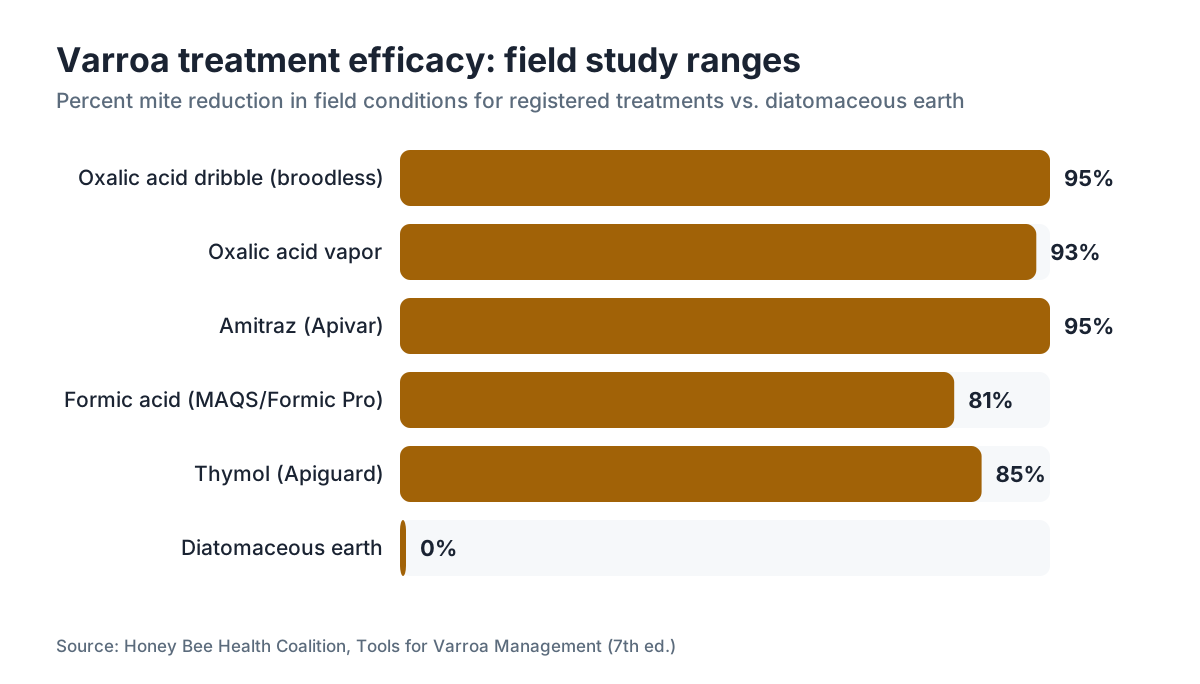
Oxalic acid, formic acid, amitraz, and thymol all have real field data behind them. DE has none. The Honey Bee Health Coalition's "Tools for Varroa Management" guide, now in its 7th edition, groups treatments by efficacy and application context [4]. Here is an honest read on the main options and their real tradeoffs.
| Treatment | Active ingredient | Efficacy range (field studies) | Key constraint |
|---|---|---|---|
| Oxalic acid dribble | Oxalic acid | 90-99% phoretic mite kill [4] | Only fully effective when broodless |
| Oxalic acid vapor | Oxalic acid | 90-99% in broodless; lower with capped brood | Requires vaporizer equipment |
| Formic acid (MAQS/Formic Pro) | Formic acid | 67-95% [4] | Penetrates some capped brood; temp sensitive |
| Amitraz (Apivar) | Amitraz | 90-99% [4] | Synthetic; resistance possible; 8-week strip |
| Thymol (Apiguard) | Thymol | 74-96% [4] | Temp sensitive; not below 59F |
| Diatomaceous earth | Silica dust | No documented field efficacy | Not EPA registered for varroa |
Oxalic acid applied during a broodless stretch (winter cluster or an engineered brood break) is the gold standard for most hobbyists. Efficacy runs very high and honey residue stays negligible at labeled rates. The HBHC guide states plainly: "Oxalic acid is approved for use in the US and has low residues in honey and beeswax." [4]
Formic acid earns its place because it pushes into capped brood to some degree, which helps when you can't force a brood break. Apivar (amitraz) is the steadiest performer across a full season, though amitraz resistance in varroa is a documented concern and proper rotation matters [4].
Want a structured way to match seasonal timing to treatment choice? The free tools at VarroaVault map your local colony calendar to the right treatment windows.
For sourcing labeled miticides and equipment, the beekeeping supply companies roundup lists vetted vendors.
Are there any situations where DE near a hive might make sense?
One legitimate use, and it has nothing to do with varroa. DE applied around the outside base of a hive, or as a dry ring on hive legs, works as a physical barrier against small hive beetles and ants crawling up from the ground. That is a barrier for crawling pests coming from outside, not a mite treatment.
Food-grade DE in a crawl space under hive stands, or dusted around hive legs in a damp yard, can knock back small hive beetles that hide in soil to pupate [10]. Different pest, different contact, and a genuinely dry surface where DE actually does its job.
Some beekeepers mix DE into sugar syrup or a soft patty, hoping mites that eat it along with the bees will die. There is no evidence for this. Varroa feed on bee fat body and hemolymph, not sugar syrup, and ingested DE does not act the way surface DE does. It sounds clever and does nothing.
So here's the line. Use DE for crawling pests outside the hive on dry surfaces. Do not lean on it for varroa.
Could integrated pest management strategies include DE as one component?
No, because a component that does nothing doesn't strengthen an IPM plan. It just adds false confidence. IPM for varroa is a real, well-documented framework: monitoring (alcohol wash or sugar roll for a mite count), cultural controls (drone brood removal, brood breaks), and chemical treatments triggered by threshold mite loads [4].
DE fits nowhere in that framework at any threshold, because it has no documented effect on colony mite loads in the field. Bolting an ineffective piece onto a working plan doesn't make the plan more integrated. It muddies your read on what's actually helping.
The cultural controls that do work alongside chemical treatment are worth knowing cold.
Breaking the brood cycle by caging the queen for 24 days forces every mite out of brood and exposes them to a follow-up oxalic acid dribble. Done right, this single sequence knocks mites down hard with no synthetic chemicals [6].
Removing a frame or two of capped drone brood, either just before capping or right after, pulls out a lopsided share of mites, because varroa infest drone brood at roughly 8 to 10 times the rate of worker brood [1].
Requeening with locally adapted, hygienic stock lowers mite reproduction rates over time. Those are the IPM pieces with evidence behind them. DE is not one of them.
What does food-grade vs. pool-grade DE mean, and is one safer for bees?
Food-grade DE is amorphous silica, the form you find in diatom fossils. Pool-grade (filter-grade) DE is crystalline silica, made by heating DE until its structure changes. Crystalline silica is a known carcinogen and does far more damage to mammalian lungs, including yours, the beekeeper handling it [11].
If DE goes anywhere near your hive or beeyard, food-grade only. And wear an N95 or better every time you handle DE in bulk, even the food-grade kind, because fine silica dust irritates lungs in the amorphous form too.
From the bees' side, both forms abrade cuticle and respiratory tissue. Food-grade is less damaging than pool-grade, but neither is harmless at hive concentrations. "Less harmful" is not "safe to use as a varroa treatment."
The EPA registers DE as a pesticide for certain crawling-insect uses, specifies food-grade formulations for indoor applications, and flags dust inhalation as a risk that needs mitigation [9]. All of that guidance is written for target crawling pests, not for dumping DE inside a hive.
How should you monitor varroa to know if any treatment is working?
You measure mite levels before and after. That's the whole discipline. You cannot know whether DE, oxalic acid, or anything else is working unless you have a number on each side of the treatment.
The alcohol wash is the most accurate standard for hobbyist monitoring. Collect roughly 300 bees (about half a cup) from frames near the brood nest, wash them in 70 percent isopropyl alcohol, and count the mites that drop. Divide mites by bees, multiply by 100, and you have a percentage infestation rate [4].
The HBHC action threshold most people cite is 2 percent, meaning 2 mites per 100 bees, during the summer brood-rearing season [4]. Some researchers and extension services set 3 percent for late summer. At 2 percent or higher, the mite population is trending toward crashing the colony before or during winter.
Treat with DE, retest four weeks later, and if the count is flat or climbing, the treatment failed. That is almost certainly what happens, based on everything we know. Alcohol wash kits are cheap and easy to find through beekeeping supply companies.
The Penn State Extension apiculture program publishes a free alcohol wash guide and threshold chart [6]. Use it. Measuring is not optional if you want live colonies in spring.
What should a beekeeper do instead of using DE for varroa?
Test your mite levels right now if you haven't washed in the last 30 days during brood-rearing season. That number drives every decision that follows.
At or above the 2 percent threshold, pick a registered treatment that fits your season and conditions. Summer with brood: formic acid strips or Apivar are your main options. Late fall or winter broodless period: an oxalic acid dribble is simple, cheap (roughly $30 buys enough to treat many colonies), and extremely effective on a broodless cluster [4].
Oxalic acid vapor stretches the window a little into brood-rearing season through repeated doses, but its reach into capped brood stays limited. Several vapor treatments spaced across the brood cycle can make up some of that gap [4].
Committed to organic or "natural" methods? Formic acid and oxalic acid both qualify. Both are naturally occurring organic acids, both are EPA-registered for varroa in the US, and both have solid efficacy in peer-reviewed literature. That is your organic toolbox. DE is not in it in any real sense.
VarroaVault's free protocol tools build a seasonal treatment calendar matched to your local brood windows. It takes about ten minutes and does more for colony survival than any amount of DE ever will.
For the broader picture on hive health and the gear serious varroa management calls for, the beekeeping supplies overview is a good next stop.
Frequently asked questions
Does diatomaceous earth kill varroa mites?
Under controlled lab conditions with direct dry contact, DE can cause some varroa death by drying out the mite's cuticle. In an actual hive, high humidity, organic matter, and beeswax coat and deactivate the particles fast. No field study has shown a meaningful mite drop in real colonies. The Honey Bee Health Coalition does not list DE among recommended or conditionally recommended treatments.
Is it safe to put diatomaceous earth inside a beehive?
Not really. At concentrations that might affect mites, DE also abrades bee cuticle and irritates bee airways. Research on powder applications in brood chambers found lower brood viability. The bees most likely to contact the dust are nurse bees and foragers, not mites, since mites spend 70 to 80 percent of their time in capped brood cells where DE never reaches.
Is diatomaceous earth EPA registered for varroa treatment?
No. The EPA has not registered any diatomaceous earth product as a varroa miticide. Using it to control varroa technically counts as using an unregistered pesticide under FIFRA. Registered varroa treatments in the US include oxalic acid (Api-Bioxal), formic acid (Mite Away Quick Strips, Formic Pro), amitraz (Apivar), and thymol products (Apiguard, Api Life VAR).
Can I use DE as part of an organic or treatment-free varroa approach?
No credible organic varroa protocol includes DE. If you want organic-approved chemistry, oxalic acid and formic acid are both naturally occurring organic acids with EPA registration and strong efficacy data. They're genuinely organic by any reasonable definition. DE has no documented field efficacy against varroa and could harm your bees without measurably lowering mite loads.
What is the best natural treatment for varroa mites?
Oxalic acid, applied as a dribble or vapor, is the most effective natural treatment available. During a broodless period it achieves 90 to 99 percent phoretic mite kill with negligible honey residue at labeled rates. Formic acid (Mite Away Quick Strips or Formic Pro) is the other major option and pushes into capped brood to some degree. Both are allowed in certified organic operations.
How often should I test my hive for varroa mites?
The Honey Bee Health Coalition recommends testing at least monthly during brood-rearing season (roughly April through September in temperate climates) and before and after every treatment. The alcohol wash on about 300 bees from the brood nest is the most accurate method available to hobbyists. An infestation at or above 2 percent during summer calls for treatment.
Does powdered sugar work any better than DE for varroa?
No. Decades of beekeeper enthusiasm and several controlled studies show powdered sugar dusting does not produce meaningful mite reduction in colonies. Sugar rolling may knock some phoretic mites loose temporarily, but dislodged mites re-attach to bees quickly. The University of Minnesota and most extension programs have stopped recommending it as a control measure.
What mite count percentage requires treatment?
The most widely cited action threshold is 2 mites per 100 bees (2 percent) during the summer brood-rearing season, set by the Honey Bee Health Coalition. Some extension programs use 3 percent in late summer. At winter cluster formation, some researchers recommend treating before mite levels reach 1 percent, because winter bees are long-lived and high mite loads during this window do outsized damage.
Why do varroa mites prefer drone brood?
Drone brood cells take longer to cap and develop (about 24 days versus 21 for workers), giving mites more time in the cell with a developing bee. Studies show varroa infest drone brood at roughly 8 to 10 times the rate of worker brood. Removing frames of capped drone brood, or letting it cap and then freezing and removing it, is a legitimate IPM control that pulls out a disproportionate share of the mite population.
Can diatomaceous earth be used around the outside of a hive?
Yes, with limits. DE applied as a dry barrier around hive legs or the base can help deter small hive beetles and ants crawling up from soil. That is a legitimate use where DE sits on a dry external surface in contact with crawling pests. It is entirely different from dusting DE inside the hive as a varroa control, which has no evidence base and a real chance of harming bees.
What is food-grade diatomaceous earth versus pool-grade, and which is safer?
Food-grade DE is amorphous silica from diatom fossils. Pool-grade DE is crystalline silica, a documented carcinogen with much greater risk to mammalian lungs. If DE is used anywhere in a beeyard, food-grade only. Both call for an N95 respirator during handling. Neither is safe as an internal hive varroa treatment, but pool-grade is substantially more hazardous to the beekeeper.
How does oxalic acid dribble work and when should I use it?
An oxalic acid dribble means applying a 3.5 percent oxalic acid solution (Api-Bioxal mixed per label directions) directly onto the bees in each seam of the colony. It kills phoretic mites on contact. Efficacy runs 90 to 99 percent when the colony is broodless, since no capped cells are shielding reproducing mites. The best window is late fall or winter when the cluster is tight and brood is minimal or absent.
Is there any research I can read on DE and varroa mites?
The most relevant published work appears in Experimental and Applied Acarology, examining DE effects on varroa under laboratory conditions. Lab results show some mite death in dry, controlled settings. There are no peer-reviewed field trials showing colony-level mite reduction. The Honey Bee Health Coalition's Tools for Varroa Management guide, free as a PDF, is the best single summary of evidence-based treatment options.
Can hygienic bee genetics reduce varroa without chemical treatment?
Hygienic behavior, the ability of worker bees to detect and remove mite-infested pupae before the mites finish reproducing, measurably slows mite population growth. Colonies bred for VSH (Varroa Sensitive Hygiene) hold lower mite levels than standard stock. Even high-VSH colonies usually still need chemical intervention at some threshold. Genetics cut the frequency and urgency of treatment; they rarely remove the need entirely.
Sources
- Honey Bee Health Coalition, Tools for Varroa Management Guide (7th ed.): Varroa reproductive cycle in capped brood; approximately 70-80% of mites in capped brood at any time; varroa preferential infestation of drone brood
- University of Florida IFAS Entomology and Nematology Department, Honey Bee Research and Extension Laboratory: Hive interior conditions (temperature ~35C, high humidity, organic matter) render physical contact treatments like dusts less effective
- Experimental and Applied Acarology (Springer), laboratory study on silica dust and Varroa destructor mortality: DE causes some varroa mortality under controlled, dry laboratory conditions via desiccation of mite cuticle
- Honey Bee Health Coalition, Tools for Varroa Management Guide (7th ed.): DE not listed among recommended treatments; oxalic acid dribble achieves 90-99% phoretic mite kill; formic acid 67-95%; amitraz 90-99%; thymol 74-96%; action threshold 2% during summer brood season; 'Oxalic acid is approved for use in the US and has low residues in honey and beeswax'
- University of Florida Honey Bee Research and Extension Laboratory, Varroa Management: DE not included in university varroa management recommendations
- Penn State Extension, Varroa Mite Management for Honey Bees: Alcohol wash protocol and threshold chart; brood break with queen caging as IPM cultural control; DE not listed
- Journal of Apicultural Research (Taylor & Francis), powder treatments in brood chambers and brood viability: Powder applications at concentrations intended to affect mites caused negative effects on brood viability and bee cuticle in 2009 study
- University of Minnesota Extension, Varroa Mite Control: Powdered sugar dusting does not produce meaningful mite reduction in colonies; extension programs have moved away from recommending it
- U.S. EPA, Pesticide Registration program: No DE product EPA-registered as varroa miticide; FIFRA requires registration for pesticidal use; food-grade DE registered for certain crawling insect applications with inhalation risk mitigation required
- University of Florida IFAS Entomology and Nematology Department, Small Hive Beetle Management: DE applied to soil around hive stands can reduce small hive beetle populations that pupate in soil
- National Institute for Occupational Safety and Health (NIOSH), CDC, Silica Dust Exposure and Health: Crystalline silica (pool-grade DE) is a known carcinogen; amorphous silica (food-grade DE) is a lung irritant requiring respiratory protection
- USDA Agricultural Research Service, Varroa destructor Biology and Management: Varroa destructor reproductive cycle details; drone brood infestation rates approximately 8-10x worker brood
Last updated 2026-07-09