Entrance reducer timing during and after varroa treatment
TL;DR
- Reduce the entrance during most varroa treatments to slow robbing, hold treatment temperatures, and stop ventilation from diluting the active chemical.
- Remove it once treatment ends and foraging picks up.
- Timing depends on treatment type, weather, and colony strength.
- Formic acid is the exception: it needs full ventilation, so leave the entrance open.
Why does entrance size matter during varroa treatment at all?
Fair question. The entrance reducer feels like a small thing next to the choice between oxalic acid, formic acid, or thymol. But during treatment, entrance size changes three things that decide whether the treatment works: robbing pressure, hive temperature, and how fast the active chemical dilutes.
Robbing is the fastest threat. A treated colony is often stressed, sometimes queenless, and carrying odors that throw off the guard bees. A full-width Langstroth entrance runs about 15 inches, and a weakened colony can't defend that [1]. Drop it to a 4-inch opening, or a 1-inch mouse notch in late fall, and the guards actually have a chance.
Temperature is the second factor, and it depends on the product. Thymol treatments like Apiguard need an internal hive temperature of at least 59°F (15°C), and ideally 65 to 70°F (18 to 21°C), for the thymol to volatilize [2]. A wide entrance in cool fall weather bleeds that heat. The Apiguard label says the treatment is ineffective below 59°F. That's not advice, that's the mechanism. A reduced entrance helps the cluster hold warmth so you don't have to wait for a warmer week.
Third, airflow through a big open entrance dilutes vapor-phase treatments faster than the label assumes. For formic acid that matters a lot, and it cuts the opposite way (more below). For contact treatments like ApiVar strips, it barely matters.
Should you use an entrance reducer with oxalic acid treatments?
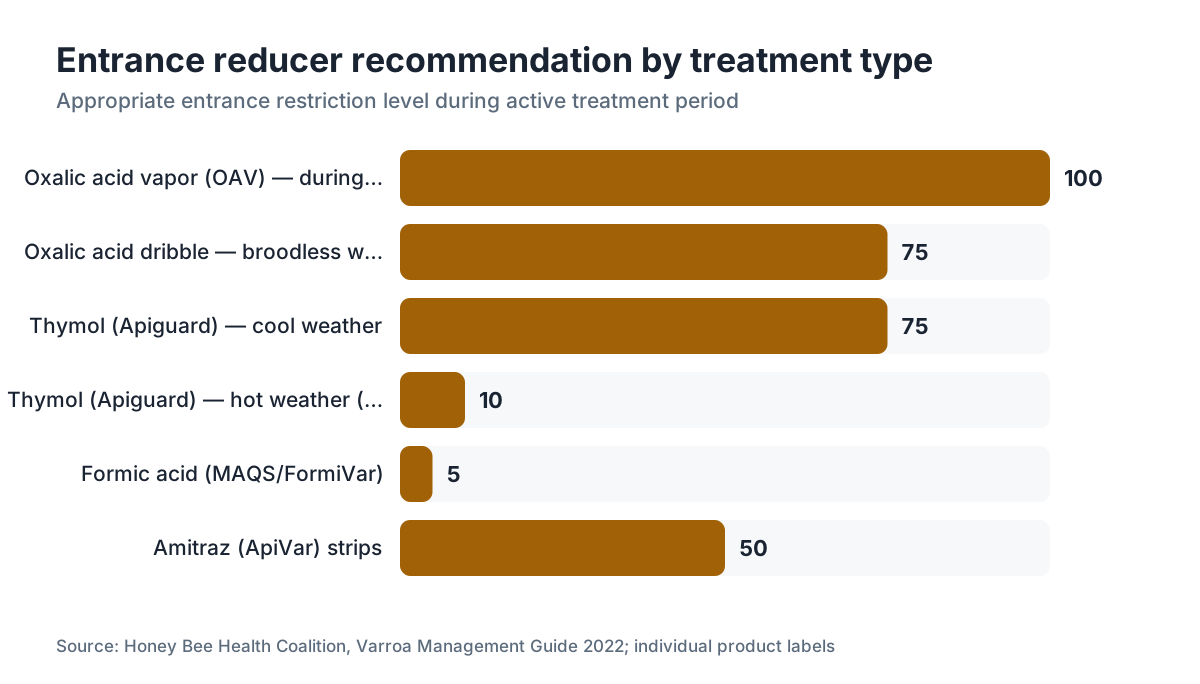
For oxalic acid vaporization (OAV), seal the entrance while you're actively treating, then keep it sealed for roughly 20 to 30 minutes after the last vaporization in a session. The logic is simple: you're pushing oxalic acid vapor into a closed box, and every gap is somewhere that vapor leaves instead of landing on a mite.
Most beekeepers seal the entrance with a foam strip or a folded towel during the vaporization itself, usually 2 to 3 minutes per hive, wait for the vapor to settle, then pull the foam. That's the floor. If you're running a series of three OAV treatments five days apart (a common brood-present protocol), you don't need a reducer between sessions. Just seal during each one.
Oxalic acid dribble is a different situation. It goes on broodless colonies in late fall or winter, and a reduced or closed entrance makes sense for other reasons. The colony is clustered, robbers and yellowjackets still work even in cool weather, and there's no ventilation reason to leave the door wide. Use a mouse guard or the small notch. The dribble itself doesn't need a seal the way vapor does, but don't leave the entrance gaping either.
The EPA-registered label for oxalic acid products such as Api-Bioxal says the hive entrance should be closed during vaporization [3]. That's a federal label requirement, not a tip.
What's the right entrance reducer approach for formic acid treatments (Mite Away Quick Strips, FormiVar)?
Formic acid is where entrance management really moves the needle, for both efficacy and bee safety, and it flips everything you just learned about oxalic acid.
Mite Away Quick Strips (MAQS) and FormiVar release formic acid vapor that soaks into capped brood cells. That reach under the cappings is the whole advantage. But the same vapor kills queens and bees when it builds up too high inside the hive. The MAQS label calls for normal hive ventilation during treatment [4]. So do NOT run a closed or heavily restricted entrance with formic acid strips.
MAQS should go on only when daytime highs land between 50°F and 85°F (10 to 29°C), and the label wants at least one upper entrance or screened bottom open so the hive doesn't overheat or concentrate vapor [4]. Block that airflow with a full reducer and formic acid can spike high enough to kill your queen. Not theoretical. Queen loss is one of the most reported side effects when MAQS runs in hot weather with restricted ventilation.
So for formic acid: keep a normal entrance, keep the screen open, and stay inside the label's temperature window. When the treatment ends (7 days for MAQS, or as labeled), go back to whatever entrance the season calls for.
Does entrance size matter during ApiVar or Apivar-type amitraz strip treatments?
ApiVar (amitraz strips) is a contact treatment. Bees walk across the strips, pick up amitraz, and pass it around through normal contact. It doesn't lean on temperature-driven volatilization or on vapor building up in a sealed box.
So during a 6 to 8 week ApiVar treatment, entrance size is about colony management, not chemistry. Pick the reducer position that fits your colony's strength and the season, not because amitraz asks for it. A weak, dwindling colony in September still needs a reduced entrance to block robbers, treatment or not. A strong August colony on ApiVar is fine with a larger opening as long as you're not seeing robbing.
One thing to watch. ApiVar runs a 56-day (8-week) window [5]. Over those two months the colony goes through normal fall contraction. An opening that made sense in August is often too wide by October. Adjust entrance size as the season moves, separate from the amitraz treatment itself.
When should you remove the entrance reducer after treatment ends?
Removing the reducer after treatment is about reading the colony and the season, not ticking a date off a calendar.
After spring or summer treatments, pull the reducer within a day or two of the treatment ending, as long as the colony is healthy and foraging hard. A strong April colony has no trouble defending a full opening. Leave a reducer on a booming spring colony too long and you get a traffic jam: bees piling up, a crowded landing board, orientation flights fouled.
Fall is a different math. Finish ApiVar in October in a northern state and the colony may never need a bigger entrance before winter. Go straight from the reduced treatment entrance into your overwintering setup, usually the small notch or a mouse guard.
Any colony coming off treatment that also looks weak (small cluster, spotty brood, low headcount) keeps its reduced entrance no matter what the treatment schedule says. A weak colony can't defend a wide door and reads as an easy target. Here the treatment calendar and the strength check have to agree before you open anything up.
The Honey Bee Health Coalition's Varroa Management Guide treats entrance management as part of integrated colony defense, and it's most useful in late summer, when yellowjacket pressure peaks right as treatments wrap up [6].
How do entrance reducers interact with screened bottom boards during treatment?
Screened bottom boards (SBB) add a second airflow path. If your hive has an SBB with the corflute insert pulled, you've got real airflow from below even with a tight reducer up front.
For oxalic acid vaporization, slide the corflute insert in and use it as a floor during treatment, then pull it after. Most OAV-experienced beekeepers do this without thinking. A screened bottom during OAV means the vapor you just generated drifts out the floor instead of hitting mites.
For thymol, a partly open SBB in mild weather can hold off overheating while still keeping the internal temperature high enough to work. That's a genuine tension: too much airflow drops the hive below 59°F and the treatment fails, too little airflow in warm weather cooks the colony. Apiguard's manufacturer guidance says that above 77°F (25°C), leaving the SBB partly open beats letting the colony overheat [2].
For formic acid (MAQS/FormiVar), you want normal or extra ventilation, so an open SBB helps rather than hurts.
For amitraz (ApiVar), the SBB position doesn't touch treatment efficacy. Set it for colony comfort and for mite-drop monitoring if you run sticky boards.
If you're sorting out the whole setup, entrance width, bottom board type, supers on or off, the protocol builder at VarroaVault can help you match those pieces to your treatment and season.
What entrance reducer position should you use by season?
Seasonal defaults exist for a reason, and treatments tend to land right on the transitions where entrance size matters most.
| Season | Typical colony status | Default entrance | Adjust for treatment? |
|---|---|---|---|
| Early spring (Feb-Apr) | Building, small cluster | Small notch or 4" | OAV: seal during treatment only |
| Late spring (May-Jun) | Growing fast | Full or 4" | Usually no change needed |
| Summer (Jul-Aug) | Peak, honey flow | Full open | ApiVar: no change; MAQS: keep full open |
| Late summer (Aug-Sep) | Drifting population down | 4" | Reduce for robbing season |
| Fall (Sep-Oct) | Contracting | 4" then small notch | OAV or ApiVar end: go straight to small notch |
| Winter (Nov-Feb) | Clustered | Mouse guard | No treatment window; maintain for mouse exclusion |
Late summer, August into September, is the highest-stakes stretch. It stacks peak robbing pressure, end-of-summer treatment timing, and a shrinking forager force all at once. Plenty of beekeepers are running ApiVar or a round of OAV dribble in this window. Keep entrances reduced. Yellowjackets are relentless and can take a hive in hours once a colony can't hold its door.
University extension programs in varroa-heavy states flag late summer as the highest-loss period for undertreated colonies, partly because high mite loads and robbing pressure feed each other [9].
Can an entrance reducer affect mite wash or sticky board counts during treatment?
Yes, though probably not the way you'd guess.
A reduced entrance doesn't change how many mites drop onto a sticky board or how many show up in an alcohol wash. The treatment does that. But entrance size can nudge the accuracy of your monitoring in a quiet way.
With a tight entrance and higher internal humidity (common with a closed corflute in fall), mites falling onto a sticky board may not travel the same as they do in summer. This is mostly a non-issue for the alcohol wash, which is the gold standard for infestation rate anyway [6].
The bigger indirect effect: a reduced entrance during treatment lifts colony temperature a little, and for thymol treatments that means better volatilization and more mite kill. So a post-treatment alcohol wash might read lower partly because the treatment worked better, not because the reducer touched the mites. Call it a package effect.
Run your post-treatment mite wash 2 to 3 days after the treatment period ends, not during it, so you're measuring residual infestation and not a treatment-disrupted snapshot [10].
Does a reduced entrance stress the bees or impair ventilation dangerously?
New beekeepers ask this constantly. Short answer: a standard 4-inch reduced entrance does not stress a healthy colony or trap dangerous heat under normal conditions.
Bees are very good at moving air by fanning. A colony in a 10-frame Langstroth deep with a 4-inch opening holds its brood nest within a degree or two of target, around 95°F (35°C), even in summer, as long as the ambient temperature isn't extreme [8]. The fanners at the entrance handle the airflow math.
The real danger is a reduced or blocked entrance paired with a thymol or formic acid treatment during a heat spike above 85°F. That's when you get queen loss, frantic propolis fanning, and in the worst cases comb meltdown. If a thymol treatment is going to run into 80-plus weather, either wait or pull the reducer and let the screened bottom hold the vapor.
A 1-inch mouse notch in January is fine. The cluster makes its own heat, and the tiny opening keeps mice out without hurting temperature control. That's exactly what the notch is for.
Good entrance reducers are cheap and easy to overlook, one of the more useful beekeeping supplies to keep on hand. Buying or building, make sure you have both positions: the 4-inch foraging slot and the 1-inch winter notch.
What if you're treating a newly installed package or a nucleus colony?
Packages and nucs are their own case. They almost always need a reduced entrance no matter what the treatment status is, because the populations are small and they haven't built the defensive geography a full colony has.
For a spring package, use the small opening for the first 2 to 3 weeks at least. If you treat a package with oxalic acid, usually a broodless dribble in the first few days, the reduced entrance already fits the colony's size, so there's nothing extra to do beyond sealing for OAV if you go that route.
A nuc being treated, say you move it into a full box and start ApiVar, keeps a reduced entrance until it fills the box. That might take 4 to 8 weeks. Don't rush the door open thinking it speeds buildup. It doesn't, and it hands a small colony to robbers who can collapse it faster than varroa would.
A varroa mite infestation hits a nuc proportionally harder than a full colony, because there are fewer host bees to carry the mite load before it crashes the whole thing. Treat early and manage the entrance. The two go together.
What do university extension services and the Honey Bee Health Coalition actually recommend?
The Honey Bee Health Coalition (HBHC) Varroa Management Guide, last updated in 2022, is the most cited practitioner reference in North America. It recommends entrance reducers as part of colony defense during treatment, especially in late summer and fall when robbing runs high and colonies are contracting [6].
Penn State Extension, one of the more active university programs on varroa, tells beekeepers to reduce the colony entrance to the smallest opening the current forager population can defend during any August or September treatment, with robbing as the main reason [7]. They point out that robbing-related loss can waste a finished treatment by wiping out the treated bees before they ever reach winter.
For product-specific rules, the EPA-registered labels are the legal and practical authority. The Api-Bioxal label (oxalic acid) says the entrance must be closed or sealed during vaporization [3]. The MAQS label says ventilation must not be restricted during treatment [4]. Those two instructions point in opposite directions because they're different treatments. The common mistake is applying OAV sealing logic to a formic acid treatment, or the reverse.
No extension program or the HBHC gives a "remove the reducer by day X" rule, because that's genuinely colony-specific. What they agree on: colony strength and season drive entrance management, and treatment timing is one factor among several, not the whole story.
Frequently asked questions
Should I close the entrance completely during oxalic acid vaporization?
Yes, during the active vaporization, usually 2 to 3 minutes. The Api-Bioxal label, the EPA-registered label for oxalic acid in the US, requires the entrance closed during vaporization so the vapor stays inside long enough to contact mites. After the session, open it once the vapor settles, usually within a few minutes.
Can I leave the entrance reducer on all summer while ApiVar strips are in the hive?
You can, but match the opening to colony size and temperature. A strong summer colony in a 10-frame box with heavy foraging handles a larger entrance well. ApiVar doesn't need entrance restriction because it's a contact treatment, not a vapor one. Use the opening that stops robbing without jamming up the landing board.
Does a screened bottom board replace the entrance reducer during treatment?
No, they do different jobs. A screened bottom gives ventilation from below and lets mites fall out. An entrance reducer limits the opening bees and robbers use. For oxalic acid vaporization you need both: corflute insert in to hold vapor, and entrance sealed during treatment. For formic acid, keep the SBB open and the entrance at normal size.
How small should the entrance be during late summer robbing season?
Four inches or less is standard for a colony of normal strength (5 or more frames of bees) in late summer. For a weak colony or a nuc, use the 1-inch mouse notch. Late August through September is when yellowjacket pressure peaks and forager numbers fall, so this is the window where entrance size makes or breaks a colony against robbing.
Will a reduced entrance hurt my treatment for Apiguard or other thymol products?
No. A 4-inch reduced entrance in cool fall weather actually helps Apiguard by letting the colony hold heat above the 59°F minimum thymol needs to volatilize. The risk runs the other way: too large an opening in cool weather bleeds heat and drops the internal temperature below the threshold. In hot weather above 80°F, pull the reducer to prevent overheating.
When should I switch from the reduced entrance slot to a mouse guard for winter?
Switch before mice start scouting entrances, usually when nighttime temperatures stay below 40°F, late October or early November in most northern states. If your fall varroa treatment ends in October, go straight from the reduced slot to the mouse guard rather than opening the entrance fully for any stretch. The colony doesn't need a bigger opening then.
Can a robbing attack during treatment wipe out the treatment's benefit?
Yes, in two ways. A robbing event can collapse the colony outright, making the treatment pointless. And robbers from an untreated hive carry varroa in, reinfesting faster than your treatment cleared the original load. Penn State Extension flags this as one of the main reasons fall treatment success rates run lower than spring rates.
Do I need an entrance reducer if I'm using a top entrance only?
If a top entrance is your primary entrance during treatment, reduce or cover the bottom entrance the same way you'd use a reducer. Robbers find any gap. For OAV, seal every entrance including the top during vaporization, then reopen after. For formic acid, keep at least one unobstructed entrance or ventilation point open as the label requires.
How long after treatment ends should I wait before removing the entrance reducer?
There's no universal waiting period. For spring and summer treatments, pull the reducer within a day or two of the treatment ending if the colony is strong. For fall treatments ending in September or October, keep the reducer in and move to a mouse guard rather than opening wider. Colony strength and season matter more than days elapsed.
Does entrance reducer size affect whether oxalic acid is safe to use?
For OAV, yes. The entrance must be sealed during vaporization as a label requirement, partly for efficacy and partly to limit applicator exposure to the vapor. For dribble, there's no sealing requirement. Oxalic acid is a naturally occurring compound approved by the EPA for honey bee colonies, and the Api-Bioxal label is the governing use and safety document for registered products in the US.
What happens if I forget to reduce the entrance before starting a formic acid treatment?
With MAQS or FormiVar, forgetting is actually the safer mistake, because formic acid labels want normal or increased ventilation. What you must not do is block airflow. If you left the entrance fully open, the treatment still works; the only cost is slightly faster vapor loss in cool weather. The dangerous error is over-restricting ventilation, not leaving it open.
Should entrance management be different for Africanized honey bees under treatment?
In areas with Africanized genetics, the same entrance principles apply during treatment, but Africanized colonies are generally more defensive and often need less robbing protection because they guard entrances aggressively. Even so, a stressed or freshly treated Africanized colony can still get robbed if its population drops hard. Read more on regional traits in our guide to the africanized honey bee.
Can I use entrance reducers as a substitute for varroa treatment?
No. Entrance reducers protect a colony during treatment and cut reinfestation from robbers carrying mites, but they do nothing to the mites already inside. A colony at 3% infestation or higher needs an active treatment (oxalic acid, formic acid, amitraz, or thymol), more than a smaller door.
Sources
- Penn State Extension, Beekeeping in Pennsylvania: Entrance management during late summer and fall to prevent robbing, including reducing to 4-inch or smaller openings for weakened or treated colonies
- Vita (Europe) Ltd, Apiguard Prescribing Information and Label: Apiguard requires minimum ambient temperature of 59°F (15°C) and preferably 65-70°F (18-21°C) for thymol to volatilize and treat effectively
- US EPA, Pesticide Registration (Api-Bioxal / oxalic acid): Api-Bioxal label requires that hive entrances be closed or sealed during oxalic acid vaporization treatment
- NOD Apiary Products, Mite Away Quick Strips (MAQS) Label and Prescribing Information: MAQS label specifies that normal hive ventilation must be maintained during treatment and that a screened bottom board or upper entrance is recommended; application temperature 50-85°F
- Elanco Animal Health, ApiVar (Amitraz) Product Label: ApiVar treatment period is 56 days (8 weeks) per the registered product label
- Honey Bee Health Coalition, Varroa Management Guide (2022): HBHC recommends entrance reducers as part of integrated colony defense during treatment periods, particularly in late summer when robbing and yellowjacket pressure peaks; alcohol wash is the gold standard for infestation rate monitoring
- Penn State Extension, Beekeeping (varroa and robbing guidance): Penn State Extension advises reducing entrance to smallest appropriate opening during August-September treatment windows due to robbing risk; robbing-related colony loss can negate completed treatments
- USDA Agricultural Research Service: Honey bee colonies maintain brood nest temperature near 95°F (35°C) through fanning behavior; a 4-inch entrance does not meaningfully impair temperature regulation in a healthy colony under normal ambient conditions
- University of Minnesota Extension: Late summer (August-September) identified as highest-loss period for undertreated colonies due to combination of peak mite loads and robbing pressure from dwindling forager populations
- Honey Bee Health Coalition, Tools for Varroa Management Field Guide: Post-treatment mite wash should be conducted 2-3 days after treatment period ends for accurate measurement of residual infestation rate
Last updated 2026-07-09