Essential oils for varroa mites: what actually works
TL;DR
- Thymol is the only essential oil with EPA-registered varroa treatments (Apiguard, Api Life VAR) and solid field efficacy, typically 74 to 93% mite knockdown under the right conditions.
- Oregano, mint, and other oils show lab promise but lack registered products and consistent field data.
- No essential oil replaces oxalic acid or synthetic miticides when mite loads run high.
Do essential oils actually kill varroa mites?
Some do, under specific conditions. The honest answer depends entirely on which oil, what formulation, what temperature, and how high your mite load is.
The research here is uneven. Thymol, the active compound in thyme oil, has decades of field trials and two EPA-registered products behind it. That's a different category than lavender oil dabbed on a hive entrance. When beekeepers lump those together under "essential oils for varroa," they're comparing a registered pesticide with a cooking ingredient.
Other oils have shown acaricidal activity in lab bioassays. Oregano oil, wintergreen, spearmint, lemongrass, and clove all kill mites on a glass slide. Petri-dish results, though. The jump from a bioassay to a meaningful drop in a 60,000-bee colony is large, and most oils don't make it cleanly.
So yes, essential oils can kill varroa mites. Thymol does it well enough that regulators approved it. The rest are still looking for their moment.
Which essential oils have real evidence against varroa?
Only thymol has a track record and a label. Oregano (carvacrol) is the most scientifically credible next candidate. Everything else is speculation with some lab backing. Here's where the evidence actually lands.
Thymol is in a class by itself. It's the active ingredient in Apiguard (thymol gel, 25 g active per 50 g dose) and Api Life VAR (thymol 74.1% with eucalyptol, menthol, and camphor) [1][2]. A 2002 field trial published in Apidologie found Apiguard achieved 74 to 93% mite mortality depending on ambient temperature and application protocol [12]. The EPA registered both products under FIFRA, which means efficacy and safety data were submitted and reviewed [3].
Oregano oil (carvacrol) is the runner-up in the lab literature. Carvacrol, the main phenol in oregano oil, is chemically close to thymol and shows real acaricidal contact toxicity against Varroa destructor in bioassays [4]. A 2014 study in Experimental and Applied Acarology found carvacrol had LD50 values comparable to thymol in adult mite exposure tests. No EPA-registered oregano product exists for hive use as of this writing, and field trials are sparse.
Menthol was used in the U.S. under registered tracheal mite products for years before falling out of favor. It has measurable acaricidal effect but is highly temperature-sensitive and can drive bees to abscond if overdosed. No current varroa label covers it in most states.
Wintergreen (methyl salicylate) shows up in older hobbyist literature. Lab data exist. Field data are thin and inconsistent.
Lemongrass, clove, rosemary, and neem all appear in bioassay papers. None have come close to registration-grade field evidence for varroa control.
| Oil / Compound | EPA-Registered Product | Field Efficacy Data | Lab Acaricidal Activity |
|---|---|---|---|
| Thymol | Yes (Apiguard, Api Life VAR) | Strong (74 to 93%) [1][12] | Strong |
| Carvacrol (oregano) | No | Sparse | Moderate to strong [4] |
| Menthol | No (varroa) | Moderate | Moderate |
| Methyl salicylate (wintergreen) | No | Weak/inconsistent | Moderate |
| Clove (eugenol) | No | Very sparse | Moderate |
| Lemongrass | No | None found | Weak |
How does thymol work against varroa mites?
Thymol is a monoterpenoid phenol. It disrupts mite neurological and respiratory function through contact and fumigation. The fumigant action is the important part. Thymol volatilizes at hive temperatures and reaches mites in capped brood cells, which is where varroa reproduces. Most soft treatments that only contact adult phoretic mites miss the majority of the population.
That fumigant property is also what makes thymol temperature-dependent. Below 59 degrees F (15 degrees C), it doesn't volatilize enough to work. Above roughly 105 degrees F (40 degrees C), it can cause bee mortality and queen loss. The Apiguard label specifies application when daytime temperatures sit consistently between 60 and 105 degrees F [1]. That window matters enormously in practice.
Thymol does not kill mites inside capped cells as reliably as it kills phoretic mites. Efficacy shifts with colony strength, ventilation, and the amount of capped brood at treatment time. Interrupting brood before treatment lifts kill rates, because you remove the mite's refuge.
Nobody should treat thymol as a failsafe. It's a good tool in the right conditions, with real limits.
How do you use Apiguard and Api Life VAR correctly?
Both products go on the top bars of the brood box, directly below the crown board or inner cover. The colony's air circulation carries thymol vapor down through the brood nest.
Apiguard protocol (from the EPA label [1]): apply one 50 g tray, leave it 2 weeks, remove it, then apply a second tray for another 2 weeks. That's a 4-week treatment. The tray goes face-up on the top bars. Keep the entrance reducer partly open for some ventilation, but not so open that the hive cools below threshold. Do not apply when daytime highs are below 60 degrees F.
Api Life VAR protocol [2]: place two tablets, one on each side of the hive, on the top bars. Replace each tablet weekly for 3 to 4 applications. The multi-compound formula (thymol plus eucalyptol, menthol, and camphor) releases a little differently than pure thymol gel and tends to perform better in warmer climates.
A few things kill your results with both products. Leaving the super on is the first. Both labels require honey supers for human consumption to come off before and during treatment, because thymol taints honey. Treating in cold fall weather is the second. If you think mites are high but temperatures have already dropped, you're wasting product while the colony keeps getting hammered. Skipping Apiguard's second tray is the third. "The mite wash dropped" is not the same as full knockdown, and one cycle rarely finishes the job.
Want to know if the treatment worked? Do an alcohol wash or sugar roll before you start and again 3 to 4 days after the second Apiguard tray comes off. See varroa mite for washing protocols.
Can oregano oil treat varroa mites in a hive?
Not legally in the U.S. as a standalone treatment. Oregano oil has no EPA registration for varroa control, so selling it as a pesticide or labeling it as a varroa treatment is a FIFRA violation [3].
The underlying chemistry is genuinely interesting, though. Carvacrol makes up roughly 60 to 80% of most oregano essential oils, and it's structurally close to thymol. Both are monoterpenoid phenols that attack arthropod nervous and respiratory systems. The 2014 Experimental and Applied Acarology study found carvacrol had contact toxicity comparable to thymol in adult mite assays [4]. Other laboratory work has found oregano-derived compounds effective in bioassays against Varroa destructor.
Here's the honest problem. Lab bioassays don't reproduce hive conditions. Volatilization rates, hive geometry, bee detoxification, and the sheer biomass of a colony all decide whether a compound reaches enough mites at a lethal dose. Nobody has published a well-controlled field trial showing oregano oil products consistently drop mite loads to safe levels in a full colony. Until that data exists, oregano oil sits in the promising-but-unproven bucket.
Some beekeepers mix oregano oil into grease patties or syrup. There's no peer-reviewed evidence those routes work. Thymol travels through the hive as a vapor. Oral routes and contact patties don't deliver the fumigant mechanism that makes thymol effective. Oregano in patties likely does very little to mite populations.
Experiment if you want, but document your mite washes before and after. Don't rely on it as your primary control when a colony hits 2 to 3% infestation or higher.
Are essential oils safe for bees and for honey?
Thymol at label rates is generally well-tolerated by bees, with two exceptions: high temperatures and queen presence. Above 105 degrees F, thymol concentrations in the hive can reach levels that harm brood and queens. Some beekeepers report elevated queen loss during summer Apiguard treatments in hot climates. The Honey Bee Health Coalition's varroa management guide flags heat and ventilation as key factors when using thymol [5].
Honey contamination is real. Thymol is fat-soluble and lipophilic. It transfers into honey and wax in contact with the treatment area. Both EPA labels require supers to be removed during treatment [1][2]. Studies have found thymol residues persisting in wax for extended periods after treatment. The EU sets a maximum residue level of 0.8 mg/kg for thymol in honey. The U.S. has no specific honey residue limit, but the label super-removal requirement covers it in practice.
For unregistered oils like oregano or wintergreen, there are no established safety thresholds in honey or wax, no label directions, and no data on sublethal effects at hive-relevant doses. That's no reason to assume they're safe. Some compounds used informally cause brood problems, queen rejection, or colony abandonment at moderate doses.
Sell honey? Stick to labeled products. The liability and food safety exposure from unlabeled compounds isn't worth it.
What does the Honey Bee Health Coalition say about essential oils for varroa?
The coalition recommends only EPA-registered products, and among essential oils that means thymol. The Honey Bee Health Coalition publishes the most widely cited practical guide to varroa management in North America [5]. Its tool selector lists thymol-based products as an approved option under the organic/soft chemical category, alongside oxalic acid and formic acid.
Their guidance is direct. Thymol products work when temperatures stay in the 60 to 105 degrees F window, when honey supers are off, and when the treatment runs the full labeled duration. They note thymol loses efficacy when colonies carry large amounts of capped brood. The coalition places thymol as a supplemental option, not the first choice when mite loads are high late in the season.
The coalition does not recommend unregistered essential oils for varroa. Its guide advises that only EPA-registered products should be used for varroa control to ensure efficacy and safety [5]. That's the professional consensus.
The guide is free and updated regularly. If you haven't read it, give it an afternoon.
How do essential oil treatments compare to oxalic acid and synthetic miticides?
Thymol sits in a useful middle ground, softer than synthetics and more temperature-fussy than oxalic acid. This is the comparison most beekeepers actually need.
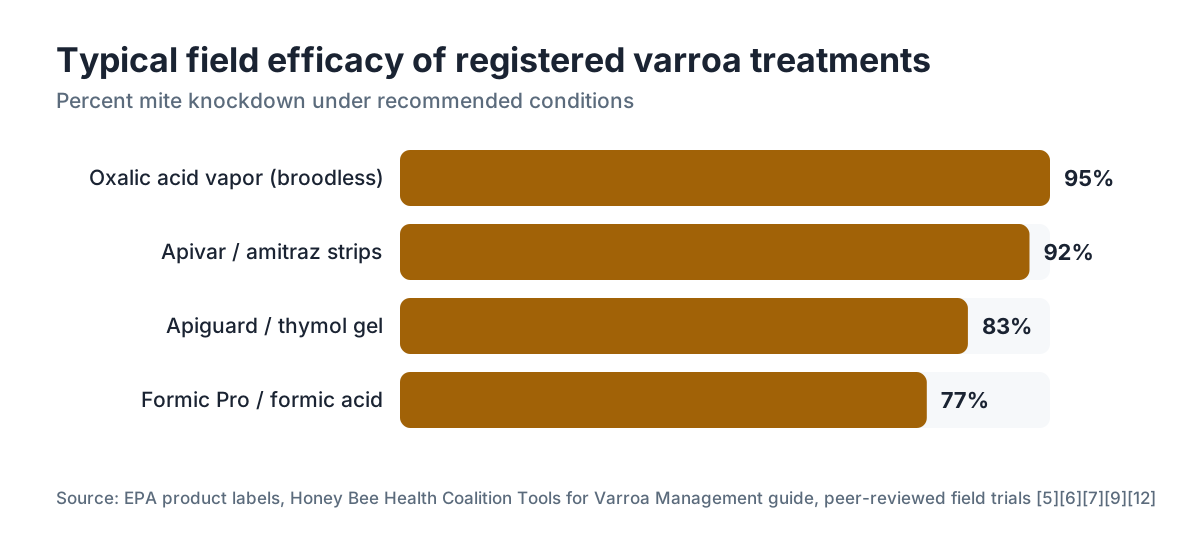
Oxalic acid is the most effective registered soft treatment available, especially as a vapor or dribble when no capped brood is present. Field trials consistently show 90 to 97% mite knockdown in broodless conditions [6]. It's cheaper per treatment than thymol products and works at lower temperatures. For a late-fall or mid-winter treatment in a broodless colony, oxalic acid beats thymol on every metric.
Synthetic miticides, mainly Apivar (amitraz strips) and Apistan (fluvalinate strips), hit 90%-plus efficacy in trials with little temperature sensitivity [7]. The downside is resistance. Fluvalinate resistance is widespread in U.S. varroa populations [8], and amitraz resistance has turned up in some regions. Rotation matters.
Thymol has no known resistance issues, leaves no persistent wax residues the way synthetic miticides do, and works reasonably well in warm-season treatments when you want to avoid synthetics. A beekeeper running packages or nucs in spring and summer, who wants to treat without pulling supers off established production colonies, faces a real constraint. Thymol gives them an option, with the caveat of timing and temperature.
Unregistered essential oils don't belong on this chart. They lack the efficacy data to make comparison meaningful.
| Treatment | Typical Efficacy | Best Use Timing | Temperature Range | Resistance Risk |
|---|---|---|---|---|
| Oxalic acid (vapor) | 90 to 97% [6] | Broodless periods | 40 degrees F+ | None documented |
| Apivar (amitraz) | 90 to 95% [7] | Spring/fall | Wide range | Emerging in some regions |
| Apiguard (thymol) | 74 to 93% [1][12] | Summer/early fall | 60 to 105 degrees F | None documented |
| Api Life VAR (thymol) | Similar to Apiguard [2] | Summer/early fall | 60 to 105 degrees F | None documented |
| Formic acid (Formic Pro) | 65 to 90% [9] | Spring/fall | 50 to 85 degrees F | None documented |
| Unregistered EOs | Unknown | N/A | N/A | N/A |
Can essential oils be used without a prescription or license?
Apiguard and Api Life VAR are EPA-registered and sold over the counter in the U.S. You don't need a veterinary prescription to buy them. They move through standard beekeeping supply companies and ship from major online suppliers.
That's an advantage over antibiotics like oxytetracycline for bacterial brood diseases, which require a veterinary feed directive. The registered thymol products carry no such gate.
Thymol products have had periodic availability problems, so check current stock at your regional retailers. Some beekeepers buy in spring when demand runs lower.
Unregistered essential oils don't require a prescription because they aren't registered as pesticides at all. Using them as pesticides without registration violates FIFRA. The gray area is wide and mostly unenforced at the hobbyist level, but it's still the legal reality [3].
If you're a newer beekeeper sorting through the available tools, VarroaVault's free protocol tools help you map a treatment calendar to your region and hive status.
What temperature and season conditions do essential oil treatments need?
Temperature is the single biggest variable separating a successful thymol treatment from a wasted one. Thymol only volatilizes at hive-relevant concentrations when ambient temperatures stay reliably between 60 and 105 degrees F [1]. That's not a guideline. It's chemistry.
In practice, most of the continental U.S. has a workable thymol window from roughly late April through September, depending on latitude and elevation. Beekeepers in the Pacific Northwest or at altitude often struggle to hit the temperature floor consistently, even in summer. Beekeepers in the Deep South run into the upper ceiling and risk queen damage in July or August treatments.
The best timing for thymol is post-harvest, early fall, when temperatures are still in the 70s and the colony is starting its winter bee rearing cycle. Getting mite loads down before that winter bee cohort is produced matters enormously for survival, as the Honey Bee Health Coalition stresses [5]. Varroa-damaged winter bees mean spring population crashes.
Don't stretch thymol into October in a northern state. Switch to oxalic acid instead.
Does treating with essential oils affect honey flavor or wax safety?
Thymol has a distinct herbal flavor. At low residue levels you won't taste it, but leave supers on during treatment (which the label prohibits) and you'll get detectable off-flavors. European beekeepers have reported thymol-flavored honey from nearby thyme agriculture, so even natural exposure shifts flavor.
Thymol in wax is well-documented. A study analyzing beeswax samples found thymol at detectable levels in wax from treated colonies well after treatment ended [10]. It doesn't build up the way synthetic miticides do (fluvalinate has a strong affinity for wax), but residues exist. For hobbyists making cosmetics or selling wax, that's worth knowing.
Unregistered oils come with no residue data and no established thresholds. Treat with homemade oregano patties or wintergreen-soaked cardboard and sell the honey or wax, and you're in territory with no safety validation.
Running a certified organic operation? Thymol-based products can be compatible with organic certification depending on your certifier and the specific program. The USDA National Organic Program allows certain thymol products. Check with your certifier before assuming [11].
Should I use essential oils as my main varroa treatment?
For most hobbyist and sideliner beekeepers, probably not as your sole strategy, but thymol products earn a place in your rotation.
Here's how I'd think about it. Treating in summer with honey supers off and want a soft option? Apiguard or Api Life VAR are legitimate choices. They're gentle on bees, leave no persistent wax residues, carry no resistance concerns, and are legal and labeled. Doing a post-harvest fall treatment while temperatures drop fast? Oxalic acid outperforms thymol on efficacy and cost. Above 3% mite load heading into fall? Use the most effective tool available (amitraz if you can get it, or oxalic acid) rather than gambling on a 74 to 80% knockdown product.
Thymol works best inside an integrated approach: mite monitoring every 30 days, treatment thresholds based on real counts, and treatment selection driven by season and colony status. Leaning on thymol or any single tool every cycle builds selection pressure and wastes opportunity.
VarroaVault's free protocol OS is built around exactly this kind of scheduling. Run your treatment calendar there to see how thymol fits your region and timing.
For the bigger varroa mite management picture, the essential oils story is really the thymol story. Everything else is still in the research pipeline.
Frequently asked questions
Is oregano oil safe to put directly on a beehive?
There's no EPA-registered product using oregano oil, and no published safety threshold for bee exposure or honey residues. Oregano oil at high concentrations is toxic to insects, bees included. Using it without a label or established dose risks harming your colony. Carvacrol, the active compound, shows lab promise against varroa but has no validated hive application protocol. Until registered products exist, avoid treating directly with raw oregano oil.
Can I make a DIY essential oil varroa treatment at home?
You can mix things and apply them, but doing so for varroa control is technically a FIFRA violation if you're using the mixture as a pesticide without EPA registration. Enforcement against hobbyists is rare. The bigger problem is efficacy: no DIY essential oil recipe has been validated in field trials. You may think you're treating while mites keep reproducing unchecked. If mites are at threshold, use a registered product.
How much does Apiguard cost per treatment?
As of 2024 to 2025, a single treatment pack of Apiguard (two 50 g trays, enough for one full colony treatment) runs roughly $8 to $15 depending on supplier and quantity. Buying by the bulk tray drops the per-colony cost. Api Life VAR runs similar, around $8 to $14 per colony. Both cost more per colony than oxalic acid, which is typically under $2 per hive treatment when bought in bulk.
At what mite level should I use a thymol treatment vs. something stronger?
The Honey Bee Health Coalition sets a treatment threshold near 2% infestation (2 mites per 100 bees on an alcohol wash) outside the winter-bee rearing period, and closer to 1% during that late-summer window. Thymol at 74 to 93% efficacy is workable at lower mite loads. At 3% or above heading into August, I'd pick oxalic acid vapor or amitraz for the higher knockdown rate.
Can I use Apiguard while honey supers are on the hive?
No. The Apiguard label requires honey supers for human consumption to be removed before and during treatment. Thymol transfers into honey and causes off-flavors and residues above acceptable levels. This is a labeled restriction and a food safety issue, more than a suggestion. Remove supers, treat, and wait until treatment is complete before adding supers back.
Does thymol treatment kill varroa inside capped brood cells?
Partially, but not reliably. Thymol fumigates through the hive atmosphere and can penetrate cappings to some degree, but field studies show reduced efficacy when large amounts of capped brood are present. Most of the mite population sits inside capped cells at any given time. Interrupting brood before treatment improves knockdown. Caging the queen for 24 days before treatment is one way to extend the broodless window.
Will varroa mites develop resistance to thymol treatments?
No resistance to thymol has been documented in Varroa destructor populations in current literature. That's one of thymol's advantages over synthetic miticides like fluvalinate, where resistance is widespread in the U.S. The mechanism of thymol toxicity (contact and fumigant action on the nervous and respiratory system) may make resistance less likely, though it can't be ruled out under sustained selection pressure over time.
How do I know if my essential oil varroa treatment actually worked?
Do an alcohol wash or sugar roll before treatment to set a baseline count. Repeat it 3 to 5 days after the treatment period ends. If the infestation rate dropped by 75% or more, the treatment worked reasonably well. If it's still above 1 to 2%, follow up with a different mechanism, like oxalic acid. Never skip the post-treatment wash. Assumed success is how colonies die going into winter.
Are thymol-based treatments compatible with organic beekeeping certification?
Potentially yes, depending on your certifier. The USDA National Organic Program allows certain thymol products in organic hive management. NOP rules and individual certifier policies vary, and not all thymol formulations may be approved on your specific program. Check with your certifier before treating, and keep documentation of the product name, lot number, and application dates.
Can I use essential oils to prevent varroa rather than treat an active infestation?
No essential oil product has shown reliable preventive efficacy in field conditions. Varroa reproduces inside capped brood continuously, so there's no chemical you can apply preventively that holds mite populations down over a season. The right approach is regular monitoring (alcohol wash every 30 days) and treating when counts hit threshold. Preventive essential oil use gives a false sense of protection while mites build.
What's the difference between Apiguard and Api Life VAR?
Both use thymol as the primary active, but the formulations differ. Apiguard is a slow-release thymol gel applied as a single tray. Api Life VAR is a tablet containing thymol (74.1%) plus eucalyptol, menthol, and camphor, applied in pieces over multiple weeks. Api Life VAR is reported to perform somewhat better in hotter climates because its multi-compound release differs from pure thymol gel. Both need the same temperature window and super-removal protocols.
Does lemongrass oil do anything useful against varroa mites?
Lemongrass oil attracts swarms (it mimics the Nasonov pheromone) but has weak evidence as a varroa acaricide. Lab bioassays show some activity at high concentrations, but no field trials demonstrate meaningful mite reduction in a live colony. It's not a useful varroa treatment on current evidence. Don't confuse its use as a swarm lure with any mite management function.
How do essential oil treatments affect queen bees?
Thymol at label rates and temperatures carries a low but non-zero risk of queen loss, particularly when ambient temperatures near the upper limit (around 100 degrees F) or when the tray sits very close to the queen. Api Life VAR's label advises placing tablets away from the brood cluster center for this reason. Some beekeepers report elevated queen problems with summer thymol treatments in hot climates. Check for queen presence 2 to 3 weeks after treatment.
Sources
- EPA, Apiguard product label (Vita Europe Ltd), Registration No. 68858-1: Apiguard protocol, temperature window of 60 to 105 degrees F, honey super removal requirement, and two-tray 4-week application schedule
- EPA, Api Life VAR product label (Chemicals Laif S.p.A.), Registration No. 68858-2: Api Life VAR active ingredients (thymol 74.1%, eucalyptol, menthol, camphor), application protocol, and temperature requirements
- U.S. EPA, Pesticide Registration under FIFRA: FIFRA registration requirements for pesticide products including varroa treatments; unregistered use as a pesticide is a violation
- Experimental and Applied Acarology (Springer), Ruffinengo et al. 2014, essential oil acaricidal activity against Varroa destructor: Carvacrol (oregano oil) showed acaricidal contact toxicity against adult Varroa destructor in bioassays with LD50 values comparable to thymol
- Honey Bee Health Coalition, Tools for Varroa Management guide: Thymol listed as an approved soft treatment; coalition recommends only EPA-registered products; treatment threshold guidance near 2% infestation; temperature and ventilation management noted as key factors
- USDA Agricultural Marketing Service, National Organic Program oxalic acid technical report; Rademacher & Harz 2006, Apidologie: Oxalic acid vapor achieves 90 to 97% mite knockdown in broodless colonies in field conditions
- EPA, Apivar product label (Veto-pharma), Registration No. 87243-1: Apivar (amitraz) achieves 90 to 95% efficacy in field trials referenced on label data; wide temperature range
- Pettis 2004, Apidologie, fluvalinate resistance in Varroa destructor in the United States: Fluvalinate resistance is widespread in U.S. Varroa destructor populations as documented in field and laboratory assays
- EPA, Formic Pro product label (NOD Apiary Products): Formic acid (Formic Pro) achieves 65 to 90% efficacy in field trials; temperature range 50 to 85 degrees F; no resistance documented
- Journal of Apicultural Research, thymol residues in beeswax after Apiguard treatment: Thymol was detected in beeswax from treated colonies well after treatment ended
- USDA National Organic Program, organic rules and regulations (7 CFR Part 205): NOP allows certain thymol-based products in organic hive management; certifier-specific approval required
- Gregorc & Planinc 2002, Apidologie, acaricidal effect of thymol-containing preparations (Apiguard) on varroa mites: Apiguard field trials showed 74 to 93% mite mortality depending on ambient temperature and application conditions
Last updated 2026-07-09