Flumethrin mode of action in Bayvarol strips explained
TL;DR
- Flumethrin, the active ingredient in Bayvarol strips, kills varroa mites by forcing their nerve sodium channels open and holding them there.
- The nerves fire without stopping.
- The mite goes into tremors, then paralysis, then dies.
- Bees shrug it off because their nerve channels bind flumethrin weakly and they break the compound down faster.
- Each strip carries 3.6 mg of flumethrin, released over 6 to 8 weeks at brood-nest temperature.
What is flumethrin and how does it fit into varroa treatment?
Flumethrin is a synthetic pyrethroid, a chemical class built to copy the natural pyrethrins in chrysanthemum flowers. In Bayvarol strips it's the only active ingredient, at 3.6 mg per strip [1]. Four strips go into a standard colony for six to eight weeks. That makes it one of the slower-release acaricide formats you can buy.
Pyrethroids have been used in farming and veterinary work since the 1970s. Flumethrin is a Type II pyrethroid, meaning it carries a cyano group at the alpha position [12]. That sounds like trivia. It isn't. Type II pyrethroids hold nerve channels open longer than Type I compounds, which gives better knock-down at lower doses against tough arthropod parasites like varroa mites.
Bayvarol has been registered in Europe since the early 1990s and holds EPA registration in the United States [2]. Rules on how you buy it vary by state, so check your local requirements before ordering from beekeeping supply companies.
How exactly does flumethrin kill varroa mites?
The target is the voltage-gated sodium channel in the mite's nerve cells. In a healthy nerve, these channels flick open when an impulse arrives, let a rush of sodium in, then snap shut within milliseconds. That quick open-and-shut cycle is how a nerve fires a signal and resets for the next one.
Flumethrin binds a specific site on the channel and jams it open [1]. The channel can't close. Sodium keeps pouring in. The nerve fires nonstop instead of in clean pulses, a state called repetitive depolarization. In the mite that means tremors, then staggering, uncoordinated movement, then full paralysis. Death comes fast because a paralyzed mite can't feed, can't move, and can't hold onto its host.
This is a contact kill, not a poison the mite has to eat. The mite doesn't swallow anything. It just needs to walk across treated comb or touch a bee carrying flumethrin residue picked up from a strip. That's the whole reason strip placement between brood frames matters so much. Bees move constantly through the nest and carry trace amounts of the compound to corners the strips themselves never touch.
Type II pyrethroids like flumethrin also disturb chloride channels in some arthropods, which knocks out inhibitory nerve signaling on top of the excitatory chaos. Hit both the excitatory and the inhibitory pathways at once and recovery becomes impossible at field concentrations.
Why doesn't flumethrin kill honey bees at the same dose?
The honest answer has two parts: bee nerve channels bind flumethrin weakly, and bees break the compound down fast.
Honey bees have voltage-gated sodium channels too. But the molecular shape of a bee's channel differs enough from a mite's that flumethrin sticks to it with much lower affinity. Studies comparing pyrethroid sensitivity in Apis mellifera versus Varroa destructor report selectivity ratios (the dose that kills half the bees divided by the dose that kills half the mites) running from the hundreds into the low thousands, depending on compound and test setup [3]. Flumethrin lands at the more selective end of the common acaricides.
Bees also detoxify pyrethroids through cytochrome P450 monooxygenases and esterases far better than mites do. Their bigger bodies and thicker cuticle slow absorption. And a bee that brushes a sublethal dose off a strip can leave. A mite riding a bee cannot.
Selectivity has a ceiling, though. Push the concentration high enough and flumethrin will hurt bees. Cram in double the labeled strips, or put a full colony dose into a tiny nucleus, and you can drive concentrations into the range where queens die and adult bees show toxicity. Dose to the label.
How do the strips actually deliver flumethrin inside the hive?
Each Bayvarol strip is a polyvinyl chloride matrix soaked through with flumethrin. The compound slowly migrates from the interior of the plastic to its surface. Temperature sets the pace. At the 34 to 35 degrees C of a brood nest, a strip gives off flumethrin steadily across the full treatment window. Cool it down and release slows hard [1].
When a bee walks across a strip or rubs it, she picks up a speck of flumethrin on her cuticle and legs. She carries it as she works the nest. Grooming contact hands it off to other bees. Mites riding those bees get dosed. The mites hiding in capped brood are the real problem, because strips can't reach a sealed cell. That's why the six-to-eight-week window is built to cover at least one full brood cycle and catch emerging mites before they breed.
The EPA-registered Bayvarol label calls for four strips in a single brood box and six in a double, hung vertically between frames in the brood area [2]. Use them wrong, leave them in too long, or let sublethal exposure drag on for months, and you hand the mite population a resistance advantage.
Flumethrin vs. other varroa treatments: how does the mechanism compare?
Knowing where flumethrin sits among the other treatments is what lets you build a rotation that actually slows resistance.
| Treatment | Active ingredient | Mechanism | Chemical class |
|---|---|---|---|
| Bayvarol strips | Flumethrin | Sodium channel opener | Synthetic pyrethroid |
| Apivar strips | Amitraz | Octopamine receptor agonist | Formamidine |
| Apistan strips | Tau-fluvalinate | Sodium channel opener | Synthetic pyrethroid |
| ApiLife Var / Apiguard | Thymol | Multi-target (membranes, enzyme inhibition) | Monoterpenoid |
| MAQS / Formic Pro | Formic acid | Enzyme disruption, respiratory irritant | Organic acid |
| Oxalic acid (Api-Bioxal) | Oxalic acid dihydrate | Likely oxidative damage to mite cuticle and tissue | Organic acid |
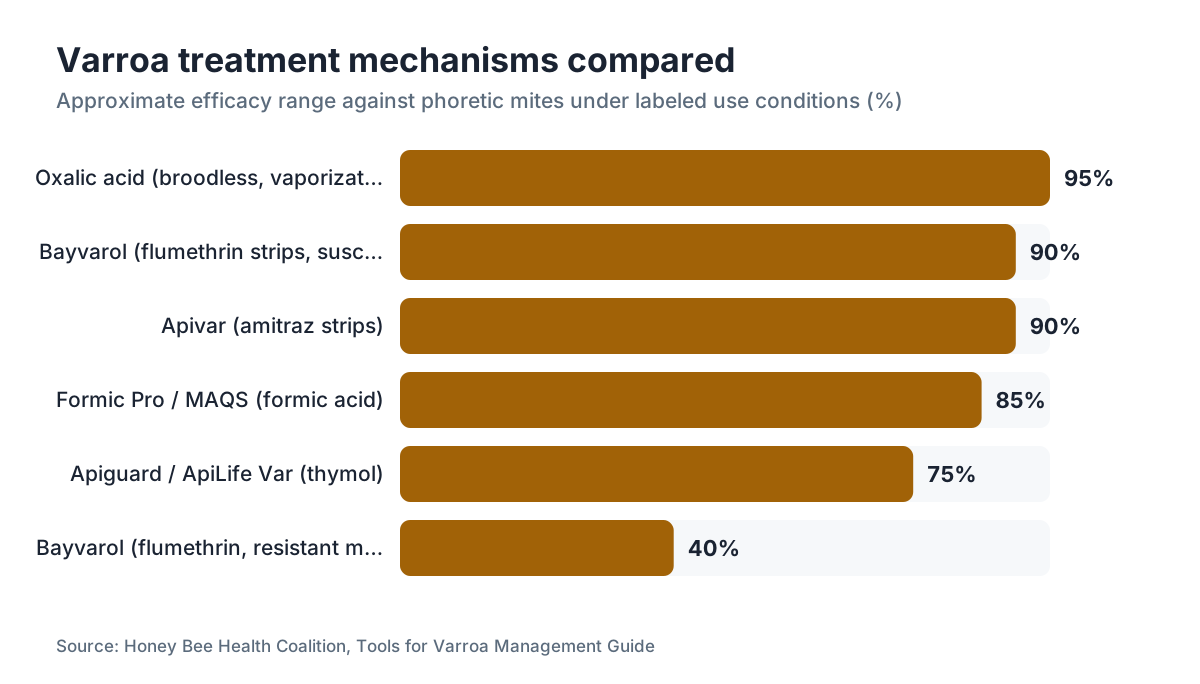
Flumethrin and tau-fluvalinate (Apistan) run on the same engine. Both are pyrethroids. Both hit sodium channels. This matters more than it looks. If your mites carry the kdr or super-kdr sodium-channel mutations that make them resistant to Apistan, those same mutations will likely blunt flumethrin too [4][9]. Rotating Apistan and Bayvarol is not a real rotation. To manage resistance you have to switch chemical class, to amitraz or an organic acid.
Amitraz runs on a completely separate receptor system, the octopamine receptors, which don't exist in vertebrates at all. That's part of why amitraz stays selective. Organic acids work by yet another route. A genuine rotation puts at least two unrelated mechanisms into your annual calendar [11].
What does varroa resistance to flumethrin look like, and how common is it?
Resistance is real and it's spread wide. The main mechanism in varroa is mutation of the sodium channel gene, the same kdr (knockdown resistance) mutations found in pyrethroid-resistant crop pests [4]. A mite carrying kdr has a channel flumethrin can't grip. The channel closes on schedule. The mite lives.
Work sampling varroa across Europe has found kdr mutations in a large share of tested populations, with some regions near fixation of the resistance alleles [4]. US data is patchier. Resistance has been confirmed in multiple states, but nobody has clean national prevalence numbers right now. The closest thing is scattered state surveys and a handful of university studies.
Here's the field version. If you've run Bayvarol or Apistan for several years straight without rotating, assume resistance pressure is building. The tell in your apiary is a mite wash that barely moves after a full course. Start at 2 percent, sit at 1.8 percent on day 42, and the treatment isn't working. Change mechanisms.
The Honey Bee Health Coalition's Varroa Management Guide is blunt about this: rotate among chemical classes to slow resistance [5]. That advice points straight at flumethrin.
How does temperature affect how well Bayvarol works?
Flumethrin release from the plastic matrix rises and falls with temperature, and that changes when you should treat. Below about 10 degrees C, release basically stops. The strips are still hanging there doing almost nothing.
So a Bayvarol treatment started late in fall, once the cluster tightens and the brood-area temperature drops, will underperform. The six-to-eight-week window assumes brood-nest temperatures near 35 degrees C for the whole run [1][8].
At normal nest temperature, flumethrin spreads reasonably well through bee contact and movement. In a very strong colony with a huge brood nest, distribution can go uneven, because the bees don't ferry the compound to every corner equally. That's part of why the label wants four strips placed symmetrically instead of two bunched together.
The flip side is that extreme heat doesn't buy you proportionally better kill. Off-label use in hot weather just burns through the strip faster without improving the result.
For planning, the Honey Bee Health Coalition ties treatment timing to the brood cycle [5]. Late summer or early fall, before the colony contracts and while a full brood cycle can still complete, is the strongest window for any strip-based synthetic.
Does flumethrin leave residues in wax, honey, or brood?
Yes. It's a documented, legitimate concern, and pretending otherwise helps nobody.
Flumethrin is highly lipophilic (fat-loving), which is exactly why it works in a wax-filled hive: it moves readily into beeswax. Residues have been detected in wax from treated colonies, and they hang around for years because wax doesn't turn over fast in a managed hive [6]. Old comb from colonies dosed with pyrethroids year after year can carry residue high enough to affect brood or queen rearing in the wrong situation.
Honey residues run lower because honey is water-based, not fat-based, and flumethrin won't partition into a water phase well. The EPA label bans use during a honey flow or with supers on the hive [2]. That's not paperwork. Treating with supers in place creates a residue problem and a regulatory one if you sell honey.
The practical version: treat in fall after harvest, or in very early spring before the main flow. Retire dark old comb on a schedule no matter what you've treated with, because comb is the sink where pyrethroid residue piles up. Buy used equipment from beekeeping supply companies and you should assume the wax carries residue from a treatment history you'll never know.
How should Bayvarol strips be used correctly to protect bee health?
The EPA-registered label is both your legal document and your field manual [2]. The core rules are short.
Four strips per single brood box, six for a double. Hang them vertically between every second frame space in the brood area, inside the bee space. Leave them a minimum of six weeks, a maximum of eight. Remove and dispose of used strips properly. Don't reuse them. Don't treat during a honey flow. Don't leave them in past the eight-week limit.
The six-to-eight-week window exists because of brood. A single varroa reproductive cycle from egg to emerging mite runs about 12 days in worker brood [10]. A full worker-brood cycle from egg to emerging bee is 21 days. To reach mites that were sealed in cells when you started, you need at least those 21 days. The longer window catches mites from late-capped brood that missed the early exposure. But past eight weeks the strips are spent, and all you're doing is leaving residue-loaded plastic in the hive: no kill, plus low-level exposure that feeds resistance.
Track your mite loads, because you should be doing that anyway. Take an alcohol wash or sugar roll before treatment, then again 42 to 56 days later. If the post-treatment count still sits above the Honey Bee Health Coalition action threshold of 2 percent mites per 100 bees, treat resistance as a live possibility and switch to a different-mechanism product [5].
VarroaVault has a free mite tracking tool and treatment planner if you want a structured way to run this across several colonies.
What are the real limitations of Bayvarol that beekeepers should know?
Resistance is the big long-term limit, and it's covered above. A few others deserve plain naming.
Bayvarol can't touch mites sealed in capped brood during treatment. It gets them as they emerge. But if your colony carries a lot of capped brood at the start, or runs a long brood cycle, efficacy drops next to a brood-free colony or a correctly timed oxalic acid dose in a broodless window.
It leans on sustained bee contact to spread. In a tiny cluster, a fresh package, or a weak nuc, distribution goes patchy. For very small colonies a broodless oxalic acid vaporization is usually the better call [7].
Temperature (covered above) means fall-only timing in cooler climates, if you want reliable results.
And flumethrin is a synthetic, so it's off the table for certified organic operations. Beekeepers holding to organic standards should reach for oxalic acid or formic acid instead.
None of this makes Bayvarol a bad product. It's well studied and effective, with decades of use behind it. It just belongs in a rotation, not as the one thing you reach for every year.
Is Bayvarol safe for queen bees and developing brood?
At labeled dose and placement, Bayvarol hasn't been shown to harm queens under normal conditions. Queens aren't bulletproof against pyrethroids, though, and two situations call for care.
First, don't hang strips right in the queen's path. The label says between frames, not against the queen or in a queen bank. At normal release rates a bee's brush-past is brief. A queen that lingers near certain frames could in theory pick up more exposure, though queen loss traced to correctly used Bayvarol isn't a well-quantified thing in the literature.
Second, early larvae may be more sensitive than adults. Studies on sublethal pyrethroid effects in honey bees report developmental harm at concentrations above what labeled Bayvarol delivers, but residues in old wax can add to a larva's cumulative load [6]. One more reason to rotate comb and to keep Bayvarol out of colonies already sitting on contaminated old frames.
If you're introducing a new queen during or just after treatment, wait until the strips are out and the brood nest has settled before you release her.
Frequently asked questions
How long does it take for Bayvarol strips to start killing varroa mites?
Contact killing starts within hours of a mite touching flumethrin, but colony-level mite drop shows up over the first week as bees spread the compound through the brood area. Full efficacy across a brood cycle takes three to four weeks. Don't judge success until at least six weeks in, once most brood that was capped at the start has emerged and those mites have been exposed.
Can I use Bayvarol strips with honey supers on the hive?
No. The EPA-registered label explicitly bans use with honey supers in place. Flumethrin is fat-soluble and migrates into wax and other hive materials. Honey itself carries low residues, but treating during a flow creates a regulatory problem for commercial sellers and a food-safety concern for anyone. Pull supers before treatment and don't put them back until strips are out and a honey-flow interval has passed.
What is the action threshold for varroa that tells me I need to treat?
The Honey Bee Health Coalition sets the action threshold at 2 percent mites per 100 adult bees during the active season, and at 1 percent or higher heading into winter. You measure by alcohol wash or sugar roll. Hit those levels and treatment should start promptly. A post-treatment count still above threshold points to treatment failure and possible resistance.
How is flumethrin different from tau-fluvalinate (Apistan) if both are pyrethroids?
Both bind voltage-gated sodium channels and share the same mechanism. The practical difference is potency and formulation: flumethrin generally kills mites at lower concentrations than tau-fluvalinate. But because the mechanism is identical, mite populations with kdr sodium-channel mutations resistant to Apistan usually show cross-resistance to flumethrin. They are not a meaningful rotation pair.
How do I know if my varroa mites are resistant to flumethrin?
The field sign is a mite count that won't drop after a full labeled treatment. Take an alcohol wash before treatment and again at six to eight weeks. If the infestation falls less than roughly 90 percent, resistance is a fair explanation. Confirmatory bioassays exist but aren't practical for most beekeepers. When you suspect resistance, switch to a product with a completely different mechanism, like amitraz or an organic acid.
How many Bayvarol strips do I use per hive?
Four strips for a single-brood-box colony, six for a double. Hang them vertically in the bee space between every second frame in the brood area. Don't bunch them in one spot. Even spacing matters for how well the bees spread flumethrin across the brood nest through normal movement and grooming contact.
Can I cut Bayvarol strips in half to treat a nucleus colony?
The label gives no guidance for nucs, and cutting strips isn't a labeled use. In a small nuc with few adult bees, a full strip delivers proportionally higher exposure, and patchy distribution gets worse because there are fewer bees to carry the compound around. Most university extension recommendations point to oxalic acid vaporization as the better fit for nucs, especially during a broodless period.
Do Bayvarol strips harm beneficial insects or other non-target organisms?
Flumethrin is highly toxic to other insects and aquatic invertebrates. Used inside a closed hive, the risk to non-target species is low compared with open field pyrethroid spraying. The main concern is disposal: don't compost used strips or toss them where runoff could carry residue into streams. Follow the label disposal instructions. Keep treatment inside the hive and keep strip material away from soil near water.
What temperature range does Bayvarol work best in?
Flumethrin release from the PVC matrix is driven by temperature and works best at brood-nest temperatures near 34 to 35 degrees C. Below about 10 degrees C ambient, release drops sharply. That makes late-fall or winter treatment essentially useless. The best window is late summer to early fall, when colonies still raise brood at full nest temperature but the honey harvest is done.
How does flumethrin get distributed through the whole hive if the strips only touch a few frames?
Contact transfer through bees. As a bee walks across or rubs a strip, she picks up trace flumethrin on her cuticle. Normal movement through the nest, plus grooming contact between bees, spreads it. Mites on those bees get dosed through contact, not ingestion. That's why strip placement in the active brood area matters: bee traffic is highest there, and that's where most mites reproduce.
Does flumethrin stay in beeswax after treatment ends?
Yes. Flumethrin is highly lipophilic and partitions readily into wax. Residues have been detected in wax from treated colonies and can persist for years in stored comb. This is one reason comb rotation matters. Dark old comb in colonies treated with pyrethroids for many years can carry meaningful accumulated residue that may affect larval development.
Can I use Bayvarol and oxalic acid in the same treatment season?
Yes, and it can be a smart plan. Many beekeepers run Bayvarol (or another synthetic) in late summer to knock down mites during brood rearing, then follow with oxalic acid during the winter broodless period to mop up survivors. The two products work by different mechanisms and don't interfere when used in sequence. Check both labels for timing requirements.
Is Bayvarol approved for organic beekeeping?
No. Flumethrin is a synthetic pyrethroid and isn't permitted under USDA National Organic Program standards. Certified organic operations are limited to oxalic acid (Api-Bioxal), formic acid products (Formic Pro, MAQS), thymol-based treatments (Apiguard, ApiLife Var), and certain essential-oil products, depending on the certifier. If you're working toward organic certification, synthetic acaricides including Bayvarol have to go.
Sources
- Bayer Animal Health, Bayvarol Strip Product Label (EPA Reg. No. 11556-133): Each Bayvarol strip contains 3.6 mg flumethrin in a PVC matrix; four strips used per single-brood-box colony for 6-8 weeks; temperature-dependent release
- U.S. EPA, Pesticide Registration (Bayvarol Strip registration and label): EPA registration requirements, prohibition on use with honey supers, dosing directions for Bayvarol
- Milani, N. (1999). The resistance of Varroa jacobsoni to acaricides. Apidologie, 30(2-3), 229-234.: Selectivity ratios between honey bees and Varroa for pyrethroids; differential sodium-channel sensitivity
- Gonzalez-Cabrera et al., studies on target-site resistance to pyrethroids in Varroa destructor, PLOS ONE: kdr mutations in Varroa sodium channel gene associated with pyrethroid resistance including flumethrin; documented in European populations
- Honey Bee Health Coalition, Tools for Varroa Management Guide: Action threshold of 2% mites per 100 bees during active season; recommendation to rotate among chemical classes to slow resistance
- Mullin, C.A. et al. (2010). High levels of miticides and agrochemicals in North American apiaries. PLOS ONE.: Flumethrin and tau-fluvalinate detected in beeswax samples from managed colonies; lipophilic residues persist in comb
- Pennsylvania State University Extension, Varroa mite integrated pest management resources: University guidance on varroa treatment options, strip placement, and brood-cycle timing for synthetic acaricides; oxalic acid for small colonies
- University of Florida IFAS Extension, EDIS varroa mite resources: Temperature dependence of strip-based varroa treatments; recommendations for fall timing and comb management
- Elzen, P.J. et al. (1999). Fluvalinate resistance in Varroa jacobsoni from several geographic locations. American Bee Journal, 139(7), 524-527.: Cross-resistance between pyrethroid compounds in Varroa; tau-fluvalinate resistance connected to sodium channel mutations relevant to flumethrin
- USDA Agricultural Research Service, honey bee pests and diseases research: Varroa biology, reproductive cycle inside capped brood cells, and implications for treatment timing
- Cornell University, Department of Entomology, varroa mite management resources: Guidance on rotating varroa treatments by mechanism to reduce resistance selection pressure
- European Medicines Agency, flumethrin veterinary use information: Pharmacological classification of flumethrin as a Type II pyrethroid with a sodium channel mechanism of action
Last updated 2026-07-10